
You're probably weighing the same question most planners hit once the venue is booked and the agenda is nearly locked. What can you put on the floor that pulls people in, keeps them there, and gives them a reason to interact without feeling forced?
That's where Giant Scalextric usually earns its place. It has the nostalgia that gets people over for a look, but the professional hire version works because it behaves like an event attraction, not a toy. Guests understand it instantly. Spectators can follow it without an explanation. Sales teams can use it to start conversations. Brand teams can turn it into a visible, shareable installation instead of another passive stand feature.
The mistake is assuming that all Scalextric hire is basically the same. It isn't. The track format, staffing model, access requirements, safety paperwork, insurance wording, and branding options all affect whether it feels polished or improvised. A good setup creates energy and smooth throughput. A poor one creates queues, confusion, and awkward operational issues on the day.
Your Guide to Unforgettable Event Entertainment
A lot of event entertainment looks good in a proposal and underdelivers in a live room. It either appeals to a narrow group, takes too long to explain, or turns into something guests try once and then ignore. Giant Scalextric avoids most of those problems because the appeal is immediate. People can see the competition, hear the commentary, and understand the objective in seconds.
That matters at exhibitions, conferences, awards evenings, and staff events. You're not just filling space. You're trying to create a focal point that helps with footfall, dwell time, conversation, and memory. A race track does that well because it gives people a reason to stop, compete, watch, and come back for another go.
Why planners keep coming back to it
What works in practice is the mix of simple participation and visible energy. A guest doesn't need prior experience. They pick up the controller, take the briefing, and race. At the same time, everyone nearby can follow who's winning and who's lost control at the corner.
That combination makes it useful for more than one event type:
- Exhibitions: It draws attention from the aisle and gives stand staff an easy opener.
- Team building: It supports head-to-head competition without needing athletic ability.
- Evening events: It adds pace and noise without taking over the whole room.
- Family-friendly functions: It works across mixed age groups when properly managed.
The strongest event attractions do two jobs at once. They entertain the participant and give everyone else something worth watching.
The practical questions sit behind the spectacle. How much space do you need? Which track format suits your audience? What does a professional package include? How should branding be handled? What paperwork should your supplier provide before your risk team signs anything off?
Those are the details that decide whether your Scalextric hire becomes a reliable centrepiece or a late-stage headache.
What Makes Giant Scalextric a Premier Event Attraction

What lifts Giant Scalextric above novelty entertainment is the way it combines spectacle, structure, and throughput. Guests don't just have a turn and walk off. The race becomes a mini event inside the wider event. People gather around it, compare lap times, challenge colleagues, and watch the leaderboard.
Professional setups also look very different from a domestic track on a trestle table. You're usually dealing with a substantial installation, staffed operation, digital scoring, and a format built for repeated use over the course of a live event. If you want a sense of how providers position the attraction for corporate use, this Giant Scalextric hire option shows the kind of turnkey setup planners usually expect.
It creates a social hub, not just a game
The value is what happens around the track. People who don't know each other start talking because the attraction gives them something specific to react to. A fast lap sparks competition. A spin at the bend gets a laugh. A leaderboard gives people a reason to return later and try to improve.
That's useful in rooms where networking can otherwise feel stilted. A race track gives guests a shared activity with low social friction. They don't need to invent a conversation starter because the attraction has already done it for them.
It also works across seniority levels. Directors, graduates, sales teams, clients, and visitors can all take part on equal terms. That's rare. A lot of corporate entertainment either skews too technical or too juvenile. Giant Scalextric tends to sit in the middle.
The technology matters more than nostalgia
Nostalgia gets attention, but digital features are what make the attraction workable for business events. Computerised scoring, visible rankings, managed race sessions, and live commentary turn it into something organised rather than chaotic.
The result is a cleaner guest experience:
- Clear competitive structure: Guests know when they're racing and what counts.
- Better spectator engagement: People can follow results instead of guessing.
- Higher repeat participation: A visible score or lap time gives guests a reason to come back.
- Stronger brand integration: Screens, leaderboards, and trackside elements are easier to tailor.
A good race host also changes the feel completely. Commentary keeps the energy up, fills dead air, and draws in people who were only passing by.
Later in the event cycle, seeing the format in motion helps internal stakeholders sign off on it with confidence.
Guests rarely remember every canapé or every slide. They do remember the moment they beat a colleague on the leaderboard in front of the rest of the team.
Choosing Your Race Format and Track Options
Not every event needs the same race format. The right choice depends on whether you need rapid turnover, longer engagement, or a structured competition that anchors the programme. Planners often improve results by effectively matching the mechanics of the track to the objective of the event.
The first choice is capacity. In UK event hire, 6-lane and 8-lane digital systems are the standard format, and the 8-lane version is described as the “king of slot racing sets” because it can pit eight racers simultaneously on a huge figure-of-eight track, which suits corporate team-building and exhibition activations well, according to Leisure Hire's Giant 8 lane Scalextric overview.
Match the race format to the event goal
A fast-moving exhibition stand usually needs one format. An after-dinner event needs another.
Fastest Lap Challenge works best when you need quick participation. One guest races, sets a lap, and the next guest steps in. It keeps queues moving and suits lead generation because stand staff can talk while people wait and watch.
Knockout Tournament is stronger when the audience is staying in the room for a longer period. It builds tension and gives the host natural moments to announce pairings, quarter-finals, and finals. It's a good fit for evening entertainment.
Team Endurance Race works well for internal events because the fun comes from handovers, mistakes, and team strategy rather than pure individual pace. It creates conversation naturally and doesn't rely on one standout driver.
Scalextric Track Options at a Glance
| Track Type | Typical Footprint (L x W) | Player Capacity | Ideal For |
|---|---|---|---|
| Figure-of-eight digital track | Varies by supplier and venue | 6 to 8 players | Exhibitions, conferences, open-access activations |
| Large custom layout | Varies by supplier and venue | Depends on build and race format | Product launches, brand activations, feature installations |
| Compact branded setup | Varies by supplier and venue | Usually suited to shorter sessions | Smaller conference spaces, receptions, private functions |
Because suppliers build in different ways, treat footprint as a venue-planning conversation rather than a number you assume in advance. If you're considering a larger showpiece installation, this largest Scalextric track example gives a useful reference point for the sort of scale some activations aim for.
What works and what doesn't
A few practical patterns show up repeatedly on live events.
- What works for exhibitions: Short qualifying runs, visible rankings, and a host who keeps calling in the crowd.
- What works for team building: Team names, cumulative scoring, and scheduled heats rather than open access.
- What works for gala evenings: Tournament brackets, short commentary bursts, and a finals moment tied into the programme.
- What doesn't work: Overcomplicated rules, long driver briefings, or a format that lets one small group monopolise the track.
Practical rule: If guests need a full explanation before they can race, the format is too complex for a busy live event.
The best race design always respects the room. On a stand, speed matters. In a hospitality suite, theatre matters. In a team day, collaboration matters. The track is the hardware. The race format is what turns it into a useful event tool.
Technical Specifications and Space Requirements
Most problems with Scalextric hire don't start on site. They start earlier, when no one has checked the basics with the venue. A track can look straightforward in a proposal and still fail the practical test if access is awkward, the floor isn't suitable, or power is too far from the installation point.
Ask the venue the right questions early
Start with where the track will sit, not where you'd ideally like it to sit. You need a flat, stable area with enough circulation space around it for racers, staff, and spectators. A track that physically fits can still be in the wrong place if queues spill into gangways or if the audience blocks nearby stands.
Power is usually simple, but it still needs confirming. Don't assume the nearest socket is usable, available, or on the right side of the stand build. Ask the supplier what connection they require and check where venue power drops or wall sockets are.
The same goes for lighting and noise. A dark corner can reduce visual impact. A badly positioned PA or stage nearby can make commentary difficult to hear.
Access can kill a good plan
Load-in is where attractive ideas sometimes fall apart. A supplier needs to know how the equipment gets from vehicle to final position. That includes service yard procedures, loading bay timings, lift availability, corridor widths, and whether there are stairs anywhere on the route.
Use this shortlist with your venue team:
- Access route: Is there a clear path from unloading point to event space?
- Lift access: If the track is going upstairs, can the goods lift take the components?
- Door clearances: Are there any narrow turns, double doors, or restricted entrances?
- Floor condition: Is the surface level, secure, and suitable for a large interactive installation?
- Build window: How early can the supplier start, and when must the area be clear?
Plan for people, not just equipment
The footprint isn't only the track. You also need operator space, player positions, waiting room, and viewing room. That matters more than many planners expect. A race track becomes a magnet. If it succeeds, it attracts a crowd.
That's why smart layouts leave room for:
- The active race line, where participants stand comfortably without elbowing each other.
- The spectator arc, where people can watch without blocking traffic.
- The staff zone, so operators can reset cars, brief guests, and solve minor issues quickly.
A track squeezed into the last bit of spare floor rarely performs well. It needs room to breathe if you want it to pull a crowd safely.
When a planner checks access, power, floor, and audience flow early, the installation tends to run smoothly. When those checks happen late, the supplier ends up solving venue problems on build day, which is the most expensive moment to discover them.
Understanding Scalextric Hire Costs and Packages
The first thing most planners want is a realistic starting point. In the UK, Giant Scalextric hire typically starts at a base rate of £375 for custom layouts and full staffing, with providers offering 6-player digital tracks and computerised scoring, as outlined by Get-Racing's Giant Scalextric hire information.
That figure is useful because it anchors expectations. It tells you that professional Scalextric hire isn't just a box of track and a few cars dropped at the venue. The entry-level quote already reflects staffing, setup, and an organised guest experience.
What a standard package usually covers
A proper corporate package generally includes the attraction in a workable event format rather than as dry equipment rental.
Typical inclusions often look like this:
- Track and cars: A configured race setup suitable for the agreed event format.
- Digital race management: Scoring, lap counting, and visible competitive structure.
- On-site staff: Operators who run the activity, brief guests, and keep sessions moving.
- Setup and breakdown: Installation and removal as part of the service.
- Basic event operation: Day-of management so your team isn't trying to troubleshoot controllers.
What changes from quote to quote is the amount of production wrapped around that core.
What pushes the quote up
The final number moves when the event gets more demanding. Extended operating hours, additional staffing, travel, venue restrictions, custom branding, and specialist layouts all change the scope. Some events need a simple managed attraction. Others need a full branded centrepiece with heavy traffic handling.
Planners should read carefully. Two quotes can look close on paper and still represent very different service levels.
Check for these cost drivers:
- Duration: A short reception hire won't be scoped the same way as an all-day exhibition.
- Location: Travel and accommodation can affect jobs outside a supplier's normal operating patch.
- Customisation: Branded barriers, bespoke cars, or themed presentation usually sit outside the base package.
- Venue complexity: Tight access, difficult build schedules, or strict inductions create extra labour.
- Competition format: Hosted tournament structures may need more active management than free-play style sessions.
How to judge value rather than just price
The cheapest quote can become expensive if it omits the things your event needs. If there's no clear staffing plan, weak presentation, or limited technical support, your team ends up absorbing the risk and the operational burden.
A better way to compare quotes is to ask three direct questions:
- What exactly is included on site?
- Who manages the attraction during live operation?
- Which elements are optional rather than assumed?
If the answers are vague, the package probably is too.
Branding and Customisation for Maximum Impact
The unbranded version of a race track is entertaining. The branded version can become part of the campaign. That difference matters most at exhibitions, launches, and sponsor-led events where every visible element needs to support a message.
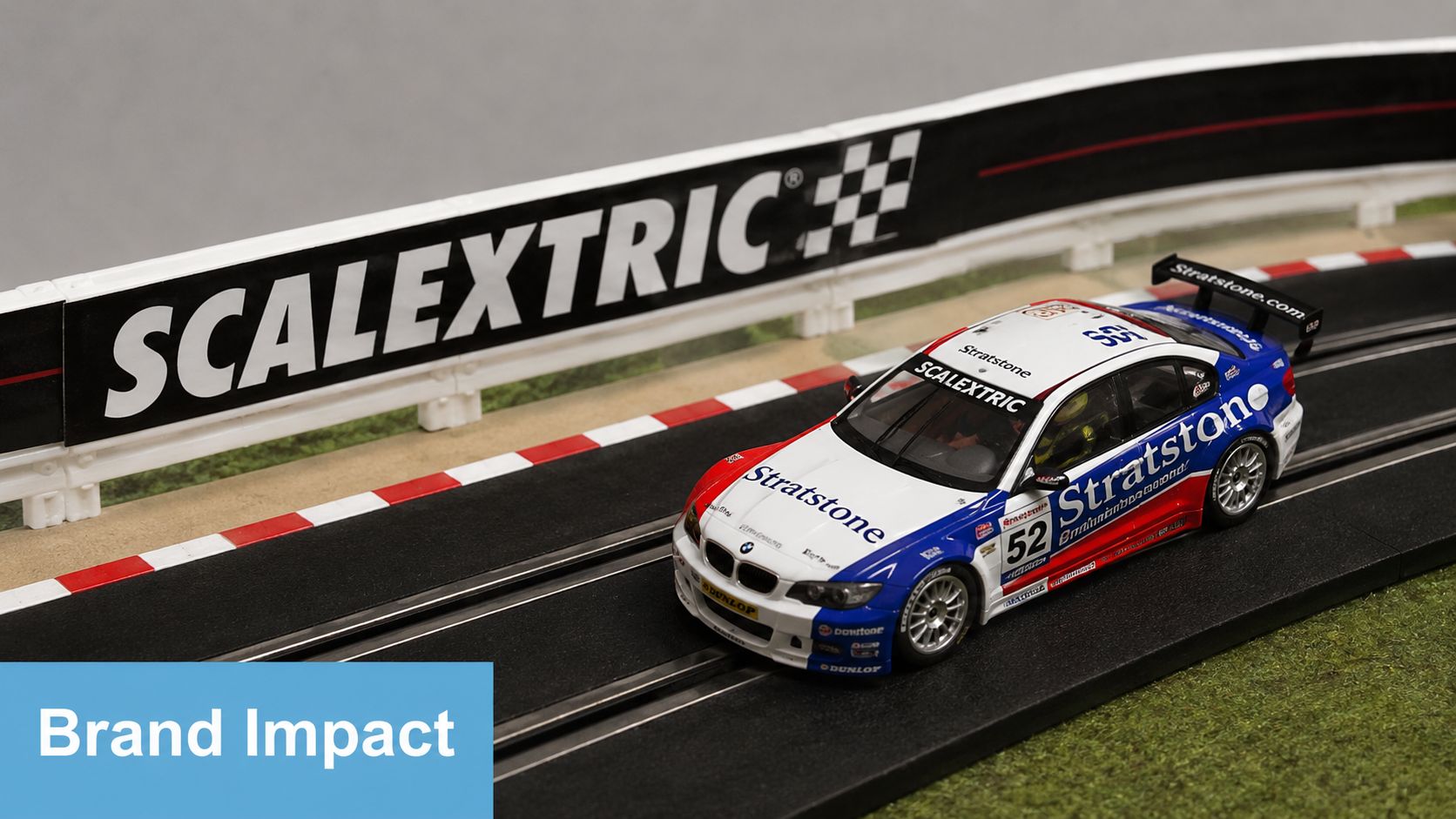
A well-customised installation doesn't just stick a logo on the side and hope for the best. It uses the race itself as a branding mechanic. Guests interact with branded cars, see branded trackside elements, and chase results on branded displays. That keeps the identity present without making the experience feel like a sales pitch.
The custom touches that usually earn their keep
Some branding options are decorative. Others actively improve the activation.
The most effective ones tend to be:
- Branded leaderboards, which keep the client name in view every time results are announced or photographed. For events that want a more polished scoring presentation, an electronic leaderboard setup is often the cleaner choice.
- Custom car liveries, which make the race itself feel tied to the campaign rather than adjacent to it.
- Trackside panels and barriers, which improve visual consistency in event photography.
- Themed naming conventions, such as team names, race names, or challenge titles linked to a launch or product message.
Good branding supports memory
The strongest customisation is the kind guests remember without needing to be told to remember it. If the cars match corporate colours, the race host uses campaign language naturally, and the winner board carries the event branding, the installation starts doing marketing work while people are having fun.
That's far more effective than treating branding as an afterthought. A plain race track can still draw a crowd. A branded one can help that crowd recall who put it there and why.
If your stand team wants photos, social content, and a reason for visitors to linger, branding the race experience is usually more effective than branding the backdrop alone.
Customisation should still be disciplined. Too much visual clutter can cheapen the look and distract from the race itself. The best builds usually pick a few strong elements and execute them cleanly.
Logistics Staffing and Critical Safety Compliance
This is the area planners most often underestimate. A Giant Scalextric installation can look playful, but from an event operations perspective it's still a staffed interactive attraction in a live environment. Delivery, build timing, queue handling, guest briefing, technical support, and insurance all need to be right.
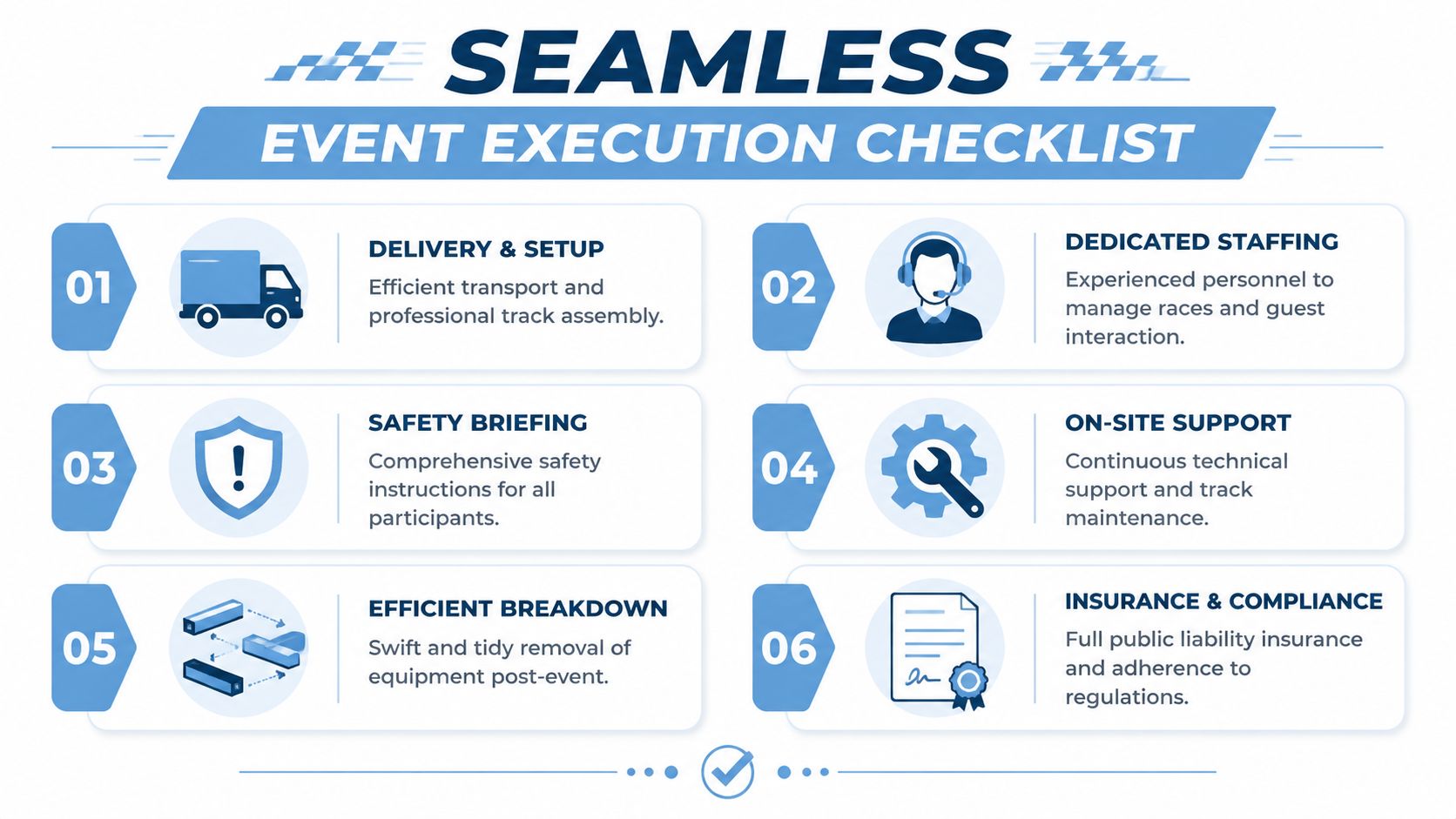
The day runs better when the supplier owns more than just the hardware. You want a team that arrives within the agreed build window, assembles the track cleanly, tests everything before doors open, and then actively manages the attraction once guests arrive. That includes race flow, controller resets, car swaps, spectator management, and quick fixes when something gets knocked out of place.
What professional staffing should look like
A staffed race track shouldn't be passive. Operators need to do more than stand nearby. They should brief guests clearly, maintain energy, monitor safe use, and keep the rotation moving so the attraction doesn't jam up.
In practical terms, that means:
- Guest briefing: Short, clear instructions before each session.
- Active hosting: Encouraging participation and keeping the pace up.
- Technical support: Resetting cars, checking controllers, and handling minor faults immediately.
- Queue management: Making sure the attraction doesn't obstruct the surrounding event space.
If the event has a commercial objective, staff also need to work with the client team rather than independently from them. That's especially important on exhibition stands where every interaction has a sales or lead-generation angle.
Insurance and risk assessment are not box-ticking
The compliance side matters just as much as the showmanship. According to the Mini Racing guide citing the UK Industry Events Survey 2025, 73% of UK corporate event contracts now require explicit proof of £10m public liability insurance specifically covering high-traffic interactive racing, yet only 12% of hired Scalextric providers disclose category-specific risk assessments in their quotes.
That gap tells you something important. Many suppliers may be willing to provide an attraction, but far fewer present the paperwork in a way that satisfies procurement teams, venue managers, or legal reviewers without a chase.
You need to be strict. Ask for:
- Public liability details that clearly cover the type of attraction being installed.
- Risk assessments specific to the activity, not generic event paperwork.
- Method statements where venue rules require them.
- Operational clarity on supervision, participant briefing, and fault response.
One provider option in this market is PSW Events, which states that it supplies planning, logistics, installation, on-site staffing, H&S compliance, and £10 million products, employee, and public liability insurance for its event work. That's the kind of operational scope planners should look for across any shortlist.
A supplier proves their value before the event as much as during it. Clean paperwork, clear responsibilities, and proper insurance reduce risk for your brand long before the first race starts.
The reputational risk sits with the client if this area is handled casually. If something goes wrong, no one cares that the attraction looked fun in the pitch deck. They care whether the supplier was properly prepared and whether the organiser asked the right questions.
Scalextric Hire FAQs for Event Planners
Can a Giant Scalextric track be used outdoors
Sometimes, but only when the supplier confirms the setup is suitable and the event environment is controlled. Weather, uneven ground, moisture, and wind all make outdoor operation harder. If the event is outdoors, ask about flooring, cover, power protection, and contingency planning.
How long do setup and breakdown take
It depends on the track size, access route, and venue rules. The important point is to confirm the full build schedule in advance rather than assuming it's a quick drop-in item. Venues with restricted loading or tight turnaround windows need special attention.
Is it suitable for adults and children
Yes, but the operating format should match the audience. Corporate races, mixed-age family fun days, and children's sessions are usually managed differently. Ask how the supplier handles supervision and briefings for your guest profile.
What happens if a car stops working during the event
A staffed supplier should replace or reset it quickly and keep the session moving. That's one reason on-site operators matter. You don't want venue staff or your internal team improvising repairs.
Where can I find a good benchmark for event FAQ wording
If you're standardising guest-facing communications across multiple attractions, YOLO TV's frequently asked questions are a useful example of how to keep answers concise and easy to scan.
If you're comparing Scalextric hire options, judge them on three things first. The race format, the operational staffing, and the compliance paperwork. Get those right, and the track won't just entertain people. It will work as part of the event.