
You're probably here because someone in the team has said, “Let's do something with an F1 simulator,” and now the practical questions have landed on your desk. Will it pull people onto the stand? How much space will it take? Is full-motion worth it? How do you justify the spend to procurement, marketing, or a client who wants impact but hates ambiguity?
A Formula 1 car simulator can be one of the strongest interactive tools in a live event mix, but only when it's planned as an activation, not hired as a prop. The simulator itself matters. So do queue design, staffing, branding, competition format, lead capture, venue access, power, and what you measure afterwards.
The planners who get the best result usually make one early decision. They stop asking “Can we fit a simulator in?” and start asking “What job is this activation meant to do?” Once that's clear, the rest becomes easier.
What Is A Formula 1 Car Simulator
A Formula 1 car simulator isn't just a racing game with a nice seat attached. At the professional end, it's a system built to recreate the inputs, responses, and physical cues that make driving feel believable.
That distinction matters for events, because guests can tell the difference quickly. A basic driving game gives them a screen and a wheel. A proper simulator gives them resistance through the steering, braking that feels progressive, a seating position that resembles an F1 cockpit, and visual feedback that matches what the car is doing.
Here's the core visual breakdown:
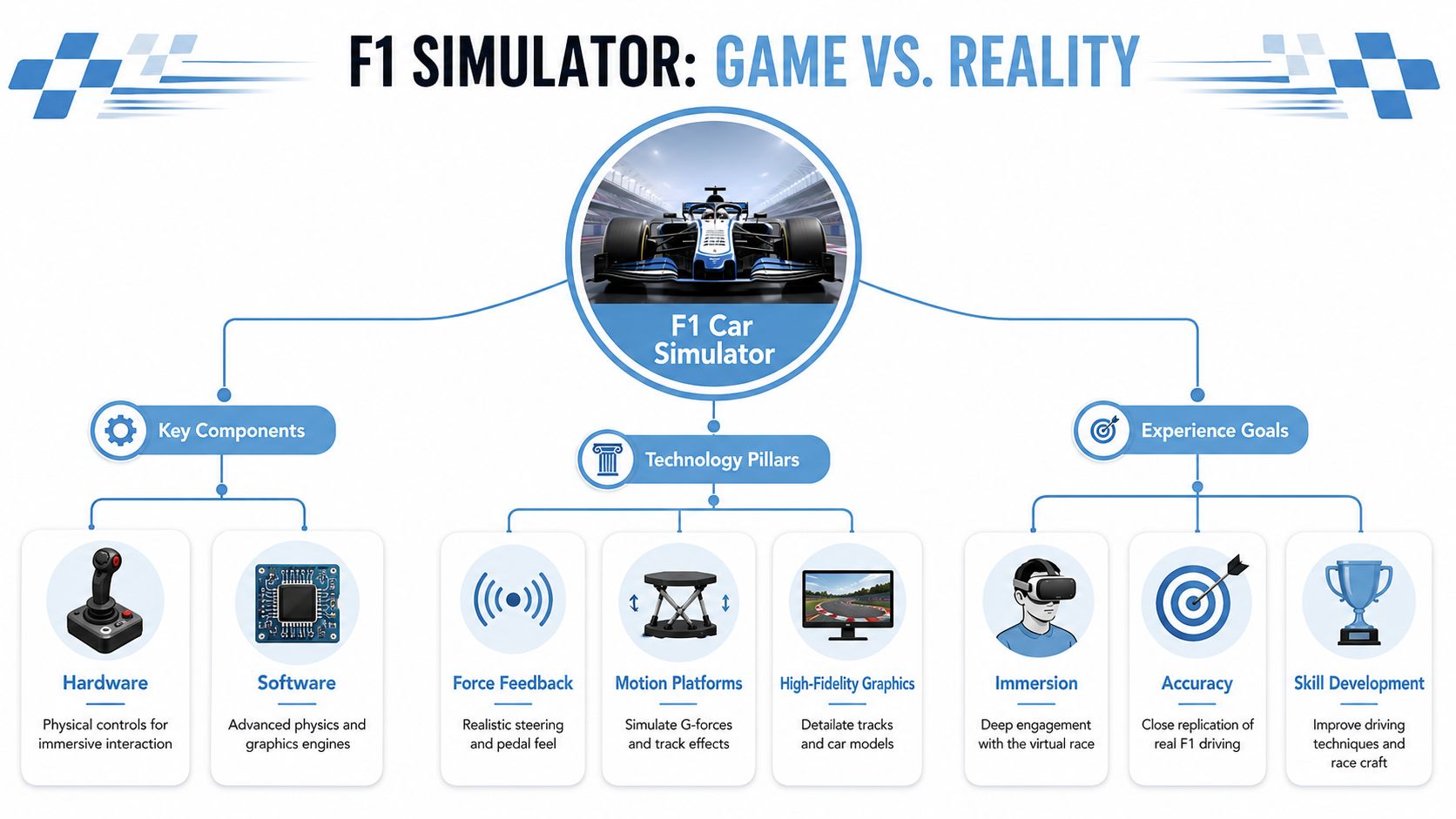
The parts that create the experience
At minimum, a good simulator combines four elements:
- Cockpit and chassis: This sets driving position, comfort, and realism. If the seating angle is wrong, the whole thing feels more arcade than motorsport.
- Wheel and pedals: These are where guests judge quality first. Weak or vague feedback kills immersion fast.
- Display system: Large-format screens, wraparound visuals, or other high-clarity display setups help guests read corners and braking points properly.
- Software and control logic: This handles car behaviour, track detail, lap timing, and event-mode setup.
The reason planners should care about these details is simple. They affect confidence, competitiveness, and shareability. If the controls feel intuitive and convincing, more guests want a turn, more colleagues gather to watch, and the activation runs with less friction.
Why a simulator is not the same as a game
The easiest way to explain it to stakeholders is this. A game entertains. A simulator reproduces cause and effect.
If a driver brakes too late, turns too aggressively, or applies throttle poorly, the simulator punishes that input in a way that feels credible. That's why Formula 1 teams adopted this technology in serious form in the late 2000s. As reported in Bloomberg Business, team simulators became hyper-realistic, data-powered tools capable of testing thousands of virtual laps, with a single team simulator costing over £10 million, and sim data in the 2023 season being credited with lap time improvements of up to 0.3 seconds in testing phases. The same source notes that high-fidelity simulators replicate the F1 car's 950 hp (710 kW) power unit and acceleration from 0 to 60 mph in 1.8 seconds through precise modelling and feedback systems in the virtual environment in Bloomberg Business coverage of how simulators shape F1.
Practical rule: If you're hiring for a corporate event, don't judge simulator quality by the body shell alone. Judge it by input feel, software stability, and how easily first-time guests can complete a lap.
What event planners should listen for
When suppliers talk about a simulator, the useful words are usually these:
- Full-motion
- Force feedback
- Cockpit ergonomics
- 4K visuals
- Operator support
- Competition mode
- Branding options
- Throughput planning
Those terms tell you whether the supplier understands events, not just hardware.
A final point. The event version of a Formula 1 car simulator doesn't need to match a team's development rig to be effective. It does need to feel polished, stable, and premium enough that guests treat it as a feature attraction rather than a novelty. That's the line you're trying to hit.
Choosing The Right Simulator Experience
The wrong simulator choice usually comes from chasing the most dramatic option instead of the most suitable one. A stand at ExCeL London has different needs from a board-level hospitality suite or an internal team day in a hotel ballroom.
The main formats fall into three categories. Static rigs, VR-led setups, and full-motion simulators. Each can work well, but not for the same brief.
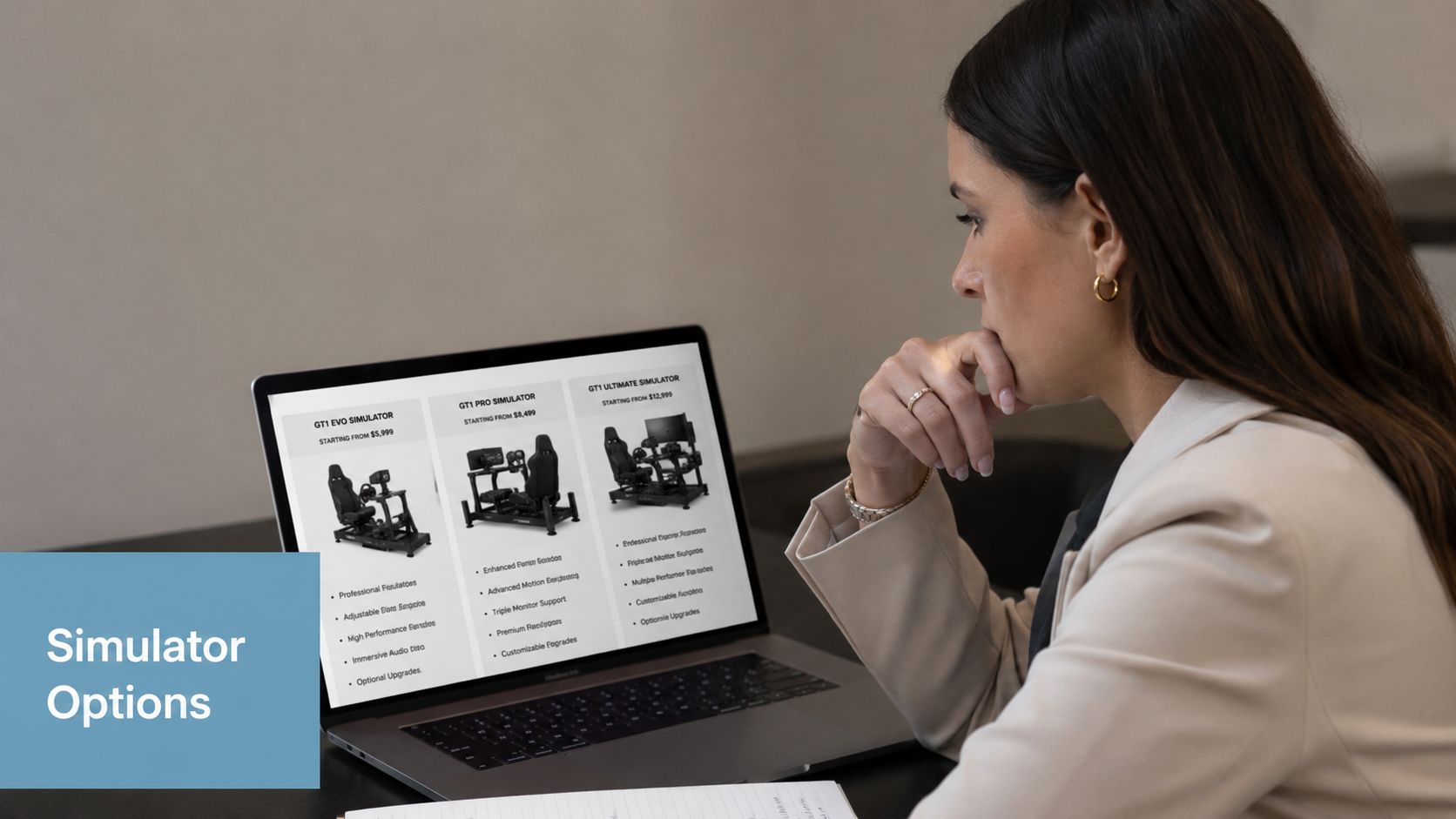
Static rigs for throughput and simplicity
A static simulator is usually the safest choice when guest numbers matter more than spectacle. It's easier to position, easier to brief, and generally simpler to operate across long event hours.
This format suits:
- exhibition stands
- conference breakouts
- staff engagement zones
- multi-unit competitions
If you need several people racing over the day with minimal reset time, static rigs often outperform more complex setups. They won't create the same visual theatre as a motion platform, but they're efficient.
VR setups for novelty and depth
VR can create strong immersion for individual users, especially in smaller groups where you want a one-to-one guided experience. The trade-off is practical. Headsets take time to fit properly, some guests won't want to use them, and busy public environments can make headset changeovers slower than expected.
VR works best when:
- dwell time is acceptable
- the audience is pre-qualified or booked in
- hygiene and operator support are tightly managed
- you don't need every guest to participate
For open-access trade stands, VR can become a bottleneck. For VIP appointments, it can feel more exclusive.
Full-motion for premium impact
A full-motion Formula 1 car simulator is usually the headline act. This is the format that stops foot traffic, draws phones out, and gives clients something they can build a full activation around.
Top-tier UK-built models show what that premium end looks like. The Formula Evolution simulator is built to ISO 9001 standards in the UK, uses laser-cut aluminium frames, mirrors F1 cockpit ergonomics, and in some versions includes hand-built steering controls aligned with McLaren's 2025 MCL39 specification. It can simulate top speeds of 375 km/h (233 mph), which is why that style of experience translates so well into public-facing venues such as F1 Box in London as shown in the Formula Evolution product specification.
Don't buy “premium” on appearance alone. Premium means stable software, clean build quality, confident operator control, and a guest experience that still works six hours into the day.
A simple decision filter
Use this when narrowing options:
| Event priority | Best fit | Watch-outs |
|---|---|---|
| High guest volume | Static rigs | Can look less dramatic if poorly branded |
| VIP hospitality | Full-motion | Needs proper space and a calm operating zone |
| Small-group novelty | VR | Lower throughput and more operator involvement |
| Exhibition centrepiece | Full-motion or multiple static rigs | Match format to stand size and queue plan |
If you're comparing motion-led options, it helps to review a specialist example of a full-motion racing simulator setup so you can ask better supplier questions about movement range, guest handling, and visual presence.
The right answer usually comes from the brief, not the brochure. If the activation must impress a handful of decision-makers, motion wins. If it must process a steady flow of delegates without drama, simpler rigs often deliver better.
Driving Engagement At Your Corporate Event
A simulator only becomes valuable when people do something with it. That means the event format around the hardware matters as much as the rig itself.
The most successful activations usually have three features in common. A clear challenge, visible progression, and a reason for bystanders to stay involved. Without those, guests drive once and walk away.

Trade shows work best with a fast-lap mechanic
For exhibitions, the strongest format is usually the simplest. Give each guest one timed lap or one short session. Put the best times on screen. Keep the queue visible. Let people watch others fail and improve.
That creates a live loop:
- Someone spots the simulator.
- They stop to watch a lap.
- They want to beat the posted time.
- Their colleague films it.
- The stand now has an audience.
If you want structure, add branded timing and a visible electronic leaderboard system so the activation feels like a competition rather than loose entertainment.
Team building needs collaboration, not just driving
For internal events, don't make the mistake of treating the simulator as a solo attraction. It lands better when teams have roles.
One format that works well is to split groups into race teams. One person drives. Another handles timing. Another acts as strategist or coach. You can rotate roles across rounds so the confident drivers don't dominate the whole session.
That changes the tone from “watch one person race” to “solve a challenge together”.
- Good approach: team heats, short debriefs, final shootout
- Poor approach: open free-play with no structure
- Better still: add a host who keeps rounds moving and keeps energy up
Brand activations should connect the sim to the message
A Formula 1 car simulator pulls attention on its own, but brand relevance still has to be designed in. If the product launch has nothing to do with speed, performance, engineering, or competition, you need a bridge.
That bridge might be:
- a branded garage environment
- car livery aligned to the campaign
- a timed challenge tied to product positioning
- hosted commentary using brand language
- post-race content capture for social and follow-up
Public interest in these experiences is real. Formula 1's own reporting on immersive public venues notes that 43% of F1 fans and 34% of motorsport fans in Britain take notice of sponsorships, which makes simulator-based activations especially useful when the objective includes brand visibility and partner engagement according to Formula 1's report on the F1 Box launch in London.
A simulator gets attention. The competition format holds attention. The branding decides whether that attention belongs to your client or just to the attraction.
The commercial lesson is straightforward. Don't drop a simulator onto a stand and hope it creates magic by itself. Give it a narrative, a challenge, and a visible outcome.
Essential Booking And Logistical Requirements
Most simulator problems don't start on event day. They start in the planning call when nobody asks the unglamorous questions.
A polished activation depends on access, power, staffing, insurance, safe operating space, queue flow, and a realistic schedule for load-in and derig. If any of those are fuzzy, the simulator can still arrive on time and yet fail operationally once doors open.
This checklist is the part planners should circulate internally before sign-off:
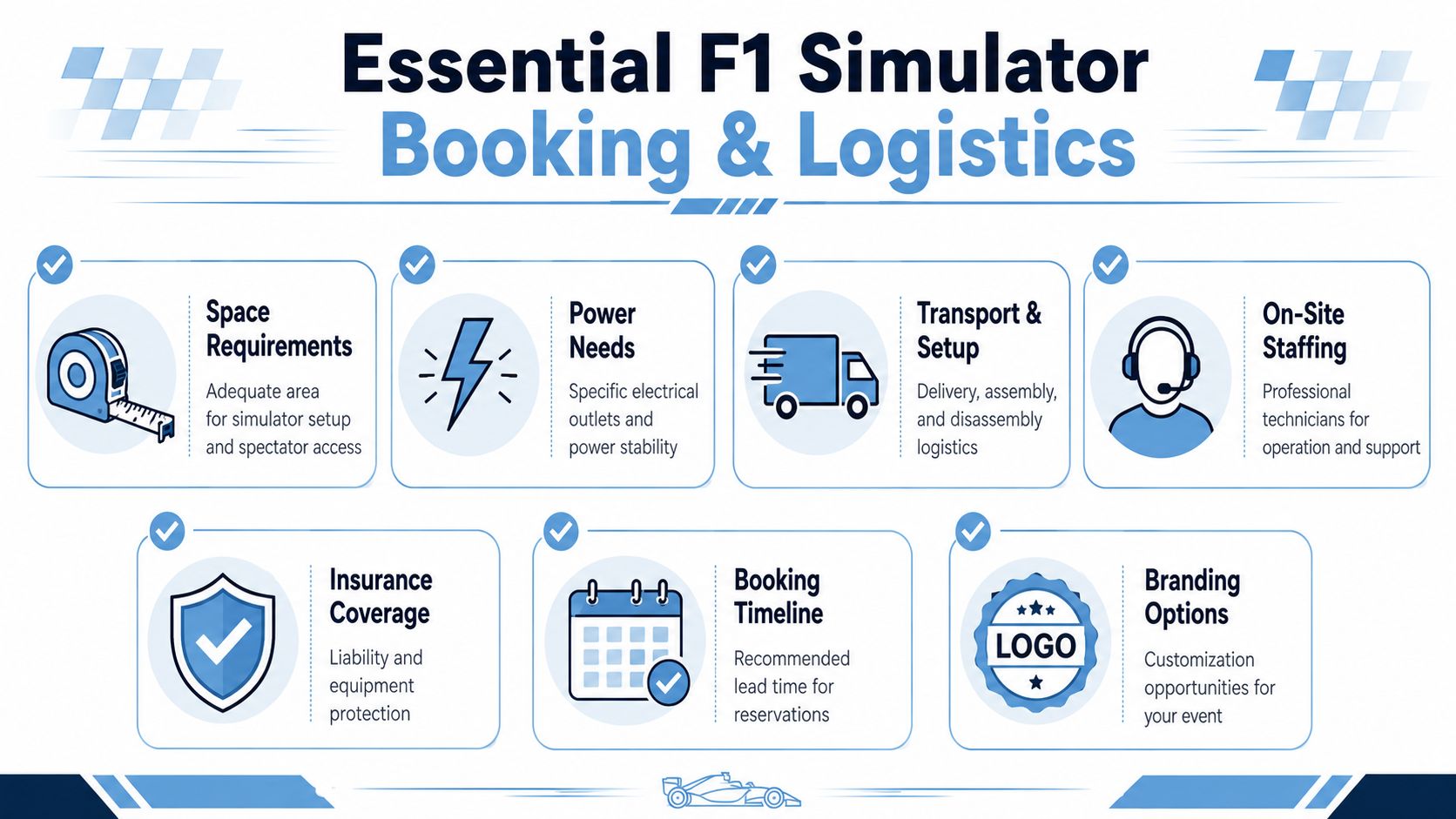
Venue access comes first
Before you discuss branding or race format, confirm whether the rig can physically get into the space.
Ask these questions early:
- Access route: Are there stairs, service lifts, narrow corridors, or tight turns?
- Door widths and loading rules: Exhibition halls and hotel venues often differ sharply here.
- Build window: Can the supplier install the day before, or only on the morning?
- Vehicle access: Is there direct unloading or a long internal move from loading bay to stand?
A simulator that looks manageable on a floorplan can become awkward fast if the route from truck to venue is constrained.
Plan for the operating footprint, not just the unit
Clients often measure the simulator itself and forget the human space around it. You need room for safe entry and exit, operator positioning, queueing, and spectator sightlines.
Think in zones:
- the simulator zone
- the operator zone
- the queue zone
- the viewing zone
- any branding or prize area
If you compress everything too tightly, the activation feels chaotic and premium value drops.
Small footprint decisions have big consequences. A simulator hidden on the back edge of a stand rarely performs as well as one positioned to stop traffic and invite an audience.
Don't leave admin until the end
Professional suppliers should be ready with risk assessments, method statements, and proof of insurance. Those documents aren't box-ticking. Venues and organisers often won't clear access without them.
You'll also want clarity on:
- On-site staffing: who operates the rig and manages guests
- Power specification: what supply is needed and whether a dedicated feed is preferable
- Health and safety process: guest briefing, age guidance, supervision, and emergency shutdown
- Branding lead times: especially if custom graphics or printed elements are involved
For registration-heavy events, pairing the simulator plan with your delegate flow matters too. If you're refining sign-up journeys, ticket tiers, or pre-booked race slots, this guide to choosing event registration tools is a useful reference because it helps planners think through arrival, data capture, and how booking data connects to the live activation.
Build a practical pre-booking list
Before confirming hire, document these items in one place:
| Requirement | What to confirm internally |
|---|---|
| Venue access | Loading bay rules, lift access, door sizes, timing |
| Power | Socket availability, cable runs, venue approvals |
| Floor space | Simulator, queue, host area, branding, spectators |
| Staffing | Supplier crew, client reps, host responsibilities |
| Compliance | Insurance, RAMS, venue forms, sign-off owner |
| Success measures | Lead capture, footfall quality, competition format |
The planners who avoid last-minute problems are usually the ones who treat simulator hire like production, not entertainment. That mindset saves time.
Understanding F1 Simulator Hire Costs
The cost of hiring a Formula 1 car simulator depends less on the phrase “simulator hire” and more on the production brief wrapped around it. Two hires can look similar in a proposal title and be completely different in delivery.
The biggest cost drivers are usually the simulator format, event duration, staffing model, transport complexity, branding requirements, and whether the activation needs to operate as a managed competition rather than a simple free-play feature.
What pushes the cost up
A full-motion simulator will usually sit higher than a static rig because the hardware is more involved, transport and setup are heavier, and operation tends to need tighter control. Multi-day use can improve value compared with repeated one-off installs, but only if the venue and access schedule are sensible.
Costs also climb when you add:
- bespoke branding on the simulator or surrounding set
- additional hosts or technicians
- evening or extended operating hours
- difficult venue access
- supporting elements such as leaderboards, staging, or commentary
What doesn't usually help is asking for “the most realistic option” without defining the event outcome. That often inflates budget without improving results.
Where you can save without weakening the activation
If budget pressure appears, cut complexity before you cut guest experience.
Good ways to control spend include:
- choosing a static rig for high-volume delegate events
- reducing custom scenic elements while keeping strong branded graphics
- shortening session length to improve throughput
- booking a multi-day format where venue access supports it
- using one premium unit well rather than multiple under-supported units
Poor ways to save money include removing operator support, underestimating space, or forcing a premium rig into a venue that can't present it properly.
Sample F1 Simulator Hire Packages
| Package Tier | Simulator Type | Branding | Staffing | Ideal For |
|---|---|---|---|---|
| Bronze | Static simulator | Standard event branding | Operator support | Conferences, staff days, compact stands |
| Silver | Premium static or entry motion setup | Custom branded elements | Operator plus host support | Exhibitions, sponsor zones, product showcases |
| Gold | Full-motion Formula 1 car simulator | Deep customisation across simulator and activation area | Managed team with technical and guest-facing support | VIP hospitality, headline launches, major exhibitions |
The best budget conversation starts with outcomes. If the client wants qualified conversations, a queue and a host may matter more than a more expensive rig.
When you ask for a quote, brief the supplier like a production partner. Include venue, access times, audience type, operating hours, event objective, branding needs, and whether lead capture or competition management matters. The more precise your brief, the more useful the proposal will be.
Measuring The ROI Of Your Simulator Activation
If your post-event summary says “people loved it,” you haven't measured ROI. You've recorded enthusiasm.
A simulator activation earns its budget when it changes behaviour you can track. At a trade show that might mean longer dwell, more qualified conversations, and stronger recall. At an internal event it might mean participation, team interaction, and usable feedback from attendees.
Start with one business objective
The simplest framework is to choose the primary job before the event starts.
That job is usually one of these:
- Lead generation
- Brand visibility
- Audience dwell
- Hospitality impact
- Employee engagement
Once you choose the job, the metrics become obvious. If lead generation is the goal, you should design the queue, registration point, and leaderboard around contact capture. If brand visibility is the goal, your focus shifts to branded visuals, social content moments, and visible competition mechanics.
The strongest ROI case is operational, not theoretical
Immersive activations are advantageous because they're observable. You can see queue length, participation volume, conversation density, repeat attempts, and audience attention in real time.
The available UK event data gives planners a useful benchmark. Experiential activations using F1 simulators can increase exhibition dwell time by 30 to 45% and capture 2 to 3x more qualified leads at UK trade shows. The same data set states that 78% of corporate planners now prioritise immersive tech over static displays as referenced in this BBC-linked event industry summary.
That doesn't mean every simulator activation will hit those results. It does mean stakeholders already understand the logic behind interactive spend, provided you measure it properly.
Track metrics during the event, not after it
A useful event-day scorecard includes:
| KPI | How to capture it |
|---|---|
| Dwell time | Observe time spent in queue, on sim, and in follow-up conversation |
| Qualified leads | Scan badges or collect entries tied to race participation |
| Participation quality | Record completed laps, retries, and hosted interactions |
| Brand exposure | Review photos, social mentions, and visible branding in shared content |
| Team engagement | Use short post-event survey feedback for internal activations |
If you want a broader planning model for proving live engagement value, this guide to experiential marketing ROI is useful because it frames activations around measurable outcomes rather than vague buzz.
There's also a lesson worth borrowing from adjacent immersive sectors. In safety and training environments, planners often justify technology by mapping experience design directly to measurable behavioural outcomes. That same thinking appears in practical work around implementing VR safety training in Australia, and it's a helpful reminder that immersive tools are easiest to defend when they're tied to clear metrics from the start.
If you can't say what success looks like before load-in, you'll struggle to prove value after derig.
The strongest post-event reports usually combine numbers with context. Not just how many people drove, but who they were, how long they stayed, what happened next, and whether the activation opened better conversations than a passive stand would have done.
Frequently Asked Questions For Event Planners
Can we brand the simulator to our campaign
Usually yes. The practical options depend on the unit and the venue, but common approaches include branded bodywork, screen graphics, leaderboards, surrounding panels, host clothing, and prize boards. The best branded activations feel integrated, not over-stuck with logos.
Is a Formula 1 car simulator suitable for all audiences
Broadly yes, but suitability depends on the exact rig, supervision level, and event audience. Corporate planners should ask the supplier for guidance on guest access, seating practicality, age recommendations, and any restrictions for people who may not be comfortable with motion-based experiences.
How many people can use it during an event
That depends on session design more than raw hardware capability. Short, hosted laps process people faster than open-ended play. If throughput matters, build a race format with fixed turn lengths and clear queue management.
Should we choose static or motion
Choose based on objective. Static rigs are often better for volume and simplicity. Motion rigs are stronger when you need a premium centrepiece, hospitality impact, or a more dramatic visual statement.
Can we run a competition over several days
Yes, if the activation is structured properly. Multi-day formats work well when lap times are recorded consistently and someone owns the rules, resets, and final adjudication. If prizes are involved, agree the format before launch.
What tracks and cars should we use
Use combinations that are recognisable, accessible, and not overly punishing for first-time drivers. For public events, the best track isn't always the hardest one. The one that keeps guests engaged and finishing laps usually performs better.
Do we need a host on-site
In most cases, yes. A host or trained operator keeps the experience moving, briefs drivers, handles resets, manages the queue, and protects the quality of the activation. Unhosted simulators often create delays and inconsistent guest experiences.
What usually goes wrong
A few repeat issues cause most problems:
- No competition format: guests don't understand what they're meant to do
- Poor placement: the sim is hidden or facing away from traffic flow
- Understaffing: queues stall and guests lose interest
- Too much complexity: long sessions reduce participation
- Late compliance checks: venue paperwork slows installation
How far in advance should we book
Earlier is better, especially for premium dates, exhibitions, and bespoke branding. The more custom the build, the more planning time you'll want for approvals, artwork, logistics, and venue coordination.
What should we ask a supplier before signing off
Use this shortlist:
- What exactly is included in the hire?
- Who supplies operators and technical support?
- What are the access and power requirements?
- What branding can be customised?
- How is performance or lead capture measured?
- What paperwork is provided for venue approval?
A good supplier will answer those questions clearly and without padding. If the answers are vague, expect friction later.
If you're planning a simulator-led exhibition feature, hospitality activation, roadshow stop, or team event, PSW Events can help you scope the right setup, manage logistics, and deliver a race experience that works in practice, not just on a spec sheet.