
A client once asked whether they could have “the world's biggest Scalextric” on a conference floor. The short answer was no. The better answer was that they didn't need it, because a professionally managed giant track delivers the spectacle people want without the chaos that comes with record-breaking scale.
What Is the World's Largest Scalextric Track
If you search for the largest scalextric track, the benchmark is clear. The Guinness World Record holder was built at Brooklands in Weybridge, Surrey, on 16 August 2009, measured 2.953 miles (4.752 kilometres), and was spearheaded by James May for James May's Toy Stories using around 20,000 track sections with 300 volunteers, as detailed by Scalextric's report on the Brooklands world record.
That's not just a large toy setup. It was a full-scale public spectacle built on one of Britain's most important pieces of motorsport heritage. The project recreated the outline of the original Brooklands circuit, which is why it still gets talked about by event people, motorsport fans, and brand teams looking for something with immediate visual impact.

Why the record matters to event planners
The record matters because it proves what Scalextric can become in the right setting. Many enthusiasts think of it as a tabletop pastime. Brooklands showed that, with enough planning and enough hands, it can anchor a live experience, pull in a crowd, and turn nostalgia into something public and shareable.
That's useful for corporate events because the same attraction still works at a smaller scale. People understand it instantly. They don't need training. They see cars, controllers, a race, and a leaderboard, and they join in.
Practical rule: The appeal of giant Scalextric isn't only the racing. It's the combination of movement, competition, nostalgia, and easy spectator value.
What the world record doesn't tell you
A record attempt and an event installation solve different problems. Brooklands was built to be the biggest. A conference or exhibition feature needs to be reliable, accessible, quick to operate, and manageable inside a live venue with guests moving around it all day.
That's where many planners get caught out. They start with the size headline, when the primary question should be how to get the strongest guest response from the space, power, staffing, and time they have.
The world's largest Scalextric track is a brilliant reference point. It shows the upper limit of ambition. For an event planner, though, it's most useful as proof that slot car racing scales beautifully, not as a literal template to copy.
Understanding Scale from Record Breakers to Event Hire
The biggest mistake planners make is assuming “largest” automatically means “best for events”. It usually doesn't. Record-breaking builds are engineering projects. Event hires are guest-experience tools.
A corporate installation has to start on time, fit the venue, run continuously, handle a queue, and reset quickly between users. That's why a commercially hired giant Scalextric track is designed very differently from a one-off record attempt.
Giant Scalextric Track Comparison World Record vs. Event Hire
| Specification | World Record Track (Brooklands) | Typical PSW Events Hire Track |
|---|---|---|
| Purpose | Public record attempt and spectacle | Fast, repeatable guest participation at events |
| Length | 2.953 miles (4.752 kilometres) | Compact giant track format for venue use |
| Track sections | Around 20,000 track sections | Professional modular layout built for managed operation |
| Build team | 300 volunteers | Delivered and run by event technicians |
| Venue type | Historic outdoor motorsport site | Indoor exhibitions, conferences, brand activations, parties |
| Core priority | Maximum scale | Reliability, throughput, safety, branding, ease of use |
That comparison matters because the design brief changes everything. A record track can afford to be cumbersome if the achievement is the point. An event track can't. It has to work under pressure with a queue of guests, a running schedule, and usually a client who wants branded visibility as much as racing.
What works in live venues
In practice, the sweet spot is a track that feels big enough to stop people walking past, but controlled enough that staff can run races cleanly. Multi-lane layouts do that well because they create instant side-by-side competition. Guests don't stand there trying to understand the format. They pick up the controller and race.
The other thing that works is predictability. Exhibition halls, hotel ballrooms, and conference centres reward attractions with straightforward access and simple utilities. If a setup needs specialist infrastructure, it becomes harder to approve and harder to deliver.
A giant track at an event should feel impressive from the aisle and effortless once the first race starts.
What doesn't work
Oversized bespoke concepts often look good in pitch decks and become awkward on site. Very long layouts can reduce visibility, complicate marshalling, and spread the experience too thinly. If guests can't see who's winning or where the action is, the theatre drops away.
Similarly, a “DIY but bigger” mindset rarely translates well in corporate settings. Exhibition organisers care about timing, floorplans, cable management, safety paperwork, and noise control. A professional event installation is less about pushing scale to the limit and more about balancing footprint, presentation, and uptime.
That's why the world record is inspiring, but the practical event answer is usually a managed giant track built for participation, not for headlines.
Planning Your Giant Scalextric Installation
Most giant Scalextric hires are easier to place than planners expect. The main requirement is being disciplined about the difference between the track size and the operational footprint around it.
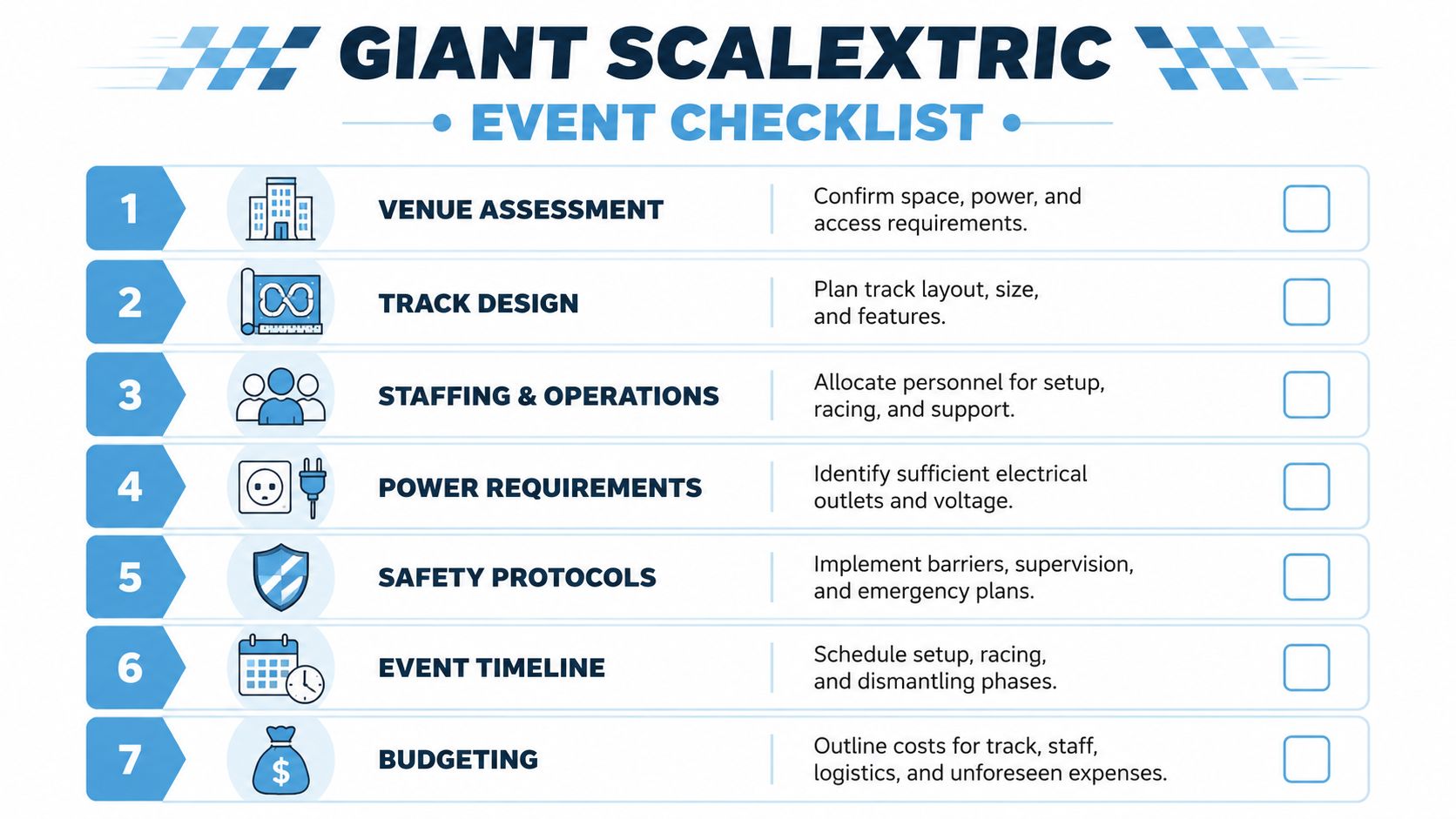
A standard commercial 8-lane giant Scalextric hire typically measures 4.5m x 2.4m and needs a 6m x 3m operational footprint, while running from a single 50W domestic plug (13A UK standard), according to MiniRacing's giant Scalextric hire specification. For venue planning, that's the sort of detail you need early because it affects stand design, traffic flow, and whether spectators can gather without blocking aisles.
Start with the site survey
Before anyone talks branding or tournament formats, confirm the basics:
- Clear floor space: Don't just measure the track. Include room for players, operator access, and a small audience.
- Power location: A standard socket is usually enough for this format, but you still want it close by to avoid messy cable runs across open guest areas.
- Access route: Check loading bay access, lifts, corridor widths, and the final room approach. A track that fits the room but not the route into the room is a preventable problem.
- Ceiling and lighting: Overhead branding, truss, or low decorative fixtures can affect visibility and camera angles more than people expect.
Design for how guests actually use it
The best layouts for events aren't always the ones with the most technical corners. They're the ones that create quick excitement and obvious head-to-head racing. If your goal is exhibition footfall, put the track where it can be seen from a distance. If your goal is staff engagement, place it where people can gather without feeling they're in the way.
For conferences and trade shows, these choices usually make the biggest difference:
- Front-facing orientation so the racing is visible from the aisle.
- Simple queueing space so players know where to wait.
- Leaderboard position where both racers and spectators can read it.
- Brand surfaces on barriers, backdrops, and cars rather than cluttering the track itself.
Site note: A compact footprint is only an advantage if the surrounding space still feels comfortable. Crowding kills participation faster than a smaller track ever will.
Build your timeline around operations
A giant Scalextric feature works best when it's treated as a live activation, not just equipment delivery. That means assigning time for installation, testing, live running, and pack-down in the venue schedule.
A practical planner will ask:
- When can the crew access the hall?
- Is setup happening during a wider exhibitor build?
- Will the attraction run all day or in scheduled sessions?
- Who signs off the final position on site?
Those decisions shape staffing, branding installation, and race format. They also affect whether the experience feels polished once doors open. The strongest installs look simple to guests because the technical planning was done properly before anyone arrived.
Ensuring a Safe and Smooth Racing Experience
A giant track is easy to enjoy. It shouldn't be left to chance to operate. In corporate venues, safety and smooth delivery are what separate a strong attraction from a constant source of small problems.
The physical setup is only part of it. The primary value sits in the paperwork, testing, staffing, and race control behind the scenes.
Risk management has to be built in
Any attraction that draws a crowd needs a proper risk review before the first guest touches a controller. That includes cable routing, trip prevention, queue management, manual handling during setup, and making sure the activity suits the audience and venue rules. If you want a practical starting point for internal planning, the ABCO Security risk assessment tool is a useful template for organising the obvious hazards and controls.
That matters because a giant Scalextric setup usually attracts spectators as well as players. Once people gather around the attraction, you're not only managing the race. You're managing how people move around it, where they stop, and whether the area remains clear and comfortable.
Why on-site technicians matter
A staffed track runs better for reasons that aren't obvious from the outside. Technicians don't just plug it in and stand back. They brief players, reset deslots, keep races moving, manage controllers, handle children and adults differently, and make quick judgement calls when the queue builds.
They also protect the guest experience. If racing becomes confusing, too slow, or too chaotic, people disengage. A good operator keeps the pace right and changes the format when needed, whether that means fastest lap sessions, short heats, or casual free-play bursts.
One of the strongest additions is a visible live results system. An electronic leaderboard for event competition gives the activity structure, especially when the goal is repeat play, prizes, or lead capture around a fastest-lap challenge.
Compliance isn't a nice extra
Professional hire matters because corporate venues expect evidence, not assumptions. That usually means public liability cover, PAT-tested equipment, documented risk controls, and staff who know how to work within venue rules rather than improvise around them.
A managed setup also reduces pressure on the client team. Marketing managers and event producers shouldn't be resolving controller issues, watching queue behaviour, or deciding whether an unsafe cable route is acceptable. They've got enough to do.
Here's a good example of the pace and presentation that helps a racing feature land well in public settings:
If you want giant Scalextric to feel premium, treat it like a staffed interactive activation, not a self-serve game table.
How Brands Win with Giant Scalextric
A giant Scalextric track earns its place when it helps a brand do something specific. Sometimes that's stopping foot traffic. Sometimes it's giving sales teams a simple conversation starter. Sometimes it's turning a passive stand into a live competition area that feels busy all day.
The attraction works because it gives people a reason to pause. Once they stop, the brand has a chance to do its job.
The strongest use cases
At exhibitions, the track acts like a magnet. People notice movement first, then competition, then branding. That sequence matters. Guests don't have to be “into motorsport” to understand the activity. They just need to see a race happening and recognise there's a place for them in it.
At internal events, it does something slightly different. It breaks formality fast. Teams that wouldn't naturally mingle start competing, comparing lap times, and drawing colleagues over. For awards nights, conferences, and client hospitality, that's useful because the entertainment creates its own conversations.
The format is also flexible enough to support campaign mechanics such as:
- Fastest lap competitions for prize draws or timed heats
- Branded car liveries that keep the sponsor visible in every race
- Host-led challenges during launch windows or stage intervals
- Charity tie-ins where racing becomes part of a wider fundraising message
A useful benchmark from a bespoke build
One of the clearest examples of Scalextric being used as more than a hobby display came from CarFest South in Hampshire. A 45-metre, 177-piece layout designed by Martin Brundle featured famous Formula 1 corners and was later auctioned for charity, as reported by CarThrottle's coverage of the Martin Brundle Scalextric track. That's a strong reminder that bespoke track design can support both audience engagement and a wider brand or charitable story.
The practical lesson for planners is that the track itself can carry narrative value. It doesn't have to be just “something fun on the stand”. It can reflect a product launch theme, a racing heritage angle, or a corporate social responsibility message.
Turning attention into action
A busy attraction is only valuable if it feeds the event objective. That's why the better activations wrap the racing inside a clear campaign structure. The race gives you the crowd. The mechanic around it gives you the business result.
A few examples of that structure:
- Lead capture: Enter the leaderboard by leaving your details.
- Product messaging: Name each lane or race format around a product line.
- Social content: Use branded backdrops and podium photos after each heat.
- Sales engagement: Give account teams a simple prompt to start conversations while guests wait.
For teams looking at broader experiential ideas, these brand activation examples for live events show how interactive formats can be shaped around different campaign goals.
A giant Scalextric track works best when the race is the hook and the campaign mechanic does the heavy lifting behind it.
Budgeting for Giant Scalextric Hire
Budget questions usually come too late. By the time someone asks for cost, the event concept is often already fixed, which makes compromise harder. It's better to set the budget logic at the same time you define the role of the attraction.
The simplest way to think about giant Scalextric hire is this: you're paying for an operating experience, not just a pile of track. Delivery, setup, staffing, testing, live management, and pack-down are where much of the actual value sits.
Use the world record as a cost benchmark, not a target
For perspective, the James May Brooklands build required over 12,000 track pieces, an estimated £5,000+ in track hire alone, and transport via 20 transit vans, according to Guinness World Records' note on the longest slot car track. That's helpful because it shows how quickly cost and complexity rise when the brief becomes “build something enormous”.
For an event planner, the takeaway isn't to scale up. It's the opposite. A managed hire package is far more efficient because it's built around known venue realities and repeatable operation.
What usually affects price
Even when no bespoke fabrication is involved, a few variables typically shape the quote:
- Hire duration: A one-day conference activation is different from a multi-day exhibition.
- Staffing level: Heavier footfall or longer opening hours may need more operator cover.
- Branding scope: Custom car liveries, barriers, backdrops, and leaderboard graphics all add production work.
- Venue logistics: Difficult access, tight installation windows, or unusual delivery rules can increase labour time.
- Competition format: Casual free-play is simpler than a managed tournament with prizes and structured heats.
Those factors matter more than chasing raw track length. Most clients get better value from cleaner branding, better staffing, and a stronger race format than from adding more physical track.
Build the business case properly
The right comparison isn't “track hire versus no track”. It's “interactive feature versus other ways of generating attention and engagement on the same floor”. A giant Scalextric track can cover multiple needs at once: spectacle, participation, dwell time, branded content, and hosted competition.
If you're weighing options across entertainment categories, it helps to compare the full mix of live attractions rather than pricing one item in isolation. A broader games rental UK service overview can help frame where giant Scalextric sits against other interactive event formats.
In practice, budget approval gets easier when the planner can explain not only what the attraction costs, but what operational work is included and what event objective it supports.
Take the Next Step for Your Event
The largest scalextric track in the world proves the format can capture attention on a huge scale. For most event planners, the smarter opportunity is to borrow that sense of spectacle and apply it in a form that works inside a venue, on a timetable, and in front of real guests.
That's why giant Scalextric continues to perform well at exhibitions, conferences, hospitality events, and branded activations. It's familiar without feeling tired. It's competitive without needing much explanation. It creates movement, noise, and a natural crowd, which is exactly what many live event spaces struggle to generate on their own.
The practical advantages are just as important. A professional setup can fit into a manageable footprint, run from standard power, and be delivered as a turnkey attraction with staff, testing, setup, and on-site support. That removes a lot of the friction that usually comes with interactive features.
If you're building a case for one, focus on three things:
- Guest engagement: People stop, watch, and join in quickly.
- Operational simplicity: The format is easier to place than many planners assume.
- Brand value: The race can be wrapped into a wider campaign, from lead capture to hospitality entertainment.
A giant track doesn't need to break records to be memorable. It just needs to be well chosen, well placed, and well run.
If you want help turning the idea into a working event plan, PSW Events can advise on giant Scalextric hire, branding, staffing, logistics, and full delivery for conferences, exhibitions, and activations across the UK and beyond. The easiest next step is to get a quote based on your venue, dates, and event objective, then match the track format to the result you want on the day.