
A lot of event stands look busy from a distance and forgettable up close. The graphics are polished, the staff are briefed, and the product message is sound, but attendees still drift past because nothing gives them a reason to stop, join in, and stay.
That's where the Batak Challenge earns its place. It cuts through passive browsing with movement, noise, competition, and a clear invitation to take part. Used well, it doesn't just entertain people for a moment. It gives your team a practical way to start conversations, capture leads, increase dwell time, and create content people want to film and share.
For a corporate marketing manager, that distinction matters. If an activation only creates a queue and no commercial outcome, it's expensive theatre. If it creates a queue, sparks conversations, and feeds measurable event goals, it becomes a serious marketing tool.
Your Guide to the Batak Challenge
You know the scene. Mid-morning at an exhibition, the aisles are full, but attention is thin. Buyers are walking quickly, glancing at stands, taking brochures they won't read, and saving their time for anything that feels live.
Then a Batak Challenge starts.
A ring of people forms almost immediately. One person is playing, two are waiting, several are watching the scoreboard, and your stand team suddenly has an opening that didn't exist five minutes earlier. Instead of trying to interrupt attendees, you're giving them a reason to approach on their own.

That's why the Batak Challenge works so well at trade shows, conferences, team-building days, and sports-themed activations. It's fast to understand, visibly competitive, and easy to wrap around a brand message or campaign mechanic. Attendees don't need a long explanation. They see lights, speed, scores, and challenge. They get it instantly.
Practical rule: If an activation needs too much explanation on a busy event floor, footfall drops. The Batak Challenge avoids that problem because the game mechanic is obvious at a glance.
The strongest use of Batak isn't “we hired a game”. It's “we built an interaction funnel”. The game attracts the crowd. The crowd creates social proof. The operator or stand staff turn that moment into a conversation, a registration, a demo, or a branded content capture.
That's the difference between filler entertainment and purposeful engagement. The Batak Challenge can absolutely deliver energy. The smarter question is how you design that energy so it supports the commercial objective you're already being judged on.
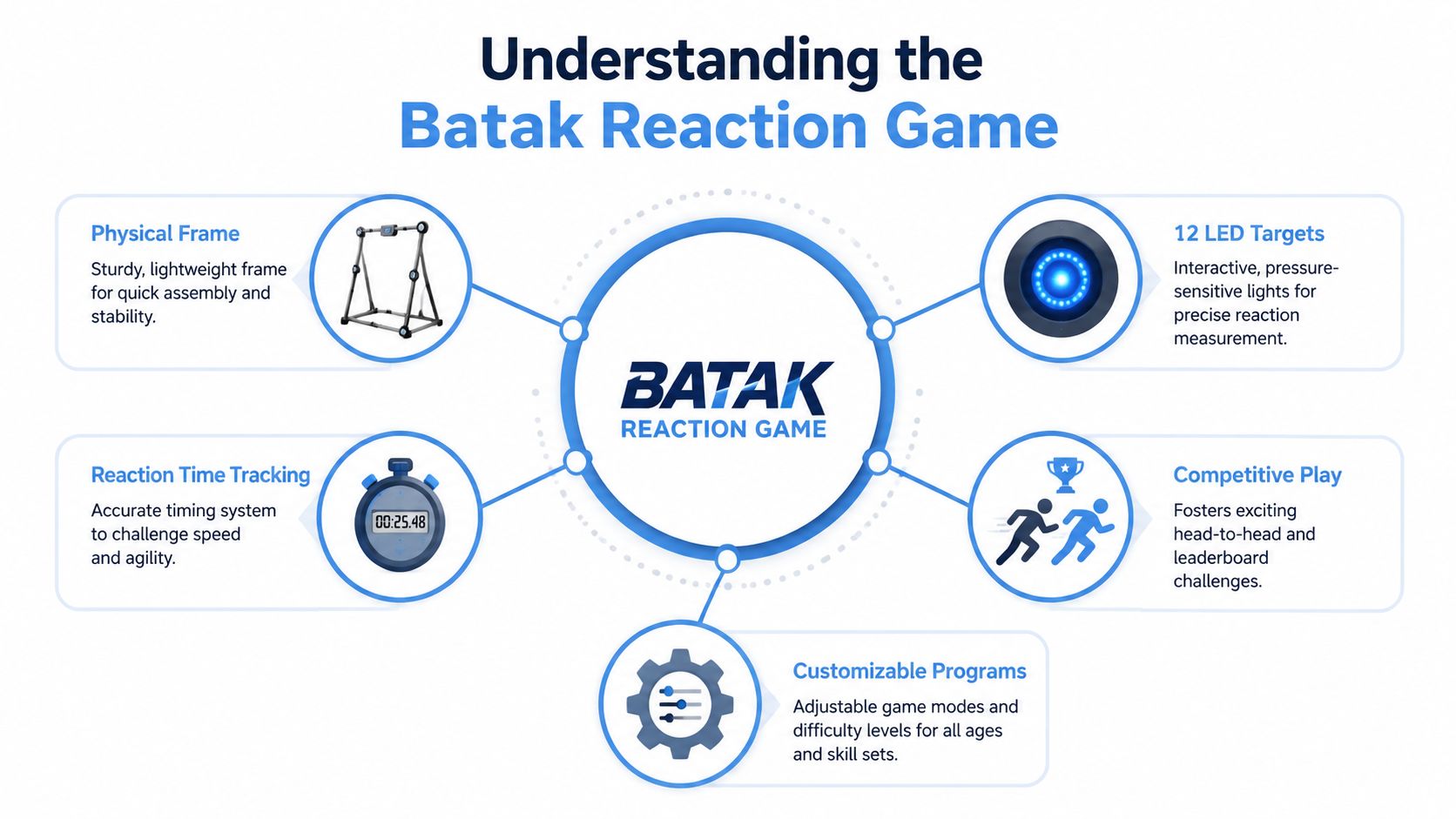
Understanding the Batak Reaction Game
The Batak Challenge is a reaction training game. Participants stand in front of an electronic frame and hit illuminated LED buttons as quickly as they appear. Standard gameplay usually runs in 30 or 60 seconds, and faster reaction speeds lead directly to higher scores.
It's simple enough for first-time players and competitive enough to keep people coming back for another attempt. That balance is what makes it so useful in live environments.
How the game works in practice
Think of it as a high-speed reaction wall. Lights appear in changing positions across the frame, and the player's job is to hit each target before the next one appears. Every successful hit adds to the score, and because the pattern changes quickly, players need concentration, hand-eye coordination, and pace.
The appeal comes from three things happening at once:
- Instant comprehension: People understand the challenge just by watching someone else play.
- Short session length: A round is brief, so turnover stays high and queues remain productive rather than frustrating.
- Visible competition: Scores are easy to compare, which naturally creates replay value.
In standard gameplay, the objective requires participants to press illuminated LED buttons as quickly as they appear within fixed intervals of 30 or 60 seconds, where faster reaction speeds directly correlate to higher point scores. The game is widely used in corporate events and sports activations across the UK as it effectively boosts energy and enhances teamwork through competitive light-chasing mechanics.
Why it feels bigger than a simple game
Batak has roots in elite performance environments, which is part of its credibility. It isn't random novelty. It's built around reaction speed and coordination, so it carries a sports-performance feel even in a corporate venue.
That matters because people treat it differently from a generic arcade machine. They want to test themselves. They want to beat colleagues. They want another attempt because the challenge feels skill-based rather than luck-based.
Batak works best when attendees feel they can improve after a first round. That second attempt is where dwell time starts to build.
There's also a practical event advantage here. The machine is active without being confusing. Some interactive attractions look impressive but need a staff member to decode the experience before anyone joins in. Batak doesn't have that friction. A player steps up, hits lights, sees a score, and hands over to the next person.
What event planners should notice
From an activation point of view, the most useful features are not technical. They're behavioural.
| What attendees see | What organisers gain |
|---|---|
| A fast reaction challenge | A steady flow of participants |
| A visible score to beat | A natural competition mechanic |
| A short, energetic turn | More chances to engage people |
| A crowd watching live play | Social proof around the stand |
That's why the Batak Challenge sits comfortably in both sporty and corporate settings. It feels high-energy, but it's operationally straightforward.
Driving Engagement and ROI with the Batak Challenge
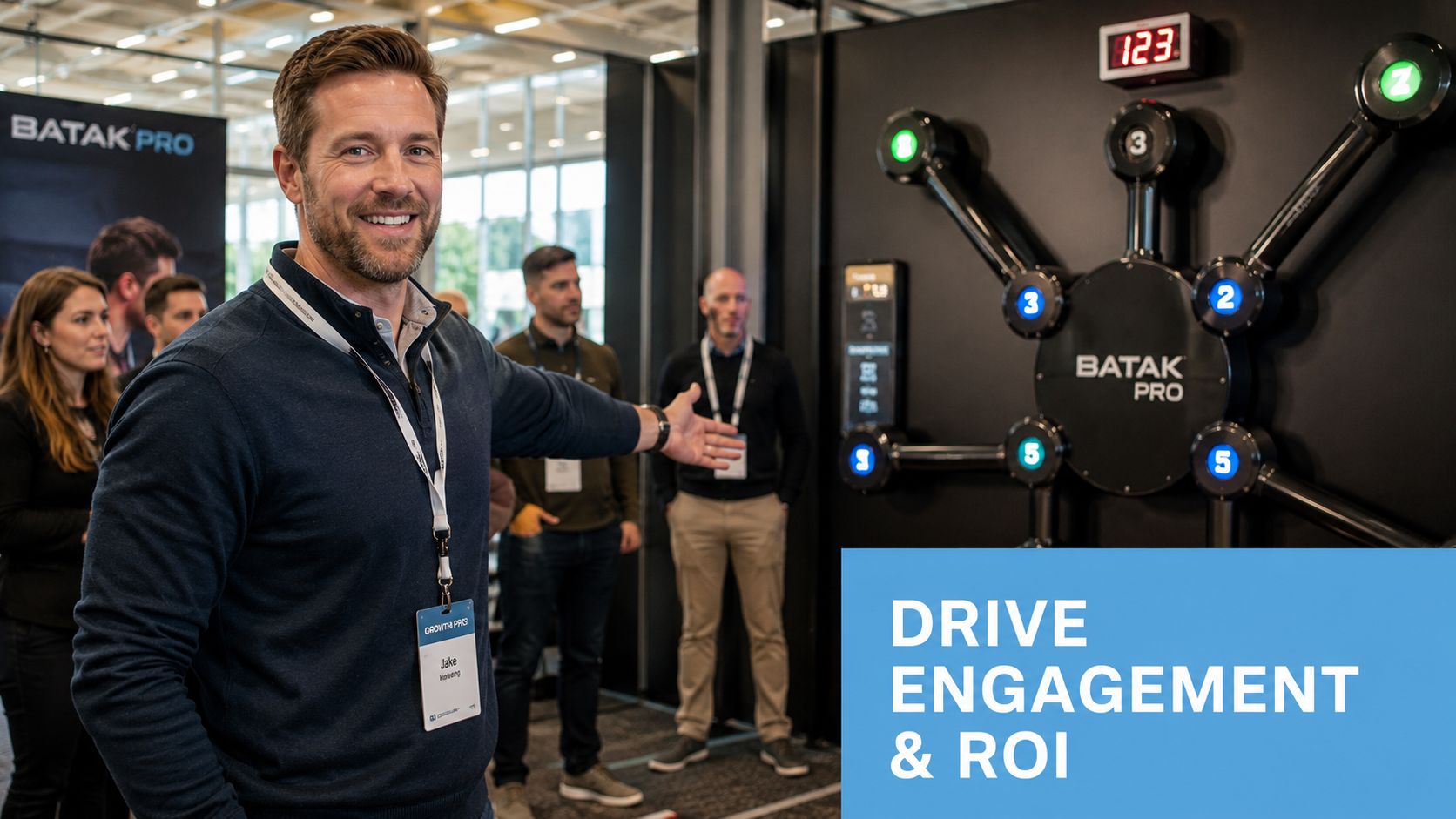
The Batak Challenge earns attention quickly, but attention on its own isn't the target. The target is useful engagement. You want the game to pull the right people in, keep them on your stand long enough for a meaningful interaction, and give your team a practical reason to qualify them.
Why it attracts footfall without feeling forced
Many stand attractions fail because they look static until somebody commits. Batak is the opposite. Flashing targets, rapid movement, and visible scores create movement on the stand, and movement draws eyes from the aisle.
That's one reason it has crossed over so well from sports environments into brand activations. An unofficial world record on the Batak Pro was set at 212 hits in 60 seconds, demonstrating the high-calibre competition it inspires. The game has also been featured by Liverpool FC, where professional footballers took on the machine, highlighting its appeal and confirming its status as a high-energy, addictive activity that keeps participants engaged.
Where the commercial value actually comes from
The smart play isn't to let people jump on, finish, and walk off. The smart play is to build a simple lead path around the challenge.
That can look like:
- Pre-play registration: Name, company, and email before the first attempt.
- Qualified entry rules: Only target prospects or invited guests are entered into the leaderboard.
- Post-play conversation: Staff use the score and competition as an easy opener for product discussion.
- Prize structure: Rewards tied to booked demos, scheduled follow-ups, or team participation.
A Batak Challenge integrates into a broader gamification in events strategy, rather than standing as a sole amusement.
A queue has no value if nobody in the queue fits your audience. Always decide whether the game is there to maximise volume, improve lead quality, or support client hospitality. The staffing script changes depending on that choice.
Batak improves dwell time when the format is right
The strongest Batak activations include watchers, not just players. A lone participant creates a moment. A visible leaderboard creates a mini-audience. Once people start cheering colleagues on or waiting to beat a top score, your stand stops being a pass-through space and starts functioning like a live set piece.
That's also where filming becomes useful. The action is quick, expressive, and easy to capture on a phone. People like posting scores, challenge attempts, and head-to-head clips because the content has a built-in narrative. There's effort, tension, and a result.
A short example helps here. If you run Batak as an open free-play station, you'll get activity. If you run it as a timed challenge with announced top scores, branded graphics, and staff prompting shares with your event hashtag, you'll get stronger audience behaviour around it.
For a quick sense of how the game looks in action, this clip gives the right feel for pace and crowd appeal.
What doesn't work
There are a few common mistakes:
- No call to action: People play, smile, and leave.
- No scoreboard visibility: Competition never properly forms.
- No staff ownership: The game runs, but nobody turns activity into leads.
- No qualifying question: Every visitor gets treated the same, including people who were never prospects.
Used with intention, Batak creates a rare mix on the event floor. It's entertaining enough to pull people in and structured enough to support measurable outcomes.
Your Event Checklist for Hiring a Batak Challenge
A Batak Challenge can look effortless to attendees and still require disciplined planning behind the scenes. The difference between a slick activation and a messy one usually comes down to basics. Placement, staffing, power, data capture, and queue management all need sorting before the venue opens.

Start with the objective, not the equipment
Before you confirm the hire, decide what the Batak unit is meant to do.
Is it there to:
- Drive lead capture: Useful for exhibitions and sponsor activations.
- Increase stand energy: Helpful when your location needs a visible draw.
- Support internal engagement: Better for conferences, staff events, and hospitality.
- Create branded content: Best when social sharing is part of the campaign plan.
That answer shapes everything from script and staffing to prize mechanics and placement.
Get the practical setup right
A Batak Challenge needs enough space for the machine, the player, the queue, and the watchers. The machine itself may only occupy a modest area, but the activation footprint is always bigger than the unit footprint. If people are likely to stop and film, allow room for that too.
Power is another simple point that often gets left late. Confirm access to a suitable nearby socket early, and make sure cables can be routed cleanly without creating trip hazards.
For events where registration or digital score submission matters, internet planning also deserves attention. A lot of activations lose data quality because connectivity gets treated as an afterthought. This wi-fi events guide is a useful reference for thinking through access, reliability, and guest experience before you arrive onsite.
Staffing changes the result
An unmanned Batak setup rarely performs as well as an operated one. Someone needs to invite attendees in, explain the challenge quickly, manage the queue, reset the flow between turns, and hand participants over to the brand team when there's genuine sales potential.
The operator isn't just there to supervise the machine. They control pace, fairness, crowd energy, and the handover point between play and conversation.
If you're mapping deadlines, approvals, and supplier coordination, it helps to build the game into your wider event planning timeline rather than treating it as a last-minute add-on.
Branding, safety, and inclusivity
The strongest executions make the game feel like part of the campaign, not a rented extra. That can include branded leaderboards, surrounding graphics, themed competition names, or a prize mechanic that ties back to the product launch.
On safety, ask direct questions before booking:
| Checkpoint | Why it matters |
|---|---|
| Insurance cover | Confirms the supplier is prepared for public-facing use |
| Risk assessment | Shows how setup and operation will be managed |
| Onsite supervision | Keeps gameplay orderly and safe |
| Delivery and derig timing | Prevents conflict with venue access windows |
One practical note often gets missed. Batak is built around speed and reaction. That makes it exciting, but it won't suit every audience equally. If your event has an inclusion brief, discuss alternative or complementary attractions at the same planning stage rather than after sign-off.
A provider such as PSW Events can handle delivery, installation, staffing, branding support, and health and safety compliance for interactive attractions including Batak Pro. The important thing is not the name on the van. It's whether the supplier thinks beyond drop-off and understands the activation workflow.
Inspiring Activation Examples and Measuring Success
A Batak Challenge becomes much more useful when you attach it to one clear scenario and one clear measurement plan. That sounds obvious, but it's where many event teams go wrong. A 2025 UK Corporate Events Industry Report noted that 68% of planners struggle to prove long-term ROI from interactive games in reporting around the Batak Challenge at Action Days. That's why KPIs need deciding before the first player steps up.
Trade show lead magnet
A simple version works well. Visitors register to take part, complete one timed attempt, and the top scores go onto a live leaderboard. Staff then use the handover point after the round to qualify the participant.
Useful KPIs here:
- Leads captured per hour
- Qualified conversations started from player registrations
- Average dwell time around the stand
Product launch ignition
For launches, Batak works best when the challenge mirrors the campaign theme. A fast, precision-focused product can use the reaction mechanic naturally. A prize for the best score during the launch window gives the game urgency and reason.
The right measures tend to be:
- Branded content captures
- Social mentions using the event hashtag
- Audience participation during key launch periods
If the activation is tied to a launch message, make the competition name and leaderboard language reflect the campaign. Generic branding weakens recall.
Team-building tournament
Internally, Batak can anchor a department-versus-department contest or a rolling leaderboard through the day. It's short enough to fit around conference agendas and lively enough to break up formal sessions.
This use case needs different measures:
- Participation spread across teams
- Repeat attempts by delegates
- Informal engagement around break periods
For reporting, don't stop at “people enjoyed it”. Build your event readout around observable actions and agreed KPIs. If you need a broader framework for doing that, this guide to experiential marketing ROI is a useful starting point.
Partner with PSW Events for a Flawless Activation
The Batak Challenge is popular for a reason. It's quick to understand, competitive without much explanation, and strong at turning passive footfall into visible participation. For marketers, the key value comes when that participation is structured properly around registration, staffing, brand messaging, and follow-up.
The operational side matters just as much as the game itself. Clean setup, sensible queue flow, confident hosting, and branded scoring all shape whether the activation feels sharp or improvised. That's why experienced event support is worth having, especially when the game sits inside a larger exhibition or campaign programme.
Inclusivity also deserves a straight conversation before booking. Batak is speed-focused, and that won't suit every audience. Recent UK workplace surveys show 41% of corporate attendees have conditions affecting reaction speed, making neuro-inclusive options like motion simulators an important consideration for an accessible event strategy, as noted by Funtasia Entertainment's Batak Pro Challenge Hire page.
If you're comparing activation partners more broadly, this guide to premier event marketing agencies gives useful context on the kinds of specialist support available across the market.
If the Batak Challenge is on your shortlist, treat it as a measurable activation tool, not just a crowd-pleaser. That's when it starts earning its space in the budget.