
A lot of corporate events look busy without being engaging.
The stand is built well. The branding is polished. The attraction itself might even be strong. But attendees drift past, glance over, check their phones, and move on. Even when they do take part, the energy often peaks for a moment and then disappears because nothing in the space shows that something important is happening.
That’s where an electronic leaderboard changes the dynamic. It gives the room a focal point. It turns a simulator run, a reaction challenge, or a skills competition into a live contest that everyone can follow. People stop to see who’s leading. Participants come back to improve their score. Colleagues pull each other over. Suddenly the activation isn’t just something to try. It becomes something to beat.
In practice, that matters because event engagement rarely comes from technology alone. It comes from visible momentum. A leaderboard creates that momentum by making performance public, immediate, and worth reacting to. For marketing teams, that means stronger dwell time, more repeat visits, better conversation flow, and a much clearer path to lead capture than a static screen or passive display usually delivers.
Introduction From Spectators to Participants
Most marketing managers know the feeling. You’ve invested in a stand, a conference activation, or a client event experience that should be pulling people in. The assets are approved. The team is briefed. The venue opens. Then the room settles into polite but forgettable activity.
People watch for a few seconds and move on. Some join in once, smile, then disappear. Your staff ends up doing the hard work of creating energy manually, repeating the same invitation over and over. That’s not a people problem. It’s usually a format problem.
An electronic leaderboard fixes that by changing what attendees believe is happening in the space. The moment scores are visible and updating in real time, the attraction becomes social. Every result creates a reaction. Every new top score gives people a reason to stay nearby. Every near miss starts a conversation.
What changes on the floor
A leaderboard does three things at once:
- It creates stakes: A golf simulator, F1 simulator, Batak Pro unit or reaction challenge becomes a contest instead of a one-off demo.
- It rewards repeat participation: People don’t just play once. They come back to climb the rankings.
- It gives bystanders a reason to watch: Spectators become part of the experience because they can follow who’s winning.
That shift from passive viewing to active participation is where the commercial value sits. You’re no longer relying on booth staff to explain why the activation matters. The display itself tells the story.
Practical rule: If attendees can’t instantly see who’s winning, what the challenge is, and why another attempt matters, the activation will usually lose momentum faster than the team expects.
The strongest event technology doesn’t sit in the background. It shapes behaviour. That’s exactly what a well-planned electronic leaderboard does.
What Is an Electronic Leaderboard Really
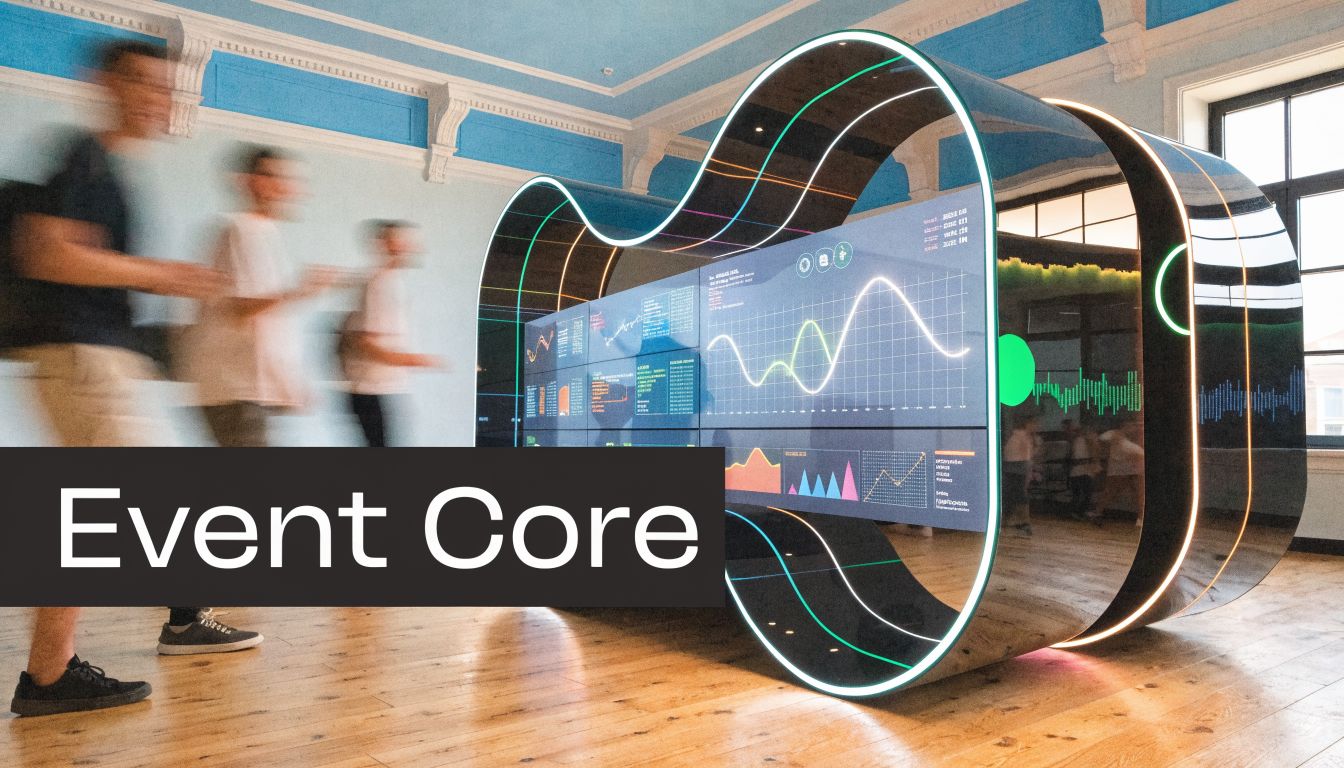
At a corporate event, an electronic leaderboard is the live control layer behind a competitive activation. It takes score data from a simulator, reaction game, skills challenge, or multi-game zone, then turns that data into a ranking the room can understand at a glance.
That sounds simple. In practice, it affects far more than score display.
A well-built leaderboard manages inputs, organises results, applies ranking logic, and presents the outcome in a format that works for both players and passers-by. At PSW Events, we treat it as part of the activation system, not a decorative screen added late in the build. That decision changes how reliably the experience runs, how much attendee data you can capture, and how much brand value the activation delivers across the day.
A basic scoreboard reports what just happened. An electronic leaderboard shapes what happens next. It gives attendees a reason to register, compete, return, and compare results with colleagues or clients. For marketing teams, that means longer conversations, clearer lead attribution, and more chances to connect participation with opt-in data.
More than a score display
In practical terms, an electronic leaderboard usually sits between the attraction, the event team, and the audience. It can pull results from activities such as:
- F1 simulators: fastest lap, best sector, cumulative race ranking
- Batak Pro challenges: highest score, quickest reactions, team totals
- Golf or skills games: nearest the pin, longest drive, accuracy leaderboards
- Multi-activity zones: combined rankings across several branded challenges
The format matters because each use case needs different logic. A fastest-lap board has to update instantly and stay readable from distance. A multi-activity board may need weighted scoring, session resets, duplicate name control, and prize thresholds. If registration is tied to the game, the system also needs to handle consent capture and export usable participant data afterwards.
That is why leaderboard planning should start early, alongside the attraction itself, the display choice, and the data journey.
| Function | What it means in practice |
|---|---|
| Competition engine | It turns separate attempts into a structured contest with visible rankings |
| Audience display | It shows results clearly enough to attract attention from across the stand or venue space |
| Brand surface | It carries logos, campaign visuals, sponsor placement, and prize messaging |
| Data layer | It links score entry to registration, opt-in capture, and post-event reporting |
What marketing teams are actually buying
The commercial value is not the screen on its own. It is the system behind the screen.
A good electronic leaderboard can identify participants, feed names or team names into the display, segment results by challenge, and support prize mechanics without slowing the queue. More advanced setups can also use AI-assisted ranking rules, adaptive content, or lead capture prompts based on player behaviour. For example, a returning participant might see a fresh call to action, while a top scorer might be prompted to claim a prize through a branded form. Used properly, that turns a competitive moment into a qualified lead opportunity.
There is a trade-off. The more advanced the leaderboard logic becomes, the more important system stability, network planning, screen placement, and operator control become. A board that looks impressive but lags, freezes, or mis-ranks players will damage trust quickly.
For UK corporate events, there is another layer that buyers often miss until late in the process. The leaderboard is part of the temporary event infrastructure, so the display, power distribution, mounting method, and connected equipment need to be specified with safety in mind. If the setup involves mains-powered screens, truss, floor-standing supports, or integrated game hardware, compliance with requirements such as BS 7671 and PUWER needs to be considered during planning, not on site during a rushed install.
That is the true definition. An electronic leaderboard is a live event system that combines competition, branding, data capture, and operational control. When it is specified properly, it does more than show scores. It helps turn an activation into a measurable marketing asset.
How Leaderboards Drive Unforgettable Event Engagement
A visitor steps onto a simulator at 11:15. By 11:20, three colleagues are watching, one is filming, and another is asking how to get on the board. That shift from passive footfall to active participation is why electronic leaderboards work so well at corporate events.
They give people a public reason to care.
At busy exhibitions and brand activations, attention is fragile. Attendees are splitting time between stands, talks, meetings, hospitality, and travel schedules. A live leaderboard cuts through that because it answers two questions immediately. What is happening here, and how well are people doing at it?

The effect is practical, not theoretical. A fastest lap table beside a racing simulator creates visible status in seconds. A Batak Pro board does the same in a tighter space. Once scores start changing in real time, people stop seeing the activation as a demo and start treating it as a contest worth joining.
Attention becomes action
The best event technology reduces the amount of explanation staff need to do. A good leaderboard shows the challenge, the result, and the incentive in one glance.
That matters commercially. If attendees can understand the experience without a long introduction, more of them take part. More participants usually means more qualified conversations, more consented data capture, and more reasons for people to come back later to improve a score or check a team position.
AI-driven leaderboard logic can improve that further when it is used properly. In practice, that can mean adapting prompts by player behaviour, rotating calls to action based on queue pressure, or surfacing team results that keep group competition alive across the day. We have seen this work well for UK brand activations where the goal is not only dwell time, but turning competitive energy into usable lead data.
There is a trade-off. More intelligent scoring and content rules create more dependencies between the game mechanic, the display system, the network, and the operator interface. If any part of that chain is poorly specified, the experience loses credibility fast.
What changes on the stand
Well-run leaderboard activations tend to produce the same operational benefits.
- Repeat plays rise: People will often try again if they can see exactly how close they are to moving up.
- Spectators convert more easily: Watching becomes part of the experience, not dead time at the edge of the stand.
- Conversations start naturally: Staff can open with score, rivalry, prize threshold, or team standing instead of a cold brand message.
- The stand looks busy for the right reason: Visible competition gives passers-by social proof that something worth joining is happening.
The psychology is familiar in sport and training as well as events. Vanta Sports' insights on gamified training explain the principle clearly. Visible progress and achievable competition keep people engaged for longer.
Better lead capture, with less friction
Lead capture performs better when it feels connected to the experience. If someone enters a challenge, sees their name on screen, and gets a genuine chance to rank, the value exchange is obvious. They are not filling in a form for its own sake. They are joining something public, competitive, and memorable.
For marketing managers, that is the strategic point. The leaderboard is not just an output screen. It is part of the mechanism that turns brand attention into participation and participation into data you can follow up. That is the difference between a novelty and a properly designed experiential marketing campaign.
Done well, the attraction becomes a live proof point for the brand. It gives attendees a moment they remember, gives staff a reason to start better conversations, and gives the event team a cleaner path to measurable ROI.
Strategic Use Cases and Placement Across Your Event
The same electronic leaderboard can behave very differently depending on where it sits and what it’s connected to. Placement is never just an AV decision. It affects footfall patterns, spectator behaviour, queue quality, and how easily staff can turn attention into conversation.
A leaderboard at the wrong spot can become background scenery. Put in the right place, it becomes the anchor for the whole activation.
Exhibition stands and visitor flow
At a trade show, the leaderboard’s main job is to create a visible reason to stop. It works best when attendees can spot it from a distance, understand the challenge in seconds, and see that other people are already involved.
That’s why stand-edge placement often works better than pushing the display deep into the footprint. If the screen is visible from the aisle, people can read the top scores before they’ve committed to stepping in. Curiosity does the rest.
Useful trade show placements include:
- Aisle-facing edge: Best for drawing first attention and creating a visible hook from passing traffic.
- Adjacent to the activity: Best when spectators need to connect the challenge to the score instantly.
- Visible from a waiting area: Best for keeping queue time productive rather than dead time.
For ideas on how this fits into stand design more broadly, this guide to interactive exhibition ideas is a practical reference point.
Conferences and internal events
Leaderboards aren’t limited to exhibitions. They work well in conference spaces, sales kick-offs, and team building days because they can introduce energy without making the event feel chaotic.
A conference sponsor zone might use a leaderboard to rank quick challenge scores between sessions. A team building programme might use one board to combine results across several activities, creating a clear running order throughout the day. Internal audiences respond particularly well when departments, regions, or teams can compare performance live.
In those settings, the display should usually be placed where people naturally regroup:
| Event type | Strong placement choice | Why it works |
|---|---|---|
| Conference | Networking area or session break zone | Captures people during natural downtime |
| Team building | Central hub area | Gives all teams a shared reference point |
| Awards or gala side activation | Reception or drinks space | Builds early buzz before the main programme |
Product launches and branded competition
At a product launch, a leaderboard can do something a standard digital screen can’t. It makes the product experience feel contested and public.
If attendees are testing speed, accuracy, reaction time, product knowledge, or simulation performance, the board turns that interaction into a visible campaign mechanic. Instead of a single attendee trying something privately, you have a room watching rankings evolve.
That’s particularly effective for automotive, sport, technology, and performance-led brands because the leaderboard reinforces the language of speed, improvement, and winning.
A leaderboard should be placed where the result feels socially visible. If nobody can see the rankings without walking into the activation zone, you’ve reduced one of its biggest advantages.
Common placement mistakes
Some of the weakest outcomes come from choices that seem minor during planning.
- Hiding the display behind the activity: Spectators can’t follow the action, so they disengage.
- Using a screen that’s too small for the venue: The board exists, but it doesn’t dominate attention.
- Ignoring sightlines: Pillars, truss, scenic elements or catering furniture can kill visibility fast.
- Separating registration from the score display: That adds friction and weakens the sense of live competition.
When a leaderboard is part of the layout from the start, it supports the whole event environment. When it’s added late, it often ends up solving less than it should.
A Planner's Guide to Technical Specifications
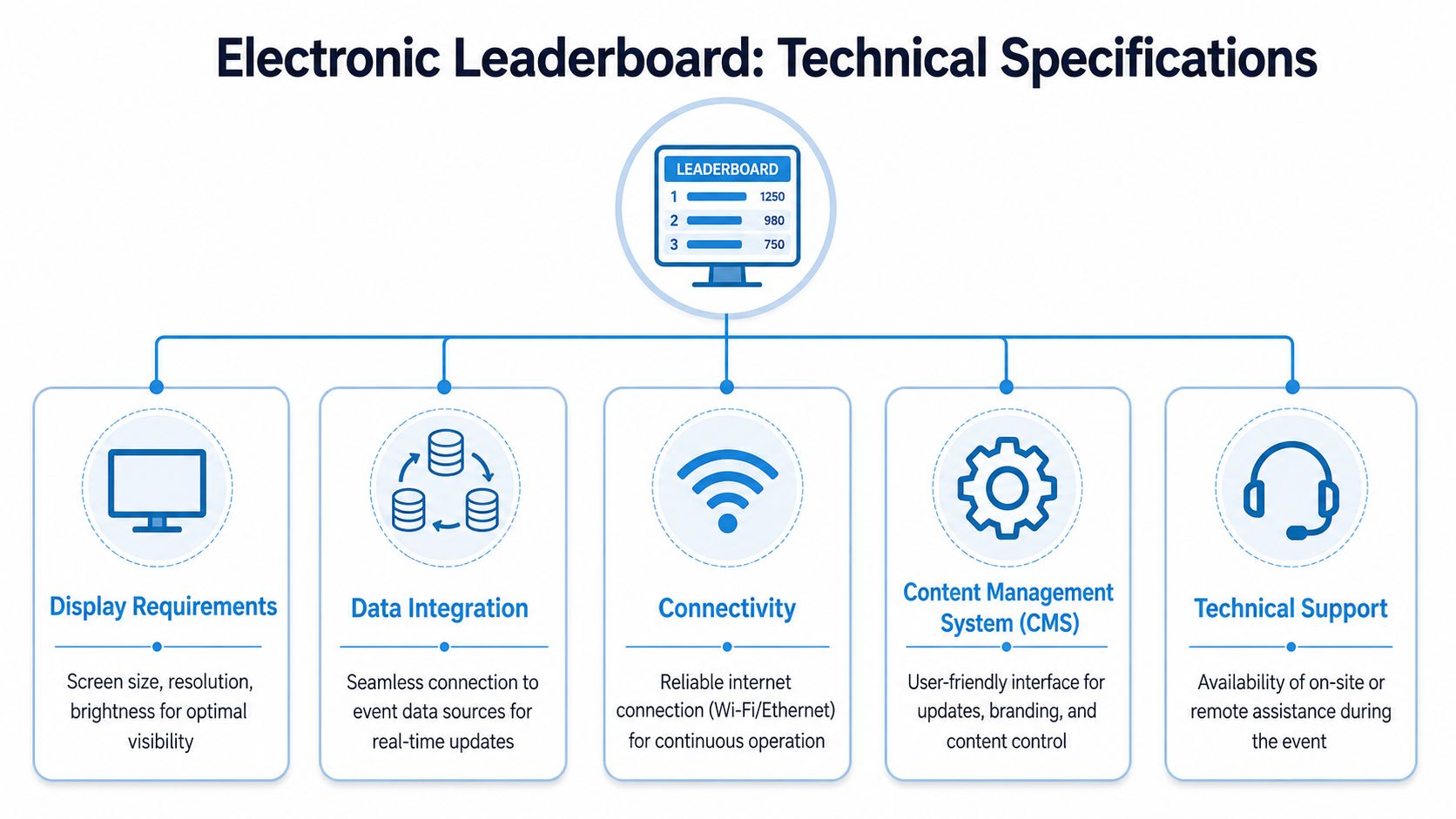
A leaderboard can be doing its job in creative terms and still fail on site because the specification was weak. I see that happen when the screen was chosen on size alone, the data path was treated as an afterthought, or power and compliance were left for the production meeting. The result is predictable. Scores are hard to read, updates feel inconsistent, and the activation looks less polished than the brand intended.
For planners, the technical brief has one job. Make the leaderboard readable, dependable, safe, and easy to operate under real event conditions.
Display brightness and visibility
Brightness is one of the first filters, especially for outdoor events or glass-heavy venues. A screen that works in a warehouse can struggle badly in a courtyard, on a concourse, or in a pavilion with shifting daylight.
Industry guidance on specifying electronic scoreboards notes that outdoor installations typically require high-brightness LED displays to stay legible in daylight, with the exact level depending on ambient light, screen position, and viewing angle, as explained in this electronic scoreboard brightness guide. The practical planning point is simple. Ask for the actual brightness specification and ask how it performs in the conditions your audience will face, not in ideal test conditions.
Three questions usually expose whether a supplier has thought this through:
- What is the rated brightness in nits?
- How will the screen be oriented against daylight and audience sightlines?
- What viewing distance and text size has the content layout been designed for?
A premium activation needs a display that holds up from first arrival to late afternoon. If names and scores are hard to read, the competition loses pace and the sponsor loses visibility.
Connectivity and data transport
Update speed shapes trust. If participants think the board is delayed, manually corrected, or intermittently wrong, the competitive tension disappears.
For that reason, I prefer a wired signal path wherever the leaderboard matters to the activation. Shorter runs may be handled over direct serial or networked cabling. Longer distances across halls, grandstands, or outdoor compounds often need a better transport plan, particularly if the control position is nowhere near the display. Venue Wi-Fi can support low-risk content tasks, but it should not be the default assumption for live score publishing in a busy corporate environment.
A workable setup usually falls into one of these categories:
| Setup type | Where it fits | Main trade-off |
|---|---|---|
| Hardwired local connection | Single activation zone with fixed operator position | More cabling, stronger consistency |
| Managed networked setup | Multi-screen environments or shared event data workflows | More planning and testing |
| Venue Wi-Fi dependent setup | Basic, low-risk applications with no strict update requirement | Least predictable under load |
Marketing teams do not need to specify protocols themselves. They do need to ask what happens if the primary connection fails, how quickly the system recovers, and whether a local fallback is in place.
Data integration and live updates
The next question is operational. Where does the score come from, and who confirms it?
Some attractions output performance data directly into the leaderboard software. Others need a staffed interface where an operator verifies the result before it goes live. Both models can work. The wrong approach is a rushed workaround involving manual entry on an overloaded laptop while the queue builds and the audience watches the screen.
A sound workflow should define:
- The source of the score
- The validation step
- Expected posting time
- Fallback process if the connection drops
- Rules for ties, resets, rounds, and team scoring
- Whether participant data is also being captured for lead follow-up
That last point matters more now than it did a few years ago. AI-driven leaderboard platforms can do more than rank results. They can connect gameplay data with registration details, segment high-intent participants, and feed cleaner lead data into post-event reporting. For a marketing manager, that changes the commercial value of the system. The board is no longer only a display asset. It becomes part of the lead capture workflow.
Diagnostic monitoring and fail-safes
Fault monitoring is often overlooked because it sits behind the audience experience. On site, it is one of the features that protects it.
The best event-ready systems monitor power status, communications health, display performance, processor load, and temperature so the crew can spot issues before they become visible failures. That is particularly important on multi-day builds, outdoor events, and touring activations where connectors, power distribution, and environmental conditions can shift over time.
If the leaderboard is central to the campaign mechanic, ask whether the supplier can monitor faults live, swap critical components quickly, and keep a fallback display state running if part of the system drops out. Those answers tell you a lot about delivery maturity.
Branding and content control
Good branding improves recognition. Bad branding hurts readability.
The content hierarchy should be obvious from a distance. Rank, participant name, and score need to dominate the screen. Sponsor treatment, campaign colours, and motion graphics should support that structure rather than compete with it. The common problems are familiar. Heavy background artwork reduces contrast. Small logos clutter the score area. Excess animation slows down the reading experience.
A board built for events is not a static digital sign with scores pasted on top. It needs a content template designed for live updates, fast reading, and clean brand presentation under pressure.
Power, environment, and UK compliance
Power planning should be part of specification, not a late production note. LED displays, control systems, operator stations, networking hardware, and any associated attraction all affect electrical load, cable routing, and distribution design. On a UK event site, that also feeds directly into safety and compliance.
For corporate event buyers, sharper scrutiny from suppliers is essential. Temporary electrical systems should be installed and tested in line with BS 7671. Work equipment used by staff falls under PUWER, which means the system must be suitable for the task, maintained properly, and operated by competent people. Outdoor use also raises questions about ingress protection, stable mounting, cable protection, and how the system behaves in heat, rain, or wind.
Those details affect risk, insurance position, and show continuity. They also affect supplier choice. A credible proposal should explain the operating environment, power requirement, mounting method, test process, and contingency plan around the screen, not just quote a panel size.
That is usually the difference between hiring hardware and hiring a system that is ready for a live corporate event.
Hiring Versus Buying A Key Strategic Decision
For most corporate events, hiring an electronic leaderboard makes more sense than buying one. That’s not because buying is wrong. It’s because the commercial logic is different.
Buying suits permanent or near-permanent installations where the display will be used repeatedly in the same environment by an in-house team that can manage storage, transport, setup, testing, maintenance, and compliance. That’s a narrow use case.
Most marketing teams don’t need ownership. They need the right configuration for a specific event, on specific dates, with support wrapped around it.
Where hiring usually wins
A hired system gives you flexibility. One event may need an indoor branded leaderboard beside a Batak Pro challenge. Another may need a brighter outdoor display paired with simulators and staffed score management. Those are not the same requirement, and ownership can lock you into using the wrong format because it’s already on the balance sheet.
Hiring also reduces operational drag.
- No storage issue: Large display hardware takes space and needs careful handling.
- No maintenance burden: LED modules, connectors, control systems and casing all need checking.
- No obsolescence headache: Event tech moves on. So do branding expectations.
- No separate crew sourcing: Delivery, rigging, testing and live operation can sit under one supplier.
If you’re already hiring attractions, hiring the leaderboard alongside them is often the cleaner route. For example, when a campaign includes simulation-based competition, simulator hire options can be paired with live ranking displays as one operating setup rather than split across multiple vendors. PSW Events offers electronic leaderboard hire in that kind of package for score-based activations.
When buying can still make sense
Buying is more defensible when a venue or organisation uses the display regularly in a controlled environment. Think permanent sports facilities, training centres, or fixed entertainment spaces.
Even then, ownership brings responsibilities that are easy to underestimate:
| Decision factor | Hiring | Buying |
|---|---|---|
| Upfront cost | Lower initial commitment | Higher capital spend |
| Flexibility | High, event by event | Lower, tied to owned hardware |
| Maintenance | Usually handled by supplier | Handled internally or separately contracted |
| Technology refresh | Easier | Slower and more expensive |
| Logistics | Included in project delivery | Ongoing internal responsibility |
The compliance angle changes the decision
There’s also a less glamorous but important issue. Once you own the hardware, you own more of the compliance and maintenance burden around it.
For teams reviewing venue or installation obligations, broader guidance such as 2026 electrical compliance for stadiums is useful context because it shows how quickly electrical responsibilities become operational rather than theoretical. Even for temporary use, the standard expected on site is serious.
That’s why many corporate clients prefer to hire from a specialist provider that can bring the display, integration, setup, support, and compliance paperwork together. It keeps accountability clearer and reduces the number of moving parts on event day.
Navigating UK Compliance and Event Safety
At 7:15 on event morning, the screen is in place, branding is loaded, and registration is building. Then venue technical management asks for electrical paperwork, inspection records, and confirmation that the temporary installation is suitable for public use. If the supplier cannot produce them quickly, the leaderboard can be powered down or removed before doors open. That is not a technical inconvenience. It is a lost engagement asset, a disrupted lead capture plan, and a visible brand failure.
Electronic leaderboards sit in an awkward category for planners because they look simple from the audience side. On site, they are powered work equipment installed in a live environment, often close to queues, walkways, feature lighting, staging, and other temporary infrastructure. In the UK corporate event market, safety and compliance have to be treated as part of delivery, not an afterthought once creative is approved.
What planners should check before sign-off
For UK events, the review usually comes down to five practical areas:
- Electrical installation to BS 7671: Temporary power still needs to be designed and installed properly. The IET states that BS 7671 is the UK national standard for electrical installations: https://www.theiet.org/standards/bs-7671/
- Suitability under PUWER: If the equipment is being used in a working environment, it must be suitable, maintained, and safe to use. The HSE summarises employer duties under the Provision and Use of Work Equipment Regulations 1998 here: https://www.hse.gov.uk/work-equipment-machinery/puwer.htm
- Inspection and test records: PAT labels alone are not enough for every venue. Planners should expect current documentation that matches the actual equipment arriving on site.
- Ingress protection and weather planning: Outdoor use needs the right IP rating, protected cable routing, stable mounting, and a realistic wet-weather operating plan.
- Marking, manuals, and traceability: UKCA or CE marking should be clear where applicable, backed by manufacturer information and operating documentation.
The commercial risk is easy to underestimate.
If a leaderboard fails venue checks, trips during service, or has to be isolated because cabling or power distribution is wrong, attendees do not separate the technical cause from the brand experience. They see a sponsored activation that is out of action, staff who cannot explain what is happening, and a queue that stops converting into usable conversations.
For marketing teams using AI-driven leaderboards, the stakes are even higher. These systems often sit at the centre of a gamified lead capture journey, combining score logic, participant data, CRM-ready exports, and real-time branded content. If the screen goes down, the issue is not limited to visibility. Data collection slows, dwell time drops, and the competitive mechanic that keeps people engaged disappears with it.
Insurance is part of the same risk picture. Public liability, product liability, method statements, and clear responsibility for on-site rectification show whether a supplier is set up for public-facing event technology or merely delivering hardware.
At PSW Events, we treat compliance documents, power planning, and installation sign-off as part of the activation design because that is what protects ROI on the day. Planners should ask for the paperwork early, confirm who owns the electrical scope, and establish who fixes problems if the venue raises concerns. Clear answers usually indicate a supplier who knows live events. Vague answers usually surface again at the worst possible time.
Frequently Asked Questions
Booking decisions usually hinge on practical details. Marketing managers want to know whether the board will fit the space, support branded lead capture, pass venue checks, and stay live all day.

How much space and power does an electronic leaderboard need
The answer depends on the display type, mounting method, viewing distance, and what else sits around it.
The screen footprint is only part of the plan. A usable leaderboard position also needs safe cable routes, access for setup and service, enough clearance for queues, and sightlines that let people read the rankings without crowding the stand. For larger activations, I also allow space for an operator position or control point, because live scoring, content changes, and troubleshooting should not happen from the middle of a busy attendee area.
Power should be assessed across the whole activation. If the leaderboard is tied to simulators, tablets, scanners, or AI-driven registration flows, the electrical design needs to be reviewed as one system so the load, distribution, and protection arrangements match the venue's requirements.
Can leaderboard data be exported for follow-up
Yes, if the registration and scoring journey has been designed properly from the start.
The useful question is not whether an export exists. It is whether the system collects the right fields, records consent clearly, and delivers the output in a format the sales or CRM team can use without manual cleanup. That matters more with AI-supported leaderboards, where the value often comes from combining competition data, participant details, and post-event segmentation into one follow-up list.
Poor setup creates a familiar problem. The event generates activity, but the marketing team leaves with a spreadsheet that cannot be matched cleanly to campaign reporting or lead scoring rules.
How much control do we have over branding
Usually a lot, within the limits of readability.
Brand colours, logos, campaign names, sponsor messages, background graphics, and motion elements can all be built in. The trade-off is clarity. If the visual treatment makes names, scores, or calls to action harder to read from a distance, the board stops performing its main job. The best branded leaderboard feels like part of the campaign while keeping rankings instantly legible.
What happens if the system develops a fault during the event
Professional event setups reduce risk through monitoring, on-site support, and sensible fallback planning.
Good operators watch power, connectivity, heat, and signal health throughout the day, then deal with issues before attendees notice them. Backup processes matter too. If live score updates pause, staff should still know how to continue the competition, protect lead capture, and restore the display quickly. At PSW Events, that operational planning is part of the activation design because a failed screen does more than create a technical issue. It interrupts the mechanic that keeps visitors engaged and sharing their details.
How far in advance should we plan
Plan earlier than the first draft schedule suggests.
A straightforward indoor hire can move quickly. A branded leaderboard connected to registration, AI scoring logic, sponsor approvals, venue power sign-off, and UK compliance checks takes longer because creative, data, and technical decisions affect each other. If the venue requires documentation on electrical scope, work equipment suitability, or installation method, those approvals should be handled well before build day.
Can one leaderboard cover multiple activities
Yes, provided the scoring model is easy to understand.
This works well for tournaments, team building formats, and multi-zone brand activations where one screen helps pull attention across the room. It works less well when unrelated activities are forced into one ranking without clear labels, timing rules, or category splits. If attendees cannot tell what the numbers mean in a few seconds, engagement drops and the board becomes background scenery instead of a participation driver.
For events where competition, visibility, and lead capture all need to work together, an electronic leaderboard often becomes the operating centre of the activation, not just the display. Done properly, it keeps people playing longer, gives sponsors visible value, and turns event traffic into follow-up data the marketing team can use.