
You're probably looking at an event brief that says something like “we need something interactive” or “we need a hero attraction that pulls people onto the stand”. That sounds simple until you're the one who has to choose something that's exciting, brand-safe, practical to run, and worth the budget.
A standard game station rarely does enough. Guests glance at it, a few people have a quick turn, and the energy drops. A racing simulator hydraulic setup sits in a different category. It isn't just screen-based entertainment. It's a full-body experience that can anchor an exhibition stand, sharpen a product launch, or give a team-building day a centrepiece people talk about afterwards.
The reason planners keep coming back to simulator experiences is straightforward. They create a visible moment. People gather around them. Colleagues film each other. Leaderboards give strangers a reason to compete. Branded content looks stronger when the activity already has natural drama.
The more important question isn't “is a simulator fun?” It's “what type of simulator creates the right result for this event?” That's where hydraulics matter. In the world of premium sim racing, hydraulic systems are associated with higher-fidelity movement and more authentic braking feel. For a public event, that can translate into a more convincing guest experience, stronger dwell time, and a more premium impression of your brand.
Creating an Unforgettable Event Attraction
It is 10:15 on the first morning of a trade show. People are walking the aisle, scanning stands, deciding where to stop. Your team has a few seconds to give them a reason. A hydraulic racing simulator does that job well because it creates movement, sound, competition, and a visible participant story all at once.
That matters for event planning because attraction value is not only about how realistic the drive feels to the person in the seat. It is also about what happens around the rig. Does it stop foot traffic? Does it create a queue that signals demand? Does it give your staff an easy opening line with prospects? The best activations answer yes to all three.
A useful way to judge any interactive feature is to treat it like a mini stage set. One guest takes part, but several others should understand what is happening from a distance. A premium simulator works well in that setting because the motion is visible, the competition is easy to explain, and the reactions are genuine. That combination helps turn a piece of equipment into an attraction with commercial value.
The UK events market is large enough that planners are judged on practical outcomes as much as creative flair. Industry bodies such as the Events Industry Alliance have highlighted the sector's economic importance in reports including the UK Events Report, which keeps the focus on delivery, capacity, and measurable return rather than novelty alone. For the engineering side of why hydraulic systems feel controlled and forceful, MA Hydraulics' hydraulic engineering insights give useful background.
For a marketing manager, the question is simple. Will this help the stand work harder?
A hydraulic simulator often earns its place because it changes the experience from "someone playing a driving game" to "someone taking on a challenge worth watching." That shift affects dwell time, crowd formation, and the quality of branded photos and video captured on site. It also gives your team more ways to build a campaign around the attraction, from fastest-lap leaderboards to timed product demos and VIP competitions.
Why planners choose premium over basic
A static rig still has uses, especially where budgets are tight or floor loading is restricted. But for launches, exhibitions, and hospitality spaces where perception matters, hydraulic systems usually create a stronger result because they offer:
- A clearer focal point that is easier to spot across a busy hall
- A more convincing guest experience because the body feels braking, movement, and weight shift
- Stronger spectator value as onlookers can see the rig react and follow the action
- Better brand fit for premium messages such as performance, precision, engineering, or innovation
- More content opportunities for social clips, winner moments, and team challenges
The commercial point is straightforward. If you are paying for floor space, staffing, and stand build, the attraction should help justify those costs by pulling people in and giving them a reason to stay. A hydraulic simulator is often chosen for that reason first, and for enthusiast credibility second.
What Makes a Racing Simulator Hydraulic
“Hydraulic” sounds technical, but the idea is simple. A hydraulic system uses fluid under pressure to create force and controlled movement. If you've ever thought about how power-assisted systems in vehicles can feel smooth but strong, you're already close to the concept.
In a simulator, that force can be used in two different ways. Many buyers become confused at this point.
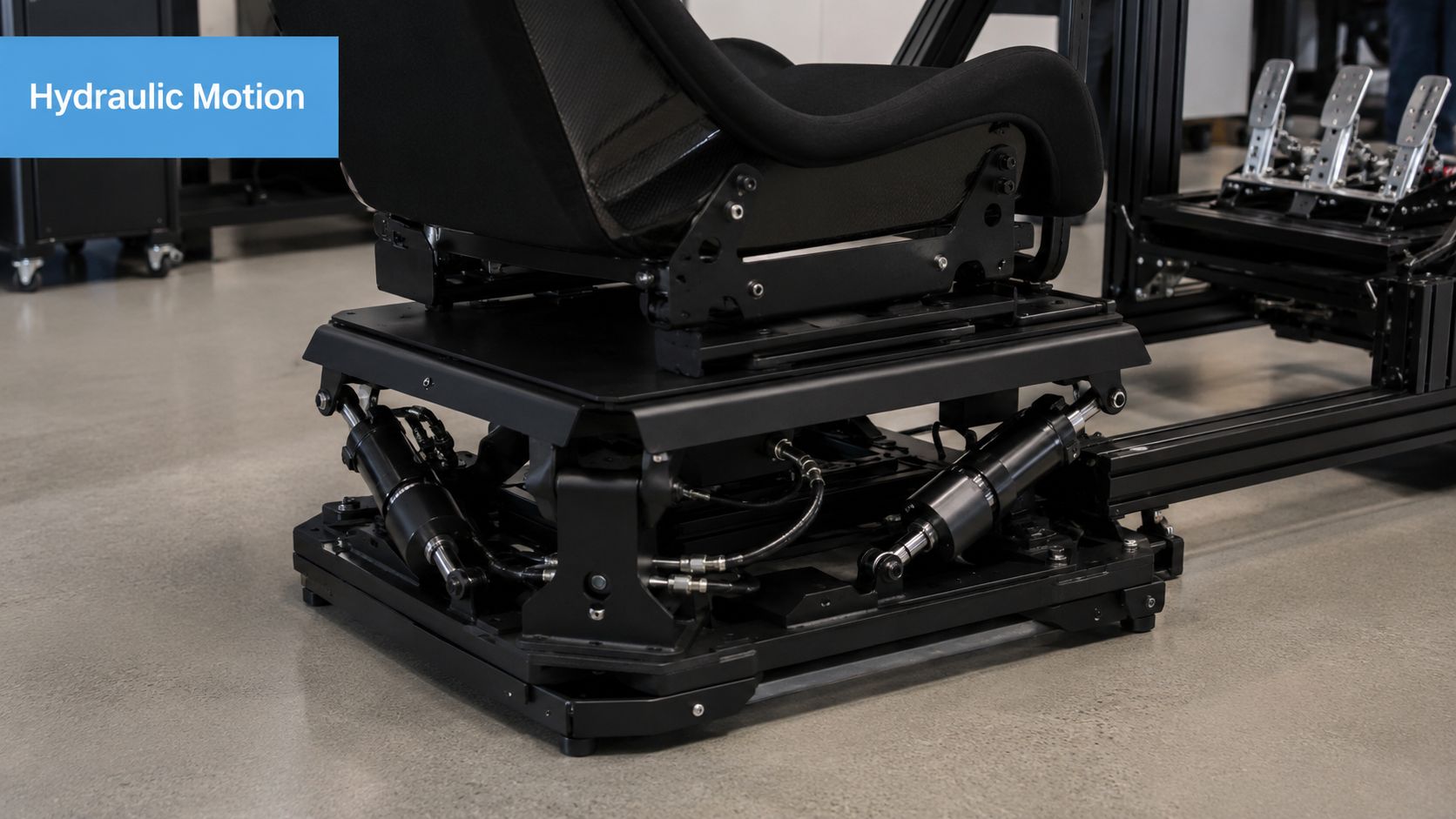
Hydraulic motion and hydraulic pedals are not the same thing
A hydraulic motion platform moves the rig itself. The seat and chassis react to acceleration, braking, cornering, kerbs, and track surface changes. The goal is to make the driver feel what the car is doing.
A hydraulic pedal system focuses on the brake pedal. Instead of a simple spring feel, it uses fluid pressure to create progressive resistance that behaves more like a real brake system.
Both are “hydraulic”, but they solve different problems:
| System | What it affects | What the guest notices |
|---|---|---|
| Hydraulic motion platform | Whole rig movement | Seat movement, weight transfer, body sensation |
| Hydraulic brake pedal | Brake feel underfoot | Firmer, more progressive, more believable braking |
If you're choosing for events, ask your supplier which of these they mean. Some rigs include hydraulic pedals but not hydraulic motion. Others use motion systems with different pedal technologies.
Why fluid power matters
The practical advantage of hydraulics is control under force. In simulator design, fluid power is chosen when high-fidelity movement is critical, and one simulator comparison notes that hydraulics are better suited than electric actuation when mass, acceleration, and sustained force feedback are the priority for replicating a real vehicle feel, according to this comparison of hydraulic and electric systems.
That sounds engineering-heavy, so here's the event version.
If you want the rig to move in a way that feels substantial rather than decorative, hydraulics are attractive. They're associated with smooth force delivery and a more convincing sense that the simulator is reacting to the virtual car, not just shaking for effect.
For a clear primer on the underlying principle, MA Hydraulics' hydraulic engineering insights give a useful plain-English explanation of how hydraulic force is created and controlled.
The event takeaway is simple. Hydraulics are less about “more movement” and more about movement or resistance that feels intentional, weighted, and believable.
What a non-technical buyer should listen for
When a supplier describes a racing simulator hydraulic setup, these are the practical clues to listen for:
- “Motion platform” means the seat or rig moves
- “Hydraulic brake” means the pedal feel is a premium feature
- “Direct-drive wheel” usually means stronger steering feedback and often sits alongside premium brake hardware
- “Commercial rig” suggests the setup is designed for repeated public use, not just home gaming
Once you understand those distinctions, the buying conversation becomes much easier. You stop comparing “simulators” as if they're all alike and start comparing the specific guest experience each rig can deliver.
Comparing Motion Systems for Your Event
A simulator choice affects more than driving feel. It shapes queue length, staffing pressure, floor planning, and the kind of crowd your stand attracts.
For a corporate event, the key question is simple. Do you need a high-throughput attraction that keeps people moving, or a hero feature that makes people stop, film it, and remember your brand afterwards?
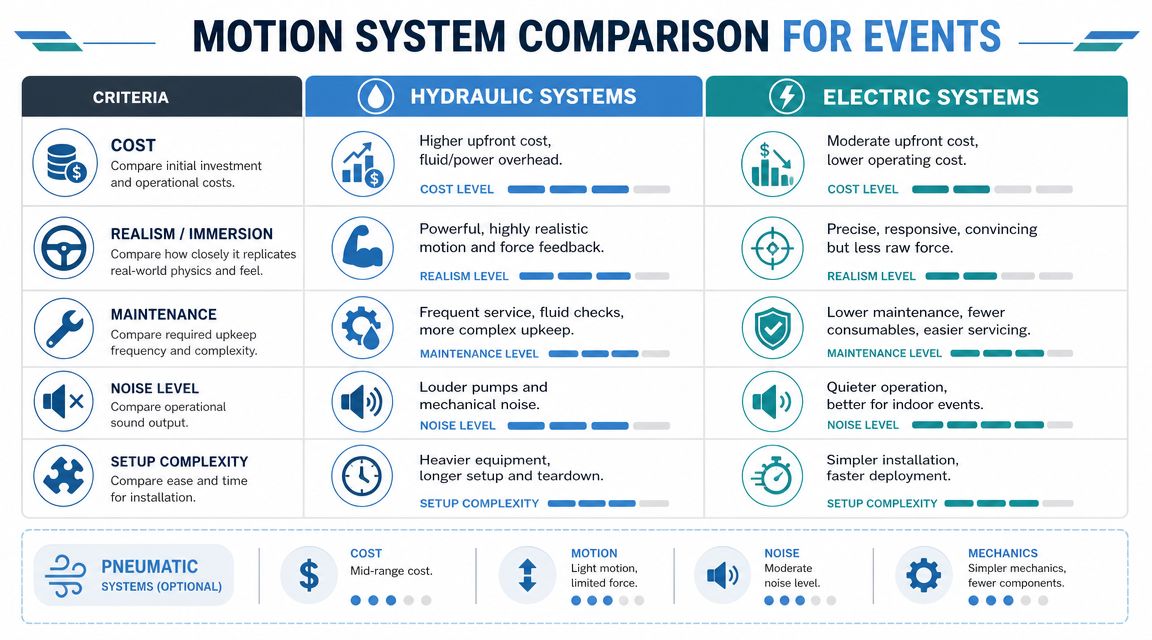
Hydraulic versus electric versus static
Hydraulic, electric, and static rigs can all work well at events. They solve different problems.
A hydraulic simulator suits activations where physical impact is part of the brief. Guests feel weight transfer, braking forces, and chassis movement in a more convincing way. From an event point of view, that usually means stronger spectator interest, more premium perception, and a better fit for automotive, luxury, or performance-led brands.
An electric motion rig sits in the middle. It adds movement and excitement, but often with less force, less infrastructure, and fewer operational demands than hydraulics. That can make it a sensible choice for venues with tighter setup windows or brands that want motion without building the whole activation around it.
A static rig removes motion but keeps the competitive element. That matters more than many buyers expect. If your event success depends on fast turnover, short briefings, and easy repeat play, static can outperform a more advanced system because more people get through it.
Here is the practical comparison:
| Criteria | Hydraulic motion | Electric motion | Static rig |
|---|---|---|---|
| Guest impact | Highest visual and physical presence | Strong but usually less force-heavy | Depends on screen, branding, and competition format |
| Venue demands | Higher | Moderate | Lowest |
| Operator oversight | More important | Important | Still needed, but simpler |
| Ease of scaling sessions | Depends on format and user mix | Often easier than hydraulic | Usually easiest |
What the choice means on an event floor
The easiest way to judge these systems is to picture the guest journey.
If a visitor walks past your stand and sees a hydraulic rig moving with intent, the attraction does part of your marketing job before anyone speaks to them. It creates theatre. It also signals that the brand has invested in something more serious than a standard arcade setup.
Electric motion can still create that draw, but usually in a lighter way. Static rigs rely more heavily on surrounding design, leaderboards, presenters, prizes, or branded content to create the same sense of occasion.
None of those options is automatically better. The right answer depends on what success looks like for your team.
Match the system to the event objective
Use the motion system the way you would use staging or screen size. It should fit the role the attraction needs to play.
- Choose hydraulic motion if the simulator is a headline attraction, a product-launch talking point, or a premium hospitality feature where guest impression matters as much as session count.
- Choose electric motion if you want a balance of movement, immersion, and easier venue integration.
- Choose static if you need reliable throughput, simpler logistics, and a competition mechanic that is easy for a broad audience to understand.
That distinction helps marketing teams avoid a common mistake. Buying the most impressive specification on paper does not always produce the best event result.
Questions to ask a supplier before you sign off
Good suppliers should be able to answer these clearly, in plain English:
- How much space does the full setup need? Include footprint, queueing room, and spectator space.
- What are the power and access requirements? A rig is only useful if it can get into the venue and run where you need it.
- How many guests can realistically use it per hour? Ask for live-event estimates, not ideal conditions.
- What staffing level is recommended? One operator can be enough for some formats, while others need active guest handling.
- What reset time is typical between drivers? Small delays add up quickly during a busy exhibition day.
- What audience is it suitable for? That includes age guidance, mobility considerations, and whether the experience is aimed at casual guests or confident gamers.
If you want a practical benchmark, this overview of commercial racing simulator motion options for events shows the sort of formats suppliers provide for public activations.
Throughput can change the best answer
A busy exhibition stand and a VIP evening often need different simulator formats, even if the brand message is identical.
At a trade show, you may care more about getting more people through the experience, capturing leads, and keeping queues manageable. At a hospitality event, you may care more about the quality of each individual session and the impression it leaves.
That is why the motion decision should involve both marketing and operations. One team defines the audience and brand goal. The other checks whether the venue, staffing plan, and timetable can support the experience without friction.
The best system is the one that gives guests a memorable moment and gives your team a practical event day.
The Unmatched Feel of Hydraulic Pedals
Most non-specialists notice the steering wheel first. Experienced drivers often notice the brake pedal.
That matters at events because the brake is where the simulator stops feeling like a game and starts feeling more like driving. When the pedal resists your foot progressively, guests instinctively realise they need control rather than button-mashing. The experience becomes more involving straight away.
Why the brake pedal changes the whole session
A simple pedal usually measures movement. You press it down, and the software reads that position. That works for casual play, but the feel can be light and synthetic.
A hydraulic brake pedal is built to mimic the pressure build-up of a real braking system. The pedal becomes firmer as the guest applies more force. That creates a more believable connection between body movement and what happens on screen.
Industry guides suggest hydraulic pedals deliver “100% authentic brake feel” with sub-1 ms response times, compared with roughly 75% realism for load-cell pedals and 40% for potentiometer pedals, according to this hydraulic pedal guide from Sim Coaches.
What guests actually feel
You don't need a motorsport background to feel the difference. Guests usually respond to three things:
- Resistance that builds naturally rather than a soft springy push
- More confidence under braking because the pedal gives clearer physical feedback
- A stronger sense of challenge because the car rewards smoother inputs
That's why hydraulic pedals often suit premium activations. They make the participant adapt, concentrate, and commit. For your event, that can mean better engagement because the experience demands attention.
A good simulator doesn't just entertain the guest. It gives them something to learn in the first minute.
Why this matters to a corporate event
For public events, pedal feel isn't just an enthusiast detail. It affects how credible the whole activation feels. A senior client, a car fan, and a first-time driver will all judge quality differently, but all three can tell when hardware feels cheap.
In UK racing simulator product literature, hydraulic brake hardware is positioned as a precision upgrade for professional rigs, and one supplier pairs it with direct-drive steering in its GT Pro range, which signals that the benefit is as much about braking consistency and control as realism, as shown in this GT Pro simulator product page.
If you want to understand how pedal options sit within the wider hire picture, this page on racing simulator pedals gives a practical commercial view.
A simple buying rule
If your audience is broad and your sessions are short, pedal detail may not be the deciding factor.
If your event is premium, competitive, automotive, or client-facing, hydraulic pedals can make the rig feel noticeably more serious. That can be the difference between “that was fun” and “that felt impressive”.
Your Hydraulic Simulator Rental Checklist
A hydraulic simulator can look impressive in a proposal and still create problems on show day. The real test is simpler. Can it load in on time, run safely for hours, keep queues under control, and leave guests talking about your brand for the right reasons?
That is the checklist corporate event teams need.
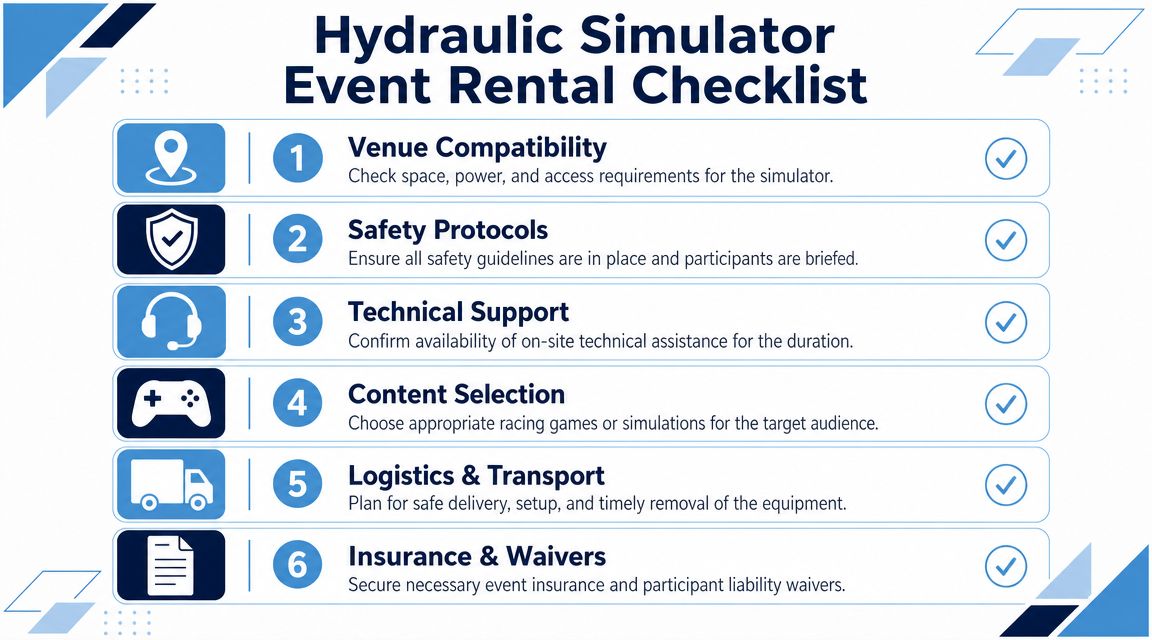
Venue and infrastructure checks
Start with the route from the loading bay to the live position. A simulator is like a small attraction, not a single screen on a plinth. If access is awkward, setup time grows, labour costs rise, and the risk of delays increases.
Check these points early:
- Access routes: Confirm lift access, loading bay rules, door widths, ramps, stairs, and the distance from unload point to stand or room.
- Operating footprint: Measure more than the rig itself. You need room for entry and exit, an operator, queue lines, and a safe spectator edge.
- Floor suitability: Hydraulic and motion-based systems need a stable surface. This matters even more in listed venues, upper-floor hospitality areas, and temporary event structures.
- Power availability: Ask where the power comes from, what else is on the circuit, and whether cable runs will affect stand layout or guest flow.
A quick floorplan check can prevent a long morning onsite.
Staffing and show-day practicality
A premium simulator is only as good as the person running it. In a public or client-facing activation, the operator shapes the whole experience. They welcome guests, explain the format, adjust the seat, keep runs short enough to maintain throughput, and spot issues before they become queue problems.
Ask one practical question: how many guests can you realistically process per hour in the format you want?
That answer affects everything from staffing and lead capture to crowd build-up around the stand. A fastest-lap competition with short resets behaves very differently from longer coached sessions for VIP guests. The hardware may be the same, but the event outcome is not.
If you are comparing suppliers, look for one that speaks in event terms. Session length, queue management, reset time, staffing ratio, and contingency planning matter as much as simulator specifications. A supplier focused only on realism may give you a strong rig but a weak activation.
Branding and experience design
The simulator should support your campaign, not sit beside it.
For a product launch, you may want polished visuals, hosted sessions, and a calmer pace that gives account teams time to talk with invited guests. For an exhibition stand, you may need short sessions, visible leaderboards, and a format that pulls in passers-by within seconds. The same attraction can serve both jobs, but only if the setup is designed around the event objective.
Consider:
- Leaderboards: Good for competition, repeat attempts, and adding energy to the stand
- Screen branding: Menus, overlays, and results screens can reflect the campaign look and message
- Physical branding: Backdrops, barriers, plinths, and rig surrounds help the attraction read as part of the stand
- Format choices: Fastest lap, head-to-head racing, or team relay each creates a different crowd pattern and different staffing demands
The branding aspect often determines whether planners gain or lose value. A well-branded simulator gives guests a memory tied to your company. An unbranded one can feel like rented entertainment with little brand carryover.
Documents and duty of care
Before sign-off, ask for the paperwork and the operating plan.
You should see:
- Risk assessments and method statements
- Insurance confirmation
- Set-up and derig timings
- Technical support plan
- A clear fault procedure if a component fails
Read the answers as carefully as the quote. Clear documents usually indicate clear delivery. Vague answers often mean the supplier is used to private hires or enthusiast setups, rather than busy public events where timing, accountability, and guest handling matter every hour of the day.
For a practical view of what full-service simulator hire for events should include, look for turnkey support rather than hardware alone.
Ensuring Safety and Accessibility for All Guests
A public simulator activation should never be planned only around the ideal participant. Real event audiences include younger guests, older guests, people in business attire, people with limited mobility, and people who don't know whether motion-based experiences suit them.
That's why safety and accessibility should be designed into the activation from the start, not added as a late-stage note.
Safety starts before the first guest sits down
For a hydraulic simulator, duty of care includes setup, supervision, and communication. The supplier should provide clear operating procedures and risk documentation. The event team should understand how the attraction fits into the wider floor plan, queue system, and emergency access routes.
Most simulator content aimed at enthusiasts ignores this. Public events can't. UK events must align with Health and Safety Executive expectations and the Equality and Human Rights Commission's guidance, making reasonable adjustments a practical requirement for public activations, as noted in this discussion of simulator pros, cons, and inclusion considerations.
Accessibility is part of experience quality
A professional activation should think through who might struggle and why.
Some guests may have difficulty stepping into the rig. Others may be uncomfortable with motion intensity. Some may need more time for seating adjustment or a clearer explanation before starting.
Good practice often includes:
- Adjustable settings so the intensity suits the audience and event type
- Clear pre-ride guidance so guests can opt in with confidence
- Alternative participation options such as spectator competition, leaderboard involvement, or lower-intensity sessions
- Operator training so staff can spot discomfort early and respond appropriately
If a guest leaves because the experience looked exclusive or intimidating, the activation hasn't done its job, even if the hardware performed perfectly.
Questions worth asking a supplier
Ask practical questions, not generic ones.
- Can the rig accommodate a wide range of participant sizes?
- How do staff assist guests entering and exiting safely?
- What happens if someone feels motion sensitive mid-session?
- Are there lower-intensity modes for family days or mixed audiences?
- How are queues managed so guests aren't pressured into taking part?
These questions protect guests, but they also protect your brand. A simulator that feels well managed sends a strong message about professionalism. A simulator that feels improvised does the opposite.
Inclusion supports better event outcomes
There's a business reason to care about this too. An attraction that welcomes more of the audience naturally gives you broader participation, better atmosphere, and fewer awkward moments on the stand.
The strongest activations don't chase maximum realism at any cost. They balance immersion with comfort, clarity, and confidence. That's what makes them work in public.
Measuring Event Success and ROI
At 11am, the stand looks busy. By 2pm, the question becomes clearer. Did the simulator draw a crowd, or did it help your team start better conversations, capture useful contacts, and give people a reason to remember your brand after the event?
A hydraulic simulator earns budget when it supports a defined event goal. For one brand, that might be footfall. For another, it might be longer dwell time with decision-makers, stronger social content, or a structured way to start sales conversations. Set that target before the doors open, because the same simulator can look successful on the surface and still underperform commercially if nobody agrees on what success means.
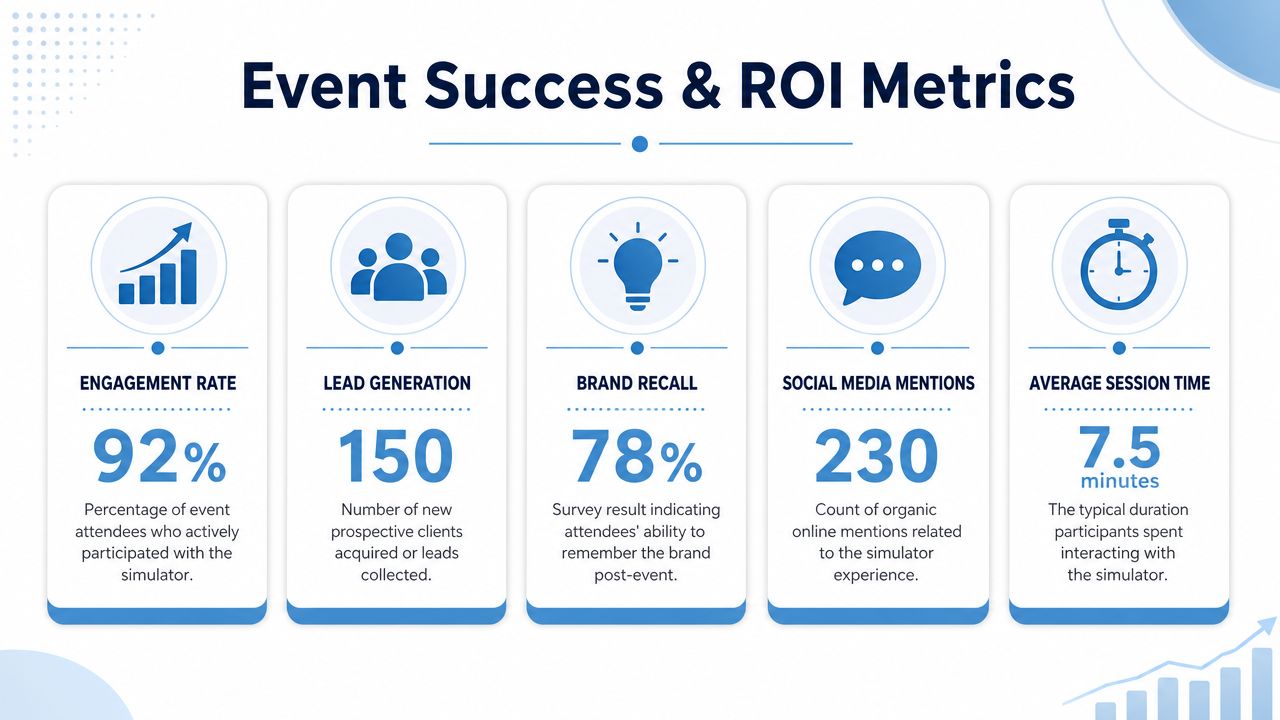
A good way to judge performance is to follow the guest journey, much like tracing a customer through a retail pop-up from first glance to purchase.
- Attraction: Are people stopping, watching, and joining the queue?
- Engagement: Are they staying long enough to absorb your message rather than taking a quick turn and walking off?
- Participation depth: Are they returning for another attempt, checking the leaderboard, or bringing colleagues over?
- Lead capture: Is the experience connected to registration, badge scans, data capture, or a booked follow-up?
- Content value: Are guests filming the ride, sharing scores, or posting branded content that extends the activation beyond the venue?
Measurement works best when it is built into the format. If guests book time slots, scan in for a race, or join a leaderboard, your team gets cleaner reporting afterward. For attendance and engagement tracking, it helps to review practical methods for collecting attendance data with QR codes, especially for timed sessions or high-traffic stands.
The commercial case is strongest when you compare the simulator against the outcome you need. If your objective is lead generation, calculate cost per qualified conversation, not just cost per participant. If your objective is hospitality, look at time spent with target clients and the quality of those interactions. If your objective is brand awareness, review queue visibility, social sharing, and how often the simulator appeared in attendee photos and video.
This is often where event teams get caught out. A simulator can be popular and still miss the mark if the queue blocks the stand, staff are too busy managing turns to talk to prospects, or branding is treated as an afterthought. The hardware creates the moment. The event plan turns that moment into value.
As noted earlier, premium simulator experiences continue to attract investment across the market. For an event planner, the practical takeaway is simple. Guests already understand the appeal, so your job is not to convince them that racing is exciting. Your job is to connect that excitement to a measurable business result.
A simulator produces stronger ROI when each session has a purpose. A booked demo, a scanned badge, a hosted client conversation, a shareable clip, or a reason to stay longer on the stand.
If you're planning an event and want a turnkey partner for simulator hire, branding, staffing, logistics, and compliant delivery, PSW Events can help you build the right format for your audience and venue.