
You're booking space, signing off stand plans, chasing artwork deadlines, and trying to choose one interactive element that won't sit there looking good but doing very little. That's a key pressure point at exhibitions and corporate events. Most activations sound exciting in a planning meeting, then disappear into the background once the hall opens.
A steady hands game solves a very specific problem. It gives people a reason to stop, a reason to try, and a reason to stay long enough for your team to start a proper conversation. It's simple enough that nobody needs instructions, but challenging enough that people want another go. That combination matters when attention is short and every nearby stand is competing for the same footfall.
From a hire perspective, the value isn't nostalgia. It's operational usefulness. A good unit is quick to understand, safe to run in public settings, easy to brand, and flexible enough to work at anything from a compact exhibition stand to a larger product launch. If you're choosing between passive display and active participation, this is the kind of attraction that helps justify its floor space.
Cutting Through the Noise at Your Next Event
Walk any busy exhibition hall and you'll see the same pattern. People slow down when something is happening, not when something is merely present. Screens, backdrops and brochure racks all have their place, but they rarely create a queue on their own.
That's where a steady hands game earns its keep. One person steps up, grips the loop, and tries to guide it across the wire without triggering the fail signal. Two seconds later, nearby visitors understand exactly what's going on. They don't need a briefing. They don't need a demo video. They get it immediately, and that instant clarity is what makes the format so useful for event planners.
Why it works in a live environment
At corporate events, the hardest part isn't often getting people into the room. It's getting them to stop at your exact spot. A precision challenge gives you a natural interruption point. People pause to watch. Colleagues encourage each other. Prospects often join in because the barrier to entry is low and the task feels approachable.
That's why this format sits comfortably alongside other interactive exhibition ideas for trade shows and brand activations. It's not overcomplicated, and it doesn't ask the audience to commit much time before they understand the reward.
The best exhibition games aren't the most technical. They're the ones people understand before your staff have to explain them.
What planners usually need from one attraction
A steady hands game tends to fit when you need several things at once:
- Fast engagement: Attendees can join without registration friction at the first touchpoint.
- Visible activity: Nearby visitors can see success and failure instantly.
- Conversation space: While one person plays, your staff can talk to the rest of the group.
- Broad appeal: It works for mixed audiences because the challenge is based on control, not specialist knowledge.
The practical advantage is that it doesn't force a trade-off between fun and function. Used properly, it gives your stand energy without turning the whole space into a sideshow.
How the Classic Buzz Wire Game Actually Works
A guest steps up, takes the wand, and starts along the wire. The rule is immediate. Keep the loop moving without touching the track. If metal meets metal, the circuit closes and the unit triggers a buzzer, light, or both.
That simple cause and effect is why the format survives busy exhibition halls, conference foyers, and evening receptions. There is no learning curve to manage at the point of play. People see the mistake, hear the result, and want a turn.
A classroom-ready version explains the core principle clearly. The loop touching the wire completes an electrical circuit and activates the output, whether that is a buzzer or an LED, as outlined in this educational overview of the steady hand game.
The simple explanation planners need
From an event delivery point of view, the circuit matters because it creates instant feedback. No software delay. No score interpretation. No host needed to explain whether the player succeeded or failed.
That changes how the attraction performs on a live stand.
- Players correct themselves straight away
- Spectators follow the result in real time
- Staff can keep talking while the game explains itself
This is the practical difference between a game that looks good in a proposal and one that keeps working once doors open. If the feedback is immediate, turnover stays healthy and the audience keeps moving.
Why straightforward mechanics win on show day
Corporate events reward games that are easy to read from two or three metres away. A visitor should understand the objective before your brand ambassador starts the script. With a buzz wire game, the task is visible. The risk is visible. The mistake is audible.
That clarity is useful if you are comparing it with reaction-based attractions such as Batak game hire for exhibition engagement. Batak tests speed and hand-eye response under pressure. A steady hands game tests control and precision. Both work well in branded spaces, but the buzz wire format usually needs less explanation and creates a slower, more watchable participation moment around the player.
Practical rule: If attendees can understand the challenge in under ten seconds, your staff can focus on conversations, data capture, and queue management.
What changes in a professional hire unit
The principle stays basic. The build does not.
A hire-grade steady hands game uses the same closed-circuit mechanic, but it is designed for repeated public use, fast setup, clean branding, and reliable resets between players. That means sturdier components, neater cable management, safer housings, and outputs loud or bright enough to cut through event noise without becoming a nuisance.
That is the point planners usually need clarified. The value is not in the science. The value is in turning a familiar challenge into a dependable branded asset that can handle traffic, fit a stand plan, and keep delivering throughout the event day.
Choosing Your Challenge Game Formats for Any Event
Not every steady hands game suits every venue. The right choice depends on space, traffic flow, audience profile and what role the game needs to play on the day. Sometimes you need a quiet participation piece. Sometimes you need a stand magnet.
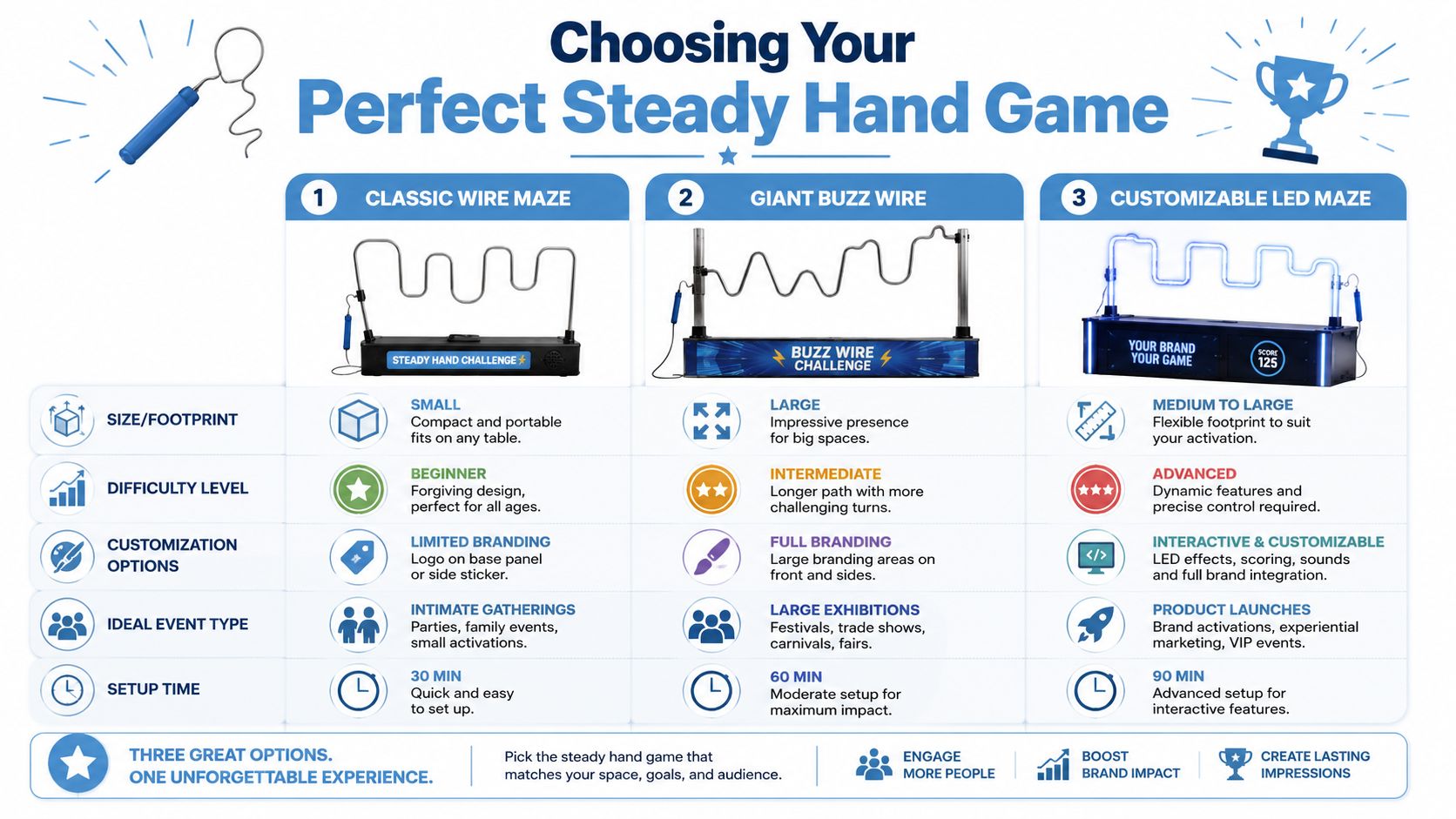
Compact tabletop units
These are the practical choice for smaller exhibition footprints, breakout areas and hospitality spaces where every bit of surface area matters. They're easy to place near a reception counter or on a branded plinth, and they don't dominate the stand.
Their strength is efficiency. Guests can step in, play quickly, and move on. The downside is visibility. If you need to catch attention from across an aisle, a tabletop unit won't do as much heavy lifting on its own.
Mid-size centrepiece builds
This is often the sweet spot for corporate hire. A mid-size unit creates enough presence to pull people in, but it still fits into a standard stand plan without forcing major compromises elsewhere.
For many planners, this is the safest choice because it balances three things well:
- Presence: It's visible without becoming awkward.
- Access: One player can participate while others gather around comfortably.
- Branding potential: There's enough structure for wrapped graphics, colour-matched elements or themed housing.
If your stand already includes another reactive game, such as Batak Pro hire for fast-paced competitive engagement, a mid-size steady hands game often complements it well because the two experiences feel different.
Giant floor-standing activations
A large-format build is a statement piece. It's there to create theatre, to stop traffic, and to turn a simple dexterity game into a public challenge.
These units work best when:
- You have clear floor space
- The stand is expected to host regular bursts of activity
- The brand wants a visible competition element
- The venue sightlines support long-distance attraction
They're not always the right answer. In tighter aisles or heavily furnished stands, giant units can cause congestion if the queue forms badly. They also need more thought around operator position, spectator space and access for delivery.
Difficulty matters more than most buyers think
A common mistake is making the game too hard. If almost nobody gets through the course, people stop trying. If it's too easy, the challenge ends before a crowd builds.
The best hire setups usually adjust difficulty through the wire shape, the length of the route, and the size of the loop. That lets the same base attraction feel family-friendly in one setting and more competitive in another.
| Format | Typical Footprint | Best For | Impact Level |
|---|---|---|---|
| Classic Wire Maze | Small | Compact stands, receptions, breakout areas | Moderate |
| Giant Buzz Wire | Large | Exhibitions, launch events, high-traffic activations | High |
| Customizable LED Maze | Medium | Branded experiences, themed campaigns, product showcases | High |
The right format isn't the biggest one. It's the one your audience can see, access and enjoy without creating operational headaches.
The Unbeatable Benefits for Corporate Events and Exhibitions
At 11am, the aisle is busy, your team is ready, and the stand still needs a reason for people to stop. A professional steady hands game gives you that trigger without forcing staff into a hard sales approach. It creates a visible challenge, holds attention long enough for conversation, and gives planners a clearer link between activity and lead quality than many passive stand props.
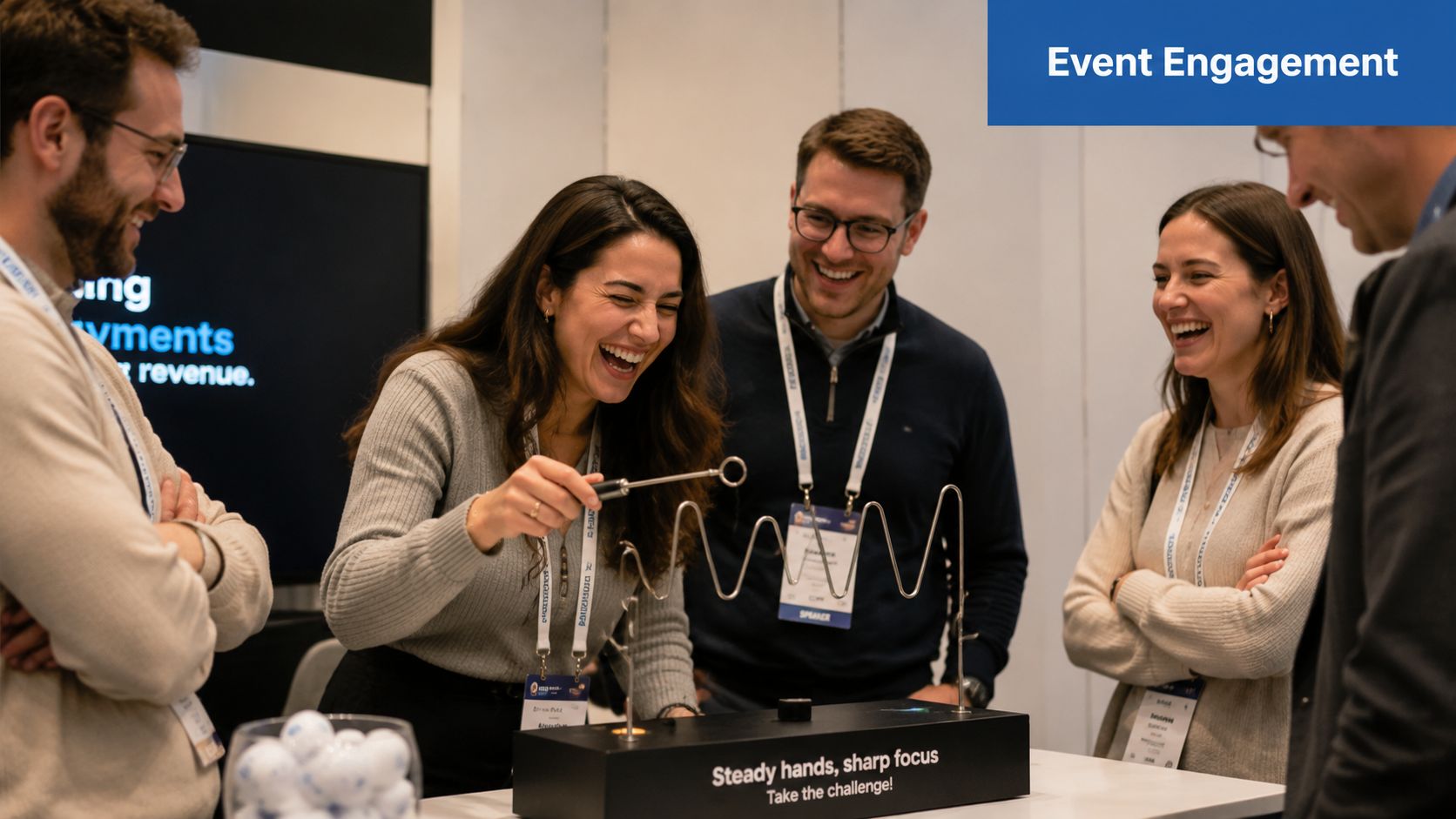
That matters because corporate hire decisions are rarely about novelty alone. Event planners usually need an attraction that works in public, fits brand goals, and can be defended after the show with more than, "people seemed to like it."
It earns attention in a way staff can use
A steady hands game is easy to read from a distance. Someone takes the wand, tries to control their movement, clips the wire, and everyone nearby understands the challenge immediately.
The feedback is public, which helps. A buzzer setup usually creates more theatre and draws eyes across a busy exhibition hall. An LED-only setup is often better where the brief calls for lower noise, tighter brand control, or a more premium feel. Neither option is automatically better. The right choice depends on the venue rules, the audience, and how much audible energy the stand needs.
It gives your team a practical opening line
This format works well because staff do not have to wait for the game to end before speaking. They can invite the next player, explain the leaderboard, ask who set the best time so far, or tie the challenge to a product message while the moment is still live.
That is a real advantage on corporate stands. Some attractions create attention but isolate the participant. A steady hands game keeps the interaction open enough for colleagues, prospects, and bystanders to join in, which makes qualification easier and less awkward for booth staff.
If a client asks why this game performs better than a generic giveaway bowl, the answer is simple. It gives sales staff permission to start a conversation that feels relevant.
It supports measurable event goals
The value is not the game by itself. The value is what the game helps your team produce on the stand.
For most corporate events, the useful measures are straightforward:
- Visible stand activity: Are people stopping, watching, and waiting for a turn?
- Conversation quality: Are staff getting enough time to qualify interest instead of delivering rushed introductions?
- Lead capture rate: Are players entering a competition, scanning a badge, or agreeing to follow-up?
- Brand recall: Do visitors remember the stand because they took part, watched a colleague fail, or saw a high score worth beating?
Those are easier to track when the game is part of a planned activation rather than a last-minute add-on. If you are comparing games, giveaways, and other engagement tools side by side, this guide to successful trade show ROI is a useful reference for judging what carries through after the event.
It works across mixed corporate audiences
One reason planners keep hiring this format is range. Senior decision-makers will try it. Graduate recruits will try it. Staff on internal engagement days will try it. Families at public-facing activations understand it instantly.
That broad appeal lowers planning risk. You are not booking a specialist activity that only suits a narrow group or needs a long explanation before anyone takes part. You are hiring a professional-grade challenge that can support brand visibility, conversation flow, and measurable engagement in the same footprint.
Logistics and Technical Specifications for Event Planners
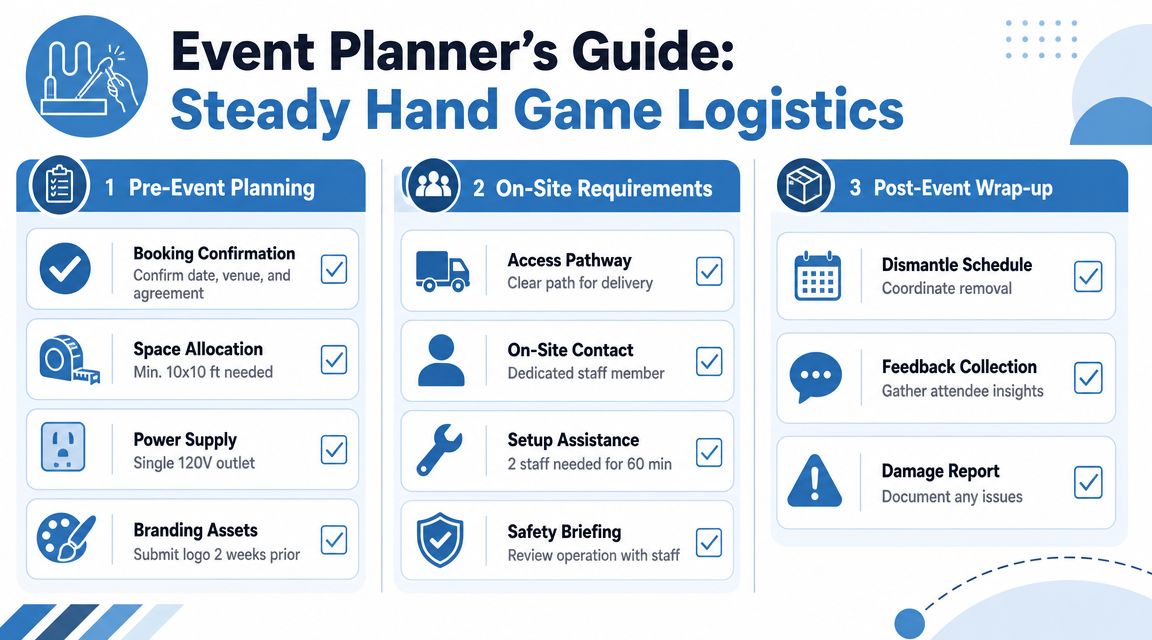
The distinction between professional hire and a homemade build emerges here. A steady hands game may look simple on the stand, but the supplier still needs to think through transport, setup, power, resilience, safety paperwork and public operation.
Power and safety
Professional and kit-based steady hand games commonly use low-voltage power, including 3 volts DC and 2 x AA batteries, with one UK-sourced kit also specifying soldering with a 15–30 W iron during assembly in this steady hand game kit specification. For event planners, the important point isn't the build process. It's that the gameplay itself relies on low-current contact detection and quick feedback, which supports safe public use.
That low-voltage approach is one reason the format is so adaptable. It can be integrated into compact setups without the complexity associated with heavier powered attractions.
The supplier questions worth asking
Before confirming any hire, ask for specifics rather than broad assurances.
- Footprint details: Ask for the operational space, not just the unit size. You need room for the player, queue and staff.
- Power method: Clarify whether the unit runs on battery, low-voltage supply, or requires venue power support.
- Reset and throughput: Ask how quickly the game resets between players and whether an operator is recommended.
- Transport and access: Confirm loading requirements, lift access, build sequence and protection for finished flooring.
A good supplier should answer those points cleanly. If they can't, they probably haven't thought through live event conditions properly.
Staffing and compliance
For corporate use, an unattended game can work in some environments, but a staffed activation usually performs better. A trained host keeps play moving, explains the challenge consistently, manages light competition, and stops the unit from becoming dead space during quieter periods.
Paperwork matters just as much as presentation. For public events, you should expect:
- PAT testing documents where relevant
- Risk assessment paperwork
- Method statements if the venue requires them
- Public liability insurance confirmation
These aren't box-ticking extras. They're part of hiring responsibly.
Ask for compliance documents before final sign-off, not the day before build. That's when preventable problems usually surface.
For planners working with PSW Events specifically, the practical reassurance is that the company provides full delivery support and carries £10 million products, employee and public liability insurance as part of its event service. That's the sort of detail procurement teams and venues often want confirmed early.
Branding Engagement and Measuring Your Success
A plain steady hands game is entertaining. A branded steady hands game becomes part of the campaign.
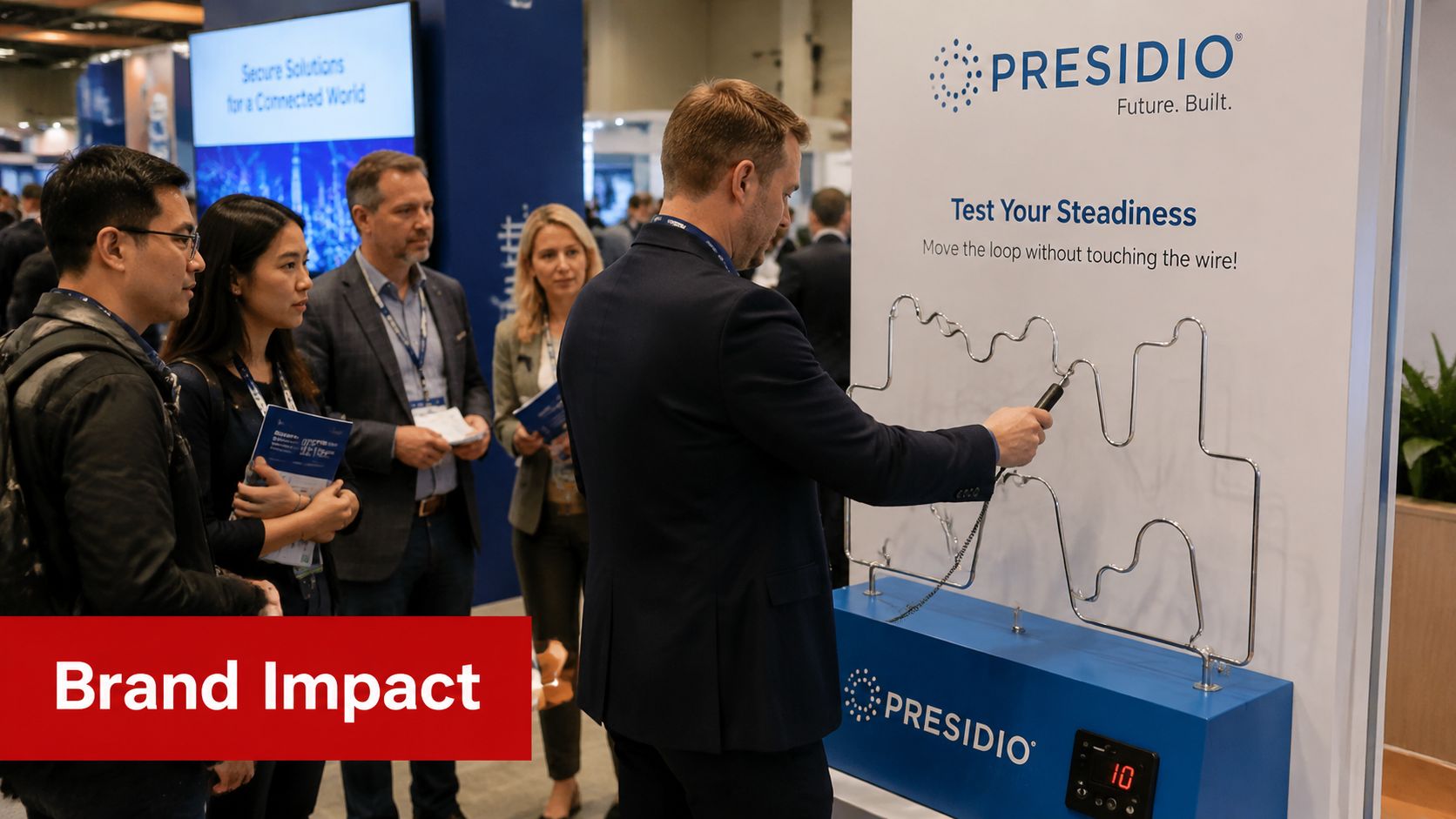
The biggest missed opportunity is treating branding as a logo stuck on the front panel. That's fine for identification, but it doesn't make the game feel specific to the launch, product or message. Better activations build the brand into the challenge itself.
Better ways to brand the experience
The wire path is the most obvious place to start. Instead of a generic curve, the route can reflect the outline of a product, a symbol linked to the campaign, or a shape that fits the sector. That turns the game from generic entertainment into a branded memory.
Other useful branding layers include:
- Base graphics: Keep the messaging short and visible from standing height.
- Colour matching: Make the game look native to the stand rather than hired in.
- Prize mechanic: Tie the challenge to a giveaway or hosted competition.
- Host script: Ensure the presenter reinforces the campaign message, not just the rules.
Measuring more than who played
You don't need inflated claims to justify the hire. What you need is a sensible measurement plan agreed before the event opens.
A straightforward setup often tracks:
- Player count as a proxy for active engagement
- High scores for competition entries
- Qualified conversations logged by staff during or after participation
- Content capture such as photos or short clips of people taking part
If the activation includes live ranking, a digital board adds structure and urgency. A visible electronic leaderboard for event competitions gives the game a second layer by turning isolated attempts into an ongoing contest.
Extending the life of the activation
The event floor is only part of the value. A good branded game also gives marketing teams content before, during and after the show. That might mean teasing the challenge in advance, posting daily top scores, or encouraging visitors to share their attempt.
If your team wants a stronger plan for that side of the campaign, these effective social media growth strategies are useful because they focus on participation and content momentum rather than just posting volume.
The strongest result usually comes from joining the pieces up. Branded challenge. Staffed delivery. Visible competition. Clear data capture. Useful content output.
If you need a steady hands game that's built for corporate hire rather than improvised from a school project, PSW Events can deliver the full package. That includes planning, branding, logistics, installation, staffing and compliance support for exhibitions, launches and roadshows across the UK and beyond. If your brief is to create a simple attraction that earns its space and supports real event goals, that's the right conversation to have.