You're at a major sporting event. The crowd is loud, the atmosphere is sharp, and every sponsor in the building wants the same thing you do. Attention.
Your logo is on the perimeter boards, your branding is on the backdrop, and your social team is posting in real time. Still, most fans won't remember your message by the time they leave the venue. They'll remember the goal, the finish, the upset, the friend they came with, and maybe the brand that gave them something to do rather than something to look at.
That's the gap sports fan engagement has to close. It isn't about adding more noise to gameday. It's about creating moments fans actively choose to join, then measuring whether those moments changed behaviour.
For brands, rights holders, and event teams, that usually means one thing. You need a joined-up strategy that connects digital touchpoints with physical experiences on the ground. The strongest programmes don't treat live activations, apps, content, and lead capture as separate jobs. They make each one feed the next.
Beyond the Noise of Gameday
A common mistake at live sport is assuming visibility equals impact. It doesn't.
A fan can walk past branded assets all afternoon and still have no meaningful interaction with the sponsor behind them. That's especially true in premium environments where every surface is already sold, every concourse has competing messages, and every attendee is splitting attention between the event, their phone, hospitality, and the people around them.
Why passive exposure isn't enough
A passive logo does one job. It signals presence.
An engaging activation does several jobs at once. It stops footfall, earns dwell time, creates a memory, gives staff a reason to start a conversation, and often generates usable data. That difference matters because brands at sports events aren't just competing with rival sponsors. They're competing with the event itself.
Fans rarely reward interruption. They respond to relevance, timing, and participation.
That shift is one reason the commercial side of engagement has grown so quickly. The fan engagement market analysis from Market.us states that the global fan engagement market was worth $16.2 billion in 2024 and is projected to reach $66.7 billion by 2034, while 81% of sports executives said they expanded their use of AI in the past year to improve efficiency and personalisation. The practical takeaway isn't that every brand needs more tech. It's that organisations are moving budget toward experiences they can personalise, optimise, and measure.
What the best event teams do differently
The strongest live campaigns usually start with a blunt question. What do we want the fan to do?
Not “see the brand”. Do something.
That action could be entering a challenge, trying a simulator, joining a leaderboard, scanning a code, signing up for updates, voting in a poll, or sharing a result with friends. Those mechanics turn a sponsorship from a media placement into an experience. If you're planning experiential marketing activations, that's the standard to use. Build around behaviour, not decoration.
A practical filter helps:
- If it only photographs well, it may support awareness but not engagement.
- If it gives fans a task, it can create interaction.
- If it captures a preference or response, it can support future marketing.
- If it links to a wider journey, it can produce measurable value after the event ends.
That's where sports fan engagement stops being a buzzword and becomes a commercial discipline. The point isn't to entertain for entertainment's sake. The point is to create a branded interaction fans enjoy enough to join, and a measurement trail your team can use later.
What Is Sports Fan Engagement Really?
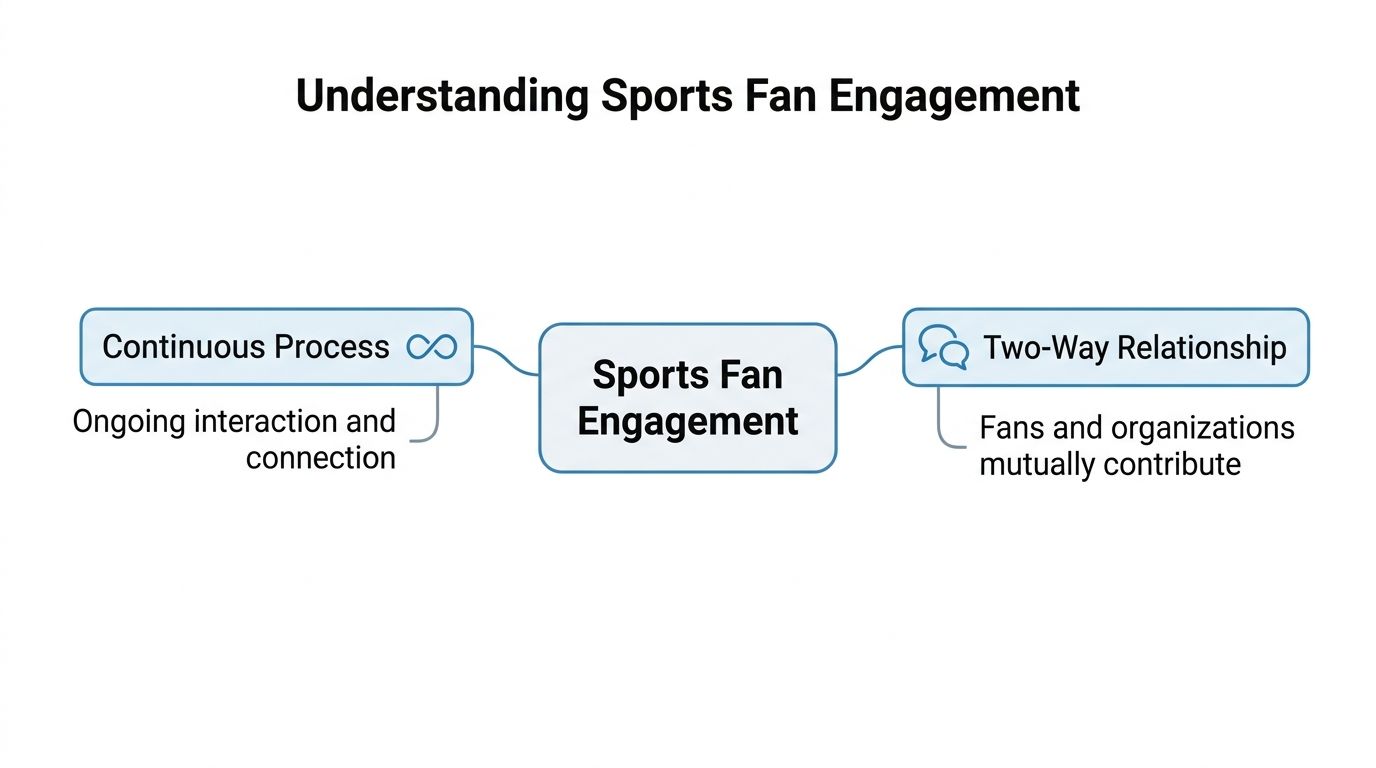
Sports fan engagement is often described too loosely. In practice, it's a continuous relationship between a fan and a team, venue, rights holder, or sponsor across live, digital, and post-event touchpoints.
It works better if you think of it as a conversation rather than a broadcast. A broadcast pushes the same message out to everyone. A conversation reacts. It learns. It changes what comes next based on what the fan just did.
Engagement is behaviour, not just attention
A fan who watches a clip is paying attention. A fan who votes, plays, shares, redeems, returns, or signs up is engaged.
That distinction matters because many event teams still confuse exposure with connection. Exposure tells you the crowd was there. Engagement tells you a person chose to act. For a brand manager, that's the difference between “people could have seen us” and “people interacted with us”.
A useful way to frame it is through three layers:
| Layer | What it looks like | What it tells you |
|---|---|---|
| Awareness | Branding, signage, sponsorship presence | The fan had a chance to notice you |
| Interaction | Polls, games, trials, scans, participation | The fan actively responded |
| Relationship | Repeat use, preferences, opt-ins, return visits | The fan is becoming more valuable over time |
The two-way part is where value is created
Modern sports fan engagement improves when organisations stop treating every fan as identical. Fans don't all want the same content, at the same moment, through the same channel. Some want a second-screen stat feed. Others want a quick challenge in the concourse. Some will happily use an app. Others won't download anything.
That's why the best programmes are built around feedback loops.
- A pre-event sign-up can trigger a customized invitation on arrival.
- An in-venue game result can initiate a prize draw or follow-up message.
- A content view or purchase can shape the next offer the fan sees.
- A stated preference can improve future timing and channel choice.
Practical rule: If your activation can't learn from fan behaviour, it's a stunt. If it can, it becomes part of a system.
Community matters more than campaign thinking
Campaign thinking often ends at the event close. Community thinking doesn't.
A strong engagement strategy creates continuity before, during, and after the live moment. That doesn't always require complex technology. It requires useful interactions arranged in the right order. Invite. Participate. Capture. Follow up. Re-engage.
When teams get this right, fans don't feel marketed at. They feel included.
That's the real definition worth using. Sports fan engagement isn't one app, one post, one fan zone, or one sponsor stand. It's the ongoing exchange of attention, participation, and value between the fan and the organisation.
The Business Value of Deep Fan Connection
Senior stakeholders usually ask the same question. What does fan engagement do for the business?
The answer is straightforward. It makes live audiences more commercially useful. It gives brands and organisers more than a crowd count. It creates reasons to stay longer, respond more often, and come back again.
Live sport still gives brands something rare
Most media is consumed on demand or half-watched in the background. Live sport still gathers people at the same time around the same moment, which is why it remains so valuable commercially.
The PwC view of digital fan engagement in sports highlights this clearly. UEFA Euro 2020 was staged across 8 European host cities including Wembley Stadium in London, and the final drew 67,173 spectators. That matters because premium in-person moments still anchor sports fan engagement in the UK. They create scale, urgency, and emotional intensity that brands can build on if they offer something participatory.
Connection drives more than memory
A devoted fan is useful in several ways at once.
First, they're easier to move from attention to action. If someone has just competed in a branded challenge, entered a leaderboard, or claimed a reward, the next step feels natural. That could be an opt-in, a follow-up offer, or a visit to another event area.
Second, engaged fans make sponsorship packages more defendable. A sponsor that can demonstrate participation, dwell time, and lead capture has a stronger story than one relying on logo placement and vague brand lift language.
Third, engagement creates richer first-party context. You learn what fans respond to, what they ignore, and which mechanics change behaviour.
Merchandise and memory work together
The commercial value of fandom isn't limited to ticketing or media. Physical keepsakes also matter because they extend the event into home, office, and gifting contexts. For brands thinking beyond matchday, curated resources such as artistic gifts for football lovers are a useful reminder that emotional connection often carries through objects fans choose to keep, display, or give.
That same principle applies to activations. If the live experience gives fans a result, a photo, a ranking, or a personalised takeaway, the brand has a better chance of staying with them after the event.
The strongest fan engagement programmes don't monetise a moment once. They create assets that can be reused across sales, sponsorship, and retention.
What the board cares about
Most leadership teams won't fund “engagement” as an abstract idea. They'll fund outcomes.
Those outcomes usually include:
- Sponsor value: Better evidence that partners received interaction, not just exposure.
- Lead generation: New opted-in contacts tied to specific event behaviour.
- Retention: More reasons for fans to return on non-matchdays and future fixtures.
- Commercial efficiency: Better targeting because teams know which fans engaged with what.
That's why deep fan connection matters. It isn't softer than traditional marketing. In many cases, it's more accountable.
Key Channels for Engaging Sports Fans
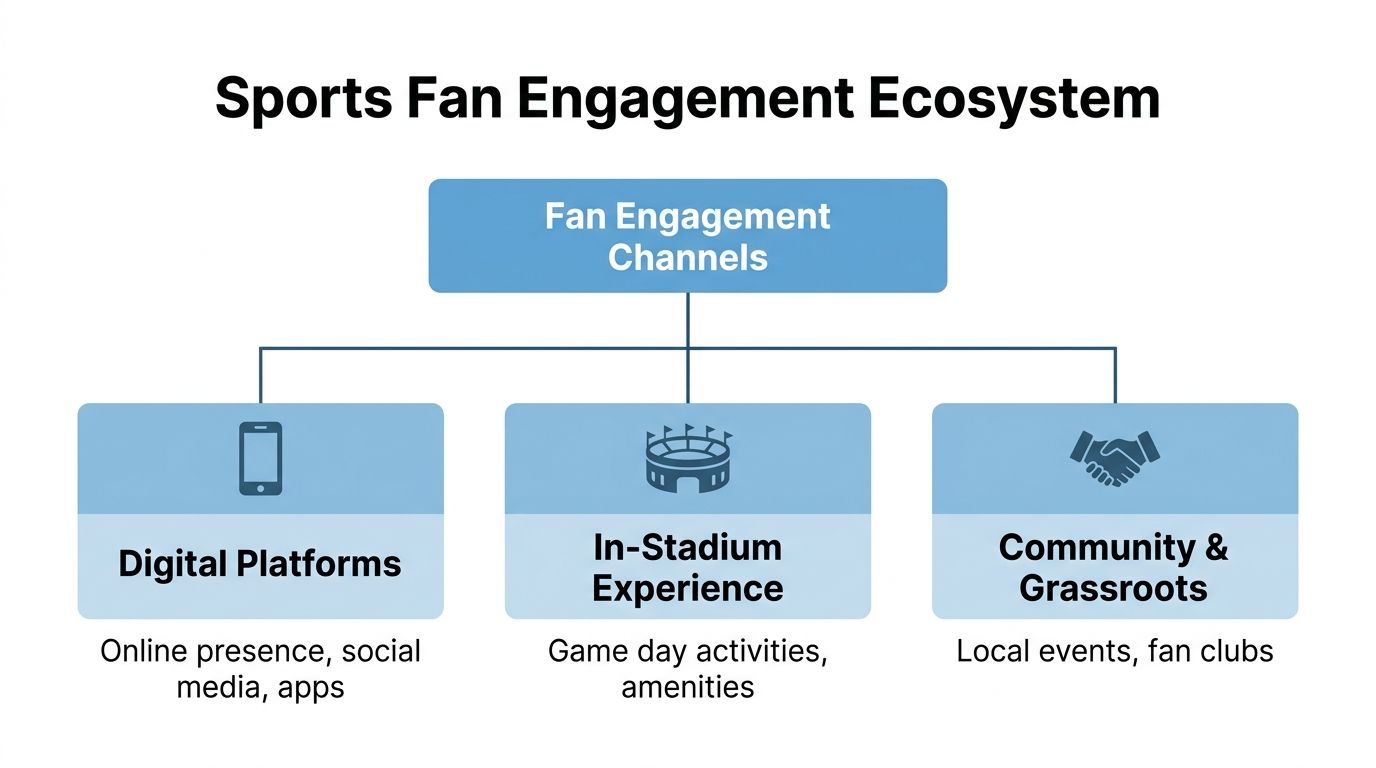
Sports fan engagement works best when channels are planned as one system. Too many event programmes still split activity into separate silos. Social sits with one team, venue screens with another, hospitality with another, and the live activation supplier with someone else entirely.
Fans don't experience it that way. They move through one journey.
Digital channels
Digital is where attention is primed, extended, and reactivated.
Before the event, digital channels handle registration, reminders, teaser content, and entry incentives. During the event, they can support second-screen moments, live updates, voting, and post-play sharing. After the event, they become the follow-up layer for offers, content, and repeat attendance prompts.
The key is usefulness. Fans respond better when digital tools remove friction or add context. A simple score predictor, notification, or fast-entry prize mechanic often performs better than a bloated branded microsite.
In-venue channels
The venue is where the emotional peak happens, but it's also where attention gets messy. Fans are navigating queues, food, conversations, and the action itself. That's why in-venue engagement has to be immediate.
The Stats Perform analysis of in-stadium fan experience notes that for 17 teams across multiple sports, average home-game attendance has declined by more than 10% over the past decade. The implication is practical. Venues need to increase the value of each visit through second-screen features such as live stats, alternate camera angles, instant replays, quick polls, and trivia. Those tools help increase dwell time and sponsor value because they give fans more reasons to stay attentive between the headline moments.
A useful in-venue mix often includes:
- Concourse interaction: Games, reaction tests, simulators, branded photo moments.
- Screen-based content: Live prompts, leaderboards, replay-linked polls, trivia.
- Hospitality engagement: Hosted competitions, premium challenges, personalised rewards.
Experiential channels
Experiential is where digital and physical finally meet in a way fans can feel.
This is the channel brands often underuse or misunderstand. They treat it as theatre rather than infrastructure. In reality, a good activation can act as the bridge between awareness and data capture. It can take a passer-by, create a queue, trigger competition, and generate a measurable interaction in a few minutes.
Here's how the channels should work together:
| Channel | Best job | Common failure |
|---|---|---|
| Digital | Drive anticipation and follow-up | Too much content, not enough utility |
| In-venue | Add value to the live day | Static branding with no action |
| Experiential | Convert attention into participation | Fun mechanic with no data path |
If a fan sees a promotion online, joins a challenge at the venue, and receives a relevant follow-up afterwards, the system is working.
That integrated journey is the goal. Not more touchpoints for the sake of it. Better hand-offs between them.
Proven Tactics and Activation Examples
The most effective sports fan engagement tactics are the ones fans understand instantly. If a mechanic needs too much explaining, queue conversion drops and staff end up doing all the work.
That's why physical interactive formats still perform well at sports events. They're visible, social, and easy to join. A fan can see what's happening from a distance, understand the challenge, and decide within seconds whether to step in.

Physical interaction still does heavy lifting
A simulator, target challenge, Batak Pro setup, racing rig, or skills-based game works because it creates a mini event inside the main event. People stop to watch. Then they stay to take part.
These formats are especially useful in fan zones, hospitality spaces, exhibition environments, and sponsor footprints where the brief includes footfall, dwell time, and lead capture. A live leaderboard can add competitive tension. A branded prize mechanic can justify data capture. A staffed host can keep throughput moving and make the brand feel welcoming rather than transactional.
A few activation patterns consistently work:
- Competitive play: Fast rounds, clear scoring, visible rankings.
- Team challenges: Good for corporate hospitality and group attendance.
- Timed skill tests: Strong for queue management because round length is controlled.
- Photo and share moments: Best when tied to a result, not just a backdrop.
Don't build only for the smartphone user
One of the biggest planning errors is assuming every fan wants to engage through mobile first. They don't.
The Dolby OptiView discussion of fan engagement and community building makes the risk clear. A strategy relying only on mobile interactivity can exclude older or lower-income fans. A more inclusive approach pairs digital layers with low-friction physical activations so participation stays broad at live UK events.
That trade-off matters in practice. If your experience only works after a download, login, and reliable connection, many people will drop out before they start. If the same idea can be joined physically first and connected digitally second, participation usually widens.
Build the entry point for the least patient fan in the venue, not the most digitally confident one.
A practical activation stack
The strongest activations usually combine three elements rather than relying on one:
A visible physical mechanic
Something people can understand at a glance. Simulators are strong here because spectators can instantly read the challenge.A simple data moment
Name entry, badge scan, QR follow-up, or prize claim. If you're planning competitive event mechanics, gamification in events is useful because it turns play into structured participation rather than random novelty.A content output
A score card, ranking, clip, or post-event message that extends the interaction after the venue.
For the social layer, brands often overproduce and under-distribute. Short, punchy recap content from an activation usually works better than polished edits nobody watches. If your team is shaping event footage for post-event reach, this guide to expert advice on Instagram Reels is worth using to tighten pacing and improve how activation moments are repackaged.
Here's what this can look like in motion: