If you're planning a racing simulator activation, your attention probably starts with the visible pieces. The car seat. The screen size. The branding wrap. The leaderboard. The queue around the stand.
That makes sense. Those are the parts everyone sees first.
But guests don't judge the quality of the experience with their eyes alone. They judge it with their feet. If the brake feels vague, too soft, too stiff, or inconsistent from one driver to the next, the whole activation starts to feel less polished than it looks. That's why racing simulator pedals matter far more than most event briefs assume.
For corporate planners, this isn't a hobbyist conversation about shaving tiny margins off lap times at home. It's an operations decision. Pedal choice affects accessibility for first-time users, fairness in timed competitions, reset speed between guests, and how much intervention your staff need to provide during a busy event day.
Why Pedals Are the Unsung Hero of Sim Racing Events
A common planning mistake is spending heavily on the parts that photograph well, then treating the pedals as a bundled extra. On paper, the rig still looks premium. On the floor, the weak point shows up quickly.
One guest brakes too early because the pedal has no meaningful resistance. Another stamps on it and gets a completely different response. A third asks whether the simulator is broken because the pedal travel feels cheap compared with the steering feedback. None of those moments ruin an activation on their own. Together, they chip away at confidence, throughput, and competitive trust.
That matters more now because sim-racing hardware has moved well beyond niche enthusiast use. Industry reporting projects continued growth in the wider category, with steering wheels forecast to grow at 8.9% CAGR and motion platforms at 8.4% CAGR, showing sustained demand for more accurate setups across training and entertainment use cases, according to Fact.MR's sim-racing gear market outlook.
What planners notice too late
Pedals affect three things immediately:
Immersion: Guests forgive a lot if the controls feel believable. They notice bad braking faster than they notice a subtle graphics upgrade.
Fairness: If you're running fastest-lap competitions, inconsistent pedal feel creates arguments about whether the leaderboard is skill-based.
Reliability: Pedals take repeated force from every participant. That makes them one of the hardest-working parts of the rig.
Practical rule: If the pedals feel like an afterthought, the whole simulator feels like an afterthought.
The broader history of sim racing also helps explain why expectations have changed. Coverage of the category traces the roots back to arcade titles such as Night Driver and Pole Position, but the rise of direct-drive and load-cell hardware in the 2000s and 2010s pushed realism much further. For event guests, that means the gap between a toy-like setup and a premium setup is now obvious.
Understanding the Four Main Types of Racing Pedals
When suppliers talk about pedals, the language can get technical quickly. For event planning purposes, the simplest way to understand the differences is to focus on what the pedal measures and how that affects guest behaviour.
Potentiometer pedals
A potentiometer pedal measures position. It operates similarly to a volume knob. The system reads how far the pedal has moved.
That's why these pedals are common on entry-level setups. They're simple and familiar. For event use, though, they usually feel less convincing on the brake because braking in a real car is more about pressure than distance.
In a low-pressure fun zone, they can still do the job. In a competitive environment, they often expose their limits.
Hall-effect pedals
Hall-effect pedals also measure position, but they do it magnetically rather than through direct contact. The practical event takeaway is that they're generally cleaner and less prone to wear than basic potentiometer systems.
They're often a sensible choice for throttle input, where smooth position tracking matters. On the brake, they still share the same limitation as other travel-based systems. The guest learns a pedal distance rather than a braking force.
Load-cell pedals
A load-cell pedal measures force. The easiest analogy is a bathroom scale. Instead of asking how far the pedal moved, it asks how hard the driver pushed.
That is why load-cell brake pedals are so widely recommended. UK-facing guidance describes them as the strongest value-to-performance upgrade because they improve lap-time consistency by tying braking to muscle memory and pressure control rather than travel distance, as explained in this sim-racing pedals buyer's guide. For events, that matters because repeatable braking gives guests a fairer run, especially when they only get a short session.
Hydraulic pedals
Hydraulic pedals use fluid pressure to mimic a more authentic brake feel. When they're good, they feel excellent. They can deliver a very convincing progressive resistance.
For shared-use event hire, the trade-off is complexity. More realism doesn't always mean better operations. If a feature needs extra maintenance, more careful tuning, or more time to explain, its value depends on the event format.
Racing Pedal Technology Comparison for Event Hire
Technology
How It Works
Feel & Realism
Durability Rating
Best For
Potentiometer
Measures pedal travel
Basic, easy to understand, less realistic on brake
Moderate for light use
Casual fun use and simple arcade-style activations
Hall-effect
Measures pedal travel with magnetic sensing
Smoother than basic entry systems, still travel-based
Specialist installs where realism outweighs simplicity
What usually works best at events
For most corporate activations, load-cell braking is the practical middle ground. It gives a clear step up in feel and consistency without pushing straight into the complexity of more specialist systems.
What doesn't work as well is buying on spec-sheet prestige alone. A pedal can be technically impressive and still be the wrong choice if guests only have a brief run, are wearing mixed footwear, and need to understand the controls immediately.
Better hardware isn't the same as better event hardware. The right pedal is the one that stays consistent across constant turnover.
Decoding Key Pedal Specifications for Event Use
The technology type tells you how a pedal behaves. The specifications tell you whether people can use it comfortably all day in a live environment.
Pedal travel and why it changes guest confidence
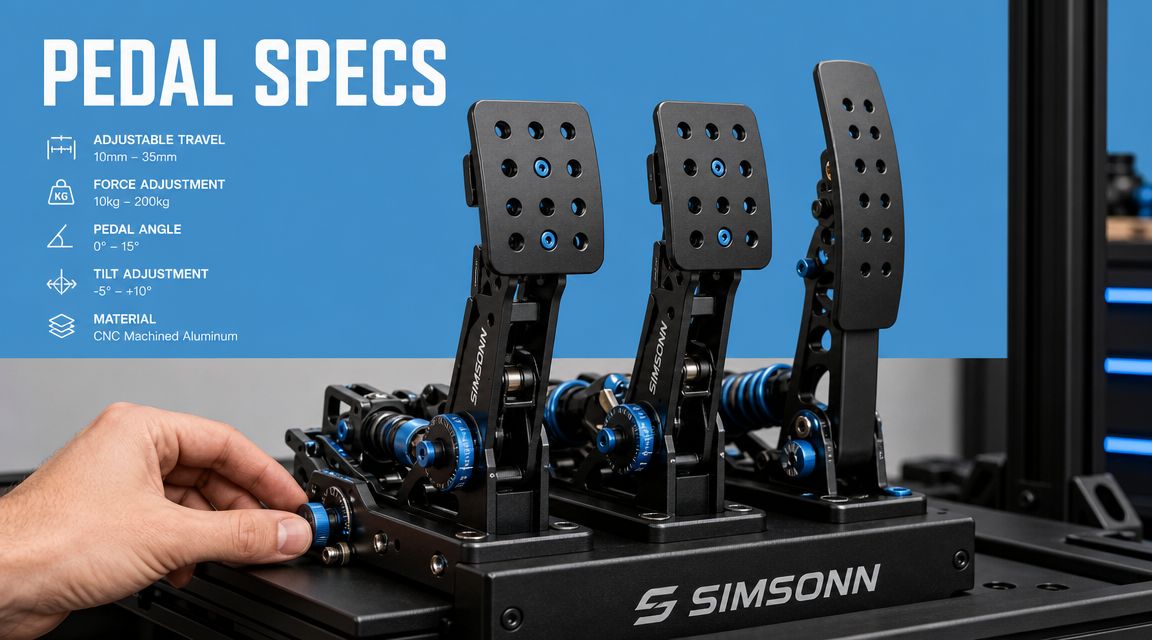
Pedal travel is the amount of movement before the input reaches full range. Too much travel can make the brake feel vague for first-time users. Too little can make the controls feel abrupt and unforgiving.
For events, the aim isn't to create a perfect replica for one skilled driver. It's to create a pedal response that feels intuitive to a wide range of guests within seconds. That usually means avoiding extremes.
A brake with a more progressive feel helps here. Premium pedal systems increasingly use dual-stage behaviour, with a softer initial phase and a firmer phase later in the stroke. UK-oriented technical guidance also describes adjustable resistance and brake forces in the 100 kg to 140 kg range, with some load cells rated up to 200 kg capacity, in this Demon Tweeks overview of sim-racing pedals. The operational benefit is simple. A firmer, clearer brake reduces accidental over-braking and gives guests better feedback.
Angle and adjustability
Angle matters more at exhibitions than many planners realise. Guests arrive in trainers, dress shoes, and sometimes less simulator-friendly footwear. They vary in height, leg length, and confidence.
A highly aggressive pedal angle may suit an enthusiast who settles in for a long session. In a shared activation, it can slow everything down. Neutral geometry is often the smarter choice because it works well enough for more people with fewer adjustments.
Key features worth asking about include:
Pedal face position: Wider or adjustable faces can make foot placement easier for inexperienced users.
Angle range: Useful, but only if it can be set once and left stable during the event.
Resistance tuning: A brake that can be made firmer without becoming intimidating is valuable.
Heel support: Helps guests place their feet consistently, especially in short timed runs.
A quick visual explanation can help non-technical teams understand what they're looking at: