
You're probably looking at a live brief with too many moving parts. The stand needs to pull people in. Sales wants leads, not just smiles. The venue wants a clean plan for access and power. Your brand team wants something that looks premium, not like a games corner pushed into the back of the space.
That's where a Formula 1 car simulator can work brilliantly, or fall flat.
Used well, it becomes a high-attention attraction that gives people a reason to stop, stay, compete and talk. Used badly, it turns into an expensive queue with no clear commercial outcome. The difference usually isn't the headline hardware. It's the planning around audience, staffing, data capture, space design and follow-up.
Understanding the Professional F1 Simulator Experience
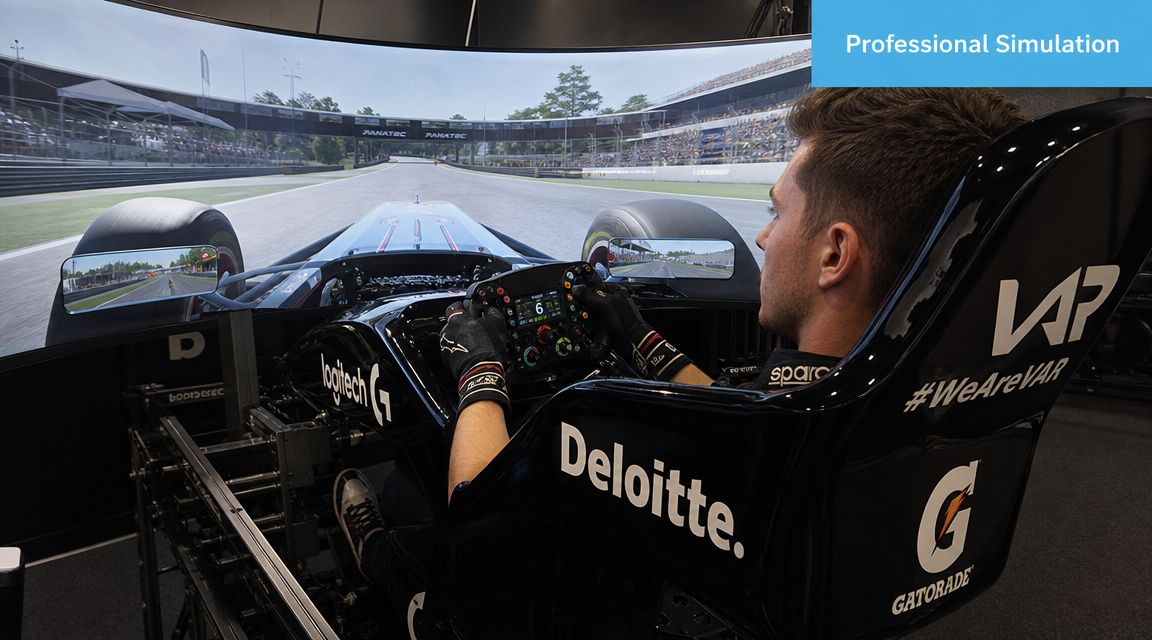
At the planning stage, this is one of the first distinctions to get right. A professional Formula 1 car simulator is an event attraction built for public use, repeat turnover and brand presentation. It is designed to deliver a convincing driving experience under exhibition conditions, not just give one person a fun ten minutes at home.
A consumer setup can be entertaining. A professional event simulator adds cockpit position, steering resistance, brake feel, visual scale and spectator appeal in a way that changes how guests respond on the stand. The driver feels exposed enough for the lap to matter. The crowd can follow what is happening without needing any motorsport knowledge.
What separates it from a games station
The difference comes from the full control environment working together.
A proper rig usually combines a dedicated cockpit, a large display, a force feedback steering system and pedals with enough precision to reward good inputs and expose poor ones. On higher-spec systems, wheel and pedal hardware make a noticeable difference. For example, Race Sim Central's overview of professional F1 simulators highlights features such as direct-drive steering, engineered cockpits and professional-grade pedal sets that are common markers of serious event hardware.
That does not mean every corporate event needs the heaviest steering or the most demanding setup. In practice, the best specification is the one that matches your audience, session length and staffing plan. A simulator for a public exhibition needs to feel credible without creating a barrier for first-time drivers. A simulator for a private client hospitality suite can afford to be more technical because guests usually have more time and more guidance.
The Impact on Your Audience
Guests read quality quickly. They feel it in the seating position, in the weight of the wheel, in the brake pedal response and in the way the screen holds their attention. Those details shape whether the experience feels premium or improvised.
That has a direct effect on event performance.
A well-presented simulator changes spectator behaviour. People gather, react to mistakes, compare lap times and start conversations without being prompted. From an event planner's perspective, that shift matters because it turns one participant into a small audience, which gives your team more chances to introduce the brand, frame the competition and qualify interest while people are already engaged.
This category also has real motorsport and gaming heritage. The wider development of Formula 1 simulation stretches back decades, with Motorsport.com tracing how F1 gaming evolved from early arcade-style formats into more serious simulation experiences in its history of Formula 1 gaming and simulation.
For a corporate event, the practical takeaway is straightforward. You are specifying an interactive feature that needs to support concept, delivery and measurable outcomes. When the simulator is chosen and configured properly, it gives the stand a premium centrepiece, gives guests a reason to participate, and gives the event team a stronger platform for conversations that continue after the show.
Why an F1 Simulator Drives Event Success
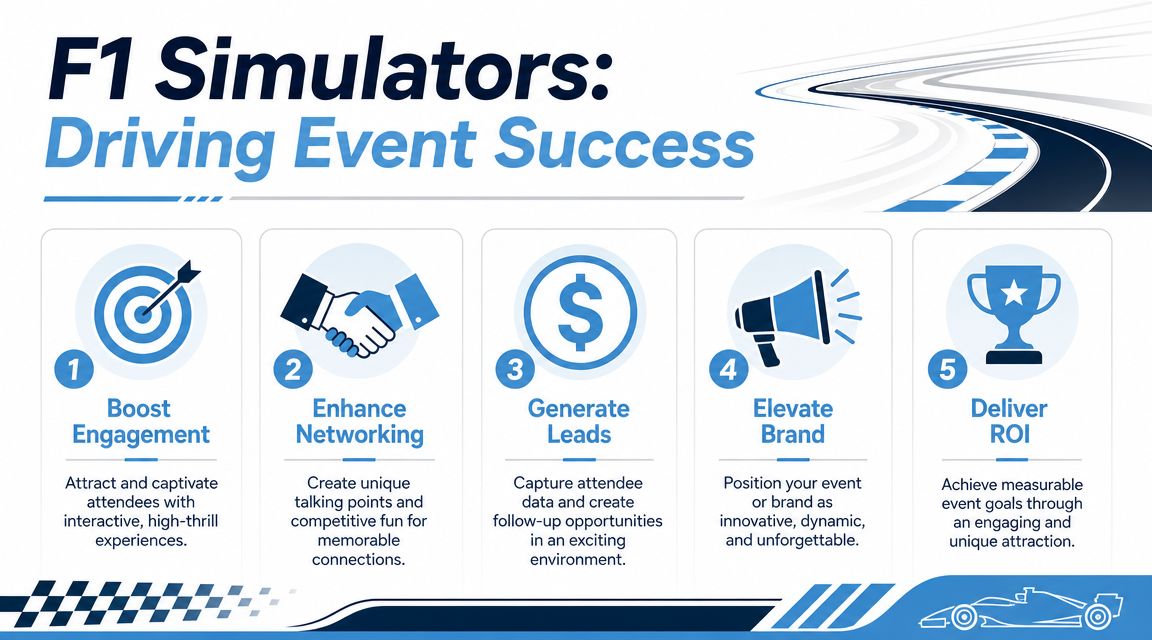
The reason to hire a simulator isn't that it looks exciting. It's that it helps solve event problems that static stands often can't.
The biggest one is attention. In busy halls and crowded activation spaces, people need a reason to break stride. A strong simulator setup gives them one. It has movement, noise, competition and a visible challenge. That combination works far better than passive messaging alone.
Footfall and dwell time
A practical challenge for buyers is that most online simulator content talks about car setup and driving technique, while event teams need help with throughput and dwell time. That gap is especially relevant in the UK exhibition market, where commercial value often depends on how many people stop and how long they stay, as noted in this event-buyer focused discussion around simulator content gaps.
A simulator helps with both.
At an exhibition, one guest drives while several others watch the screen, react to mistakes and wait for their turn. Even people who don't participate often stay long enough to absorb branding, hear a pitch or ask what the challenge is. That gives your team more time than a brochure handoff ever will.
Lead generation that feels natural
The strongest activations don't bolt lead capture on at the end. They build it into the experience.
A simple example is a fastest-lap leaderboard. To enter, participants register their name and company details before driving. If the flow is designed well, that interaction feels like part of the competition rather than an interruption. The sales team then gets context, not just a badge scan. They know who engaged, who came back and who invited colleagues over.
Later in the event, a running leaderboard gives your staff a reason to restart conversations. “You're still top three” is a much easier re-entry line than “Can I tell you about our services?”
Here's a useful visual example of how these activations play in a live setting:
Better brand memory
People remember what they did. They remember even more when other people saw them do it.
A Formula 1 simulator creates a moment with stakes. It might be playful, but it isn't forgettable. Guests sit in the cockpit, commit to a lap, hear reactions from the crowd and often want a photo or result afterwards. That's useful for launches, hospitality spaces and staff engagement because it turns your brand from a backdrop into part of the story.
Practical rule: If you can connect the simulator challenge to a clear message, product theme or campaign hook, the attraction stops being entertainment spend and starts working as event media.
Networking without forced icebreakers
Some of the best event conversations happen sideways, not across a meeting table.
People discuss lap times. They coach colleagues through corners. Senior guests challenge junior ones. Teams cheer each other on. If you need an attraction that creates natural interaction without forcing scripted engagement, this format does that well.
Choosing the Right Simulator for Your Audience
The right simulator depends less on motorsport purity and more on who's attending.
If your audience is mixed, your first filter should be accessibility, not absolute realism. Corporate events rarely have a room full of trained sim racers. They have prospects, clients, colleagues and guests with very different levels of confidence. That's why the best choice usually follows event goals first, not technical bragging rights, which aligns with this discussion on balancing realism and accessibility in F1 driving experience.
Static rigs and motion rigs
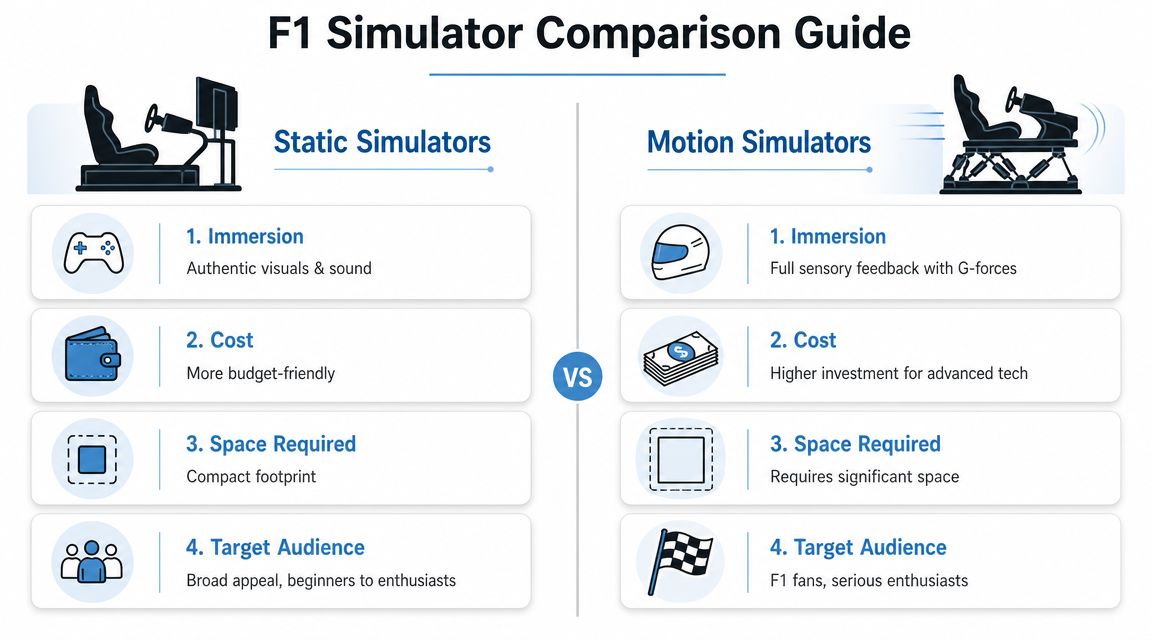
A static simulator is often the smarter event tool.
It's easier to place, simpler to manage operationally and usually faster to turn around between guests. For exhibitions, conferences and reception spaces, that matters. You want the queue moving and the onboarding quick. Guests should be seated, briefed and racing without a long technical preamble.
A motion simulator offers a bigger sensory hit. That can be excellent for fan zones, hospitality and premium launches where spectacle is central. The trade-off is practical. Motion units generally need more space, more careful queue handling and clearer briefing for guests who may not enjoy a more intense ride.
A quick comparison helps:
| Type | Best fit | Main strength | Main caution |
|---|---|---|---|
| Static simulator | Exhibitions, conferences, mixed audiences | Faster onboarding and broader appeal | Less theatrical than motion |
| Motion simulator | Premium activations, fan experiences, hospitality | Stronger spectacle and physical immersion | More operational complexity |
Full-size show car or compact rig
A full-size Formula 1 style show car simulator does two jobs at once. It acts as a visual centrepiece and an interactive attraction.
That makes it effective when the stand itself needs a landmark. People spot it from distance, photograph it and use it as a meeting point. The downside is footprint. If floor space is tight, a compact rig can sometimes produce better commercial value because it preserves room for conversations, storage and guest circulation.
For event teams comparing formats, this motion racing simulator hire overview is a useful example of the motion end of the market and the kind of application where that style of setup makes sense.
Single seat or head-to-head
If your goal is competitive energy, linked simulators usually outperform a single hero unit.
Head-to-head racing changes the atmosphere immediately. Colleagues compare reactions, not just lap times. Spectators pick sides. Presenters can run heats and finals. For team building or hospitality, that shared format often creates better engagement than one person driving alone while everyone else watches.
Choose the simulator style by asking one question first. Do you need a visual centrepiece, maximum participation, or the deepest driving experience? You usually get two out of those three, not all three at once.
Planning Your Space and Technical Logistics
Most simulator problems don't start on event day. They start when someone approves the concept before checking the floorplan.
A Formula 1 simulator activation needs enough room for the rig, operator access, guest queueing, spectator sightlines and safe circulation. If you only plan for the machine itself, the stand quickly feels cramped and the experience loses polish.

Space, sightlines and flow
Think of the simulator area as a mini stage.
The driver needs a clean operating zone. Staff need space to brief, adjust and reset the rig. Waiting guests need somewhere to stand without blocking neighbouring stands or venue aisles. Spectators need a clear view of the screen, otherwise you lose the social pull that makes the attraction work.
The easiest planning mistake is putting the simulator too close to the stand edge. That creates crowd spill into the aisle and leaves your team nowhere to manage the queue. It's usually better to pull the attraction inward and design a defined front-of-house area around it.
Power, access and setup planning
Power is rarely glamorous, but it's one of the first questions worth asking a supplier.
You need to confirm what supply the simulator requires, whether any additional display or branding elements change that requirement, and where sockets are positioned relative to the stand. Last-minute cable runs make an activation look temporary, even when the hardware is excellent.
Access matters just as much. Before sign-off, check:
- Loading route: Confirm the path from vehicle to stand, including any distance across halls.
- Doorways and lifts: Ask whether the unit arrives assembled or in sections, and whether venue access points can accommodate it.
- Build timings: Make sure there's enough installation window for testing, not just unloading.
- Storage needs: Some activations need cases and packing materials held off-stand during open hours.
If you're evaluating turnkey options, a page like car simulator hire for events gives a useful reference point for the sort of event-led setup support suppliers may provide alongside the simulator itself.
Connectivity and branding
If you want live leaderboards, social posting, lead capture or digital score displays, discuss connectivity early.
Some venues provide reliable internet. Some don't. A supplier can often work around that, but only if the requirement is known in advance. The same goes for branding. If you want logos on screens, custom challenge names, branded bodywork or podium-style result moments, those decisions need to happen before the truck leaves the warehouse.
Site check shortcut: Ask for a supplier checklist covering floorplan position, power, access, staffing location, queue space and internet requirement. If they don't have one, you'll probably end up writing it yourself under pressure.
Ensuring a Safe and Engaging Guest Experience
A simulator can draw a crowd in minutes and lose it just as quickly if the live experience feels slow, awkward or intimidating.
That part usually comes down to delivery, not display. Corporate guests judge the activation as a whole. How quickly they get seated, how clearly the challenge is explained, whether colleagues can watch and join in, and whether the session feels polished enough to justify the floor space and budget.
Operators shape the outcome
The best simulator setup still needs capable event staff. On a busy stand or at a hospitality event, operators do more than supervise driving. They set the tone, adjust the experience for each guest, keep sessions on schedule and protect the queue from stalling.
That matters because audiences are rarely uniform. One guest wants a realistic racing challenge. The next is in formalwear, has never used a simulator, and only has four minutes before the next agenda item. Good operators make both experiences work without slowing the whole activation.
For planners, this has a direct commercial effect. Better staffing means more completed sessions per hour, fewer drop-offs, stronger crowd energy and a better chance that guests leave with a positive brand association rather than a story about waiting around.
Safety starts before the guest gets in
A good briefing is short, clear and consistent. Guests should know how to get in and out, what the pedals and steering do, how long their session lasts, and what kind of driving standard is expected. That removes hesitation and keeps turnover efficient.
Real-world event conditions matter here. Shoes, skirts, fitted suits, name badges and conference fatigue all change how comfortable a guest feels getting into a racing seat. The right team anticipates that and adapts. Sometimes that means lowering force feedback, simplifying the track choice, or switching the goal from fastest lap to clean completion.
Safety and inclusivity usually support the same outcome. More people take part when the simulator feels approachable.
Accessibility should be discussed at planning stage, not on the day. Some events need easier entry and exit, gentler control settings, or a nearby viewing position where non-drivers still feel involved. If guest registration and memory capture are part of the activation, a simple process helps keep that experience organised. This EventUploader guest book guide is a useful reference for handling arrivals and participant moments in a more structured way.
The queue is part of the activation
Queue management affects perceived quality as much as the simulator itself.
A line can build interest or kill momentum. The difference is whether guests understand the format and can see progress. One clear rule works best. Fastest lap, beat the benchmark, or team total score. If people need a long explanation, the session design is too complicated for a live event environment.
Visible scoring helps. So does a staff host who keeps the crowd informed, celebrates good runs and invites the next driver forward without dead time. Short sessions usually outperform longer ones at corporate events because they increase participation and keep the surrounding audience engaged.
Treat the queue like a preview, not a holding area. That is where colleagues start competing, phones come out, and undecided guests choose to join.
Creative Activation and Branding Ideas
The weakest use of a simulator is a generic fastest-lap contest with no wider idea attached to it.
The strongest use ties the driving challenge to a business objective. That could be lead quality, team bonding, product storytelling or social content. Once you approach it that way, the simulator becomes a platform rather than a prop.
Team race formats for internal events
For staff conferences or client hospitality, team-based racing works well because it spreads ownership.
Instead of one winner and many spectators, each table or department contributes laps to a combined score. That changes the room dynamic. People coach one another, discuss handovers and celebrate consistency, not only outright speed. It's especially useful when you want networking and collaboration rather than individual bravado.
Product launches with a message built in
A simulator can also support product positioning if the challenge is framed properly.
If the campaign is about precision, speed, control or decision-making, the driving mechanic gives you a live demonstration metaphor. Staff can connect the driving task to the product conversation without sounding scripted. That's one reason experiential campaigns work when they're designed around participation rather than passive display. For broader planning ideas around that approach, this guide to experiential marketing for event planners is a worthwhile read.
Beat-the-benchmark competitions
Another reliable format is the benchmark challenge.
Set a target lap recorded in advance, then invite guests to beat it. The benchmark could represent your brand ambassador, your sales director, a client team captain or a themed “house driver”. This works because it gives every participant a clear objective, even if they know they won't top the full leaderboard.
It also makes hosting easier. Staff don't need to explain an elaborate mechanic. They frame the challenge, start the session and build conversation around whether the target stands.
Branded environments, not just branded screens
Branding usually gets reduced to logos on a monitor. That's a missed opportunity.
The better approach is to brand the whole moment. That might mean custom challenge naming, podium backdrops, winner photos, branded result cards or commentary that ties back to the campaign. If the simulator sits inside a wider trackside-style environment, guests are more likely to photograph it and remember who created the experience.
Measuring ROI and How to Book a Simulator
The simulator session ends. Guests are still talking about lap times, your stand team has a queue, and the event looked busy all day. The actual question starts after that. Did the activation create qualified conversations, useful follow-up, and a clearer case for event spend next time?
That should be planned before the simulator arrives on site.
A Formula 1 simulator earns budget approval when it is set up as a measurable event tool, not just a crowd-puller. Motorsport offers a useful parallel. Mercedes-AMG F1 explains that simulation only helps decision-making when the inputs are reliable and the model is used properly, not treated as blind prediction, in this Mercedes-AMG F1 overview of how simulation works. Event ROI works the same way. If registration, qualification, and reporting are added as an afterthought, the post-event picture will be vague.
What to measure
Start with outcomes your team can act on after the event.
Track:
- Lead quality: Who registered, what business details they shared, and whether they fit your target account or attendee profile.
- Engagement depth: Who completed a session, who came back for another attempt, and who brought colleagues to join.
- Content value: Which parts of the activation generated photos, social posts, press interest, or internal stakeholder coverage.
- Sales follow-up value: Which conversations gave your team a credible reason to reconnect after the event.
The strongest event reports connect simulator activity to commercial next steps. That might mean matching participant data to target accounts, comparing stand conversations before and after the activation went live, or tracking how many follow-up meetings came from the experience. A practical framework in this experiential marketing ROI guide can help shape those measures before budget sign-off.
What to ask before you book
Ask any supplier these questions:
- Event objective fit: Is the simulator package right for exhibitions, hospitality, team building, client entertainment, or high-footfall public events?
- Operational delivery: Who handles delivery, install, testing, staffing, and resets during the day?
- Branding options: What can be customised on the car, screens, set build, leaderboards, and winner moments?
- Insurance and compliance: What documents are available for venue approval and risk management?
- Data integration: How will registration, consent, leaderboard data, and post-event reporting be managed?
The quality of those answers usually tells you more than the simulator spec sheet. A supplier focused on events, like PSW Events, will typically bundle the simulator with delivery, logistics, and on-site support, rather than leaving your team to coordinate separate moving parts.
Good booking decisions come down to fit. The right supplier should understand your audience, your venue constraints, your staffing pressure, and what success needs to look like after the event, not just on the day.