
You've closed the event. The stand was busy, the simulator queue never really stopped, and the sales team said the conversations felt strong. Then the finance director asks the question that cuts through all the post-event excitement: what did we get back for the spend?
That's where most experiential campaigns get into trouble. Teams can describe energy, footfall and buzz in detail, but they can't show how a branded interaction at ExCeL London, Manchester Central or SEC Glasgow turned into a sales conversation, an accepted opportunity, or revenue later in the quarter.
That gap is why experiential marketing roi needs a different lens. Not a softer brand story. A harder attribution model.
Beyond Buzz The Real Challenge of Experiential ROI
The usual event debrief is full of activity metrics. Stand visitors. Demo participation. Social mentions. Maybe a few photos of the queue. None of that satisfies a sceptical CFO if the campaign was supposed to support commercial growth.

The core problem isn't that live experiences are hard to justify. It's that many teams still measure them as if the event itself is the finish line. It isn't. The event is only the point where intent becomes visible.
Recent UK-focused B2B and event research notes that in-person events are still highly valued for relationship-building and lead generation, yet marketers often struggle to connect those outcomes to revenue because the impact appears weeks or months later. That's exactly the pressure point for exhibitions, conferences and launches where the key question is whether interactions become SQLs, repeat meetings or closed deals, as discussed in Gradient Experience's ROI perspective.
Where good campaigns often lose the argument
A common example looks like this:
- The activation worked on-site: People stopped, played, watched and talked.
- The team captured some data: Badge scans, business cards or form fills.
- Follow-up happened loosely: Sales contacted some leads, marketing nurtured others.
- Reporting stayed at event level: The final deck stopped at attendance and engagement.
That reporting chain breaks right before the commercial proof.
Practical rule: If you can't trace an event interaction into your CRM, you're not measuring ROI. You're measuring activity.
Venue choice also affects your ability to prove value. Layout, dwell zones, access points, weather resilience and branding control all influence how consistently you can capture interaction and lead data. That's why operational planning matters just as much as creativity, and resources like Premier Marquee Hire corporate venue advice are useful when you're evaluating spaces that need to support both experience design and measurement.
For teams that need a clearer definition of the discipline itself, experiential marketing fundamentals are worth revisiting before you build an ROI model around it.
The standard has changed
The strongest event marketers now treat the activation as the first measurable step in a sales journey. That means asking tougher questions at the planning stage:
- What action counts as intent
- How will we capture that action
- Which follow-up path does it trigger
- How will sales confirm whether it became pipeline
That's the difference between a memorable event and a defendable investment.
Why Measuring Event ROI Is Non-Negotiable in 2026
In 2026, no serious marketing team can afford to treat live activity as a black box. If experiential sits outside the same accountability expected from paid media, outbound, partner marketing or field sales, it becomes the first budget line that leadership questions.
The commercial context in the UK makes this clear. A UK Event Industry Report states that 83% of UK event professionals believe live events are the most effective marketing channel for building brand awareness, and 76% say events are the best channel for generating sales leads, according to Team Tecna's summary of UK event statistics. Once stakeholders view live events as a lead-generation channel, they stop accepting vague reporting.
Budget defence gets harder every quarter
Finance teams don't approve spend because an activation looked premium. They approve spend because they can see why the investment belongs in the mix and what commercial outcome it's expected to support.
Without ROI measurement, three things usually happen:
- Budget requests weaken: Marketing asks for repeat spend based on anecdotal success.
- Costs get scrutinised in isolation: Staffing, travel, space, branding and technology look expensive when detached from outcome.
- Cheaper tactics look safer: Even when they produce lower-quality engagement.
That's why measurement isn't an admin task added after the event. It's part of how the budget gets protected in the first place.
Better measurement improves future event design
Teams often think measurement is only for reporting upwards. In practice, it's just as valuable for improving future activations.
When you know which touchpoints produced the strongest intent signals, you can make sharper planning decisions:
- Keep the attraction that produced meaningful conversations
- Drop the element that drew a crowd but little data
- Change staffing if the queue was strong but lead capture was weak
- Adjust the call to action if interactions didn't progress to follow-up
A busy stand isn't the same as an effective stand. The difference shows up when you compare engagement quality against what happened after the event.
Marketing earns more influence when it speaks in revenue terms
This is the point many teams miss. Measuring experiential marketing roi doesn't just justify one campaign. It changes how leadership sees marketing.
If the sales director can see which interactions produced accepted leads, and the finance director can see how campaign cost linked to pipeline influence, marketing moves from “events organiser” to commercial operator.
That shift matters. It changes internal conversations from “Was it worth doing?” to “How do we scale what worked?”
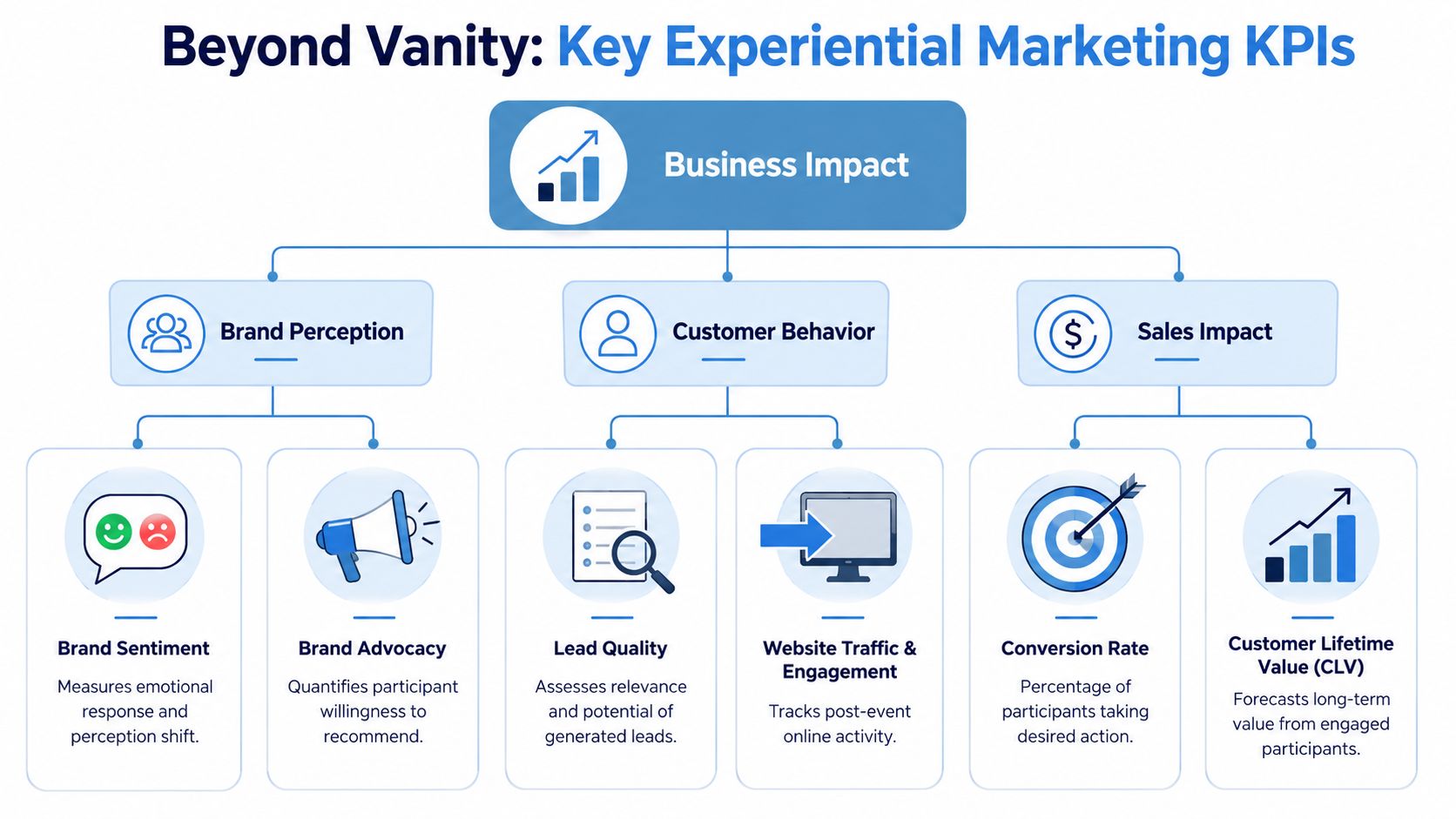
Key KPIs Beyond Footfall and Social Mentions
The fastest way to weaken an ROI discussion is to lead with metrics that look impressive but don't indicate intent. Footfall has a role. So do social mentions. But they sit at the edge of the picture, not the centre.
The more useful KPIs are the ones that show whether someone moved from passive attention to active participation.
Interaction depth matters more than raw crowd size
For interactive experiences, interaction depth is the strongest signal to watch. Guidance cited by Southern Made on measuring experiential ROI says that interaction depth is the single best predictor of conversion intent, and that metrics such as dwell time per touchpoint and the number of completed actions are more useful than total footfall alone.
That changes how you evaluate a stand or activation.
If someone walks past a racing rig, glances at the leaderboard and keeps moving, they've noticed the brand. If they queue, take part, compare results, scan a QR code, opt in to receive more information and ask a product question, they've shown intent. Those are not the same category of visitor.
KPIs that are worth tracking
Use a layered KPI set instead of one headline number.
- Dwell time per touchpoint: Measure how long participants stay at the specific branded activity, not just how long they remain somewhere near the stand.
- Completed actions: Track meaningful steps such as finishing a simulator session, entering a leaderboard, watching a product demo to the end, or completing a branded challenge.
- Digital capture rate: Record how many participants move into a trackable channel through QR scans, form completion or badge capture.
- Lead quality score: Classify leads using criteria agreed with sales, such as job role, buying need, timeframe or fit.
- Post-event response behaviour: Look for booked demos, replies to follow-up, landing page visits and meeting acceptance.
What good KPI design looks like in practice
A racing simulator is a useful example because it can produce both shallow and deep engagement.
A weak KPI setup would count:
- total stand visitors
- total plays
- social posts
A stronger KPI setup would track:
- how many people completed a full session
- how many returned to improve a score
- how many scanned the event-specific QR code
- how many accepted follow-up
- how many matched target buyer criteria
If you're planning activations for trade shows and branded environments, these interactive exhibition ideas are useful because they naturally lend themselves to measurable actions rather than passive observation.
The KPI question isn't “How many people came near us?” It's “What did they do that suggests buying intent?”
A quick test for vanity metrics
Before adding any metric to your report, ask one simple question: can this help explain pipeline movement later?
If the answer is no, keep it as supporting context, not as proof of return.
Choosing Your Attribution Model for Events
Collecting better KPIs is only the first half of the job. The harder half is deciding how the event gets credit once a deal involves multiple touches.
Think of attribution like a football goal. The striker scores, but the move may have started with a press, a pass into space and a cross from the wing. If you only credit the final touch, you miss how the chance was created.
That's exactly what happens when event teams rely on simple reporting in a long sales cycle.
Why attribution design has to be planned before the event
In UK experiential campaigns, the strongest ROI case comes from attribution design. Guidance highlighted by Statsig's experiential marketing ROI article stresses that attendance, dwell time and lead capture only become financially meaningful when they're tied to post-event actions and conversions through QR codes, dedicated landing pages and CRM matching.
If those tracking routes aren't designed in advance, you'll spend weeks after the event arguing over assumptions.
Experiential marketing attribution models compared
| Attribution Model | How it Works | Best For | Potential Pitfall |
|---|---|---|---|
| First-touch | Gives primary credit to the event if the activation created the first identifiable interaction | Brand launches, new market entry, discovery-stage campaigns | Overstates event impact when later channels did the heavy lifting |
| Last-touch | Gives credit to the final action before conversion, such as a booked demo or signed order | Short sales cycles, direct-response activations | Undervalues the event if live engagement started the buying journey |
| Multi-touch | Splits credit across several interactions, including the event, email nurture, sales meetings and web activity | B2B exhibitions, enterprise sales, longer buying journeys | Requires cleaner CRM discipline and agreement between teams |
| Position-based | Gives heavier weight to the first and key conversion-driving touches while sharing some credit elsewhere | Mid-length sales cycles where both introduction and follow-up matter | Can become too complex if the team can't apply it consistently |
How to choose the right model
The right model depends less on preference and more on sales reality.
Use these decision points:
- Choose first-touch if the event is designed to create net-new demand and most attendees are previously unknown.
- Choose last-touch if the activation is mainly there to push warm prospects into a final decision.
- Choose multi-touch if sales typically involve several meetings, internal approvals and a delayed close.
- Choose position-based if your team wants a practical middle ground without going fully custom.
The minimum viable attribution stack
You don't need an overly engineered system to make event attribution credible. You do need consistency.
A workable stack usually includes:
- Event-specific QR codes that point to dedicated landing pages
- Badge scans or form capture tied to named campaigns
- CRM source fields that distinguish exhibition, fan zone, conference or launch activity
- Sales follow-up tags that record meeting outcomes and progression
- Post-event reporting windows long enough to reflect the actual sales cycle
If sales can't see where the lead came from, and marketing can't see what happened next, neither team can defend the investment.
The biggest mistake is trying to solve attribution with one metric. Event ROI is usually won by joining several signals together.
How to Calculate Experiential ROI with Examples
At some point, the discussion has to become numerical. The standard formula is simple:
ROI = [(Financial Gain – Cost of Investment) / Cost of Investment] x 100
The difficulty isn't the maths. It's deciding what belongs in each side of the equation.

What goes into cost of investment
Include the full delivered campaign cost, not just the obvious line items.
That usually means:
- stand space or venue cost
- creative production and branding
- attraction hire or build
- staffing and training
- transport, install and derig
- insurance, venue compliance and health and safety requirements
- lead capture technology
- pre-event promotion and post-event follow-up costs where directly tied to the activation
Teams often understate event cost by excluding internal labour or follow-up execution. That makes the final ROI figure look cleaner, but weaker under scrutiny.
What counts as financial gain
For B2B, financial gain should come from revenue that can be credibly tied to event-sourced or event-influenced opportunities.
For B2C, it may include:
- direct sales during or after the campaign
- tracked voucher or QR redemptions
- attributable online purchases from event-specific landing pages
- retail uplift tied to event-coded offers if your data setup allows it
If you can't defend a revenue connection, don't force one. Report it qualitatively as influence rather than as closed financial return.
A short explainer on ROI mechanics can help align internal stakeholders before reporting starts:
Example one B2B trade show
A technology company exhibits at Manchester Central and uses an interactive simulator to attract decision-makers. The activation captures leads through badge scans and routes interested participants to an event-specific booking page.
The calculation process looks like this:
List all campaign costs
Include space, build, attraction, staffing, logistics and follow-up.Identify event-attributed opportunities
Only count opportunities that entered the CRM through the event source or were validated by agreed attribution rules.Separate pipeline from revenue
If deals are still open, report influenced pipeline separately from realised revenue. Don't present projected wins as closed return.Apply the formula
Use actual financial gain where available. If revenue hasn't landed yet, present an interim pipeline view and a later revenue view.
Example two B2C product launch
A beverage brand runs an interactive game at a UK festival and pushes players to scan a QR code for a claim page, product information and a follow-up offer.
The same framework applies, but the gain side changes:
- event-coded redemptions
- event-specific ecommerce visits
- attributable purchases from the landing page
- repeat purchase signals where the brand can track them
Working principle: The cleaner your attribution path, the less time you'll spend defending assumptions after the event.
Two reporting mistakes to avoid
- Mixing pipeline and revenue into one number: Keep them separate unless the revenue is closed and attributable.
- Ignoring the time lag: Some activations show commercial value later. If your sales cycle is long, schedule staged ROI reviews instead of one rushed post-event summary.
Actionable Strategies to Improve Experiential ROI
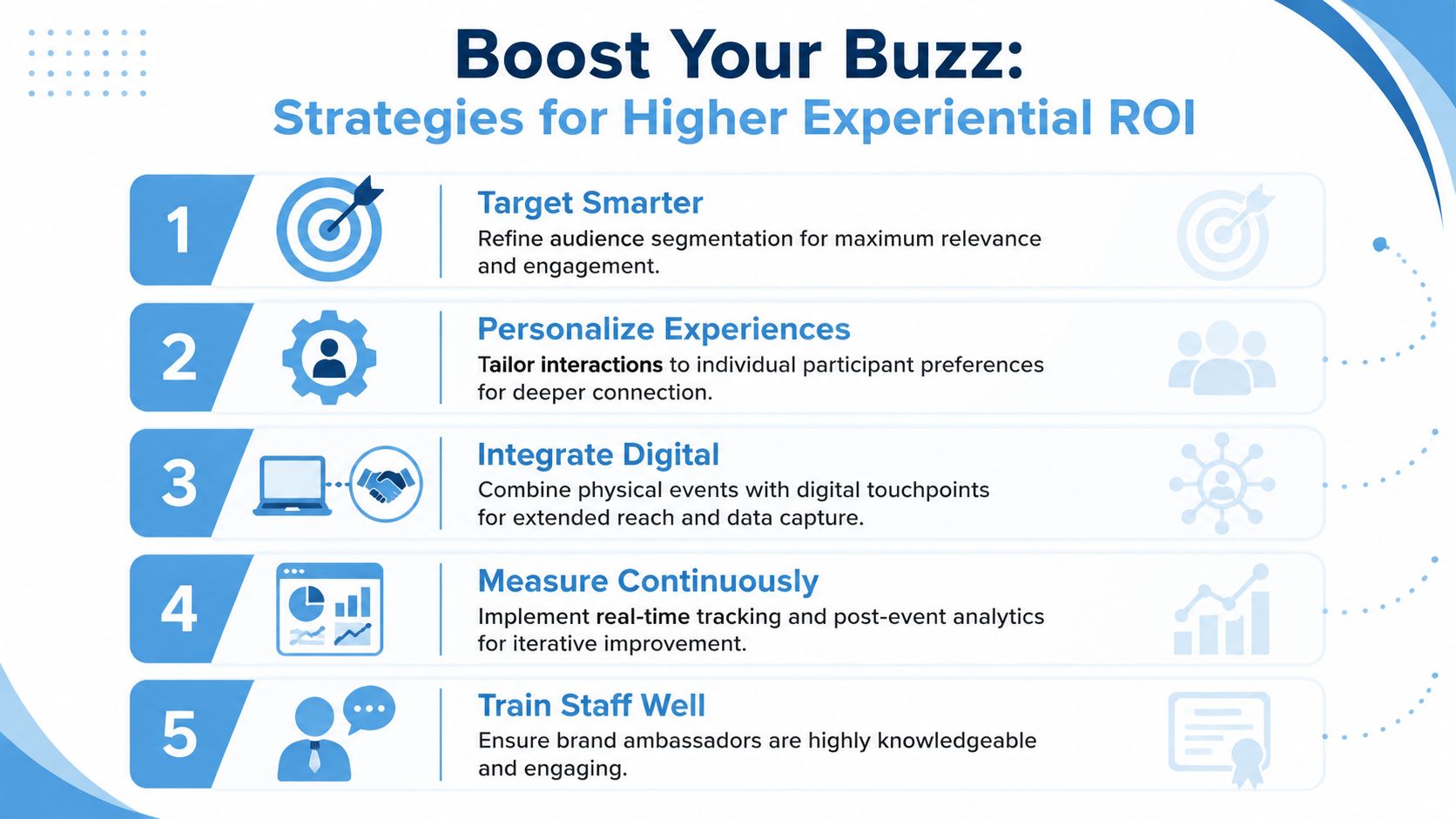
Once the measurement model is in place, the next challenge is improving performance without solely increasing spend. That usually comes down to better qualification, stronger interaction design and faster conversion after the event.
Start with audience quality, not footfall volume
A packed stand can still underperform if the wrong people are engaging.
Pre-event work should focus on who you want at the activation and why. For B2B, that might mean booked appointments, account targeting, partner invites and event-time outreach from sales. For B2C, it may mean location choice, timing, incentive structure and call-to-action clarity.
The aim isn't maximum traffic. It's qualified interaction.
Match the format to the commercial goal
Many event plans become inefficient; teams often choose the most visually impressive build rather than the format most likely to produce measurable return.
UK event buyers often need to know whether a premium simulator or VR feature will outperform lower-cost interactivity once staffing, logistics and insurance are included. With budgets under pressure, the attraction has to generate enough dwell time and qualified leads to justify full delivered cost, as explored in Good Kids' analysis of experiential ROI trade-offs.
That means asking practical questions:
- Do we need deep one-to-one engagement or broad throughput
- Will a premium attraction create better lead quality, or just a longer queue
- Can a modular format achieve the same data capture outcome with less complexity
- Will venue rules or staffing constraints reduce the value of a larger build
For brands evaluating concept routes, immersive experience design options are most useful when assessed against lead capture mechanics, queue management and follow-up potential, not just visual impact.
The tactics that usually lift ROI
- Tighten the call to action: Every activation should drive a next step, not just participation.
- Train staff to qualify, not just host: Brand ambassadors need a script for capturing intent signals and routing prospects correctly.
- Use modular interactivity where appropriate: Sometimes a simpler mechanic is easier to deploy, easier to explain and easier to measure.
- Build digital follow-through into the experience: QR journeys, dedicated landing pages and event-specific offers extend value beyond the stand.
- Follow up fast: The warmer the interaction, the shorter the acceptable delay before response.
Fast follow-up often does more for experiential marketing roi than adding another expensive production layer.
A useful way to think about post-event value is through forecast logic rather than event theatre alone. Teams that already use structured revenue planning may find Reachly's pipeline forecasting methodology helpful as a way to pressure-test how event-sourced leads move into forecast categories after capture.
Where teams usually overspend
The biggest waste isn't always in the attraction itself. It often sits in misalignment.
A premium experience underperforms when:
- the audience wasn't right
- the stand team couldn't qualify properly
- the CTA was vague
- the CRM route was broken
- follow-up landed too late
That's why ROI improvement is mostly operational discipline supported by smart creative, not the other way round.
Reporting Your Success and Building the Business Case
A strong event can still lose support if the reporting is messy. Leadership doesn't need a scrapbook of everything that happened. They need a clean explanation of what the investment produced and what should happen next.
Build the report around business questions
A useful experiential ROI report usually answers five questions:
- What was the commercial objective
- What audience did the activation reach and engage
- What measurable actions did participants take
- What pipeline or revenue outcomes followed
- What should be repeated, changed or cut next time
That structure works because it mirrors how finance and sales teams think.
Tailor the same result for different stakeholders
The underlying data may be the same, but the framing should change.
- For finance: show total cost, attribution method, return status, and where assumptions are limited.
- For sales: show lead quality, meeting conversion, pipeline progression and acceptance by the team.
- For senior leadership: show whether the event supported the broader commercial strategy and whether the model is scalable.
Include qualitative evidence as support, not as the headline. Photos, attendee comments and examples of strong engagement help explain why results happened, but they shouldn't replace outcome reporting.
Good reporting doesn't ask stakeholders to infer value. It states the value, shows the evidence and makes the next decision easier.
Use comparable logic across sponsorship and event activity
This matters if your programme includes exhibitions, hosted experiences, partner events or hospitality. The business case gets stronger when all activity is evaluated through a similar lens: cost, engagement quality, attributable next steps and commercial movement.
That's one reason sponsorship teams often benefit from reviewing adjacent planning models such as creating valuable golf sponsorship opportunities, where package structure and value articulation have to be clear before anyone signs off the spend.
A final practical point. Don't wait until the event is over to decide how you'll report it. If the reporting narrative isn't built in advance, the team will collect whatever is easy rather than whatever proves value.
If you need interactive attractions that are built for measurable engagement, PSW Events delivers simulator-led brand experiences, exhibition features and fan-zone activations across the UK. Explore PSW Events for support with planning, branding, logistics, staffing and compliant delivery.