
You've booked the stand. The graphics are sharp. The team is briefed. Then the doors open, people slow down just enough to glance over, pick up a brochure, smile politely, and carry on walking.
That's the problem most event teams are trying to solve. Not attendance. Not even awareness. Active participation.
Gamification in events works when it changes behaviour on the show floor, in the conference space, or inside a branded activation. It gives people a reason to stop, try, compete, return, share, and talk. Done badly, it feels bolted on. Done properly, it becomes the mechanism that turns passive traffic into measurable engagement.
That's why this matters far beyond novelty. The global gamification market was valued at $11.94 billion (£8.9 billion) in December 2021 and was projected to grow at 12.9% annually through 2025, according to Pavegen's live event engagement overview. That tells planners something important. Gamified mechanics are no longer a fringe add-on. They're now part of mainstream event strategy.
Transforming Attendees from Spectators to Participants
A static event space usually looks busy from a distance and quiet up close. People drift through, collect materials, maybe ask one safe question, then move on. The stand team spends the day trying to start conversations with attendees who haven't yet found a reason to stay.
A gamified space behaves differently. Someone sets a score on a simulator. A small crowd gathers. Colleagues challenge each other. Visitors scan in to take part. Another attendee returns later to improve their position. The same footprint suddenly carries more energy, more dwell, and more conversation because there's a clear action to take.
What changes when participation has a trigger
The biggest shift is simple. Attendees stop being observers and become participants.
That participation can come from app mechanics such as points, badges, and missions. But in live environments, the strongest trigger is often something physical and immediate. A racing challenge, reaction game, sports simulator, or branded skill contest gives people a visible activity and a clear outcome. They know what to do within seconds.
Gamification works best when the action is obvious from across the aisle and easy to join within moments.
That matters at exhibitions, conferences, and brand activations where attention is scarce and queues, noise, and competing messages are constant. If someone needs a long explanation before they can play, the mechanic is already under pressure.
Why this has become a core event skill
Gamification in events isn't about making every experience feel like an arcade. It's about adding structured incentives and feedback to the behaviours the event already needs. That might mean booth visits, demo participation, networking, content recall, or lead capture.
The practical question isn't “Should we gamify?” It's “What attendee action matters most, and what mechanic will motivate it without creating friction?”
For some events, an app-based passport is enough. For others, especially busy trade show floors, a physical attraction gives the game a centre of gravity. People can see it, hear it, and understand it instantly. That's often the difference between interest and action.
The Psychology of Play Why Gamification Works
Most planners overcomplicate gamification at first. The principle is much simpler than the tech stack around it.
A coffee shop loyalty card is gamification. Buy enough coffees, get a reward. You can see progress. You know the rule. The next action feels worthwhile. Event mechanics work the same way. Attend a session, complete a challenge, beat a score, visit a zone, answer a quiz, earn the next reward.

The behaviour loop that drives action
Effective gamification in events rests on a short loop:
- A clear task gives the attendee something specific to do.
- Immediate feedback shows whether they've succeeded, progressed, or scored.
- Recognition or reward makes the action feel worthwhile.
- A next step keeps momentum going.
That loop is why a simple fastest-lap challenge can outperform a beautifully designed but passive stand. The attendee doesn't have to guess what matters. The mechanic tells them.
UK-relevant performance benchmarks report that gamified event experiences can generate up to 48% more engagement than non-gamified formats, as noted in EventsAir's guide to event gamification. In practice, that translates into behaviours planners already care about, such as booth visits, dwell time, and lead capture.
Four motivations most event audiences respond to
Not everyone plays for the same reason. Good event design gives people more than one reason to join.
- Achievement: Some attendees want to beat a target, complete a mission, or top a score table.
- Status: Others enjoy public recognition, even if the prize itself is modest.
- Progress: Visible advancement keeps people engaged, especially across a longer event journey.
- Social connection: Shared challenges create an excuse to interact with colleagues, clients, or strangers.
That's one reason immersive formats are often so effective in person. They combine the game mechanic with spectacle, social proof, and conversation. A visible attraction doesn't just entertain the player. It draws in the next participant and creates a natural opening for the stand team. Teams planning these environments often start with a broader immersive experience design approach so the mechanic supports the event objective rather than distracting from it.
Practical rule: If the reward loop is stronger than the brand message, people remember the game and forget who ran it. If the brand message dominates and the game feels tokenistic, people don't bother playing.
What doesn't work
Gamification fails when it asks too much too early.
A long sign-up flow, confusing rules, hidden scoring, or rewards that don't feel relevant will all kill momentum. So will mechanics that rely entirely on competitive public ranking. Some audiences love leaderboards. Others disengage the moment they feel they can't win.
The psychology matters because the event environment is fast. People decide quickly. The best mechanics make participation feel easy, visible, and worth repeating.
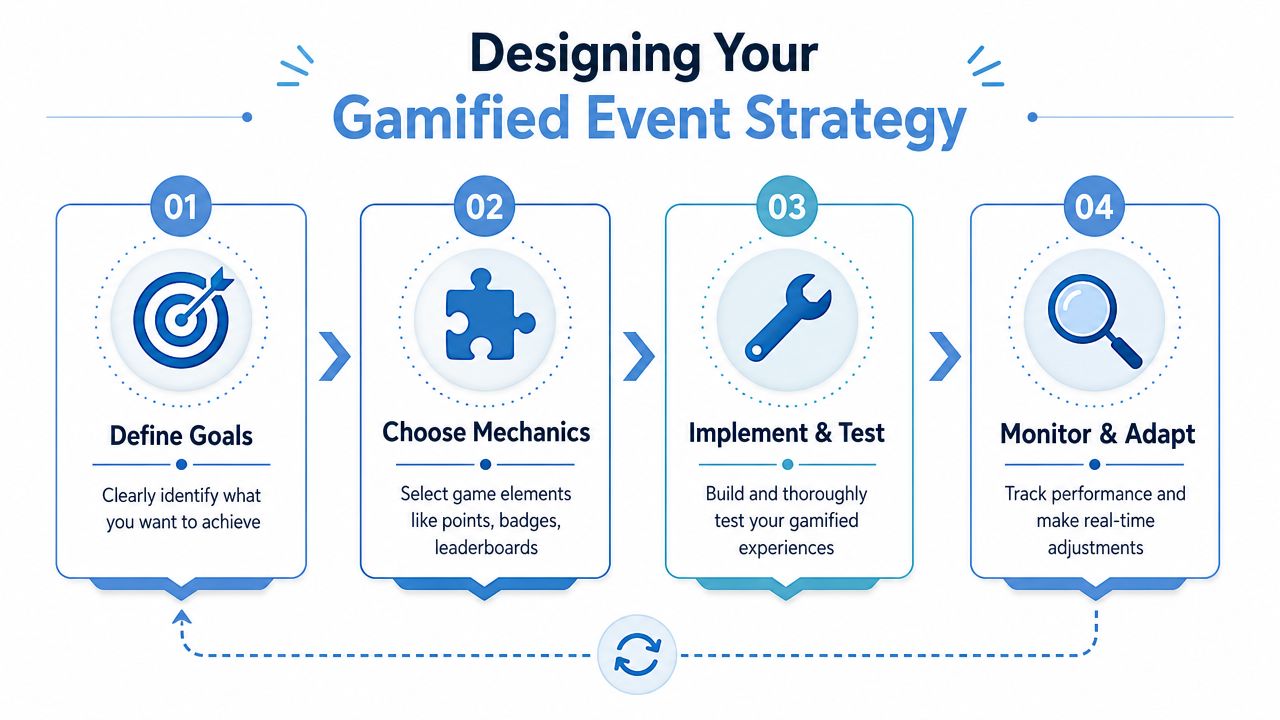
Designing Your Gamified Event Strategy
The best event games don't start with the game. They start with the business objective.
If a planner says, “We want something interactive,” that's still too vague. Interactivity is a format. Strategy begins when you decide what the interaction needs to achieve. More qualified conversations. Better product recall. Increased sponsor footfall. Stronger team connection. Higher-value scans.
Start with the action you want to change
A useful way to plan gamification in events is to write one sentence:
We want attendees to do X, because it helps us achieve Y.
Examples:
- Visit a specific zone, because that zone houses the sponsor message or hero product.
- Stay longer at the stand, because dwell time creates space for deeper sales conversations.
- Return later in the day, because repeat visits improve lead quality.
- Work together in teams, because the event is designed around internal culture and collaboration.
That sentence stops teams from choosing a mechanic just because it looks exciting.
Build the game around measurable behaviours
Gamification works best as a behaviour-design layer. The mechanic should reward actions you can observe or capture, not vague ideas like “engagement” on its own.
A strong model usually includes:
- Primary action: the one behaviour that matters most
- Secondary actions: useful follow-on behaviours
- Feedback method: live score, timed result, ranking, badge, or checkpoint
- Reward structure: prize, recognition, access, or team outcome
According to Leap Event Technology's event gamification guide, successful implementations use a points-and-feedback loop tied to measurable attendee actions, and can produce up to 48% higher engagement, 30% better information retention, and 40% more interactions. The operational takeaway is more valuable than the headline number. Reward the behaviours that matter first, and make the feedback immediate.
Here's a simple planning view:
| Objective | Strong mechanic | Weak mechanic |
|---|---|---|
| Drive booth visits | Timed challenge with badge scan entry | Generic prize draw with no action |
| Reinforce product knowledge | Quiz after demo or hosted challenge | Random giveaway unrelated to content |
| Increase team interaction | Small-group competition | Individual-only leaderboard |
| Create social buzz | Highly visual physical contest | Hidden app task no one can see |
A quick example helps. If your event goal is sponsor exposure, don't award the most points for downloading the app. Award them for sponsor-linked actions. If your goal is lead quality, don't over-reward volume. Design the challenge so participation naturally creates a conversation.
Choose mechanics that fit the audience
At this point, many strategies wobble. The same mechanic won't suit every room.
A sales conference might respond well to live competition. A senior executive audience may prefer a polished challenge with lighter public ranking. A family fun day needs instant clarity and broad accessibility. A trade show crowd often needs a mechanic that can be understood while walking past at speed.
Good choices include:
- Time-based challenges for fast throughput and visible excitement
- Skill contests when you want replay value and spectator interest
- Team missions for internal events and relationship building
- Knowledge-linked games when retention matters more than spectacle
The attraction should also match the brand context. A motorsport-linked brand can lean into racing. A premium hospitality launch may suit golf or reaction games. A technology brand might combine a branded simulator with a product story and leaderboard.
A lot of teams find it helpful to watch a live activation example before committing to the mechanic. This event video shows the pace and visibility a physical game can bring to the floor:
Test friction before launch
The most common design mistake is assuming attendees will tolerate complexity because the concept is clever. They won't.
Before sign-off, check five things:
- Can someone understand the challenge in under a minute?
- Can the queue move steadily without killing atmosphere?
- Can staff explain the value in one sentence?
- Can you capture the data you need at the point of play?
- Can the mechanic survive real event conditions, including noise and interruptions?
A game doesn't need to be simple in concept. It needs to be simple to join.
That distinction matters. The audience can enjoy depth once they're in. But entry has to be effortless.
Bringing Gamification to Life with Interactive Attractions
Apps can award points. A physical attraction does more. It stops traffic, creates theatre, and gives the game a visible home.
That's why the strongest examples of gamification in events often move beyond digital-only mechanics. A simulator, reaction wall, giant race set, sports challenge, or branded contest gives attendees a reason to gather and a reason to take part. It also gives the stand team something better than a cold opener. They can invite someone into an experience rather than into a pitch.

Trade show stand with a score-led attraction
A busy exhibition floor rewards visibility and speed. An F1 simulator or multi-racing rig works well here because the challenge is obvious. Set the fastest lap. Join the leaderboard. Beat the current time.
The mechanic is straightforward. Attendees register or badge-scan before the drive, complete a timed session, then see their result immediately. That single sequence can support several outcomes at once:
- Footfall: People stop because the attraction is visible and active.
- Dwell time: Players stay for the experience, and spectators often remain to watch.
- Lead capture: Entry can be linked to a scan, form fill, or hosted qualification conversation.
- Repeat visits: Participants often return to improve their score.
Where teams get the most value is in weighting the touchpoints around the challenge. For example, a host can ask one qualifying question before the race and one follow-up question after it. The game creates the opening. The staffing plan turns that opening into a commercial result.
For planners looking at ways to make a stand work harder physically, this round-up of interactive exhibition stand ideas is a useful reference point.
Team building with shared competition
Internal events need a different tone. Pure individual ranking can energise some groups and alienate others. A better format is often a multi-activity challenge with team scoring.
A corporate decathlon model works well because it mixes abilities and personalities. One person might excel on Batak Pro. Another might contribute on a climbing wall, sports simulator, or giant Scalextric challenge. The format spreads attention and creates multiple moments for success.
This kind of design also changes the room dynamic. Instead of a handful of highly competitive people dominating the entire experience, more attendees find a route in.
If you want broad participation, don't make every mechanic about being the best in the room. Give people different ways to contribute.
That principle matters more than the attraction itself. The hardware creates excitement. The scoring model determines whether the audience feels welcomed or filtered out.
Product launches and branded activations
For launches, the attraction has to do more than entertain. It needs to support the message.
A golf simulator with a nearest-the-pin challenge is a good example when the event wants a polished, premium feel. It works especially well if the contest can be visually branded, tied to a themed prize, or integrated into hospitality. The challenge gives guests a low-pressure interaction. The branding and host script connect that interaction back to the product story.
A boxing simulator, rugby conversion challenge, or American football passing game can do the same for sport-led campaigns. The important point is fit. The attraction should feel like an extension of the activation, not a random crowd magnet dropped into the corner.
For inspiration outside the simulator category, it's also worth browsing formats that planners use for lower-footprint participation moments. This guide to discover fun event games is useful because it shows how simple physical play can still create structure, visibility, and social interaction.
Why physical attractions outperform hidden mechanics
App-led gamification has a place. It's useful for journeys across larger programmes, session attendance, scavenger hunts, or hybrid formats. But it has one built-in limitation at live events. If attendees can't see the game happening, the mechanic has to be promoted harder.
Physical attractions reverse that. The gameplay advertises itself.
That visibility changes three things:
| App-first mechanic | Physical attraction |
|---|---|
| Requires explanation before interest | Creates interest before explanation |
| Often individual and screen-based | Naturally social and spectator-friendly |
| Easy to miss in crowded environments | Hard to ignore when placed well |
For many planners, the best answer isn't app or attraction. It's both. Use the attraction as the hero moment and the digital layer to capture, score, route, and follow up.
Measuring Success and Proving Event ROI
The quickest way to lose confidence in gamification is to report the wrong metrics.
“Three hundred people played” sounds positive, but it tells a budget holder very little. Were they the right people? Did they stay? Did they speak to the team? Did the sponsor get more meaningful traffic? Did the activity improve recall, lead quality, or follow-up opportunity?
That's the standard. Not whether the game was popular, but whether it changed a business outcome.

Stop reporting vanity metrics on their own
Vanity metrics still have a place. Participation volume, leaderboard activity, and repeat plays can help you understand attraction strength. They just shouldn't stand alone.
As Beamian's guidance on gamification in hybrid and virtual events argues, the critical question is whether gamification moved outcomes such as dwell time, sponsor visits, lead capture quality, or learning retention. That's the difference between “people liked it” and “it was worth the budget.”
A stronger reporting structure looks like this:
- Top-of-funnel indicators: participation, queue interest, repeat attempts
- Mid-funnel indicators: dwell time, host interactions, demo attendance, sponsor visits
- Bottom-funnel indicators: qualified leads, follow-up actions, meeting bookings, content recall
Match each metric to the event objective
If your goal was traffic, report movement and attention. If your goal was education, report retention. If your goal was sponsor value, report sponsor-linked engagement.
Planners often improve their reporting by writing a simple metric map before the event:
| Event goal | What to measure | What to avoid overvaluing |
|---|---|---|
| Increase stand traffic | Entries, repeat visits, queue formation, dwell time | Total points awarded |
| Improve lead capture | Badge scans, qualified conversations, captured data quality | Raw plays without identity |
| Support sponsor ROI | Sponsor zone visits, branded challenge participation | Generic social buzz with no sponsor link |
| Reinforce learning | Quiz completion, correct responses, follow-up recall | Applause and anecdotal enthusiasm |
If you need a broader framework for linking engagement activity to commercial outcomes, this guide to experiential marketing ROI is a helpful starting point.
Build measurement into the mechanic, not after it
The easiest ROI wins come from design decisions made early.
A few examples:
- Require a badge scan or registration step before play.
- Give hosts a short qualification script while the attendee waits.
- Tie scoreboards to identifiable participants where appropriate.
- Create separate prize categories if you need both volume and quality.
- Record not just who played, but which product area, sponsor zone, or message they engaged with.
If the activity creates attention but no usable data trail, the commercial story will always be harder to prove.
That doesn't mean every game must feel transactional. It means the event team should know what evidence the mechanic is supposed to generate.
Report the story stakeholders care about
Senior stakeholders usually want three answers:
- Did it attract the right audience?
- Did it create more valuable interaction than a standard format?
- Should we invest again?
Your post-event report should answer those directly. Use participation data as context, not the headline. The headline should be the business movement the game helped produce.
That's when gamification stops being viewed as entertainment spend and starts being seen as a performance tool.
Logistics and Avoiding Common Pitfalls
The creative idea is usually the easy part. Delivery decides whether gamification feels polished or painful.
A physical attraction needs more than floor space. It needs the right placement, power, queue management, staffing, branding integration, safety planning, and a realistic understanding of throughput. If the game blocks sightlines, creates a dead queue, or overwhelms the stand team, the same feature that should improve engagement can start working against the event.
The practical issues planners should solve early
The strongest executions answer operational questions before build-up day.
- Space and footprint: Check not only the attraction size but also player movement, spectator space, and queue spill.
- Power and connectivity: Some formats need little more than a standard supply, while others need more careful technical planning.
- Staffing model: A great host can explain the challenge, manage flow, and convert gameplay into conversation.
- Brand integration: If the game can't carry the message cleanly, it risks becoming disconnected entertainment.
- Health and safety: Attractions need proper risk planning, supervision, and compliance procedures.
These details are rarely what attendees remember. They're exactly what makes the attendee experience feel smooth.
Common mistakes that reduce participation
Most underperforming event games fail for one of these reasons:
- The mechanic is too complicated: People walk away if they need a long briefing.
- The reward is misaligned: A flashy prize can attract the wrong crowd if it has no connection to your objective.
- The leaderboard dominates everything: Public ranking can energise some audiences and discourage others.
- The game is detached from the stand journey: If no one bridges the attraction to the conversation, the commercial value weakens.
- The whole format relies on confidence: Some attendees won't join if the experience feels too public or too competitive.
That final point matters more than many teams realise. A key pitfall in gamification in events is ignoring accessibility and inclusion. Effective design must consider quieter or disabled attendees and shift the focus from pure competition towards equitable participation, particularly in the context of the UK's Equality Act 2010, as discussed in Everwall's perspective on inclusive event gamification.
Design for broader participation
Inclusive gamification doesn't mean making everything soft or passive. It means giving more people a way in.
You can do that by:
- offering team-based formats rather than only individual ranking
- celebrating multiple achievements, not just one winner
- using low-friction entry mechanics
- rotating visibility so one live leaderboard doesn't dominate the whole experience
- making sure staff invite participation in a way that feels welcoming rather than pressurised
The best event games create energy without making people feel exposed. That balance is where strong design shows.
Gamification works when it's treated as a strategic layer, not a novelty feature. The mechanic should support a clear objective, fit the audience, work in the room, and generate evidence that the event delivered something commercially useful.
If you're planning a stand, conference feature, brand activation, or team event and want a physical game mechanic that does more than entertain, PSW Events can help you shape the concept, supply the attraction, and deliver it end to end. Their range includes racing, sports, reaction, flight, VR, and leaderboard-led experiences designed for measurable engagement at events across the UK and beyond.