
You're probably here because the brief sounds simple and what's involved doesn't. Someone in the team has said, “Let's get a football simulator on the stand,” and now you have to work out what that means in practice in venue terms, branding terms, queue terms, and budget terms.
That's the right instinct. A football simulator can pull people in fast, but only if the hire matches the objective. The wrong setup creates a bottleneck, feels gimmicky, and leaves your team apologising for wait times or technical hiccups. The right setup gives you a clean attraction, a reason to stop, and a practical route into lead capture, brand recall, and conversation.
From a UK corporate events perspective, the best results usually come from treating the simulator as part attraction, part campaign tool, and part operational project. It needs to look good, run reliably, work for mixed audiences, and fit your stand or venue plan without drama on build day.
What Is a Football Simulator for Events
A football simulator for events is a physical, interactive game system that lets guests kick a real football into a digital experience. At its best, it sits somewhere between sport, gaming, and live brand activation.
That distinction matters because many buyers initially picture a console game on a screen. That's not what event teams usually mean. A proper event simulator combines a projection or display, ball tracking, game software, challenge modes, and a safe playable area so the participant is doing something real, not just pressing buttons.
What guests actually experience
At a trade show or conference, the most familiar format is a penalty shootout or target challenge. A guest steps up, takes a shot, sees instant feedback on screen, and often gets a score or ranking. That quick loop is why the format works so well in busy environments.
The interaction is simple enough for walk-up participation, but it still feels competitive. That's the sweet spot for events. You want something people understand in seconds, not something that needs a tutorial and a queue marshal explaining the controls every time.
For corporate buyers looking at interactive football game hire, the practical value is usually one of three things:
- Footfall generation: A visible kicking game gives people a reason to stop.
- Conversation opening: Sales teams get a natural way to start talking.
- Memorability: Guests remember what they did, not just what they were handed.
Practical rule: If a passer-by can't understand the challenge within a few seconds, the setup is too complicated for most exhibition environments.
What separates a simulator from a novelty game
The better systems rely on accurate sensing and responsive software. That's what makes the shot feel connected to the screen outcome. If the ball flight looks wrong or the response lags, people notice immediately.
Professional systems are also built around repeat use. At a live event, the attraction needs to cope with participant after participant, different footwear, varying confidence levels, and a constant need to reset quickly. That's a different requirement from a consumer game or a basic inflatable target.
A good hire also includes the surrounding event detail, not just the hardware:
- Safe play area design: Enough room for the shot and for spectators to gather without crowding the player.
- Operator support: Someone who keeps the line moving, explains the challenge, and handles resets.
- Brand integration: Screen graphics, scoreboards, and winner moments that feel connected to your campaign.
- Venue compatibility: Access, power, loading times, and surface suitability all checked in advance.
Why it works so well in live environments
A football simulator creates movement, noise, and reaction. That changes the atmosphere around a stand or activation. People don't just see a logo. They see someone taking a shot, hear the crowd response, and want to know what's happening.
That's why it often outperforms passive attractions. It gives your audience a role. They're not watching your activation. They're inside it.
Comparing Football Simulator Experiences
Not every football simulator delivers the same outcome. Some are built for high throughput and easy participation. Others are designed for immersion, realism, or a more premium feel. Your audience should drive the choice, not the flashiest demo clip.
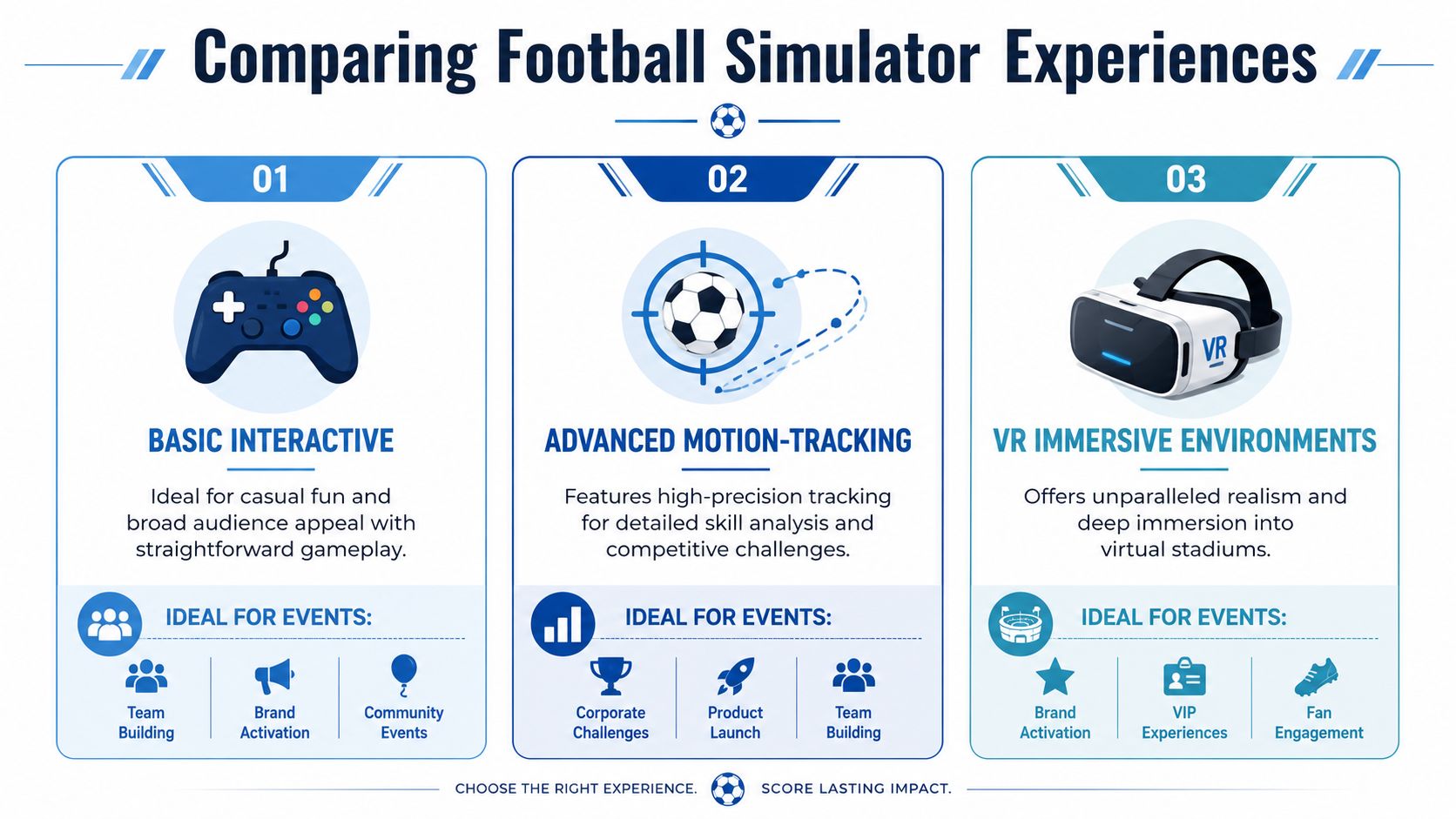
Basic interactive systems
This is the format most corporate buyers end up choosing, and often for good reason. The guest kicks a real football at a target or projected goal, the system scores the attempt, and the next person steps in quickly.
It's the most forgiving option for mixed audiences. You don't need football knowledge, special kit, or much explanation. For exhibitions, staff parties, indoor fan zones, and conference networking spaces, this is usually the safest commercial choice.
What works well:
- Fast turnover: Good for busy stands where queue length needs controlling.
- Low learning curve: Guests join in without feeling self-conscious.
- Clear scoring: Easy to build around leaderboards, timed rounds, or beat-the-target mechanics.
What doesn't work as well is deep realism. If your objective is to impress a premium audience with a highly technical or cinematic experience, a basic rig can feel functional rather than spectacular.
Advanced motion-tracking systems
This category steps up the fidelity. The system tracks shot direction, pace, and placement more precisely, and the software can present more advanced challenge modes. Some football simulators can offer access to over 3,500 playable sporting venues and more than 60 different sports challenges within a single system, which shows how far high-end event rigs have developed according to Blooloop's review of the sports simulator market.
These systems suit buyers who want the game to feel more premium and more obviously technical. They're a good fit for sport-led brands, innovation showcases, internal events where competition matters, and activations where data-rich scoring adds value.
A practical advantage is that stronger tracking gives cleaner winner selection. If you're running a competition with prizes, people trust the result more when the system feels precise.
Better tracking doesn't just improve realism. It reduces arguments, retakes, and awkward moments around scoring.
VR immersive environments
VR football experiences are a different proposition. They prioritise immersion over throughput. The guest wears a headset and enters a virtual stadium or challenge environment, often with a stronger sense of spectacle and novelty.
For premium launches, hospitality suites, and invitation-only activations, VR can be excellent. It gives people a memorable one-to-one experience and photographs well when staged properly.
The trade-off is operational. VR usually takes longer per participant, needs more supervision, and is less efficient when you need large volumes of people through the experience. Some guests also prefer not to wear a headset at a busy public event.
How to match the format to the brief
Use this simple decision filter:
| Simulator type | Best for | Main strength | Main trade-off |
|---|---|---|---|
| Basic interactive | Exhibitions, staff events, general audiences | Fast and accessible | Less premium feel |
| Advanced motion-tracking | Brand activations, sport-led campaigns, competitive formats | Better realism and scoring | Higher production expectation |
| VR immersive | Premium hospitality, launches, invite-only experiences | Strong immersion | Lower throughput |
If your audience is highly performance-minded, it also helps to understand how tracking technology is discussed in adjacent products. SoccerWares' ultimate guide to soccer trackers is useful background reading because it frames the wider expectation around data, movement analysis, and what people now consider believable sports tech.
One more decision point matters in the UK market. Be precise about whether you mean association football or American football. Clients sometimes ask for a “football simulator” and only discover late in the process that the supplier is talking about field goals or quarterback throws rather than penalty shootouts and free kicks. That's an avoidable mistake, but it still happens.
Driving Engagement at Corporate Events
The strongest football simulator activations start with a live-event problem. The stand needs stopping power. The fan zone needs an activity that isn't passive. The team-building day needs something competitive that doesn't feel forced.
That's why this format has become more visible across the wider immersive entertainment market. The global sports simulator market was valued at $2.5 billion in 2024 and is projected to reach $4.5 billion by 2029, while the adjacent UK golf simulator market is projected to grow at a 16.1% CAGR, according to Market Report Analytics on the sports simulator market. For event planners, the important point isn't the category size on its own. It's that buyers and venues are now much more comfortable with simulator-led experiences as part of mainstream event delivery.
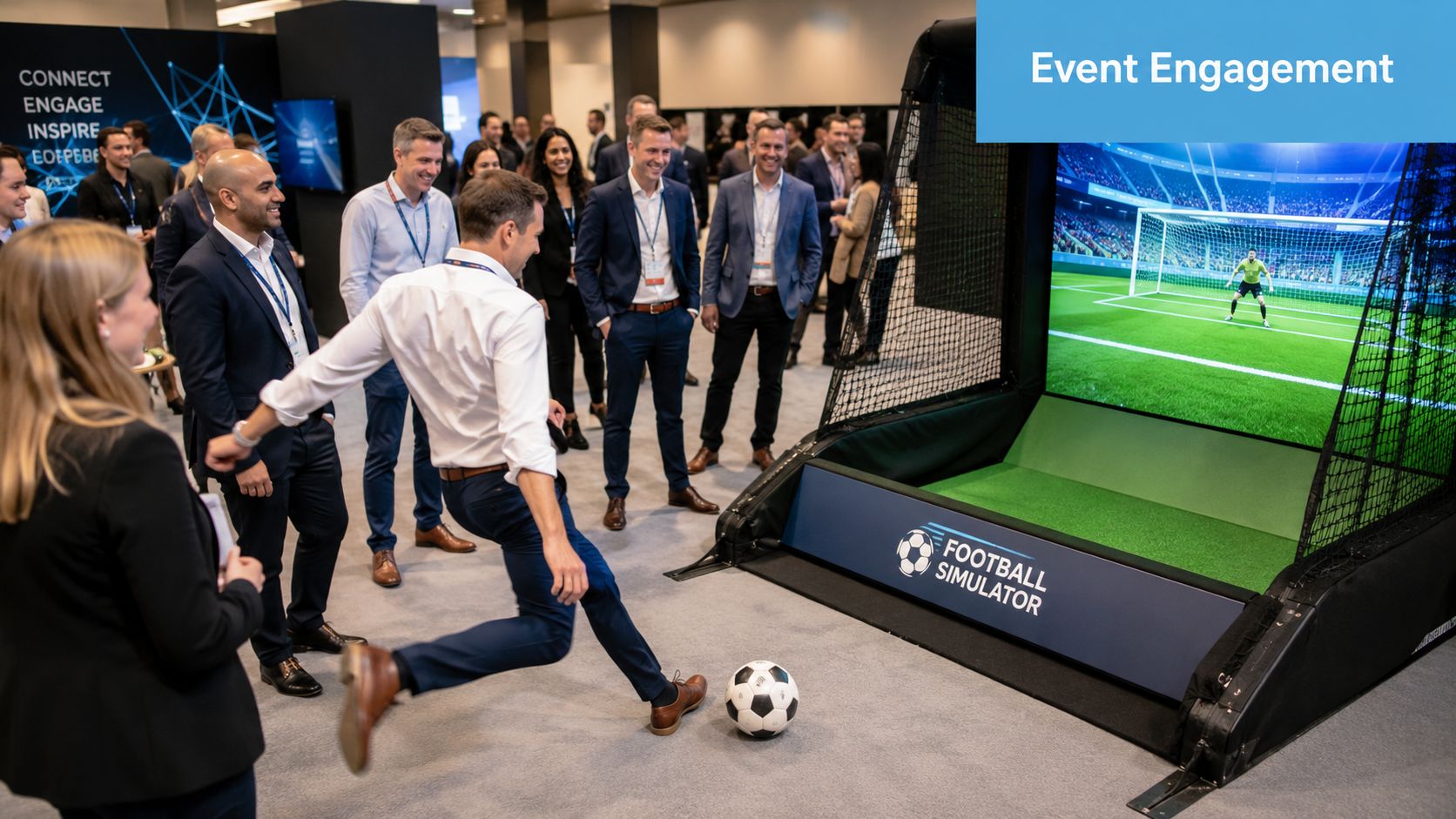
Exhibition stands that need stopping power
At exhibitions, the simulator works best when it sits near the front of the stand and gives spectators a clean sightline. One person plays, several people watch, and your team gets a natural opening line without having to hard-sell.
The most effective setups usually keep the game mechanic simple. Closest to the top corner. Fastest shot. Best of three. Ultimate leaderboard winner. Those formats are easy to explain and easy to reset.
For brands investing in sports fan engagement activations, the biggest gain often comes from what happens around the simulator rather than only on screen. Staff collect details through competition entry, hosts call out high scores, and branded content teams capture usable photos and clips.
Fan zones and brand activations
In a fan zone, authenticity matters more. Guests already have emotional context. They want the challenge to feel connected to the sport, not just football-themed wallpaper around a generic game.
That usually means paying attention to:
- Visual environment: Stadium-style graphics, club colours where appropriate, and a credible goal interface.
- Competition format: Short rounds, head-to-head moments, or timed sessions that suit crowd energy.
- Presenter style: Someone who can keep momentum high without turning it into a forced stage show.
The football simulator becomes a participation anchor. People who don't want to queue still watch. People who watch often convert into players. That spectator-to-player loop is one of the reasons the format works so reliably in open public settings.
Team building that doesn't feel contrived
Corporate team building is different again. The simulator succeeds when it removes social friction. Not everyone wants to do a trust exercise or a problem-solving workshop with strangers from finance and sales.
A football challenge gives people permission to compete lightly. It's familiar, short, and easy to laugh about. You can run knockout brackets, department leagues, or mixed team formats without overcomplicating the day.
The best team-building activities give people something to do together before asking them to network. A football simulator does that quickly.
One caution here. If the whole experience depends on sporting confidence, you lose part of the room. The strongest team-building hires use adjustable difficulty, varied challenge modes, and an operator who can bring hesitant guests in without putting them on display.
Your Ultimate Planning and Logistics Checklist
Most football simulator problems don't start on the event day. They start earlier, when practical questions weren't asked. The booking looked straightforward, but nobody checked loading access, queue width, artwork deadlines, or whether the venue would allow the chosen footprint.
That's why good planning matters more than the headline creative. A simulator should feel simple to the guest because the logistics were handled properly behind the scenes.
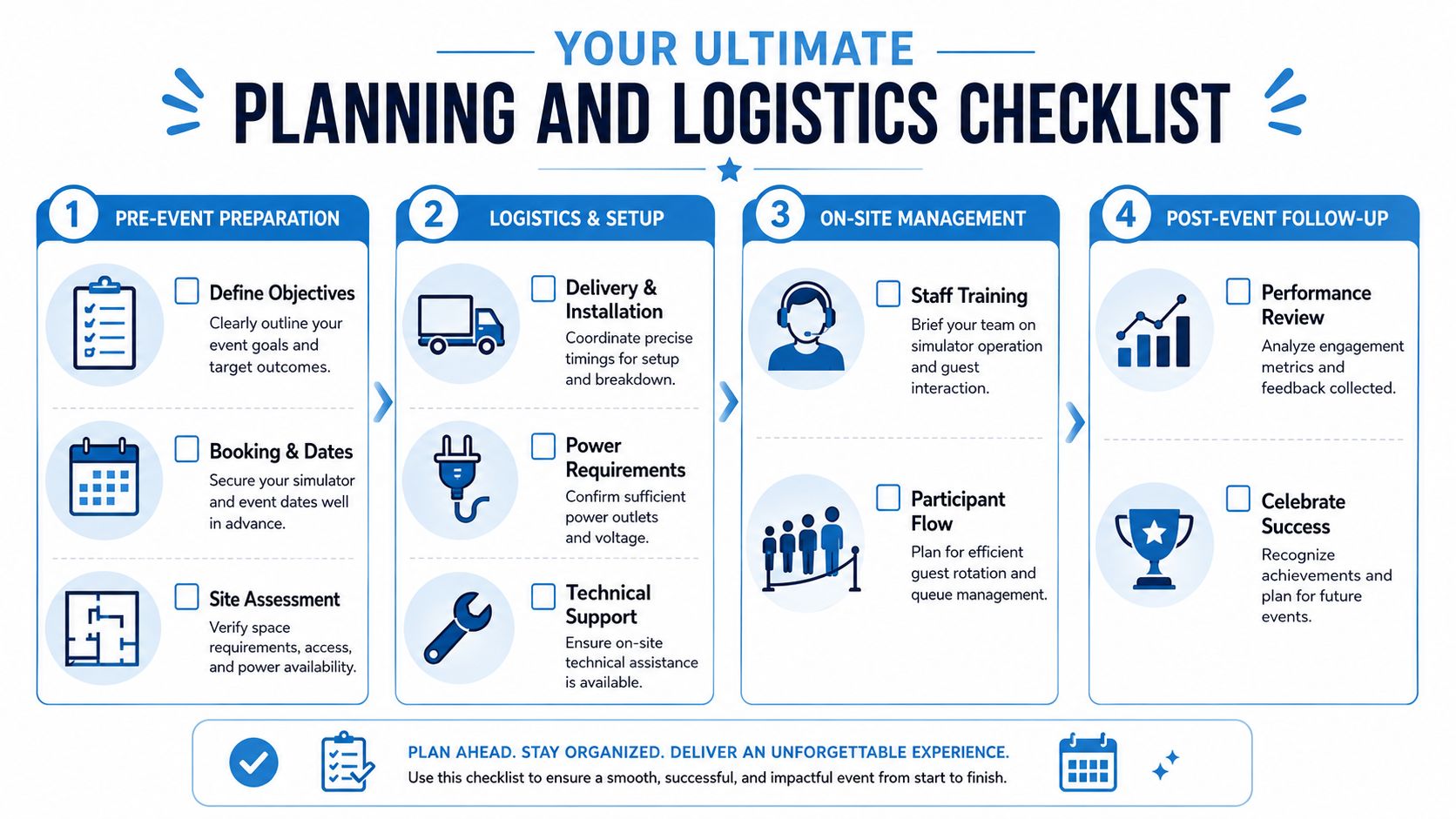
Start with the objective
Before talking about screen size or branding, decide what the simulator must do for the event.
If the goal is lead capture, you need a mechanic that supports registration cleanly. If the goal is stand traffic, visibility and throughput matter more. If the activation is for hospitality or VIP guests, production finish and host quality may matter more than volume.
Ask these questions first:
- Primary outcome: Are you aiming for footfall, data capture, staff engagement, content creation, or hospitality value?
- Audience type: Are these football fans, general B2B guests, families, or mixed demographics?
- Success measure: What will make the hire feel worthwhile after the event?
Confirm space, access, and power early
Many bookings go wrong. “It will fit” isn't enough. You need to know the exact playable space, spectator space, and any ceiling constraints. Then check how the kit gets into the venue.
A proper supplier should talk through:
- Footprint needs: Not just the unit itself, but safe run-up and circulation around it.
- Build access: Lift sizes, dock times, stairs, narrow doors, carpet protection, and loading restrictions.
- Power requirements: Socket type, cable routes, and whether the venue power plan matches the rig.
Outdoor use needs even more scrutiny. The question isn't only whether the simulator can operate outside. The main question is whether the environment can be controlled well enough for safe, reliable use. Wind, glare, moisture, and surface conditions all affect the experience.
Don't treat staffing as optional
A football simulator without a trained operator often underperforms. Guests hesitate. The queue gets messy. Minor technical resets become noticeable. Sales staff get pulled away from their actual job.
On-site crew should cover more than setup. They should manage participation, explain game modes, maintain pace, and keep the attraction looking active. That human layer is a big part of why a premium hire feels premium.
On-site reality: If nobody owns the queue, the game stops being an attraction and starts becoming a blockage.
Build branding into the experience, not around it
Buyers often think of branding as a printed panel or logo board. That's the minimum. The better approach is to integrate the campaign identity into what the participant sees and does.
That can include:
- Screen assets: Branded welcome screens, challenge names, and end screens.
- Leaderboard design: Company colours, campaign title, and prize messaging.
- Physical dressing: Headers, surrounds, backdrops, and queue-line signage.
- Content moments: Winner photos, branded score graphics, or social-ready clips.
Branding only works if it remains readable at a glance. Overloaded screens and cluttered graphics reduce the game's impact.
Get health and safety paperwork before show week
This should be routine, but it still gets left late. For UK venues and agency approvals, you'll typically want risk assessments, method statements where required, and insurance documentation ready in advance. For many corporate and venue environments, £10 million public liability cover is the standard benchmark.
Also check practical safety controls:
- Ball containment: How the setup prevents stray shots from affecting adjacent space.
- Surface suitability: Grip, trip prevention, and cable management.
- Operator procedures: What staff do if a guest needs assistance or the game needs pausing.
Plan GDPR and follow-up at the same time
If the simulator is part of a lead capture strategy, the form design matters as much as the game. Don't collect data just because you can. Collect what your team can use and follow up on quickly.
Keep the flow simple. Name, company, email, opt-in, then play. If the process feels longer than the game itself, conversion usually drops.
Here's a practical checklist you can use with any supplier:
| Category | Key Question | Ideal Standard |
|---|---|---|
| Objectives | What is the simulator meant to achieve? | A single primary goal agreed before booking |
| Space | Do we have room for play, spectators, and queueing? | Full footprint and circulation signed off with venue |
| Access | Can the equipment reach the event space easily? | Loading path confirmed in writing |
| Power | What power supply is required on site? | Requirements checked against venue tech plan |
| Staffing | Who runs the experience during live hours? | Dedicated trained operator included |
| Branding | What can be customised physically and on screen? | Artwork scope and deadlines agreed early |
| H&S | What documents will be supplied? | Risk docs and insurance provided before build |
| Lead capture | How will data be collected compliantly? | Clear opt-in process aligned with GDPR |
| Reporting | What results will be available afterwards? | Agreed post-event summary and usable data export |
Calculating the ROI of Your Simulator Hire
The ROI question is usually framed the wrong way. Buyers ask whether a football simulator “works”, as if the answer is universal. It isn't. The better question is whether it improved the event outcome you cared about.
That means defining the right KPIs before the build starts. If no one agrees what success looks like, the post-event review turns into opinion.
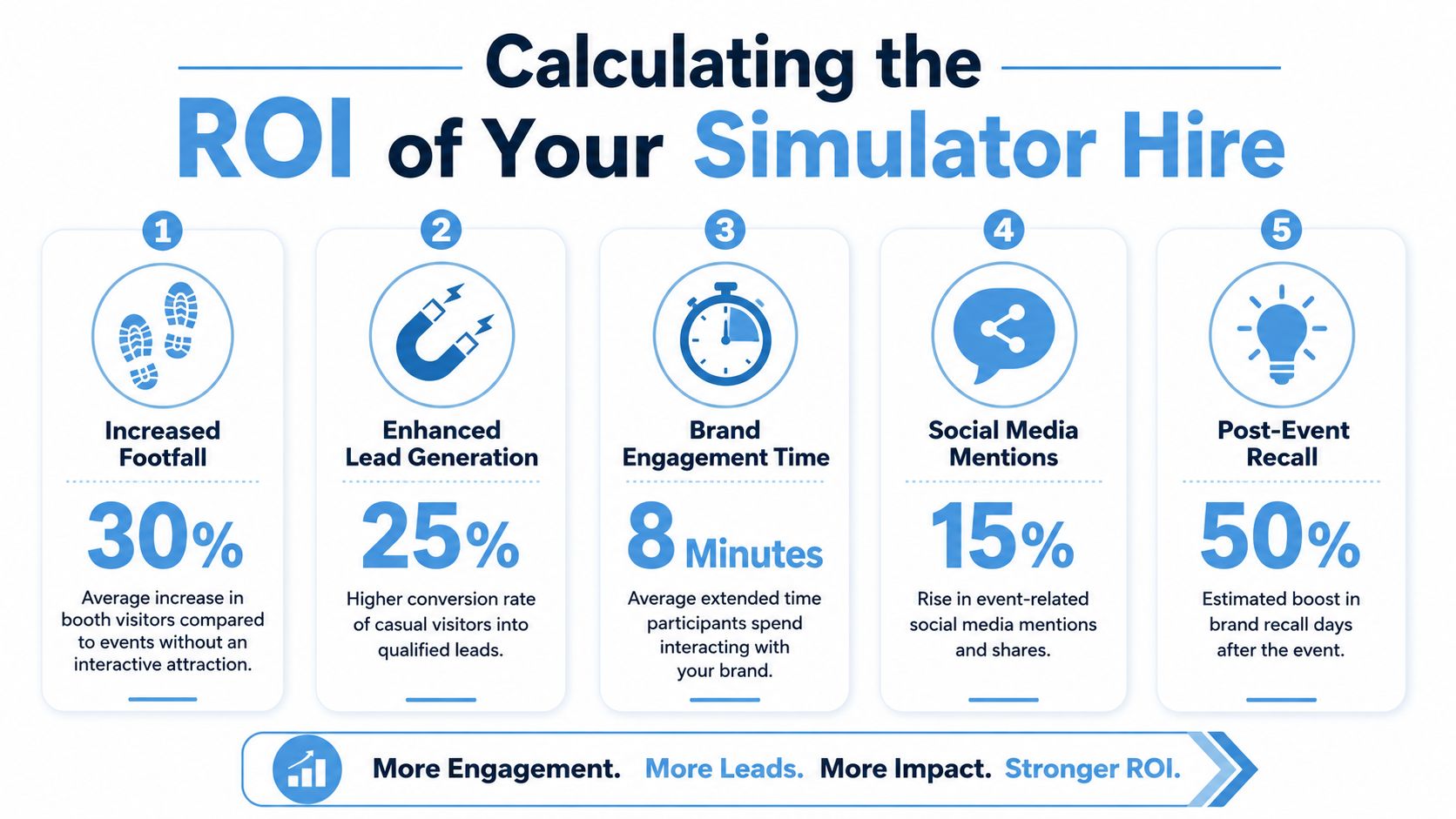
Measure the right event outcomes
For most corporate activations, the useful metrics fall into a few straightforward buckets:
- Footfall: Did more people stop at the stand compared with your normal setup?
- Dwell time: Did visitors stay long enough for meaningful conversation?
- Lead capture: How many opted in, and how many were relevant?
- Content value: Did the activation generate usable photos, clips, or social posts?
- Brand recall: Did attendees remember your brand because of the interaction?
If your team already tracks exhibition performance, compare the simulator event against your own previous benchmark rather than chasing generic averages.
Accessibility has a direct effect on return
Many activations' value is often determined by these factors. A 2025 UK Event Industry Association survey found that 68% of trade show attendees prefer “low-skill, high-engagement” interactive games, yet only 12% of simulator vendors publish accessibility data for non-sports fans, according to Sports Simulator software research. For B2B events, that gap matters.
If the game only appeals to confident football fans, you're narrowing your addressable audience on purpose. If the challenge is welcoming, quick to understand, and adjustable in difficulty, more people join in. More participation usually means more conversations and better value from the floor space you've paid for.
A simple ROI review framework
After the event, review the hire against the original objective:
What did the attraction change?
Did it increase stop rate, improve energy on the stand, or help staff start better conversations?What did it produce?
Look at leads, opt-ins, content, competition entries, or internal engagement.What friction showed up?
Queue length, poor positioning, weak briefing, or overly hard gameplay can all reduce return.What should change next time?
Sometimes the answer isn't “don't book it again”. It's “book the same type of activation with a better flow or better game format”.
For a deeper view of event performance, it helps to connect attraction metrics to wider campaign thinking. This guide to experiential marketing ROI is useful when you need to explain results internally in commercial terms rather than just saying the stand felt busy.
The most profitable event attractions aren't always the flashiest. They're the ones your audience understands quickly and your team can convert efficiently.
Football Simulator Hire FAQs
Can a football simulator be used outdoors
Yes, but outdoor hire needs control measures. A marquee or sheltered structure is often necessary to protect the equipment, maintain screen visibility, and keep the playing surface safe. The right question to ask isn't “can it go outside?” It's “what weather protection and ground conditions are required for reliable operation?”
If the event is exposed and weather risk is high, many planners keep a fallback indoor position or covered contingency plan.
How much lead time do I need for a branded hire
The earlier the better, especially if you want printed branding, custom screen assets, or venue paperwork processed without a rush. A simple hire can often be turned around more quickly than a fully dressed activation, but branding, artwork approval, and logistics all take time.
For agency-led events, build in extra room for client sign-off. Delays rarely come from the simulator itself. They come from creative approvals and venue processes.
Is it suitable for non-football fans
It can be, if the game mode is chosen properly. Penalty formats, target shots, and simple score challenges tend to work well because they don't require deep knowledge of football. Difficulty settings, operator coaching, and a supportive presentation style make a big difference.
This matters at trade shows and conferences where many guests are there for business, not sport.
Is it suitable for different ages and abilities
Often yes, within the limits of the chosen setup and venue environment. The key is to ask about adjustable challenge levels, play area design, and how the operator supports guests who may want an easier or more relaxed experience.
A professional supplier should openly discuss who the setup is and isn't suitable for, rather than pretending every format fits every participant.
What makes a high-end football simulator better than a cheap alternative
The difference usually shows up in tracking quality, responsiveness, reliability, and operator support. Cheaper systems may look acceptable from a distance but feel inconsistent once people start playing. That affects trust, competition fairness, and the overall polish of the activation.
Professional football simulators use high-efficiency, Rust-based simulation engines and AI to model complex ball physics and tactical scenarios in real time, which is one reason they feel more responsive than simpler arcade-style alternatives, as described by MakerX's analysis of football simulation engines.
Do I need an operator on site
For nearly all corporate events, yes. An operator protects the guest experience. They keep the game moving, explain the challenge, manage minor resets, and help maintain safe participant flow.
If you remove that role to save cost, your own event staff often end up filling the gap badly and reluctantly.
What should I ask a supplier before booking
Keep it practical:
- What exact footprint is required on site
- What access and power do you need
- What branding options are included
- Who operates the game during live hours
- What H&S documents do you provide
- How does lead capture work if we want it
- What happens if the venue or weather conditions change
Good answers are usually detailed and calm. If the replies stay vague, that's often a warning sign.
If you're planning a football simulator hire and want experienced support on logistics, branding, staffing, and delivery, PSW Events can help you build an activation that works in practice, not just in a pitch deck.