
You've booked the stand, approved the graphics, briefed the team, and sorted the giveaways. Then the event opens and the problem becomes obvious. Your stand looks fine, but “fine” rarely pulls a crowd.
A cycling simulator changes that dynamic fast. Instead of asking people to stop for a conversation, you give them a reason to engage first. Competition creates noise. Screens create theatre. Leaderboards create repeat visits. That combination matters when your goal isn't just visibility, but conversations, data capture, and a stand people remember after the hall clears.
Why Your Event Needs More Than Just a Banner
At most exhibitions, passive stands all blend together. Branded backwalls, literature racks, and a bowl of sweets don't give attendees much reason to stop unless they already planned to speak with you. That's a weak position if your team needs fresh leads or stronger footfall.
A cycling simulator changes the social behaviour around your stand. One person rides. Two colleagues film it. A few more stop to watch the leaderboard. Suddenly your activation isn't static. It has pace, noise, and a reason for people to gather.
Passive visibility versus active engagement
The difference is simple. A banner delivers a message. An interactive challenge creates a moment. For corporate marketers, that's the more valuable asset because moments give sales teams an opening.
At trade shows, the best-performing activations usually do three things well:
- They attract attention from a distance. Movement on screen and live competition pull eyes across a busy hall.
- They hold people in place. Riders stay for their attempt, and spectators often stay for several.
- They give staff a natural opener. “Want to beat the top time?” works better than “Can I tell you about our services?”
That's why cycling simulators sit naturally within wider experiential marketing activations. They aren't just entertainment. They create the conditions for better conversations.
A busy stand doesn't happen because branding is polished. It happens because people can see something worth joining.
Why this matters to a marketing manager
If you're responsible for event performance, the challenge isn't only getting noticed. It's making sure the activity supports a commercial objective. A cycling simulator helps because it can be shaped around the outcome you need. One event might use it to build queues and increase dwell time. Another might use it to support internal team engagement. Another might use it as the front end of a lead capture mechanic.
What doesn't work is treating the simulator as a novelty and hoping the crowd somehow converts. The attraction gets attention. The format, staffing, and follow-up turn that attention into value.
What Exactly Is a Cycling Simulator for Events
A cycling simulator for events is best understood as a physical racing game powered by the rider. It combines a real bike position with a smart resistance unit and software that displays a virtual course on screen. The rider pedals, the system responds, and the audience sees the performance live.
That's very different from putting a spin bike on a stand and calling it interactive. A gym bike gives you exertion. A proper simulator gives you feedback, competition, and spectacle.
The three parts that matter
First, there's the rider interface. That usually means a road-bike-style setup mounted to a smart trainer or purpose-built simulator frame, so the experience feels closer to real cycling than generic gym equipment.
Second, there's the resistance control. Event-quality systems differentiate themselves through resistance control. Modern cycling simulators achieve route fidelity through “ergo” control protocols that map virtual gradient changes to real-time resistance modulation with a latency of under 100 milliseconds, creating a direct cause-and-effect feel. A 5% virtual climb can instantly increase trainer resistance by approximately 25 watts for a rider at 100w output, according to the referenced explanation of indoor cycling resistance behaviour in this ergo control overview.
Third, there's the software layer. That's the visual world, the route logic, the timing system, and often the leaderboard. This is what turns effort into an experience people can follow.
A simple visual summary helps clarify it:

Why attendees respond to it
People understand competition instinctively. They don't need a technical briefing. They see a bike, a course, a timer, and a score. That's enough.
For events, that matters because low-friction participation wins. If attendees need too much explanation, queues collapse. If the challenge is obvious, staff can onboard people quickly and keep the activation moving.
A strong event setup usually includes:
- A clear challenge mechanic. Fastest lap, shortest sprint, or head-to-head race.
- A spectator-friendly display. Riders need feedback, but the crowd also needs something legible.
- Visible results. Rankings give people a reason to return later and check whether they still lead.
What it is not
It isn't a cycling studio class. It isn't a wellness bike hidden in a quiet breakout room. And it isn't automatically immersive just because there's a screen.
Practical rule: If the rider can't feel the course changing and the audience can't follow the result, you've hired an exercise bike, not a true event simulator.
That distinction matters when budgets are under scrutiny. If you're paying for a feature attraction, it needs to work as both participant experience and visual magnet.
Simulator Types and Race Formats Explained
Not every event needs the same cycling simulator setup. A trade show stand has different demands from a staff engagement day or hospitality suite. The smartest choice usually comes down to one question. Do you want a steady stream of individual participants, or do you want a crowd gathered around direct competition?
Hardware setups that fit different event goals
A single-bike setup is often the most efficient option for exhibitions. It takes less floor space, keeps queue management simple, and works well when the objective is high turnover with quick participation. It's also easier to integrate with lead capture because each rider has a defined start and finish moment.
A multi-bike rig changes the atmosphere. Head-to-head racing creates more theatre and more noise, which is ideal when crowd energy is part of the brief. The trade-off is operational. You need more space, more supervision, and a format that keeps both bikes occupied consistently.
A premium visual setup with a large screen or event-facing display is often more important than adding another bike. Plenty of activations fail because the participant can see the race, but nobody else can.
For brands comparing suppliers, it helps to review a range of simulator hire options in relation to venue footprint, queue flow, and staffing, not just headline visuals.
Choosing the Right Cycling Event Format
| Event Format | Best For | Key Feature |
|---|---|---|
| Time Trial | Trade shows and exhibitions | Individual attempts feed a live leaderboard and support straightforward lead capture |
| Head-to-Head Race | Brand activations and hospitality spaces | Two riders compete live, which creates stronger spectator appeal |
| Team Relay | Team-building days and internal events | Shared performance turns the activity into collaboration rather than solo effort |
| King of the Mountain | Sports-themed events and endurance challenges | Climbing effort creates a dramatic finish and a clear “hero” moment |
| Fastest Sprint | High-footfall venues with limited time | Quick attempts keep queues moving and lower the barrier to entry |
What works in practice
The time trial format is usually the safest commercial choice. It's simple, quick to explain, and easy to brand around a “beat the clock” mechanic. Marketing teams also like it because every rider generates a result that can be tied to a name, company, or follow-up action.
Head-to-head works best when atmosphere matters more than throughput. It's ideal for hospitality, VIP spaces, or launches where people want visible competition. It's less effective on a very crowded exhibition stand if queue discipline is poor.
Team relay is excellent for internal events because it changes the conversation. Instead of focusing on who's fittest, it gives mixed groups a shared goal. That usually lands better with departments that want participation across the business rather than a handful of serious riders dominating the activity.
If your objective is lead capture, choose the format with the shortest explanation and the clearest finish point.
Common mistakes to avoid
Some planners overcomplicate the activation with too many rules. If staff need a script to explain the game, you're making the barrier to entry too high.
Other teams choose a long endurance format because it sounds impressive. On a busy stand, that often backfires. Long rides reduce throughput and make it harder for more attendees to take part.
The most reliable event formats are usually the simplest. Short, visible, competitive, and easy to reset.
Driving Real ROI with Simulator Activations
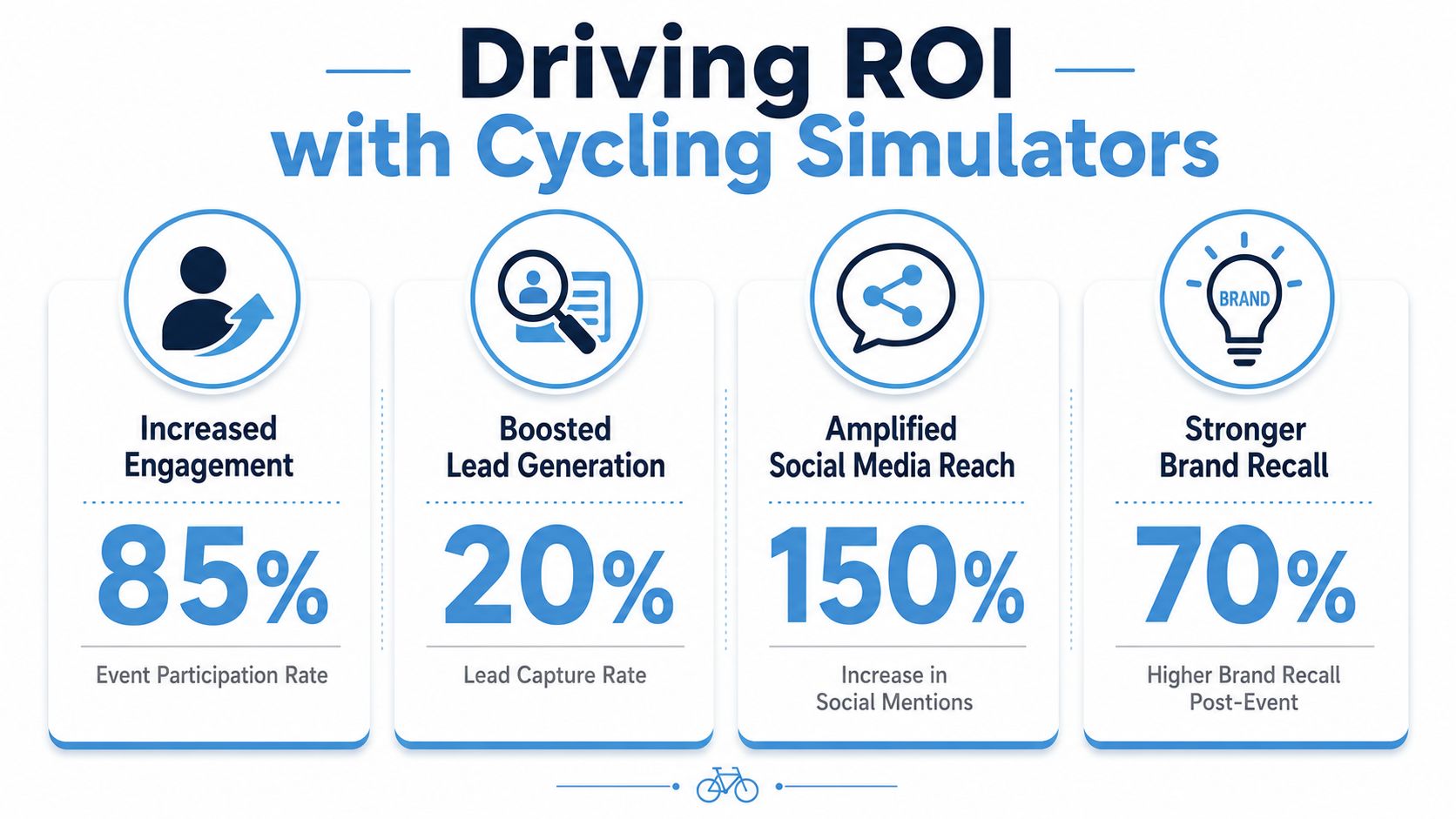
The business case for a cycling simulator isn't “people enjoyed it”. That's nice, but it won't defend a budget. The stronger case is that it gives your team a structured way to attract prospects, start conversations, capture details, and create branded content on the stand.
That only happens when the activation is designed around outcomes, not just participation.
What marketers can measure
A cycling simulator gives you several practical points of measurement. Footfall is the obvious one. If the activation is positioned well, people stop because they can see movement, competition, and a score worth watching.
Dwell time is often the next gain. Participants stay for their ride, but just as important, spectators often stay to watch colleagues or rivals take a turn. That creates a longer window for staff to qualify interest and book follow-up conversations.
For teams that want a clearer reporting structure after the event, it helps to define how you'll track event KPIs before the stand opens. The simulator becomes more valuable when it's tied to named metrics rather than described as a crowd-puller.
This visual is useful as a reminder of the business lens many stakeholders apply:
Where the return actually comes from
The strongest return usually comes from combining the attraction with a simple data journey. That might be leaderboard entry, prize registration, or a post-ride results email. The key is that the mechanic feels like part of the game, not a separate admin task.
Some corporate teams also want the activation to deliver a more substantive takeaway. That's where the less obvious capabilities matter. Beyond simple race wins, simulators can provide tangible health or performance insights by measuring rider asymmetry, which supports the demand for more meaningful “measurable moments” in wellness-led event formats, as noted in this reference to rider asymmetry in simulator-based assessment.
That's useful when the budget owner sits in HR, internal communications, or employee engagement rather than straight brand marketing.
What doesn't produce ROI
The common failure points are predictable:
- No capture mechanism: People ride, enjoy it, and leave with no useful follow-up path.
- Poor staffing: A queue forms, but nobody converts attention into conversations.
- Weak branding integration: The activity is memorable, but attendees remember the game, not the sponsor.
- No reporting plan: The team knows the stand felt busy, yet can't prove what that delivered.
A more disciplined approach ties the activation to a specific event outcome. If the brief is awareness, design for spectacle. If it's pipeline, design for qualified interactions. If it's internal engagement, design for inclusive participation and post-event reporting.
For planners weighing spend against outcome, that's the right benchmark for experiential marketing ROI. Attention is useful. Structured attention is what pays back.
Your Practical Guide to Hiring a Cycling Simulator
Hiring a cycling simulator is usually simpler than clients expect, but the details matter. The smoothest projects start with the practical questions early. How much space do you have, what does access look like, how visible does the setup need to be, and what do you want people to do after they ride?
Those decisions shape the package more than the bike itself.
Start with operations, not visuals
A planner's first instinct is often branding. That matters, but the better starting point is logistics. The supplier needs to know the venue, access times, floor loading conditions if relevant, and whether the activation sits in an open exhibition aisle, a private hospitality suite, or a conference breakout.
Then look at compatibility and technical standards. In the UK market, 78% of corporate event cycling simulator setups use Bluetooth FTMS and ANT+ FE-C to support major training apps, and that technical standard ensures 95% of rider power variance is accurately captured during high-intensity sessions in venues such as ExCeL London, according to this UK training app and connectivity guide. For a marketing manager, that isn't trivia. It's a sign that the setup can deliver a responsive, credible experience rather than laggy, unreliable gameplay.
The hiring checklist I'd use
- Space planning: Ask for the full footprint, not just the bike dimensions. You need rider space, queue space, staff working room, and sightlines for spectators.
- Power and screen position: Check where the nearest supply is and whether cables can be routed safely without compromising presentation.
- Access window: A great setup can still become stressful if the venue only allows a tight load-in.
- Branding surfaces: Clarify what can be branded. Screens, leaderboard graphics, bike surrounds, backdrops, and surrounding scenic all create different levels of visibility.
- On-site staffing: Don't assume your stand team can run the attraction properly while also selling. Dedicated operators usually make the activation cleaner and more productive.
- Risk documents: Ask for method statements, risk assessments, and insurance confirmation before sign-off.
Good event tech feels easy on the day because someone handled the difficult details in advance.
Branding and delivery expectations
The strongest activations treat the simulator as part of a wider stand environment. That can include branded race names, custom leaderboard graphics, prize messaging, and supporting scenic that frames the activity rather than leaving it exposed in open space.
If you're comparing suppliers, look closely at whether they only deliver hardware or whether they handle transport, installation, staffing, and health and safety compliance as part of the hire. PSW Events is one example of a supplier that provides cycling simulator hire within a broader turnkey event delivery model, alongside planning, branding, logistics, installation, and on-site staffing.
That full-service approach is often the safer option when the event team is already managing multiple moving parts.
Advanced Applications Beyond the Basic Race
A lot of event activations stop at “fastest rider wins”. That works, but it leaves value on the table. The more interesting applications come when the cycling simulator is used to create a skill-based challenge, a wellness conversation, or an experience adapted for the venue itself.
That's where the format becomes more than stand entertainment.

Realism as a differentiator
At motorsport venues and premium hospitality events, attendees often expect something closer to racing than fitness. Existing simulator content often neglects the biomechanics of braking and cornering, which weakens the promise of immersion in corporate team-building and branded racing experiences. Simulators that address virtual cornering offer a clear point of differentiation, as discussed in this article on virtual cornering in bike training software.
That matters in practice. If the event is hosted at a circuit or in a performance-led environment, realism builds trust in the activation. Riders don't just push watts in a straight line. They engage with the challenge more like a race.
The more closely the experience matches the audience's expectation of “real riding”, the easier it is to justify premium positioning.
Wellness and personalised feedback
The other advanced use case is corporate wellbeing. A race format is fun, but some organisations want a more personalised takeaway. In those cases, the simulator can support a discussion around pedalling efficiency, rider balance, or coaching-style feedback rather than pure competition.
That changes the tone of the activation. Instead of rewarding only the fastest participant, you create value for a wider group, including people who wouldn't normally volunteer for an all-out race.
A useful way to frame this with internal stakeholders is by comparing event design to customer journey design. Just as tourism operators think carefully about equipment fit and route suitability, such as the rider-focused framing in these Great Taste Trail bike options, event planners can shape cycling activations around comfort, confidence, and individual experience rather than raw performance alone.
Better use cases for advanced setups
These formats tend to work especially well in a few settings:
- Motorsport and premium sports venues: Realistic handling and course behaviour support the venue story.
- Corporate wellness days: Data-led feedback gives participants something more personal than a leaderboard result.
- Executive hospitality: A nuanced skill challenge often lands better than a loud, purely physical contest.
- Innovation showcases: Advanced simulation features help technology brands demonstrate sophistication, not just fun.
The key is alignment. Advanced features only matter when they support the event brief.
Get Your Next Event in the Fast Lane
A cycling simulator earns its place at an event when it does more than entertain. It should pull people in, keep them engaged long enough for your team to act, and support a clear commercial or internal objective.
That's why the format matters so much. The right setup can create a steady flow of qualified stand interactions, a stronger team-building moment, or a branded centrepiece that people talk about after the event. The wrong setup becomes a busy-looking distraction with no clear return.
The practical trade-off is straightforward. If you want a simple crowd magnet, a short competitive format usually works. If you want richer value, build in lead capture, branded results, or a more advanced use case such as realism-led racing or wellness feedback. The technology can support both, but the event design has to be intentional.
For marketing managers and event planners, that's a significant opportunity. A cycling simulator gives you a flexible tool that can be shaped around exhibitions, conferences, product launches, hospitality, and internal engagement. It's visible, easy to understand, and adaptable to very different audiences.
If your next event needs more than static branding, it's worth mapping the activation before you brief suppliers. Define the audience, the format, the data capture point, and the role your staff will play around the experience. Once those pieces are clear, the simulator becomes far easier to cost, plan, and justify.
If you're exploring ideas for a conference, exhibition stand, team day, or branded activation, speak with a specialist supplier early and ask for a proposal built around your event objective rather than a generic package. That's how you turn a cycling simulator from a nice attraction into a working part of your event strategy.