
You're probably balancing the same pressures most corporate planners face. The stand needs to pull people in, the activation needs to justify its footprint, and the sales team needs something better than another bowl of sweets and a branded pen. A passive setup rarely solves that.
A cycle simulator works when you need attendees to stop, participate, stay longer, and give your team a reason to start a proper conversation. Used well, it isn't just a novelty. It becomes a structured event tool that supports lead capture, branded content, timed competition, and memorable face time with your audience.
Transform Your Event from Static to Sensational
A flat event usually looks the same every time. A neat stand. Good graphics. Staff waiting for the right person to wander over. Visitors glance, smile, and keep moving because nothing on the stand gives them a reason to stop.
A cycle simulator changes that dynamic fast. The moment one attendee starts riding, other people watch. Then someone asks how fast they can go. Someone else wants to beat the score. Your stand shifts from display space to live activity.
That matters because planners don't need abstract “engagement”. They need visible momentum on the floor. They need a stand that signals activity from aisle distance and creates a natural queue without looking chaotic. That's where a simulator earns its place.
Why passive stands struggle
Static branding can explain a message, but it can't create shared energy on its own. People at exhibitions respond to movement, competition, and visible participation. A cycle simulator gives you all three in a format that's easy to understand instantly.
It also helps your team avoid forced prospecting. Instead of trying to interrupt passing delegates, staff can start with a simple prompt such as leaderboard position, race time, or route choice. The interaction begins with the experience, not the sales pitch.
Practical rule: If attendees can understand the activity within three seconds of looking at it, your attraction has a much better chance of generating steady traffic.
Where it fits best
The strongest results usually come when the simulator is part of a broader activation rather than a standalone gimmick. It works particularly well inside experiential marketing activations where the ride, screen graphics, scoring, and branded challenge all point back to a campaign objective.
Typical examples include:
- Exhibition stands: Draw footfall from the aisle and create a live focal point.
- Conferences: Add energy to sponsor areas that otherwise feel static between sessions.
- Team days: Turn a simple activity into structured competition between departments.
- Product launches: Give guests something physical and visual to associate with the brand.
The essential change is this. People stop remembering the event as “the one with the nice stand” and start remembering it as “the one where we raced on the bikes”.
What Is a Cycle Simulator
At event level, a cycle simulator is best understood as a high-tech spin bike connected to interactive software and a display system that turns pedalling into a live digital experience. That could be a timed hill climb, a sprint challenge, a scenic route, or a head-to-head race.
The core idea is simple. The rider pedals a physical bike, the software reads that effort, and the screen responds in real time. That feedback loop is what makes it compelling. People aren't just exercising on a static bike. They're controlling something visible.
The three parts that matter
Most event-ready setups rely on three components.
- The bike hardware: This is the physical riding position, resistance system, and sensor setup. Good hardware feels stable, easy to mount, and responsive enough that first-time users understand it immediately.
- The software layer: This controls route visuals, competition logic, speed response, and often the leaderboard or scoring mechanism.
- The display: This is what sells the experience to the crowd. A single large screen works well for throughput. A more immersive setup can create a stronger premium feel.
For a planner, the question isn't whether the technology is clever. The question is whether it's intuitive under event conditions. Can a delegate in work shoes get on, start quickly, and understand what success looks like within moments? If the answer is yes, the attraction will usually perform well.
What realism actually means
Not every simulator needs to feel like elite sports training gear, but realism still matters. Research-grade bicycle simulators have shown how advanced systems can replicate riding behaviour with precise lateral and roll dynamics, using steering, braking, and speed inputs with less than 5% error compared with outdoor cycling in validation work published in this bicycle simulator study.
That level of realism is more than most event activations require, but it highlights an important point. Better simulator design improves user confidence. Riders trust the experience more when the bike responds naturally, the screen feedback feels immediate, and the controls don't feel vague.
A good event simulator doesn't need to overwhelm people with complexity. It needs to feel credible, stable, and easy to use under pressure.
What attendees experience
From the rider's point of view, the best activations feel straightforward:
- Get on the bike.
- Receive a quick briefing.
- Start pedalling.
- See progress instantly.
- Finish with a score, time, or ranking.
That simplicity is what keeps queues moving and participation high. If a simulator needs too much explanation, throughput drops and the crowd loses interest. If it's clear, fast, and visually strong, it becomes one of the easiest interactive formats to deploy at a busy event.
Choosing the Right Cycle Simulator Technology
Not all cycle simulator setups do the same job. One format is built for throughput. Another is built for immersion. Another is built for competition that spectators can follow. The right choice depends on your event objective first, and the technology second.
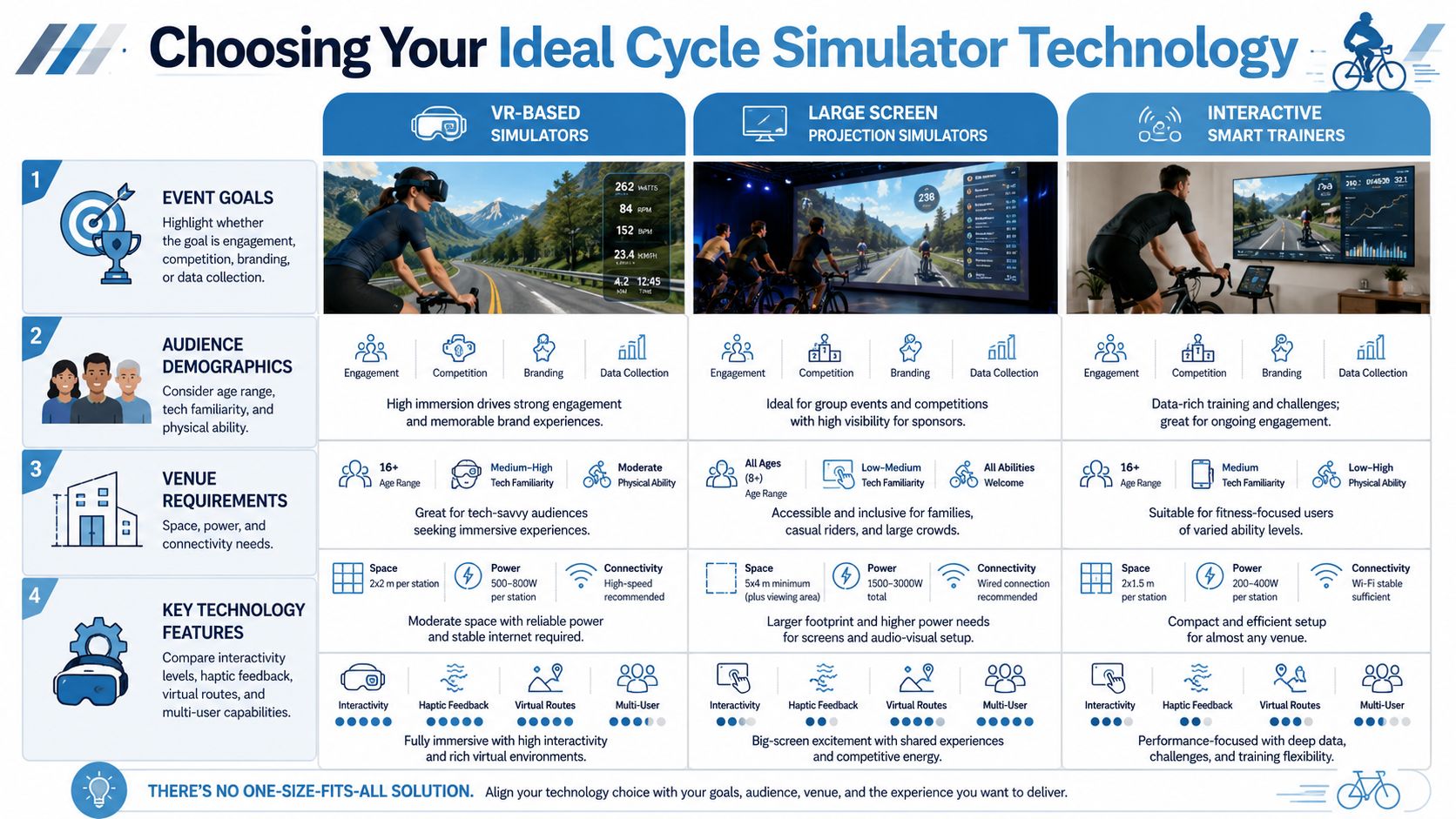
Three common event formats
Here's the practical comparison planners usually need:
| Simulator type | Best for | Strengths | Trade-offs |
|---|---|---|---|
| VR cycle simulator | Premium demos, product launches, innovation zones | Deep immersion, strong novelty, memorable one-to-one experience | Lower throughput, more operator input, some guests prefer not to wear headsets |
| Large-screen competitive rig | Exhibition stands, conferences, footfall-led activations | Easy to watch, easy to understand, excellent for leaderboards and crowd building | Less immersive for the rider than VR |
| Motion or high-realism platform | VIP experiences, specialist showcases, technical activations | Strong realism, premium feel, more convincing ride feedback | More space, more setup complexity, often best for smaller groups |
Match the technology to the business goal
If your goal is aisle-stopping visibility, a large public-facing screen beats a headset most of the time. People need to see the action from a distance. A visible race, timer, or leaderboard does that far better than a participant wearing VR goggles.
If your goal is a premium hosted experience for selected guests, VR can be excellent. It feels distinct, more personal, and better suited to a carefully managed flow.
If your audience includes serious riders, engineers, or a technically curious crowd, realism matters more. In those cases, details such as steering response, braking input, and stable ride physics become part of the attraction's credibility. For planners working with performance-led audiences, these insights on cycling functional threshold power are useful background because they show how cyclists think about effort, pacing, and performance metrics.
What works in busy venues
The simplest format often wins on the show floor. A bike facing a large branded display, with a clear challenge and visible score, is easier to manage than an over-engineered setup.
Ask these questions before choosing:
- Will people understand it instantly? If not, participation slows.
- Can spectators enjoy it too? Public visibility matters.
- How much operator support does it need? Some systems need more hands-on management.
- Does the venue suit the experience? Ceiling height, noise, space, and queue flow all affect the choice.
Selection rule: Choose the simulator that supports the event format you actually have, not the demo you admired in a showroom.
The best hire isn't always the most advanced system. It's the one that fits the room, the audience, and the outcome you need.
The Business Case for Simulator Hire
Most event attractions fail budget scrutiny because they're framed as entertainment. A cycle simulator gets approved more easily when it's positioned as a working part of the stand strategy. It gives attendees a reason to stop, gives staff an easier opening line, and gives the brand a visible focal point.
That's the difference between “something fun” and “something useful”.
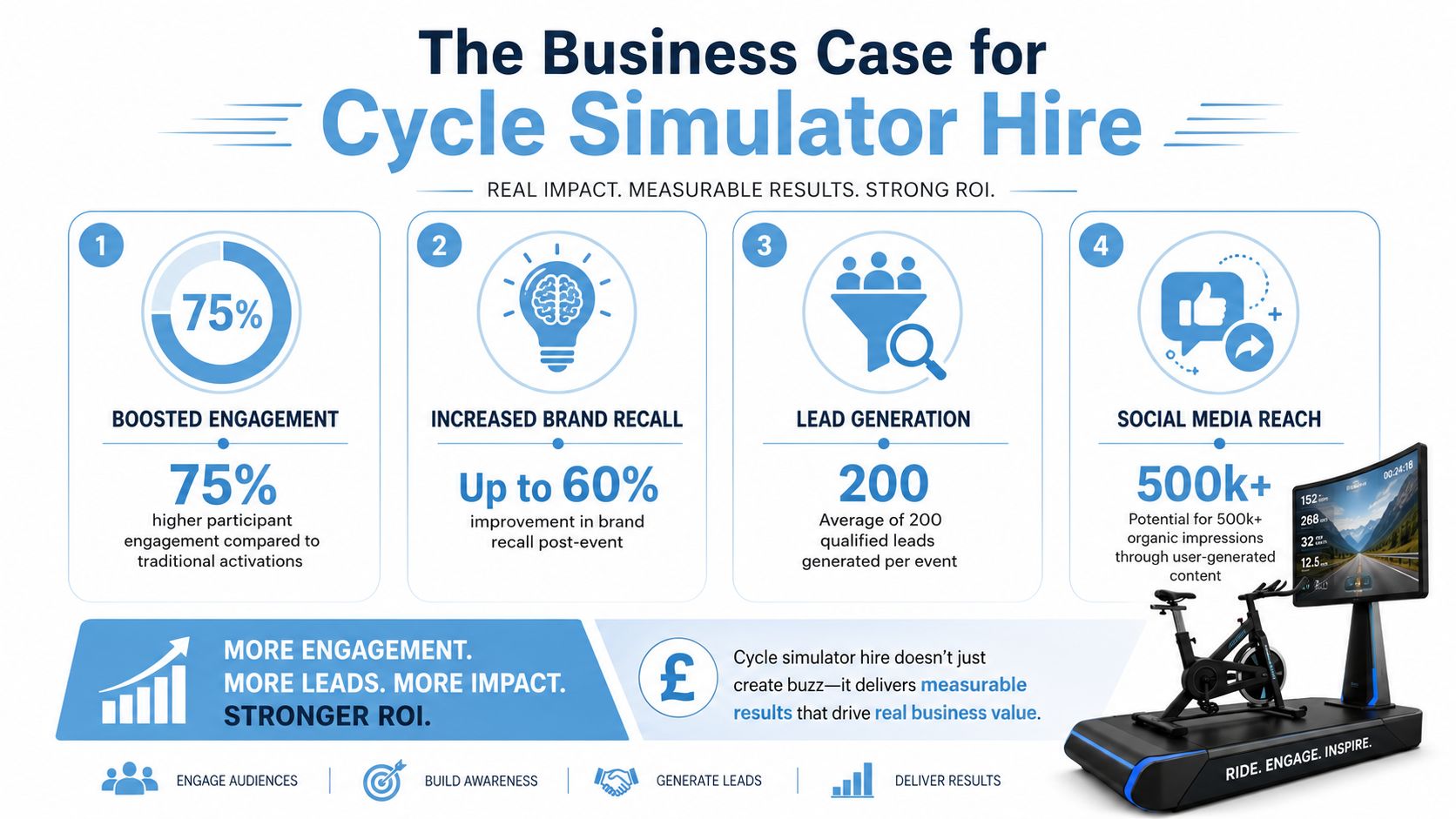
Why cycling is a strong event theme
A cycle simulator benefits from a built-in public familiarity with cycling. In England, participation grew from 5,044,400 in 2016 to 6,479,900 in 2021, which is an increase of over 28%, and household spending on bicycles reached £2.3 billion in 2021 according to the UK government's walking and cycling statistics for England.
That matters commercially. You're not asking attendees to decode a niche sport. Attendees immediately understand what the bike is, what the challenge involves, and how to take part.
How it supports measurable event objectives
A cycle simulator can help with business outcomes in ways that static stands usually can't:
- Footfall quality: The attraction creates a visible reason to approach the stand.
- Dwell time: Participants stay longer because the interaction has a beginning, middle, and end.
- Lead capture: Staff have a natural moment to collect details around entry, results, or prize mechanics.
- Brand memory: Physical participation tends to leave a stronger impression than passive viewing.
- Content creation: Screens, scores, and rider reactions create useful moments for event photography and social posts.
If you need internal buy-in, frame the hire around measurable activation design. That means agreeing in advance what success looks like. Strong planners often tie the simulator to stand KPIs and post-event reporting, not just experience design. In this context, a structured view of experiential marketing ROI becomes useful.
What doesn't work
A simulator won't fix a weak stand concept by itself. It underperforms when:
- the branding on screen is generic
- no one is managing the queue
- staff don't know how to convert participation into conversation
- the challenge has no obvious reward, score, or story
If you can't explain why the simulator is on the stand in one sentence, attendees will enjoy it but your team may struggle to convert the attention into value.
The best business case is practical. The simulator attracts the crowd, your team qualifies interest while people wait or recover, and the brand becomes part of a memorable interaction rather than background decoration.
Key Hire Considerations for Event Planners
Once you've decided to hire a cycle simulator, the practical details start determining whether the activation feels polished or stressful. Most problems aren't caused by the bike itself. They come from rushed planning around footprint, queueing, power, branding, and staffing.

Space and venue fit
The bike is only part of the footprint. You also need room for safe rider access, a clear operator position, waiting participants, and spectators who stop to watch. If you're using a large screen or branded backdrop, sightline planning matters too.
Ask for a proper floorplan before sign-off. In exhibitions, a simulator pushed too close to the aisle can create congestion. In conferences, placing it near catering can create sound clashes and awkward traffic flow.
Check these basics early:
- Access route: Can the equipment get from loading bay to stand without issue?
- Build timing: Does the setup window match venue rules?
- Power position: Is the nearest supply practical for the final layout?
- Surface condition: Stable flooring matters for rider confidence and equipment setup.
Branding and game format
A generic ride experience rarely delivers the strongest brand result. What works better is a branded challenge with a visible reason to care. That could be a sprint to a milestone, a route themed around a campaign, or a leaderboard tied to a giveaway.
Good branding usually appears in four places:
- On-screen visuals and start screens.
- Leaderboard or results display.
- Physical set dressing around the bike.
- Staff script and competition mechanic.
The key is restraint. Too much messaging makes the experience feel like an advert. Too little and people remember the ride but not the brand.
Staffing and participant flow
A simulator should never be left to run itself at a corporate event. You need at least one person focused on operation and rider handover, especially when queues build. On larger stands, a second person often helps by handling registration, encouraging spectators, and feeding leads to the client team.
A strong operator does more than explain the controls. They keep the pace up, make the scoreboard feel live, and stop dead time between riders.
Smooth throughput is usually the difference between a popular attraction and a productive one.
Safety and compliance
This part matters more than many planners expect. A professionally managed simulator gives guests a controlled way to experience cycling-themed competition without the unpredictability of real roads. That context matters because UK cycling safety concerns remain significant. One source reports that only 37% of cyclists feel safe all the time when cycling alone, while 56% feel safe sometimes and 7% never feel safe, and between 2015 and 2020 there were on average 2 pedal cyclist deaths and 83 serious injuries per week in Great Britain according to these UK cycling safety statistics.
For event planners, the implication is clear. The simulator must be managed as a public interactive activity, not treated like a spare gym bike. Ask the supplier about:
- Risk assessments: Specific to venue, audience, and event type.
- Insurance cover: Public liability and related operational cover.
- On-site supervision: Who stays with the equipment during live hours.
- User suitability guidance: How riders are briefed and screened where appropriate.
If you're comparing suppliers, look beyond the headline hire fee. The better benchmark is whether they can handle the full delivery, including planning, setup, operation, and H&S. That's especially important when booking through a specialist in simulator hire for corporate events.
Cycle Simulators in Action Inspiring Use Cases
The easiest way to judge a cycle simulator is by the role it plays in a live environment. The same hardware can behave very differently depending on the brief.
Trade show stand with low passing traffic
A common problem at exhibitions is that the stand looks professional but doesn't interrupt attendee movement. A head-to-head cycle challenge solves that by creating visible motion and a reason for people to watch before they commit to joining in.
The strongest setup here is usually a public-facing screen, branded race graphics, and a simple leaderboard. One rider attracts a small crowd. The crowd supplies social proof. Then the queue starts to build.
What makes it work isn't just the bike. It's the scripting. Staff invite people to beat the current best time, photograph the effort, and continue the conversation while they catch their breath.
Team-building day with mixed confidence levels
Cycle simulators work well in team days because people can contribute without needing advanced sporting ability. A short sprint, a relay format, or a department leaderboard keeps the activity inclusive while still feeling competitive.
If you're shaping a broader team day, it helps to look at wider ideas alongside the simulator. For planners assembling a mixed programme, these team building tips from ABC Hire are useful because they show how interactive activities work best when paired with clear objectives and simple participation rules.
Teams respond better to short, well-explained challenges than long formats that create queues and uncertainty.
Product launch with premium immersion
For a launch event, the cycle simulator can become part of the product story rather than a side activity. A wellness brand might use scenic virtual routes. A mobility campaign might use an urban ride. A sustainability activation might centre the experience around active travel.
At the higher end, immersive formats can go much further. Transport safety research has used simulator environments built as a five-display cave with room-scale tracking and motion-tracked controllers to support fully immersive cycling scenarios, as described in this virtual cycling simulator research.
That kind of setup isn't necessary for every event, but it shows what's possible when the brief calls for immersion over throughput.
Internal engagement roadshow
For internal communications, a cycle simulator often works best as a travelling activation. It gives each site a consistent challenge format and an easy way to compare participation across locations, while still allowing local branding or messaging around wellbeing, charity, or performance culture.
The practical advantage is repeatability. Once the format is right, the activation becomes easier to roll out from venue to venue with a consistent participant journey.
Your Cycle Simulator Hire Checklist and FAQs
Hiring well comes down to clarity. If you know what the simulator needs to achieve, who it's for, and how success will be judged, the rest of the process becomes much easier.

Booking checklist
- Set the objective first: Decide whether the cycle simulator is there for footfall, lead capture, team competition, branded content, or a mix.
- Confirm the audience: A trade show crowd needs fast onboarding. A VIP event can support a more immersive format.
- Review the venue properly: Check access, power, footprint, queue space, and viewing angles.
- Specify the branding: Don't leave the game skin, screen graphics, and leaderboard treatment until the last minute.
- Plan staffing: Decide who operates the simulator and who converts interest into conversations or lead scans.
- Agree your reporting: Track outcomes such as leads scanned per hour, number of rides completed, average dwell time, social mentions tied to a campaign hashtag, and staff-booked follow-up meetings.
Common questions
How much does it cost to hire a cycle simulator?
Price depends on hire length, simulator type, branding level, transport, staffing, and whether you need a simple single-bike setup or a more advanced competitive or immersive installation. A detailed brief will always produce a better quote than a generic request.
Can it be used outdoors?
Sometimes, yes. It depends on weather protection, power access, ground conditions, and screen visibility. Outdoor use needs tighter contingency planning than indoor deployment.
What ROI should you expect?
That depends on what you measure. For exhibitions, focus on lead quality, conversations started, and stand traffic patterns. For internal events, look at participation and team interaction. For launches, track content capture and message retention indicators from your own post-event reporting.
A cycle simulator is at its best when the hire brief is disciplined. Clear objective, correct format, strong staffing, and proper event logistics. That combination produces the kind of activation people remember for the right reasons.
If you're planning a corporate event and want a cycle simulator that's delivered with full logistics, branding, staffing, and H&S support, PSW Events can help you scope the right setup.