
93% of disabled delegates who took part in research covering 1,000 recent event attendees hit a barrier at an event, and the barriers they named were mostly not ramps and lifts. They were noise, layout, untrained staff and information that never arrived.
That gap is the whole argument for treating Corporate Event Planning as one system instead of a venue booking followed by a checklist. The building passed. The experience failed. The same split runs through lead times, budgets, safety and carbon, because each decision is made by a different person at a different moment and nobody owns the join.
What follows is how the parts fit together for UK events, from the date you pick to the numbers you publish four weeks after the doors close. It is written for the person holding the plan, not the person approving the invoice.
Corporate Event Planning Timelines and Lead Times
Pin this table to the wall. It shows how far ahead each format realistically starts, what has to happen first, and who normally owns it.
| Event format | Start planning | Core tasks | Typical owner |
|---|---|---|---|
| Large conference or multi-day summit | 9-12 months ahead | Venue hold, speakers, accommodation block | Event manager with venue liaison |
| Trade show or exhibition stand | 6-9 months ahead | Stand design, exhibitor sign-up, freight | Exhibition planner with contractor |
| Staff awards or gala dinner | 4-6 months ahead | Venue, catering, entertainment, AV | Events lead with HR |
| Product launch or brand activation | 3-6 months ahead | Creative, footfall targets, activation hire | Marketing lead with agency |
| Internal fun day or team building | 8-12 weeks ahead | Site plan, activities, staffing, safety | Internal lead with supplier |
| Internal lunch or meeting | 2-4 weeks ahead | Room, catering, invitations | Office administrator |
These are typical windows, not rules. They compress badly in April, May, September and October, when every venue in the country is chasing the same corporate spend. If your date lands in a busy month, add four weeks and expect to lose the first-choice room.
The bigger risk sits in the short formats. An internal fun day in eight to twelve weeks is comfortable. A multi-day summit in the same window means paying a premium for the venue, settling for the third-choice speaker and running an accommodation block that is split across three hotels.
How to count back from the event date
Work backwards from the day itself and put one named owner against each milestone. Owner and date, not just a date, because a milestone with no name attached is a note.
- Twelve months out: venue held, budget approved in principle, headline supplier or attraction pencilled.
- Six months out: contracts signed, deposits paid, speakers confirmed, stand design signed off.
- Three months out: programme locked, registration open, first draft of the risk assessment written, staff briefed on the objective.
- One month out: final numbers to venue and caterer, run of show drafted, every supplier's site details collected.
- Final week: logistics call with each supplier, site walk, emergency contacts circulated, signage printed.
The six-month test: if the venue, the budget and the headline supplier aren't confirmed with deposits paid six months out, the timeline is already broken. Change the scope or change the date, because the plan won't absorb the difference later.
I would rather move a date in month nine than discover in month two that the room, the crew and the budget are all fixed but nothing else is.
Start With the Objective and the Audience
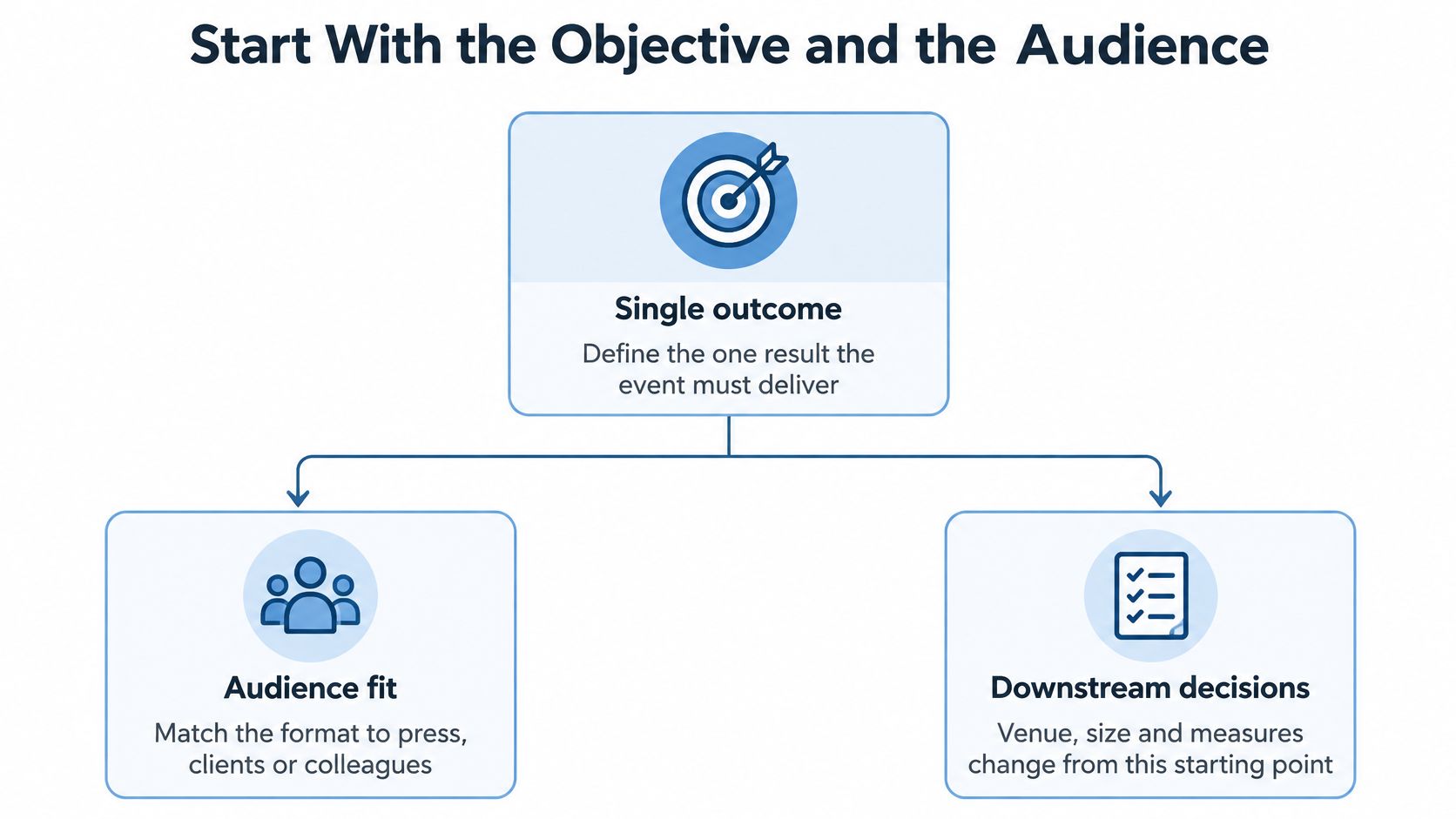
One sentence decides everything after it. Write the outcome the event must deliver before anyone rings a venue, because that sentence sets the room size, the staffing ratio, the format of the day and the numbers you report to whoever paid for it.
A product launch for press and clients needs a small, controlled space, a tight schedule and coverage as the win. A staff reward day needs volume, dwell time and a genuine sense of generosity, and its success measure is engagement and retention rather than leads. Same budget, completely different brief, and a supplier who quotes for one will fail the other.
Four questions, answered in writing, close that gap.
- What must this event achieve? A number and a date. Forty qualified follow-up meetings, or 120 staff attending, or twelve press pieces in the first week.
- Who is in the room and what do they need to leave with? A client needs a reason to keep talking. A journalist needs a story. A colleague needs to feel the company spent the money well.
- What will be measured? Attendance alone tells you the room was full, not whether the event worked.
- What should attendees feel or do afterwards? Book a meeting, tell their manager, use the product. If you can't name the action, the format is decoration.
The scale you're being judged against
Corporate exhibitions are a serious commercial platform, not a marketing sideline. The UK held 1,145 exhibitions in 2024, attracting 7.2 million visitors and generating £11.5 billion in business sales, according to the Events Industry Alliance's 2024 sector figures.
That scale changes how a stand or an activation gets evaluated. If a show delivers 7.2 million visitors across the country, then your result depends on visitors to your stand, the leads captured and the minutes people spend with you, not on the organiser's headline footfall. Dwell time is the metric that separates a crowd walking past from a crowd engaging, and it's the one most exhibitor reports leave out.
A worked example that forces decisions
Say a client wants 200 invited guests and 40 qualified follow-up meetings. That's a 20% conversion from a room where many attendees came to be polite. Achieving it means the format has to create conversation: no fixed seating, staff who know which accounts are in the room, and something to do that gets two strangers talking for eight minutes.
Format choice follows the same logic. If the audience is clients and the goal is a long, low-pressure conversation rather than a quick handshake, it's worth comparing charity and client golf events before booking a drinks reception, because a shared activity does more of the introduction work than a circulating tray.
Put the sentence at the top of the brief and keep it there: "Generate 40 qualified follow-up meetings with named client accounts by hosting 200 invited guests at a city-centre venue on 14 May, measured by meetings logged within 48 hours of the event." Everyone from the caterer to the stand builder can work with that.
Build a Budget With Clear Cost Lines
Budgets don't fail because a price was wrong. They fail because a line was missing. This split is a starting point to adjust to your format, not a fixed formula.
| Cost line | Typical share | What it covers | Common overrun |
|---|---|---|---|
| Venue hire and site | Largest share, planner to confirm | Room, marquee, power, load-in | Extra power and additional hours |
| Catering and drinks | Largest share, often close to venue | Food, bar, staffing, licences | Headcount changes after booking |
| Production and AV | 10-15% | Stages, screens, sound, lighting | Rigging and crew overtime |
| Entertainment and activations | Often the first line cut | Simulators, games, performers | Delivery charges and extra staff |
| Travel and accommodation | 5-15% | Transfers, hotel room blocks | Late release of unused rooms |
| Staffing and event management | 5-10% | Planner, stewards, on-site crew | Extra shifts on the day |
| Contingency | About 10% | Reserve for late changes | Often skipped or cut first |
Build it in three passes
Pass one is fixed: venue, production, the attraction hire and anything with a signed contract. Pass two is variable and moves with headcount, which means catering, drinks, badges, seating, transport and the number of stewards. Pass three is contingency, and it should sit at about 10% of the total, held by the person who signs off changes rather than the person spending it.
The trap is what gets cut when the total exceeds the budget. Entertainment and activations are usually the first casualty, even though they're often what generates the dwell time and conversation the objective depends on. Cutting the thing that produces the leads to protect the thing that produces the room is a bad trade, and it happens constantly.
Cost per head and cost per outcome
Divide the total by confirmed attendees and you get a per-head figure. Run it at 80% and 120% of expected numbers to see what flexes. Say the approved budget is £60,000 for 200 guests. That's £300 a head. At 160 guests it's £375, at 240 it's £250, and the difference is almost entirely catering, drinks and staffing, because the venue and the production didn't move.
The per-head figure is also where the hidden costs bite. None of these usually appear in a first draft.
- VAT treatment: check whether every quote is inclusive or exclusive before you compare two of them.
- Power and utilities: connections, distribution and generator hire, plus who is licensed to connect them.
- Load-in and load-out: hours beyond the contract, plus crew overtime after the venue's cut-off.
- Licences: premises licence extensions, music, and anything the venue charges to administer.
- Insurance: check whether your policy covers the attraction, the crew and the public, and whether the supplier's does.
- Late booking premiums: the cost of deciding in month two what should have been decided in month six.
- Travel for staff and suppliers: parking, congestion charges, overnight stays and per-diems.
Supplier pricing varies enough that it's worth reading a GM GROUP Services event pricing guide before you set the staffing and security lines, because those are the two that get estimated from memory and corrected later.
Approval rule: every cost line has one named owner, and any change above 10% of that line triggers a review before the order goes out. Verbal approvals are how a modest overspend becomes a difficult conversation.
It also pays to get attraction and equipment rates in writing early, with delivery, installation and operator costs listed separately, so you can see how equipment rental rates are built rather than comparing one all-in number with another. Present the finished budget to finance as three figures: total, cost per head, and cost per outcome, whether that's cost per lead, per meeting or per attendee retained. Finance understands the third number better than the first.
Choose Venues and Suppliers With a Written Brief
A one-page brief turns a series of sales conversations into a comparison. It lists the objective in one sentence, the date window, headcount, site constraints, power and access needs, and the budget range. Send the same document to every venue and supplier and you get answers you can put side by side.
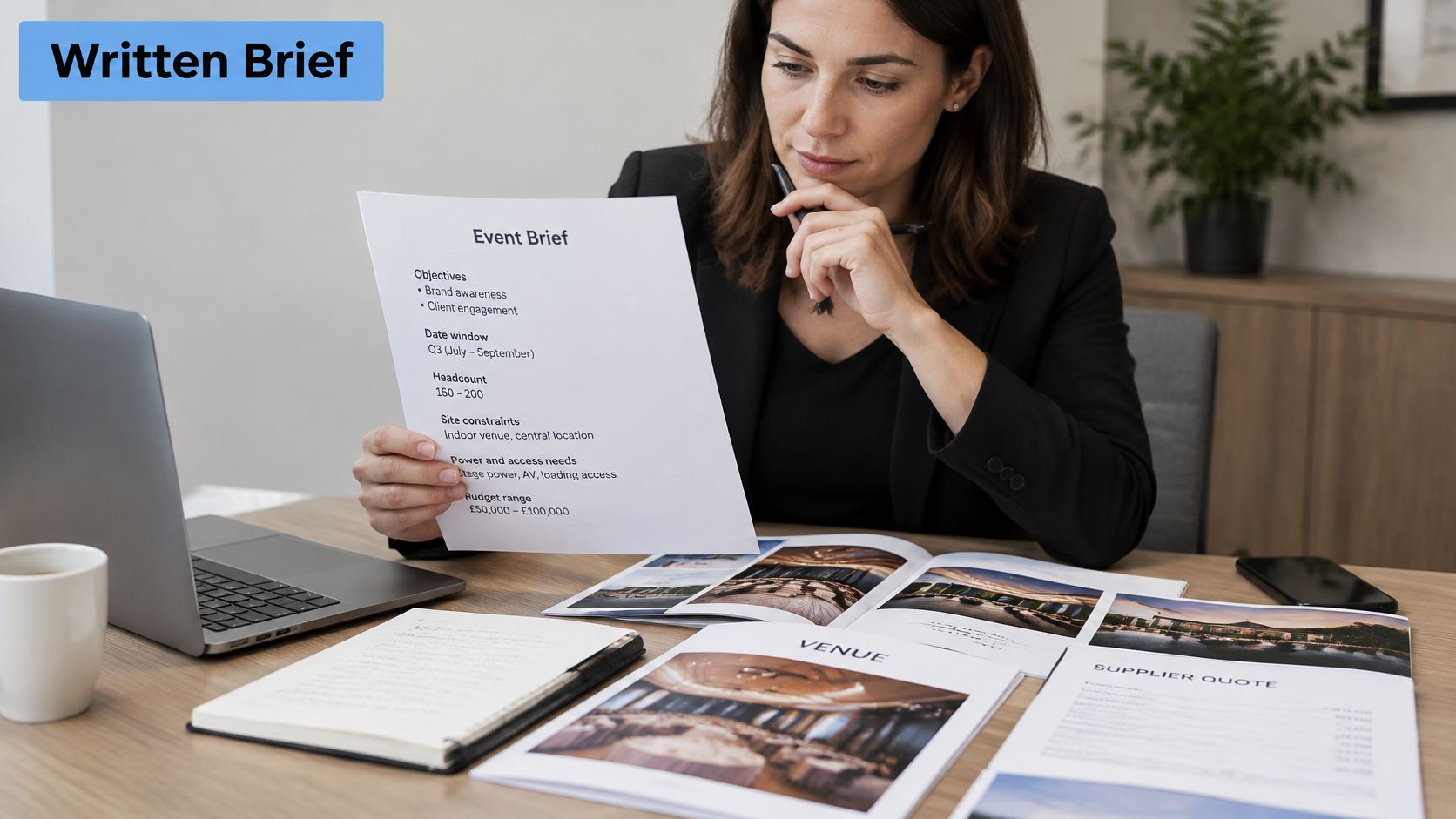
Score each option on the same criteria: transport links, footprint and height clearance, weatherproofing if a marquee is involved, power capacity, insurance cover, relevant sector references and the staffing they'll bring. Two venues can look identical in photographs and be completely different to operate in, especially once you add an attraction with a queue.
London isn't the default
The UK hosted an estimated 1.08 million conferences and meetings in 2024, with direct expenditure at venues and in destination economies reaching about £19.3 billion, according to the UK Events Report update from the Events Industry Alliance. Residential delegates, the ones staying at the venue, accounted for 40% of that expenditure.
That 40% is the number to argue with when someone books a central London room out of habit. Multi-day programmes carry accommodation, catering and evening activity, and those costs behave very differently in Manchester, Birmingham, Glasgow or Edinburgh. Parliamentary evidence put 38% of business events outside London, so regional venues aren't a compromise, they're where a large share of the market already is.
For offsites with an overnight element, it's worth doing a structured venue comparison for company offsites rather than accepting the first property that has availability, because the residential share of the budget is the easiest one to get wrong.
Service levels, described honestly
At one end is dry hire, where the equipment arrives and your team runs it. At the other is full event management, where the supplier handles planning meetings, site visits to build the site plan, power and utility requirements, staffing and the event on the day. We work across that range, from dry hire with no operator required up to a full event management service, and the honest trade-off is control versus capacity. Dry hire is cheaper and gives you flexibility, but it assumes you have people on site who know the kit and can troubleshoot it.
One constraint that catches people out: the client arranges any help needed to access or leave the venue, and rooms or marquees have to be large enough for the equipment in footprint, height clearance and weatherproofing. A low ceiling or a narrow service lift can rule out a rig that looked fine on paper.
The sequence that works is consistent. Site visit first, then a site plan you both sign off, then final details collected by online form or phone, then a run-through with the logistics team the week before the event. We ring the week before for exactly that reason, to catch the changes nobody emailed.
Ask on every quote: "What's excluded, and who pays for it?" Delivery, installation, operator hours, power, waste removal and late collection are where two apparently similar prices diverge.
Keep a scorecard on file. Location, cost, capacity, insurance, references and the quality of the site plan they produce. The supplier who sends a drawing without being asked is usually the one who turns up prepared.
Promote the Event to Drive Registrations
Promotion converts a plan into a headcount, and the headcount sets capacity, staffing and the safety numbers. Get the forecast wrong and every downstream decision inherits the error.
Set the registration target above the attendance target. Invitations don't convert at 100%, and a target of 220 registrations for 180 attendees is a more honest brief than a target of 180 and a scramble in the final week.
The invitation sequence does most of the work:
- Save the date, about three months out for a large conference or summit, sent to the core audience with no registration link attached.
- Full invitation, six to eight weeks out, with the agenda, travel options and the registration form in the same email.
- Reminders at two weeks and two days, aimed only at people who haven't registered, with a different subject line each time.
- Access and dietary questions on the form, not in a follow-up email later, so accessibility planning and catering numbers start from real data.
- A source tag on every link and form, so you can see which channel produced registrations and which produced people who attended.
Warm invitations outperform cold ones, so give account managers a short list of named clients and a one-paragraph message they can send themselves. Partner channels fill the gaps that paid promotion can't reach, particularly for specialist audiences.
Track registrations weekly against the target rather than checking daily. Compare the no-show rate with your previous event and use that figure for the venue and the safety brief, because a forecast built on hope produces a queue that nobody staffed for. Agree who owns the invitation list and who approves each message before anything is sent, or the same contact gets three versions from three teams.
Crowd Safety, Accessibility and Activation Checks
Crowd safety starts with a legal duty, not a conversation on the day. The Health and Safety Executive states that dutyholders must take reasonable steps to eliminate or reduce risks, and that risk assessment is required by law. Its venue suitability guidance says the site must let people assemble, enter, move around and exit safely.
That makes access, circulation and evacuation part of the initial design. A generic safety statement copied from another event proves nothing about your layout, your queue or your equipment positions.
Write the assessment around the layout
Name the specific risks: queue formation at the busiest attraction, equipment placement that narrows a walkway, pedestrian routes that cross vehicle routes, emergency exits that a queue could block, and restricted areas that need stewarding rather than a rope.
HSE guidance on crowd management and control is blunt about people. Everyone involved, including volunteers, needs the information, instruction and training to work safely, supervision has to match the risk and the nature of the event, and an appropriate number of stewards or signposts should be visible to keep people on safe walkways and out of prohibited zones. Printed tabards and clear signage do more for a queue than a briefing nobody heard.
We train every member of staff on every piece of equipment we house, and that matters most at the attraction itself, where the person running the kit is also the person spotting a problem in the queue.
Set an intervention threshold, then measure against it
Capacity isn't a single number. Localised congestion happens well below total capacity when one popular attraction absorbs demand.
Practical threshold: if the queue at a simulator reaches a marked point on the floor plan, open a second station or a second game. Decide the trigger in the site plan, not in the moment.
Practical controls are unglamorous and effective: barriers that separate queues from emergency routes, timed access slots, an overflow area, clear pedestrian and vehicle routes, and stewarding at the pinch points. Monitoring should measure both total occupancy and where people are, using wristbands, manual counts, people-counting sensors, thermal counting, CCTV or observation posts.
For any attraction, write an operational brief that specifies footprint, queue geometry, maximum simultaneous users, staffing ratio, sightlines, accessible routes, escalation triggers and a live communications channel to the control point. Better real-time visibility buys you the option to redistribute people before a queue becomes pressure.
Test the attendee journey, not the venue statement
Accessibility is where compliance and experience diverge most sharply. A step-free entrance says nothing about whether a delegate can reach the controls of a rig, hear an instruction over a crowd, or find a quiet room when the noise becomes too much.
- Collect needs in advance on the registration form, with a named contact who reads the answers.
- Publish an access guide covering arrival, toilets, quiet space, assistance animals, hearing loops and who to ask on the day.
- Design for sensory load, with controllable lighting and volume, a quiet room away from the main floor, and a stated period of reduced sound if the programme allows.
- Brief every steward on assistance, evacuation support and who to escalate to, not just on where the exits are.
- Walk the full route before doors open, and involve disabled people in that walk-through if you can, because layout problems are obvious in a wheelchair and invisible from a standing height.
The rehearsal is the cheapest safety improvement available. Run one hour of peak demand with real queues, time the cycle at each station, and count how many people the space holds.
Measure Results and Cut Event Emissions
Decide the measurement set before the event, not in the week you have to write the report. Five metrics cover most corporate formats.
| Metric | How to measure it | Reference point |
|---|---|---|
| Attendance against target | Ticket, wristband or badge counts | Booked versus actual attendees |
| Dwell time at the activation | Sensor counts or staff observation | Average minutes per visitor |
| Leads captured | Badge scans or sign-up forms | Qualified leads against target |
| Audience travel emissions | Attendee origin, transport mode and distance | CO2e per attendee |
| Post-event satisfaction | Post-event survey | Score against the stated objective |
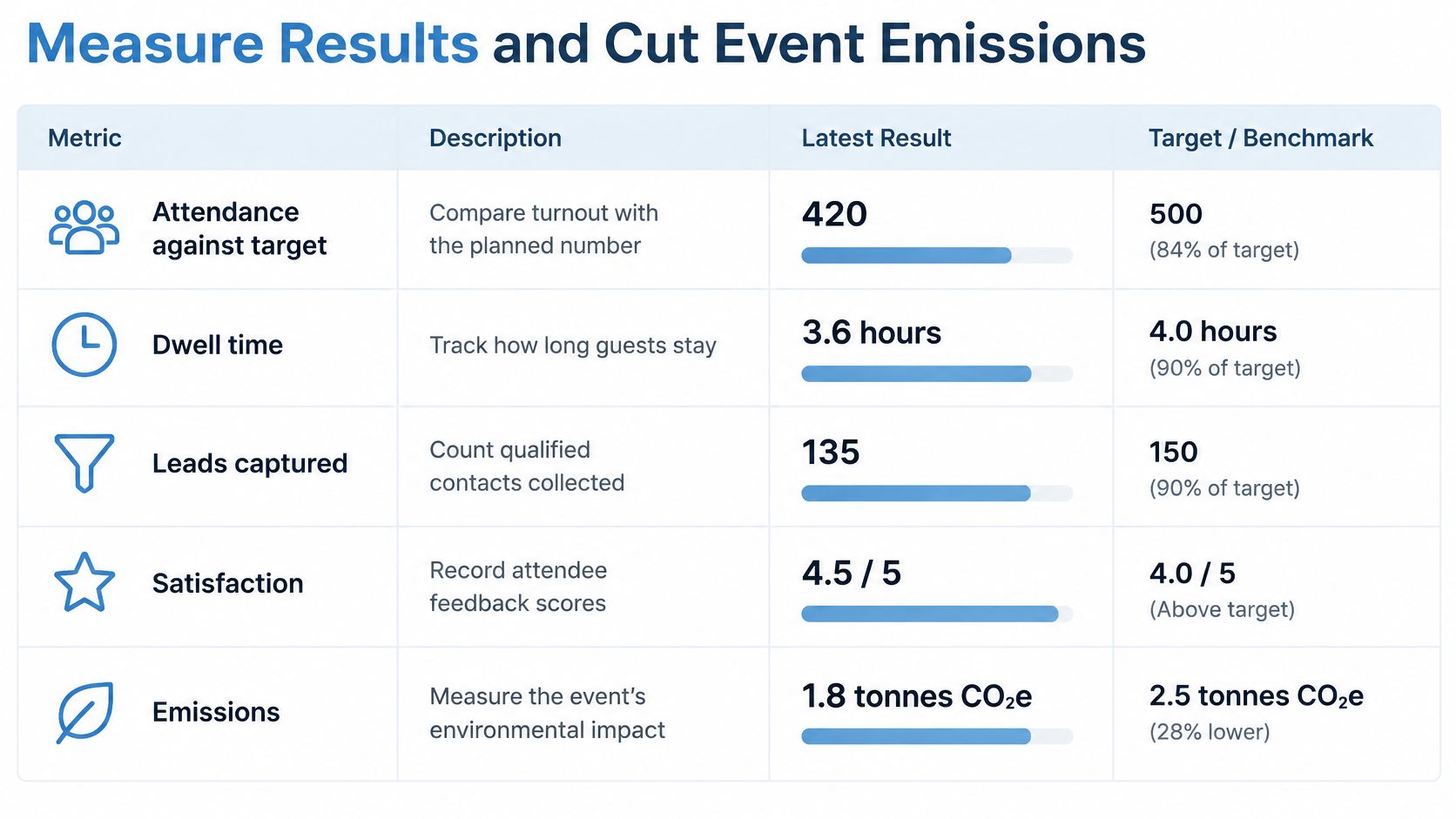
Attendance is the easiest metric and the least useful on its own. A room of 200 people who stayed for 25 minutes and left is a worse result than 90 people who stayed for two hours and booked meetings.
Why travel dominates the carbon figure
Audience travel represented 39% of total event emissions across nearly 1,000 events held in 22 European countries in 2024, according to isla's event carbon emissions analysis reported by PCMA. The dataset is European rather than UK-only, but the travel patterns, venue access and event formats overlap closely with the UK market.
The practical consequence is that measuring venue electricity, production and waste and calling it your footprint understates it, sometimes badly. Collect attendee origin, transport mode, distance and occupancy assumptions, then convert those inputs to CO2e with one method and keep using it. Separate staff and supplier travel, freight, equipment movements, power, accommodation and material reuse rather than rolling them into a single total.
Once you have the baseline, the reductions become obvious and mostly free: rail-accessible venues, shuttle routes from the nearest station, start times that work with public transport instead of against it, and remote participation for part of the programme. Our event carbon footprint breakdown covers how an activation's own power, freight and staff travel sit alongside the audience figure.
Reporting rule: circulate the full metric set within four weeks of the event, with assumptions and data completeness stated. A number you can't explain is a number nobody uses.
Ask your suppliers for a post-event carbon report as a procurement condition, and give the figures scope, such as CO2e per attendee or per qualified lead. Intensity lets you compare two campaigns of different sizes. Absolute totals only tell you which event was bigger.
Confirm the Brief and Take the Next Step
The last decision is a sign-off, and it should be boring. One named owner confirms the brief, including the one-sentence objective, the cost per head and the risk assessment, before any booking is placed. If the objective can't be written in a sentence, the event isn't ready to be costed.
Send that agreed brief to two or three suppliers and ask each for a site plan, their power requirements and a staffing outline. Quotes that arrive without those three items can't be compared, and the cheapest number usually turns out to be the one with the most exclusions.
Then move in three stages. Hold an online planning meeting to agree the brief and the lead-time milestones. Book a site visit to build the site plan and check power, access and crowd routes. Hold a final logistics call the week before to confirm staffing, the run of show and emergency contacts.
For a Cambridge-based event management and corporate entertainment company, that route looks the same as it does for an in-house team, and it's how we run it. You can request a quote at sales@pswevents.com, ask for our events guide brochure, or meet the team at our offices in Cambridge if a site visit is easier that way. We can also come to you.
None of this depends on the supplier. The timeline, the objective, the budget lines and the safety thresholds are yours. Get those right and the event stops being a gamble on the day.
PSW Events plans, staffs and delivers corporate events and interactive attractions across the UK, from a simulator hire for a conference to a full managed fun day for thousands of guests. We handle site plans, power and utility requirements, installation, on-site crew and health and safety compliance, so your team can stay with the clients and guests. If you're building a brief for a launch, exhibition, staff reward or family fun day, visit PSW Events to see the range and start a quote.