
What decides whether a brand activation works: the idea, or the venue? A brilliant concept dies in an hour if the loading bay is narrower than the truck, or if the only power drop sits on the far wall from the stand. So the question isn't which venue photographs best on a site visit. It's which one can power your build, get it through the door, and put it in front of the right people.
Choosing between brand activation venues comes down to five practical tests: location and footfall, build access, capacity, technical provision and budget transparency. The scale of what you're buying into is worth knowing. The Association of Event Organisers' Size and Scale Index for Exhibitions 2025 counted 1,154 exhibitions and conferences with an exhibition element at the UK's main venues in 2025, with each occupying its venue for an average of 4.3 days but with a typical public opening period of just 2.0 days. Heavy logistics, narrow windows.
The seven venues below each answer those tests differently, from riverside London footfall to blank-canvas East London warehouses.
1. Southbank Centre
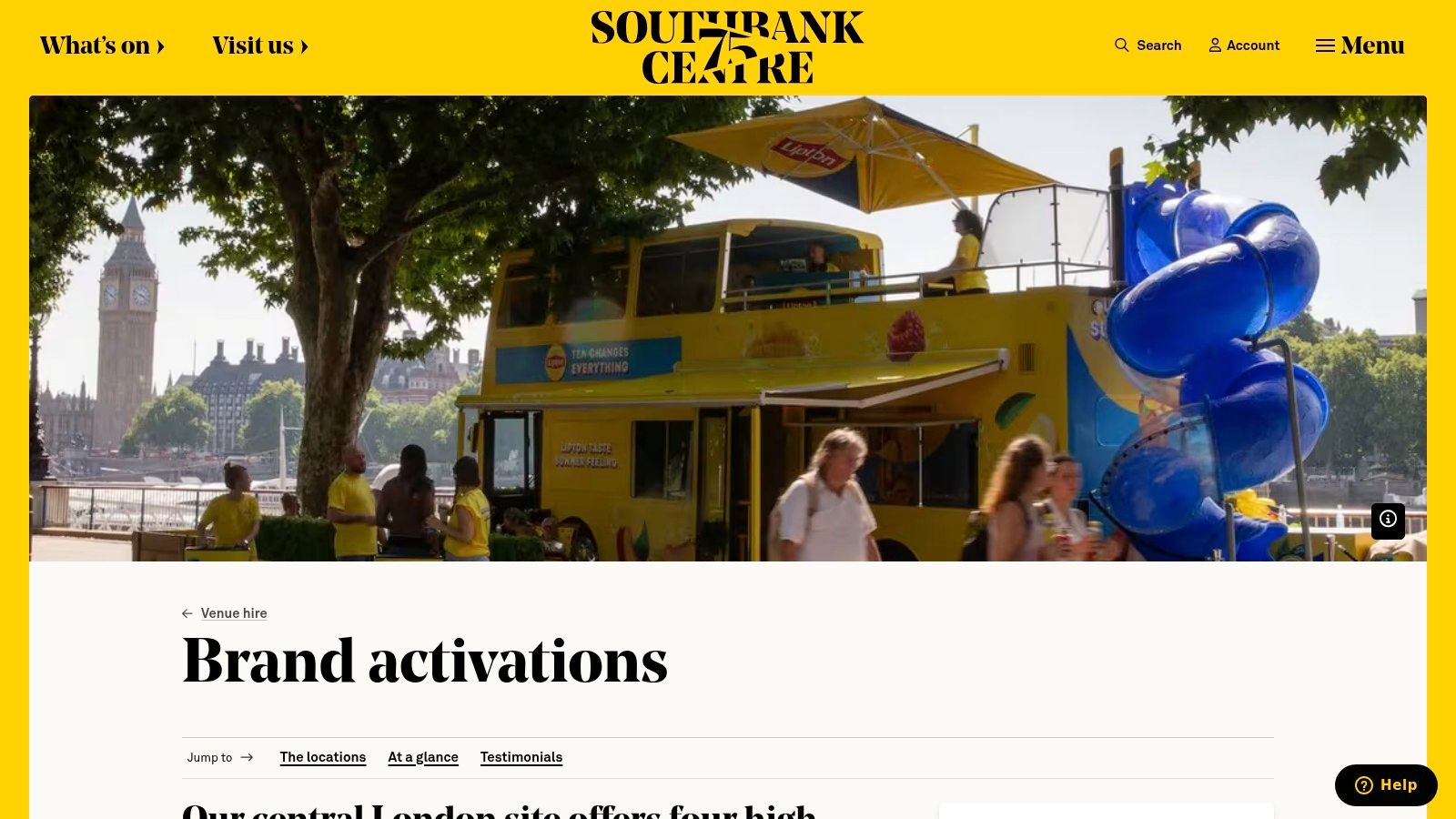
Footfall is the entire proposition here, and footfall is exactly what most activations fail to convert into memory. Research commissioned by ZEAL Group and conducted by Censuswide across 2,000 UK adults found only 26% recalled seeing or taking part in a live brand experience in the previous year, dropping to 9% among baby boomers while Gen Z recall reached 48%, as LBB Online's report on the ZEAL study sets out. A pitch on the Queen's Walk buys you volume. It doesn't buy you recall.
Four sites are on offer: Queen's Walk, Southbank Centre Square, Builder's Yard and the Royal Festival Hall riverside. Listed hire rates run £7,000 to £9,000 excluding VAT depending on location, according to the Southbank Centre brand activation pages. Adidas, Burberry, Disney and ASDA have all worked the site, and the venue provides production support alongside a selected catering offer.
- Works well: sampling, demo-led stands, anything readable from three metres that stops a walking crowd.
- Struggles: scripted 20-minute experiences that need queue management for a fixed audience.
- Watch the budget: the headline rate is the start, not the total. Build, power, security and reinstatement sit on top.
If you want London formats that fit a footprint like this, corporate event ideas in London covers the practical options.
2. Somerset House
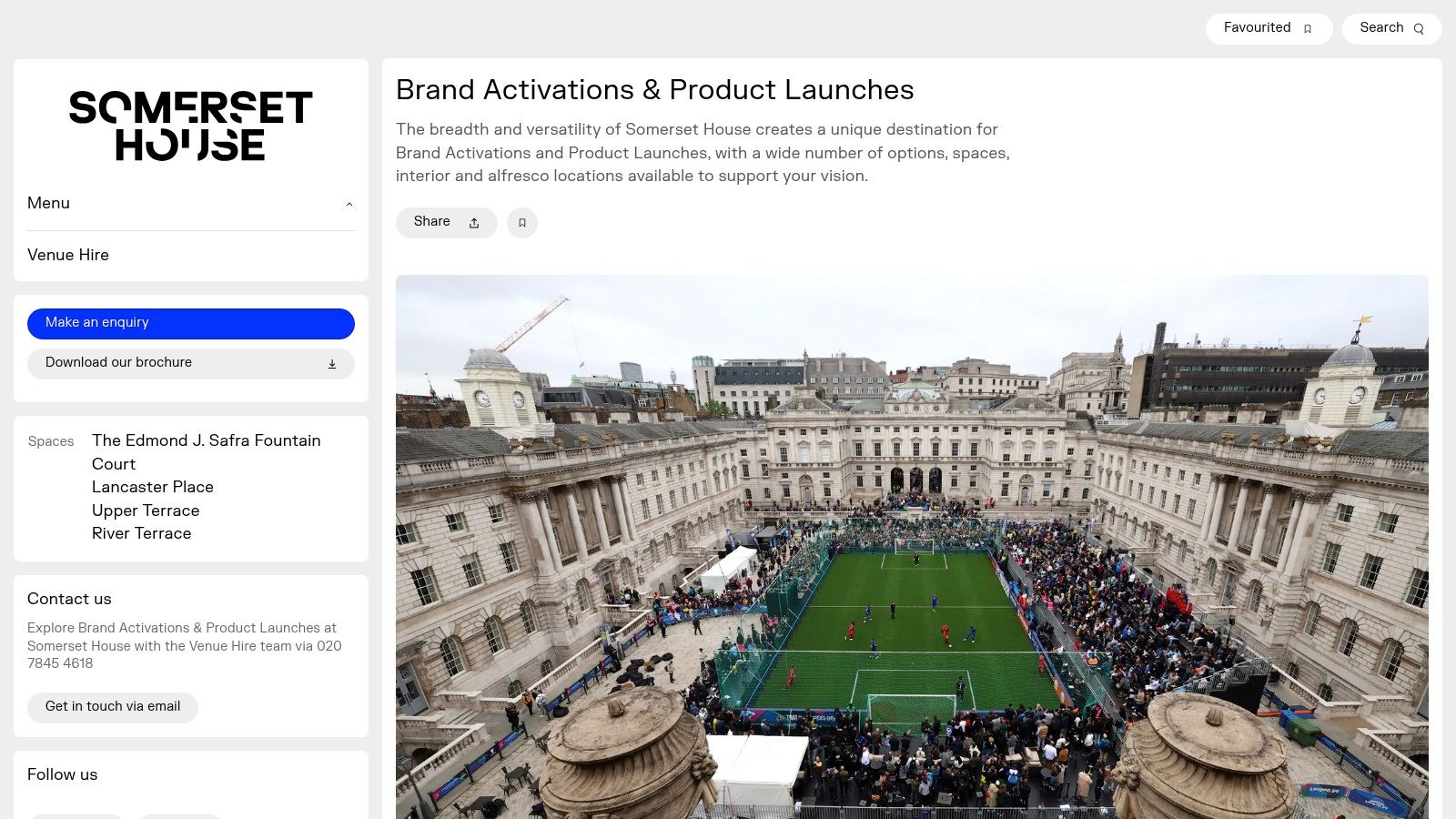
The architecture does half the design work. Fountain Court, Lancaster Place, the Upper Terrace and the River Terrace give you four completely different photographs of one campaign, and the venue has hosted activations for UEFA, The Macallan and Omega. Pricing is enquiry-based, so start the conversation early and expect it to hinge on which space you take and for how long.
The signage rule people forget
Heritage frontage means outdoor branding runs into planning law, not just venue approval. Planning Portal's guidance on adverts and signs states that an advertisement larger than 0.3 square metres displayed on or outside business premises may need advertisement consent, and illuminated advertisements may need consent regardless of size. Temporary notices for local events get a limited exemption at no more than 0.6 square metres.
That catches more builds than you'd expect: a three-metre fabric banner across a courtyard entrance, a lightbox in a window, a directional totem on the pavement.
Production note: put the consent application in the timeline, not the contingency. Approval that lands after your print deadline is money spent twice.
Somerset House is a working cultural venue, so availability shifts with its own programme of exhibitions and events. Enquiries run through the venue hire team, and your footprint, timings and access arrangements get agreed in that conversation rather than read off a rate card. The trade-off is control. Heritage fabric limits rigging, fixings and where you can safely put weight, so brief your build contractor before you commit to the concept.
3. Queen Elizabeth Olympic Park
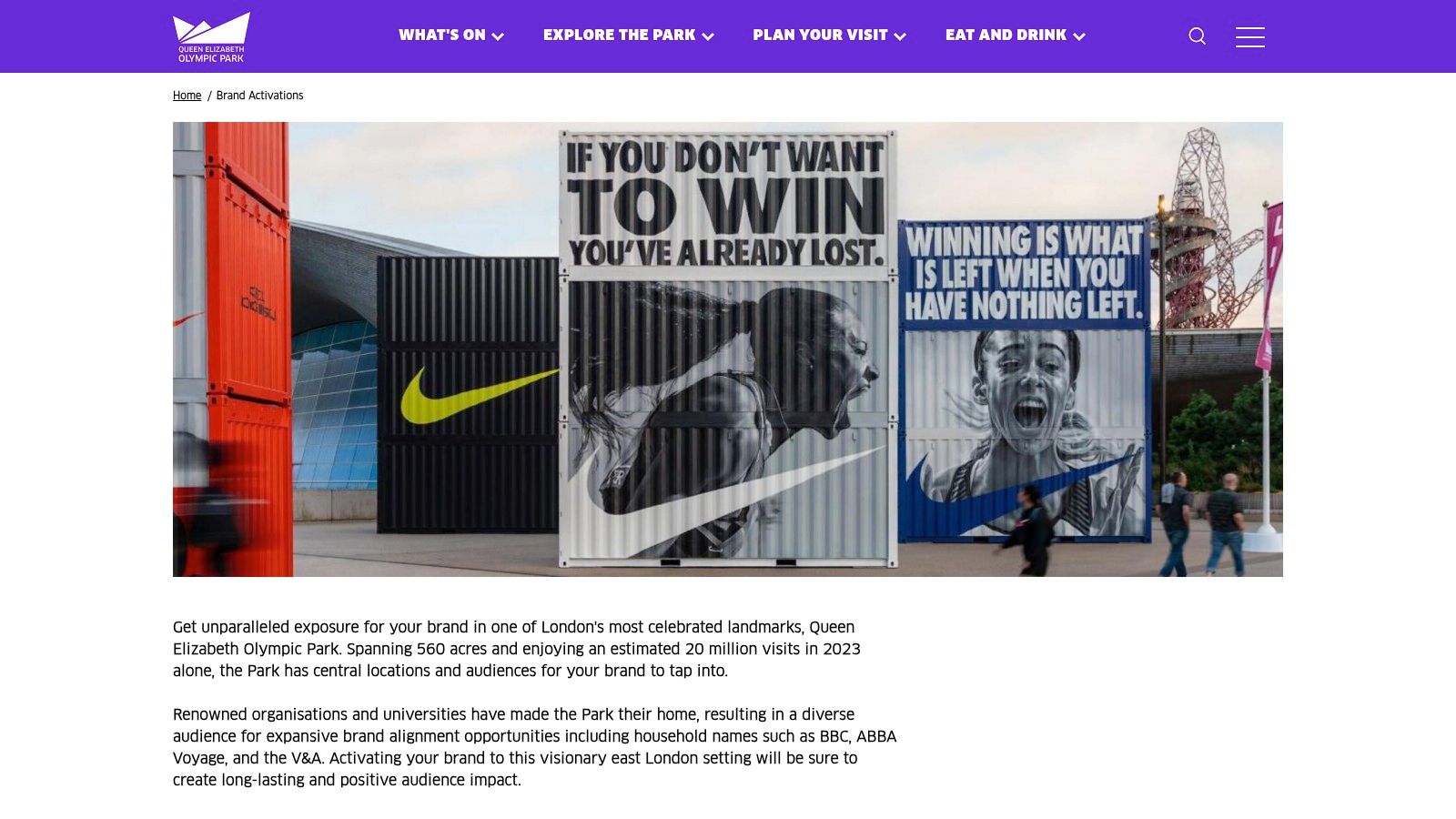
Pick this when the campaign needs open-air scale and services already in the ground. Stratford Walk publishes 35m × 25m and 15m × 15m areas, Mandeville Place lists 30m × 30m, and the Carousel Room gives an indoor fallback, all detailed on the QEOP brand activation pages. Some sites list power, portable water and vehicle access, which lets a producer price generators, bowsers and load-in routes before the creative is locked.
Dry hire moves the operational load to your side: security, crowd management, safety documentation and utilities at extra cost. The counterweight is footfall with intent. The park already draws crowds, and sport or fan-zone concepts look native there. Interactive formats suit timed challenges, leaderboards and simulator queues better than quiet luxury retail, with the trade being less exclusivity and more public throughput.
- Data collection isn't permitted on site, and flyering and alcohol giveaways are restricted. If your mechanic is lead capture or sampling, redesign it before you book.
- Sport and fan-zone concepts suit the setting, and the park's own audience does much of the attendance work.
- Pricing isn't published, so get a written quote against your specific site, dates and utility draw.
Fan-zone formats at this scale are covered in football fan zone planning.
Permissions sit outside the venue
Park approval is one layer of the permission set. Public-realm activity can still need local event permission, and alcohol, regulated entertainment or selling can trigger a different licence route, so put consent work on the critical path with months of lead time, not weeks.
4. Museum of Brands
Small, brand-literate and built around a story rather than a floorplate. The Time Tunnel, Exhibition Hall, conservatory and garden let you sequence a guest journey: arrive through the history, present in the hall, host in the garden afterwards. Evening hire starts at £2,500 plus VAT, with capacity for 150 standing or 84 seated, and the Museum of Brands activation page lists a projector, screen, fast Wi-Fi and an on-site events team.
The honest trade-off: this is an invited room, not a walk-up site. Nobody wanders in off the street. You're buying context and control, and accepting a smaller audience for it.
Catering and BYO arrangements can add cost, including corkage where it applies, so get the food and drink terms in writing before you compare the total against a dry-hire warehouse.
Capture the numbers anyway
A curated room still has to prove it worked, and the benchmark from the exhibition floor is high. At Southern Manufacturing & Electronics 2025, more than 72% of visitors had purchasing influence and each stand collected an average of 60 leads, per DPA on the Net's event report. A launch for 150 invited guests should still leave you with named contacts, consented data and one person who owns the follow-up.
Format ideas for rooms this size sit in brand activation examples.
5. Aviva Studios
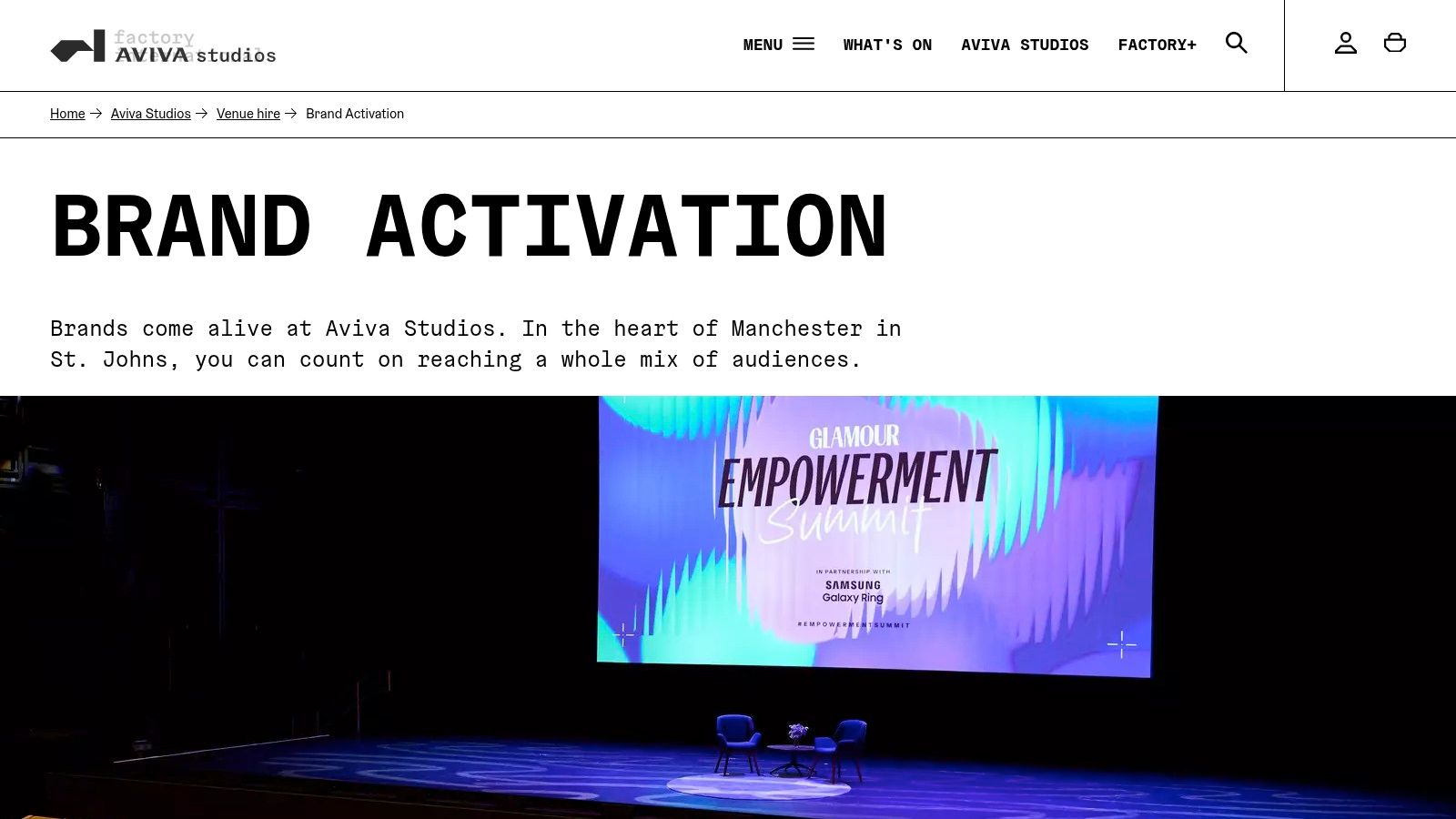
Manchester's answer to a London problem: where do you put an ambitious build without London rates? The Warehouse takes up to 5,000 people with direct articulated truck access, and the Hall, Public Realm and Social spaces scale down from there, as the Aviva Studios brand activation hire page explains. The Public Realm includes covered space and expects annual footfall of 850,000, which is a planning estimate, not a guarantee for your event day.
What the production team will ask you
In-house lighting and sound expertise is reason to book it. On a rig with moving lights, a multi-camera simulator setup and a live host, having the house team on the same drawing as your contractor removes a whole category of on-site argument. Pricing is proposal-based, so arrive with a clear footprint, a power schedule and a rigging plot.
Sustainability is where large venues still fall short. The 2025 Venue Trend Report found more than 40 UK venues reporting environmental initiatives, but only 15% tracking their carbon footprints. If your client's procurement team wants activity-level emissions for a simulator rig, ask for metered consumption, separated waste streams and delivery-access data rather than a sustainability badge.
- Strong for: immersive builds, large live events, brand experiences with a technical centre.
- Wrong for: a 40-guest press breakfast, where the scale works against you.
6. The Hackney
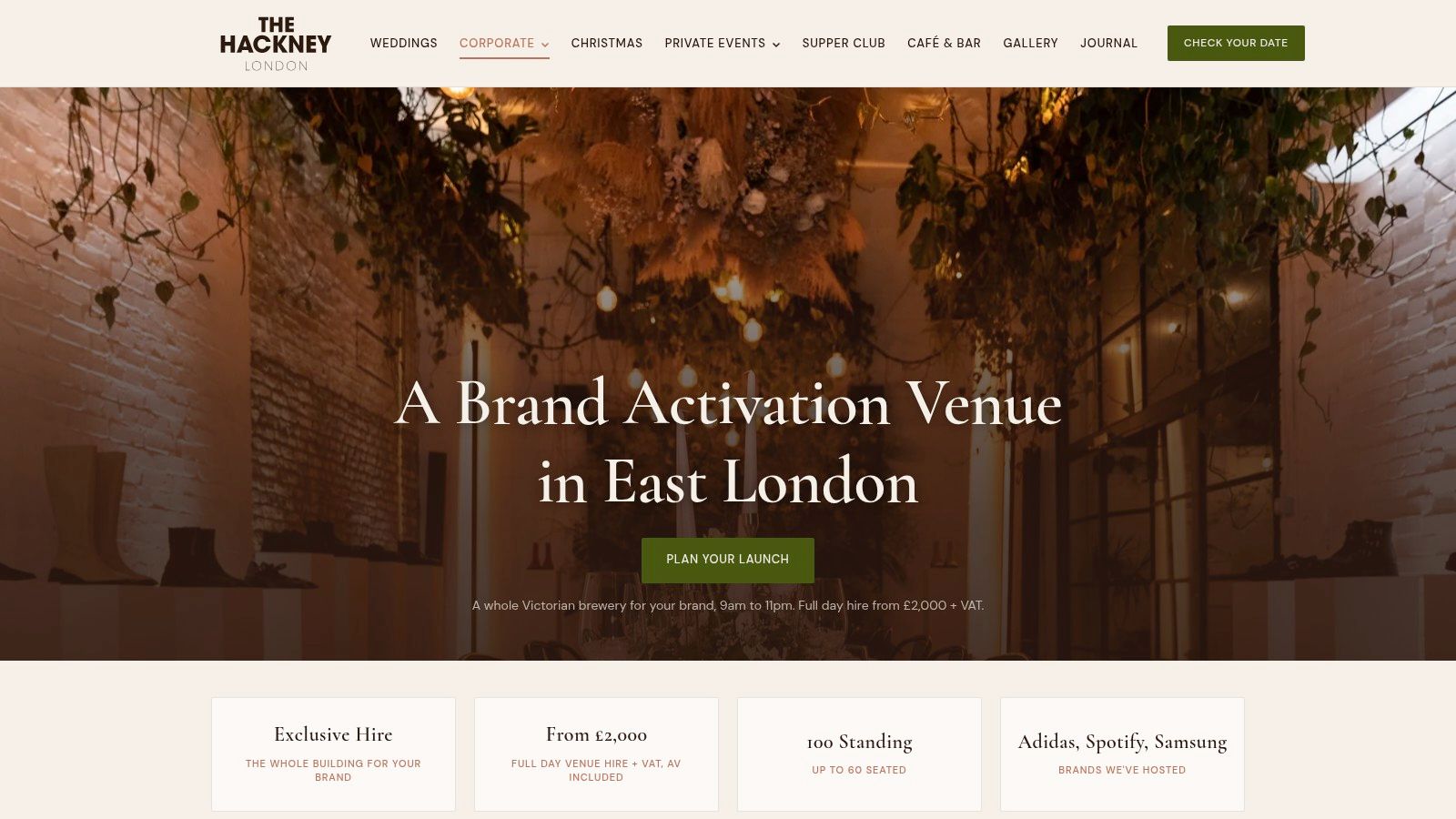
An exclusive-hire Victorian brewery conversion in East London with four spaces: Winter Garden, Lounge, Covered Terrace and Bar Area. A 9am to 11pm hire day starts at £2,000 plus VAT, capacity is 100 standing or 60 seated, and the rate includes a venue manager, furniture, projector, screens, sound system and Wi-Fi, per The Hackney's brand activation page.
The character is the value. A room that already has brick, glass and a winter garden needs less set dressing than a white box, and that changes your production budget more than the day rate does. Adidas, Spotify and Samsung have all used it. Food and drink are charged separately and extra staffing may be required, so put both into the comparison before you shortlist.
Book it for control, not reach. Exclusive use means one brand on every wall, no competing sponsor, no public wanderers, and a guest list you can actually manage.
The conversion gap
An invited room hides a problem that trade floors can't. Only 6% of trade exhibitors reportedly felt confident about converting event leads, according to Event Concept's analysis of trade show performance. A private launch carries the same exposure: 60 delighted guests and nobody owning the follow-up is a wasted booking. Name the person who sends the email before the event runs.
7. Hoxton Arches
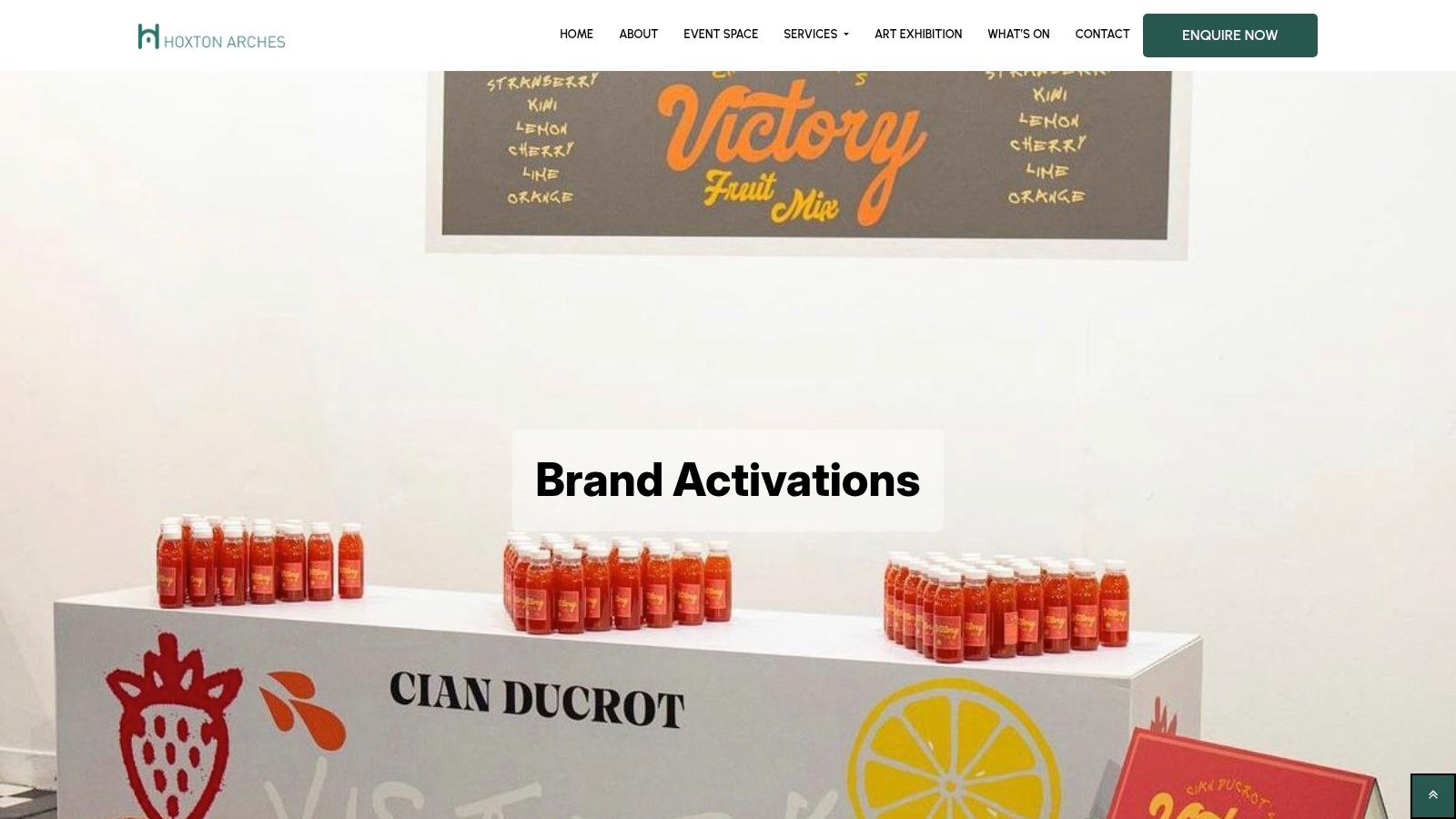
A 2,500 square foot dry-hire space near Hoxton Station, with capacity for 250 standing or 100 seated, per the Hoxton Arches brand activation page. It's the closest thing on this list to a genuine blank canvas: white walls, high ceilings, two movable partitions and a private backyard.
The practical detail that matters
The site lists front access, parking, disabled access, fast internet and mounted speakers, and the street-facing sliding doors can be branded. Front access is the detail to build your load-in around. If your activation includes a racing rig, a flight simulator or a large prop, reversing a van to the doors saves hours of manual handling and removes the risk of clipping a doorway on the way in.
- Dry hire: confirm what's included and price the rest. Tables, staffing, power distribution and cleaning usually land with you.
- Backyard: a second zone for an external bar or a quiet room, useful when you're rotating guests through a demo.
- Exposure: depends on your invited list and whatever the frontage pulls in. Pricing isn't published, so enquire early.
Don't assume the sign is exempt
Branding those sliding doors counts as advertising, and the rules on size, placement and duration sit with the council. Before you print anything, ask the local planning authority, here the London Borough of Hackney, whether a temporary sign on the frontage needs consent and what limits apply. Get the answer in writing. A commercial activation that skips this step risks being told to strip the branding before doors open.
Brand activation venues at a glance
| Venue | Location | Capacity / Footprint | Starting Price | Best For |
|---|---|---|---|---|
| Southbank Centre | Central London | Four activation locations; footprint varies by site | £7,000–£9,000 excluding VAT | High-visibility, public-facing activations |
| Somerset House | Central London | Multiple indoor and outdoor spaces; capacity varies by space | Enquiry-based | Distinctive launches and activations |
| Queen Elizabeth Olympic Park | London | Multiple sites; examples range from 15m × 15m to 35m × 25m | Not publicly listed | Large outdoor, sports or fan-zone experiences |
| Museum of Brands | West London | Up to 150 standing or 84 seated | From £2,500 plus VAT for evening hire | Brand storytelling, press events and modest-sized launches |
| Aviva Studios | Manchester | Warehouse holds up to 5,000; multiple adaptable spaces | Proposal-based | Ambitious builds and large-scale activations |
| The Hackney | East London | Up to 100 standing or 60 seated | From £2,000 plus VAT for full-day hire | Controlled product launches and press events |
| Hoxton Arches | Near Hoxton Station, East London | 2,500 sq ft; up to 250 standing or 100 seated | Enquiry-based | Flexible installations and product showcases |
Booking Smart: How to Lock In the Right Venue
Shortlist against three numbers before you sign: footprint, height clearance and weatherproofing. Venue rooms and marquees have to be large enough for the equipment you're hiring on all three counts, and the only reliable way to settle it is a dimensioned plan from the supplier checked against a dimensioned plan from the venue.
Then the access conversation. Ask who provides load-in and load-out assistance, what the dock height is, whether the goods lift takes a pallet, and which hours the loading bay is staffed. On a simulator install, equipment arrival is the critical path of the whole schedule, so confirm who meets the truck.
Permissions are usually the organiser's job, not the venue's. Licensing, advertising consent, road closures and local-authority permits belong on your tracker, each named to a person, with lead times written down. Insurance documentation comes next: public liability certificates, risk assessments and method statements exchanged before the build, never on the morning.
- Site visit: go at the same time of day as the event and watch the crowd, not just the room.
- Power: get the utility draw from your supplier and send it to the venue in writing. Extra supply is a cost and a lead time, not a switch on the wall.
- Lead times: book public-space permissions first, then hold your production dates against them.
The one rule: match the venue type to the goal. Public footfall sites are for reach and sampling. Private rooms are for control, press and invited guests. Dry-hire warehouses are for builds that need drive-in access and a blank wall.
PSW Events, a Cambridge-based event management company with over 50 years of combined experience, supplies and fully manages interactive attractions such as sports, racing and flight simulators at leading UK venues including Silverstone, ExCeL London, Manchester Central and Wembley, handling planning, logistics, installation, staffing and H&S compliance. If you publish the results afterwards, practical ways to earn backlinks covers how to make that content work harder.
PSW Events brings the attraction, the crew and the compliance paperwork to whichever venue you book, from racing and flight simulators to Batak Pro, giant Scalextric, VR and electronic leaderboards, installed and staffed on site. Send over your venue, dates and power supply and the team will build the layout around your footprint instead of squeezing your activation into the space that's left. Visit PSW Events to plan an activation that gives people a reason to stop and a way to be counted.