
You've booked the stand. The artwork is signed off. The venue paperwork is done. Then the harder question lands: how do you get people to stop, engage, and remember you when every aisle is packed with screens, coffee carts, and competitors saying roughly the same thing?
That's the point where a Batak Wall starts to make sense. Not because it is merely “fun”, and not because flashing lights automatically equal results. It works when you need a fast, visible activity that gives people a reason to step onto your space, stay there, compete, and start a conversation with your team.
For corporate events, exhibitions, team building days, and branded activations, the value of a Batak Wall isn't the hardware on its own. The value is what it lets you measure. Who stepped up. How long they stayed. Whether they came back with colleagues. Whether your sales team got a cleaner opening line than “Can I help you?”. Used properly, it becomes a practical engagement tool rather than a novelty.
The Ultimate Event Engagement Challenge
A familiar event problem looks like this. You've taken a strong stand position at ExCeL London or another major venue. The build looks sharp, your messaging is clear, and the team is briefed. Footfall is there, but attention is thin. People glance over, keep walking, and default back to their phones.
That gap between visibility and actual engagement is where most exhibition budgets underperform. A branded backdrop can look expensive and still do very little if nobody physically interacts with it. Brochures don't solve that. A looping video rarely solves it either. You need a reason for people to stop in the moment.
A Batak Wall works because it creates a live focal point. One person plays, two colleagues watch, somebody comments on the score, and suddenly you have energy around the stand instead of polite pass-through traffic.
Why passive stands struggle
At busy corporate events, attendees make split-second decisions. If the interaction looks slow, awkward, or sales-led from the first second, many people won't enter the space at all. That's especially true at trade shows where visitors are already managing information overload.
A reaction game changes the first exchange. Instead of asking for time, you offer a challenge. That's a much easier commitment for a passer-by to make.
Practical rule: If your activation needs a long explanation before anyone can take part, footfall will leak away.
The Batak Wall also suits the psychology of crowded venues. It's visual, competitive, and self-explanatory. People understand the challenge almost instantly. Hit the lit targets. Beat the score. Watch someone else try.
The business issue behind the engagement issue
Most clients don't have an “entertainment” problem. They have one of these:
- Low dwell time that limits meaningful conversations
- Weak lead capture because attendees don't see enough reason to stay
- Poor memorability after a crowded event day
- Flat team interaction during internal events or away days
That's why it helps to treat a Batak Wall as part of a wider stand strategy. It should sit beside staffing, lead capture flow, branding, and a clear next step for participants. When it's isolated from those things, it becomes background activity. When it's integrated properly, it becomes the thing that starts conversations your team would otherwise miss.
What Is a Batak Wall and How Does It Work
A Batak Wall is best understood as a vertical reaction game. A frame holds multiple illuminated targets, and those targets light up in sequences. The player hits each target as quickly as possible before the next one appears. The system records speed and score, which is why it works equally well for sport-style competition and branded event engagement.
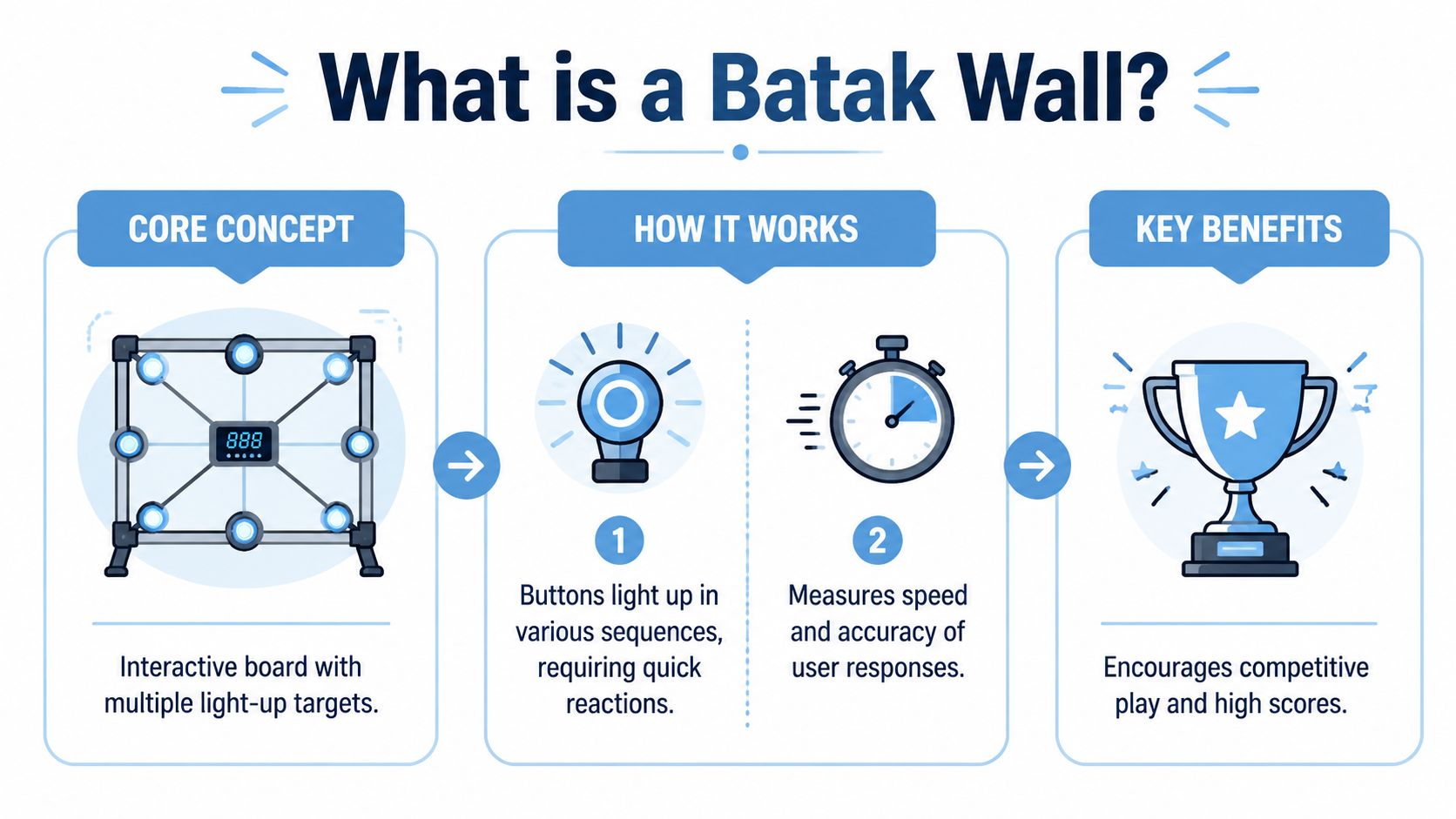
Its origins are more serious than many people expect. The Batak Wall came from professional tennis training in the early 2000s, using illuminated buttons instead of a standard ball. Those early versions used 10 to 12 targets and required reactions within 0.2 to 0.5 seconds. By 2010, they were used by 45% of UK national tennis academies, with 15% improvement in player reaction times after six weeks of regular use, according to the Batak history overview from Tricycle.
What the player actually experiences
From the player's point of view, it's simple:
- Stand in front of the wall and wait for the first target.
- Hit each illuminated button as it appears.
- Keep moving as the sequence speeds up or changes pattern.
- Check the score and decide whether to try again.
That simplicity matters. At events, the best interactive pieces don't need a long tutorial. People should be able to understand the objective by watching someone else for a few seconds.
The game also scales well across audiences. Competitive guests want to chase a leaderboard. Less competitive guests still understand it immediately and will often join because the barrier to entry is low.
Why it feels more compelling than many stand games
A good Batak setup combines speed, visibility, and challenge. Those three things create a nice loop:
| Element | What attendees notice | Why it matters at events |
|---|---|---|
| Light-up targets | Clear visual movement | Draws attention from aisle traffic |
| Fast scoring | Instant feedback | Encourages repeat attempts |
| Physical reach | Full-body involvement | Makes participation visible to others |
That's one reason event teams often choose it over slower touchscreen interactions. A touchscreen is private. A Batak Wall is performative. People see effort, reactions, and scores in real time.
For planners comparing options, PSW Events' interactive gaming wall page gives a useful reference point for how this type of attraction is typically presented in event environments.
The easier it is for a guest to understand the challenge without being briefed, the easier it is to build a crowd.
Key Benefits for Your Corporate Event
The strongest case for a Batak Wall is commercial, not decorative. If your event objective is to increase active participation, create a natural competition mechanic, and support cleaner lead capture, it has a lot going for it.
It turns passive footfall into active engagement
At most corporate events, the challenge isn't getting people near your stand. It's getting them to do something. A Batak Wall gives attendees a low-friction first action. Step up. Play. See your score. That single action is often enough to move somebody from passer-by to participant.
Because the activity is physical and immediate, it also creates a visible sense of momentum. When one person plays, others tend to watch. That gives your team an easier opening for conversation than a cold approach on the aisle.
It creates competition people actually join
Leaderboards matter here, but not just because people like winning. They give structure to the experience. Internal teams can compete by department. Prospects can challenge colleagues. Senior staff can be pulled in by seeing someone else set the pace.
In event terms, that matters because it shifts the energy from one-off play to repeated attempts and group interaction. The Batak Pro's eight LED targets in a maximum stretch layout have been associated with an 18% improvement in hand-eye coordination over 10 sessions, according to Big Fun Hire's Batak Pro hire page. For event planners, the practical takeaway isn't athletic training. It's that the activity has a measurable performance component, which is why competition around it feels credible rather than gimmicky.
It supports lead capture without making the stand feel transactional
A lot of activations fail because they ask for details too early, or they separate the data capture from the experience so completely that the form feels bolted on.
A Batak Wall works better when the data request sits naturally after participation. Score submission, leaderboard entry, prize qualification, or team tracking all give you a sensible reason to capture details. The attendee has already engaged. The form isn't the first thing they see.
A practical approach usually looks like this:
- Before play for pre-qualified sessions or booked competitions
- After play for general exhibition traffic
- After repeat play when you want a stronger signal of interest
- With staff follow-up if the objective is lead quality rather than volume
What works: capture data as part of the challenge flow.
What doesn't: placing a generic form in front of the activity and hoping people complete it first.
It gives your event team something useful to work with
The Batak Wall isn't a replacement for good staff. It's a tool that gives staff a better opening. Scores create conversation. Competition creates context. Repeat attempts create time.
That means your team can do three things more easily:
- Spot stronger prospects by observing who stays, returns, or brings others over
- Start natural conversations based on performance, not script
- Segment follow-up around participants, team entries, or prize qualifiers
For clients who care about ROI, that's the gain. The interaction doesn't end at the wall. It creates the conditions for a better sales or brand conversation.
Batak Wall in Action Event Use Cases
Different events need different outcomes. The same Batak Wall can work very differently at a trade show, an internal staff day, or a product launch.
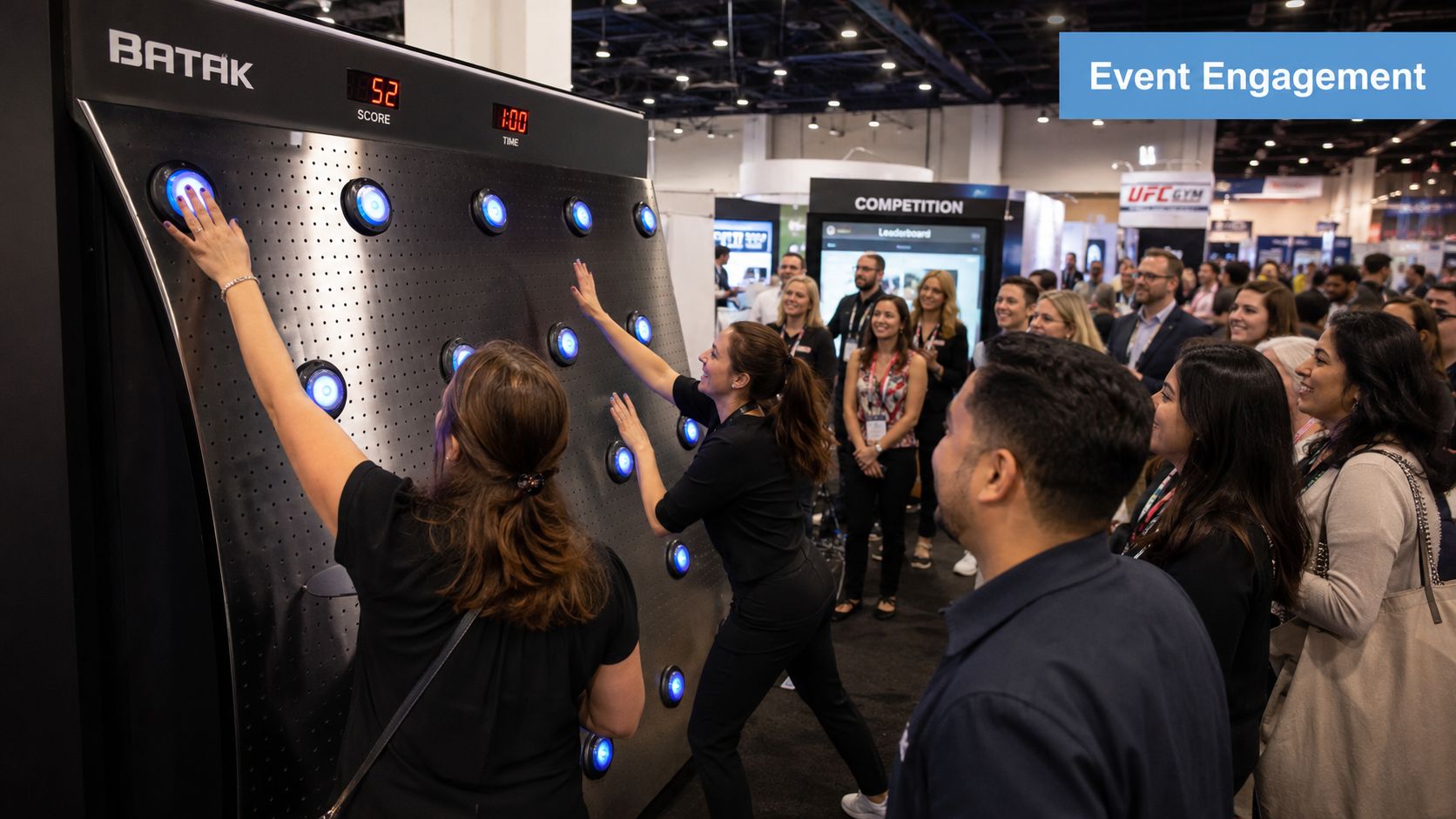
Exhibition stand magnet
On a busy exhibition floor, the job is simple. Stop people in motion. A Batak Wall does that well because it creates movement, noise, and a visible challenge without needing a presenter to explain every step.
The Batak Pro is a standard fixture at over 300 UK venues, including Silverstone and ExCeL London, and Leisure Hire reports that Batak activations deliver a 25% average increase in dwell time, with 78% of attendees engaging for at least 3 minutes. For an exhibitor, those are useful indicators because more dwell time usually means more chances for meaningful conversation.
In practice, the stand dynamic changes quickly. Instead of your team trying to pull people in one by one, the game itself creates the draw. That's especially helpful when your brand message needs a human explanation after the initial hook.
Team building catalyst
Internal events need a different rhythm. You're not trying to capture external leads. You're trying to get people involved without making the activity feel forced.
Batak works well here because it gives teams a shared task with immediate feedback. You can run quick individual rounds, department competitions, or paired challenges. It breaks the ice without requiring people to perform in a more awkward workshop-style format.
What tends to work best is simple scoring and a visible progression through the session. What tends not to work is overcomplicating the format with too many rules, categories, or prize layers. The appeal is speed and clarity.
A short clip gives a sense of how that energy looks in a live setting.
Product launch focal point
At launch events, the Batak Wall works best when the brand and the game feel connected. If the attraction looks like a generic rental dropped into the room, it can still draw a crowd, but it won't carry much of your message.
A stronger approach is to use the game as the central live element around a reveal, challenge, or social content moment. That might mean staff-versus-guests rounds, timed brand challenges, or a prize mechanic linked to the new product.
A launch activation should give guests something to do, something to watch, and something to talk about afterwards. Batak can cover all three if the branding and staffing are handled properly.
The common thread across these use cases is visibility. People don't need to be told there's activity happening. They can see it immediately. That's why the format keeps turning up in high-footfall venues and high-energy event briefs.
Technical Requirements and Setup Logistics
The Batak Wall is straightforward to deploy, but smooth delivery depends on getting the basics right before event day. Most avoidable problems come from access, layout, or power planning rather than the game itself.
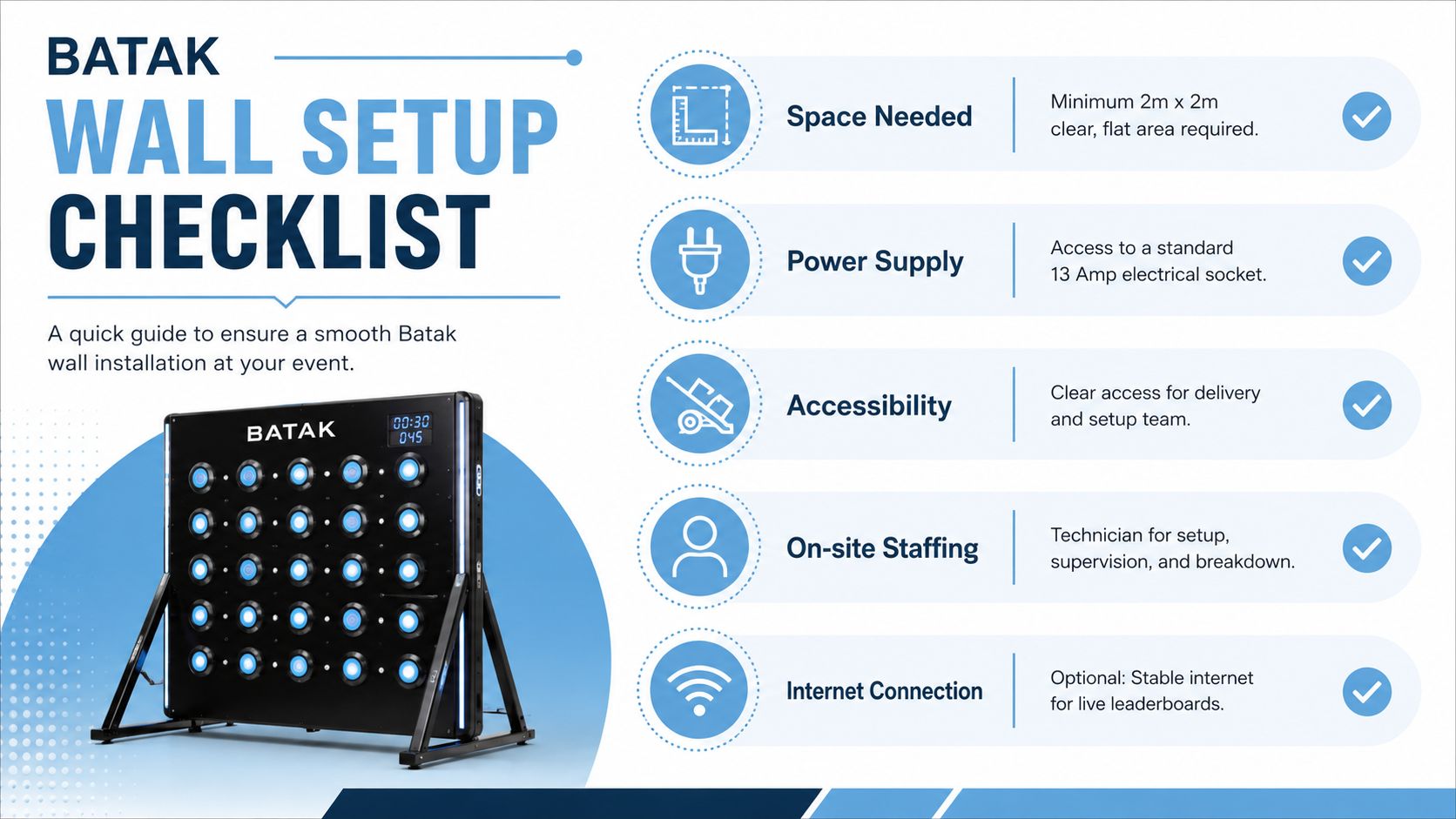
Space and power
The Batak Lite requires a minimum indoor footprint of 3m x 2m and a dedicated 13amp power socket within 5m, according to Batak Lite's product information. That same source notes a frame weight of 27kg, with total weight around 45kg including frame and free-standing feet.
Those numbers matter because they help planners answer three venue questions quickly:
- Can it fit the stand plan? Yes, if you allow clear operating room rather than drawing to the minimum line.
- Does it need specialist power? No, a standard supply is typically enough.
- Will the venue need structural changes? In most corporate settings, no.
That said, minimum footprint and practical footprint aren't always the same thing. For public-facing events, it's wise to allow extra room for queueing, side access, and audience viewing.
Access and staffing
Access is usually the next checkpoint. Before confirming hire, check loading routes, lift sizes, and any timed build restrictions set by the venue. A compact piece of equipment can still become awkward if your stand is deep inside a hall with tight delivery windows.
On-site staffing also matters more than some clients expect. An operator doesn't just switch the unit on. They keep rounds moving, explain the challenge, manage basic queue flow, encourage participation, and help maintain energy during quieter periods.
A practical setup checklist looks like this:
- Clear access route for delivery team and equipment movement
- Flat event surface so the frame sits safely and consistently
- Dedicated power point close enough to avoid messy cable runs
- Operating space in front of the wall for play and observation
- Supervision plan for public events, exhibitions, and branded activations
On-site reality: A well-run operator can make the difference between a Batak Wall that looks busy and one that actually converts attention into interaction.
Health and safety questions to ask
This area needs a practical view. The current market has a documented content gap around UK-specific health and safety guidance for Batak Walls in high-footfall public venues, including a lack of neutral published detail on emergency shutdown protocols and public-space compliance comparisons, as noted by JS Fun Event Hire's discussion of the issue.
That doesn't mean the equipment is unsafe. It means planners should ask direct questions instead of assuming all suppliers handle compliance the same way.
Ask for:
| Checkpoint | What to confirm |
|---|---|
| Risk assessment | Event-specific documentation for your venue and audience |
| PAT and maintenance status | Current testing and maintenance records |
| Insurance | Public liability and relevant equipment cover |
| Operator supervision | Who manages use during live hours |
| Emergency process | Shut-down procedure and fault response on site |
Those checks are standard event practice. They're worth doing properly.
Branding and Digital Integration Options
A Batak Wall becomes more valuable when it looks and behaves like part of your campaign rather than a standalone piece of kit. Basic branding can help, but the stronger results usually come from combining visual identity with a digital competition layer.
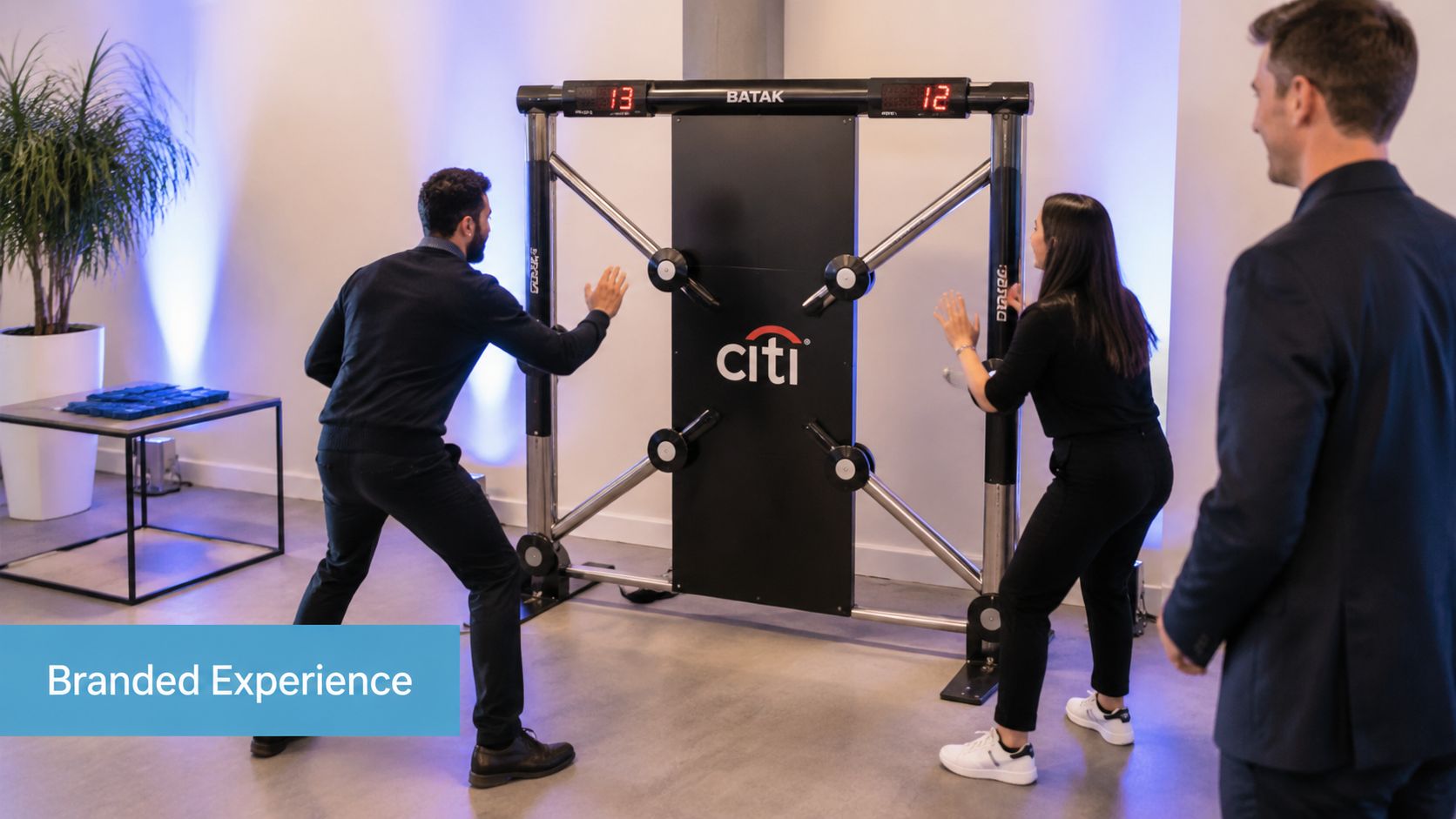
What to brand
Most clients start with the obvious visual areas. The outer frame, side panels, and surrounding set can all carry campaign creative. That's useful, but surface branding alone won't do much if the game flow still feels generic.
The better question is this. Where does the attendee see your brand during the experience?
Good answers include:
- Pre-play screen with campaign message or event prompt
- Leaderboard styling in brand colours and identity
- Prize mechanic tied to a product, message, or launch moment
- Backdrop and floor area designed to look intentional in photos and video
When those pieces line up, the attraction becomes a branded experience rather than branded hardware.
Digital layers that improve ROI
Electronic leaderboards are one of the most practical add-ons because they solve several event problems at once. They make the competition visible, give attendees a reason to submit details, and create social proof around participation.
If you're comparing options, PSW Events' electronic leaderboard setup is one example of how this layer can sit alongside interactive attractions at exhibitions and corporate events.
The trick is not to overload it. At many events, a simple name entry and score display is enough. If your team wants qualification questions, product interest flags, or consent options, build them carefully so they don't slow the queue or kill momentum.
Branding should support the challenge, not smother it. If every screen becomes a marketing message, play speed drops and interest usually follows.
Pairing the game with physical follow-up
A branded Batak Wall often works even better when the post-play moment is thought through. That could mean prize fulfilment, a takeaway tied to the score challenge, or a simple team photo opportunity.
For planners looking at ideas around practical branded giveaways, T-Shirt Envy event swag suggestions are a useful reference because they focus on items people are more likely to keep rather than discard. That matters. The game gets attention on the day. The follow-up item can help extend recall afterwards.
The main trade-off is speed versus depth. More branding layers and data points can improve campaign value, but only if they don't make the experience feel slow or over-managed.
Measuring ROI and Booking Your Batak Hire
If you're trying to justify a Batak Wall internally, “people enjoyed it” won't be enough. You need a simple measurement model that ties the activity to event outcomes your team already reports on.
There's also a real market gap here. While many providers say Batak Walls are ideal for team building, there's still a lack of UK-specific case studies that quantify direct contribution to B2B lead capture or dwell time at major venues in a neutral, comparative way, as noted by The Events Company's Batak Pro Wall page. That means planners need to build their own event-level measurement framework instead of relying on vague claims.
The KPI model that's worth tracking
In practice, four measures are usually enough:
Number of participants
This tells you whether the attraction converted passing traffic into active engagement.Average time spent around the activity
This is your practical dwell-time indicator. It matters because longer interaction creates more opportunities for staff conversation.Lead capture linked to participation
Separate these from general stand scans if you can. A game-generated lead often behaves differently from a passer-by badge scan.Quality signals after the event
Did participants book follow-up meetings, request demos, return with colleagues, or engage with post-event outreach?
A simple working table can help:
| Metric | What to record | Why it matters |
|---|---|---|
| Players | Total participants and repeat attempts | Measures attraction pull |
| Engagement time | Time spent playing and watching | Indicates conversation window |
| Captured contacts | Entries tied to the game | Measures lead mechanism |
| Commercial follow-up | Meetings, demos, qualified prospects | Connects activity to pipeline |
How to think about cost
Two calculations usually help internal stakeholders.
Cost per interaction
Total activation cost divided by total participants.Cost per captured lead
Total activation cost divided by the number of contacts captured through the game flow.
That won't tell the whole story, but it gives marketing and event teams a practical baseline. If your Batak Wall also improves stand visibility, social content, or staff engagement, note those outcomes separately rather than trying to force them into one number.
For teams building a wider reporting model, this guide to experiential marketing ROI is a useful starting point for connecting event activity to measurable commercial outcomes.
Booking decisions that make the hire worthwhile
Before you confirm any supplier, ask five direct questions:
- What exactly is included in delivery, setup, operation, and breakdown?
- How will branding be applied across the unit and any digital screens?
- What data capture options are available without slowing play?
- Who provides risk assessments and insurance documentation?
- How will success be measured on the day and reported afterwards?
One practical option in the UK market is PSW Events, which supplies Batak Pro hire alongside delivery, setup, staffing, branding support, logistics, and health and safety documentation for corporate events.
If your event needs a visible attraction that can support dwell time, competition, and cleaner engagement data, a Batak Wall is worth serious consideration. The key is to treat it as part of an event system, not a standalone game. When the setup, staffing, branding, and lead flow all line up, it does more than entertain. It gives your team something measurable to work with.