
You’re probably looking at an event floorplan right now, or a stand render, and thinking the same thing most marketing managers think before a big show. The stand looks polished. The messaging is approved. The team is briefed. But none of that guarantees people will stop.
That’s the core problem at exhibitions, conferences, launch events, and staff activations. Attention is scarce. Attendees walk past rows of printed graphics, looping videos, bowls of sweets, and well-meaning sales teams who all want the same thing. A few seconds of interest. A conversation. A reason to remember the brand afterwards.
An interactive gaming wall changes that exchange. Instead of asking people to read, watch, or wait, it gives them something to do. And that shift, from passive viewing to active participation, is what makes it valuable. Not because it’s flashy, but because it gives event planners a practical way to earn dwell time, spark conversation, and build a moment people remember once the show is over.
Transform Your Event Space from Passive to Playable
At most trade shows, the pattern is predictable. People scan your stand from the aisle, decide within seconds whether it’s worth stopping, and keep moving if nothing grabs them. Brochures don’t stop them. A branded backdrop rarely stops them. Even a good product demo can struggle if the space feels static.
Then there’s the stand with movement around it.
Someone throws a ball at a digital target. A scoreboard updates instantly. Colleagues cheer. Nearby attendees turn their heads to see what’s happening. Phones come out. A queue starts to form. The attraction isn’t just the game. It’s the visible energy around it.

That’s what a playable space does. It turns your footprint from a place people pass into a place people enter.
Why passive stands struggle
A passive stand puts all the work on the attendee. They have to read the headline, interpret the offer, decide it matters, and choose to engage. In a busy hall, that’s asking a lot.
A gaming wall reverses the order:
- Action comes first: People interact before they fully understand the brand story.
- Conversation follows naturally: Staff can talk to players while they’re engaged, not while trying to interrupt them.
- Memory gets anchored to a moment: The brand becomes tied to an experience, not just a logo panel.
The most effective event spaces don’t just display a message. They give people a reason to participate in it.
For corporate marketers, that matters because event success rarely comes from being merely visible. It comes from being memorable, easy to approach, and worth talking about afterwards.
What Exactly Is an Interactive Gaming Wall
At its simplest, an interactive gaming wall is a large digital surface that responds when people touch it, throw at it, move in front of it, or trigger it with physical actions. If you want a simple mental model, think of it as a giant playable screen that combines the visual pull of a video wall with the immediacy of an arcade game.
People often assume it’s one piece of equipment. It isn’t. It’s a system made up of three parts that work together.
The display
The first part is the visual layer. This is the wall people see.
That might be an LED wall, a projected surface, or a large display system built into scenic branding. The choice depends on the venue, the lighting conditions, and the look you want. A bright exhibition hall often favours a display with strong visual impact. A darker event environment can work well with projection.
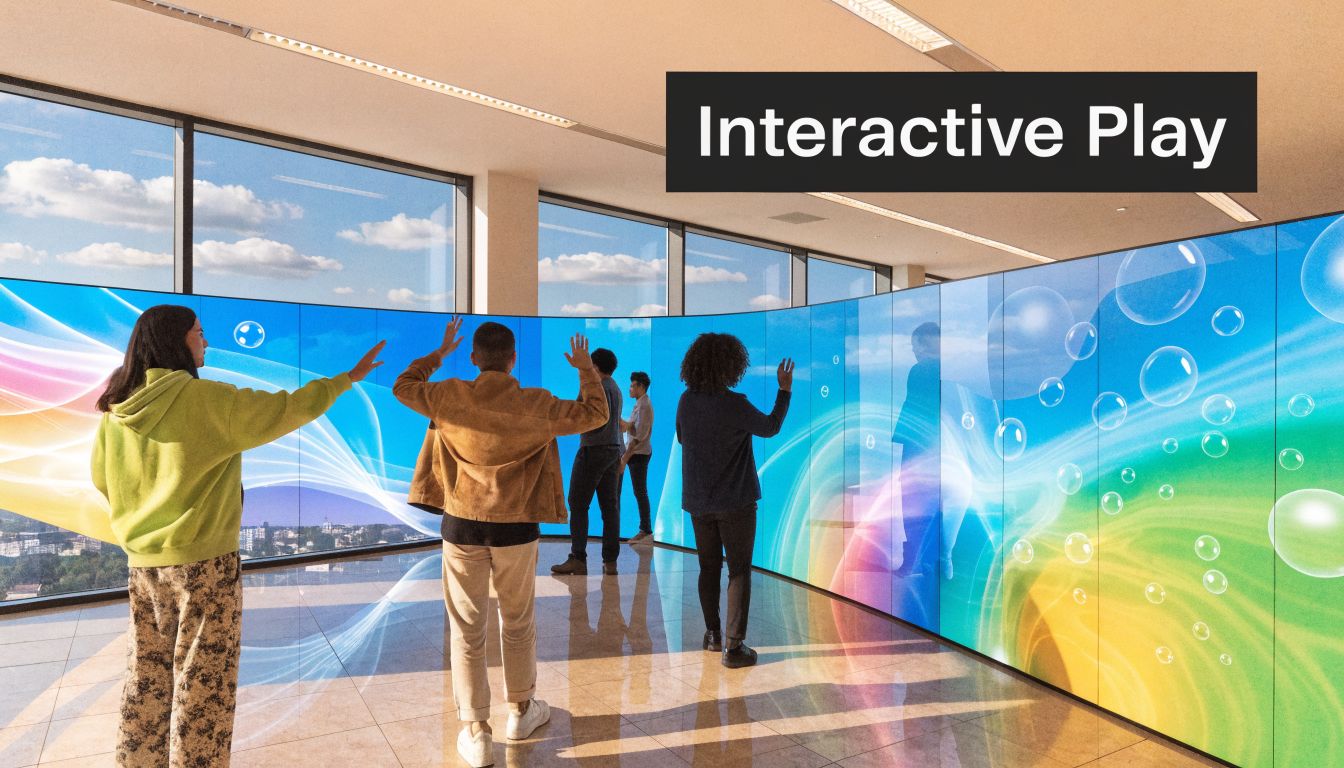
The display is the stage set. It gives the game scale and visibility. Without it, you don’t get the spectacle that draws attention from across the room.
The sensors
The second part is what makes the wall interactive. These are the sensors that detect input.
Depending on the system, that input might come from:
- Touch: Players press or strike targets directly on the wall.
- Motion tracking: Cameras detect hand, arm, or body movement.
- Object interaction: Soft balls, bats, or other safe props trigger targets and scoring.
- Proximity or gesture: The wall reacts when someone enters the play zone or performs a movement.
If the display is the stage set, the sensor layer is the referee. It watches what the player does and decides what counts.
That’s often the bit people find confusing. They see the animation and assume the software is doing everything. In reality, the magic comes from the wall recognising physical behaviour in real time and linking it to a game response.
The software
The third part is the game engine. It houses the rules, scoring, visuals, and branding.
Software determines whether the experience feels like a quick reaction challenge, a collaborative puzzle, a sports-style target game, or a branded quiz. It also controls practical features such as countdown timers, scoreboards, player names, lead capture prompts, and end screens.
Why this matters to a marketer
The hardware creates attention. The software creates relevance.
A plain game can entertain, but a branded game can reinforce a campaign line, support a product launch, or qualify visitor interest. That’s the difference between renting a novelty and deploying a marketing tool.
For a simple visual comparison, some event teams use room décor to test a theme before investing in a full scenic build. For example, resources on vinyl Fortnite decals show how environmental graphics can quickly shape the feel of a gaming space. An interactive wall applies the same idea at a much higher level. The environment doesn’t just look themed. It responds.
Simple rule: If a static display is a poster you can watch, an interactive gaming wall is a campaign you can play.
Why Gaming Walls Are a Game Changer for Events
The obvious benefit is that people notice them. The more important benefit is what happens after they notice them.
A well-chosen interactive gaming wall helps event teams solve four recurring problems. Low footfall. Short conversations. Weak brand memory. Thin lead data.
They pull people in
Most event teams know the hardest part of stand engagement is the first stop. Once someone is in your space, your staff can do their job. The challenge is creating enough curiosity and energy to break aisle flow.
Gaming walls do that because participation is visible. Attendees don’t have to imagine what the experience is like. They can see it from a distance. They can hear the reaction. They can understand the goal quickly.
That makes the activation function like a live demonstration of itself.
A static screen says, “Watch this.”
A gaming wall says, “Have a go.”
They extend dwell time without forcing it
People stay longer when there’s a clear activity, a score to beat, or a social reason to stick around. Even those who don’t play often watch others first, which still keeps them inside your event footprint.
That matters because more time creates more openings for:
- Staff conversations: A host can speak while players wait, compete, or review scores.
- Product messaging: Screens can rotate between gameplay and campaign visuals.
- Peer interaction: Colleagues often encourage one another to take part, which helps group engagement.
Shorter, low-pressure interactions often work better than trying to force a formal sales conversation too early.
They improve brand recall through participation
People remember what they do more clearly than what they glance at. That’s why experiential formats work when they’re designed well. They tie your message to a physical action and an emotional response.
If someone competes in a reaction game branded around speed, accuracy, security, precision, or teamwork, the product message becomes more than copy on a wall. It becomes a felt experience.
Active participation gives your message a memory hook. That’s what passive media struggles to create in a crowded venue.
This is especially useful when your product is hard to demonstrate physically. Software, financial services, logistics platforms, data tools, and professional services often have a harder time creating visual drama on a stand. A gaming wall gives those brands a way to express an idea through interaction rather than trying to make screenshots do all the work.
They make lead capture feel less transactional
Most badge scans tell you very little. Someone stopped. Someone was polite. Someone wanted the freebie. That doesn’t always mean real interest.
A gaming wall can collect richer context if you design the flow properly. For example, the experience can invite players to enter details before or after a game, choose a challenge linked to a product theme, or opt into a leaderboard or prize draw. Staff can then use behaviour as a conversation starter.
That changes the quality of the exchange. Instead of opening with “Can I scan your badge?”, the team can open with “You picked the security challenge. Is that the area you’re focusing on this year?”
They work for internal events too
Not every event goal is external lead generation. At team-building days, conferences, employee engagement events, and family fun days, the value often sits in shared participation.
A gaming wall can support:
- Friendly competition between departments
- Collaborative games that reward communication
- Ice-breakers for mixed teams who don’t know one another well
- Energy in transition spaces such as registration areas or breakouts
One point often gets overlooked in this context. 72% of players believe games create community, according to the Entertainment Software Association’s Essential Facts 2024. That doesn’t automatically mean every event game builds connection well, but it does explain why game-led formats can feel more social than passive entertainment when they’re designed for the audience.
Planning the Practicalities Space Tech and Branding
An interactive gaming wall feels ambitious from the outside, but the planning usually becomes much simpler once you break it into three decisions. Where will it go. What does it need. How should it look.
Start with the footprint
The wall itself is only part of the space requirement. You also need a play zone in front of it so participants can move safely and spectators can gather without blocking the aisle.
When planning your footprint, think in layers:
- The wall zone: The structure, screen, or projection surface itself
- The player zone: Clear space for movement, throwing, stepping, or reacting
- The viewing zone: Room for colleagues, passers-by, or queued participants
- The staff zone: Space for a host, lead capture device, or prize handout point
Planners often go wrong here. They measure the attraction, not the experience around it.
If you’ve ever reviewed golf simulator setup dimensions, the principle is similar. The hitting screen isn’t the only consideration. You also plan for swing clearance, player position, and safe use around the equipment. A gaming wall needs the same mindset. Don’t just ask how wide the wall is. Ask how people will move around it.
Check the venue realities early
Ceiling height, rigging restrictions, ambient light, access times, and floor loading all affect the best setup. A projection-based system may need more control over surrounding light. A built scenic surround may need earlier access for install. A narrow shell scheme stand might benefit from a simpler front-facing format than a deep immersive build.
A practical venue check should include:
- Access route: Can the equipment get from loading bay to stand without issue?
- Power availability: Is standard event power sufficient for the chosen setup?
- Operating hours: Will the wall run all day, or only at programmed intervals?
- Noise environment: Does the game need audio cues, or should it rely more on visuals?
- Audience mix: Are you expecting quick exhibition traffic, invited guests, or family groups?
On-site reality check: The best activation on paper can fail if the audience can’t see it clearly or queue for it comfortably.
For turnkey hire options and a clearer sense of how these activations are delivered in practice, it helps to review a specialist provider’s interactive wall hire solutions.
Branding needs to do more than decorate
The strongest branded gaming walls don’t just add a logo in the corner. They weave your campaign into the structure of the experience.
That can include:
- Branded game skins: Colours, iconography, and visual style matched to campaign assets
- Custom targets or prompts: Product names, feature themes, or message pillars built into gameplay
- Leaderboard graphics: End screens that reinforce the brand after each round
- Physical scenic surround: Fascias, headers, and side panels that make the wall feel built into the stand
- Call-to-action screens: Follow-up prompts after play, such as demo bookings or prize entry
A good rule is this. If you removed the logo, would the game still feel like your brand? If the answer is yes, the branding is integrated. If the answer is no, it’s probably just surface-level dressing.
From Gamification to Measurement Maximising Your ROI
Fun alone isn’t a business case. Fun tied to a clear event objective is.
The brands that get the most value from an interactive gaming wall don’t treat it as a side attraction. They treat it as part of the campaign journey. That means deciding in advance what behaviour matters and building the game flow around it.
Match the game mechanic to the marketing goal
Different game types support different outcomes.
A high-speed reaction game works well when you want quick throughput and visible energy. A quiz-led challenge can connect more directly to product education. A team format suits internal culture events or shared participation at hospitality activations.
The key is alignment. If your objective is lead quality, don’t choose a game that only creates a queue. If your objective is social visibility, make sure the visual moment is easy to film and share.
Build data capture into the experience
The least effective version of lead capture sits outside the game. Someone plays. They finish. Then a staff member asks them to fill in a separate form. That creates friction and breaks momentum.
A better setup makes data capture part of the flow. For example:
- Pre-play registration: Useful when you need names for a leaderboard
- Post-game results screen: Good for collecting details while interest is still high
- Prize mechanics: Effective when tied to consent and clear follow-up
- Choice-based paths: Helpful if you want to understand topic interest through the type of game selected
What matters isn’t just collecting contact details. It’s capturing context. Which challenge did they choose? Did they play solo or with colleagues? Did they return for a second attempt? Did they ask for a product demo afterwards?
That context gives your sales team something more valuable than a badge scan. It gives them a warmer opening.
Use the wall as a content engine
A gaming wall can also support your event content strategy if you design for it.
A branded high-score moment, an instant win celebration, or a team challenge finale gives you a natural point for photo or video capture. That material can feed event recap edits, internal communications, social clips, and sales follow-up content.
The best activations often include one or more of these content triggers:
- A visible scoreboard moment
- A celebratory final screen
- A branded victory pose area
- A host-led challenge announcement
- A short round length that creates repeatable highlights
For brands building wider campaigns, a gaming wall comfortably integrates into broader experiential marketing activations, rather than operating as a standalone novelty.
Don’t ask only “Was it popular?” Ask “What did popularity help us achieve?”
Decide your KPI framework before the event
You don’t need invented benchmarks to measure success well. You need a clean framework that matches your objective.
For exhibitions and brand activations, teams usually track a mix of:
| KPI area | What to look at | Why it matters |
|---|---|---|
| Engagement | Number of plays, repeat plays, queue interest | Shows whether the concept attracted attention |
| Dwell | Time spent in or around the activation zone | Indicates depth of interaction |
| Lead quality | Opt-ins, qualified conversations, booked follow-ups | Connects play to pipeline |
| Content value | Photo moments, usable clips, social-friendly scenes | Extends value beyond the live event |
| Team activity | Staff interactions triggered by the game | Helps judge whether the activation supported sales conversations |
A simple post-event debrief should answer three questions. Did it attract the right audience. Did it create useful engagement. Did it support the wider commercial goal.
Real World Success Case Studies and Game Concepts
The easiest way to judge an interactive gaming wall is to picture how it behaves in a live brief. Not in a generic demo video, but in a real event setting with real constraints.
A B2B tech launch at ExCeL London
A software brand launches a new platform at a major industry show. The stand message centres on speed, visibility, and fast decision-making. The challenge is obvious. The product itself lives on a screen, and every competitor nearby is also showing dashboards.
So the team uses a reaction-based gaming wall instead of another passive monitor. Attendees step into a short challenge where branded icons light up across the wall and must be hit in the correct order. The game round is quick. The scoring is immediate. A leaderboard sits above the play area.
The result isn’t just entertainment. It gives the stand team a better opening line.
Visitors who choose to play signal willingness to engage. Staff can connect the game mechanic to the product story. Fast response. Clear priorities. Better visibility under pressure. After each round, players can enter their details to save their score and request a follow-up conversation.
What works here is the fit between metaphor and message. The game doesn’t feel random. It expresses the campaign theme in a way people can feel physically.
A corporate family fun day for a large employer
Now take a very different brief. A company runs a family day with employees, partners, and children attending together. The objective isn’t product marketing. It’s culture, inclusion, and shared enjoyment.
A competitive solo challenge could work, but it might narrow participation. A better fit is a cooperative wall game where players solve visual tasks together, respond to colour prompts, or clear targets as a team.
The wall becomes a social anchor. Children join in quickly. Adults who wouldn’t volunteer for a stage activity often participate because the barrier to entry is low. Colleagues cheer one another on. Families take photos. The game supports a warm, communal feel without needing a presenter to force energy into the room.
For this style of event, the activation succeeds because it welcomes different confidence levels and different ages without needing a long explanation.
Some of the best event technology disappears into the experience. People don’t talk about the sensor system. They talk about who beat them, who joined in, and whether they can have another go.
Interactive Game Concepts and Their Ideal Use Cases
| Game Concept | Primary Goal | Player Format | Best For… |
|---|---|---|---|
| Splat the Logo | Brand reinforcement | Single player or head-to-head | Exhibition stands, product launches, high-throughput activations |
| Digital penalty shootout | Crowd building and spectator appeal | Single player | Sports campaigns, fan zones, sponsor activations |
| Reaction light challenge | Footfall and fast engagement | Single player with leaderboard | Trade shows, conference breakouts, tech launches |
| Team-based puzzle quest | Collaboration and communication | Small teams | Team building, internal conferences, family fun days |
| Branded quiz wall | Education and lead qualification | Single player or pairs | B2B launches, training events, regulated sectors |
| Target hit product challenge | Message retention | Solo or competitive pairs | New product campaigns, retail activations |
| Timed values challenge | Culture reinforcement | Teams or departments | Staff engagement events, awards evenings, company away days |
Some planners also compare formats against more established attractions before deciding. If you already know the appeal of speed-and-reaction experiences, it’s worth looking at Batak wall hire options as a related benchmark. They illustrate why simple rules, visible scores, and instant feedback work so well in busy event environments.
How to choose the right concept
Don’t start by asking which game looks coolest. Start by asking what behaviour you want.
If you want quick throughput, choose a game with short rounds and instant understanding. If you want better conversations, choose one that gives staff a natural follow-up topic. If your audience includes families or mixed-ability groups, favour formats that don’t rely on speed alone.
A useful selection filter is this:
- High traffic event: Keep rules simple and rounds short
- Education-led campaign: Build the message into the challenge
- Hospitality or networking: Prioritise shared participation over pure competition
- Internal culture event: Choose collaboration before complexity
The right game makes the business objective easier to achieve. The wrong game still entertains people, but it won’t give your team much to work with afterwards.
Your Interactive Gaming Wall Planning Checklist
By the time many teams enquire about an interactive gaming wall, they already know they want stronger engagement. What they need next is a cleaner buying checklist.
Start with the objective, not the equipment. If the goal is lead generation, design for data capture and staff conversation. If it’s brand awareness, prioritise spectacle and easy visibility from a distance. If it’s internal engagement, focus on accessibility, group play, and ease of participation.
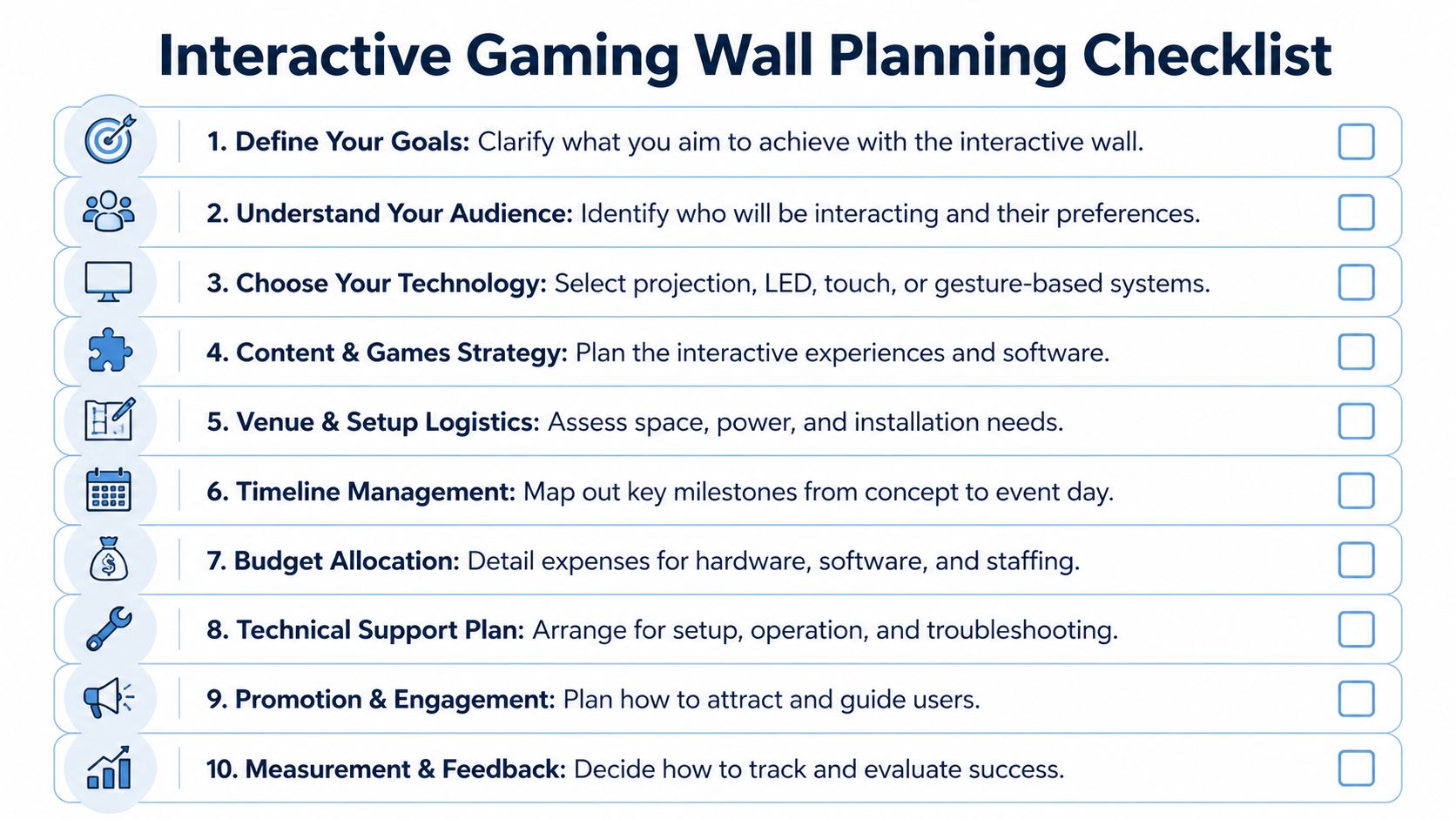
The core checklist
- Define the result: Decide whether success means leads, dwell, content capture, team building, or a mix.
- Audit the venue: Confirm footprint, access, power, lighting, and audience flow.
- Choose the interaction type: Touch, motion, object-based, or a hybrid.
- Match the game to the goal: Short competitive rounds for traffic, collaborative formats for culture, quiz structures for learning.
- Plan the branding properly: Build your campaign into the gameplay and end screens, not just the header panel.
- Assign staffing roles: Someone needs to host, manage flow, and connect the game back to the event objective.
- Set measurement rules early: Agree what your team will record during and after the event.
Don’t overlook accessibility
Many otherwise strong activations fall short in this specific area.
72% of players believe games create community, according to the Entertainment Software Association’s Essential Facts 2024, yet many commercial interactive walls still don’t account properly for neurodivergent participants or guests with mobility impairments. For UK event planners, that makes supplier choice more than a technical decision. It becomes an inclusion and compliance decision too, especially when you need an experience suitable for mixed-ability groups under the Equality Act 2010.
That means asking practical questions such as:
- Can the game difficulty be adjusted?
- Can the experience work for seated participants?
- Are there sensory-friendly options?
- Is the host briefed to adapt participation rather than rush people through?
- Does the supplier treat inclusion as part of design, not an afterthought?
Accessibility isn’t a bonus feature. It shapes who gets to take part and how welcome they feel doing it.
Choose a partner, not just a box of kit
A wall on its own won’t deliver much. You need logistics, install planning, branding support, risk assessment, on-site operation, and a team that understands event pressure. If you want a useful primer on how professional coordination supports that process, this overview of expert event planning services is a helpful reminder that execution work sits behind every smooth guest experience.
When you’re ready to turn the idea into a live brief, PSW Events can help design, deliver, brand, staff, and support an interactive gaming wall activation that fits your event objective instead of fighting it.
If you’re planning an exhibition stand, internal conference, family fun day, or branded activation and want a practical recommendation, talk to PSW Events about the right interactive format for your audience, venue, and ROI goals.