
A UK events company plans, produces, staffs and runs live events, from conferences and exhibitions to private parties, so the client can hand over the whole job. Business events draw visitors and spending on a scale that keeps the sector busy year-round.
You may be comparing quotes for a conference, launch or exhibition activation and trying to work out what the supplier will take off your plate. The price matters, but so do the less visible details: who files the venue's paperwork, who briefs stewards on crowd management, and whether the space works for guests with different access needs. Permits and accessibility belong inside the buying decision, because a supplier who prices them in will look very different from one who treats them as an afterthought. Check them before you sign, not after the floor plan is fixed.
What a UK Events Company Actually Does
A UK events company turns a client's brief into a working event, coordinating planning, production, logistics, staffing and live delivery. Think of it as the general contractor on a building site: you own the vision, the venue provides the shell, and the events company coordinates the trades so the finished job functions as intended.
The work runs from concept and venue sourcing through build, staffing and live operation to dismantling. A venue sells space; a creative agency sells ideas and design; an events company delivers the operational whole, sometimes bringing in the venue and creative work as part of its package. For a broader explanation of how those responsibilities fit together, Creventa's guide to event management offers useful context.
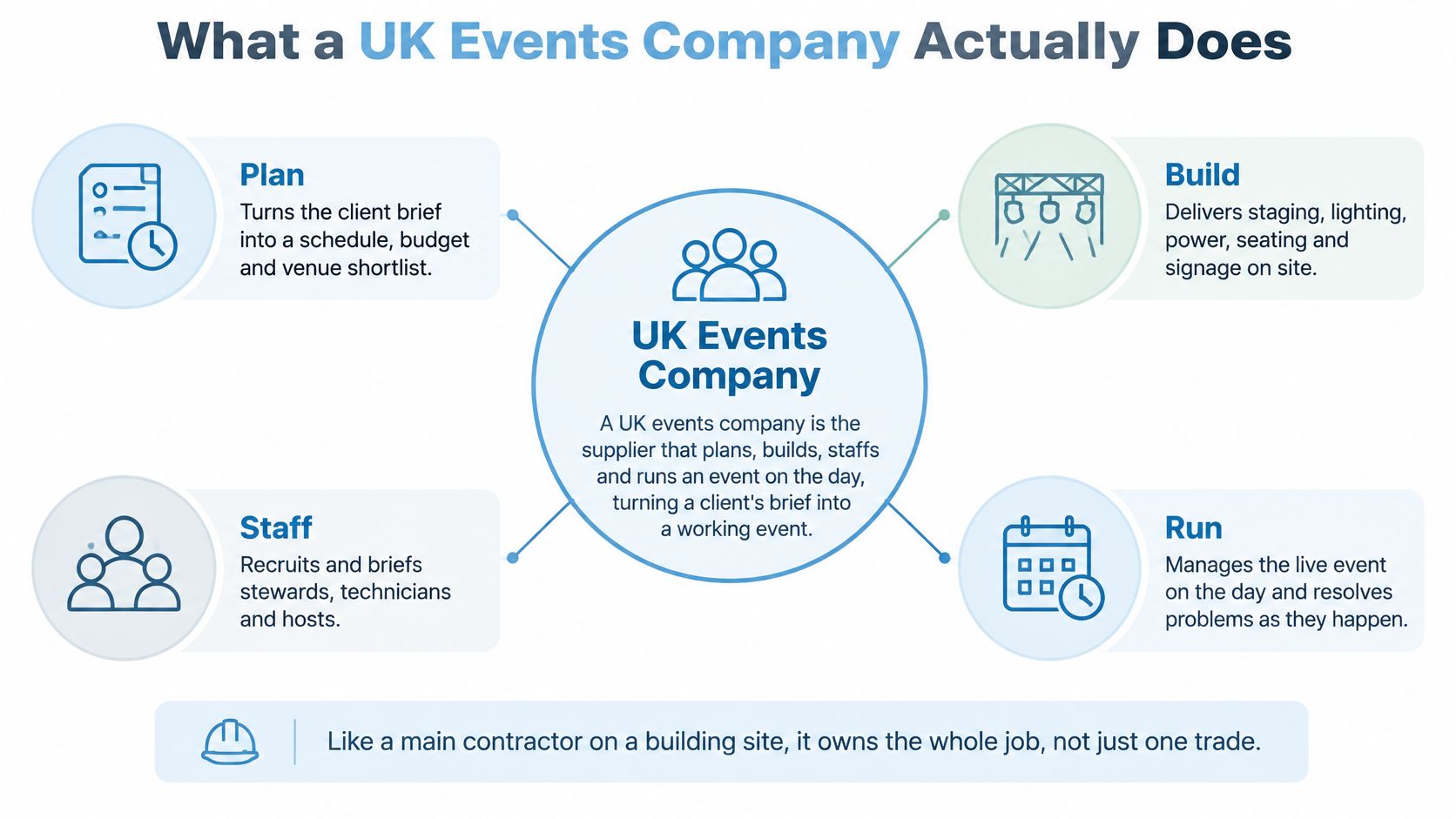
Consider a 300-guest product launch at ExCeL London. The supplier might coordinate stands, power, hosts and registration flow, then manage the installation and show-day operation. For a 120-person staff awards dinner in a Cambridge hotel, the focus could instead be staging, sound and timed entertainment.
VisitBritain counted 2.561 million inbound business-events visits to Great Britain in 2024, generating £2.768 billion in expenditure, across meetings, conferences, exhibitions and other business events (VisitBritain's business-events research). That visitor spending reaches beyond venue hire to accommodation, transport, restaurants and other local services.
If your brief needs someone to make the event happen, not just decorate it, you need a full events company.
Services a UK Events Company Typically Offers
Most companies bundle these services into full-service packages, but many also sell individual elements, such as equipment hire without event management. This comparison helps you see what should be included and what you may need to arrange separately.
| Service | What it covers | Typical client | What you receive |
|---|---|---|---|
| Full event management | Concept, budget, timeline, supplier management and live running | Corporate planners and marketing teams | One accountable lead and a run-of-show document |
| Production and technical | Staging, lighting, sound, power distribution and screens | Conference and product launch organisers | Technical rider, load plan and on-site engineers |
| Venue sourcing and logistics | Venue shortlists, load-in, transport, storage and site access | Organisers working across multiple cities | Site survey, access schedule and logistics plan |
| Interactive entertainment and attractions | Simulators, racing rigs, VR, climbing walls and giant games | Brands, exhibitors and team-building buyers | Installation, operator staff and session data |
| Exhibition and stand activation | Stand design, lead capture, timed challenges and leaderboards | Exhibitors and trade show agencies | Engagement plan and lead-capture reporting |
| On-site staffing and hosts | Brand ambassadors, technicians, stewards and queue management | Any venue-based event | Named staff roster and briefing pack |
| Catering and hospitality coordination | Supplier liaison, hospitality zones and dietary management | Corporate and residential conferences | Catering schedule and supplier contacts |
| Branding and content | Signage, wayfinding, digital screens and photo or video capture | Brands and agencies running activations | Brand guidelines applied and content files |
| Private celebrations | Parties, weddings, family fun days and milestone events | Private clients | Single point of contact and package quote |
For a 1,000-delegate conference, the main events company could manage production, venue logistics and the running schedule, while a specialist attraction supplier operates an engagement zone. That division can work well, provided the contract names who handles power, floor space, queues, staffing and safety coordination. A useful way to compare full-management support with individual services is to review event management services.
For an exhibition attraction, set the measurement plan before production. The engagement funnel should distinguish estimated passers-by, participants, repeat participants, data-capture opt-ins and sales-qualified leads. The UK events industry was estimated to contribute £68.7 billion to the national economy in 2025; exhibitions generated approximately £11.5 billion in economic output and supported 126,000 jobs, according to the Events Industry Alliance's 2025 report. That's a reason to treat an activation as a commercial tool, not just entertainment.
Electronic leaderboards, QR-linked scorecards, timed challenges and branded registration screens can help make engagement trackable without adding a cumbersome sign-up process. Ask for expected throughput, average interaction duration, queue abandonment, staff-to-participant ratio and cost per captured lead. For practical event-entertainment planning considerations, MyKaraoke Video's advice for entertainment professionals is a useful supplementary read.
Buy hire-only equipment separately when your team can manage delivery, operation and safety coordination. Bundle production, installation, staffing and live running when those pieces depend on one another or when no in-house producer owns the hand-offs.
How to Evaluate a UK Events Company
The common mistake is choosing on price and portfolio, then discovering too late that nobody has checked insurance, safety arrangements or staffing. Compare providers against the same written criteria, and ask for evidence rather than reassurance.
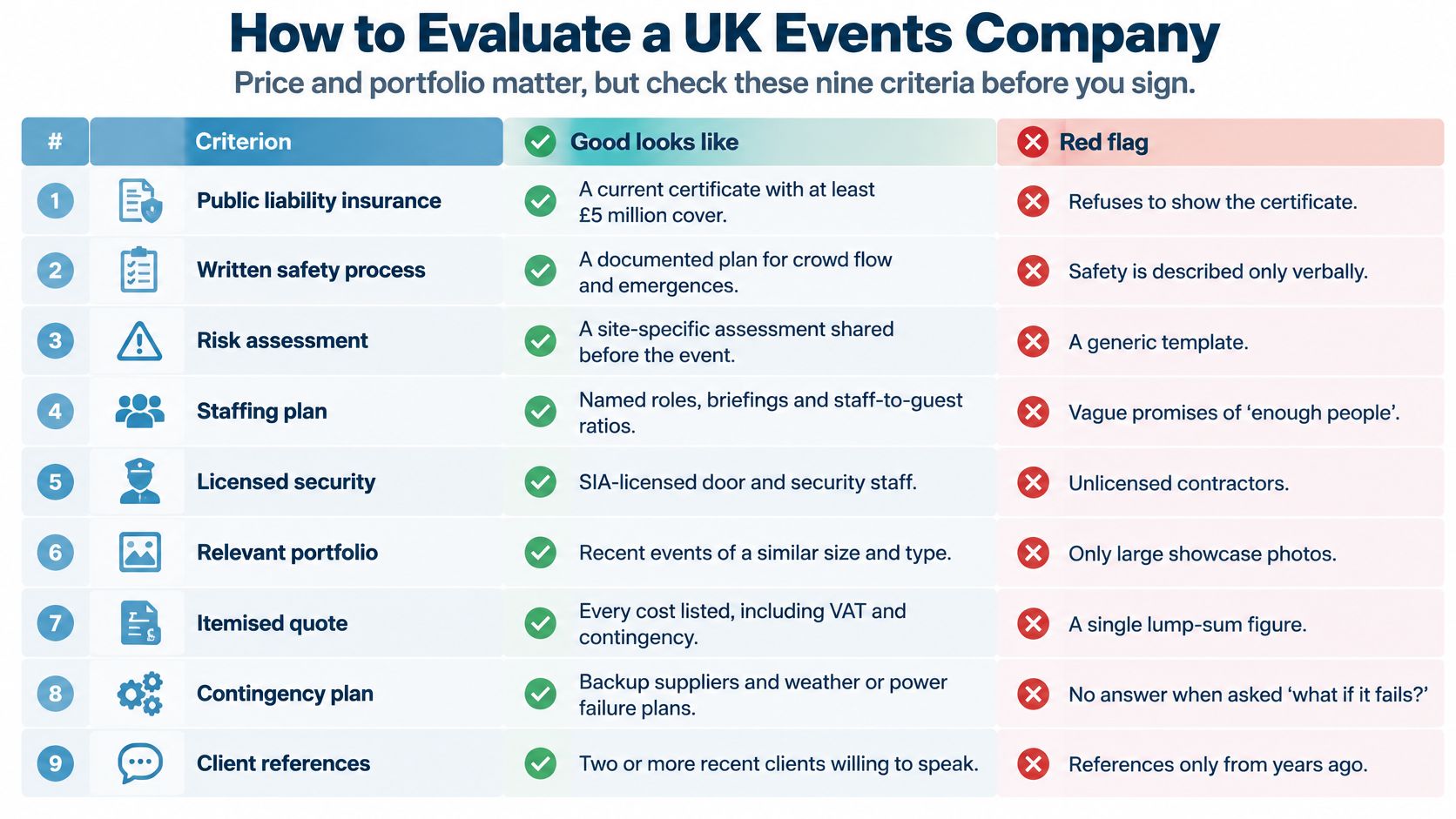
| Criterion | What good looks like | Red flag |
|---|---|---|
| Public liability insurance | Named insurer and certificate showing cover of £5 million to £10 million | Verbal assurance only or cover below the venue requirement |
| Product and employer's liability | Certificate covering equipment and any staff employed on site | No evidence that equipment is covered |
| Health and safety record | Written risk assessment and a named H&S lead for your event | Generic safety statement with no site-specific plan |
| Relevant track record | Two or more references from events of similar size at similar venues | Portfolio of unrelated work only |
| Staffing model | Named roles, staff-to-guest ratio and briefing process | Staff numbers only given as a total |
| Written scope | Itemised scope, dates, site survey and change-control process | Fixed price with no site visit |
| Measurable reporting | Agreed metrics such as footfall, dwell time, participation and leads | Reporting limited to photos |
| Accessibility approach | Documented plan for access needs, sessions and communications | No answer beyond step-free access |
| Payment and cancellation terms | Clear deposit schedule and cancellation tiers in writing | Full payment before any written contract |
Public liability cover should meet the venue's requirements, and you should see the current certificate. Also confirm product and employer's liability cover if equipment and staff are part of the delivery. Ask who will act as the named health and safety lead, and request the event-specific risk assessment and staffing plan.
Ask what went wrong: Request references from comparable events, then ask what failed or changed on the last one and how the team handled it.
A supplier who can't name its insurer or offers a fixed price without a site survey is asking you to accept avoidable uncertainty. Check the written scope for what's included, what triggers an extra charge and how changes are approved. Agree the reporting measures in advance, whether that means visitor numbers, dwell time, participation or leads.
Accessibility should be more specific than a promise of step-free access. Ask how the supplier will communicate with guests, adapt participation and brief staff. For a practical way to assess the supplier's scope and fit, use a structured vendor selection criteria scorecard.
Score each provider against the same list. Reject any supplier that fails your insurance or safety requirements, regardless of how attractive the headline price looks.
What Drives Event Pricing and Your Budget
Quotes differ because suppliers price different scopes, not only because one is dearer. Compare the line items before comparing totals.
For illustration only, consider a two-day exhibition stand with an interactive attraction, staffed for ten hours a day, including installation and dismantle at a London venue. The following percentages are illustrative assumptions, not market rates. They show one way to split a total budget so you can apply the proportions to your own brief.
| Budget line | Illustrative share of total |
|---|---|
| Production | 22% |
| Attraction hire | 18% |
| Staffing | 18% |
| Installation and dismantle | 12% |
| Transport | 10% |
| Insurance and permits | 5% |
| Branding and content | 5% |
| Contingency | 10% |
Keep the contingency visible rather than burying it in an unexplained total. The right allowance depends on what could change, such as venue access, build time or branding approval. A quote should say who controls that budget and what evidence is needed to draw on it.
| Cost driver | How it moves the price | Ask for in the quote |
|---|---|---|
| Audience size and session length | More guests or longer sessions need more equipment and staff hours | Price per session and per operating hour |
| Venue and location | London venues often carry higher load-in and labour costs | Venue-specific load-in and labour line |
| Equipment and production | Scale of staging, screens, lighting and attraction hire | Itemised equipment list with hire periods |
| Staffing hours | Weekend, overtime and night shifts raise the rate | Staff roster with hourly rate and overtime terms |
| Installation and dismantle | Build time and access restrictions add labour days | Build and strike schedule with access windows |
| Permits and insurance | Licences, insurance certificates and compliance paperwork | Named permit and insurance costs |
| Branding and content | Signage, graphics, video capture and data capture setup | Design and print costs separated from hire |
| Transport and storage | Freight, vehicle hire and storage between dates | Logistics costs with carrier and storage terms |
| Contingency | Buffer for late changes, weather or extended build | Contingency stated as a percentage, typically 10 to 15 per cent |
Day rates can suit an in-house team that already has a producer and can coordinate the moving parts. A package is often easier for a single brief because one supplier takes responsibility for linked tasks. Before you compare offers, ask what's included, what costs extra and what happens to the price if the schedule moves. For a reference point when scoping equipment hire, review equipment rental rates, then request an itemised quote for your actual venue and operating plan.
Venue and Permit Issues That Delay Events
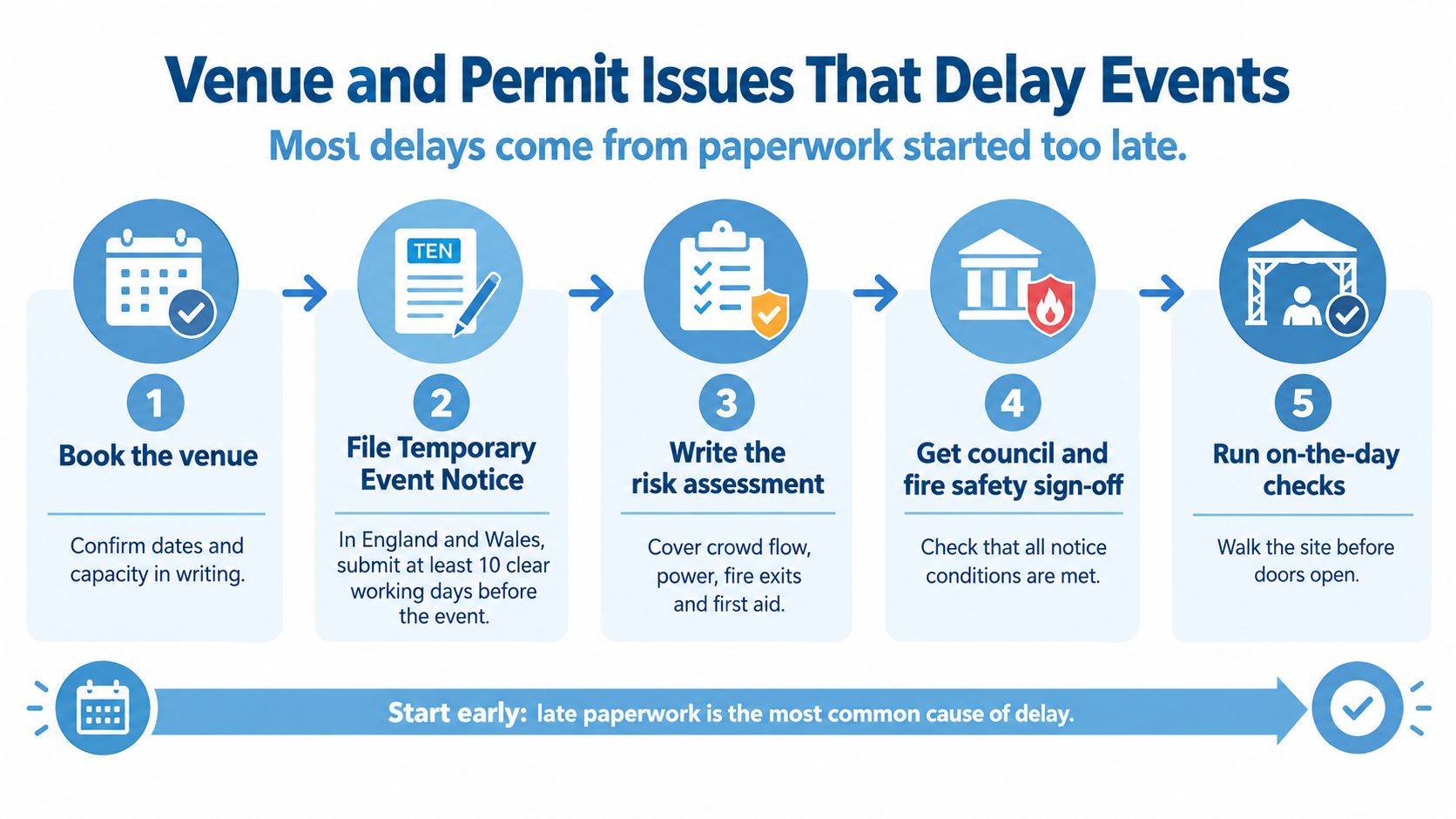
Most event delays come from paperwork started too late, not from the live event itself. Licensing rules differ across the UK, so confirm the requirements with the relevant local authority and venue before you commit to a production plan.
| Issue | When it applies | Action before the build |
|---|---|---|
| Temporary Event Notice | Small licensable events in England and Wales with fewer than 500 people, lasting up to 168 hours | Submit at least 10 working days before the event |
| Premises licence | Licensable activity beyond a temporary notice or at a venue without a licence | Confirm the venue licence covers your activities and hours |
| Venue capacity certificate | Any venue-based event with set capacity limits | Confirm the capacity figure and plan queues to stay within it |
| Crowd-management plan | Queues, attractions and peak arrival or exit periods | Map arrival, circulation, exit and dispersal with named stewards |
| Rigging and structural approval | Flight simulators, truss, climbing walls and heavy rigs | Provide load data and get venue sign-off before delivery |
| Electrical testing and power | Attractions with high power draw or multiple circuits | Confirm power supply, test certificates and cable routing |
| Noise limits | Music, games and sound effects near residential areas or shared spaces | Agree decibel limits and session times with the venue |
| Highways and outdoor permission | Outdoor sites, road closures or pedestrian diversions | Apply to the local authority with lead time for approval |
The Temporary Event Notice process applies in England and Wales; Scotland and Northern Ireland have separate licensing regimes. Don't assume a venue's existing licence covers every activity or operating hour in your event plan. Check before signing, especially if the event includes entertainment or other licensable activity.
Crowd management needs to account for the complete movement of people: arrival, entry, circulation, exit and dispersal. The Health and Safety Executive's crowd-management guidance advises organisers to assess venue suitability, manage queues and pedestrian routes, keep emergency access clear, and ensure exits remain open and unobstructed. Organisers retain overall responsibility for public safety even when they contract out stewarding.
For interactive attractions, map the queue, spectator area, cables, emergency routes and separation between waiting and active play. Ask the attraction supplier for its session cycle time and staffing plan, then use those to judge practical throughput rather than assuming equipment capacity equals audience capacity.
Follow this order: venue check, permit application, risk assessment, site plan, staff briefing. Give each item an owner and deadline so the supplier, venue and organiser aren't working from conflicting assumptions.
Accessibility Checks Most Event Briefs Skip
An attraction can be reachable and still exclude people. A simulator might have a step-free route but require a seat transfer; its controller may be hard to grip, or flashing effects and time pressure may make the experience difficult to use.
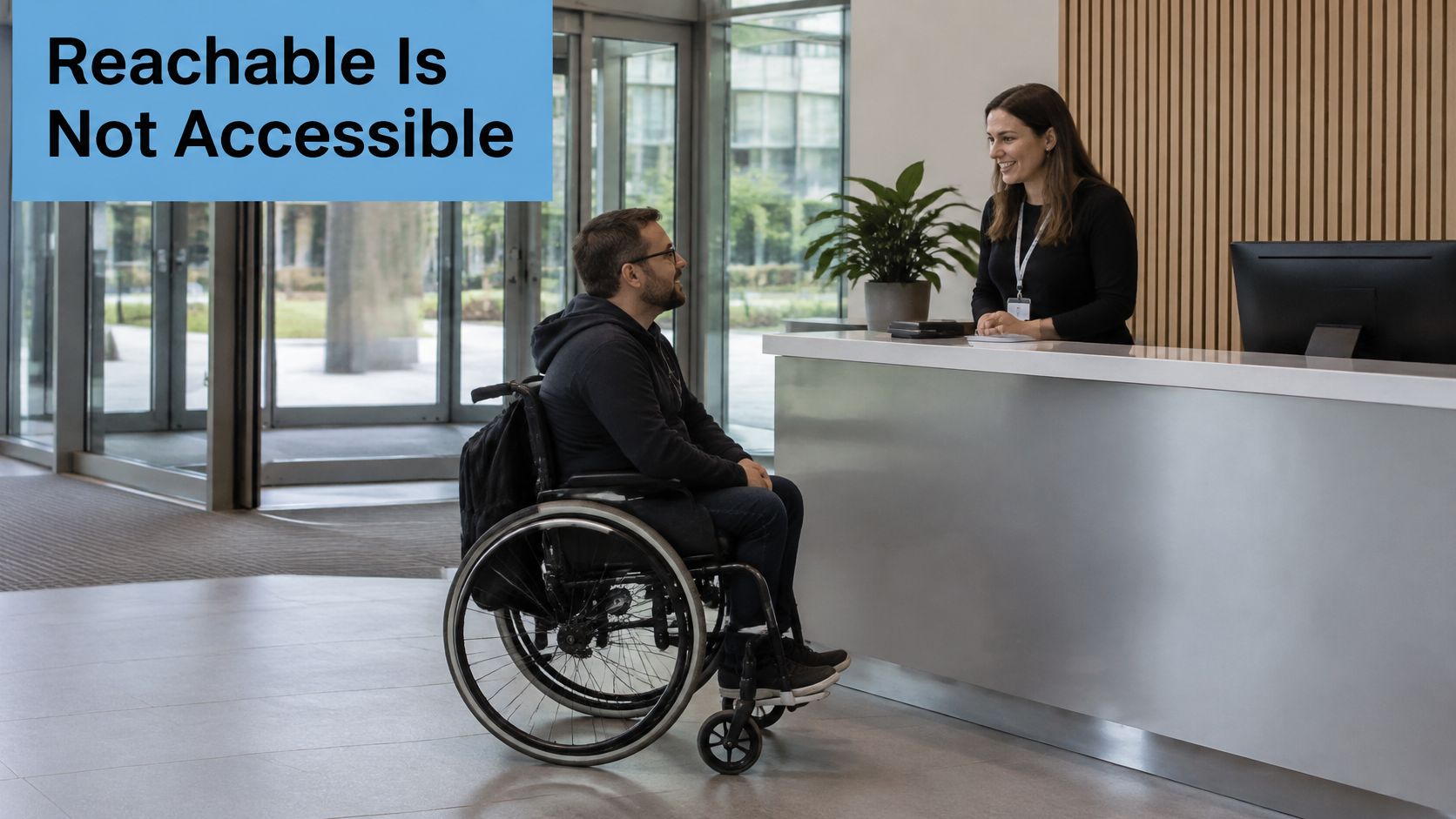
Accessibility guidance covers facilities such as step-free routes, toilets, viewing areas, signage and emergency evacuation, but the attendee's experience also depends on how the attraction works in practice. A guide by Dr Deborah Lawson on event accessibility reports that 52% of disabled people struggle to attend live events because of accessibility barriers, while 68% of respondents in an inclusivity study identified insufficient diverse representation as a barrier.
Check the whole journey, not just the venue entrance:
- Booking: Can attendees share access needs voluntarily, without being asked for unnecessary personal details?
- Arrival: Are the entrance, route to the attraction and viewing area usable?
- Queuing: Can guests wait comfortably, or use a flexible queue or quieter time?
- Participation: Are assisted play, alternative controls, captions, interpreters or a less time-pressured mode possible?
- Feedback: Can people report what worked or blocked participation after the event?
Build an access matrix with one row per attraction. Include step-free access, seat transfer, controller alternatives, lighting and noise, session pacing, and captions or interpreters. Mark each feature adapt, adapt with notice or not adaptable, and have the supplier confirm the status before contract.
Pair the matrix with an opt-in pre-event questions template asking what adjustments a guest needs for booking and arrival. Brief staff to offer assisted play before asking, avoid comments about a guest's ability, and know when quiet sessions are available.
Track participation rate, queue abandonment, satisfaction and repeat engagement alongside other event measures. That gives you a practical way to spot where an apparently accessible setup still creates friction.
Confirm Your Shortlist Before You Brief
Use one process for every provider so the quotes and paperwork are comparable:
- Shortlist three providers whose services match the work you need.
- Send the same brief to each, including date, venue, headcount, session length, budget range, access needs and known permit requirements.
- Ask how each provider will handle access and permits, then score the answers against your evaluation criteria.
- Compare quotes line by line against the cost drivers, not just the headline total.
- Set a signing date only when the paperwork is in hand, and the contract states reporting metrics and cancellation tiers.
PSW Events is one option to test against this process. It's a Cambridge-based company offering event management and interactive attractions for exhibitions, conferences, brand activations, team-building days, festival fan zones and private celebrations. Assess it with the same scorecard as any other provider, and verify its insurance certificate, risk assessment and staff roster before relying on any claim.
A full-service model can suit simulator-led activations when production, attractions and staffing need to run as one plan. The decision rule is simple: choose the provider whose scope, insurance and safety paperwork you can verify, not the one with the lowest headline price.
If you're planning an exhibition, conference or brand activation, PSW Events can provide interactive attractions alongside planning, logistics, installation and on-site staffing. Share your venue, audience, access requirements and goals to discuss a delivery plan you can check before signing.