
You're probably dealing with the same brief many marketing and event teams face. You need an attraction that pulls people onto the stand, gives sales teams a reason to start conversations, and doesn't become dead space after the first burst of curiosity.
That's where scalextric hire earns its place. Used properly, it isn't just entertainment. It's a compact competition format that creates a crowd, gives people a reason to stay, and gives organisers a structure for interaction, data capture, and team engagement. The difference between a mediocre setup and a strong one usually comes down to planning the whole lifecycle properly: the right track format, the right footprint, the right staffing, the right branding, and a clear idea of what success looks like before race one starts.
Why Scalextric Hire Captivates Any Audience
A lot of event attractions fail for one simple reason. They look interesting from a distance, but they don't create participation fast enough once people arrive.
Scalextric works because the format is instantly understood. Guests don't need a long briefing, specialist clothing, or a big time commitment to get involved. They can watch for a few seconds, grasp the competition, and step in. That matters at exhibitions, conferences, hospitality spaces, team-building days, and internal events where attention is fragmented.
The commercial value is what planners often miss. Interactive attractions can boost footfall by 25-40% at trade shows, according to UK event industry data referenced here. The same source also notes that many planners still underestimate how to justify £500-£2,000 hire costs against outcomes such as stronger networking interaction. That gap matters, because it means some buyers still treat scalextric hire as a novelty rather than a working part of the event strategy.
It attracts mixed audiences well
Not every guest wants to use a simulator, throw a rugby ball, or stand in a VR headset queue. Slot car racing lands differently. It appeals to competitive guests, casual guests, senior decision-makers, and people who'd usually stand back at the edge of an activation.
That broad appeal makes it useful when your audience isn't uniform. A trade stand might host prospects, existing clients, distribution partners, and internal staff over the same day. Scalextric gives all of them an easy route into the experience.
Practical rule: If an activation needs too much explanation, you lose passers-by before the sales conversation even begins.
It gives people a reason to talk
The best exhibition games don't isolate players. They create conversation around them.
A race naturally pulls in colleagues, challengers, spectators, and commentators. People compare lap times, call out overtakes, talk strategy, and stay to see who tops the board. If you're planning around networking, hospitality, or lead generation, that social energy is part of the return.
For planners comparing options, it's worth looking at specialist slot car racing hire for events in the same way you'd assess any branded engagement tool. Ask what it does for dwell time, crowd formation, and data capture, not just whether it looks fun.
Choosing Your Perfect Racing Experience
The first decision isn't whether to book scalextric hire. It's which version fits the job.
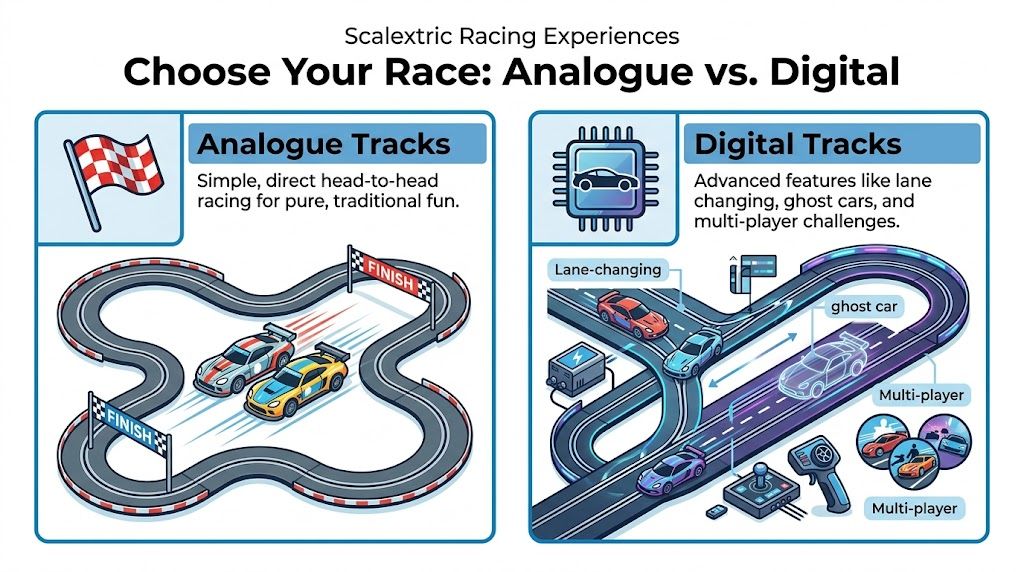
A standard analogue setup can work very well when space is tight or when you want fast, simple head-to-head play. A giant digital setup changes the experience completely. It turns the race into a more strategic, higher-capacity attraction with stronger tournament potential.
Standard analogue tracks
Analogue tracks are straightforward. Each driver controls one lane, the rules are obvious, and races are easy to rotate quickly.
That simplicity can be an advantage in smaller event spaces or internal socials where you want short bursts of play without much explanation. They also suit events where the attraction supports the room rather than dominating it. If the race is there to add atmosphere, break the ice, and give people something light-touch between meetings or presentations, analogue can be the right call.
Analogue is often a good fit for:
- Compact footprints where every square metre matters
- Short-format participation with quick turnover
- Informal socials where the game supports conversation rather than becoming the centrepiece
- Budgets that prioritise simplicity over advanced digital features
Giant digital tracks
Digital tracks are where scalextric hire becomes a stronger activation tool.
Giant digital Scalextric tracks with 6 to 8 lanes see a 30-50% increase in participant dwell time compared with 4-lane analogue versions, and their lane-changing plus live leaderboard format can keep guests engaged for 45-60 minutes per heat while handling 200+ racers in a 4-hour session and delivering up to 25% higher lead capture rates, based on giant digital track benchmark data.
That matters if your brief includes volume, spectacle, and measurable interaction. Digital lane changing adds tactics. Computerised scoring adds legitimacy. A live board changes the guest mindset from "I'll have a quick go" to "I want another run because I can beat that time."
The leaderboard is what turns a fun activity into a repeatable competition. Without it, many guests race once and move on.
What the choice looks like in practice
If you're running a stand where traffic is intermittent, analogue may be enough. If you're paying for premium exhibition space and need a visible attraction that keeps pulling people back, digital usually gives you more to work with.
A useful way to think about it is this. Analogue is a game. Digital is a format.
| Feature | Standard 4-Lane Track | Giant Digital 8-Lane Track |
|---|---|---|
| Racing style | Fixed-lane, straightforward racing | Multi-car racing with digital lane changing |
| Best for | Smaller events, lighter-touch fun, compact activations | Exhibitions, brand activations, team tournaments, high-traffic events |
| Guest learning curve | Very quick | Still accessible, but with more strategic depth |
| Scoring | Basic race outcome or lap timing depending on setup | Computerised scoring with live positions and lap times |
| Spectator value | Good | Much stronger due to overtaking and leaderboard drama |
| Repeat play | Moderate | Higher because guests chase times and positions |
| Capacity | Lower than large digital formats | Better suited to high-throughput sessions |
| Brand activation potential | More limited | Stronger when paired with screens and digital data capture |
Match the track to the event objective
The wrong way to choose is by asking which track is "better". The right way is to ask what the attraction has to do.
If you need:
- A compact crowd-pleaser, choose analogue.
- A centrepiece with strong replay value, choose digital.
- A team competition tool, go digital and build heats, finals, and live ranking into the session.
- A motorsport-adjacent feature for a larger racing-themed brief, pair the slot car attraction with other formats such as racing simulator hire, so different guest types have different levels of competition to engage with.
The practical trade-off is simple. Analogue is easier to slot in. Digital provides greater commercial advantage if the event depends on attention, dwell, and visible interaction.
Making the Race Your Own with Branding Options
A plain track can entertain people. A branded track can support a campaign.
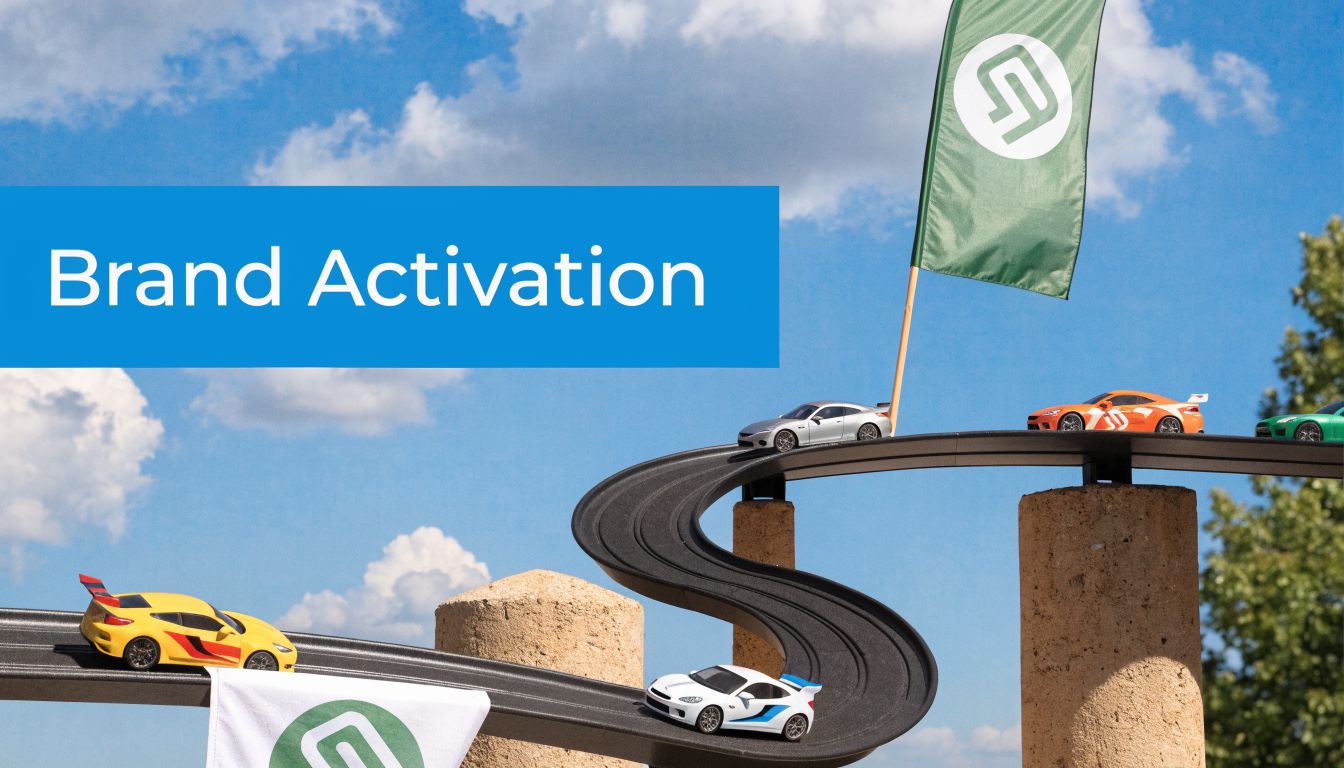
That's the difference many exhibitors miss. If you're investing in scalextric hire for a launch, a sales push, or a hospitality activation, the race should look and feel like part of your event, not a hired add-on dropped into the middle of it.
Start with the surfaces people actually see
The strongest branding usually isn't the most complicated. It's the branding that appears in the places guests photograph, watch, and interact with.
That normally means:
- Trackside barriers carrying logos, campaign lines, or product names
- Bridges and gantries that frame the racing action
- Backboards and surrounding set panels that help the feature sit inside the wider stand design
- Cars in brand colours where the visual identity is simple enough to read clearly at speed
If your team is already producing event collateral, it helps to review external references for custom printing options early. Not because every activation needs a full print suite, but because branded physical elements work best when they follow the same artwork logic as the rest of the campaign.
Use the leaderboard as branded media
Digital displays matter because they turn the attraction into visible branded content.
If the race uses electronic timing and on-screen results, that screen shouldn't be treated as a pure utility item. It can carry your logo, event title, product message, sponsor hierarchy, or call to action. When guests wait for their result, challenge colleagues, or photograph the rankings, your branding is already in the frame.
This is also where good event design gets practical. A visible branded leaderboard can support:
- Lead registration messaging
- Fastest lap competitions
- Scheduled finals or team brackets
- Sponsor integration at partner activations
- Sales prompts such as scan-to-enter mechanics
Build brand interaction into the race flow
The strongest branded activations don't stop at visuals. They shape the participant journey.
A simple example is registration. Instead of letting guests walk straight into a race anonymously, give the race a clear start point. Register name, company, team name, or stand badge. Then display that information on the result sequence or ranking screen where appropriate. That creates a cleaner interaction for both the guest and the event team.
Another option is themed race structure. Product launch? Name heats after product lines. Internal conference? Group racers by department or region. Dealer event? Run supplier-versus-customer brackets. The attraction doesn't need to change physically for the format to feel bespoke.
A branded game only works when the branding supports the experience. If logos make the setup harder to read, slower to run, or visually cluttered, you've gone too far.
Here's a quick visual example of how race presentation can support the atmosphere:
Keep the branding operationally sensible
There are a few mistakes that come up repeatedly.
Avoid overloading every surface. Don't choose finishes that reflect badly under venue lighting. Don't put vital race information where branding obstructs it. And don't leave artwork approval too late if multiple stakeholders need sign-off.
A well-branded scalextric activation should still look like a race first. The campaign gains more value when the attraction feels polished, legible, and competitive.
Essential Logistics for a Flawless Race Day
At 7:30am, the track can be built, the branding can be approved, and the guest list can be ready. The activation still fails if the crate cannot get through a service corridor, the power point is 15 metres from the stand, or the queue blocks a fire route before the first heat starts.
That is why logistics decide whether scalextric hire performs like a high-value brand activation or just becomes another feature on the floorplan.
Plan the operating footprint, not just the track
The quoted track size is only the starting point.
Planners need space for the build, the host position, queued participants, casual spectators, cable routing, and safe circulation around the feature. If the track fits but the operating zone does not, race throughput drops, staff start improvising, and the guest experience becomes harder to control.
A supplier guide from The Fun Experts' Scalextric race package page gives a useful reference point for venue conversations, covering footprint, modular access, power needs, and setup timing. The practical takeaway is simple. Ask the venue for the full usable area, then test that space against how the activation will run.
Access decides whether install stays on schedule
Load-in problems usually start long before race day.
Confirm the route from loading bay to final position. That includes door widths, lift size, ramp access, tight corners, carpet protection rules, security check-in, and the venue's permitted install window. Exhibition halls are generally straightforward. Hotels, listed buildings, and conference venues often need more care, more time, and clearer paperwork.
This is the same kind of planning challenge you see in the wider logistical puzzle of group events. Transport, timing, people flow, and supplier access need to be managed as one plan.
Get the venue details in writing
A short written sign-off prevents a lot of avoidable calls during load-in.
Confirm these points before the event:
- Exact footprint. Include pillars, furniture, shell scheme walls, and any restrictions that reduce usable space.
- Access route. Check loading bay rules, door and lift dimensions, install times, and any manual handling constraints.
- Power location. Confirm socket type, distance from the track, and whether the circuit is shared with AV, catering, or stand lighting.
- Queue and viewing space. Allow room for waiting players and a small crowd without blocking aisles or neighbouring stands.
- Floor condition. Flag uneven surfaces, cable covers, and any late furniture or staging changes.
The best installs usually come from one simple habit. Send the supplier a floorplan, annotated access notes, and a marked power position before the event opens.
Staffing, safety, and throughput need active management
A track can be physically installed and still underperform commercially.
Someone needs to brief players quickly, reset races, keep the queue moving, and step in when competitive guests want extra runs or challenge results. If the activation is being used for lead capture, team competition, or scheduled finals, that host role matters even more because every delay affects participation volume and data quality.
Safety needs the same attention. Cables should be protected, spectator positions should be controlled, and the track should sit where guests can engage without backing into aisles or service routes. In busy venues, good event delivery is less about the game itself and more about disciplined flow management.
Handled properly, logistics protect more than setup time. They protect dwell time, staff efficiency, lead volume, and the credibility of the activation.
Driving Event ROI Beyond the Finish Line
The track itself doesn't create ROI. The format around it does.
Too many activations stop at "people enjoyed it". That's not enough if the marketing team needs lead data, if the sales team needs better conversations, or if the event manager has to justify floor space. A race feature pays back when it's structured to produce useful behaviour.

Give people a reason to return
A one-off race creates a moment. A ranked competition creates repeat visits.
The strongest event formats usually include one or more of these:
- Fastest lap of the day for individual competition
- Department or team brackets at internal events
- Timed knockout heats on exhibition stands
- Scheduled finals announced in advance to bring people back later
- Simple prizes that are visible enough to motivate but not so large that they distort the event atmosphere
This works because the race becomes a live programme rather than a static attraction. People don't just notice it. They plan around it.
Connect the race to data capture carefully
Lead capture should feel like entry into the experience, not an awkward interruption.
A simple registration point before the race often works best. That might mean badge scanning, a name entry, or a short sign-up step linked to leaderboard participation. The key is speed. If registration takes too long, queues form and the crowd thins out.
The handover between event host and sales team matters too. If someone posts a strong time, wins a heat, or returns repeatedly, that's often a warm interaction point. Sales staff should know when to step in and when to let the competition breathe.
Good activations don't force a sales pitch at the start. They create enough engagement that the conversation happens naturally afterwards.
Use hosting to increase perceived value
Commentary changes the atmosphere quickly.
A host with a microphone can call starts, announce best laps, build anticipation around finals, and keep energy high during quieter patches. That doesn't mean turning the stand into a shouting match. It means giving the race presence and helping spectators understand what they're watching.
Smaller details help as well:
- Visible rankings make the game feel official.
- Clear race rules prevent delays and confusion.
- Short turnaround between heats keeps the crowd from drifting.
- A defined winner mechanic gives people closure and a reason to celebrate or challenge again.
Team building works best with structure
For internal events, the same principle applies. Scalextric hire is more effective when it isn't left as a free-play side activity.
If the brief is team building, build the session around cooperation and rivalry. Mix departments. Create relay-style score formats. Rotate drivers under time pressure. Give teams a shared target to chase. The race then becomes a tool for interaction rather than background noise in the corner of the room.
The strongest return doesn't always show up only in lead numbers. Sometimes it shows up in queue depth, stand buzz, meeting quality, or how long guests choose to remain in the space. Those signals matter if the attraction was bought to create energy and connection.
What to Expect for Scalextric Hire Pricing and Booking
A quote only helps if it matches the event you are running.
For corporate planners, the gap between two prices usually comes down to delivery scope, not supplier optimism. A compact staff party setup costs less than an exhibition activation built to stop traffic, capture data, and run all day without queues getting out of control. The practical question is not "what does Scalextric hire cost?" It is "what format gets the result we need, and what has to be included to deliver it properly?"
What affects the quote
Five variables usually shape the price:
- Track format. A simple circuit for casual play is priced differently from a larger digital setup with race control, lap timing, and stronger visual presence.
- Operating time. An evening reception, a full conference day, and a multi-day exhibition each require different staffing hours, setup plans, and on-site support.
- Branding scope. Printed trackside panels, branded leaderboard screens, and custom winner mechanics add production time as well as materials.
- Venue access. Distance matters, but so do loading bays, freight lifts, parking, security check-in, and restricted build windows.
- Crew requirement. Some bookings only need supervision. Others need an experienced host, registration support, and staff who can keep heats turning over at pace.
In practice, cheap quotes often become expensive. If transport, crew, setup time, or branding management sit outside the headline price, the budget can move quickly once the actual show requirements are clear.
What a sensible booking process looks like
The best bookings start with the event objective, not the track.
A supplier should ask what the activation needs to do. Drive stand traffic. Support lead capture. Create a team tournament. Reward clients at a hospitality event. Each brief points to a different setup, and each setup affects cost, space, staffing, and schedule.
At PSW Events, that early conversation usually covers four points first:
- What the event is trying to achieve
- Who will be racing and how many guests are expected
- How much usable space the venue or stand gives you
- What has to happen around the attraction, including data capture, hosting, or brand messaging
If you are comparing formats, reviewing giant Scalextric hire options for corporate events helps clarify what changes from one package to another. The useful part is not the product gallery. It is understanding how presentation level, throughput, and activation goals affect the booking.
What to have ready before you enquire
Good information shortens the quoting process and reduces revisions later.
Have these details ready:
- Venue name and postcode
- Event date, live hours, and access times
- Indoor or outdoor location
- Available footprint, including queue space
- Branding requirements
- Whether guest registration or lead capture is part of the plan
- Any venue constraints such as stairs, timed loading, early breakdown, or strict health and safety sign-off
One missing detail can change the whole delivery plan. A stand that looks generous on the floorplan may not have enough clearance once queueing, barriers, and spectator positions are mapped properly.
Where planners get caught out
Late artwork approval is a common one. So is underestimating how much room people need once the racing gets busy.
Another issue is procurement timing. Marketing may approve the concept quickly, but sponsorship teams, venue operations, and legal often need to review branded elements, data collection methods, or competition mechanics before anything is signed off. Build that into the timeline.
The strongest bookings are rarely the fastest. They are the ones where the quote reflects the actual operating conditions, the event objective, and the expected return. That is how Scalextric hire stays easy to run on the day and easier to justify after the event.
Answering Your Key Scalextric Hire Questions
These are the questions serious planners tend to ask once the attraction is shortlisted.
What health and safety documents should a supplier provide
For UK exhibitions and corporate events, the essentials are clear. You should verify that the supplier holds £10m public liability insurance, provides PAT tested equipment, and carries out risk assessments aligned with the UK's Event Safety Guide, as outlined in guidance on giant Scalextric hire safety compliance.
That same guidance notes that 15% of event incidents involve electricals or trips, which is why organisers should also confirm the use of IP-rated power supplies and appropriate flooring. This isn't admin for the sake of it. It reduces exposure for both organiser and venue.
What should I check on site before opening
Walk the setup before guests arrive.
Look for cable routes, trip points around queue lines, clear controller positions, stable barriers, and enough room for staff to supervise the attraction properly. If branding or set panels have been added, confirm they haven't obstructed sightlines or emergency routes.
Safety paperwork matters, but the live environment matters just as much. A compliant setup still needs a sensible operating area.
Can scalextric hire work outdoors
It can, but outdoor use needs tighter planning.
The key questions are weather cover, surface stability, power protection, and whether the event environment allows the race to operate consistently for the whole hire period. Wind, rain risk, uneven ground, and public traffic flow can all affect performance. If the attraction is central to the event outcome, indoor deployment is usually the cleaner option.
How far ahead should I book
Book as early as the event brief allows, especially if you need branding, specific staffing, or a major venue install window.
Popular dates cluster. Exhibition periods, summer activations, end-of-year events, and motorsport-linked weekends all create demand. Even when stock is available, the surrounding logistics may become tighter closer to the date.
Is scalextric hire only for exhibitions
No. It works across exhibitions, conferences, hospitality, internal team-building, staff reward events, client entertainment, and family-friendly corporate days.
What changes is the race format. At a trade show, you'll usually focus on attraction and lead handling. At a team event, you'll focus more on tournament design and interaction between colleagues. At a hospitality function, you may want a looser format with hosted highlights rather than rigid heats.
What usually goes wrong when the activation underperforms
Usually one of four things:
- The track is too small for the event objective
- The race has no visible scoring or competitive structure
- The queue and registration flow are poorly managed
- The attraction is treated as décor instead of a live hosted activity
If you avoid those mistakes, scalextric hire becomes much more than a nostalgic talking point. It becomes a working event tool that creates attention, interaction, and a clear reason for people to stay engaged.
If you're planning a stand, conference feature, or team event and need the race format to do more than entertain, build the brief around outcome first. Then choose the track, branding, staffing, and logistics to match. That's what turns scalextric hire into a successful activation rather than just a fun extra.