
You're halfway through a busy exhibition build, the stand's finally taking shape, and then the supplier rolls up with the reaction unit. The venue door is narrower than the kit, the power drop is farther away than anyone admitted on the floor plan, and your “simple” attraction has turned into a logistics problem. That's the world of reaction game hire, and it's why the smartest planners treat it as an operational decision first, and an entertainment choice second.
Reaction games earn their place because they do a job other attractions can't always do cleanly. They pull people towards the stand, keep them there, and give them a reason to have a second go. That matters in UK exhibition halls and brand activations where attention is expensive and space is tight, especially after the reopening of large live-event venues in 2021 brought experiential marketing back into the core of event planning. If you need a broader planning framework for the rest of the event, the corporate event planning guide is a useful reference point, but the practical truth is simple, the activation has to fit, work, and earn its footprint.
For planners building gamified activations, the logic also overlaps with wider event engagement strategy, which is why teams look at gamification in events as part of a bigger audience-retention play. A reaction wall is not a gimmick when it is placed, staffed, and branded properly. It is a controlled way to create queue energy, spectator interest, and repeat participation without eating the whole floor plan.
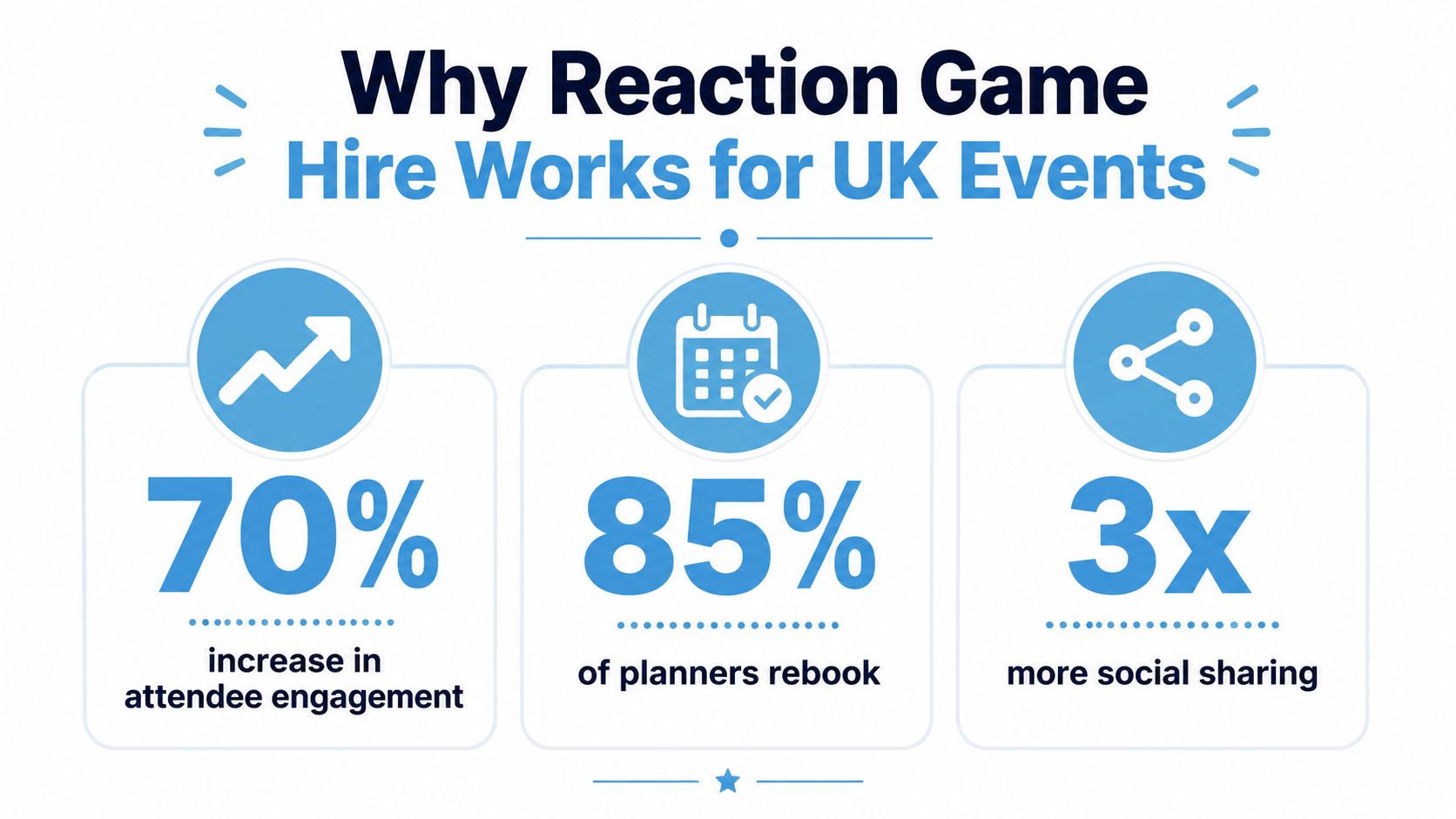
Why Reaction Game Hire Works for UK Events
The most honest reaction-game story usually starts with a mistake. A planner has signed off the stand design, the supplier has confirmed delivery, and then someone measures the access route properly. The unit will not clear the door, or it will clear the door but leave no sensible line for queueing, reset, or operator movement. That is the point where a decent hire becomes a headache, and a rushed hire becomes a write-off.
What saves the day is not luck, it's format. Reaction games work because they are fast, obvious, and easy to join. At an exhibition, that means footfall doesn't just pass by, it pauses. People stop to watch a score, then they step in to beat it. That cycle is exactly why these units have become part of the standard UK experiential toolkit rather than a novelty add-on.
The market context matters too. UK venues such as ExCeL London, which reported 4 million+ visitors annually before the pandemic, and The NEC Group, which has said its venues welcome millions of visitors each year, create the audience density reaction-based attractions need to make sense. Those numbers are why this category tends to show up at high-traffic exhibitions, launches, and conferences, not in quiet low-traffic rooms. The event has to justify the interaction, and the interaction has to convert space into dwell time.
Practical rule: if the attraction doesn't increase stops, stalls, and repeat attempts, it's taking up space for no reason.
For a planner, that's the core argument. Reaction game hire is useful because it compresses entertainment into a compact footprint and gives the brand a visible reason to talk to the audience. The unit isn't the point, the interaction is. If the audience is dense enough and the event window is short enough, the game earns its slot.
Where the format fits best
- Exhibitions and trade shows: ideal when you need a visible draw from the aisle.
- Brand activations: useful when the client wants a simple competitive hook.
- Corporate hospitality: works when the brief needs light competition without a long briefing.
- Team-building moments: suitable when you want quick turn-taking and a shared scoreboard.

If you've ever seen a good stand go quiet because the attraction looked too complicated to approach, you already know why this format works. It's immediate. It rewards curiosity fast, and in UK event spaces that's usually enough to justify the hire.
Types of Reaction Games Available to UK Hirers
Not every reaction game does the same job, and pretending otherwise is how planners end up buying the wrong unit. A Batak-style wall is built for visibility and competition, a compact reflex board is better when space is controlled, and a screen-led challenge is useful when you want something softer, lighter, or easier to reposition. The trick is to match the format to the audience, not to the most dramatic photo in the supplier's brochure.
Batak-style walls
A Batak-style reaction wall is the obvious exhibition choice because it looks busy even before the first player steps up. It's a single-player format with obvious spectator value, which is why it tends to sit so naturally on a trade-show floor. If the brief is “get people to stop walking,” this is usually the first format I'd put on the shortlist.
Compact reflex boards
Smaller wall-mounted or tabletop reflex games make more sense when the event is not built around aisle traffic. Private functions, internal staff events, and tighter hospitality spaces benefit from something that creates a game without demanding a major footprint. These units still reward fast reactions, but they're easier to tuck into a corner or alongside other attractions.
Screen and app-driven challenges
Digital formats work when the organiser wants a more flexible, less physical experience. They can be easier to brand around, and they fit neatly into mixed entertainment programmes where the activation is part of a broader content mix. They're not a substitute for a strong physical game on a packed exhibition stand, but they can be a better fit for other event types.
Choose the format that fits the room. If the footprint is wrong, the game will look impressive and still underperform.
For a straight visual match-up, the decision usually comes down to three things. First, how much floor area you can spare. Second, whether you need one player at a time or faster rotational play. Third, how much of the attraction has to be seen from across the hall. That last point matters more than planners admit, because if people can't spot the game, they won't drift towards it.
If you want to compare a classic wall format with a more specific product example, the Batak Challenge is the simplest reference point. It represents the style most planners mean when they say reaction game hire, but the market includes enough variation that you should never stop at the first glossy image.
Choosing the Right Reaction Game Supplier
The supplier is the key decision. The unit might look the same from one website to another, but the delivery, staffing, access planning, and venue paperwork can be worlds apart. A good supplier reduces risk. A weak one hands you a box and hopes the venue sorts the rest out.
Start with evidence, not promises. Look for real product specifications, clear delivery coverage, and signs that the company understands event logistics rather than just retail hire. If a supplier lists specific cities, regions, or named catchments, that's usually more credible than vague “nationwide” language with no operational detail behind it. A serious operator knows where they work.
What to check before you enquire
- Portfolio proof: ask for recent event examples that look like your brief, not random party photos.
- Operational coverage: check whether they list the areas they serve, because that tells you how they think about logistics.
- Branding capability: confirm whether they can handle wraps, headers, or score-screen branding without outsourcing everything.
- On-site staffing: make sure the quote includes an operator if the venue expects supervision or queue management.
- H&S readiness: ask for RAMS, insurance, PAT testing, and installation paperwork early.
If you're comparing suppliers against other event-kit providers, even a simple pricing page such as tent and chair rental pricing can be a useful benchmark for how transparent a company is about what's included, what's extra, and what's left for the buyer to chase. Reaction game hire should be just as clear. If the quote hides delivery, staffing, or branding, you're not looking at a turnkey supplier, you're looking at a partial one.
PSW Events is one of the operators in this space, and it supplies Batak Pro hire alongside wider event entertainment and corporate hire services. That matters because planners usually need more than a unit, they need someone who can manage planning, installation, and H&S without creating another layer of coordination. I'd still tell any buyer to compare proposals line by line, because the supplier who answers access questions properly on day one is usually the safer bet.
How UK Suppliers Price Reaction Game Hire
Reaction game hire in the UK is not priced like a shelf item, and that is exactly how it should be. The quote usually moves with the event date, the hire duration, the venue location, access conditions, and whether the supplier is also providing other equipment. If a vendor throws out one headline figure with no detail, that is not a proper quote, it is a rough opening number.
The commercial structure should be clear from the first conversation. Deposits, balance timing, transport, installation, and staffing all need to be set out before anyone signs. That matters because the supplier has to hold the unit, schedule the crew, plan the route, and cover the work before the event starts. If you are used to comparing hire costs across other event services, tent and chair rental pricing is a useful benchmark for the level of transparency buyers should expect around deposits, add-ons, and what is included.
Typical Reaction Game Hire Cost Drivers in the UK
| Cost Driver | Typical Impact | Planner Action |
|---|---|---|
| Event location | Travel and logistics can shift the quote | Share the venue postcode early |
| Hire length | Longer use usually needs more resource | Confirm the exact event window |
| Hire date | Peak dates are harder to schedule | Book earlier for exhibitions and launches |
| Bundled equipment | One supplier handling more items can simplify costs | Ask for a combined package price |
| Staffing | Operator cover changes the commercial shape | Confirm whether supervision is included |
| Branding | Wraps and custom graphics add production work | Approve artwork deadlines early |
The biggest cost drag is usually not the reaction game itself. It is everything around it. Delivery mileage, crew travel, overnight stays, branding production, and on-site operator cover all move the number up or down. London and the South East often sit at the sharper end of that because access, parking, and delivery windows are tighter.
Ask for a fully itemised quote, not a day rate. The price should show base hire, logistics, staffing, and any branding or setup work separately. If the supplier cannot split those parts out cleanly, the commercial picture is still blurred.
If you want a real-world example of how suppliers package this sort of hire, PSW Events supplies Batak Pro hire alongside wider event entertainment and corporate hire services. That is useful because planners often need one supplier who can handle planning, installation, and H&S paperwork without creating extra coordination work. I would still compare proposals line by line, because the supplier who answers access questions properly on day one is usually the safer option.
Booking Timeline and Lead Times
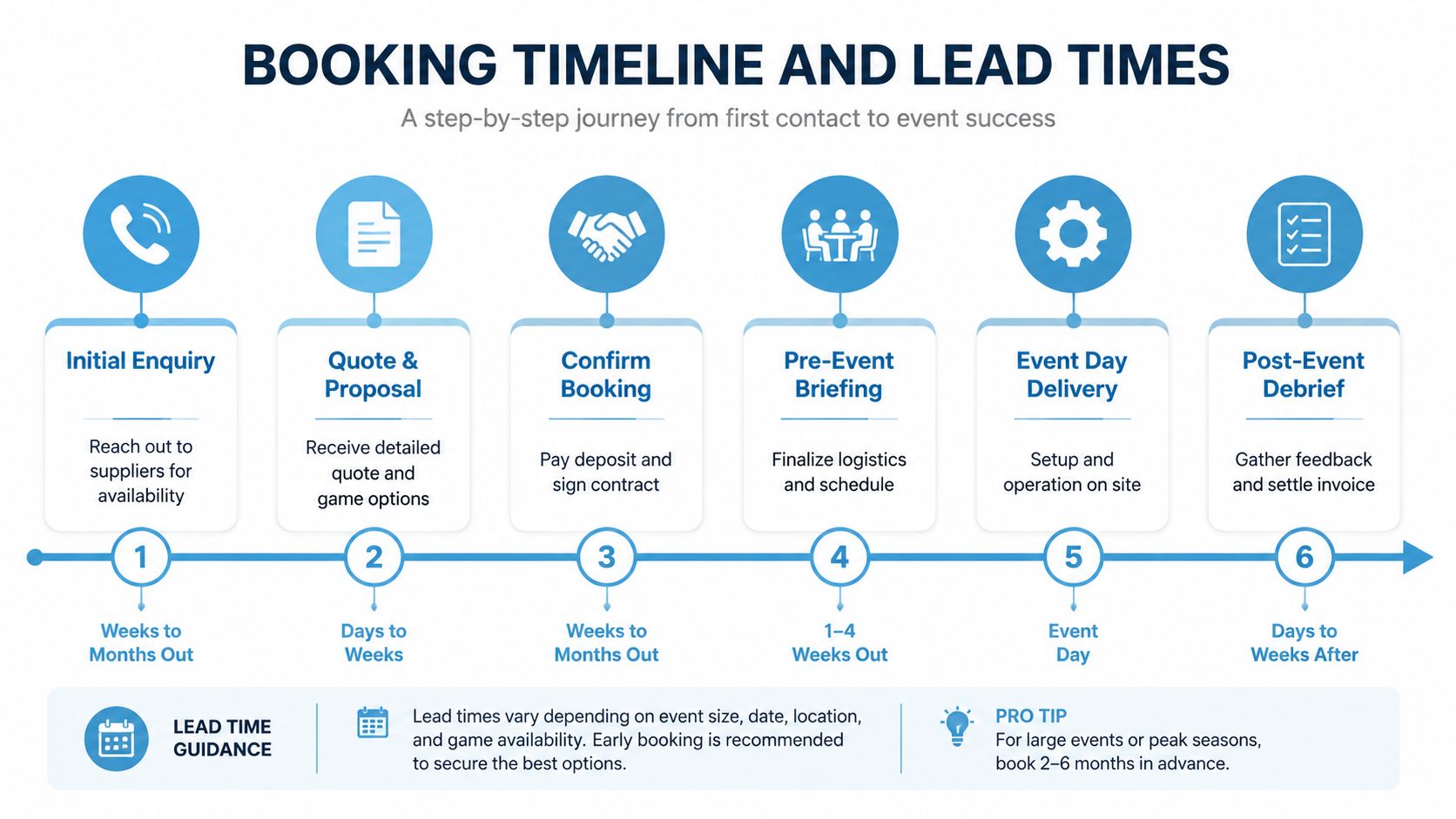
The booking timeline should start the moment the stand concept gets serious, not when someone remembers that “we should probably get a game.” Reaction game hire is a supply-chain decision. If you leave it too late, you don't just risk losing the unit you wanted, you risk losing time for branding, access checks, and venue sign-off.
Start with the venue date and work backwards. The supplier needs to know where the event is, how long the hire runs, and what the access route looks like before they can give you a credible answer. Once you have the quote, the booking moves into confirmation, which is where the deposit mechanics matter and the lead times start tightening. The earlier you do that, the fewer surprises show up during build week.
The strongest bookings I've seen follow the same rhythm. Enquiry, quote, deposit, logistics, artwork, installation, and then a quick debrief after the event. That order matters because each step leads to the next one, and reaction-game hires are too physical to leave vague. If the venue wants a method statement, they'll want it before build day, not when the crew is already unloading.
For peak exhibition periods, I'd treat reaction games like other high-demand event assets. The same logic that applies to exhibit build, AV, or branding production applies here too. If your team is chasing a spring trade-show slot or a summer activation, don't assume last-minute availability means the market is healthy. More often, it means the supplier hasn't been specific enough about what they're offering.
Book early, brief clearly, and get the venue requirements confirmed before you commit the hire.
The post-booking stage is where decent planners separate themselves from the rest. They confirm power, access, and timing with the venue, then they send the supplier the final event schedule. That keeps the installation calm, and it gives the operator a clean run at setup and testing.
Site, Power, Access, and Health and Safety Requirements
Reaction-game bookings succeed or fall apart based on several factors. The unit itself is rarely the problem. The problem is the route to the stand, the socket that's too far away, or the venue rule nobody checked before confirmation. If you've ever watched a crew try to angle event kit through a narrow service door, you know exactly how fast a neat plan can unravel.
Batak Pro-style hire listings can be very specific about the practicals. One UK listing gives an equipment size of 1.7m × 0.9m, an operational area of 2.6m × 2m, and a 13A socket within 5m, while another lists up to 60 users per hour and requires step-free access plus a minimum door width of 0.6m. That tells you what matters most. Measure the route, not just the footprint. The space in front of the unit matters almost as much as the unit itself, because queueing, operator movement, and reset time all sit around the game.
What the venue needs to allow
- Power supply: confirm a suitable socket near the activation point, not at the other side of the hall.
- Access route: check doors, lifts, loading bays, and any steps or thresholds.
- Floor space: include the queue lane, operator position, and spectator ring.
- Venue approvals: get method statements and RAMS approved before the build.
- Insurance and testing: ask for public liability cover and PAT documentation in advance.
- On-site supervision: decide who manages the game and who controls the line.
For venues with strict compliance procedures, that paperwork is not optional. ExCeL London, the NEC, and Manchester Central all expect proper H&S documentation, and buyers should be ready with the usual pack, RAMS, public liability insurance, PAT testing, and a clear method statement. If you need a practical starting point for the paperwork, the event risk assessment template is a sensible reference when aligning supplier documents with venue requirements.
A good supplier should also be able to discuss insurance without hesitation. In high-footfall environments, I'd want a provider who can produce solid cover on demand, not one who starts digging through old emails while the venue team waits. That's not bureaucracy for its own sake. It's the difference between an easy install and an avoidable delay.
Branding, Data Capture, and On-Site Staffing
A reaction game only becomes a proper activation when it's treated like one. Left unbranded and unattended, it's just an entertaining box. Staff it properly, wrap it properly, and connect it to a lead-capture mechanic, and it becomes a measurable draw that supports the client's stand goals.
Branding is the easiest win. Suppliers often offer full vinyl wraps, header boards, branded score screens, and digital leaderboards, and that makes sense because the game ends with a score. The score is the hook, but the brand is what stays in the visitor's memory. On a crowded exhibition floor, that's valuable because every player becomes both a participant and a spectator target. If the game is visible from the aisle, the logo travels with it.
Data capture is the next layer, and it's where a lot of planners are too timid. A reaction game can support opt-in lead capture through on-screen forms, QR codes, or a branded competition mechanic. That works because the activity already creates dwell time, so you're not asking people to pause for a form in the middle of nowhere. You're asking them after they've interacted, which is the right order.
Strong rule: if you strip out the operator, the game often loses pace, queue control, and brand discipline at the same time.
That staffing role is not cosmetic. The operator explains the rules, resets scores, keeps the queue moving, and makes sure the activation doesn't drift away from the brand script. When planners cut that role to save money, throughput usually drops and the whole area feels less polished. The attraction may still work, but it stops feeling like a planned experience.
For buyers comparing options, PSW Events is a real UK supplier that can provide reaction-based kit as part of broader event delivery, including planning, branding, logistics, installation, on-site staffing, and H&S compliance. That mix matters because the client usually wants one accountable team, not a chain of subcontractors. The safer choice is the supplier that can explain how the activation will be branded, how leads will be handled, and who will own the on-day operation before the booking is signed.
Quick answers planners usually ask
How far ahead should I book for a peak UK exhibition date? Earlier is better, because these units are tied to venue access, staffing, and branding deadlines, not just stock availability.
Can a reaction game work outdoors or in a marquee? Sometimes, but only if the supplier confirms the surface, weather protection, power, and access route first.
What insurance level does a venue usually want? Venues tend to expect proper public liability cover and the supporting H&S paperwork, especially in high-footfall halls.
Can branding artwork change between events? Yes, if the supplier builds the unit around changeable graphics or removable wraps, but that needs planning before the first install.
Do I need an operator? If the activation is in a busy exhibition or public-facing space, yes, because queue control and reset speed matter.
If you want a reaction game hire partner that can handle the practical side as well as the show value, talk to PSW Events about Batak Pro, branding, and on-site delivery for exhibitions and brand activations. Visit PSW Events to brief your next event properly, compare the options, and lock down a hire that will fit the venue, the schedule, and the audience.