You've got the venue pack open, the client wants sign-off today, and the blank event risk assessment template is staring back at you. That's the moment a lot of planners either do the job properly or start copying old wording from the last event and hope it passes.
That approach usually falls apart once the activation includes live audiences, power, moving kit, brand deadlines, and a venue safety team that wants specifics. It falls apart even faster when the attraction is interactive. A racing simulator, VR station, Batak Pro wall, or motion platform doesn't fit neatly into a generic “trip hazards and fire exits” document.
A strong event risk assessment template should help you think clearly, prioritise properly, and brief the team in plain language. It should also stand up to scrutiny from venues, insurers, clients, and your own crew on show day. The practical challenge isn't filling boxes. It's building a document that reflects what's happening on site.
Why Your Event Risk Assessment is Non-Negotiable
The paperwork can feel like the least exciting part of an event. Most planners would rather focus on build schedules, branding, staffing, and guest flow than spend time writing control measures. But the risk assessment is the document that connects all of those moving parts.

In the UK, event risk assessments became a statutory requirement under the Management of Health and Safety at Work Regulations 1999. That shift followed rising incidents, including the 1989 Hillsborough disaster, which exposed critical failures in risk planning. The later use of standardised templates has helped cut event-related prosecutions by 60% since 2000, according to the HSE risk assessment guidance.
Why venues and insurers keep asking for it
A venue doesn't ask for your assessment because it likes forms. It asks because your activity changes the venue's risk profile. The moment you bring in powered attractions, queuing crowds, branded structures, external contractors, or audience participation, the venue needs to know what can go wrong and what controls you've put in place.
Insurers look at it the same way. They want evidence that hazards were identified before they became incidents. Local authorities and venue safety officers want to see that emergency access, egress, supervision, and equipment use have all been thought through by someone competent.
That matters even more for attractions with a sports or gaming feel, where participant excitement can mask obvious hazards. A queue surges. Someone steps over a barrier for a better photo. A guest climbs out of a simulator faster than the operator expected. Those are normal event-day behaviours. A proper document anticipates them.
Practical rule: If your template reads like it could apply equally to a wine tasting, a conference panel, and a motion racing rig, it isn't specific enough.
It's not just a safety document
A good assessment is also an operating document. It tells your crew what the safe version of the event looks like. It defines who checks cabling, who manages participant turnover, who stops operation if a control fails, and who updates the client if a venue condition changes.
For teams working across multiple markets, it also helps to understand broader legal risk systems for global business, because commercial risk and safety risk often overlap in live delivery. Delay, unclear responsibility, and inconsistent documentation usually create both.
If your event includes fan engagement or sports-themed participation, a sport-specific framework helps too. This guide to football event risk assessment practice is useful because it shows how crowd energy changes the control plan, even when the footprint looks simple on paper.
How to Complete Your Event Risk Assessment Template
Start with the actual event, not the form. The template is only useful if it reflects the actual venue, the actual equipment, the audience profile, and the live operating plan. Generic wording is where most weak assessments begin.

Best-practice UK templates follow a six-step methodology, and 40 to 50% of assessment failures come from poor hazard mapping during planning. The same guidance also notes that consulting experienced on-site staff is missed in up to 30% of assessments, which is one reason polished office documents can fail on show day when the practical setup starts. That comes from the six-step event risk assessment guide.
Define the event properly
The first section should pin down the event in concrete terms. “Corporate activation” isn't enough. Write what the event is, where it's happening, what equipment is being used, how long the public will interact with it, and what the space looks like.
Include details such as:
- Venue specifics like hall name, floor surface, loading route, ceiling height, nearby fire exits, and any venue restrictions
- Activity detail such as supervised play, timed competition, leaderboard use, queueing system, and whether participants are seated, standing, or moving
- Expected attendance pattern including whether footfall is steady, peak-based, invite-only, or open public access
- Operational windows covering setup, live hours, maintenance checks, and breakdown
This sounds basic, but it's where planners often lose accuracy. If your build route crosses public circulation space, that creates one set of controls. If the attraction sits inside a stand with enclosed branding walls, that creates another.
Identify hazards by system, not by memory
Don't sit there trying to “think of risks”. Walk through the activation in phases. Build, test, operate, pause, reset, and break down. Then look at hazards under a few consistent headings.
A practical structure looks like this:
- People risks including queue build-up, slips, participant conduct, children wandering into operation zones, tired crew, and contractor overlap
- Equipment risks such as trailing power, unstable monitors, pinch points, sharp edges, overheating kit, and damage during transport
- Environmental risks including poor lighting, tight gangways, uneven floors, weather exposure, restricted ventilation, or noise bleed from nearby stands
- Emergency risks like blocked exits, power loss, evacuation during operation, and confusion over who shuts equipment down
- Welfare and inclusion risks covering accessibility, medical contraindications, manual assistance, and safe participation limits
That system stops the common mistake of listing only obvious hazards. Most poor assessments focus heavily on fire and trips, then ignore user behaviour, reset procedures, and supervision quality.
The strongest assessments are written by people who've watched the activity happen, not just by people who've seen the kit list.
Be precise about who could be harmed
This field is often completed with “staff and public”. That's too blunt to be useful. Different groups face different risks.
For a live activation, separate them properly:
- Participants who sit in the simulator, grip controls, enter and exit the rig, and may become excited or disorientated
- Queued guests who stand close to cabling, barriers, and moving participant flow
- Crew and technicians who handle transport cases, power distribution, resets, cleaning, and troubleshooting
- Venue staff and nearby exhibitors who may pass through the same space during build or breakdown
- Guests with limited mobility or underlying conditions who may need adaptations or may not be suitable for certain attractions
That level of detail changes the controls you choose. The right answer for a trained technician isn't always the right answer for a first-time participant.
Document controls like an operator, not a policy writer
Weak templates use broad phrases such as “staff to monitor”. Better templates say exactly what staff are checking, when they're checking it, and what action they take if something is wrong.
Useful control wording tends to include:
- Physical measures such as cable ramps, barrier placement, anti-slip flooring, signage, fixed monitor stands, and equipment spacing
- Procedural measures including pre-opening inspections, participant briefing, maximum one user at a time, supervised entry and exit, and stop-use conditions
- People measures with named responsibility for setup sign-off, power checks, queue control, and incident escalation
- Review measures that confirm when the control is checked again and by whom
This visual walkthrough is a good companion while you draft the document:

Assign ownership and review dates
An event risk assessment template becomes credible when every important control has an owner. Someone checks the rig is level. Someone confirms the power route is protected. Someone decides whether operation pauses during crowding, cleaning, or a nearby build issue.
If no one is named, everyone assumes someone else is covering it.
A short completion checklist helps:
| Field | What good looks like |
|---|---|
| Event description | Specific activity, venue, timings, and footprint |
| Hazard | One clear hazard per line |
| Persons at risk | Specific groups, not just “public” |
| Controls | Observable actions and equipment |
| Owner | Named role responsible on site |
| Review point | Before open, during operation, after incident, or after venue change |
How to Use a Risk Assessment Matrix
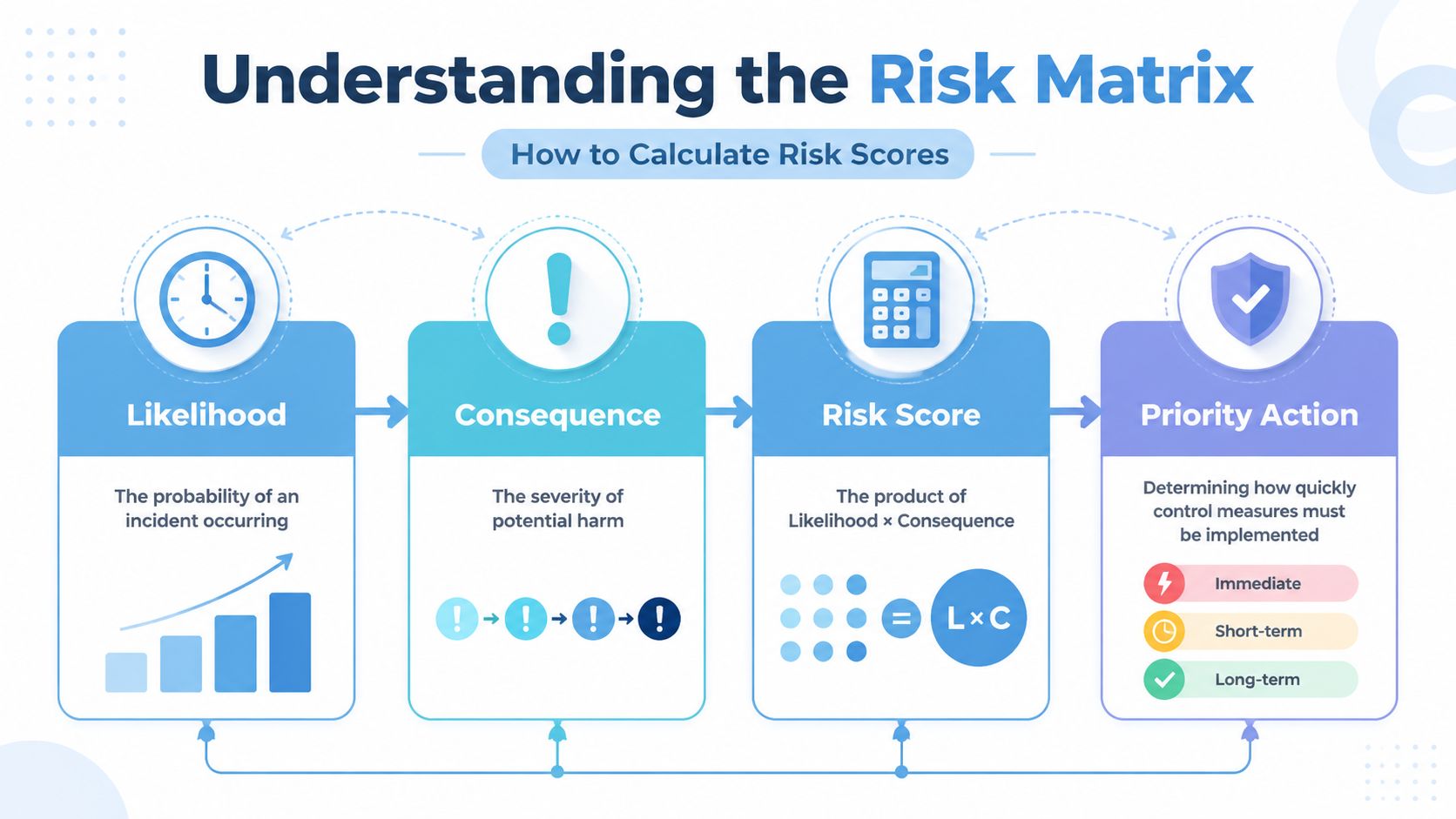
The matrix is where a lot of planners either overcomplicate the process or reduce it to guesswork. It's neither. A matrix is just a prioritisation tool. It helps you decide what needs immediate action, what needs stronger controls, and what's already manageable.
UK-aligned frameworks use a 5×5 consequence-likelihood matrix based on ISO 31000 principles, and that model is used to calculate residual risk after controls are applied. For major venues such as Wembley and ExCeL London, that residual score is a practical compliance step, not a theoretical one. The same framework notes that early hazard identification through this approach can reduce incident rates by 60 to 70%, as outlined in the risk management plan template.
What the two axes actually mean
Likelihood asks one question. How probable is it that this incident will happen in the actual conditions of this event?
Severity asks another. If it does happen, how bad is the outcome likely to be?
That's it. Don't score for drama. Score for reality.

A loose cable in a back-of-house corridor may have moderate likelihood and minor severity. A participant falling while climbing out of a raised simulator platform may have lower likelihood, but higher severity. The score tells you where attention belongs first.
Example 5×5 Risk Assessment Matrix
| Likelihood / Severity | 1 (Insignificant) | 2 (Minor) | 3 (Moderate) | 4 (Major) | 5 (Catastrophic) |
|---|---|---|---|---|---|
| 1 Rare | 1 | 2 | 3 | 4 | 5 |
| 2 Unlikely | 2 | 4 | 6 | 8 | 10 |
| 3 Possible | 3 | 6 | 9 | 12 | 15 |
| 4 Likely | 4 | 8 | 12 | 16 | 20 |
| 5 Almost certain | 5 | 10 | 15 | 20 | 25 |
Initial risk versus residual risk
This is the part that separates a form-filling exercise from competent planning.
First, score the hazard as it exists without controls, or with only baseline conditions in place. Then list the measures you will apply. After that, score it again. The second figure is the residual risk.
For example:
- Hazard. Participant trips on entry platform
- Initial view. Possible likelihood, moderate consequence
- Controls. Staff-assisted entry, non-slip surface, clear step edge marking, queue separation, no personal bags on platform
- Residual view. Unlikely likelihood, minor consequence
That second score is what venues want to see. It shows you haven't just identified risk. You've actively reduced it.
A matrix should drive decisions. If the score changes but the operating plan doesn't, the document isn't doing its job.
Common scoring mistakes
The most frequent mistakes are operational, not mathematical.
- Scoring everything as medium because no one wants to justify stronger controls
- Ignoring setup and breakdown and only assessing live hours
- Forgetting residual scoring after controls are added
- Treating supervision as a magic fix without defining what the supervisor does
- Leaving severe but rare risks unexplained, which makes reviewers question the whole document
For interactive attractions, score with the actual audience in mind. A carefully briefed internal team behaves differently from a busy public exhibition crowd. The matrix should reflect that.
Real-World Example A Completed Assessment for a Racing Simulator
Generic templates often miss the practical realities of interactive attractions. That's a real gap in event planning. Data cited in a simulator-focused template source notes that 28% of entertainment industry accidents involve amusement devices, and a 2026 survey found 62% of planners want simulator-specific risk matrices for corporate activations. That need is highlighted in the event risk assessment form example.
A racing simulator is a good example because it looks low risk to clients. It's seated, compact, and familiar. In practice, it introduces a specific mix of electrical, behavioural, access, and operator risks.

The activation scenario
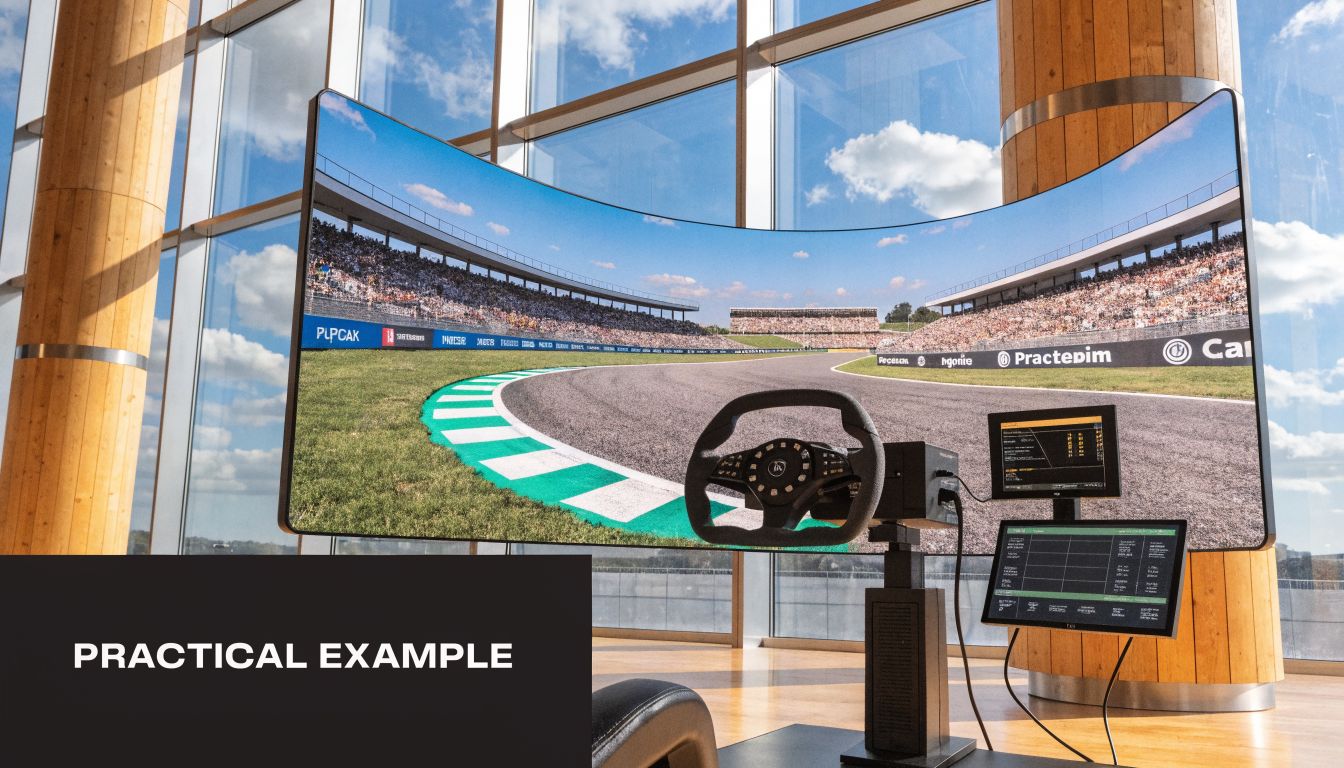
The setup is a branded F1-style racing rig on an exhibition stand. Guests queue, take timed turns, and compare lap times on a leaderboard screen. The simulator includes seat, pedals, steering controls, display hardware, power supply, and staff supervision.
If you're not familiar with how enthusiast-grade rigs are physically configured, browsing examples of Gamer Hardware sim racing builds helps. It gives useful context on pedal frames, wheel mounting, monitor placement, and how quickly a “simple rig” can become a layered hardware setup once accessories are added.
What the completed assessment looks for
This is the kind of hazard list that belongs in a real event risk assessment template for a simulator activation:
| Hazard | Who could be harmed | Typical controls | Residual view |
|---|---|---|---|
| Trip at platform edge or cabling | Participants, queued guests, crew | Cable protection, taped routing where suitable, clear perimeter, managed queue line, supervised entry and exit | Reduced to manageable level |
| Pinch points around seat, pedal area, moving adjustment parts | Participants, technicians | No unauthorised adjustment, staff-only setup, hands clear briefing, pre-open check | Reduced to manageable level |
| Electrical fault or power interruption | Participants, crew, nearby stands | PAT-checked equipment where required, protected leads, suitable power source, no overloaded extension chains, shutdown procedure | Reduced to manageable level |
| Participant loses balance on exit | Participants | Operator-assisted exit, stable step area, no rushed turnover, one participant at a time | Reduced to manageable level |
| Unsuitable participant use | Participants | Staff briefing, clear exclusion guidance, stop-use discretion for operator, visible rules | Reduced to manageable level |
| Queue congestion around attraction | Public, neighbouring stands | Defined queue footprint, barrier layout, active host, no crowd spill into gangway | Reduced to manageable level |
The risks generic templates usually miss
Most standard forms will catch trailing leads and fire exits. They won't always prompt for the issues operators see.
Those often include:
- Adrenaline-led movement where a participant stands up too quickly after a competitive run
- Photo and filming behaviour from colleagues leaning into the operator space
- Reset-phase exposure when staff are adjusting seating or wiping controls between users
- Medical suitability judgement when a guest appears unsteady, uncomfortable, or unsuitable for the attraction
- Stand design conflicts where branding walls, furniture, or giveaway units narrow the safe operating zone
If the attraction is interactive, assess the moments between use just as carefully as the use itself. Entry, exit, reset, and queueing create a lot of the real exposure.
A completed assessment for a simulator should read like it was written by someone who has operated one at a live event, because that's when these details become obvious.
Managing Risks on Event Day
The document matters before the event. The team's behaviour matters during it.
An event risk assessment template isn't something you email to the venue and forget. It should sit with the event manager, the lead operator, and anyone responsible for public-facing delivery. If site conditions change, the assessment needs to change with them.
What to check before doors open
A calm pre-opening sweep catches most practical issues before guests arrive. Use the assessment as a live checklist, not a background file.
Focus on a few critical questions:
- Is the footprint still as planned or has furniture, branding, or neighbouring activity reduced your safe space?
- Are control measures in place such as barriers, cable covers, signage, and clear access routes?
- Does the crew know the stop conditions for the attraction, including fault, crowding, participant suitability, or evacuation?
- Has anything changed since sign-off including power location, venue instruction, staffing level, or queue plan?
A lot of event-day safety failures come from drift. The plan was right at approval stage, then the physical build changed and nobody updated the operating assumptions.
Dynamic assessment during live hours
Experienced event managers earn their keep. The written assessment gives you the baseline. Dynamic risk assessment is the live judgement you apply when reality shifts.
That might mean pausing operation because the queue has doubled and is obstructing a gangway. It might mean stopping use after a power fluctuation. It might mean changing the briefing because guests are entering the attraction too quickly between turns.
For medical response readiness, teams should also understand basic escalation and first-response structure. Guidance on how to stabilise medical incidents is a useful complement to venue procedures, especially for activations where guests are physically engaged and staff may be first on scene.
The crew briefing that actually works
Short briefings work better than long speeches. Cover the hazards that matter to each role.
- Operators need participant rules, stop-use authority, cleaning and reset procedure, and escalation path
- Hosts need queue spacing rules, visibility of exclusion guidance, and when to call the operator over
- Technicians need power and equipment checks, fault isolation process, and who signs off any adjustment
- Managers need venue contact details, incident logging process, and authority to amend the plan
If you're scaling up delivery, specialist event staffing support becomes part of risk control. Competent staff reduce confusion faster than any form ever will.
Getting Sign-Off and Communicating Your Plan
A risk assessment only works when the right people have seen it, challenged it, approved it, and understood their role in it. Sign-off isn't an admin finish line. It's the point where responsibility becomes clear.
That matters commercially as much as operationally. Organisations using HSE-approved templates can reduce incident severity by 40%, and a 2024 UK Events Industry survey found 78% of organisers credit templates for zero-incident events, while non-users may face three times higher insurance premiums, according to the PMB event risk assessment template reference.
Who should sign it off
For most corporate activations, the document should be reviewed by the people who control the main operational risks.
That usually includes:
- The organiser or project lead who owns the event delivery
- The venue safety contact who checks compatibility with house rules and emergency procedures
- Key contractors or attraction providers who understand the equipment-specific hazards
- The on-site manager who will apply the plan live
If local authority input or special venue conditions apply, build that review in early. Late sign-off creates rushed edits, and rushed edits often create contradictions.
Communication beats paperwork
Some teams produce a detailed assessment, collect signatures, and then fail to brief the crew properly. That's the worst of both worlds. You've done the work, but the people exposed to the risk don't know the controls.
The key points should be turned into short operational instructions:
- What the main hazards are
- What controls must always remain in place
- Who has authority to stop operation
- How incidents, faults, or near misses are escalated
- What changes require the document to be reviewed
The best risk assessments are easy to brief from. If your team can't pull the key controls out in a few minutes, the wording is too dense.
Keep one version of the truth
Version control matters more than people think. The venue copy, the client copy, and the on-site team copy must match. If the queue layout changed yesterday but only one PDF was updated, you've created avoidable confusion.
That's why centralised tools help. Event teams using event coordination software can keep approvals, revisions, task owners, and live operating notes tied to the same plan instead of scattered across email chains.
A reliable event risk assessment template does three jobs at once. It satisfies compliance, guides the crew, and protects the event when conditions change. If it only does one of those jobs, it needs work.
If you need a simulator-specific event risk assessment template, or want a delivery team that can handle planning, installation, staffing, and on-site H&S for interactive attractions, PSW Events can help.