
You're probably looking at a run sheet, a floorplan, and a budget that's already under pressure. Someone has suggested a pick n mix stand because it feels easy, familiar, and crowd-pleasing. That instinct is often right, but the stand only works when it's planned like an activation, not treated like a bowl of sweets on a table.
A good pick n mix stand can draw people in, hold them long enough for a brand conversation, and give guests something tactile in an event environment that's usually overloaded with screens and signage. A badly planned one does the opposite. It creates queues, messy presentation, uncertain allergen handling, and a refill problem halfway through the busiest point of the day.
The difference comes down to operations. Space, stock, signage, staffing, waste control, and compliance all matter more than most planners expect.
Why a Pick n Mix Stand Is a Smart Event Choice
When planners ask for something “safe but not boring”, a pick n mix stand is one of the few ideas that usually lands with both guests and stakeholders. People understand it instantly. They don't need instructions, a host pitch, or a long dwell time before they engage.
That familiarity matters. The format has deep UK roots. Woolworths introduced the concept to the UK in 1909, after the model had already existed in North America from 1886, and customers later coined the term “pick n mix” in the 1950s. When Woolworths collapsed in 2008, all 807 UK stores closed, but the format carried on through supermarkets, cinemas, specialist retailers, and online sellers, which is exactly why it still feels recognisable across age groups and event types today, as outlined in this history of pick n mix in the UK.
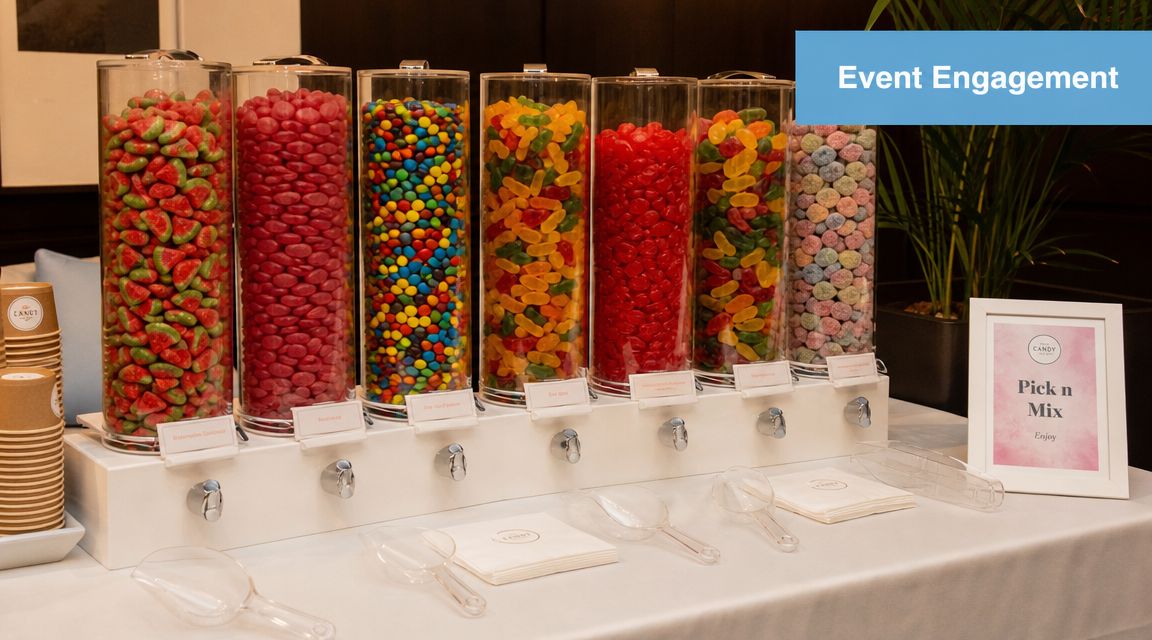
At exhibitions, that recognition translates into low-friction footfall. At staff events, it cuts through the stiffness that can make branded hospitality feel forced. At private parties, it works because guests personalise the experience themselves. They choose, compare, linger, and often come back.
Why it performs better than novelty for many events
A lot of event features look good in a pitch deck but need too much explanation on site. A pick n mix stand doesn't. It's self-explanatory, visual, and familiar enough to attract attention without needing a hard sell.
That makes it useful in several settings:
- Exhibition stands: It gives attendees a reason to step off the aisle and pause.
- Conferences: It creates a break-point between sessions and draws people into networking areas.
- Brand activations: It supports custom bags, colour-led merchandising, and simple lead capture prompts.
- Internal events: It feels generous without becoming overproduced.
Practical rule: If guests can understand the attraction from five metres away, your staffing burden drops and your interaction rate usually improves.
There's also a lesson here for planners working across regions and sectors. The same thinking that applies to concession planning in retail and leisure applies at events too. If you're comparing self-serve formats more broadly, this piece on understanding food service options for Oklahoma businesses is useful because it frames food service as an operational choice, not just a visual one.
Strategic Planning and Budgeting Your Stand
At 10:15 on an exhibition morning, a pick n mix stand can be doing one of two jobs. It can be pulling the right people into a conversation, or it can be burning budget while delegates grab sugar and walk off. The difference is usually decided in planning, not on the day.
A clear brief comes first. Set the job of the stand before you approve the format, sweet mix, branding, or staffing plan. A stand built for lead capture needs dwell time, a clear point for staff interaction, and a simple mechanism for collecting contact details. A stand built for guest hospitality needs faster service, tighter portion control, and less friction at peak times. If the stand is there to reinforce brand presence, printed bags, header boards, and colour matching should sit in the core budget from the start.

Start with cost per head, not hire price
Hire cost is only one line. The working figure planners need is cost per served guest, because that exposes whether the stand makes sense against your event objective.
Include the full delivery cost. That means stand hire, sweet stock, branded packaging, transport, setup, collection, refill labour, and expected waste. If you are comparing formats, do it against guest behaviour as well. A self-serve sweet stand often creates more handling loss and over-portioning than a staffed format, while a portioned concession can reduce waste but lower the sense of abundance. The right answer depends on whether you want throughput, dwell time, or a stronger premium feel. Teams weighing several concession formats often compare sweet stands against a popcorn rental machine for exhibition and event use because the staffing demand, mess profile, and per-head spend can be very different.
Waste deserves its own line in the budget.
A stand that looks generous can still be inefficient. Overfilled bags, broken sweets, contaminated stock from guest handling, and leftovers that cannot be reused all affect real cost. Planners often miss this because supplier quotes tend to centre on the visible elements, not the stock loss.
Build the budget in layers
Use a layered budget model. It gives you a cleaner approval process and makes scope creep easier to spot.
- Base hire: Stand structure, containers, scoops, tong sets, standard dressings.
- Stock: Sweet selection, refill stock, premium lines, dietary-specific options if included.
- Packaging: Bags, cups, twist ties, labels, branded stickers, napkins.
- Branding: Header panels, vinyls, product cards, QR signage, campaign messaging.
- Logistics: Timed delivery, access restrictions, waiting time, lift access, out-of-hours collection.
- Labour: Setup crew, service attendant, refill support, breakdown crew.
- Contingency: Extra stock, replacement utensils, spare signage, venue-driven changes.
That structure helps with supplier comparison as well. A low headline quote can become expensive once you add branded bags, venue-compliant delivery slots, and staff to keep the stand presentable through a busy session.
Plan stock against behaviour
Attendance numbers are only a starting point. The better forecast is based on likely take-up rate, average portion size, event duration, and how visible the stand will be from the main traffic route.
For example, a stand positioned on an exhibition aisle usually gets more impulse visits and faster depletion of recognisable favourites. A stand inside a hospitality lounge often sees fewer visits but larger portions because guests stay longer. Family audiences behave differently again. They usually create heavier demand for familiar lines and more refill pressure early in service.
Stock also depletes unevenly. Bestsellers go first. Once the most recognisable sweets are missing, the display can look understocked long before total volume becomes a problem. That is an operational issue as much as a visual one because a half-empty front row changes queue behaviour and lowers perceived quality.
Use three planning checks:
- Expected participation rate. What share of attendees will take sweets?
- Service style. Self-serve, portion-controlled, or fully staffed?
- Refill trigger point. At what level does the stand start to look poor on camera or to passing guests?
If you cannot answer those before ordering stock, the budget is still too loose.
Budget decisions that usually improve performance
Some choices consistently protect spend better than others.
| Budget Area | Better Decision | Why it works |
|---|---|---|
| Stock mix | Choose a balanced mix of recognisable lines and lower-cost fillers | It protects margin without making the stand feel cheap |
| Portion control | Set bag size or use staff-led serving at peak periods | It reduces over-serving and gives you a more reliable cost per head |
| Staffing | Add cover for launch period, breaks, and refill peaks | It prevents queues and keeps the stand looking full |
| Branding | Prioritise the header, front-facing panels, and takeaway packaging | Those are the items guests notice and photograph |
| Waste control | Approve a refill plan instead of loading all stock at once | It cuts spoilage and improves presentation |
| Packaging | Select disposal-ready materials that suit the venue waste stream | It reduces cleanup issues and supports sustainability reporting |
Packaging choices also have a financial effect. If the event has ESG reporting requirements or strict venue waste rules, review this practical guide for UK businesses before signing off bags or cups. It is a useful reference when you need packaging that works operationally as well as visually.
A simple approval test
Before you confirm the order, check five points with the client or internal stakeholder:
- What result is the stand expected to produce?
- What is the target cost per engaged guest or per served guest?
- Who owns refill and presentation on site?
- What level of waste is acceptable?
- How will success be measured. Footfall, leads, dwell time, or guest satisfaction?
If those answers are vague, the stand is still at concept stage, even if the artwork is already in progress.
Selecting Your Supplier and Customising the Stand
A supplier decision often looks fine on a quote and then fails under venue pressure. The problem usually shows up late. Delivery access is tighter than expected, branding files are wrong, allergen information is incomplete, or nobody has agreed who is refilling and serving. That is why supplier selection needs the same scrutiny as any other event contractor.
Start with the operating model, not the sweet list. Decide whether you need a drop-off stand, a staffed service, or a branded feature that also supports lead capture. Those are different products with different costs, risks, and staffing implications. If a supplier keeps steering the conversation back to colours and confectionery ranges, push them back onto setup responsibility, documentation, and service cover.
Questions that expose whether a supplier is event-ready
Use the first call to test whether the supplier understands live events, not just retail display.
- Insurance: Can they send current public liability and product liability documents that meet corporate venue requirements?
- Food handling: How are sweets sourced, transported, stored, and protected on site?
- Allergen information: What ingredient and allergen details will be available to guests and event staff?
- Service model: Is this staff-attended, self-serve, or drop-off only?
- Branding production: Can they supply branded headers, front panels, labels, and takeaway packaging to deadline?
- Contingency: What is the plan for vehicle delay, damaged fixtures, missing artwork, or stock shortfall?
Good suppliers answer those directly and in writing.
The stand itself also needs checking before artwork is approved. Many floor-standing pick n mix units follow a similar format. Tall enough to read from a distance, wide enough to create display impact, and heavy enough that transport, handling, and venue access have to be planned properly. Ask for a current specification sheet, bin layout, and loaded weight from the supplier you are hiring, then match that against the venue route, lift access, and floor loading rules before sign-off.
Customisation that supports the event objective
Branding should help the stand do a job. For corporate events, that job is usually a mix of attraction, brand recall, and measurable interaction. The highest-value branding positions are normally the header panel, the front-facing body panels, and the packaging guests carry away.
A few custom elements usually outperform a fully wrapped unit:
- Header panel: Best for the brand name, campaign message, or event-specific call to action.
- Takeaway bags or cups: Useful for brand recall because guests keep them after leaving the stand.
- Sweet labels: Helpful for themed naming, category signposting, or allergen prompts.
- QR signage: Best used for a clear action such as prize entry, lead form, or product page visit.
The same rule applies across concession builds. A branded food feature should look integrated with the activation and the guest journey. That is also true if you are comparing sweets with other interactive options such as popcorn machine hire for branded event catering.
Customisation affects cost and speed. Bespoke panels, printed packaging, and custom sweet labels improve visibility, but they also add artwork deadlines, proofing rounds, and reprint risk if the campaign changes late. For short lead times, I usually prioritise the header, front panels, and packaging first. Those are the surfaces guests notice and photograph.
Contract points that prevent expensive surprises
Do not leave commercial detail sitting in email threads. Put it in the booking confirmation or hire agreement.
Check these points before paying a deposit:
- Delivery window and latest acceptable install time
- Who unloads, positions, and dresses the stand
- Collection timing and overnight storage responsibility
- What happens to unused stock after the event
- Replacement terms for damaged stock, broken bins, or failed branding items
- Whether on-site staffing, refill stock, scoops, bags, and signage are included or charged separately
Cost-per-head can slip. A quote that looks competitive may exclude branded packaging, service staff, replenishment stock, or post-event collection waiting time. Get the full hire scope written down, then test it against your expected guest volume and service plan. That is the only way to judge whether the stand will perform commercially as well as visually.
Managing On-Site Logistics and Operations
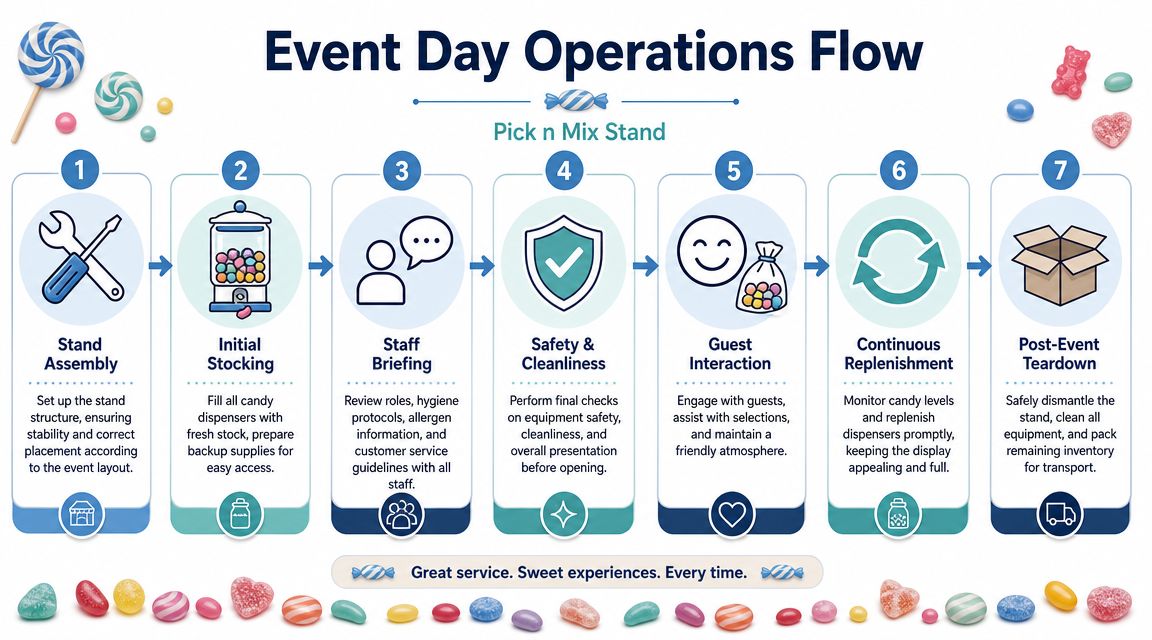
On event day, the pick n mix stand is a small food service operation. Treat it that way. It needs access planning, placement logic, refill discipline, and someone accountable for presentation.
The physical spec drives most of the logistics. A standard floor stand at around 1,480 mm high, 845 mm wide, and 630 mm deep, with a mass of about 80 kg, isn't enormous, but it does need realistic handling and a stable final position once installed. This stand specification reference is useful when checking whether the unit will suit your venue layout.
Placement decisions that affect performance
Where you put the stand changes how well it works. Near an entrance can drive immediate footfall, but it can also create congestion. On a stand corner, it can attract visitors from the aisle, but only if there's enough room for people to stop without blocking the frontage.
The best positions usually have three things:
- Natural pause space so guests can step in without creating a bottleneck.
- Clear sightlines so the sweets are visible from a distance.
- Back-of-house access so staff can refill quickly without cutting through the crowd.
What to plan before the venue opens
The stand should be ready before guest traffic starts. That means more than filling the bins.
- Check the route in: Measure doors, goods lift access, loading bay restrictions, and final approach.
- Set refill stock aside: Don't leave all backup stock mixed with general event kit.
- Brief the team: Staff need to know service rules, product layout, and when to intervene.
- Test the presentation: Full bins, straight labels, clean scoops, visible allergen information.
- Prepare the waste plan: Bag disposal, wipe-downs, empty packaging, and sweep checks nearby.
If the venue has a short install window, pre-labelling and pre-sorting stock off site will save time.
Replenishment is not optional
A standard hire stand often carries 19 sweet varieties and about 40 kg in total, but that doesn't mean it will look full throughout a busy session. High-demand lines can disappear quickly, which is why mid-event top-ups should be planned rather than improvised, based on this UK hire planning reference.
Many activations frequently slip. The team assumes the opening fill is enough. Then the crowd hits, the popular compartments empty, and the stand loses its visual impact.
If the stand looks half-empty, guests assume they've arrived too late and move on.
Simple operating model for live events
A workable live-event rhythm usually looks like this:
| Event Phase | Operational Focus | Common Mistake |
|---|---|---|
| Opening | Full presentation and clean service tools | Rushing setup and opening with incomplete labels |
| Peak traffic | Queue management and rapid refill | Letting one staff member do everything |
| Mid-session | Presentation reset and stock rotation | Topping up only when bins are nearly empty |
| Final hour | Controlled serving and pack-down planning | Overfilling close to event end |
For lighter footfall, the stand can sometimes be self-serve with periodic checks. For exhibitions, conferences, and branded activations, an attendant is usually worth having because they protect hygiene, answer product questions, and stop the stand from becoming messy.
Ensuring Health Safety and Allergen Compliance
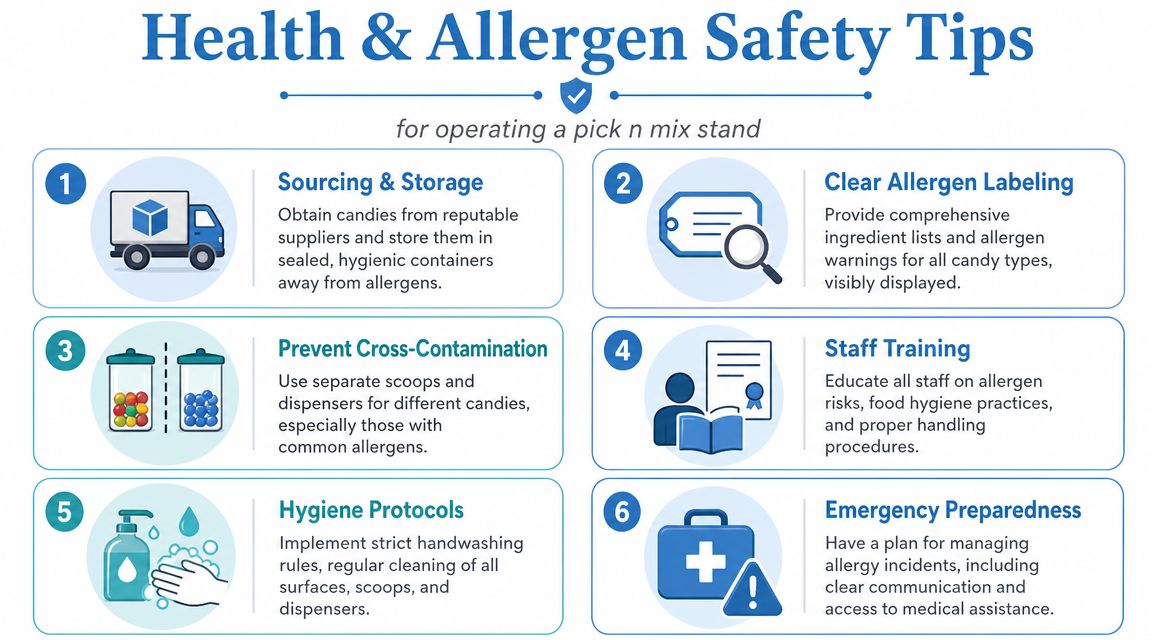
This is the part planners can't afford to treat casually. A pick n mix stand is handling edible product in a public setting. That brings legal, reputational, and duty-of-care responsibilities that are very different from decorative catering props.
The Food Standards Agency estimates that around 2 million people in the UK have a diagnosed food allergy, and Natasha's Law has made clear labelling a central issue in food presentation and sale, which is why allergen management must be part of supplier selection and stand operation from the start, as highlighted in this UK pick n mix hire compliance discussion.
What compliance looks like in practice
Compliance isn't just having a sheet in a folder somewhere. Guests need clear, accessible information at the point of choice.
That means:
- Each sweet is identified clearly
- Allergen information is available without delay
- Staff know where that information is and how to explain it
- Cross-contact risks are actively managed
- The serving area stays clean throughout service
If any part of that chain breaks, the stand becomes a risk.
Cross-contact is the hidden problem
Even when stock is labelled correctly, service can still fail if the stand is managed poorly. Shared scoops, sweets dropped into the wrong compartment, guests using hands instead of utensils, and refill stock handled carelessly all create avoidable issues.
A safer layout usually includes physical separation between products that present higher allergen concerns and those intended for wider access. Staffed service can also be the better choice where the event audience is mixed and the organiser wants tighter control.
A clean-looking stand isn't automatically a safe stand. Safe service depends on process.
For broader context, this guide on how to safeguard your business with food hygiene is worth reading when you're reviewing supplier standards and internal procedures.
Build the controls into your event paperwork
A pick n mix stand should appear in the event risk file like any other live feature. That includes setup risk, food handling risk, guest interaction risk, and waste management controls.
Useful points to document include:
- Who supplies the allergen data
- Who checks labels on site
- Who is authorised to refill products
- How used scoops are cleaned or replaced
- What happens if a compartment is contaminated
- Who handles guest queries or incidents
If you need a framework for documenting those controls, an event risk assessment template is a practical starting point.
Non-negotiables for professional events
Some standards shouldn't be debated at all:
| Compliance Area | Minimum Expectation |
|---|---|
| Product identification | Every item clearly named |
| Allergen access | Information available at point of service |
| Serving tools | Separate utensils and clean backups |
| Staff knowledge | Team briefed before opening |
| Cleaning | Ongoing wipe-downs and service resets |
| Incident response | Clear escalation route |
If the supplier treats these as optional extras, they're not suitable for a professional event.
Measuring Success and Maximising Event ROI
A pick n mix stand becomes valuable when it supports an event objective you can assess. If you only judge it by whether people seemed to enjoy it, you'll struggle to defend the spend later.
The stand should connect to one of three outcomes. Attention, conversation, or capture. Sometimes all three. The setup changes depending on which matters most.
Turn footfall into something measurable
For exhibitions and activations, the easiest mistake is letting the stand attract people without giving them any next step. That creates traffic, but not much else.
Better options include:
- QR-led entry: Add a scannable sign on the header or counter for prize entry, brochure download, or meeting request.
- Staff-led qualification: Let guests collect sweets after a short brand conversation.
- Pack-based messaging: Print a simple call to action on the bag or sticker.
- Themed selection: Use product names or category labels to reinforce campaign messaging.
The point isn't to overcomplicate a simple format. It's to stop the stand becoming a dead-end hospitality feature.
Match the measurement to the goal
Use the same success logic you'd apply to any experiential element. If the brief was brand awareness, look at interaction quality and stand traffic. If the brief was lead generation, count usable enquiries captured on site. If it was internal engagement, review guest feedback and repeat visits during the event.
That's the same wider discipline covered in this guide to experiential marketing ROI. The attraction itself matters less than whether it moved the event towards a defined result.
The sweetest activation in the room still needs a job to do.
The complete Pick n Mix Stand checklist
Use this as the final supplier and planning review before sign-off.
| Area | Key Consideration | Action / Question for Supplier |
|---|---|---|
| Objectives | What the stand is meant to achieve | Ask how the setup supports footfall, dwell time, lead capture, or guest hospitality |
| Format | Stand size and service style | Confirm the unit type, footprint, and whether it is staffed or self-serve |
| Branding | Visual integration with the event | Ask what can be branded, including headers, bags, and labels |
| Stock | Assortment and refill plan | Confirm sweet range, backup stock, and how top-ups will be handled |
| Packaging | Guest take-away and waste impact | Ask what bags or containers are included and whether alternatives are available |
| Delivery | Access and timing | Confirm load-in requirements, install timing, and collection arrangements |
| Setup | On-site responsibility | Ask who assembles, merchandises, labels, and signs off the stand |
| Staffing | Active management during service | Confirm whether an attendant is included or recommended |
| Hygiene | Cleaning and service discipline | Ask how scoops, surfaces, and containers are kept clean during operation |
| Allergens | Guest safety and legal compliance | Request clear allergen and ingredient information for each item |
| Risk | Event documentation | Ask for the supplier's RAMS and add the stand to your event risk file |
| Performance | Post-event review | Decide how you'll measure interactions, scans, conversations, or leads |
A pick n mix stand works best when it's treated as part concession, part engagement tool, and part live operation. Done properly, it can pull people in, keep the atmosphere relaxed, and support measurable event goals. Done casually, it creates avoidable cost and risk.
If you need a pick n mix stand delivered as part of a wider event activation, PSW Events can help with planning, logistics, branding, staffing, and compliant on-site execution across the UK and internationally.