
You're probably looking at an event brief that says something like “we need a showpiece”, but the venue has tight access, limited power, a cautious ops team, and no appetite for anything that looks high-risk. That's where an artificial ice rink moves from nice idea to serious option.
Used well, a rink does three jobs at once. It stops traffic. It gives guests something active to do, not just something to look at. And it creates a branded environment people photograph without being asked. Used badly, it becomes a logistics problem with expensive transport, awkward floor-loading conversations, slow-moving queues, and a supplier who only talks about the headline hire fee.
Most corporate teams don't need another article arguing in circles about “real ice versus fake ice”. They need to know what fits the venue, what keeps the H&S file clean, what staffing is required, and what the total cost of ownership looks like once delivery, installation, supervision, cleaning, and breakdown are included.
That's the practical lens worth using. Not “which sounds more impressive on paper?” but “which rink will work in this building, with this audience, on this schedule?”
Bringing the 'Wow' Factor to Your Next Event
For a corporate party, product launch, exhibition stand, or winter activation, the attraction has to earn its footprint. An artificial ice rink can do that because it combines spectacle with participation. People don't just notice it. They queue for it, film it, and talk about it afterwards.
That said, novelty isn't enough. If the rink causes long installation windows, venue pushback, or a poor guest experience, the “wow” factor disappears quickly. The strongest activations start with the event objective first. Is the rink there to drive dwell time, reward staff, attract footfall, support a seasonal campaign, or create a branded hero moment for content capture?
A good planning question is simple: what does success look like once guests arrive? If you need broad appeal, easy setup, and a manageable operating model, a rink can work extremely well. If you need elite skating performance, the answer may be different.
For teams still weighing up interactive options, it helps to compare a rink with other high-engagement formats such as the attractions in these unique event entertainment ideas. The rink stands out when you want a shared, photogenic experience rather than a one-player-at-a-time game.
Practical rule: Book the attraction that matches the venue's constraints as closely as it matches the creative concept.
The rest of the decision comes down to mechanics. What kind of artificial ice rink are you hiring? How does it install? What does it need from the venue? And where do the hidden costs usually sit?
What Exactly Is an Artificial Ice Rink
At a practical level, an artificial ice rink is any engineered skating surface that doesn't depend on a naturally frozen body of water. For events, that usually means one of two things. Either you're hiring a temporary rink that creates genuine frozen ice through a refrigeration system, or you're hiring a synthetic rink built from interlocking skating panels.
Two families of rink
A temporary refrigerated rink is real ice. The system uses chillers, pipework, and water to create and maintain the frozen surface. In event terms, think of it as a portable version of a conventional rink, with many of the same engineering demands.
A synthetic rink works differently. Panels lock together over a prepared flat surface and create a skateable top layer without refrigeration or continuous water use. The easiest analogy is a high-spec skating surface made from modular boards. Not toy plastic. Not a decorative prop. A purpose-built system designed for blades.
That distinction matters because many briefs use “artificial ice rink” as a catch-all phrase. Suppliers may mean very different things by it, and the wrong assumption at enquiry stage leads to the wrong venue plan.
A UK story, not a new fad
Britain has a real place in the history of engineered skating surfaces. The Glaciarium in Chelsea, London, opened on 7 January 1876 as the world's first mechanically frozen rink, developed by British inventor John Gamgee, and earlier UK experiments with chemical cooling mixes date back to 1841, as noted in this account of the first artificial ice rink in London.
That history is useful for one reason. It reminds planners that “artificial ice” has always been an engineering question, not just a novelty product. The same is true today.
What this means for a marketing manager
If you're signing off a rink for a campaign, don't ask only “is it skatable?” Ask:
- What surface is it really? Synthetic panels and refrigerated ice solve different problems.
- What experience are we promising? Casual fun and hero visuals need a different setup from serious skating.
- What does the venue have to support? Access, power, humidity, water, and floor approval all sit behind that creative idea.
Those answers shape everything that follows, from quote structure to queue management.
Comparing Rink Technologies Synthetic vs Refrigerated
Choosing between synthetic and refrigerated ice is the decision that affects almost every other line in the event plan. It changes the build method, utility demands, surface feel, staffing model, and often the venue shortlist.
A useful visual comparison helps before you get into quotes.
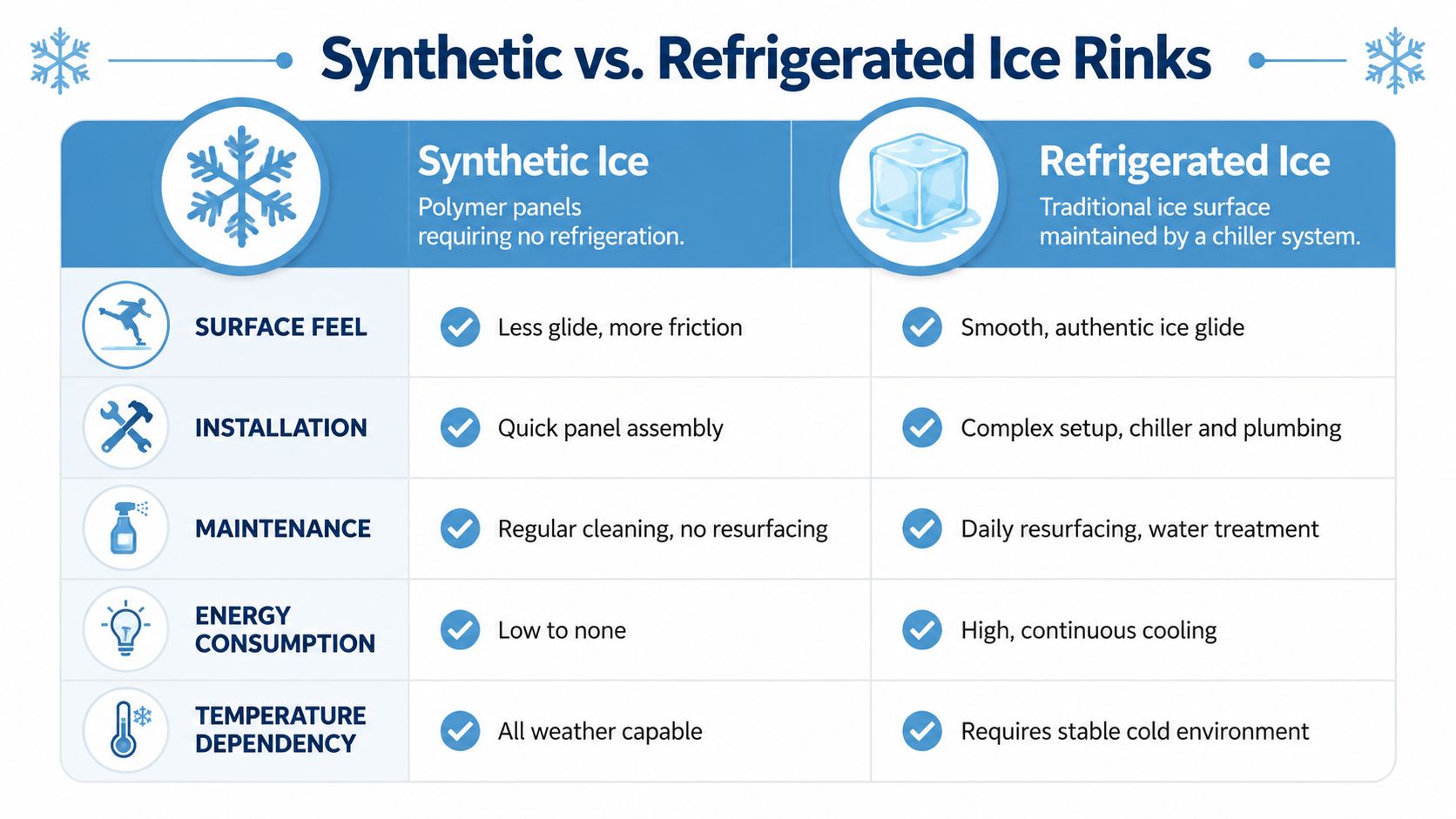
Installation and venue fit
For temporary events, the core difference is straightforward. Refrigerated ice needs an insulated base, pipework, and humidity control. Synthetic ice uses interlocking panels on a flat surface and removes the need for cooling and large water inputs, as explained in this guide to how temporary ice rinks are built.
That single distinction answers a lot of practical questions.
If you're activating in an exhibition hall, retail atrium, hospitality space, or corporate venue where utilities are limited, synthetic usually gives you more workable options. You're not trying to introduce a full cooling stack into a building that wasn't designed for one. You're installing a modular activity surface.
Refrigerated ice can absolutely be right, but it works best where the venue can support the extra engineering and the brief needs authentic ice.
The experience on skates
Event teams must be honest: synthetic and real ice do not feel the same.
Refrigerated ice gives the familiar glide people expect from a proper rink. It suits performance-led skating better and aligns with audience expectations when “real ice” is part of the appeal.
Synthetic has more friction. That's the trade-off for flexibility. For brand activations, beginner sessions, informal public use, and light hockey-style activities such as skills drills or shooting, that trade can be entirely acceptable. For high-speed skating, it usually isn't the first choice.
Here's a short comparison planners can use early in the scoping stage:
| Factor | Temporary Refrigerated Rink (Real Ice) | Synthetic Ice Rink (Polymer Panels) |
|---|---|---|
| Surface feel | Authentic ice glide | Slower feel with more friction |
| Build complexity | Higher, with refrigeration infrastructure | Lower, modular panel assembly |
| Water use | Required | Not required for the skating surface |
| Utility demand | Ongoing cooling requirements | No refrigeration requirement |
| Venue flexibility | More restricted | Better suited to constrained venues |
| Best fit | Performance-led skating | Brand activations, casual skating, drills |
A quick video can also help non-technical stakeholders understand the difference in setup and operation.
Total cost of ownership, not just hire price
Many UK event budgets often drift off course. Buyers often compare the visible hire fee, then get caught by everything around it.
With refrigerated ice, cost tends to follow complexity. You're dealing with specialist plant, build time, more demanding site preparation, environmental control, and often a longer operational checklist. The attraction may be stronger for certain audiences, but it rarely wins on simplicity.
Synthetic tends to reduce operating friction in the literal and commercial sense. There's no refrigeration stack to power and manage. There's no dependency on continuous cooling. It's often easier to place in venues that would reject a real-ice proposal on technical grounds.
The right comparison isn't “which rink is cheaper per day?” It's “which rink can be delivered, operated, and removed cleanly in this venue without creating cost elsewhere?”
Which one usually works
For exhibitions, shopping centres, conference venues, and branded corporate events, synthetic is often the more practical answer.
For premium winter experiences where authentic ice is part of the product, refrigerated can justify the extra complexity.
What doesn't work is choosing real ice because it sounds more impressive, then discovering the venue can't support the infrastructure, or choosing synthetic while promising guests a pro-rink skating feel.
Key Specifications for Your Event Plan
Once the rink type is decided, the conversation shifts from concept to engineering reality. Three specifications matter most in venue approval and cost control. Footprint, power, and weight.
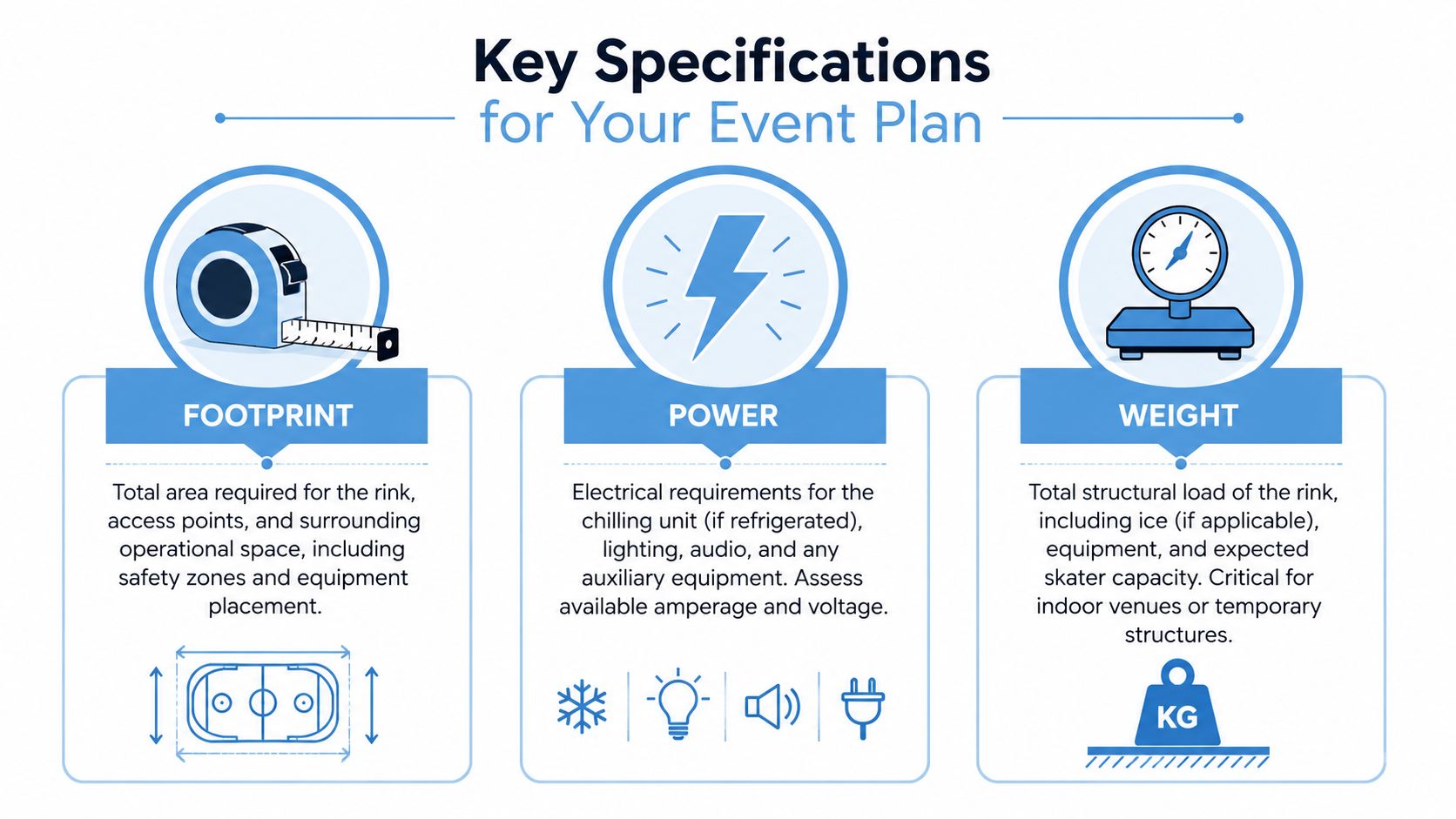
Footprint means operational space, not just skating area
The rink itself is only part of the required area. You also need circulation space, skate issue and return, queuing, barriers, staff positions, and spectator sightlines. If the activation includes branding, add room for set elements, photo moments, and any lead-capture desk.
A common challenge for event teams arises when they reserve floor area for the rink mat or ice bed, then realise the supporting operation has nowhere to go. A rink that looks compact on a floorplan can become awkward fast if guests can't enter, exit, or wait safely.
Power and technical services
A refrigerated build has a much heavier technical footprint than a synthetic one. That's the point at which venue power conversations become critical, not optional. Synthetic setups may still need electricity for lighting, sound, or adjacent branding features, but the skating surface itself doesn't require the same cooling infrastructure.
If a venue already has limited temporary power provision, this can decide the project before design is finished.
Weight and floor loading
Floor loading is one of the least glamorous parts of the job and one of the most important. Indoor venues, upper floors, temporary structures, and atrium spaces all need proper review. It isn't enough to ask whether the rink fits. You need to know whether the structure can safely support the full installed load plus people.
Engineering benchmarks show why real ice becomes demanding so quickly. Top-level hockey guidance sets rink dimensions at 60 m by 26 m to 30 m, with corners of 7.0 m to 8.5 m radius, and the ice itself is typically only 1 to 1.5 inches thick, maintained at roughly 20 to 22°F, while the slab beneath is cooled to around 16°F before flooding begins. Those details from this explanation of how hockey rink ice is made underline the thermal control and supporting systems behind real ice.
For temporary corporate use, the lesson is simple. Even a relatively shallow real-ice layer depends on serious infrastructure. Synthetic systems avoid that refrigeration stack, which is why they're often easier to place in malls, atriums, and hospitality environments.
Site note: Ask the venue for floor-loading guidance before creative approval, not after artwork is signed off.
The specification questions worth asking early
- How much non-skating space does the rink operation need?
- What power is available at the exact installation point?
- Has the venue approved the combined floor load of rink, barriers, kit, and guests?
- What access route will the build crew use, and does that route have its own loading limits?
These details won't make the campaign deck, but they decide whether the activation runs smoothly.
From Booking to Breakdown A Logistics Guide
The easiest way to lose money on an artificial ice rink is to treat it like a simple hire item. It isn't. It's a live installation with delivery, site constraints, operating procedures, and a breakdown plan that needs just as much attention as the launch day.

Before you confirm the booking
The first useful supplier conversation isn't “what's your day rate?” It's “what assumptions is this quote based on?” You need to know whether transport, installation crew, supervision, cleaning, branding, barriers, skate stock, and out-of-hours venue working are included or sitting as extras.
Event planners often get drawn to “zero energy” messaging around synthetic surfaces, but a proper UK comparison should include installed cost, transport, floor loading, installation time, and whether the venue can support a refrigerated system at all, as discussed in this article on how ice rinks are made and costed.
That's the right commercial frame. Not just energy. Total ownership.
Site survey and approvals
A competent supplier should want a site survey, floorplan review, or detailed venue pack before final sign-off. Access routes matter. Lift sizes matter. Door widths matter. If the installation crosses finished flooring or public circulation zones, protection measures matter too.
The operational planning often sits well inside a wider event system, especially when multiple contractors are involved. Tools that centralise timelines, venue data, and contractor actions make rink builds easier to manage alongside staging, catering, branding, and registration. That's where platforms for event coordination software can help keep technical decisions visible to the full project team.
Build day and live operation
On installation day, the rink crew needs enough clear time to unload, assemble, test, and hand over safely. If the venue schedules the build too tightly against another contractor, delays follow. That's especially common in exhibitions and multi-use halls.
During live operation, someone needs to own the guest journey. That includes:
- Skate issue and sizing: Poorly managed footwear slows throughput and frustrates guests.
- Marshalling: Guests need clear direction on entering, exiting, and what level of skating is appropriate.
- Surface care: Synthetic panels need routine cleaning. Real ice needs active surface maintenance.
- Incident response: First aid, reporting lines, and stop procedures should be clear before the first guest skates.
Ask who controls the rink once the doors open. If nobody owns operations, small issues pile up quickly.
Breakdown is part of the event, not an afterthought
Breakdown costs time, labour, and vehicle access. If the venue has strict load-out hours or shared docks, that needs planning at contract stage. Synthetic usually makes this cleaner because there's less infrastructure to remove, but it still needs disciplined packing, panel handling, and site reinstatement.
What works best is a turnkey approach where one supplier manages the full chain from pre-production through removal. What rarely works is splitting responsibility across multiple vendors and assuming they'll sort it out on site.
Creative Use Cases for Brand Activations
A strong artificial ice rink activation doesn't start with “let's put in a rink”. It starts with “what behaviour are we trying to create?” The best uses are built around audience movement, participation level, and how the brand appears in the experience.
Exhibition stands that need footfall
At a trade show, a full skating rink usually isn't the point. A compact synthetic installation often works better. It can become a branded challenge zone, a skills-based game, or a visual anchor that separates your stand from rows of screens and shell scheme graphics.
The main advantage is that people understand it quickly. They don't need a long explanation. They see skates, a surface, a small crowd, and branded barriers, and they know something is happening.
If lead capture matters, don't rely on the rink alone. Build the data moment around it. Entry booking, scoreboards, instant photo share, or prize redemption all create sensible points to collect details. Teams planning that wider physical brand layer often get useful ideas from FLYP's event merchandise playbook, especially when the activation needs take-home items that extend the interaction.
Product launches and seasonal campaigns
For a launch, the rink can act as a live set rather than just an activity. The barriers, edge graphics, lighting, staff uniform, and skate area can all carry campaign branding. That's what turns the rink from “fun thing in the corner” into the centre of the environment.
This works particularly well when the product already has a winter, premium, family, or performance association. It can also work in contrast. A summer or lifestyle brand can use the rink because the unexpected setting makes the content more shareable.
Staff rewards and client hospitality
Internal events often benefit from a rink because it encourages low-pressure participation. Not everyone wants to climb, compete hard, or take the microphone. Skating feels social without demanding much from guests.
The key is matching the rink to the audience. Synthetic glide varies and can feel different from refrigerated ice, so the right question is whether the goal is high-speed skating or a more accessible experience for beginners and children, as noted in this discussion of synthetic ice performance and upkeep.
That's why many corporate teams choose synthetic for mixed groups. It suits casual engagement better than trying to recreate a sports venue.
For brands building larger live campaigns, a rink often works best as one part of a broader experiential marketing activation, especially when the brief includes dwell time, social content, and conversation with staff.
A rink works best when the brand interaction continues before and after the skate, not only on the surface itself.
Your Event Planner's Ice Rink Booking Checklist
A rink brief is easy to approve too quickly because the creative is obvious. The risk sits in the questions that don't get asked. Use the checklist below to pressure-test the plan before contract signature.
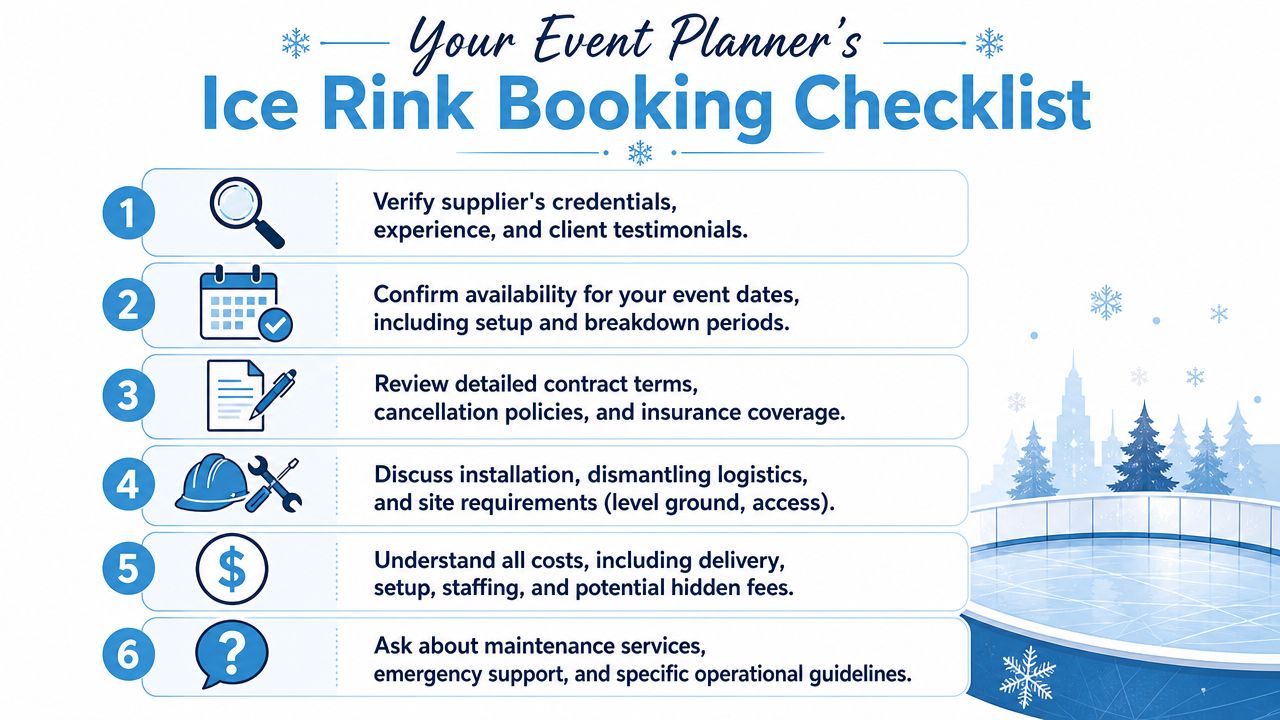
Supplier checks
Start with experience. Has the supplier delivered rinks in venues like yours, or are they mainly selling the product and leaving the venue work to others? Ask for examples of similar environments such as exhibition halls, retail spaces, hospitality venues, or corporate sites.
Then review the quote line by line.
- Transport clarity: Does the price include delivery, unloading, and collection?
- Crew scope: Who installs, supervises, and dismantles?
- Operational extras: Are skate marshals, cleaning, branding, and out-of-hours labour included?
- Contingency support: If a panel shifts or a barrier needs adjustment, who responds?
Venue checks
Your venue team should confirm practical approval, not just verbal enthusiasm. Get written confirmation on the essentials.
| Check area | What to confirm |
|---|---|
| Access | Delivery route, loading bay use, door widths, lifts, timing restrictions |
| Floor loading | Whether the surface and surrounding operation are structurally acceptable |
| Power | Supply availability at the exact rink position |
| Surface condition | Flatness, protection needs, and any restrictions on fixing or anchoring |
| Public circulation | Queue space, emergency routes, and spectator management |
H&S and live operation
A rink supplier should be comfortable providing documentation and talking through responsibilities. If they sound vague, keep looking.
Ask for:
- RAMS: Risk assessments and method statements for build, operation, and breakdown
- Insurance evidence: Product, employer's, and public liability documents
- Incident process: Who logs issues and who has authority to pause operation
- Staffing plan: Who fits skates, marshals guests, cleans the surface, and manages flow
Commercial sense check
The cheapest quote often becomes the expensive one if it excludes the difficult parts. A stronger test is whether the supplier has priced the job around your real venue conditions and event hours.
The shortlist question is this: can this company deliver the attraction safely, on time, with no hand-waving around access, approvals, staffing, or removal?
If the answer is yes, you're looking at a viable rink project. If the answer depends on “we'll work that out later”, you're not.
An artificial ice rink can be one of the most effective event attractions in the market when it's chosen for the right reason and planned with the same discipline as any other technical installation. For UK event teams, the smart decision usually comes down to venue fit, operating model, and total ownership cost, not just whether the surface is “real”.
If you need a turnkey partner to plan, deliver, and staff interactive event attractions across the UK, including branded experiences and full logistics support, PSW Events is worth speaking to.