
The UK golf simulator market hit USD 214.5 million in 2025 and is projected to reach USD 436.6 million by 2033, which tells you this is no longer a novelty lane tucked into a corner of the venue. It's part of a broader shift in UK leisure and events, where a well-run interactive sports simulator can do real work on the show floor, not just look impressive in a proposal deck.
At Silverstone and ExCeL, I've seen the same pattern repeat. A simulator bay that looks straightforward on paper can become the busiest point on a stand, or it can sit there underused because the format, footprint, and audience don't match the brief. The difference is rarely the kit itself, it's the job you ask it to do.
What an Interactive Sports Simulator Actually Does at Events
At a busy hospitality build, I watched simulator bays create a 40-minute queue inside a 20 x 10 metre marquee. That result was not down to the equipment alone. The format gave visitors a reason to stop, compete, and stay available for a brand conversation. An interactive sports simulator turns a familiar sporting action into a measured digital experience through sensors, software, and a physical rig.
A genuine simulator tracks movement from the participant. That could be a golf swing, a thrown ball, a punch, or steering input in a racing cockpit. The system then converts the action into an on-screen result, such as distance, accuracy, reaction, or lap performance. Arcade cabinets usually use simplified controls, so they provide a different type of interaction and require less physical involvement.
What counts as a simulator on a UK event floor
UK event buyers use the term for several distinct activation formats. Golf swing bays, racing cockpits, football penalty walls, boxing force pads, baseball lanes, and cricket batting cages all sit within the category. Their purpose and operating requirements vary, from quick challenges that attract passing traffic to higher-fidelity rigs designed for repeat play and competition.
That distinction affects the commercial brief. A golf bay needs room for a full follow-through, while a compact football target wall can fit a tighter stand footprint. They also produce different event outcomes. A fast penalty challenge can support footfall and throughput, whereas a racing rig may generate longer dwell time but serve fewer participants during a session.
The format should match the KPI before the kit is selected.
Practical rule: never ask for a quote until you've decided whether the simulator is there for footfall, dwell, lead capture, or all three.
Lead capture adds another layer. A score can trigger a competition entry, a permission-based follow-up, or a conversation with the stand team, but only if the data process is planned and staffed. A queue without an engagement route may create attention without producing useful leads.
Footprint, power draw, ceiling height, rigging, staffing, and data capture vary widely between formats. A proposal can make the activation look straightforward while hiding those operational differences. For an exhibition, hospitality suite, or brand activation, confirm the deployment requirements before committing to the simulator format.
Core Simulator Formats Used Across UK Events
The UK market isn't one neat category, it's several product families sold under one label. That's why planners get caught out. A sports simulator that works beautifully for a golf sponsor on a stand can be the wrong answer for a football brand activation or a racing hospitality suite.
Golf, racing and football do most of the heavy lifting
Golf bays are the most familiar format. In the UK you'll usually see two versions, an overhead launch monitor setup or a fully enclosed screen cabin. The first gives you the driving-range feel, the second gives you the fuller course experience and tends to work better where the client wants a more premium look.
Racing cockpits are a different discipline. They're built around a seat, wheel, pedals, and often a motion platform with force feedback. The branded content usually leans on motorsport or F1-style visuals, which makes these rigs especially useful when the sponsor already lives in that world. For more on tournament display and live viewing setups, the guide to screen mirroring at tournaments is a useful operational reference when you're pairing play with audience screens.
Football formats split into three useful subtypes. Penalty shootout walls focus on target zones. Skills walls test first touch and shot placement. Goalkeeper rigs are more reaction-driven and work better when you want spectators to watch each attempt like a mini contest.
What works on site: the more obvious the scoring, the faster the queue forms. People understand a target, a leaderboard, or a fastest-lap result without explanation.
Other formats fill niche briefs
Boxing pads are popular because they're easy to understand and quick to cycle through. A participant takes a punch, sees a reading, and steps aside. That makes them attractive for fitness-led brands, especially when the client wants movement without long instruction.
Cricket, baseball, and rugby variants tend to show up seasonally or around sponsor launches. They're useful when the brand already has a sport-led audience and wants something that feels customized rather than generic. PSW Events also provides sports simulator hire across formats such as football, rugby, golf, boxing, and racing-seat experiences, which is useful when a planner wants one supplier who can cover several use cases. PSW Events simulator hire
| Format | Core Hardware | Typical Footprint | Player Experience | Best-Fit Event Type |
|---|---|---|---|---|
| Golf bay | Launch monitor, screen, enclosure, mat, projector | Medium to large | Solo or paired, longer turns | Exhibitions, hospitality, premium activations |
| Racing cockpit | Seat, wheel, pedals, motion base, display | Medium | Solo, competitive lap-based play | Motorsport events, brand partnerships, lounges |
| Football wall | Targets, sensors, rebound area, scoring display | Small to medium | Fast group turns | Trade shows, family events, brand stands |
| Boxing pad rig | Punch pads, timing sensors, visual scoring | Small | Very short solo turns, high throughput | Fitness brands, mall activations, pop-ups |
| Cricket or baseball lane | Bat or throw zone, sensor tracking, display | Medium | Solo with spectator appeal | Sponsor launches, seasonal events, fan zones |
The practical question isn't which format looks coolest on a deck. It's which one matches your audience flow. A high-footfall show floor needs a fast cycle. A hospitality suite can afford a slower, more immersive unit. A retail pop-up often needs something that catches attention from a distance and resets quickly.
Business Benefits and Measurable Event Outcomes
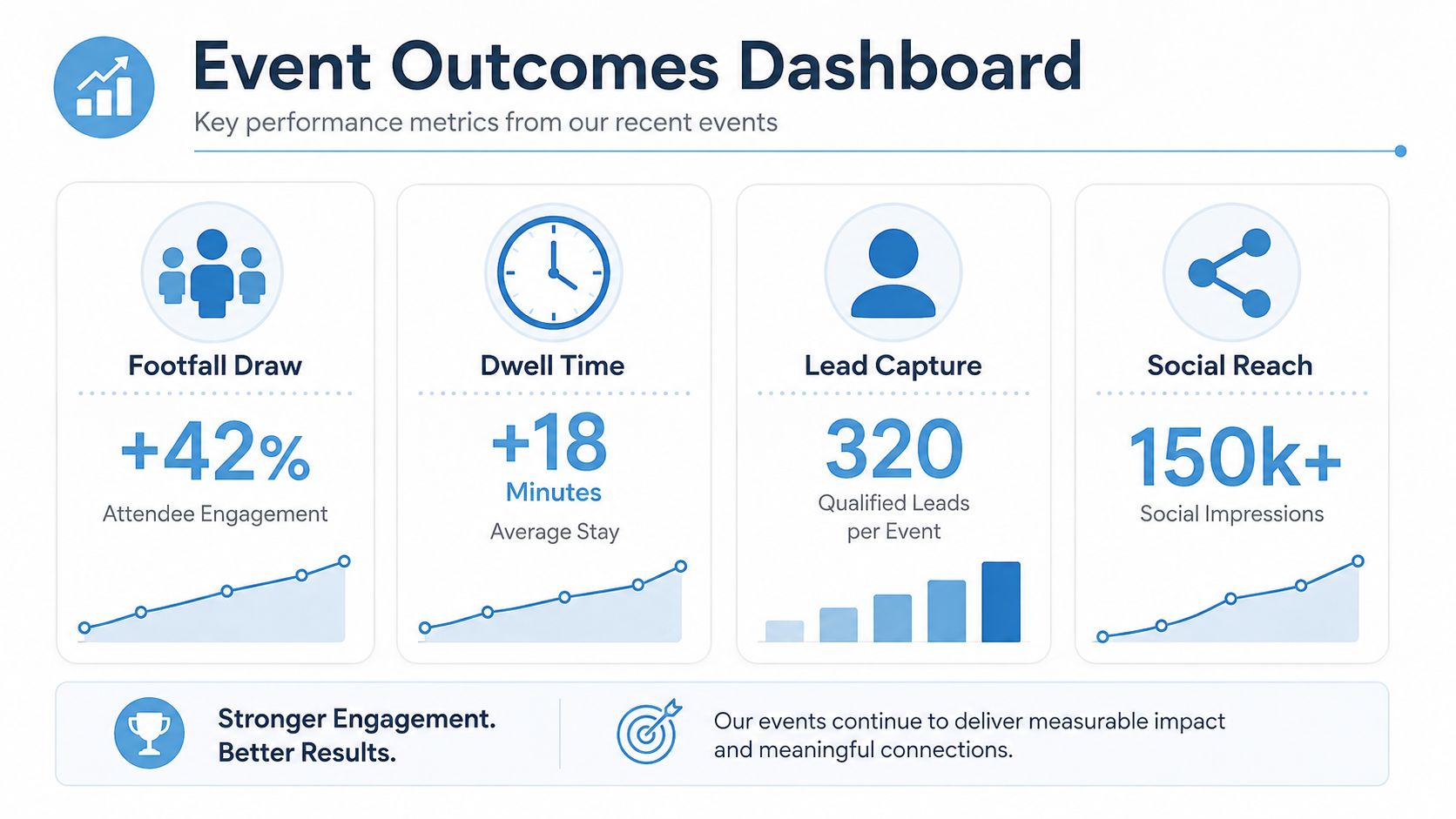
The commercial value of an interactive sports simulator only makes sense when you attach it to the outcomes a client cares about. That starts with footfall, moves into dwell time, and ends with lead quality. Anything else is just entertainment language dressed up as strategy.
A working simulator earns attention because it's active, noisy in a controlled way, and easy to understand from across a stand. Put it badly and it becomes a bottleneck. Put it well and it becomes the place where your team can start a proper conversation instead of waving people over with a brochure.
Where the value comes from
In a practical exhibition layout, a live simulator can pull measurable footfall from several metres away because people can see movement, score updates, and other attendees competing. Once they stop, the experience typically stretches dwell time well beyond the brief glance a static stand gets. That extra time is what gives sales teams room to qualify interest, explain a product, or move someone onto a follow-up list.
The strongest setups add a tablet or QR landing page at the point of play. That simple step changes the output from “we had lots of interest” to “we collected usable contact data from people who engaged.” If you're reporting into marketing, that matters more than applause.
A simulator isn't just an attraction. It's a reason for visitors to stop, wait, play, and then speak to someone while they're already invested.
What to judge in a proposal
The more useful KPI discussion is usually this, how many meaningful interactions does the unit create per day, and what does that do to the cost per lead? A planner who can tie the rig to measurable conversations has a much better case than one selling “buzz.” For a commercial planning lens, the ROI framing on experiential marketing return is the right kind of document to pressure-test before signing a hire.
Use the simulator where conversation quality matters. Use it where your audience needs a reason to stay. Use it where you need a branded moment that people can't skim past. Those are the event conditions where the category earns its place.
How Simulators Compare With VR and Traditional Attractions
A simulator is often compared with VR, a classic crowd-puller, or a static display wall, but those choices don't solve the same problem. The best option depends on what you're trying to move. If you need dwell and lead quality, one answer rises quickly. If you need novelty or pure volume, another may fit better.
Side-by-side event logic
| Metric | Simulator | VR Experience | Classic Attraction | Static Stand |
|---|---|---|---|---|
| Footfall draw | Strong, especially when motion is visible | Strong on novelty | Strong at first glance | Low to moderate |
| Dwell time | Strong | Moderate to strong | Moderate | Low |
| Lead capture | Strong when paired with a form | Strong if managed well | Mixed | Usually weak |
| Setup footprint | Moderate | Often compact | Variable | Small |
| Staffing need | Moderate | Moderate to high | Moderate | Low |
| Cost per interaction | Usually efficient at scale | Can be efficient, but often slower to cycle | Good for quick volume | Low cost, low return |
| Accessibility | Better than many VR experiences | Can be restrictive | Often broad | Broad, but passive |
| Brand customisation | Strong | Strong | Moderate | Strong visually, weak interactively |
For high audience volume and a KPI built around dwell, the simulator usually wins. It gives people a physical task, visible scoring, and a reason to stay in place. That makes it more useful than a static stand and often more practical than a VR rig that needs headset management and tighter supervision.
VR still has a place. If the brief is social sharing, novelty, or a one-off spectacle, it can outperform on first-glance impact. The problem is throughput. In a busy UK exhibition hall, headset handling can slow the line, and that can damage the very footfall the client expected to win.
Classic attractions still have a role when budget is tight and the brief is mostly about attracting attention. They're quick to explain and easy to recognise. But for a premium brand, they can look too familiar unless the creative wrap is doing a lot of work.
If you're choosing in one line, use this rule. High volume plus dwell means simulator. Pure novelty means VR. Tight budget plus simple footfall means classic attraction.
UK Deployment Scenarios for Exhibitions and Brand Activations
Four UK demand pockets tend to produce four different simulator briefs. Exhibition stands usually prioritise footfall and qualified leads, motorsport hospitality focuses on dwell time and comparison, retail pop-ups need rapid throughput, and corporate events want participation across a group. The venue, audience, and access route determine which format can deliver those outcomes before the first cable is laid.

Four setups that actually make sense
At ExCeL London, a 6 metre by 4 metre island suits a golf or football simulator when the KPI combines footfall, dwell time, and lead capture. A branded interface, host, leaderboard, and tablet-based data capture give visitors a reason to stop and give the team a clear point to start a conversation. The island layout allows approach from several sides, so the queue can support the activation rather than block a neighbouring stand. Clean power, sensible floor loading, and a defined queue line still need checking before the build.
At Silverstone, a motorsport racing pod belongs in a hospitality suite where the audience already values speed, timing, and comparison. Telemetry screens and sponsor liveries support longer dwell because they give spectators something to watch between turns. The pod must match the suite's access times, cabling route, and ceiling height. Those practical details decide whether the installation looks polished or rushed.
A shopping-centre pop-up has a different commercial job. Boxing or cricket simulators can attract casual weekend visitors, but the unit must communicate its purpose from several steps away, reset quickly, and accept short sessions. Here, footfall and throughput matter more than a complex scoring system. Queue management matters as much as the game.
Corporate away days in hotel ballrooms often suit football simulators. Team scoring, round-based play, and a host-led format create a tournament structure that includes people without specialist knowledge. The brief should prioritise group participation and dwell time rather than exhibition-style lead capture. For a turnkey operator, PSW Events provides a useful benchmark because it handles planning, branding, logistics, installation, staffing, and compliance across these settings.
The practical test is simple. The unit must fit the venue's flow, not fight it. Respect access, queueing, power, and audience behaviour, and the activation feels deliberate. Ignore them, and even a strong simulator looks awkward.
Booking Simulators in the UK With Confidence
A good booking starts with a brief that is specific enough to stop wrong quotes. You need the date, venue, expected footfall, audience profile, brand assets, and the KPI you're trying to improve. If you leave those out, suppliers will fill the gaps with assumptions, and that's how the wrong format ends up on the floor.
The details that catch first-time buyers out
Venue liaison is where most mistakes surface. Power phases, floor loading, ceiling clearance, access times, and rig-in routes all matter before anyone talks about graphics or prize mechanics. If you're using a ballroom, a shell scheme stand, or a historic venue, check the loading limits and access windows early, because those constraints shape the whole build.
Compliance is straightforward when the operator is organised. You should expect PAT-tested equipment, public liability insurance, usually at £10m for serious UK event work, and RAMS for larger or more complex venues. If the activation is tied to alcohol service or prize-giving, licensing may also come into play.
What a proper supplier should hand over
A sensible payment structure usually involves a deposit, a balance due before the event, and clear cancellation terms. A site survey often saves money because it prevents over-ordering kit or discovering too late that the access route won't take the rig. On the day, you should get an unbranded or branded unit exactly as agreed, a trained operator, and on-screen data capture if it was part of the brief.
Never accept a “we can sort that on the day” answer for branding, power, or data collection. Those are booking issues, not surprises.
You also want a debrief after the event, not just a dismantle. That should include what played well, what slowed the queue, and whether the simulator delivered the engagement your proposal promised. If the supplier can't talk clearly about those points, keep looking.
A Practitioner's Checklist Before You Hire
Treat this as a final gate before the purchase order goes out. It's the point where you catch the missing details that usually only surface when the rig is already in the loading bay. If everything below is clear, the event is much less likely to become a site-room problem.

Tick these off in order
- Confirm the brief and objectives, including the KPI target, the audience, and the event format.
- Verify the venue conditions, especially ceiling height, floor loading, access times, and whether the site uses temporary demountable structure rules or other venue-specific constraints.
- Check rigging and power, then confirm where the cable runs will sit and whether the load-in route works for the kit.
- Review the full cost breakdown, including staffing, branding, transport, and any extras that change the headline price.
- Lock branding deadlines, so artwork, sponsor logos, and screen assets arrive in time for production.
- Confirm on-site technical support, including who handles faults, resets, and scoring issues.
- Agree on data capture, consent flow, and the final deliverables you expect back after the event.
- Check insurance and liability, plus RAMS and any venue paperwork that applies.
- Confirm operator cover, including DBS checks where the venue or audience mix requires it.
- Sign the debrief template in advance, so reporting doesn't get forgotten once the event is over.
For larger UK venues such as ExCeL, Olympia, and the NEC, it's also smart to check CDM responsibilities and follow ABTT rigging guidance where relevant. Those issues may sit outside the simulator itself, but they can still affect how the installation is signed off.
The strongest activations are the ones that look simple because the planning behind them was exact. When the supplier, venue, and brand team agree the details early, the simulator does the job you paid for instead of creating avoidable friction.
If you're planning an exhibition, hospitality build, or branded activation and want a simulator that fits the venue and the KPI, speak to PSW Events. They handle simulator hire, branding, installation, staffing, and compliance across UK events, so you can compare formats properly before you book.