
You've got the brief in your inbox, the stand builder wants the floorplan, and someone has just asked whether the activation should “have VR” because the competitors are doing it. That's usually the point where budgets start drifting, because virtual reality hire for events can be brilliant in the right format and a complete distraction in the wrong one.
The practical question isn't whether VR looks modern. It's whether it earns its place on your stand, in your launch schedule, or in your hospitality space, and whether it does so at a cost you can defend later. A lot of the noise around immersive activations treats VR as a novelty layer, but the UK market for virtual events is already sizable, with revenue of USD 5,662.4 million in 2024 and a projection to USD 18,031.0 million by 2030, which implies 21.3% CAGR from 2025 to 2030 in the source outlook (PSW Events' market overview).
That growth sits alongside a real planning tension. UK event marketing reporting cites that 95% of exhibitors prefer in-person over virtual events, while the same environment still shows virtual formats growing, which tells you demand for immersive content hasn't vanished, it's just become more selective (UK event-marketing insight). The right lens is cost per engaged minute, not novelty per square metre.
Why UK Planners Are Rethinking Virtual Reality Hire for Events
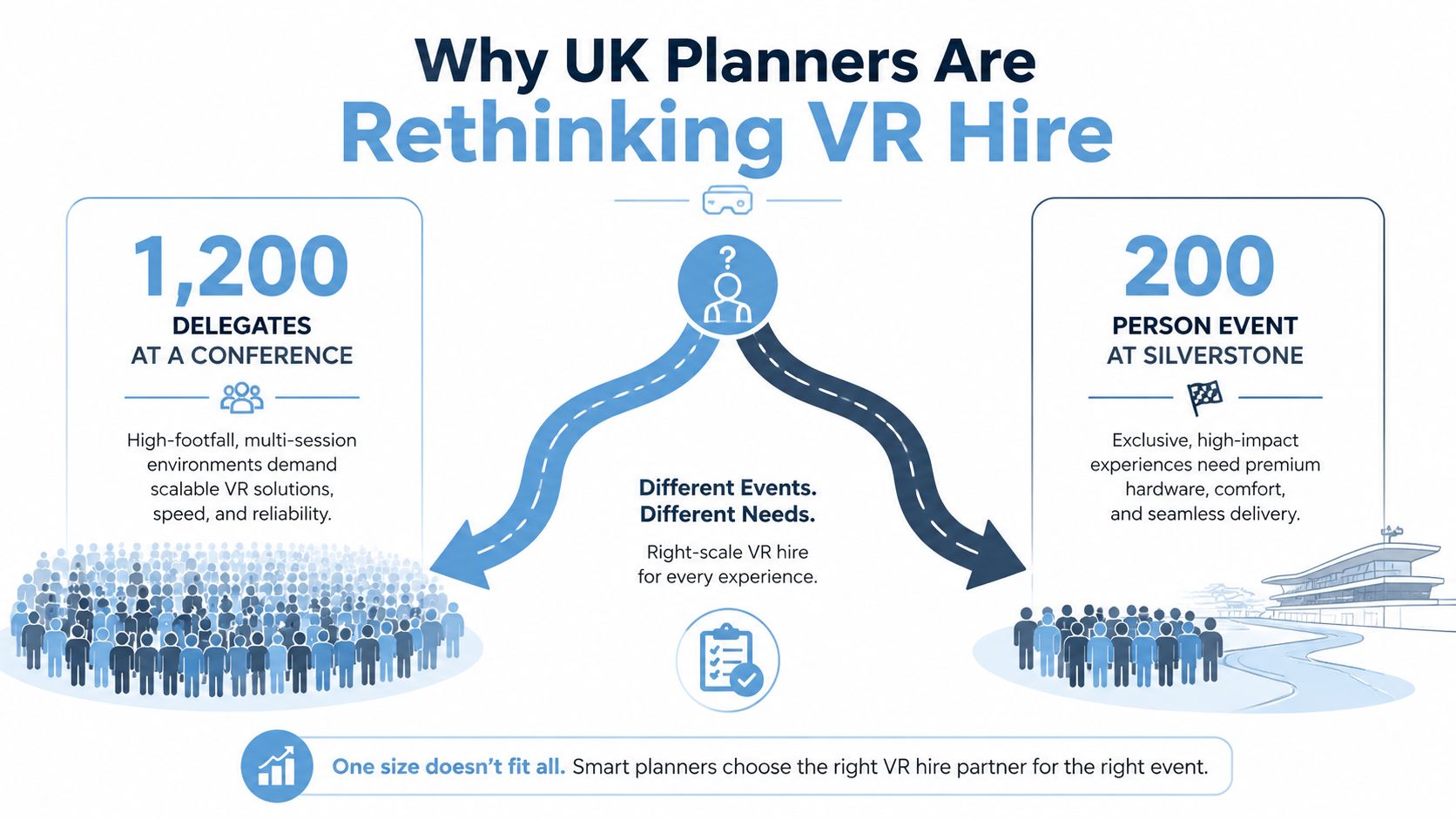
A marketing lead gets two calls in the same morning. First, a 1,200-delegate conference team at ExCeL wants a stand draw that feels fresh without blowing the floorplan. Then a smaller, 200-person experiential evening at Silverstone needs something more theatrical than a screen and a host with a microphone. Those are very different jobs, and VR only works if you treat it that way.
The strongest hires I've seen start with a business outcome, not a gadget. If the goal is to pull people off aisle traffic, create a pressable moment, or keep a VIP group occupied in a controlled space, VR can be sharp and memorable. If the goal is to fill a corner because the deck needs “innovation”, it usually underdelivers.
Practical rule: if you can't explain why VR is the right format for this audience, on this floorplan, at this time of day, don't hire it yet.
The market data matters because it proves the format isn't fringe. The UK virtual events market has moved into multi-billion-dollar territory, and the source outlook says external events accounted for 39.15% of revenue in 2024, which fits the reality that launches, exhibitions and activations still drive a lot of demand (PSW Events' market overview). That doesn't mean every event should use VR, it means planners are buying into a mature category, not a novelty toy.
That's where the cost-per-engaged-minute lens helps. A headset that produces a short queue and a lot of admiration may look busy, but if those minutes don't convert into qualified conversations, footfall, or content capture, the cost is high. The guide below keeps asking the same question, what does this activation earn each minute it holds attention?
The Three Core VR Formats You Can Actually Hire
Think of VR hire like kitchen equipment. A standalone headset is the microwave, quick to deploy and useful for a single task. A motion rig is the dishwasher, bulkier, more theatrical, and designed to do a very particular job well. A free-roam zone is the full kitchen, because once you need multiple users moving at once, the footprint and control requirements jump fast.
Standalone headsets
These are the simplest format to specify and the easiest to place on a busy stand. A modern all-in-one unit like the Meta Quest 3 is sold in the UK at £469.99 on the reference supplier page, which gives you a useful benchmark for what current-generation standalone hardware looks like (UK headset benchmark). In event use, that usually translates into fast changeovers, less cabling, and fewer setup variables.
They suit high-footfall trade show lanes, product demos and short interactive experiences where you want control and throughput. One headset won't entertain a crowd, but it can keep a lead engaged long enough for a meaningful handover to a salesperson. The catch is obvious, single-user VR can become a bottleneck if you expect it to carry serious volume.
Motion rigs
Motion rigs cover racing pods, flight seats, haptic chairs and similar theatre pieces. They are heavier, louder, and more attention-grabbing than a simple headset, which is exactly why they're useful in VIP areas, private dinners and brand moments where the audience is smaller but the optics matter. You need more crew attention, and you need the schedule to allow for individual turn-taking.
Free-roam zones
These are the shared-play setups, often used with synced tracking and a larger contained area. UK event-hire guidance commonly points to a minimum 3x3m play area for safe operation, and in practice a serious free-roam footprint grows quickly once you add queueing, operator space and spectator protection (operational guidance). This format is best for team activities, launches and social experiences that can justify the footprint.
| Format | Footprint | Typical Use Case | Crew Required |
|---|---|---|---|
| Standalone Headsets | Small, controlled station | High-footfall trade shows, short demos | Low to moderate |
| Motion Rigs | Medium, dedicated area | Brand theatre, VIP hospitality | Moderate to high |
| Free-Roam Zone | Large, contained zone | Team-building, launches, shared experience | High |
Matching VR Formats to Event Objectives
The easiest way to waste budget is to start with the kit list. The better route is to start with the outcome, then work backwards into the format. If you know whether success means dwell, lead capture, press value or internal engagement, the choice becomes much clearer.
Choose by the job, not the brochure
Standalone headsets work best where queues are useful. On a trade show floor, a line of people signals interest, and the format lets you move qualified visitors through a repeatable demo without building a full theatre. That makes them useful when your sales team wants a controlled handover, not a sprawling spectacle.
Motion rigs fit better when the event needs a focal point. A brand theatre moment, a hospitality suite or a private launch benefits from something that people can watch as well as use. The experience becomes part of the room's atmosphere, which is harder to achieve with a solitary headset on a pedestal.
Free-roam zones are strongest when the brief is social or collaborative. Team-building sessions, consumer launches and group experiences need interaction, not just immersion. They're also the most likely to disappoint if the audience is too small or too time-sensitive, because the format asks a lot from space, staffing and on-site flow.
Short test: what needs to be true at 9pm on event night for this to count as a success, and which format gets you there with the least friction?
Watch for obvious mismatches
A free-roam zone for a 40-delegate board dinner is usually overkill. A single headset for a 5,000-visitor expo can be the opposite problem, because the queue becomes the activation. The fit matters more than the novelty.
The most effective planners treat VR as one tool inside a wider event journey. Used well, it opens the conversation. Used badly, it becomes the thing people remember for the wrong reason, because they waited too long, didn't understand the controls or never got a turn.
UK Pricing Models and the Real Cost of VR Hire
VR quotes in the UK tend to look simple on page one and messy on page two. The headline number usually covers the hardware, but the cost depends on how much operational support sits around it. A single-station package can include 1 VR headset, a full game library, a professional operator, a 4-hour hire period, and safety briefings, with a quoted price of £495 on a vendor-published example (single-station benchmark).
What sits inside the quote
The pricing model usually falls into four buckets. First, there's the basic daily rental. Then there are bundled multi-station packages for busier floors. After that comes fully managed activation, where staffing and operation are central to the service. Finally, some longer residencies are structured on a revenue-share basis.
The important detail is what's excluded. Delivery, on-site setup, branded overlays, content licensing, consumables, insurance, overtime and venue-specific access can all sit outside the first figure. If the supplier is vague on these, the first quote is not your real quote.
Where budgets quietly expand
Weekend events and out-of-London venues often need extra mobilisation time, and that can change the final number quickly. A three-day conference can land materially above the single-day price once rigging, travel and crew accommodation are added. In practice, the uplift is often the thing that surprises internal stakeholders, not the hardware itself.
Budget rule: ask for the quoted cost, then ask for the operational cost of making that quote actually work at your venue.
A cost-per-engaged-minute framework is the most defensible way to compare VR against a photo booth, roaming entertainer or AR alternative. If the activation creates long dwell but poor conversion, the cost per engaged minute climbs. If it creates concentrated engagement that hands cleanly into sales conversations, the number starts to look healthier.
| Pricing Model | Typical UK Cost | What's Included | Watch For |
|---|---|---|---|
| Daily Single-Station Hire | Around £495 for the benchmark package | Headset, game library, operator, safety briefing | Time limits, extra content fees |
| Bundled Multi-Station Package | Quote-based | Multiple stations, larger staffing, coordinated setup | Queue management and space needs |
| Full-Service Managed Activation | Quote-based | Delivery, install, live ops, support | Overtime, travel, venue restrictions |
| Revenue-Share Residency | Quote-based | Longer-term operation, shared returns | Reporting terms, content rights |
Venue, Power and Connectivity Requirements
A booking should stay provisional until the venue information is complete. Wireless headsets reduce cabling, not planning. The footprint, floor conditions, power supply and network determine whether guests move through the activation smoothly or queue around technical delays.
Space and access
Allow a minimum 3x3m play area for standalone headset use, with indoor operation as the usual controlled-safety option. Suppliers may also exclude private-home use, a useful warning about the space and supervision these setups require (venue suitability guidance). Check mezzanine floor loading early, before the footprint reaches the final floor plan. Use the venue's installation requirements guidance to confirm access, loading and setup constraints alongside the supplier's technical brief.
Motion rigs need more clearance. A 2.4-metre ceiling height allows arm extension and reduces collision risk. Tethered systems require cable-managed floor zones, so show routes, barriers and carpet transitions on the deck plan before build, rather than trying to solve them once the stand is dressed.
Access can be as limiting as the play area. Confirm delivery routes, lift dimensions, storage, setup windows and the distance from unloading to the activation. At ExCeL London or Silverstone, ask about rigging restrictions, outdoor-only windows and floor loading before approving the footprint. Venue rules can change the format, not just the installation time.
Power and connectivity
Start with one dedicated 13A double socket per station, plus a separate feed for charging racks. A generator requires surge protection. Standalone headsets can often run offline, which helps when the venue network is busy or unreliable.
A hardwired 100Mbps uplink matters when cloud-rendered content or multiplayer synchronisation drives the experience. Test the network at the actual activation position, not only in the organiser's office. Pre-event device preparation and local testing reduce loading delays, tracking problems and weak onboarding (operational note).
“Wireless” describes the headset connection. It does not remove technical planning. The experience still depends on safe movement, charged devices, stable tracking and a workable guest flow.

Staffing, Health and Safety and Insurance
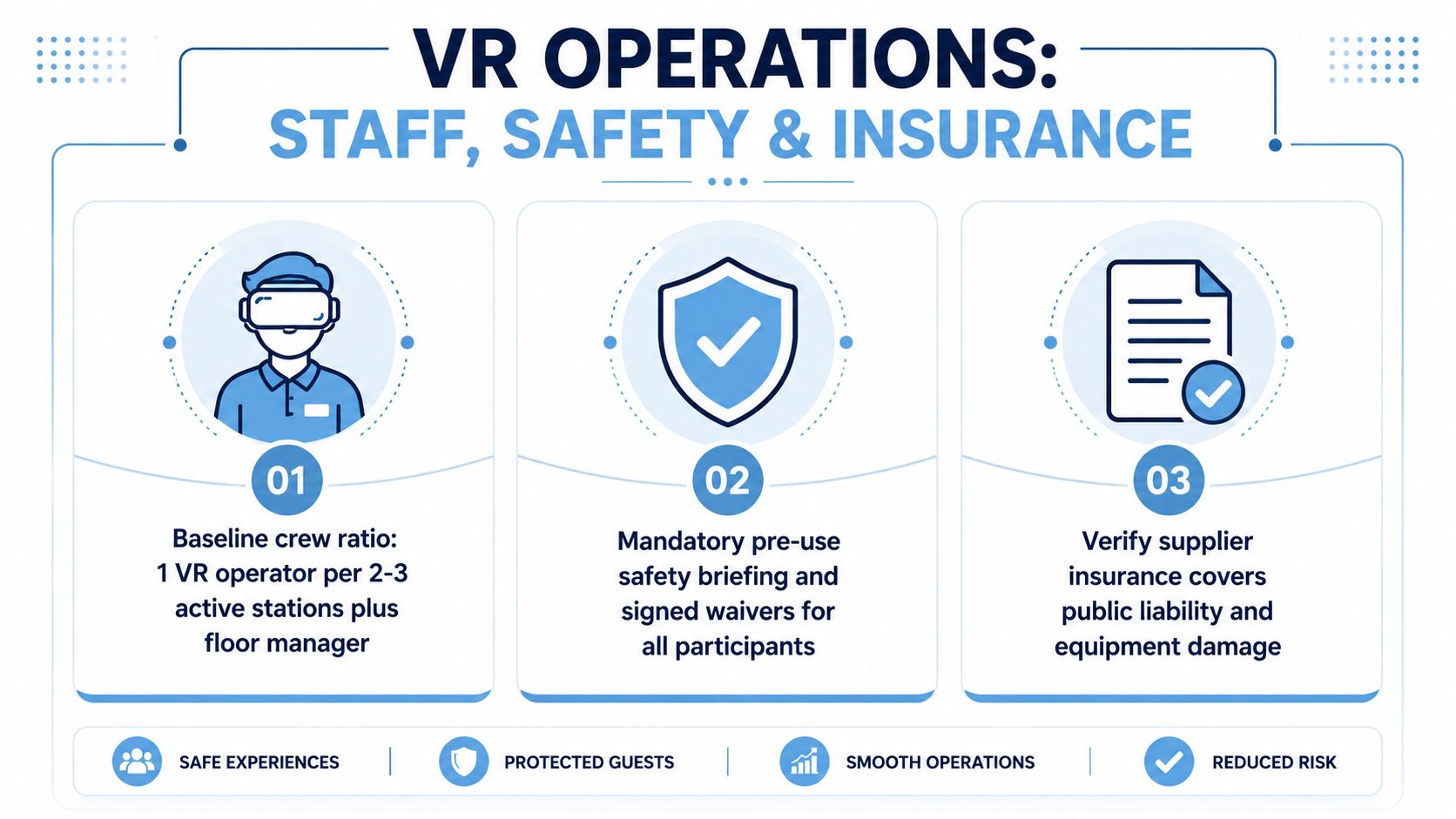
VR staffing isn't an admin line, it's the operating model. If the crew is thin, the queue gets messy, the briefing gets rushed and the guest experience drops. A practical baseline is one VR operator per two to three active stations, plus a floor marshal during busy periods, so the live area stays controlled and guests don't wander into blind spots.
Safety checks that shouldn't be skipped
For family audiences and any under-18 attendance, DBS-checked staff are the sensible minimum. Headset sanitisation before each use should be standard, not a bolt-on, and spectator barriers help keep bystanders clear of moving users. Seated simulators need chaperone rules, especially where motion is involved or guests are unfamiliar with the kit.
You also need clear warnings for epilepsy and photosensitivity, and recording notices if any on-site filming captures participants or headset footage under UK GDPR. Those notices aren't just for the supplier's file, they protect the organiser as well. This is the same discipline PSW Events applies across its event installations, where crew, logistics and H&S are handled as part of delivery rather than afterthoughts.
Insurance and operator discipline
Most venues expect £5 million public liability as a baseline, alongside the supplier's own product liability cover. The organiser and venue should be named properly where required, and the supplier should be able to show the paperwork without delay. If they can't, keep looking.
Practical insight: the best VR operators don't just start and stop the headset, they slow guests down before the experience begins.
A useful pre-event briefing is short and consistent. Tell every guest what they'll feel, how to step in and out, how to remove the headset, and what to do if they feel off balance. That one-minute script prevents a lot of the complaints that later show up in post-event debriefs.
Branding, Lead Capture and Measuring ROI
VR is easy to admire and hard to measure unless you build the measurement into the experience. The right way to think about it is simple, what did the guest do, how long did they stay, and what happened next? If you can't answer those three questions, the activation is mostly decoration.
Brand assets that actually carry over
Headset strap wraps and in-experience overlays are the most obvious brand placements, but they only help if they're visible for long enough to be remembered. Multi-user arenas are better when the brief includes social sharing, because they create a shared moment rather than a private one. Seated rigs are strongest when the downstream objective is a follow-up sales conversation, since they create a natural pause point at the end of the ride.
Lead capture should stay consent-compliant. QR hand-outs, post-experience survey links and CRM uploads are cleaner than trying to trap data inside the headset session itself. Filming inside the headset needs signage and a proper data process, otherwise you create a GDPR headache that has nothing to do with the fun part of the activation.
Measuring cost per engaged minute
The useful measure is not just how many people tried the experience, but how long they stayed engaged. A 4 to 6 minute average dwell figure is the right benchmark for thinking about time-on-task in VR, and it gives you a basis for comparing the activation with staffed demos on the same stand. Once you know the total hire cost and the number of engaged minutes, you can start defending the spend in a review.
For planners looking at lead capture mechanics in more detail, PSW Events' lead capture guidance is a sensible companion read. The point isn't to turn VR into a spreadsheet exercise, it's to make sure the memorable moment also leaves a usable trail.
Vendor Checklist and a Sample Lead Time Timeline
A polished quote can conceal the operational gaps that matter on site. Before committing, request evidence of PAT-tested hardware, public liability cover, DBS-checked operators, content licences, named on-site engineers and a documented swap-out procedure for failed units. These details affect queue continuity, guest safety and the cost of keeping the activation live.
Questions to ask before you sign
- Hardware readiness: Ask when the kit was last tested, then request the maintenance record and swap-out steps.
- Crew capability: Confirm the operator count, supervisor structure and whether staff are cleared to work with family audiences.
- Content rights: Establish who owns and licenses the experience, and whether your brand may reuse captured footage.
- Overtime and access: Put late load-in, extended live hours and venue delays into the quote, with rates stated clearly.
- Fallback plan: Ask what happens to the queue, brief and guest journey if a station fails.
The supplier should answer these points without hesitation. If the responses are vague, the first quote is not your final cost. Clarify whether replacement equipment, extra crew, storage, travel and extended access are included, because each can alter the budget after approval.
A working lead-time timeline
At twelve weeks out, lock the brief and confirm the format, audience and success measures. Arrange the venue survey next. Space, access routes, ceiling height, storage and loading restrictions will shape the equipment plan and crew requirement.
Approve content before dry-rig. The production team then has time to test the experience, apply branding and resolve technical issues before the live build. Make the load-in plan reflect restrictions already raised by the venue, including delivery windows and access limits. Live day should feel uneventful because the main risks have been reduced in advance.
Debrief properly after the event. Ask whether queues became excessive, operators were rushed, lead data was usable and the format supported the business goal. Compare the total hire cost with engaged minutes and qualified follow-up, rather than judging success by applause or photographs alone.
One serious red flag can justify walking away. A supplier that cannot explain its insurance, name its crew structure or describe the swap-out process is leaving operational risk for you to absorb.
VR earns its slot at flagship launches, training demos and crowd-pulling consumer moments. It underperforms when footfall is low, dwell budgets are tight, or a well-trained product specialist could deliver the message more efficiently. Use three questions to decide quickly. Does the audience need immersion? Is the space ready for it? Will the experience create measurable value beyond novelty?
If the answer is yes, request two quote formats, a single-station option and a multi-user package, by Friday. PSW Events supplies turnkey VR and simulator-style activations with delivery, installation, staffing and H&S support across UK venues. Visit PSW Events and ask for the format that matches your floorplan and goals.