
You’re probably looking at an event plan where the stand design is sorted, the messaging is approved, and the team is booked, but one problem remains. You still need something that stops people walking past.
That’s where batak wall hire earns its place. It isn’t just a piece of entertainment. Used properly, it gives people a reason to step onto your space, stay there, compete, talk to your staff, and remember your brand afterwards.
The difference between a Batak activation that works and one that wastes budget usually comes down to execution. Placement matters. Queue handling matters. Branding matters. Lead capture matters even more. A Batak wall can pull a crowd on its own, but the best results come when you treat it as part of the event strategy, not as an add-on.
Why a Batak Wall Elevates Your Event Experience
Most corporate events suffer from the same issue. Attendees see too many stands, too many screens, and too many sales conversations that start before they’ve got any reason to engage.
A Batak wall changes that dynamic because it gives people an immediate challenge. They don’t need a long briefing. They understand the task quickly, and the competitive element does the rest.
It creates a crowd without forcing a pitch
When one person plays, other people watch. Then they compare scores. Then someone from the team decides they can beat it. That’s the point where a passive stand becomes an active space.
At exhibitions, that matters because attention is scarce. A 2025 UK Events Industry Report noted that interactive games like Batak can boost dwell time by 35% at trade shows compared with static displays, according to this summary from Novel Events on Batak Lite hire.
That uplift only matters if you use it well. More dwell time means more chances for staff to qualify visitors, explain the offer, and move a fun interaction into a useful business conversation.
The challenge feels fair, but still competitive
Batak works because people instantly understand the objective and still feel they can improve with another go. That’s a strong format for team building, exhibition engagement, and product launches.
A useful benchmark comes from a 2015 study on elite UK athletes, which reported average hit scores of 45 to 55 targets in 60 seconds for professional rugby players, compared with 30 to 40 for amateurs in controlled testing, as recorded in the Mendeley dataset. In event terms, that gives you a natural way to frame competition. Guests can test themselves against a visible score target, even if they’re only playing for fun.
A Batak wall works best when the score matters to the audience. Give them a number to chase and they’ll stay longer.
It supports brand memory when the activation looks joined up
The game draws attention, but the surrounding presentation decides whether attendees remember your company or just the activity. Branded scoreboards, branded backdrops, and a clear visual identity make a big difference to recall. If your team is reviewing stand design at the same time, this guide on the importance of branding is worth reading because it explains why consistency matters beyond the logo itself.
A Batak wall is strongest when it does three jobs at once. It attracts, it entertains, and it gives your team a practical reason to start the right conversation.
Choosing the Right Batak Model and Package
Not every event needs the same setup. Some clients need a flagship piece for a busy exhibition aisle. Others need something more compact for an office, conference breakout area, or smaller hospitality space.
The first decision is simple. Choose the model based on space, throughput, and the kind of interaction you want.
Batak Model Comparison for Event Planners
| Feature | Batak Pro | Batak Lite |
|---|---|---|
| Best fit | High-footfall exhibitions, conferences, brand activations | Smaller spaces, office activations, tighter footprints |
| Presence | Strong visual impact and more of a crowd-puller | More compact and easier to place discreetly |
| Throughput planning | Best where you expect steady queues and repeat play | Better for lighter traffic and less public competition |
| Operational data available | Detailed published specifications and event-use metrics are available | Often marketed as compact and flexible, but less operational benchmarking is typically published |
| Venue suitability | Good for large venues such as exhibition halls and fan zones | Useful where access or floor area is more constrained |
| Branding potential | Works well with leaderboards, surrounding graphics, and competitive formats | Works well when you need a simpler branded activity in a smaller area |
When Batak Pro is the right choice
If your objective is to stop traffic and build energy around the stand, Batak Pro is usually the stronger option. It has the presence to pull attention in a noisy hall, and it suits environments where public score-chasing helps.
That’s especially true at trade shows, expos, and larger conferences where visitors are scanning for something worth stepping into. A larger-format reaction game gives them a reason to cross the aisle.
Practical rule: If your event goal is footfall first, choose the model people can spot from distance.
When a lighter-touch package makes more sense
A compact setup works well when the event isn’t driven by aisle traffic. Internal team days, office roadshows, and smaller networking events often benefit from a version that feels accessible rather than dominant.
That can also be the better route if:
- Access is restricted: Older venues and upper-floor event rooms can make equipment movement harder.
- The activity supports another feature: If Batak is one element within a wider entertainment mix, a smaller unit may fit better.
- The room needs flexibility: Some planners need quick repositioning between sessions, speakers, or breakout formats.
What to check in the hire package
Quotes can look similar on paper and still be very different in practice. Ask what’s included.
Look for clarity on:
- Delivery and collection: Who handles transport, and when do they arrive on site?
- Installation: Is setup included, and who signs off the unit as ready to use?
- Branding options: Can the activation include scoreboards, surrounding graphics, or branded panels?
- On-site support: Is the unit self-run, or does the package include trained staff?
- Venue coordination: Will the supplier check access, power, and floor plan requirements before event day?
The best package isn’t always the cheapest one. It’s the one that fits the venue, the audience, and the way you want the interaction to work.
Essential Logistics for Your Batak Wall Hire
At 8:30am, the kit is on site, the stand is built, and the first visitors are already moving through the hall. Then the crew discovers the goods lift is too tight, the nearest socket is behind a storage wall, and the queue line blocks the corner of the neighbouring stand. That is how a good activation loses trading time before the event has properly started.
Treat the logistics as part of the performance. A Batak wall that is easy to see, easy to access, and easy to run will usually hold people longer and create more usable conversations than the same unit squeezed into the wrong part of the floor. That matters if you are using interactive activity to support lead generation or wider experiential marketing activations.
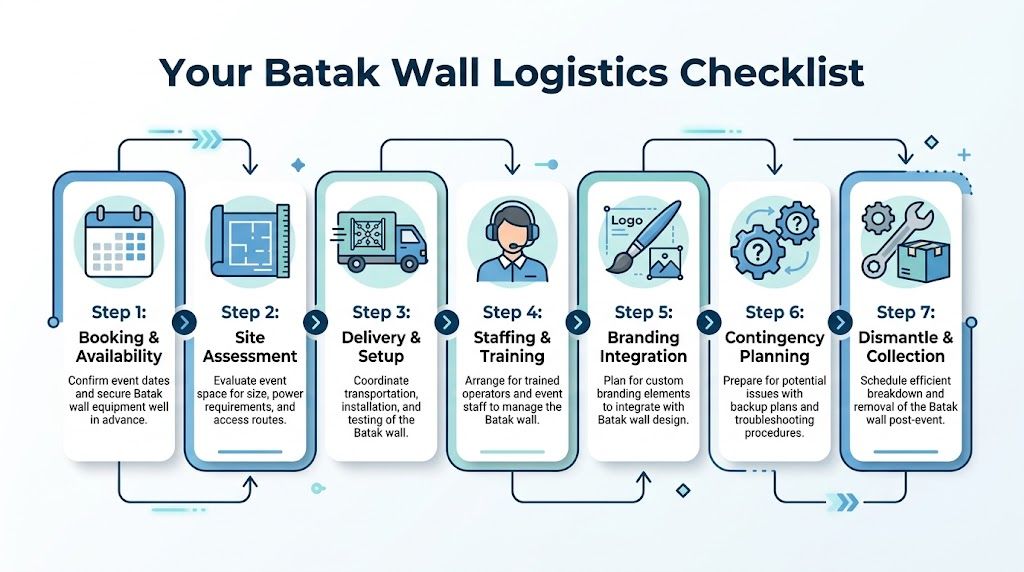
Start with operating space, not just stand space
A floorplan can show that the unit fits. It does not show how the activation behaves once people start playing.
Altitude Events specifies a minimum operational space of 3m x 2m x 2m, a minimum doorway width of 0.6m, a minimum age of 6 years, and notes that players must be able to reach the lower button bank at 1.15m high on its Batak Pro hire guidance. Those numbers are useful for technical sign-off. They are not a recommended live-event footprint.
For a corporate exhibition or conference, plan the space in three layers:
- Play zone: The area the participant needs to move freely and safely.
- Queue zone: The holding area for the next few people waiting to play.
- Watch zone: The space where spectators gather once high scores start pulling attention.
That third zone is the one planners often miss. It is also where extra dwell time starts. If spectators have room to stop without choking the aisle, the activation works harder.
Check the access route before you confirm the booking
The unit arriving on time means very little if it cannot get from the loading bay to the stand without delays.
Ask the venue and supplier to confirm:
- Loading door sizes
- Corridor widths and tight turns
- Goods lift dimensions
- Build-hour restrictions
- Vehicle wait times at the loading bay
Older venues, listed buildings, and city-centre hotels tend to be the trouble spots. Access can be perfectly manageable, but only if the supplier knows the route in advance and packs the install accordingly.
Power is simple. Cable routing is not.
The Batak wall normally runs happily from a standard mains supply, but the planning issue is rarely the socket itself. It is where that socket sits in relation to the stand, the cable run, and the public route.
Check four points before event day:
Socket position
Confirm the exact socket location on the final stand plan, not the draft plan.Exclusive or shared use
If the same outlet is feeding screens, fridges, charging lockers, or demo kit, test the setup with the supplier.Cable management
Any cable crossing a public edge needs proper routing and cover, not a last-minute tape job.Contingency
If the stand build changes late, agree who provides extension leads or alternative power access.
This is not glamorous work. It prevents the kind of ten-minute delay that costs an hour of trading once the hall opens.
Build for flow, not just visibility
A Batak wall gets attention quickly. The operational question is whether the surrounding layout turns that attention into useful interaction.
Place the unit near traffic, but outside the main stream of it. Give the operator a clear line of sight to the queue. Leave enough width for people to stop, watch a score, take a photo, and move on without clipping your meeting area or your neighbour's frontage.
If content capture matters, add a designated photo position beside the unit rather than in front of it. That keeps the game cycle moving while still giving guests a clear moment for shareable content. Pairing the activity with instant event photo delivery can also shorten the gap between participation and follow-up, which helps if you want branded images sent while the interaction is still fresh.
Site checks that protect ROI
The planners who get the best return from Batak hire usually ask operational questions early, not the day before build.
Use this pre-event checklist:
- Does the live footprint include queue and watch space, not just the unit itself?
- Can the equipment reach the stand through the actual loading route?
- Is the floor level and stable enough for repeated play all day?
- Is power close enough to avoid awkward cable runs?
- Will the queue interfere with neighbouring stands, fire routes, or speaker session entrances?
- Does the audience profile match the published player suitability guidance?
- Who has final sign-off on setup, testing, and safe operation?
A Batak wall earns its keep when people can spot it, join it, and complete a turn without friction. Good logistics make that possible. Poor logistics cut throughput, shorten dwell time, and reduce the number of real conversations the activation can produce in a day.
Maximising Engagement and Measuring Event ROI
The biggest mistake with batak wall hire is treating the game as the result. It isn’t. The game is the mechanism.
The actual result is what happens around it. More conversations. Better brand recall. More qualified leads. More time spent with the right people.

Build the activity around a business action
A Batak wall naturally attracts people, but you still need to decide what you want them to do next.
For most corporate events, that means linking the play experience to one of these actions:
- Lead capture: Enter details to log a score or claim a prize.
- Product messaging: Tie the challenge to a campaign theme or launch line.
- Team interaction: Use score tables or head-to-head formats to start conversations.
- Content creation: Encourage participants to share results, photos, or short clips.
The key is keeping the path simple. If people have to stop, think, and fill in too much before they play, you’ll kill the pace. If they can play first and then take one short next step, conversion is usually cleaner.
Use dwell time as a planning metric
Interactive activities matter because they hold attention longer than static displays. As noted earlier, a 2025 UK Events Industry Report found that interactive games like Batak can increase dwell time by 35% at trade shows. That matters because dwell time is usually the gap between “walked past” and “spoke to someone”.
For planners building wider campaigns, experiential thinking is particularly helpful. A Batak wall performs best when it sits inside a broader activation plan with clear audience goals, staffing roles, and capture points. This overview of experiential marketing activations is useful if you’re mapping the game into a larger event journey rather than treating it as a standalone attraction.
Simple tactics that improve return
The best-performing setups tend to use a few repeatable tactics.
Make the score visible
People engage faster when they know there’s a target to beat. A visible leaderboard gives bystanders a reason to watch and a reason to step forward.
Give staff a script
Your team shouldn’t ask vague questions like “Want to have a go?” They should invite with purpose. Try score challenge language, team-versus-team language, or prize language.
Add a branded follow-up moment
That could be a leaderboard photo, a short clip, or a post-play image. If fast sharing matters for your campaign, tools and workflows around instant event photo delivery can help shape how guests receive and share branded content after the interaction.
A short demonstration helps clients and venue teams understand the pace of play and the atmosphere it creates:
Measure what the activation actually did
Don’t rely on “it felt busy”. Set measurable outputs before the event starts.
Track:
- Number of players
- Queue length at peak times
- Average conversation volume after each play cycle
- Lead forms completed
- Qualified leads, not just total scans
- Staff observations on what invitation language worked
Good Batak ROI doesn’t come from counting plays alone. It comes from linking those plays to conversations and conversion.
If you can report that the game attracted the right audience, held them long enough to engage, and fed a lead capture process cleanly, the budget becomes much easier to defend.
Your On-Site Batak Wall Execution Plan
At 10:00am the stand opens, three people stop to watch the first player, and within minutes you either have a controlled crowd that feeds your sales team or a blocked aisle that venue staff want cleared. That outcome is decided by execution, not by the kit alone.
Batak is easy for guests to understand. Running it well on a live event floor takes tighter control than people expect. The aim is simple: keep play cycles short, keep sightlines open, and turn attention into usable conversations without creating friction on the stand.
Control pace at the front of the stand
A Batak wall only produces strong footfall and dwell time if the handover between players stays tight. The common failure point is dead time. One guest finishes, nobody steps in, the operator explains too much, and the crowd thins out.
A good operator keeps the next player ready before the previous score is even announced. That alone changes the feel of the activation. It keeps the aisle-facing energy up, gives passers-by a reason to stop, and protects the throughput you need if the Batak wall is there to support lead capture rather than just entertain.
That pacing also affects ROI. Faster resets mean more visible play cycles per hour. More visible play cycles mean more watchers, more invite moments, and more chances for your team to start qualified conversations.
What the on-site team should actually do
The on-site team needs clear roles from the start. If nobody owns the transition points, the activation slows down and the sales opportunity drops with it.
They should handle:
- Player flow: Line up the next participant early so the wall is rarely idle.
- Briefing: Give a short rules explanation in one sentence or two.
- Queue control: Keep the waiting line clear of stand entrances, gangways, and neighbouring exhibitors.
- Energy on the stand: Call out good scores and invite the next challenger with intent.
- Conversation handoff: Pass interested players to the brand team while attention is still high.
For busier exhibition floors, experienced promotional staff usually outperform general event crew because they understand timing, crowd reading, and handoff discipline. If you need that support, these event staffing solutions are the kind of roles that keep the activation commercially useful on the day.
Keep the footprint safe and easy to manage
The player area needs enough room for quick movement without spilling into the aisle. Cable routing needs to be tidy and protected. The unit needs to sit level on the event surface. None of this is complicated, but it does need checking before doors open, not after the first queue forms.
Use a simple pre-open checklist:
- Clear floor space around the player position
- Cables routed safely to power and taped or covered where needed
- Unit positioned securely on a flat surface
- Staff briefed on player suitability, including younger guests and shorter participants
- Venue approvals, access timing, and paperwork confirmed before live use
Insurance and PAT paperwork matter here because venue teams will often ask for them during build or before sign-off. State those requirements clearly with the supplier before event day and get the documents in advance. That avoids the usual last-minute chase during install.
Setup and breakdown need discipline
The best Batak installs are quiet, early, and tested properly. Build with enough time to position the wall, check power, confirm any branding elements, and run trial games before attendees enter the hall.
I always advise clients to agree one named person for live sign-off. That prevents the all-too-common situation where the unit is physically in place but nobody has confirmed it is ready to use.
Breakdown should follow the same standard. Stop play in time to clear the queue fairly, power the unit down correctly, remove branding materials, and coordinate collection around the venue's loading window. A tidy finish protects the equipment, keeps the venue team happy, and makes the next hire easier to deliver without extra cost or friction.
Batak Wall Hire in Action Real-World Examples
Real confidence comes from seeing how the format works in live environments. Batak has stayed relevant in the UK because it adapts well to very different event types.
One of the clearest public markers of that came in 2012, when Batak appeared at the London Olympics fan zones, where over 50,000 participants logged scores, helping establish it as a proven high-impact attraction for large public and corporate settings, as noted by Novel Events’ Batak Pro hire page.
Example one from the exhibition floor
At a B2B exhibition, the strongest use of Batak is usually as a front-of-stand engagement tool.
A typical effective format looks like this:
- A branded Batak wall placed on the aisle-facing edge of the stand
- A visible leaderboard that gives people an immediate reason to watch
- One staff member inviting players in
- One team member ready to pick up the conversation after each attempt
- A simple lead process linked to the score challenge
What tends not to work is placing the game deep inside the stand or treating it like background entertainment. Once it’s hidden, you lose the crowd-building effect. Once nobody owns the transition from game to conversation, you lose the business value.
For brands reviewing broader concepts for this kind of setup, these interactive exhibition stand ideas are a useful reference because they show how game-led features fit into stand design rather than sitting apart from it.
Example two from a corporate social event
At a company party, family day, or mixed-audience activation, the value shifts slightly. Here the game becomes a social magnet.
You’ll usually see the best results when the Batak wall sits in a visible area with room for spectators and repeat attempts. Colleagues challenge each other. Children want to watch adults try it. Senior staff join in because the game is easy to understand and doesn’t require specialist clothing or a long explanation.
What works in that setting:
- Short score challenges
- Team-versus-team contests
- Timed prize windows
- MC-style announcements of top scores
What doesn’t work:
- Overcomplicated tournament formats
- Poor crowd visibility
- No staff ownership of queue and score tracking
The most effective Batak activations don’t rely on novelty alone. They give people a simple reason to compete and a clear reason to stay involved.
That’s why the format has lasted. It’s flexible enough for trade shows, internal events, fan zones, and branded activations without needing guests to learn anything complex first.
Frequently Asked Questions About Batak Hire
Can a Batak wall be used outdoors
Yes, but only with proper planning. The unit needs a suitable power solution and protection from poor weather. Outdoor setups also need careful thought around flooring, cover, and equipment positioning so guests can play safely and staff can manage the area properly.
Is Batak wall hire suitable for children
It can be, but not for every child. Published guidance states a minimum age of 6 years, and players need to be able to reach the lower button bank. For family events, that means the activity should be supervised and clearly signed so expectations are set before children join the queue.
How long can you hire a Batak wall for
Short event-day hire is common, but longer hires can also work well for roadshows, multi-day exhibitions, and extended brand activations. The main consideration is operational support. Longer campaigns need a plan for daily setup checks, venue coordination, and how the equipment is supervised through the run.
Does it need a lot of space
Not a huge amount, but it does need the right kind of space. The equipment footprint is only part of the requirement. You also need room for the player, the next participant, and the small crowd that forms once scores start drawing attention.
Do you need a staff member on the unit all day
For low-key internal use, some clients prefer a simple self-run format. For exhibitions and public-facing events, staffed operation is usually better. It keeps throughput moving, improves queue handling, and helps turn play into useful engagement.
What’s the biggest mistake planners make
They book the game, but not the journey around it. A Batak wall works best when the invite, branding, queue, score display, and follow-up action are all planned together.
If you want a Batak activation that’s built for engagement, logistics, branding, and clean delivery, PSW Events can help plan and supply the right setup for your event. Explore the options at https://pswevents.com.