
You’re likely looking at an event brief that says something vague like “make the stand more interactive” or “add something football-themed that pulls people in”. That sounds simple until you have to justify floor space, manage venue rules, protect the brand, and prove the attraction did more than entertain a queue of existing fans.
That’s where football interactive games work well when they’re planned properly. Used badly, they become a novelty. Used well, they become a working part of the event strategy: attracting traffic, qualifying interest, extending dwell time, collecting data, and giving the sales team a reason to start a conversation that doesn’t feel forced.
In practice, the biggest difference isn’t the game itself. It’s the operating model around it. The right format, the right footprint, the right staffing, the right leaderboard logic, and the right follow-up process determine whether the activation supports the event objective or distracts from it.
Beyond the Booth What Are Football Interactive Games
At the simplest level, football interactive games are video-game logic played through physical movement. Instead of pressing buttons, guests kick, pass, react, aim, or compete against a projected challenge, digital wall, or simulated goalkeeper.
That sounds playful, and it is, but the commercial value comes from the blend of three things:
- Recognisable football behaviours such as shooting, passing, target practice, and reaction drills
- Real-time digital feedback through sensors, projections, scoreboards, and branded overlays
- Structured event outcomes such as data capture, rankings, team competition, and sponsor messaging
For a planner, that combination matters because it bridges two common event problems. First, many stands struggle to get people to stop. Second, many activations get attention but don’t convert that attention into anything measurable. Football simulators can do both if the game mechanic is linked to a business objective.
Why football works so reliably in the UK
Football carries cultural weight in a way few themes do. The first official international football match took place on 30 November 1872 between Scotland and England, ending 0-0, and the historic results archive from 1872 to 2023 records 45,315 matches, giving developers a deep statistical foundation for authentic simulations, as outlined in the CMU football history dataset project.
That heritage matters because modern simulators don’t feel random. They tap into a long-established football culture that UK audiences already understand instinctively. Whether the activation is styled as a penalty challenge, a target wall, or a tournament ladder, the format needs almost no explanation.
Football is one of the few themes that can attract senior decision-makers, junior staff, clients, and family-day guests without changing the core interaction.
What they are not
A lot of event briefs treat football games as if they’re all the same. They aren’t.
A proper interactive football setup isn’t just a TV with a console in front of it. It’s not passive entertainment, and it’s not there to fill dead space. The stronger formats combine physical action with measurement. They tell the player something useful or competitive straight away, such as shot placement, ball speed, score progression, or leaderboard ranking.
That distinction affects event performance. Passive play tends to create spectators. Active measured play creates participants, and participants are easier to engage commercially.
Where they fit best
These experiences are flexible, but they tend to work especially well in a few environments:
- Exhibitions and trade shows where stopping power and lead capture matter
- Brand activations where sponsor visuals, prizes, and social content need to sit inside the experience
- Team-building events where shared challenge is more useful than passive hospitality
- Fan zones and hospitality spaces where queues can become part of the atmosphere rather than a problem
The practical takeaway is simple. If your event needs energy, structure, and a reason for people to interact with your brand for longer than a passing glance, football interactive games can do far more than decorate the space.
A Breakdown of Football Game Mechanics and Technology
The best way to evaluate football interactive games is to ignore the marketing label and look at the mechanic. What is the player doing? What is the system measuring? And what output do you get that helps the event team run a better activation?
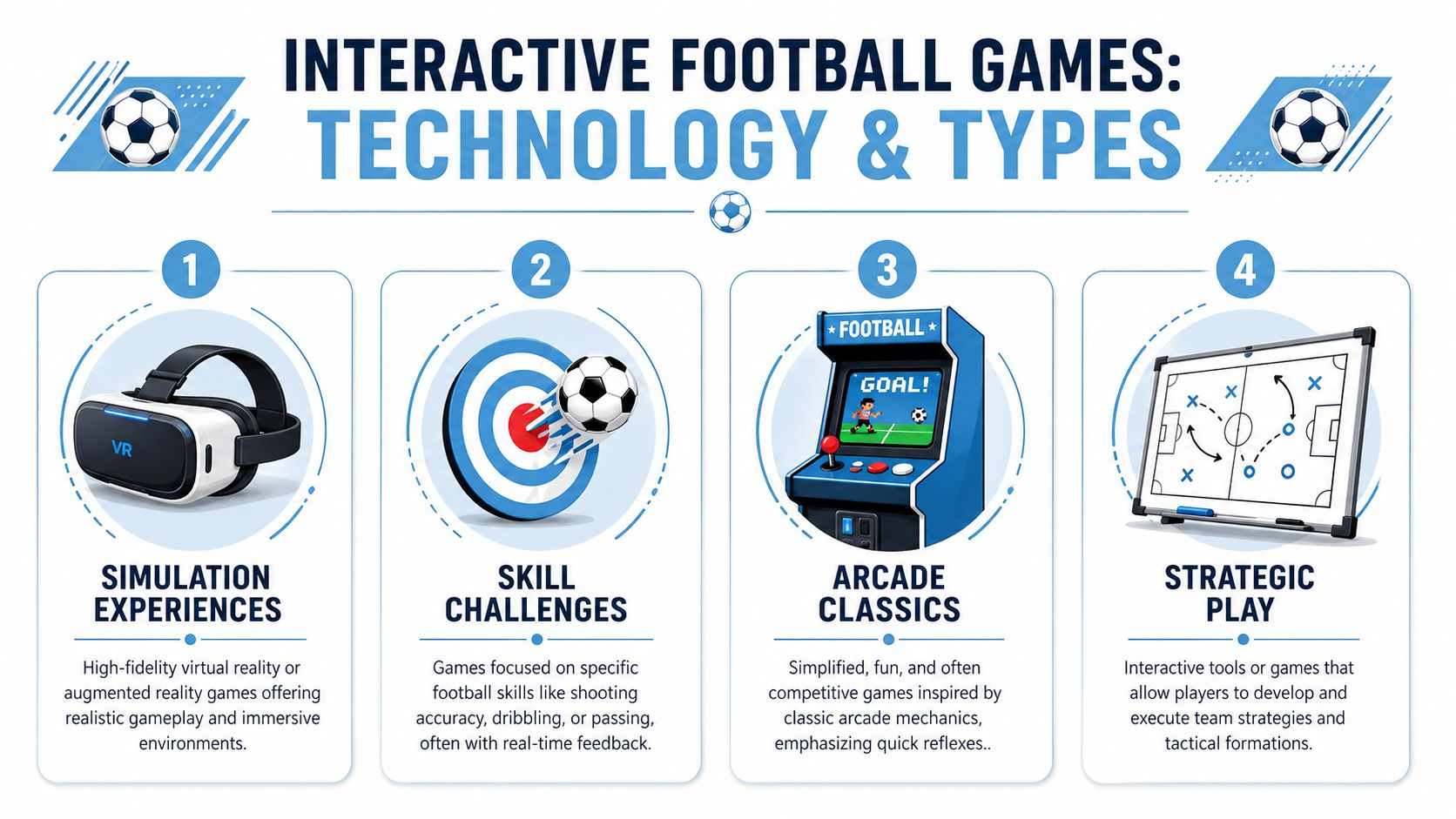
Skill challenges
This is the most common category for exhibitions and corporate events because it’s easy to understand and fast to cycle through. The player kicks at a projected target, a goal zone, or a moving challenge, and the system scores the result.
Typical formats include:
- Penalty shootouts with a simulated goalkeeper
- Target shooting where points vary by zone
- Passing drills aimed at precision rather than power
- Reaction games that force quick directional choices
These work best when throughput matters. If you’re trying to process a steady stream of attendees without slowing the stand to a halt, a concise challenge often outperforms a long-form simulation.
Simulation experiences
These lean further into immersion. Instead of a quick score challenge, the guest experiences a more realistic football scenario through projection, augmented reality, or a more layered gameplay environment.
This format suits premium hospitality, fan engagement, and launches where the brief calls for spectacle. The trade-off is practical. More immersion usually means longer play sessions, more explanation, and tighter control over the surrounding space.
Arcade-style formats
Arcade-inspired football games strip away realism and increase pace. They’re useful when the audience is broad and mixed, especially in family settings or evening networking events where guests may join mid-flow and don’t want a long briefing.
They’re often underrated because they look less serious. In reality, arcade-style mechanics can be very effective when the objective is to keep energy high and encourage repeat attempts.
Strategic play modules
Many suppliers limit their offerings. Most focus on shooting alone because it’s obvious and easy to sell. But more advanced event planners are starting to ask for tactical play, especially when the brief is team cohesion rather than simple footfall.
One of the more interesting underused options is diagonal play. According to the analysis in Diagonality football’s hidden dimension of play, implementing a tactical mode around diagonal options can expand attacking routes by up to 60% geometrically, and the same source notes that 75% of UK marketing teams report insufficient tactical depth in current event simulator hires.
Practical rule: If the event message is collaboration, decision-making, or strategy, don’t default to “hardest shot wins”. Use a format that rewards communication and choices, not just power.
What the technology actually does
The hardware matters because it determines whether the game feels credible. According to the technical overview from Jamma Park’s simulation football systems guide, top-tier football walls use high-speed infrared sensors with 98% accuracy in ball impact detection and latency under 50ms. Advanced simulators also use augmented reality high-speed cameras capturing 240fps to track ball speed up to 100km/h with ±1° precision, with goalkeeper logic trained on 10,000+ EFL match clips.
For planners, those figures aren’t there for technical bragging rights. They answer practical questions:
| Consideration | Why it matters on site |
|---|---|
| Detection accuracy | Players trust the result. That reduces disputes and keeps queues moving. |
| Low latency | The action feels responsive, which makes the game look premium rather than gimmicky. |
| Speed and angle tracking | You can build meaningful scoring formats, not just basic hit-or-miss games. |
| AI goalkeeper behaviour | The challenge feels less repetitive across repeated attempts. |
What doesn’t work is overcomplicating the experience in the wrong environment. A highly technical simulator on a noisy exhibition aisle can underperform if the guest needs too much explanation. On the other hand, a simplistic target wall can feel thin at a premium brand launch where guests expect something more polished.
The right choice depends on throughput, message, staffing, and available space. The mechanic should fit the objective, not the other way round.
Putting Interactive Games to Work in Your Event Strategy
The most useful way to think about football interactive games is not by product category but by event job. What are you asking the activation to do?
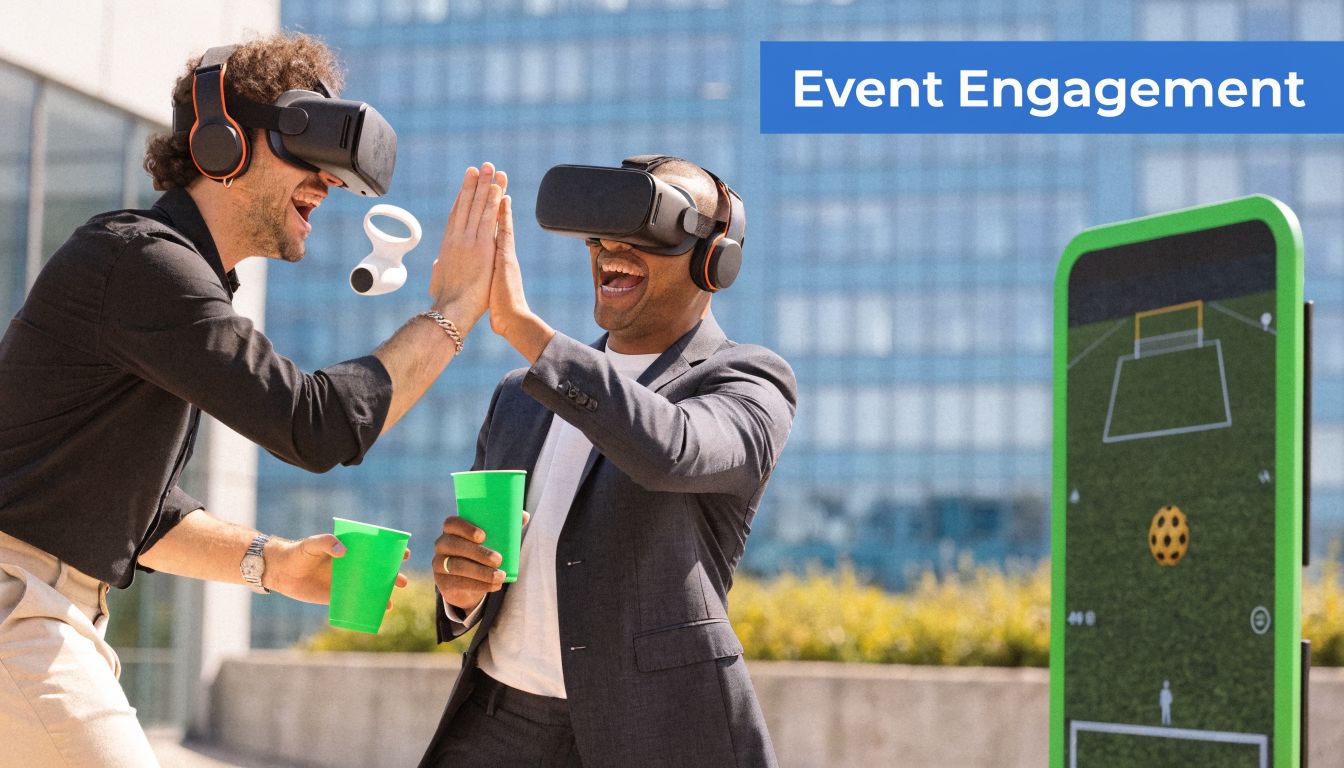
Trade show stand that needs lead capture
At an exhibition, the football game should do more than create a crowd. The crowd has to become a pipeline for conversations.
A strong setup is a branded “Top Scorer” challenge with digital ranking. The attendee steps up, takes a small number of attempts, sees their name on a live leaderboard, and is then invited to enter details to remain eligible for the end-of-day or end-of-show prize. That sequence feels natural because the registration is tied to a visible outcome.
The mistake many exhibitors make is placing the game too far from the conversation area. If the simulator sits on one side and the sales team sits on the other, you create two separate zones instead of one joined-up experience. The game needs to feed directly into the stand journey, much like the thinking behind broader experiential marketing activations.
Family fun day that needs participation across age groups
A family event has a different requirement. You don’t want a format that rewards only the strongest or most football-confident player. You want repeatable participation with a low barrier to entry.
Collaborative passing or accuracy games tend to work better here than pure power challenges. Teams can accumulate points together, children can join without feeling exposed, and parents don’t stand on the side as spectators. The atmosphere becomes collective rather than competitive in a narrow sense.
What works in these settings is flexibility. You need game modes that can be softened or sharpened depending on who steps up next.
Product launch that needs energy and social buzz
Launch events often need movement in the room. Not chaos, but momentum.
A fast reaction wall or pressure-based shooting sequence can do that well because people understand the challenge in seconds, spectators can follow the action, and branded visuals remain visible throughout. If the launch theme has anything to do with speed, precision, performance, or teamwork, football mechanics can reinforce the message without feeling heavy-handed.
If a launch brief asks for “something immersive”, ask what kind of immersion is actually useful. Sometimes the right answer is visual pace and audience visibility, not a headset that isolates the player from the room.
Team-building that needs more than a laugh
Advanced tactical modes deserve more attention. Most hired football setups reduce the activity to striking a ball. That’s fine for casual competition, but weaker for teams that need to work together.
A more thoughtful approach uses staged rounds. Start with individual accuracy, move into paired passing or reaction work, then finish with a tactical module that rewards diagonal movement and decision-making. That kind of sequence gives the session a shape. It also answers a growing complaint in the market that football hires often lack tactical depth.
When football interactive games are mapped to the event objective like this, they stop being “entertainment on the side” and become part of the programme design.
Measuring the ROI The Tangible Benefits of Interactive Play
The commercial case for football interactive games isn’t that people enjoy them. Of course they do. The case is that they can produce measurable event outcomes when the activation is branded, staffed properly, and connected to a capture process.
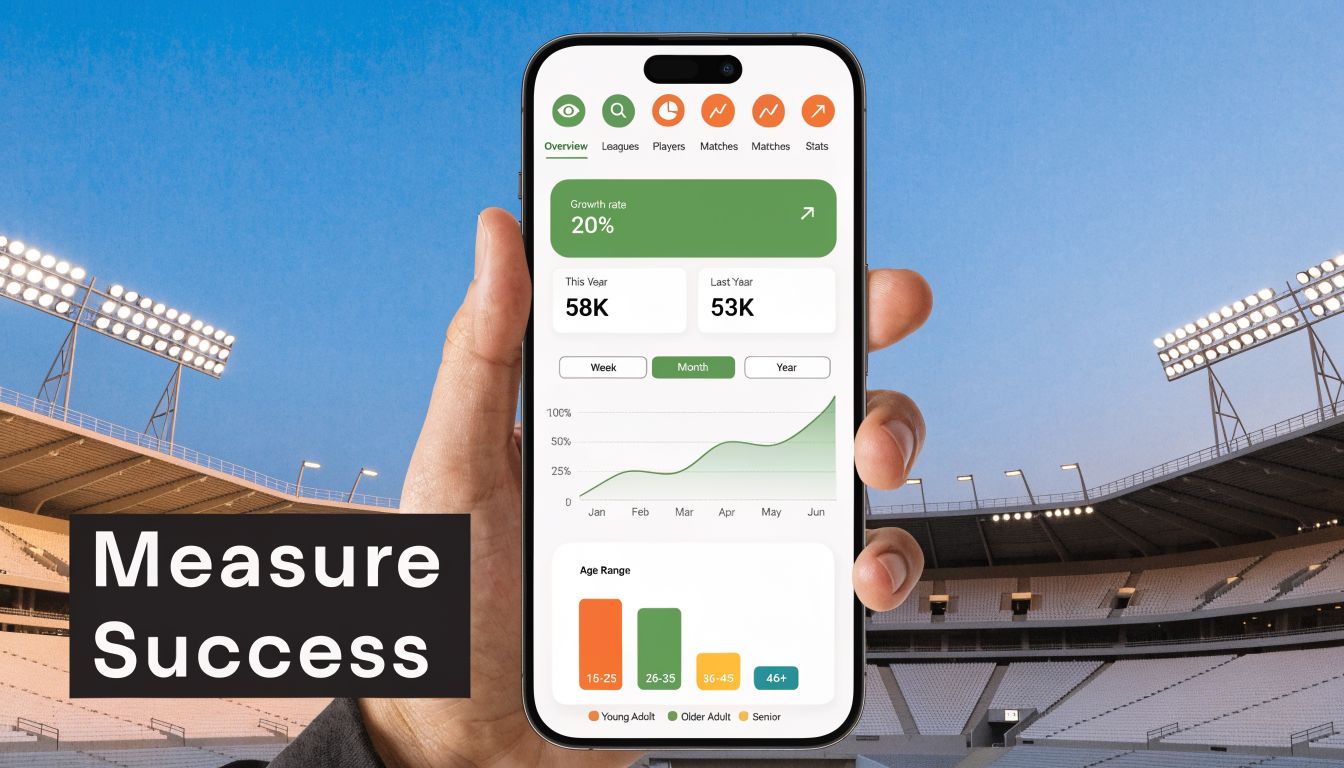
According to PSW Events’ ROI guidance for exhibition activations, interactive attractions such as football simulators have shown 3x higher footfall and a 28% lead conversion uplift when branded. The same source notes that a dwell time over 15 minutes is a critical benchmark, yet 82% of trade show organisers currently lack a benchmark for dwell time.
Those numbers matter because they move the conversation away from taste and towards performance. If a planner has to defend budget internally, “people liked it” won’t carry much weight. “It increased qualified stand interaction and gave us a measurable capture mechanism” will.
The KPI framework that matters on site
A football activation usually earns its keep through a small group of practical metrics:
- Footfall quality. Not just how many people approached, but whether the right audience stopped.
- Dwell time. How long they stayed in the branded environment.
- Lead capture rate. How many participants gave usable details or triggered a follow-up conversation.
- Engagement depth. Whether they took one shot and left, or stayed to compare scores, ask questions, and involve colleagues.
- Brand recall. Whether the game mechanics and visuals reinforced the campaign rather than distracting from it.
None of these needs to be theoretical. Leaderboards, check-in forms, prize mechanics, and staff notes can all contribute to the picture.
Why branded play outperforms generic play
A generic simulator may still attract attention, but it leaves value on the table. Branded overlays, scoring screens, naming conventions, and prize logic convert play into a branded experience rather than a football break inside your stand.
That distinction is easy to spot in the results. A plain game attracts casual interest. A branded challenge creates a reason to remember who hosted it.
Here’s a useful example of the kind of format that tends to work in the wild:
What to report after the event
The post-event report doesn’t need to be bloated. It does need to connect the game to the commercial objective.
A useful reporting summary usually covers:
| Measure | What to look for |
|---|---|
| Participation volume | Total plays, peak periods, and queue patterns |
| Lead capture | Registrations, opt-ins, and prize-entry completions |
| Sales interaction | Conversations triggered after play |
| Audience profile | Whether participants matched the target visitor type |
| Operational notes | Downtime, queue handling, and staffing effectiveness |
Key takeaway: The game isn’t the ROI. The system around the game is the ROI.
That’s why some activations look busy but achieve little, while others generate usable data and better sales conversations from the same basic football mechanic.
The Event Planner's Playbook Logistics and Setup
A football simulator can be easy to buy and difficult to deliver if the logistics are handled casually. Most on-site problems don’t come from the game itself. They come from late-stage surprises around access, power, branding approvals, staffing, or safety paperwork.
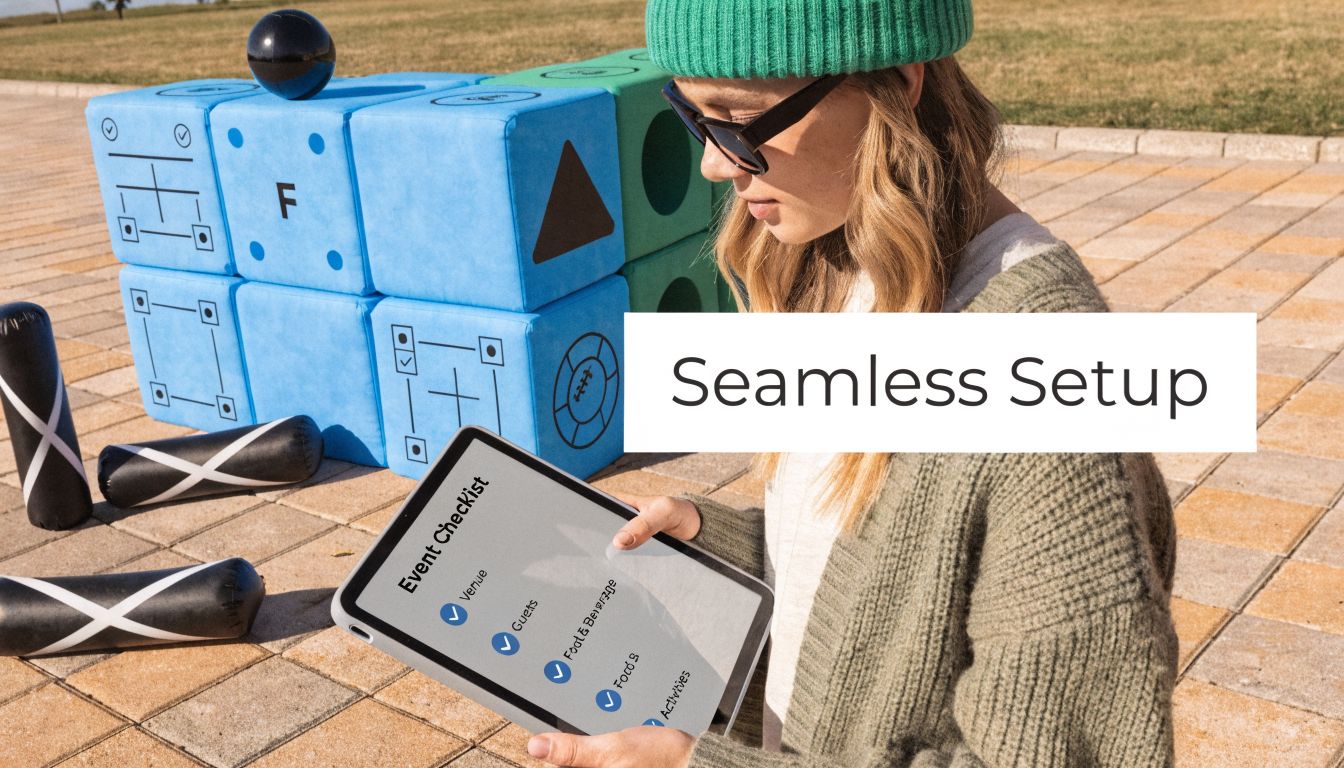
Start with venue reality
The first check is always the room, not the game brochure. Some football interactive games need a clear run-up and audience space. Others need a controlled frontage so passers-by don’t cross the play zone. If you’re still confirming the host site, it helps to review spaces that already suit active formats, especially when you need room for circulation, spectators, and hospitality together. Venue round-ups that let you book private event venues can be useful at shortlist stage because they help you visualise whether the activation belongs in a bar setting, a private room, or a larger event floor.
Then ask practical questions early:
- How much usable floor space is there? Ignore the theoretical footprint. Include queueing and viewing room.
- What’s the ceiling height? Projection sightlines and safe ball flight both matter.
- How close are power points and service routes? Long cable runs can create avoidable issues.
- What are the access windows? Build times often look fine on paper until you factor in venue restrictions.
Know the technical brief before sign-off
Not every unit has the same requirements. Some are self-contained. Others need more careful positioning and testing.
A supplier should be able to tell you, in plain terms:
| Item | What you need to confirm |
|---|---|
| Power | Single or multiple feeds, and whether the venue supply is close by |
| Load-in | Van-to-stand route, lift access, stairs, and timed access slots |
| Set-up window | How long installation and calibration actually take |
| De-rig | How quickly the kit can clear once the event closes |
| Branding points | Screens, side panels, scoreboards, staff clothing, and data-capture forms |
If those answers come back vague, expect friction later.
Staffing and flow planning
A football game rarely runs itself in a commercial environment. Even when the technology is simple, someone needs to invite players in, explain the challenge, manage the queue, and hand the participant across to the sales or brand team.
The smoothest setups usually assign clear roles:
- Host role to pull in traffic and explain the challenge
- Game operator to manage resets, scoring, and pace
- Brand or sales contact to take the conversation forward after play
That handover is where a lot of value is won or lost. Without it, the activation can stay busy but commercially disconnected.
A queue is only useful if it’s organised. An unmanaged queue blocks the stand, frustrates delegates, and hides your message behind the crowd.
Health and safety is not optional
This is the area where planners should be firm. Ask for the risk assessment, method statement, insurance confirmation, and any site-specific control measures before the event goes live. If you need a reference point on the kind of detail to expect, this guide to a football simulator risk assessment is a useful benchmark.
Public liability cover matters too. The standard many planners expect is £10 million public liability insurance, and that due diligence should happen before final sign-off, not during venue paperwork week.
Also check the practical safety controls. Soft-impact areas, sensible ball management, safe spacing, cable protection, and clear operator supervision all matter more than flashy features.
Branding that actually helps
The temptation is to put the logo everywhere and call it done. Better branding is selective. Use the challenge title, scoreboard, entry screen, and prize mechanic to reinforce the campaign. Physical branding should support wayfinding and photography, not clutter the play area.
Done well, the setup feels coherent. Done badly, it feels like a hired game with a banner next to it.
How to Choose and Book a Turnkey Supplier
When planners compare suppliers, they often focus first on catalogue range. That’s understandable, but it’s rarely the deciding factor on site. The more important question is whether the supplier can turn a football game into a dependable event operation.
What to test in supplier conversations
A strong supplier discussion should cover more than availability and price. Listen for whether the team can answer operational questions without padding.
Look for evidence in these areas:
- Venue experience. They should understand the realities of major UK venues and the paperwork that comes with them.
- Game suitability. They should recommend a format based on objective, not just what’s easiest to sell.
- Brand integration. They should understand how screens, scoring, and registration align with your campaign.
- On-site delivery. They should be clear about who installs, who staffs, who troubleshoots, and who owns the running order.
- Compliance. They should be comfortable supplying risk and insurance documentation without hesitation.
A broad games portfolio can help because it shows flexibility. For example, suppliers with a wider UK games rental range are often better placed to match the football format to the audience profile rather than forcing one stock item into every brief.
What good answers sound like
The strongest suppliers usually speak in trade-offs, not slogans.
They’ll tell you when a high-throughput target game is better than a more immersive simulator. They’ll explain when a leaderboard helps and when it slows the stand. They’ll flag if your chosen venue layout creates a queue bottleneck. They’ll ask who owns lead follow-up after the event.
That’s what you want. Useful friction early is better than expensive improvisation later.
A simple decision filter
If you’re reducing a shortlist, use this filter:
| Question | Why it matters |
|---|---|
| Can they adapt the game to the event objective? | Prevents a one-size-fits-all setup |
| Can they handle branding and data flow? | Turns play into measurable value |
| Can they manage install, staffing, and de-rig? | Reduces stress on your internal team |
| Can they satisfy venue compliance requirements? | Avoids last-minute approval issues |
| Can they explain what success looks like? | Shows they understand the event commercially |
Choose the supplier that talks most clearly about operations and outcomes, not the one with the noisiest product list.
What booking should look like
A good booking process is orderly. You should expect a proposal that defines the game format, footprint, power assumptions, branding scope, staffing plan, timing, and compliance responsibilities. If any of those remain vague, the proposal is not ready.
The best partnerships feel turnkey because each stage has an owner. The planner doesn’t end up chasing artwork specs one day, risk paperwork the next, and on-site staffing answers the day after that. That joined-up delivery is what turns football interactive games from an appealing idea into a reliable event asset.
Frequently Asked Questions About Football Game Hire
How much does football simulator hire usually cost
It depends on the format, hire duration, branding level, staffing requirement, and venue logistics. A simple exhibition challenge and a fully branded staffed simulator for a premium activation are very different jobs. The sensible way to compare quotes is to ask what’s included in delivery, installation, operation, branding, and paperwork rather than judging the headline number alone.
How much branding is actually possible
Usually more than planners expect. The strongest options tend to be digital rather than purely physical. Challenge names, score screens, leaderboard displays, registration forms, and prize messaging often do more work than a printed panel alone. Ask to see exactly which elements can be branded before sign-off.
What’s normally included in a standard hire package
That varies by supplier, but a proper package should be clear about the equipment provided, delivery and collection, set-up and de-rig responsibilities, on-site staffing if required, and health and safety documentation. If anything sounds implied rather than confirmed, ask for it in writing.
How far in advance should I book
Earlier is better, especially for busy exhibition periods, major sporting windows, and branded builds that need artwork approval. If the event is at a venue with strict access rules, early booking also gives more time for paperwork and site coordination. Last-minute hires are possible in some cases, but the choice of format and branding options may narrow.
Are football interactive games only suitable for football fans
No. The strongest event formats don’t require specialist knowledge. Guests understand “aim here”, “beat the keeper”, or “score more than your colleague” instantly. That broad accessibility is one reason these games work well across exhibitions, team-building events, family days, and hospitality settings.
What should I ask a supplier before confirming
Ask about footprint, power, access, staffing, queue management, branding scope, risk documentation, insurance, and post-event reporting. Also ask what they’d change about your brief. A supplier who can improve the plan is usually more valuable than one who says yes to everything.
If you’re planning football interactive games for an exhibition, launch, hospitality event, or internal team day, the key is to treat the game as part of the event system. Match the mechanic to the objective, design the participant journey properly, and insist on clear logistics from the outset. That’s what turns a popular attraction into a commercially useful one.