
You can see the problem from ten metres away. It's mid-afternoon at ExCeL. The aisle is packed, scanners are chirping, a racing rig has drawn a ring of onlookers, and the stand team is pleased because it feels busy.
Then you ask what happened on the stand.
Who stopped because they're in market now. Who stayed long enough to understand the offer. Which conversations moved beyond polite chat. Whether anyone captured consent properly. Whether sales will know who to call first tomorrow morning. Very often, nobody can answer cleanly.
That gap is where experiential marketing for events either earns its budget or wastes it. In the UK market, where Google still accounts for more than 90% of all general search queries according to the CMA's 2025 decision on Google's search services via Statista's UK search market reference, event teams also need their thinking and content to be easy to find on UK search engines. But search visibility is only the front door. On the show floor, the job is to turn attention into data, and data into follow-up that sales can use.
Why Most Busy Stands Still Underperform
A crowded stand can hide weak performance.
I've seen shell schemes with a decent lightbox, a bowl of sweets, two branded plinths and a giveaway queue that looks promising from the aisle. Staff smile, hand things out, and scan a few badges. By the end of the day the team says traffic was strong, yet the sales director leaves unconvinced because the lead list is vague, duplicated or impossible to prioritise.
Activity is not the same as progress
The recurring failure pattern is usually simple:
- The stand is built for visibility, not interaction. People glance, pause, then move on because there's nothing to do.
- The giveaway becomes the whole proposition. Visitors remember the free item, not the product.
- Lead capture sits outside the experience. Staff try to collect details after the moment has already gone cold.
- Nobody qualifies intent. A student, competitor and ready-to-buy prospect all end up in the same export.
- Follow-up is left to chance. Notes live on paper, in someone's phone, or nowhere at all.
That's why a busy floor can still produce weak outcomes. The stand looked alive, but it behaved like an expensive billboard.
What the better teams do differently
Strong experiential work doesn't start with “how do we look bigger?” It starts with “what do we want a visitor to do, feel and tell us?” That shift changes the build, the staffing plan and the capture method.
A stand earns its keep when dwell time leads to a meaningful interaction, and that interaction leads to a usable next step.
At producer level, that means designing moments that slow people down without trapping them. A simulator, a live demo pod, a tactile product test, a timed challenge, a consult station, even a well-run tasting counter. Each one gives staff a reason to start a real conversation and a visitor a reason to stay.
If you're benchmarking layouts and visitor flow beyond the UK market, looking at how firms approach exhibition stands Australia can be useful because the good examples tend to solve the same problem. They pull people off the aisle and into a defined interaction, rather than relying on branding alone.
The floor test that matters
Ask three blunt questions before sign-off:
- What makes someone stop?
- What makes them stay?
- What makes them give permission for the next contact?
If the answer to all three is “the staff will handle it”, the stand is undercooked.
What Experiential Marketing for Events Actually Means
Experiential marketing for events isn't just “something fun on a stand”. It's a live interaction designed to make the audience participate, remember the brand, and leave a useful signal behind.
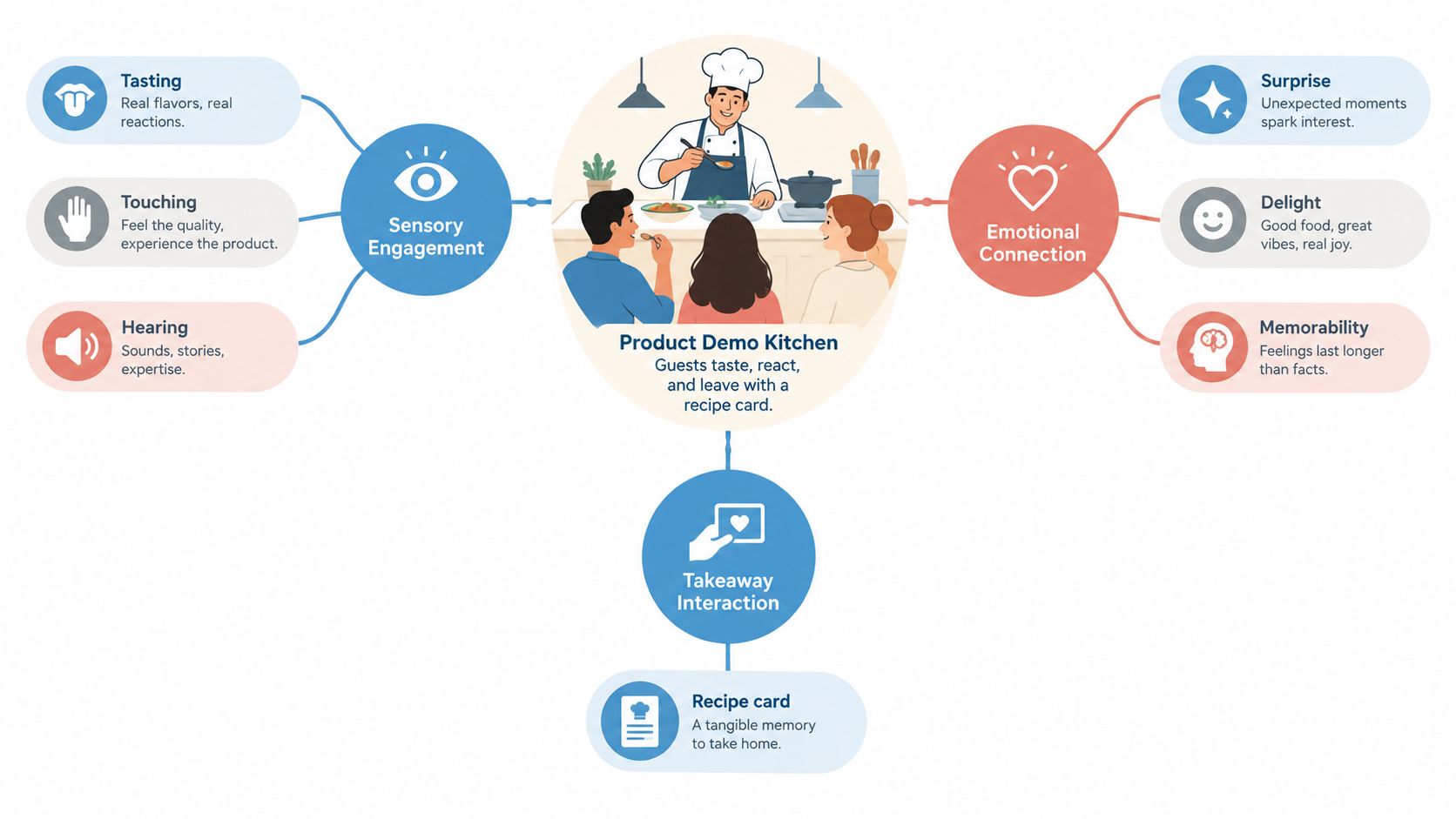
A practical way to think about it is a product demo kitchen. Guests don't just look at packaging on a shelf. They taste something, react to it, ask questions, watch how it's made, and leave with a recipe card. The brand becomes tangible because the audience did something with it.
The three working parts
That kitchen analogy holds up because most effective activations are built from three linked parts.
Sensory engagement
People touch, test, taste, hear, drive, throw, compare or build something. In B2B, that might be a live software walk-through or a hardware test station. In consumer work, it could be sampling, gaming or a branded challenge.
Emotional connection
The experience needs a feeling attached to it. Surprise, competition, satisfaction, curiosity, pride. Not sentimentality for its own sake. A reaction that makes the moment stick.
Takeaway interaction
Visitors need something that travels beyond the stand. Sometimes that's literal, such as a printed result, a branded clip, a photo, or a product sample. Sometimes it's digital, such as a booked demo, an emailed spec sheet, or a follow-up offer.
Where teams get muddled
Experiential is not the same thing as buying sponsorship rights. Sponsorship gives you access, placement and association. It doesn't guarantee participation.
It's also not the same as event marketing in the broad sense. Event marketing includes the whole effort around attendance, promotion, registration and communications. Experiential is the part where the audience actively engages with the brand in real time.
For a concise backgrounder that aligns with this distinction, PSW's explainer on what experiential marketing is is a useful reference point.
Practical rule: if the attendee can walk past, understand the message instantly, and never do anything with the brand, it's probably branding, not experiential.
A lot of planners also benefit from reviewing examples of unforgettable experiential marketing campaigns because the better ones make the interaction mechanic obvious. You can usually tell within seconds what the visitor is meant to do.
Why the UK Market Is the Right Place to Invest
The UK isn't a side market for live experience. It's a large, structured events economy, and the budget signals have been moving in the right direction for teams that can prove value.
In Q1 2024, events and experiences grew by 23.1% year on year, up from 15.9% in the prior period, and the Institute of Practitioners in Advertising described it as the fastest expansion in the 11-year history of the series. The same Bellwether coverage reported that 32% of UK marketers increased event budgets while 9% reported cuts, producing a net balance of +23% according to the IPA Bellwether coverage summarised by the IPM.
That matters because it shows experiential isn't being treated as decoration around an event plan. It's getting its own line of investment.
The size of the live economy matters
The broader platform underneath that spend is substantial. A UK industry factsheet estimates the UK events sector at £42 billion, supporting 570,000 full-time jobs, with more than 85 million event attendees and over 10,000 venues nationwide. The same factsheet breaks out £19.9 billion for conferences and meetings and £11 billion for exhibitions and trade fairs. It also cites £171.9 million in UK brand experience budgets in 2015 to 2016, including £81.4 million in London alone, according to the UK event industry statistics factsheet from Liveforce.
What that means on the ground
For planners, the implication is straightforward:
- Exhibition environments are crowded. Attention has to be earned, not assumed.
- Audiences are still physically present at scale. That supports activations that need live participation.
- Budgets are real enough to justify specialist thinking. Experiential shouldn't be buried inside generic event operations.
Consumer and B2B work still behave differently. A fan-zone activation at Silverstone has different success criteria from a manufacturing stand at the NEC or a software launch at ExCeL. But both sit inside a market where brands clearly believe in face-to-face interaction.
UK Live Events Market Snapshot
| Indicator | Cost / Value / Figure |
|---|---|
| UK events sector value | £42 billion |
| Full-time jobs supported | 570,000 |
| Annual event attendees | More than 85 million |
| Venue count nationwide | Over 10,000 |
| Conferences and meetings segment | £19.9 billion |
| Exhibitions and trade fairs segment | £11 billion |
| UK brand experience budgets | £171.9 million |
| London share of brand experience budgets | £81.4 million |
For UK teams planning against Google-first discovery, this is also why event content deserves proper optimisation. The search market is highly concentrated. StatCounter reported 91.47% all-platform UK search share for Google in April 2026, with Bing at 5.88% and Yahoo! at 1.37%, as summarised by Wolfestone's UK search engine market overview.
A Four-Stage Planning Framework for Live Activations
Most weak activations fail before anyone arrives on site. The concept gets signed off before the team has agreed who the audience is, what the visitor journey looks like, and how the data will move after the event.
A planning framework fixes that, but only if it behaves like a loop. Each activation should feed the next one.
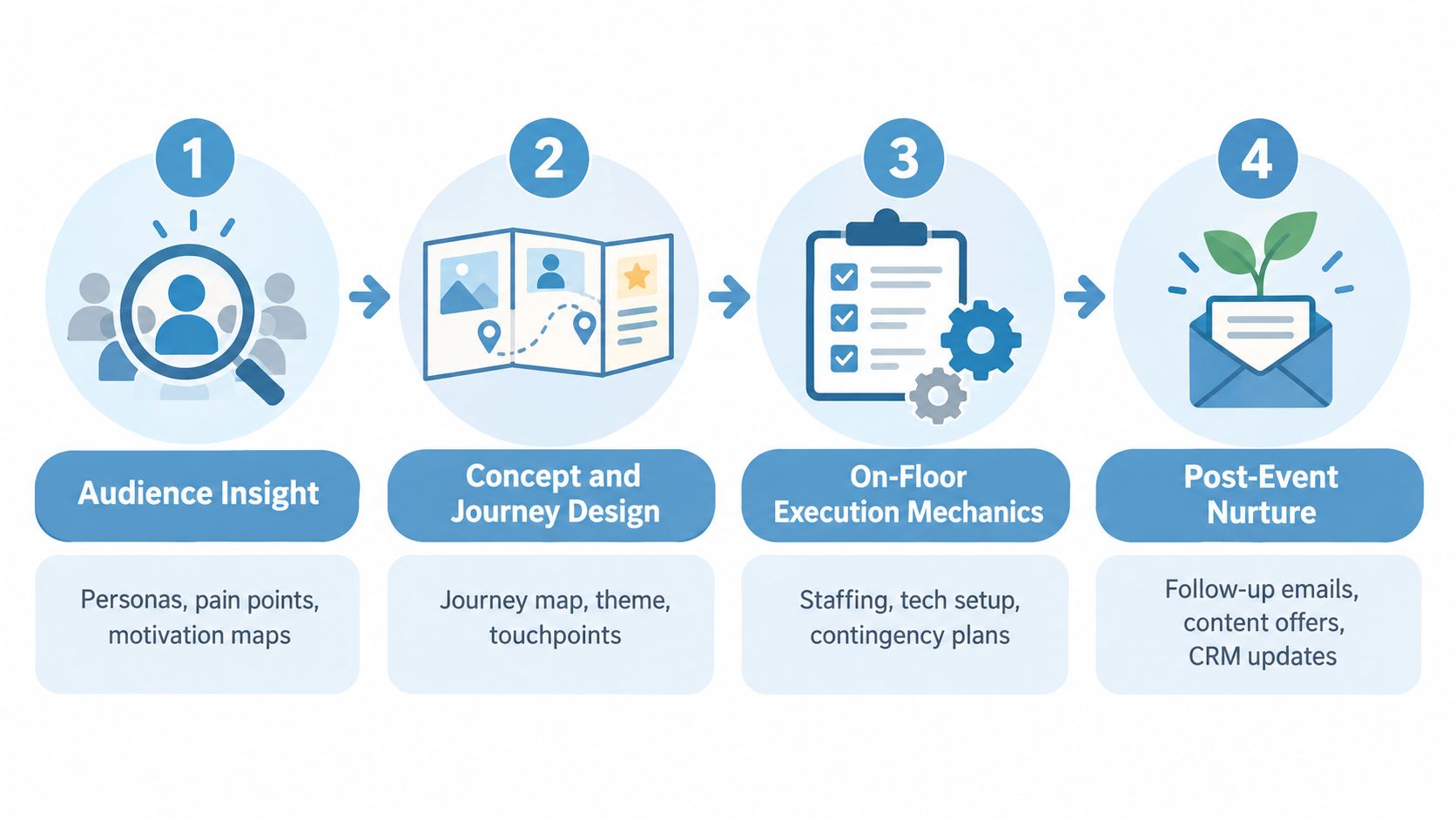
Stage one: audience insight
Start with a persona map that goes beyond job title or age band. What does this person want from the event. Why would they stop. What are they wary of. What would make them happy to opt in.
Useful working documents include:
- A motivation map that separates curiosity visitors from active buyers
- A pain-point sheet for staff talking tracks
- A priority list of who must be captured on site versus who can be nurtured later
If you can't describe why your best-fit attendee would spend time with you, the creative idea is still too early.
Stage two: concept and journey design
Now build the activation around the audience, not around the prop.
Sketch the stand or space as a storyboard. Mark the stop point, the engagement moment, the capture point and the exit route. Teams decide whether the experience is open flow, timed, host-led or self-guided.
A useful strategic companion here is PSW's guide to brand activation strategy, particularly when you need to align creative mechanics with a wider campaign instead of treating the stand as a separate world.
Stage three: on-floor execution mechanics
This is the unglamorous part that decides whether the activation works.
You need a build matrix, staffing matrix, technical checklist, reset timings, queue plan, accessibility check, consumables list and contingency plan. At Wembley or ExCeL, where footfall surges can change the mood of a stand in minutes, poor reset discipline can kill a good concept.
If the queue forms faster than the interaction clears, your “popular feature” becomes a blockage.
Pressure-test the live mechanics with hard questions:
- Where does the conversation start?
- Who records intent?
- What happens when three people arrive at once?
- What can fail without collapsing the whole experience?
Stage four: post-event nurture
The follow-up sequence should be written before the build starts. That sequence can include same-day thank-you emails, sales routing, content offers, booked callbacks and a 30-60-90 day nurture track.
The activation's design reveals whether it functions as theatre or as a commercial tool.
Choosing the Right Channels and Interactive Formats
There isn't one correct experiential format. There's only a better fit between audience, venue, budget tolerance and the action you want next.
A good rule is to start with the KPI and work backwards. If you need qualified conversations, don't choose a format that only creates a photo queue. If you need mass trial, don't build something that handles one person every few minutes.
Matching format to use case
In B2B exhibitions, strong formats usually create enough dwell for a proper sales conversation. That could be a guided demo pod, a simulator challenge tied to a business message, a comparison station, or a hosted workshop pocket inside the stand.
Consumer activations behave differently. At a festival, retail concourse or fan zone, the format may need to pull larger numbers through quickly while still giving you a clear opt-in point. Sampling, gamified stations, branded content capture, AR filters, NFC taps and short competitive experiences all have a role if the flow is right.
When teams need turn-key interactive attractions, one practical option in the UK market is PSW Events, which supplies simulator-led activations, sports challenges, VR and branded engagement features for exhibitions, conferences and fan zones. That kind of kit works best when it's tied to a clear message and a capture route, not dropped onto a stand as entertainment filler.
Channel and format options at a glance
| Format | Typical build cost | Avg dwell time | Capture potential | Best fit |
|---|---|---|---|---|
| B2B demo pod | Low to medium | Medium to high | High | SaaS, tech, manufacturing |
| Simulator or skill challenge | Medium to high | Medium to high | Medium to high | Exhibitions, fan zones, sponsor villages |
| Sampling station | Low to medium | Low to medium | Medium | Food, drink, FMCG |
| Pop-up environment | Medium to high | Medium | Medium | Retail, launches, city-centre activations |
| AR or immersive room | Medium to high | Medium to high | Medium | Premium launches, brand storytelling |
| Sponsorship takeover with digital layer | Medium | Low to medium | Medium | Sport, music, large public events |
What to rule out early
Use this shortlist before approving a format:
- Weak message fit: It looks fun, but you can't explain why it belongs to the brand.
- Poor throughput: The queue will outgrow the space before conversations happen.
- Thin capture route: Staff will have no natural point to ask for details.
- Reset burden: The team can't maintain it across the full event day.
- Aisle-only appeal: It draws watchers, not participants.
The best format isn't the loudest one. It's the one that delivers dwell and capture in proportion to spend.
Measuring What Matters Beyond Footfall
A stand can look packed at 11am and still fail by 5pm.
That happens all the time. Teams report traffic, post a few crowd shots, and call the activation a success. On the floor, the better question is whether the right people stayed, engaged, shared usable details, and did anything after the event.
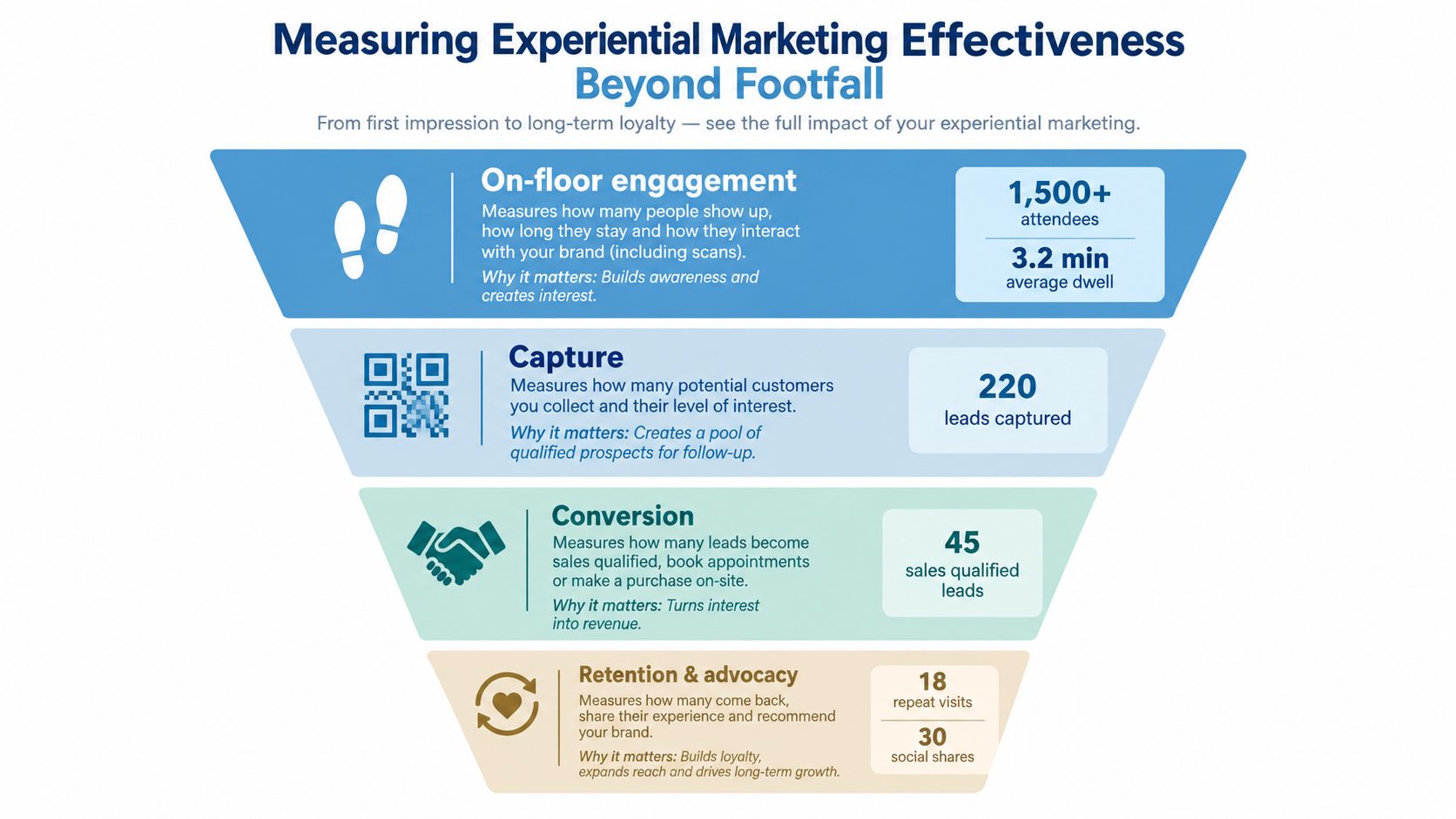
The measurement model I trust has four tiers. It links attention to data quality, then to sales movement. If you want a fuller version, use a framework for measuring experiential marketing ROI. It gives commercial teams something stronger than a footfall total and a highlights reel.
Tier one and tier two
Start with on-floor engagement. UK exhibition teams have used zone-based sensing to measure ingress, egress, average dwell, longest dwell, occupancy by time block and heatmaps across the stand, as described in Rocket X's discussion of UK experiential measurement. Those numbers show whether attendees entered the experience or just slowed down at the aisle edge.
Then track capture quality. Busy stands often fall short. A badge scan has little value on its own if nobody records role, product fit, budget signal, buying timeframe or requested next step. High volume with weak qualification creates clean-looking reports and poor follow-up lists.
Tier three and tier four
The third layer is engagement quality. I would rather have a simple scoring method the team will use properly than an overbuilt survey nobody completes. That can be a staff-rated conversation score, a short post-demo question, content opt-in, or a post-event response signal tied back to the contact record.
The fourth layer is commercial outcome. Measure booked meetings, sales-accepted leads, opportunity creation and attributed revenue where the CRM allows it. That is the point where experiential stops being treated as a brand-awareness luxury and starts being run as an attention-and-data engine.
UK event teams also need to get the handover right. Display Wizard's UK event marketing statistics note that UK attendees expect prompt follow-up after events, and that in-person trade shows hold real strategic value for UK businesses. Delay the outreach window and the stand has only done part of its job.
Crowds create visibility. Conversion comes from dwell, qualification and follow-up discipline.
A scorecard finance can actually use
For a mid-sized B2B activation, use one scorecard with weighted measures agreed before the event. Do not force a false level of precision if the systems behind it are patchy. A clear banded model is usually enough to compare formats, justify spend and cut what is underperforming.
A practical scorecard might include:
- On-floor engagement: dwell time, repeat interaction, throughput
- Capture quality: record completeness, consent status, fit against target criteria
- Engagement quality: conversation score, content opt-in, feedback signal
- Commercial movement: meetings booked, lead acceptance, pipeline progression
This gives UK marketing and sales teams a model they can act on. Footfall still has a place, but only as the top line, not the verdict.
Two UK Activation Scenarios Worth Studying
Theory is useful. Floor reality is better.
Here are two scenarios that show how the same framework behaves differently depending on audience and venue.
Scenario one: B2B software at a London tech expo
A software firm takes a space at a London exhibition and wants more than logo exposure. The pre-event plan starts with an account list and a short outreach sequence inviting target prospects to timed demo slots on the stand.
On site, the centrepiece is a live demo pod with a fixed run time and a clear host. People can still watch from the edge, but the interaction happens inside the booked or semi-booked demo moment. Badge scans sit at the entry point, not as an afterthought on the way out. Staff tag each record by role, product interest and whether a follow-up meeting was requested.
The strongest signal here isn't total stand traffic. It's who stayed for the full demo, who asked implementation questions, and who agreed to the next step. Post-event, the nurture sequence lands inside the expected response window and routes hot prospects to sales first.
What this team measures:
- On site: dwell around the pod, demo attendance, scan completion, qualifier fields
- Afterwards: meeting bookings, content clicks, sales acceptance of leads
What tends to go wrong if the design is weak:
- The pod becomes a theatre piece with no capture discipline
- The team scans everybody but qualifies nobody
- Sales receives a long list and trusts none of it
Scenario two: energy drink activation at a UK summer festival
The consumer version starts from a different brief. The brand wants trial, shareable content and opt-ins for future offers. The crowd is younger, less patient and less interested in a scripted conversation.
The activation uses a gamified sampling station with a visible challenge and a clear photo moment at the finish. The interaction is short enough to keep throughput moving. RFID wristband opt-in or a mobile capture route handles permissions for follow-up offers. User-generated content becomes a secondary KPI because the audience is likely to post if the visual moment is right.
What this team measures:
- On site: participation rate, sample completion, opt-ins, repeat turns through the station
- Afterwards: offer redemptions, content engagement, return interaction at later events
The B2B stand needs depth. The festival activation needs pace. Both still need a clean exchange of value for data.
That's the key distinction. Channel choice and KPI shape should change with the environment, but the discipline doesn't.
A Pre-Event Checklist and Final Takeaways
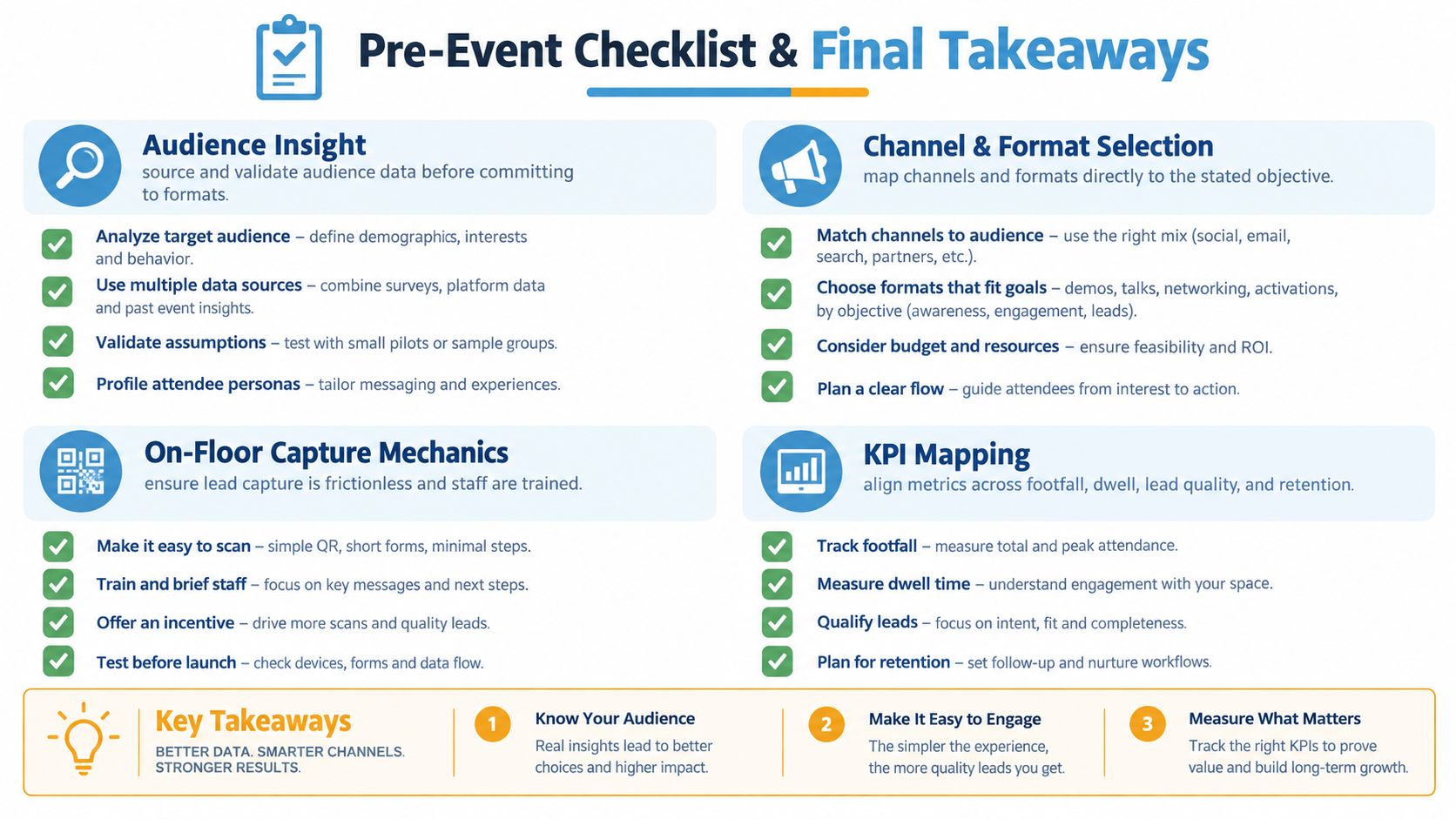
Two weeks before go-live, most event teams don't need more inspiration. They need a ruthless checklist.
Pre-event checks that actually matter
- Audience insight is written down: Your best-fit visitor types, motivations and objections are clear enough for staff to use.
- Format matches objective: The interaction suits the venue and the result you want, whether that's trial, demos, content or lead capture.
- Capture is frictionless: QR, badge scan, tablet form or wristband flow has been tested on the exact devices being used.
- KPIs are tiered: You've defined what success looks like on engagement, capture quality and commercial follow-up.
- Staff are briefed to convert: They know how to open, qualify, record and hand off, not just greet.
- Follow-up is already built: Sales routing, email copy, CRM tags and ownership are in place before the event opens.
If you're still debating giveaways at this stage, a practical resource on trade show promo planning can help teams sanity-check whether merchandise supports the activation or distracts from it.
The decisions that decide payback
Creative polish matters, but insight quality matters more. Dwell time is often the first useful sign that the experience is doing its job. Capture rate is the bridge between engagement and revenue. And the activation only pays back properly when it plugs into the wider campaign instead of sitting alone in a post-event photo deck.
UK teams don't need to treat experiential as a luxury line item. They should treat it as an attention-and-data engine. If the stand creates meaningful participation, captures usable intent, and triggers fast follow-up, it works. If it only looks lively from the aisle, it doesn't.
PSW Events helps brands and organisers build interactive live experiences that are designed for more than footfall, from simulator-led exhibition features to fan-zone and conference activations that support dwell time, lead capture and branded engagement. If you need a UK delivery partner that can plan, install and staff experiential features around clear event objectives, visit PSW Events.