
Being seen isn't the same as being remembered. The strongest brand activation activities turn passive attention into active participation, and that shift matters in a market with serious event volume. The UK events industry was worth £61.6 billion in total event-related visitor spend, including £16.3 billion from conferences and meetings, £10.9 billion from exhibitions and trade fairs, £6.0 billion from fairs and shows, and £9.7 billion from sporting events, while adding £11.5 billion to the economy in the 2024 economic impact study, according to this UK brand activation market summary.
That scale explains why activation isn't a side feature any more. It sits inside the places where brands already meet buyers, fans, staff and partners. Good activations give people a reason to stop, try something, talk about it and leave with a clearer memory of the brand than they would from a banner wall or brochure stand.
The format you pick should depend on context, not trend. An exhibition stand needs throughput and lead capture. A launch needs product framing and social shareability. A team event needs inclusion. A fan zone needs queue control and spectacle. Private celebrations need flexibility across age groups. Sponsorship work needs branding that feels present without feeling forced.
Operational choices decide whether an idea works. Space, power, staffing, session length, accessibility, safety, queue design and the follow-up action all change the outcome. That's where many activations succeed or fail.
1. Interactive Simulator Experiences
Interactive simulators earn attention fast. In crowded UK venues, that matters because people decide within seconds whether to stop, watch or keep walking. The format suits audiences who already respond to competition, performance or skill testing, especially at motorsport hospitality, tech exhibitions, aerospace events and sports-led brand spaces.
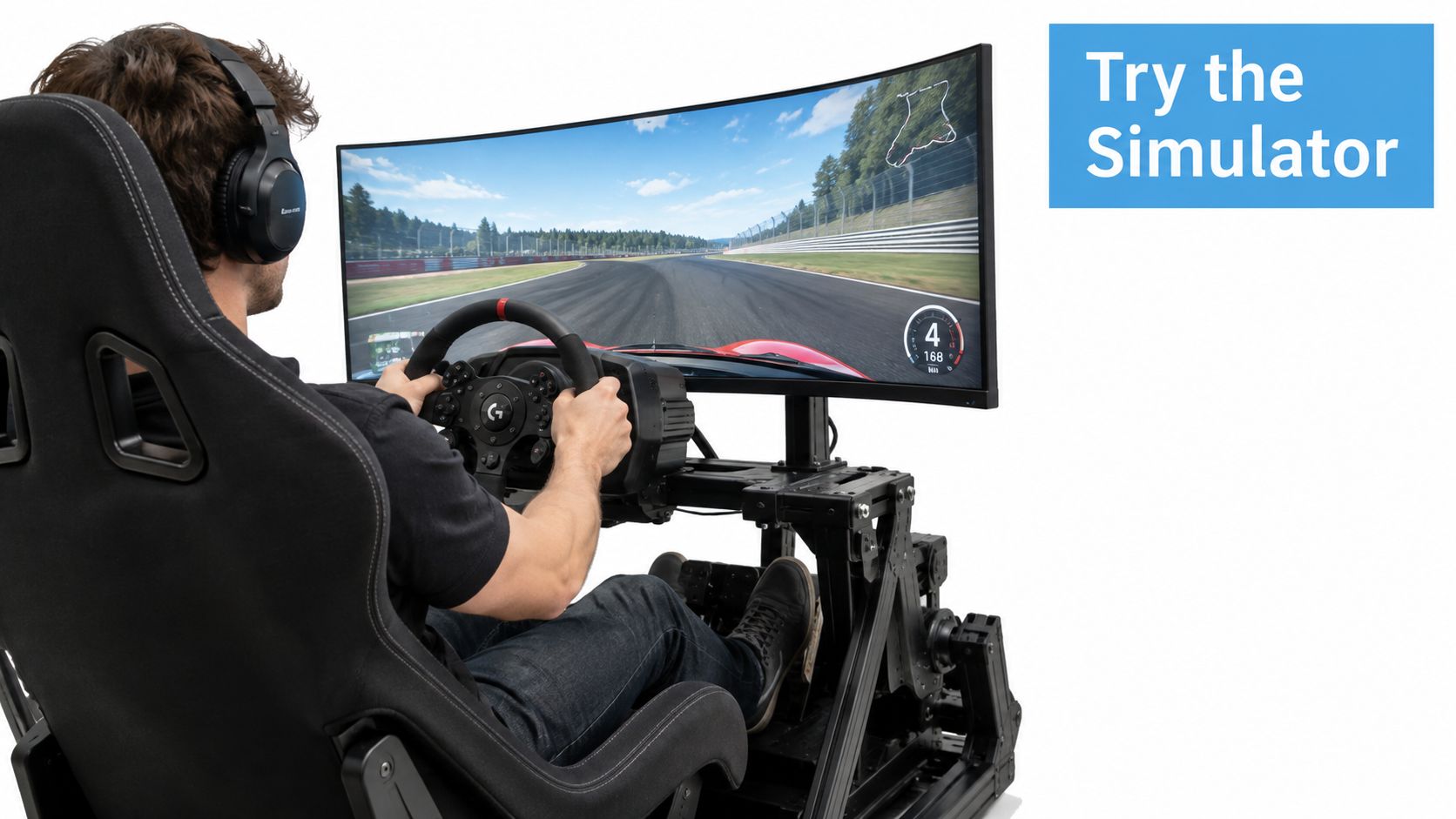
The appeal is simple. Sit down, complete a short challenge, see your result, compare it with someone else. That clarity reduces the briefing time and helps mixed audiences join in, including people who would ignore a more technical demo.
Context decides whether simulators work. An F1 rig fits naturally in a Silverstone hospitality suite because the crowd already values speed and competition. A flight simulator suits an aerospace conference for a different reason. It gives engineers, buyers and partners something physical to test while still supporting a technical message.
Set the format around venue pressure
At exhibitions, throughput usually matters more than session depth. A four-minute run with a visible leaderboard often does more for footfall, lead capture and crowd energy than a ten-minute premium experience for a small number of guests. In hospitality lounges or private client events, the balance can shift. Longer sessions make sense when the goal is relationship time rather than volume.
The operational trade-off is straightforward. Longer sessions create better immersion. Shorter sessions create more participant turns, more watchable moments and fewer dead periods around the stand.
A practical setup usually includes:
- One clear objective: Fastest lap, closest-to-the-pin, cleanest landing or highest score.
- A visible results screen: Spectators need to understand the contest without asking staff for context.
- A queue line with purpose: Mark where guests wait, where they watch and where staff qualify leads or scan badges.
- Accessible entry and exit space: Some rigs are hard to board quickly, so allow room for staff support and alternative participation routes where needed.
- Branding on the experience itself: Screen graphics, score screens, seat wraps and holding slides carry more weight than a logo panel off to one side.
Staff placement changes results. Put one person on briefing and turnover, and another on conversation and data capture. If both stand behind the rig, queues slow down and bystanders go unspoken to.
Multi-rig racing setups work well at motor shows and large public events because they create participant action and spectator tension at the same time. For teams assessing layout, power and rig options, this guide to simulator hire for events shows the main formats used on UK event floors.
One final point. If the queue looks clear and competitive, the simulator is helping the stand. If the queue blocks access, hides staff or leaves people unsure what happens next, the same activation starts working against you.
2. Experiential Product Launches
Launches fail for a simple reason. The room remembers the stunt, but not the product.
A good launch format ties attention to the product claim and then moves people into the next action. That action changes by audience and venue. Press previews need clean reveal timing and camera angles. Buyer events need hands-on access and space for proper questions. Public launches at venues such as ExCeL London need a visible draw first, then a controlled route into demos, sign-ups or sales conversations.
The format should follow the buying context.
For trade buyers, short guided demos usually outperform open-ended play because staff can qualify interest while the product is still in the visitor's hands. For consumer launches, a faster participation layer often works better because it creates social proof and keeps the area active. Automotive brands often use simulator-supported launches well in this setting, but only when the simulator proves the product message, such as handling, speed or realism, rather than pulling focus from the vehicle itself.
Three decisions shape the result more than the headline idea:
1. Throughput.
A high-value product demo can justify longer dwell time, but that choice cuts total volume. If the objective is broad awareness, keep the interaction brief and repeatable. If the objective is qualified demand, accept lower volume and build for better conversations.
2. Accessibility.
A launch should not rely on one physical interaction route. Give guests more than one way to engage, such as live handling, a seated demo, a large-format screen explanation or staff-led walkthroughs. That matters in mixed audiences and busy UK venues where noise, crowding and sightlines quickly affect who can take part.
3. Capture method.
Badge scans at entry produce bigger numbers. Post-demo capture usually produces better intent data. Teams need to choose which matters more before the stand design is signed off.
The strongest launch floors tend to separate four jobs across the space: attract, reveal, trial and convert. That does not require a huge footprint. It requires clear sequencing. Guests should know where the product is introduced, where they can try it, where staff answer technical questions and where the follow-up happens.
I usually pressure-test launch plans with one question: what happens in the first 90 seconds after someone stops? If the answer is vague, the launch is still an idea, not an operating model.
For brands mapping that flow in detail, this guide to product launch event planning support is useful when reveal timing, demo logistics, branding and audience movement all need to work together.
3. Trade Show and Exhibition Booth Activations
A busy exhibition hall rewards stands that explain themselves from five metres away.
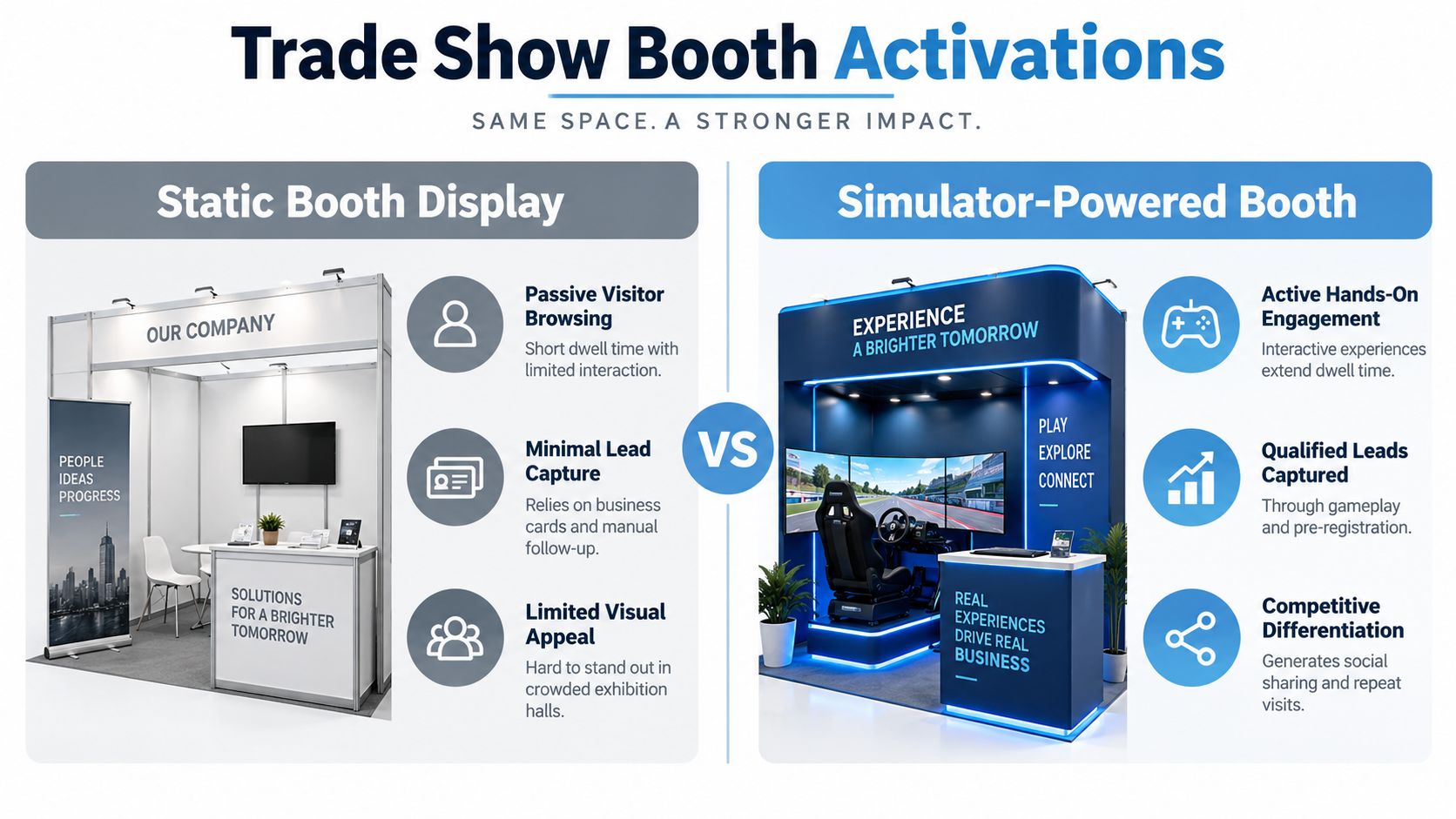
Booth activations work best when the audience is cold, time-poor and comparing several suppliers in one pass. In that setting, a simulator, timed challenge or hosted demo gives the stand an obvious point of entry. Passers-by can see the task, judge the wait, and decide whether to step in. Static graphics rarely do that on their own.
The format suits different goals depending on show type. At a broad industry expo, short-play interactions help stop traffic and create enough dwell time for a first question. At a niche trade event, the same footprint can be configured for fewer participants and better qualification, with staff using the activity as a conversation starter rather than the main event.
The main design decision is not the game. It is crowd shape.
A stand handling corridor traffic at the NEC or ExCeL usually needs three visible layers operating at once:
- Front edge: a live visual that can be understood without explanation
- Play zone: a controlled participation area with clear entry and exit points
- Sales position: a quieter spot for badge scans, technical questions and next-step booking
If those layers collapse into one space, queues block sightlines, staff end up shouting over the feature, and good prospects leave before the useful conversation starts.
There is also a trade-off between spectacle and throughput. A boxing or racing challenge can create strong stand energy, but long session times reduce total plays per hour. A lighter-touch mechanic, such as nearest-the-pin golf or a short reaction test, processes more people and suits shows where the buyer audience is spread thinly across the day. For teams comparing formats, these interactive exhibition stand ideas for lead capture and footfall balance are useful because they show how attraction mechanics affect sales follow-up.
Operations usually decide whether the stand performs well. Useful choices include:
- Set a visible session length: Visitors join faster when they know whether the activity takes 60 seconds or six minutes.
- Use one host and one qualifier: The host runs the experience. The qualifier speaks to waiting attendees and filters genuine prospects.
- Choose capture timing deliberately: Pre-play capture lifts volume. Post-play capture often gives better data because the visitor has context.
- Design for watchers: A scoreboard, large repeater screen or simple MC script keeps non-players engaged instead of drifting off.
- Protect scenic elements in transit: Repeated installs quickly damage custom edges and branded structures, so items such as foam edge protection wholesale are a practical part of the build plan.
One more point gets missed. Accessibility at exhibition stands is not only about compliance. It affects participation rate. If the activation can only be understood from one angle, heard at one volume, or played by one type of guest, the stand narrows its own audience. Clear viewing areas, alternative participation routes and staff who can explain the format in one sentence usually improve both inclusion and lead quality.
4. Corporate Team Building and Staff Reward Events
Team building activations succeed or fail on one question. Will the format bring different types of staff into the room, or will it only reward the confident few?
That makes internal events a different operational job from public brand activity. The audience already knows each other. Office dynamics travel into the venue. Seniority, confidence, mobility needs, alcohol intake, and department culture all affect who joins in and who hangs back.
A simulator tournament can work well at an awards night, but only if the room supports more than head-to-head competition. Staff need an easy way to watch, a low-pressure way to take part, and a reason to stay involved between turns. A boxing challenge may create energy for a sales team. It may also switch off finance, HR or guests who do not want a physical contest in front of colleagues.
At Manchester Central and similar UK venues, the better choice is often a cluster of activity types rather than one dominant set-up. One station can carry the competitive element. Another can support paired play, casual retries or a hosted drop-in challenge. That format improves throughput and accessibility at the same time, because attendees are not forced into one queue, one mood, or one level of public visibility.
Three planning choices usually decide whether the event feels inclusive or awkward:
Format mix. Pair one high-energy attraction with something easier to approach. Racing simulators, arcade reactions, photo moments, and team quizzes can sit together if the scoring system is clear.
Scoring model. Individual leaderboards create sharp competition. Team totals create better cross-department participation and reduce the fear of looking slow or unskilled.
Session structure. Open access suits smaller guest lists. Timed heats or department slots work better once numbers rise, especially if dinner, speeches or awards need the room back on schedule.
A good staff activation feels hosted. A poor one feels like equipment placed in a corner with no social plan around it.
Content capture also needs more care at internal events than at public ones. Event teams often want reaction shots, winner clips and employer-brand footage. Staff need clear notice on what is being filmed, where it will be used, and whether participation includes being photographed. That is partly a privacy issue and partly a participation issue. People join more readily when the rules are obvious.
There is also a branding trade-off here. Internal reward events do not need the same level of overt brand messaging as a launch or exhibition stand. Overdressing the room with campaign graphics can make the experience feel corporate in the wrong way. Light-touch branding, clear host scripting, and visible team scoring usually do more for measurable engagement than filling every wall with logos.
Premium venues often encourage over-programming. In practice, one well-run competitive feature, one accessible side activity, a strong MC, and a disciplined running order usually produce better participation than a long list of disconnected novelties.
5. Fan Zones and Sports Event Activations
Fan zones reward activations that read at a glance. Guests are already on the move, checking timings, finding seats, meeting friends or heading for food and bars. If the mechanic needs a long briefing, participation drops fast.
The strongest formats in this setting are short, visible and easy to score. Football challenges, reaction games, racing rigs and head-to-head contests all suit that job because they create two audiences at once. One group plays. Another watches, films and waits for a turn.
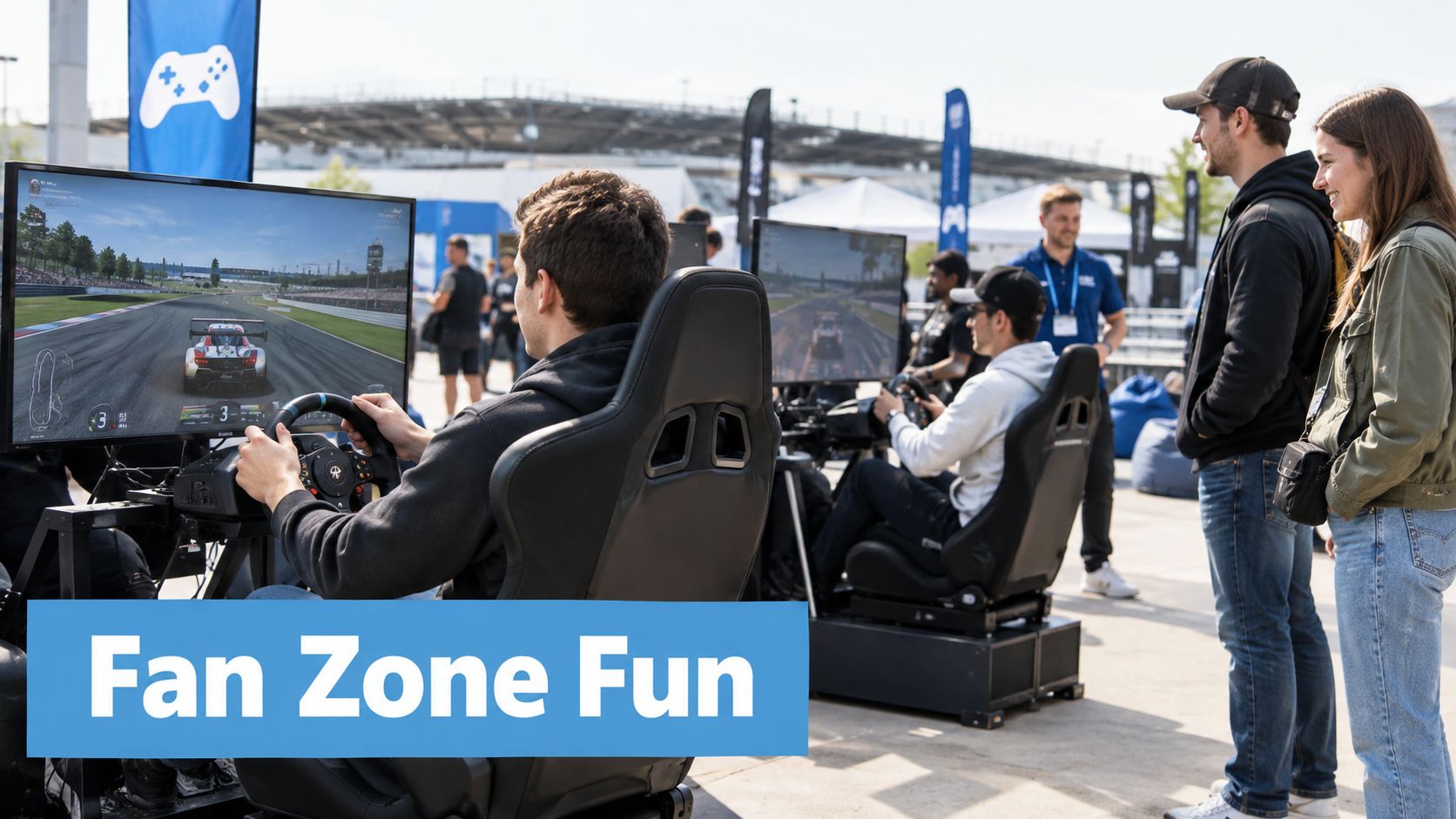
At a stadium, placement is an operations decision before it is a creative one. A high-traffic route looks attractive on a floorplan, but it can fail once a queue forms and sightlines collapse. Wider holding space, clear entry and exit points, and enough room for spectators usually outperform a tighter position closer to the main concourse.
Audience mix changes the format choice. Pre-match public areas need quick-turn participation and broad appeal. Hospitality lounges can support longer dwell time, branded prizes and hosted competitions. Family zones need lower barriers to entry, simpler controls and room for parents to watch without blocking the route.
Five setup choices usually decide whether a sports activation works:
- Throughput: Keep each turn short and the reset process simple.
- Visibility: Make the game, score and prize outcome readable from several metres away.
- Accessibility: Offer at least one way to take part that does not rely on speed, height or prior gaming confidence.
- Lead capture: Decide whether registration happens before play, after play or only for prize redemption.
- Branding: Put sponsor identity where cameras and bystanders will see it, not only on the side panels.
Accessibility also starts before anyone reaches the stand. Large venues can be confusing, especially for guests unfamiliar with the ground or attending as part of a corporate package. Tools such as venue navigation with Waymap show how wayfinding and participation affect each other in live sports settings.
Lead capture needs restraint here. In a fan zone, every extra form field slows the line and loses drop-ins. A better model is often score first, data second. Let people play, show the result, then offer prize entry, photo delivery or leaderboard registration for those willing to continue.
Sponsor teams also need to decide what counts as success before build day. At some events, the priority is mass participation and branded visibility. At others, it is qualified guest engagement in hospitality, content capture for partners, or redemption tied to merchandise and offers. The format should follow that objective, because the same simulator can function as crowd theatre in one venue and as a data-led hospitality asset in another.
6. VR and Immersive Technology Experiences
VR works best in venues where the brand needs controlled attention rather than raw volume. A busy exhibition hall, a premium hospitality suite, a property launch or a closed-door stakeholder event can all justify it. The common factor is the brief. Show something people cannot inspect on a stand, such as an unbuilt space, a hidden process, a future product or a guided brand world.
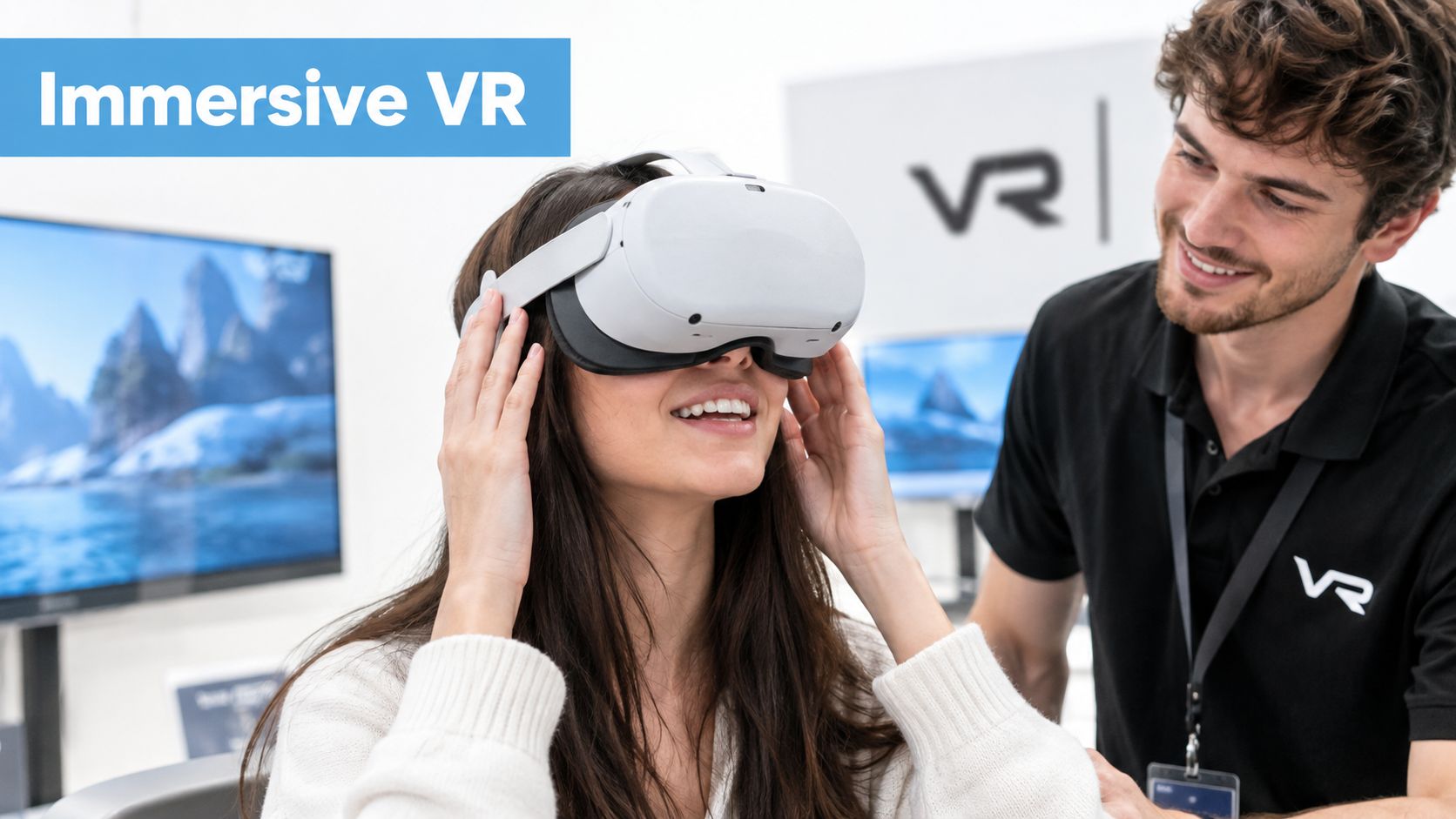
It is a lower-throughput format by design. Headsets need fitting, users need briefing, and some guests need reassurance before they commit. That trade-off is acceptable if the objective is depth of engagement, stronger message retention or qualified post-demo conversations.
A useful way to choose the format is to match it to the audience context:
- Property, construction and placemaking audiences: guided walkthroughs of developments, fit-outs or public spaces that do not exist yet.
- Automotive and engineering audiences: product storytelling that shows internals, materials, performance environments or concept features.
- Premium consumer launches: tightly controlled mood, sound and visual framing where the physical venue is too noisy or generic.
- Investor, partner or press briefings: shorter, high-context experiences that support a staffed explanation immediately afterwards.
The operational choices decide whether VR feels polished or slow.
For public footfall, keep the headset journey short and scripted. A concise host briefing before the guest steps on the platform saves time later. For appointment-led settings, session length can stretch slightly if the conversation value is higher. In both cases, an external screen matters because bystanders need to understand what the participant is seeing.
Accessibility needs planning earlier than many teams expect. Some guests will not want to wear a headset. Others may be uncomfortable standing, turning quickly or using hand controllers. A good build gives them another route in: mirrored content on a large display, a tablet version, a guided film edit, or a seated mode with simple inputs. Without that fallback, the activation excludes part of the audience and narrows lead capture to confident early adopters.
Branding also behaves differently in VR than on open-play activities. The headset user sees the virtual environment, but everyone else sees the physical set, the host, the holding area and the spectator screen. If those elements are weak, the stand can look inactive even while someone is fully engaged inside the experience.
One format often works better than VR alone. Pair it with a product sample, a physical model, a short consultation point or a simple touchscreen explainer. That combination covers two jobs at once: immersion for the participant, and visible activity for the wider crowd.
UK event briefs are also putting more pressure on build efficiency and audience value. As this UK immersive experience trend article notes, planners are paying closer attention to sustainability, authenticity and smaller-scale immersive moments. VR supports that approach when it replaces oversized scenic build and serves a clear story. If the content is vague, guests read it as novelty rather than substance.
7. Private Event and Celebration Activations
Private event activations succeed or fail on social fit.
At a wedding, birthday, Bar Mitzvah or family fun day, guests are not arriving with the mindset of exhibition visitors. They are there to celebrate, catch up, eat, watch speeches and move between groups. The activation has to earn its place inside that flow. If it feels too branded, too loud or too competitive for the room, people avoid it.
The format works best when it is chosen by guest mix and timing, not by novelty alone. A racing simulator suits evening receptions where guests want a focal point and a bit of friendly rivalry. A golf simulator or reaction game often suits mixed-age private dinners because the pace is slower and the learning curve is lighter. For family-heavy events, the better choice is usually an activity with short turns, visible scoring and no long reset between users.
Three operational choices decide whether the setup adds energy or creates friction.
First, place it where people naturally pause. Near a bar, lounge area or secondary breakout space usually works better than the centre of the dancefloor or directly beside the speeches. Guests should be able to join, watch and leave without feeling they are interrupting the event.
Second, set the activity in layers. Private events do not run on a steady queue. Demand comes in waves. Ten guests may want a turn straight after dinner, then nobody for twenty minutes, then children may circle back repeatedly. A good build handles all three conditions with a quick-play mode, an optional scored round and a clear spectator view.
Third, tune the branding to the host occasion. For a branded private dinner, subtle logo placement on screens, scorecards or photo outputs is usually enough. For a personal celebration, custom theming matters more than logos. Colour treatment, welcome screens, event naming and host-led commentary tend to land better than overt sponsor treatment.
A useful planning check is simple:
- High guest turnover: choose activities with short briefing time and fast resets
- Mixed ages and confidence levels: include an easy first attempt with staff assistance
- Formal moments in the schedule: use a format that can pause instantly without disrupting scoring
- Photo-led celebrations: make sure the set looks good even when nobody is playing
- Lead capture or guest data needs: decide in advance whether collecting details is appropriate for the occasion
That last point needs judgment. At public brand events, data capture is often part of the brief. At private celebrations, asking every guest to enter details can feel clumsy unless the host has a clear reason, such as prize fulfilment, photo delivery or a post-event follow-up for invited clients. In many cases, measured engagement is better tracked through participation count, dwell time, repeat plays and content shares rather than forced form fills.
The strongest private activations feel like part of the event design, not a hired add-on. They give confident guests something to do immediately, give hesitant guests a reason to watch first, and leave enough room for the celebration itself to stay in charge.
8. Sponsorship Activation and Brand Partnership Integration
Strong sponsorship activation has to do two jobs at once. It must give the venue audience a reason to take part, and it must give the sponsor a result they can report without forcing the branding so hard that participation drops.
Audience and event context decide the format. At a race circuit, a performance-led simulator suits a sponsor because the setting already supports speed, data and competition. At a conference, the same hardware only works if the sponsor message is clear enough to justify it. Otherwise, guests see a branded attraction with no obvious link to the partner.
The operational choices matter more here than in a privately branded event, because two brands usually need to share the same footprint. That affects queue design, visual hierarchy, staff briefing, approval timelines and what gets measured at the end.
Build for recall, throughput and sponsor fit
A sponsor usually wants prominence. The audience wants a fast, enjoyable experience. The activation has to satisfy both.
In practice, that means making a few clear decisions early:
- Set the branding hierarchy: decide which brand owns the main visual space, which one supports, and where co-branding appears on screens, set panels, scoreboards and photo outputs.
- Match session length to footfall: a three-minute play cycle works better for busy public venues than a longer premium experience that creates a static queue.
- Choose the right capture method: QR follow-up, badge scan, photo email and app entry all change completion rates and staff workload.
- Script the staff intro carefully: operators need one short line that links the activity to the sponsor without turning the briefing into a sales pitch.
- Define success before build: sponsor teams often ask for leads, reach and dwell time together, but some formats are better at one than the others.
Accessibility also needs proper attention. If the sponsor insists on a competitive format, add an easy entry point for guests who are less confident, shorter in stature, or unwilling to commit to a long session in front of a crowd. A good activation widens participation without weakening the sponsor message.
Measure what the sponsor can actually use
Queue length is only a partial signal. A packed stand can still underperform if guests leave without remembering who sponsored it, if the lead capture is poor, or if the content cannot be reused after the event.
Useful reporting usually combines operational and brand metrics:
- participation volume
- average session time
- completion rate
- dwell time around the footprint
- data capture rate, where appropriate
- branded photo or video outputs
- repeat plays
- sponsor recall in post-event follow-up
Post-event search and follow-up content matter as well. If guests are likely to look up the campaign later, the activation name, recap assets and landing page naming need to be simple and consistent. That is less glamorous than set design, but it often determines whether interest converts into measurable traffic or disappears after the venue closes.
The best partnership activations feel integrated at ground level. Guests understand why the sponsor is there, staff can explain it in one sentence, branding appears in the right places, and the format suits the pace of the venue rather than fighting it.
8-Point Brand Activation Comparison
| Activation Type | Implementation Complexity 🔄 | Resource Requirements ⚡ | Expected Outcomes ⭐📊 | Ideal Use Cases | Quick Tip 💡 |
|---|---|---|---|---|---|
| Interactive Simulator Experiences | Moderate–High 🔄, specialist setup, H&S | High ⚡, motion rigs, space, power, trained staff | High ⭐⭐⭐ 📊, extended dwell time, social reach, session metrics | Exhibitions, product launches, festivals, corporate events | Position in high-traffic areas; 3–5 min sessions to maximise throughput 💡 |
| Experiential Product Launches | High 🔄, multi-zone coordination & promotion | High ⚡, venue production, entertainment, logistics | High ⭐⭐⭐ 📊, media/influencer coverage, trials, sales leads | Major B2B/B2C product introductions and brand launches | Combine 2–3 complementary experiences and efficient registration 💡 |
| Trade Show and Exhibition Booth Activations | Moderate 🔄, compact integration and staffing | Moderate ⚡, booth space, power, operators, branding | High ⭐⭐⭐ 📊, increased footfall and qualified leads | Trade shows, sector conferences, expos | Place simulator front-and-centre; clear signage and short sessions 💡 |
| Corporate Team Building & Staff Reward Events | Moderate 🔄, scheduling, inclusivity planning | Moderate ⚡, multi-activity setups, coordination, hospitality | Medium–High ⭐⭐📊, improved morale, retention, internal comms | Offsites, staff rewards, annual company events | Offer diverse activities by ability and stage competitions with awards 💡 |
| Fan Zones & Sports Event Activations | High 🔄, venue coordination, crowd management | Very High ⚡, multiple stations, staffing, infrastructure | Very High ⭐⭐⭐⭐ 📊, extra revenue, sponsorship value, social reach | Stadium fan zones, major sporting/music events | Use tiered participation, fast-pass systems and broadcast-friendly leaderboards 💡 |
| VR & Immersive Technology Experiences | High 🔄, technical optimisation & content dev | High ⚡, VR hardware, tracking, content specialists | High ⭐⭐⭐ 📊, distinctive storytelling, strong shareability | Tech, automotive, gaming, luxury brand activations | Limit sessions (3–5 min), provide acclimation and trained tech staff 💡 |
| Private Event & Celebration Activations | Low–Moderate 🔄, bespoke planning, guest logistics | Moderate ⚡, flexible kit, hospitality, staff | Medium ⭐⭐ 📊, memorable entertainment, strong photo/video content | Weddings, milestone parties, family fun days, private celebrations | Tailor activities to guest demographics and manage queues carefully 💡 |
| Sponsorship Activation & Brand Partnership Integration | High 🔄, sponsor-event coordination & approvals | High ⚡, branded assets, premium positioning, reporting | High ⭐⭐⭐ 📊, measurable sponsorship ROI and visibility | Corporate sponsorships at major events, conferences, stadiums | Align branding with sponsor values; capture engagement data for reporting 💡 |
Choose the Activity That Fits the Moment
The best brand activation activities aren't chosen by novelty. They're chosen by fit. Start with the audience and event setting, then narrow by footprint, throughput, accessibility, staffing level, power, noise tolerance and the action you want people to take afterwards.
That usually leads to clearer choices than a creative brainstorm on its own. If you need fast participation on a crowded exhibition aisle, a short-format simulator challenge often beats a slower immersive build. If you need product understanding at a launch, combine spectacle with guided demo time. If you need broad inclusion at a staff event, spread activity across multiple formats instead of forcing everyone into one competitive experience.
Success measures should be set before anything is booked. Not after the stand has been designed, and not after the venue plan is fixed. Participation, dwell time, qualified leads, content creation, sponsor visibility and post-event follow-up all point to different activation designs. A queue can signal popularity, but it can also signal poor throughput. A high-energy installation can create social content, but it may weaken lead capture if staff have nowhere to talk properly.
The operational layer matters more than many teams expect. Session length changes capacity. Screen placement changes spectator interest. Staff brief quality changes lead quality. Accessibility affects who participates and how inclusive the brand feels in the room. Branding placement affects whether the memory sticks to the sponsor or only to the activity. These aren't finishing touches. They shape the result.
There's also a search dimension that planners shouldn't ignore. A live activation has an afterlife online. People search the sponsor, the product, the event and the experience they just saw. Another UK industry report placed Google's share of UK search at 91.17% in May 2026, with Bing at 6.22%, Yahoo at 1.25%, DuckDuckGo at 0.7% and Ecosia at 0.33%, reinforcing how strongly discovery is concentrated in one platform, according to the UK SEO Industry Report 2026 PDF. If your activation is meant to generate follow-up traffic, your branded pages, event recaps and campaign assets need to be easy to find there.
Search is also a major commercial channel in its own right. IBISWorld estimates the UK search engines industry at £5.7 billion in 2026, with Alphabet Inc. holding the largest market share, as summarised in this UK search industry market report overview. For event planners and marketing teams, that means activation strategy and search visibility shouldn't sit in separate boxes.
When the brief calls for interactive attractions, branding, logistics, installation, staffing and H&S coordination across UK or international venues, PSW Events is one relevant turnkey option to consider. The practical advantage is having the experience format and the delivery layer handled together rather than split across multiple suppliers.
PSW Events supplies simulator-led brand activation activities for exhibitions, launches, fan zones, team events and private celebrations, with planning, branding, logistics, installation, staffing and H&S coordination built into delivery. If you need an activation that works in a real venue, not just on a concept deck, visit PSW Events and review the formats that fit your audience, footprint and event objective.