
You've paid for the stand, the floor space is busy, and people are walking past in every direction. Yet the team is seeing shallow conversations, short visits and very few usable leads. The attraction looks impressive from a distance, but it isn't giving visitors a clear reason to stop, participate or share their details.
That's the practical problem a strong brand activation strategy solves. It connects the creative idea to audience behaviour, venue geography, staffing, data capture and follow-up. The result isn't a crowded stand. It's an experience that earns attention, creates useful interaction and gives the marketing team evidence of what happened next.
Why Brand Activation Strategy Matters Right Now in the UK
On a busy UK exhibition floor, footfall can create a false sense of success. Hundreds of people may pass a stand, while only a small proportion slow down, take part or speak with a member of the team. A branded wall and a looping video can generate visibility, but visibility alone doesn't tell you whether visitors understood the offer or remembered the brand.
An activation gives people a job to do. They can test a product, compete against a colleague, solve a challenge or experience a service in a way that makes the proposition tangible. That participation creates a more useful commercial moment than passive exposure, provided the interaction has a clear route into a conversation, a scan or an opted-in follow-up.
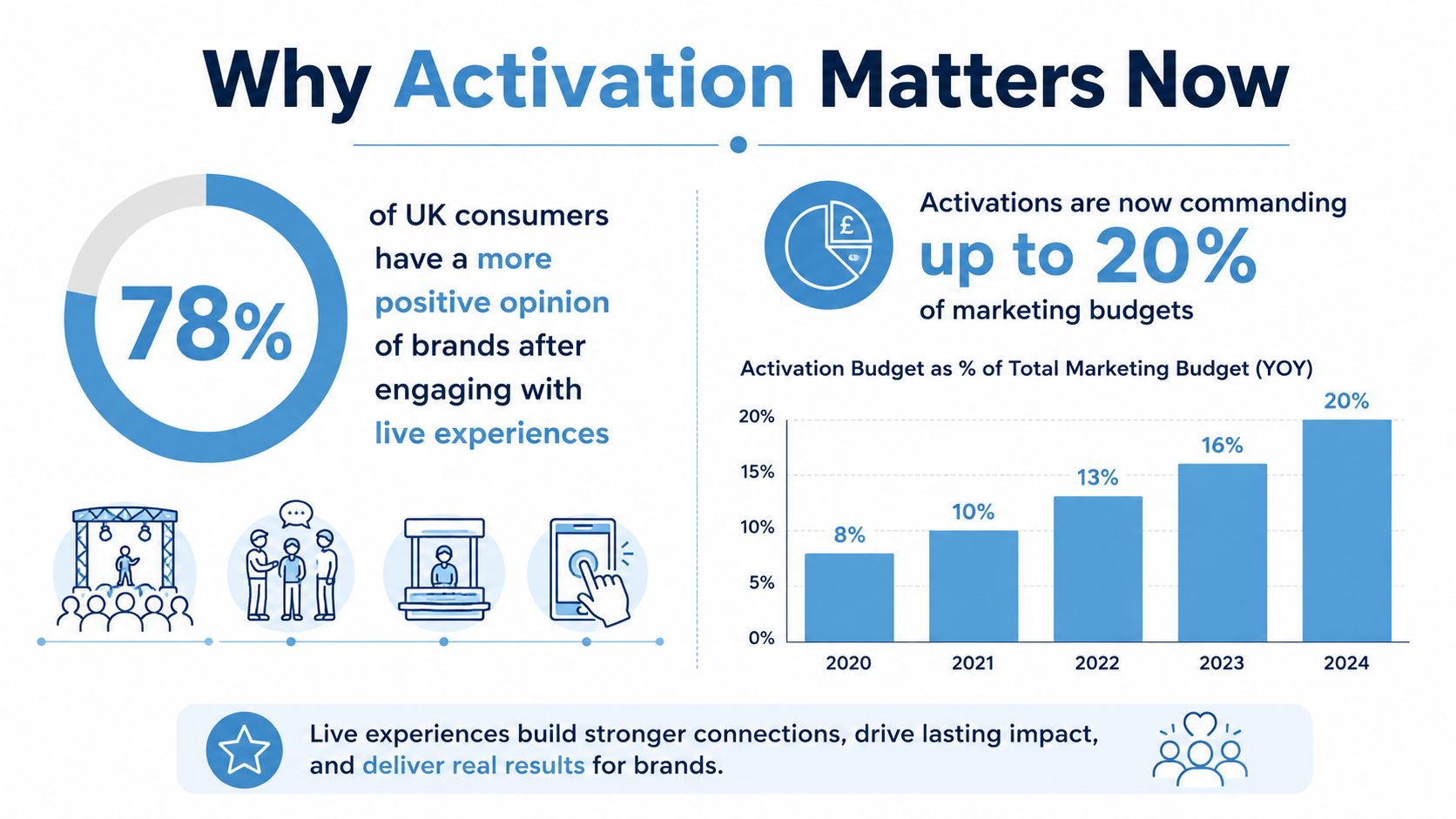
The UK budget picture supports treating experiential work as a core channel rather than decorative event entertainment. The IPM's Bellwether report analysis recorded events and experiences spending growing by 23.1% in Q1 2024, up from 15.9%, which the IPM described as the fastest expansion in the 11-year history of its dataset. That shift matters because marketers are funding live experiences where they can connect awareness with consideration and engagement across B2B and B2C audiences.
Interaction has become part of the value proposition
UK consumer behaviour also explains why an activation can influence preference, not just attention. One survey reported that 57% of UK consumers had engaged with an experiential activity in the previous 12 months. The same research found that 73% of 18–34s rated experiences over physical products, while 60% felt more loyal to brands they could interact with, as reported by Conference News' coverage of the research.
Those figures don't mean every audience wants a loud attraction. They mean interaction has strategic value when it suits the category and context. A B2B buyer may prefer a practical simulator that demonstrates performance, while a consumer audience may respond to competition, sampling or a shareable visual moment. The format must serve the brand promise.
The UK search environment reinforces the need for a joined-up approach. Google held 91.75% of UK search market share in August 2026, compared with 5.67% for Bing, 1.25% for Yahoo! and 0.71% for DuckDuckGo, according to Statcounter's UK search engine market data. Activation content, event pages and post-event search campaigns should therefore be built for how UK audiences discover information, while the physical experience supplies the memory and proof that digital advertising often lacks.
A useful test is simple: if the attraction disappeared, would the campaign still have a meaningful audience action? If the answer is no, the concept is probably entertainment without strategy. If the answer is clear, the attraction can become a measurable growth channel.
For a practical definition of the discipline, this guide to experiential marketing provides useful context on how live participation differs from passive advertising.
Setting Objectives and Mapping Your Activation Audience
Start with the action you need from the visitor, not the attraction you'd like to hire. “Increase awareness” is too broad to brief a producer or judge on site. A useful objective describes the behaviour that should happen, the audience who should take it and the evidence your team will collect.
Turn a broad ambition into an activation job
Use a funnel that reflects the physical journey:
- Awareness: Make the brand recognisable from the main aisle or approach route.
- Footfall: Give the right visitor a compelling reason to enter the space.
- Dwell time: Keep that visitor involved long enough to understand the proposition.
- Sampling or demonstration: Let them experience the product or service rather than hear a claim.
- Lead capture: Secure permission for a relevant follow-up while interest is still fresh.
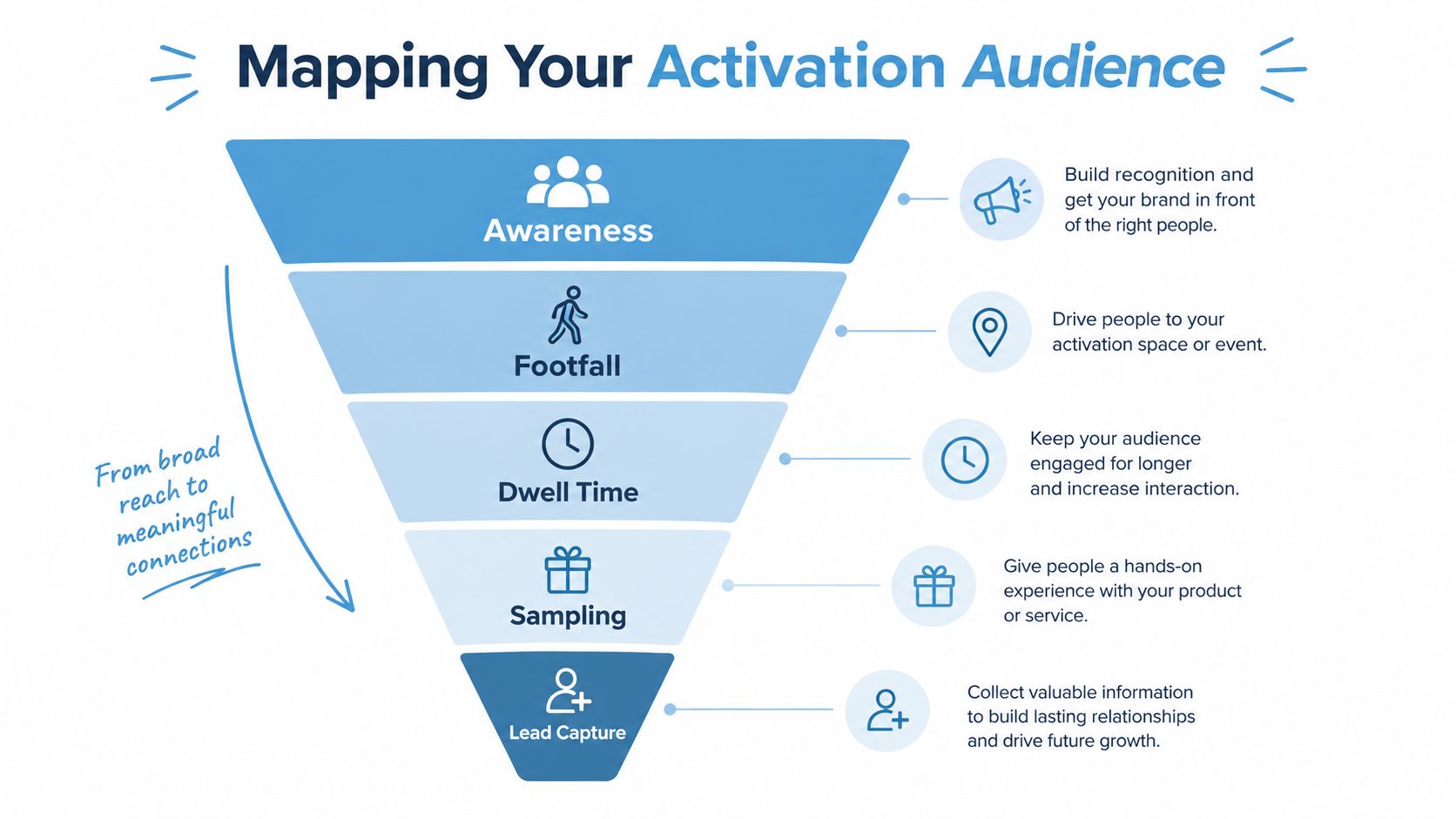
The sequence prevents a common planning error. Teams often buy a high-energy attraction to generate footfall, then discover that it attracts people with no relationship to the offer and leaves no time for a useful conversation. A quieter interactive demonstration may produce fewer visitors but stronger intent.
Map audiences by behaviour and context, not job title alone. At an exhibition, a technical evaluator may want proof and detail, a senior decision-maker may want commercial relevance, and an existing customer may want recognition or a reason to advocate. At a fan zone, the same person behaves differently because competition, social energy and queue visibility influence the decision to participate.
Build a behaviour-led audience map
Ask four questions for each audience group:
- What brings them past the activation? A scheduled meeting, a product need, a competition, a colleague or simple curiosity.
- What would make them stop? Visible gameplay, a useful demonstration, a prize, a social moment or a clear brand benefit.
- What level of involvement will they accept? A quick scan, a short challenge, a guided demo or a longer conversation.
- What should happen afterwards? A sales call, product information, a sample reminder, an invitation or a content sequence.
The answers should shape the brief. They also help determine whether an influencer partnership supports the experience or merely adds reach around it. For planners developing that layer, Social Cloud's influencer strategy offers relevant context on connecting creator activity with campaign objectives and audience behaviour.
Set a baseline before the event. Record existing brand awareness, consideration or preference using the same questions you'll ask afterwards. Without that starting point, a positive survey result can describe a good audience rather than a genuine change created by the activation.
Finally, write one sentence that defines success. For example, the team may need qualified conversations with buyers, opted-in product testers or category preference among a specific audience. That sentence should govern the attraction, footprint, staffing pattern and data flow. If a creative idea can't support it, remove the idea before production begins.
Creative Concepts and Interactive Attractions That Earn Attention
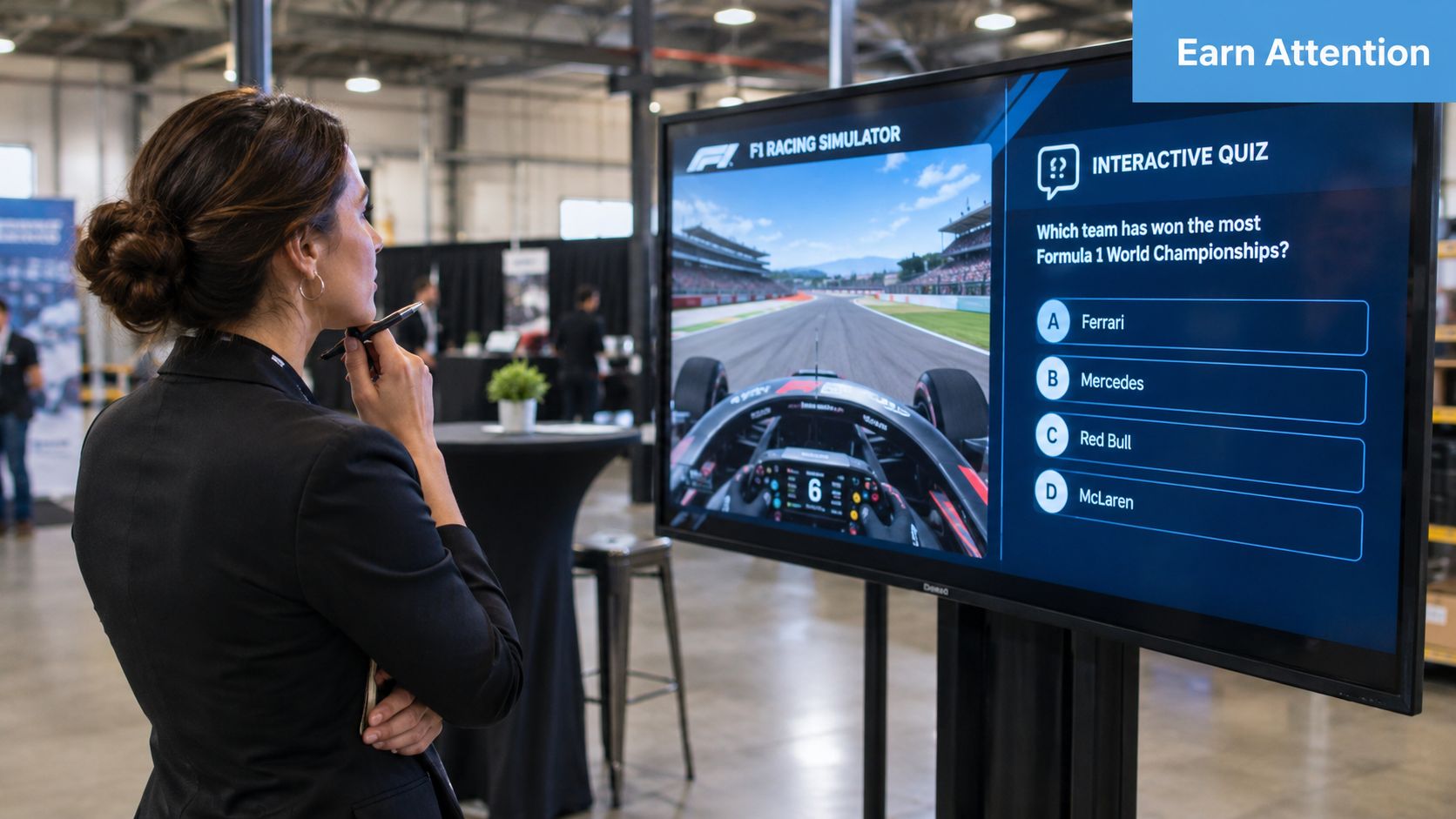
The right attraction earns attention, but it also controls dwell time, queue behaviour and the quality of the conversation that follows. A simulator-led activation can work brilliantly for a motorsport, automotive, travel or technology brand because the interaction demonstrates speed, control or performance. It can fail just as quickly if the queue is long, the game is difficult to understand or the brand message arrives only after the participant has finished.
Choose the format by the job it must do
F1 and multi-racing rigs create a strong visual hook and naturally support competition. Electronic leaderboards can encourage repeat visits and give staff a reason to start a conversation, but the setup needs careful space planning, trained operators and a clear reset process between participants. They suit audiences comfortable with a visible challenge and brands that can connect performance to their own story.
Batak Pro and reaction games are easier to understand from the aisle. They work well when the objective is rapid participation, high throughput and a simple score. Their weakness is that the experience can feel interchangeable unless the branding, challenge language and follow-up offer give the game a distinctive purpose.
VR and motion simulators create a more immersive encounter. They can support a product demonstration or transport audiences into a branded environment, but hygiene, content loading, supervision and accessibility need to be planned from the beginning. A technically impressive experience still underperforms if visitors can't see what others are doing or if the operator spends the whole session troubleshooting.
Sports simulators, including golf, football, rugby and boxing, connect quickly with competitive audiences and fan-zone visitors. They're particularly useful when the brand can build a natural social layer around the activity, such as team scoring, coaching or a branded challenge.
Make the brand part of the experience
Branding should guide the participant, not just decorate the equipment. Use the colour palette on the structure, place the value proposition at the decision point and let the host explain why the challenge relates to the brand. A prize can increase motivation, but it shouldn't be the only reason people participate.
Design the queue as part of the experience. Display the rules where people are waiting, show live scores when appropriate and give staff a short opening question that connects gameplay to the commercial conversation. If data capture happens only at the end, many participants will leave before they reach the form. Build the permission moment into the journey while the interaction still feels relevant.
A useful reference for linking the experience to a broader message is this resource on brand narrative for organic growth. It reinforces a point producers see repeatedly: the attraction earns the pause, but a coherent narrative gives the pause meaning.
For further inspiration on formats and execution, review these brand activation examples, then remove anything that doesn't support your audience, venue or measurement plan.
Bringing Your Activation to Life On Site
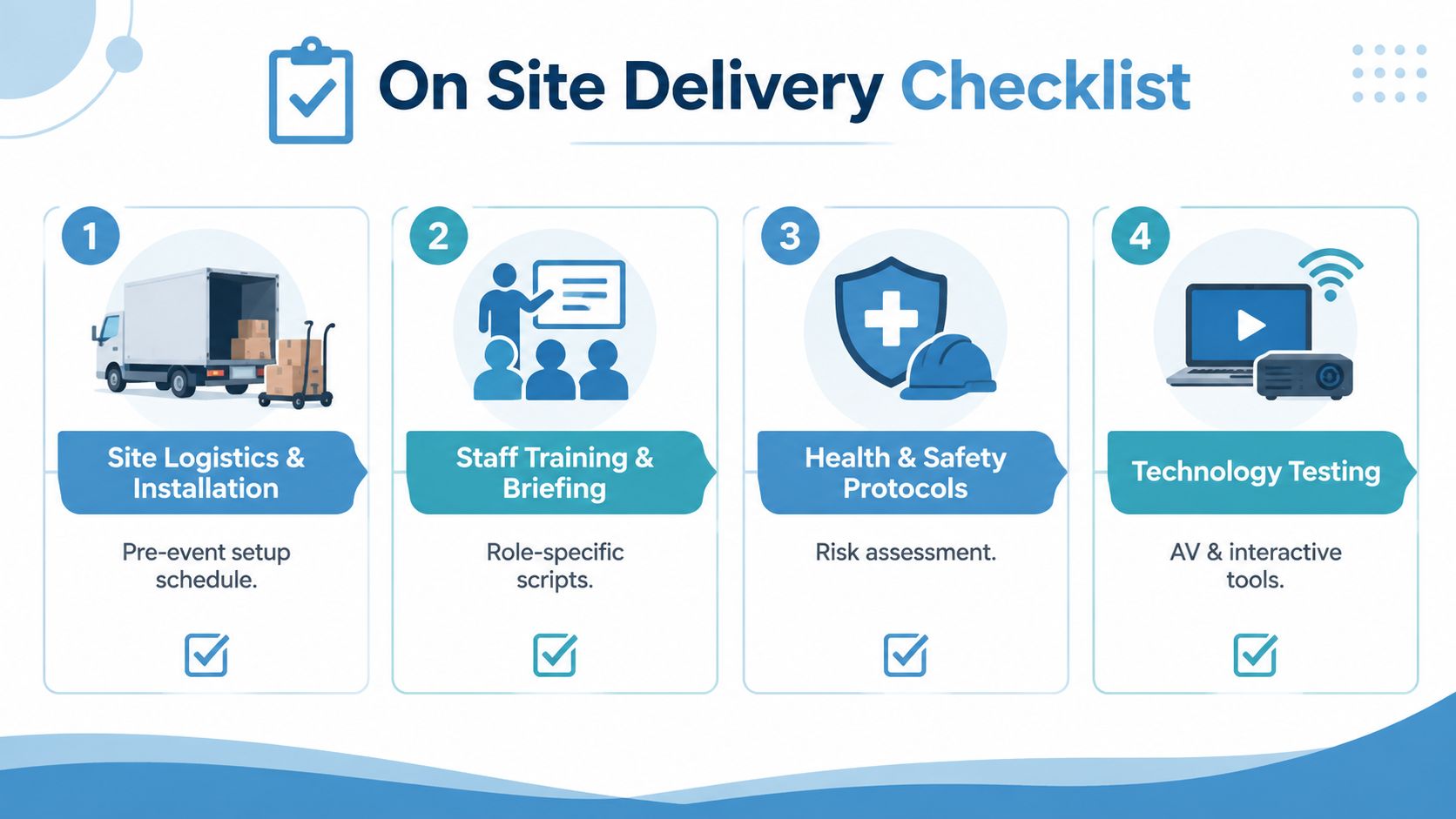
A concept becomes credible when the operational plan is specific. Before equipment arrives, the production team needs a scaled footprint, loading schedule, power plan, access route, storage position, staffing rota and agreed handover process. Venues such as ExCeL London, Wembley and Manchester Central each impose their own access, rigging, noise and health and safety requirements, so a floor plan from one location can't be reused without checking the details.
Sequence the build before briefing the team
The installation plan should answer practical questions early:
- Access: Who has the delivery slot, and can the vehicle reach the stand or activation area?
- Power: What equipment needs power, where are the outlets and who controls cable protection?
- Technology: Has every screen, simulator, QR code, tablet and leaderboard been tested on the actual network or offline fallback?
- Branding: Are graphics fitted, clean, correctly positioned and visible from the intended approach?
- Safety: Has the risk assessment covered moving parts, trip hazards, queue pressure, participant suitability and emergency access?
- Handover: Who signs off the attraction, and what happens if a component fails during opening hours?
Staffing needs to reflect the visitor journey rather than the size of the stand. Put a greeter where people make the decision to stop, an operator where the attraction needs supervision and a host near the exit who can translate the experience into a conversation or consented follow-up. One person trying to welcome, operate, explain and capture data will create bottlenecks.
Protect the queue and the participant
Queue design is a commercial decision. A line that blocks the aisle can create venue problems and discourage visitors, while no visible queue can make an attraction look unpopular. Use clear entry and exit routes, keep spectators separate from active participants and tell waiting visitors how long the interaction takes in plain language.
Staff briefings should include the script, escalation route and data rules. Operators need to know how to restart the equipment, when to pause participation and how to record a technical issue. Hosts need to ask permission before capturing details and should understand which fields are essential, because long forms reduce completion.
Technology testing must happen with the full team present. Scan every QR code from different phones, test tablet capture, confirm that submissions reach the right system and prepare a manual fallback. A high-footfall activation can lose attribution quickly when staff collect names on loose paper or ask visitors to “look us up later”.
Practical rule: If the participant journey takes longer to explain than to enjoy, simplify the experience before opening.
Insurance and compliance also belong in the creative review, not at the end. Moving simulators, VR equipment, climbing elements and sports challenges all need appropriate controls, supervision and documentation. Production quality protects the brand because visitors judge the organisation by the condition of the equipment, the confidence of the staff and the ease of the interaction.
Measuring Success and Optimising Performance
Attendance is an input, not a result. A measurement stack should follow the visitor from exposure to interaction, permission and later commercial response. The strongest approach uses phases, beginning with a brand baseline, then recording on-site behaviour, capturing first-party data and completing follow-up while the interaction remains recent.
UK event-attendee research reports that 72% expect a follow-up email within 48 hours, according to UK event marketing statistics from Display Wizard. That makes speed a measurable conversion lever. The CRM handover should be agreed before the event, with ownership, segmentation and message content prepared in advance.
Build the measurement stack in phases
Before the activation, record baseline brand-lift measures. Awareness, consideration and preference questions should use a consistent audience definition and survey wording. Where possible, use a control group or compare against a similar audience that didn't encounter the activation.
On site, capture the behaviour that corresponds to the funnel:
- Footfall: How many people enter the activation footprint, measured consistently across time periods.
- Dwell time: How long visitors remain engaged, separated from time spent merely waiting.
- Scan completion: Whether visitors complete a QR interaction or another defined action.
- Opt-in conversion: The proportion of eligible participants who consent to follow-up.
- Assisted recall: Whether visitors remember the brand and the relevant message after the interaction.
Afterwards, send the agreed follow-up within the 48-hour expectation, then connect responses to meetings, opportunities or sales activity. For UK experiential measurement, teams commonly use a 30-day sales window and a 90-day brand-lift window, as described in the experiential marketing ROI guide. Those windows should be agreed with sales and research teams before launch, not selected after seeing the results.
Use benchmarks as diagnostic tools
The following operational ranges come from UK activation KPI guidance. They're useful for identifying friction, not for promising a result regardless of audience or venue.
| KPI | Healthy Range | What It Tells You |
|---|---|---|
| Sample scan rate | 22% to 35% | Whether sampling or participation gives visitors a strong reason to scan |
| Sample-to-opt-in conversion | 35% to 60% with tablet capture | Whether the permission flow, offer and staff explanation work together |
| Owned-content reach | 12x to 18x sample volume | Whether the activation creates content that extends beyond the physical interaction |
These ranges are cited in UK brand activation measurement analysis from Fresh Ether, which also identifies common causes of weak performance, including poor staff density, friction in the opt-in flow, weak creative hooks and insufficient dwell-time design.
Don't report total impressions without context. A large figure can include people who saw a logo from a distance but never understood the offer. A control group, baseline survey and participant-level actions provide stronger causal evidence than social buzz alone.
Optimisation should happen during the event where possible. If scans are weak, shorten the form and move the call to action closer to the attraction. If dwell time is short, simplify the rules or add a host-led explanation. If the queue grows while staff remain idle elsewhere, move people to the entry point. The dashboard should help the producer make those decisions, not just create a polished report after everyone has left.
Your Next Brand Activation Made Measurable and Memorable
A practical UK activation plan starts with commercial intent. Define whether the experience needs to generate qualified conversations, product trial, first-party data, preference or a combination of these outcomes. Then map the audience by behaviour, choose an attraction that earns the right kind of attention and select a venue based on audience locality and fit, not headline footfall alone.
Geography now deserves a deliberate place in the decision. UK experiential reporting has cited 3,493 live activation days across 360 venues in 90 towns and cities in a 2025–2026 report, showing how activity is spreading beyond London, as reported in Andrew Bodwick's UK experiential update. A flagship London installation may provide density and visibility, while regional activations can offer stronger local relevance, less crowded surroundings and a better connection to the communities a brand needs to reach.
Keep the decision grounded in evidence. Google handled over 90% to 100% of annual UK queries between January 2018 and December 2024, while Bing accounted for approximately 5% to 10%, according to the UK government's market outcomes evidence. That makes Google the main search priority for UK activation landing pages, event content and post-event discovery, while the live experience supplies the human interaction that search alone can't create.
Brief suppliers with the full journey, not just a request for a simulator or games package. Include the objective, audience behaviour, footprint, venue constraints, staffing model, data fields, follow-up owner and measurement windows. A delivery partner such as PSW Events can provide interactive sports, racing and flight simulators alongside branding, logistics, installation, on-site staffing and health and safety compliance.
Then set a review point immediately after the event. Compare footfall with dwell time, scans with opt-ins and follow-up activity with the original objective. That discipline turns each activation into a better-informed next one.
PSW Events delivers interactive sports, racing and flight simulator experiences for UK exhibitions, conferences, fan zones and brand activations, with planning, branding, logistics, installation, staffing and compliance handled as one service. Visit PSW Events to discuss an activation designed around your audience journey and measurable lead outcomes.