
Two stands sit opposite each other in the same hall. One has a banner, a brochure rack and a team waiting for someone to stop. Visitors glance, keep walking and forget the name before the next aisle. The other has a screen, a short queue and two people cheering as a bracket updates. Passers-by pause for the finish, then ask how they get a go. That gap is the whole case for exhibition game ideas. A game gives people a reason to cross the carpet, stay long enough for a conversation and hand over a name without it feeling like a form.
This guide sets out eight formats that draw a crowd, stretch dwell time or create a clean moment for contact details. Each one is matched to the job it does on a stand, plus the staff, space and safety it needs. You are not choosing the newest toy. You are matching a mechanic to your hall, your budget and the people walking past.
The UK floor is busy enough that a slow attraction wastes the day. In 2023, about 1,016 exhibitions ran at the country's main venues and drew an estimated 6.9 million visits, with the median show attracting 3,000 visitors, according to the VisitBritain business events briefing. Trade shows were 42% of that programme. People are already in the building. Your job is to stop them.
1. Head-to-Head Knockout Bracket
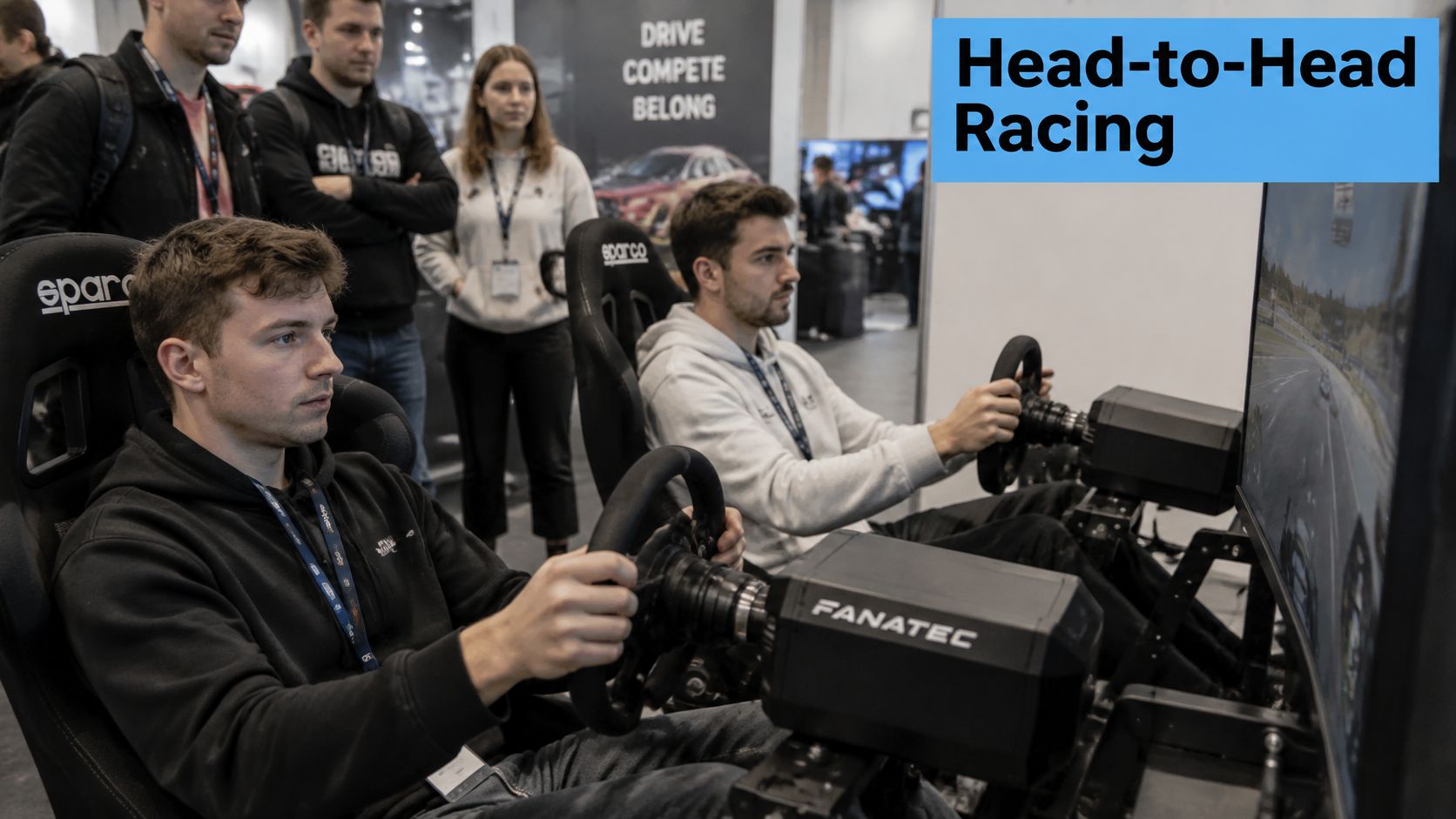
A knockout does one job better than almost anything else on a stand. It pulls a crowd that is not even playing. Two visitors sit side by side on matched racing rigs, a giant Scalextric or a pair of sports simulators. The winner goes through. Losers are out. By the afternoon you have a story, a final and people who came back because they want to see who wins.
That return visit matters on a trade floor. The average visitor spends about 5.5 hours at a trade show, and 52% were more likely to visit a stand that offered a giveaway, in the same VisitBritain briefing. A short heat plus a small prize uses both facts. People have time to come back, and a tangible reason helps them cross from the aisle.
What you actually put down
Plan two identical stations so nobody can claim the kit was unfair. A 3 m by 4 m footprint per rig is a workable minimum once you add chairs for the next pair and a marshal. Giant Scalextric needs a longer table and a clear walkway behind the drivers, because spectators lean in. Put the live bracket on a screen tall enough to read from the aisle. If people cannot see who is still in, they will not stop.
Racing-rig heats work at motorsport brand zones. Giant Scalextric heats work at family festivals and mixed public shows, where the track itself is the advert. I would rather run eight three-minute races than two ten-minute ones. Long rounds kill the queue and the noise.
Say a drinks brand has a 6 m stand at a consumer show. You open heats at 10:30, close entries at 15:00 and run the final at 16:00. Early losers get a branded can or a voucher. The final pulls the aisle back. Your hosts are not cold-approaching. They are checking names off a list.
Pre-register with a QR code: An online form before the doors open cuts the clipboard queue and gives you consented emails before anyone sits down.
Fix the final time: A published 16:00 final builds a second wave of footfall. A rolling “whenever” final does not.
Show the bracket from the aisle: Passers-by follow a name they recognise. That is free spectating, which is half the footfall.
Give early losers something: A consolation prize stops people lingering to argue and keeps the next pair moving.
Practical rule: One marshal runs the bracket, one host runs consent and prizes. If you only have one person, do not run a knockout. The screen will stall and the queue will wander off.
Power is the quiet failure. Two rigs, a screen and a router need a dedicated socket, not a trailing lead shared with the coffee machine. Brief the marshal on stopping play if a pedal sticks or a child climbs the rig. Knockouts fail when the story is good and the changeover is slow.
2. Timed Time-Trial Leaderboard
A knockout needs an audience. A time trial needs a reason to try again. Each visitor gets one timed attempt, or a fixed number, on a racing seat, a flight sim or a sports station. The best lap or score goes on an electronic board. Colleagues come back at lunch to beat each other. That repeat trip is dwell time you can count, and every logged score is a contact worth having.
Exhibitors are already spending more on each stand, even as the audience shrinks. Direct spending per exhibitor rose from about $34,710 to $42,150 between 2018 and 2022, a 21.4% increase, while visitor numbers fell 33% from 9.1 million to 6.1 million, according to the UFI UK exhibition report for 2022. A board that records attempts, completions and scores gives you something to show for that spend. It works as the participation log for the whole stand.
How the scoring should work
Put the board where the aisle can read the top five. Hide it inside the stand and you have bought a game nobody hunts for. Set the first-attempt target so a competent novice can land on the board, then make the top three hard. If nobody features, people walk. If everyone features, nobody cares.
Reset or split the board each morning on a multi-day show. Yesterday's professional lap kills today's casual players. Flight-sim time challenges suit trade shows where the brand wants a technical story. Racing seats suit mixed audiences who understand "fastest lap" in one sentence.
A software firm at a two-day conference might run 90-second laps, three attempts maximum, with opt-in captured when the score posts. The host stays quiet during the lap. The pitch happens in the twenty seconds while the time loads, when the player is still looking at their result.
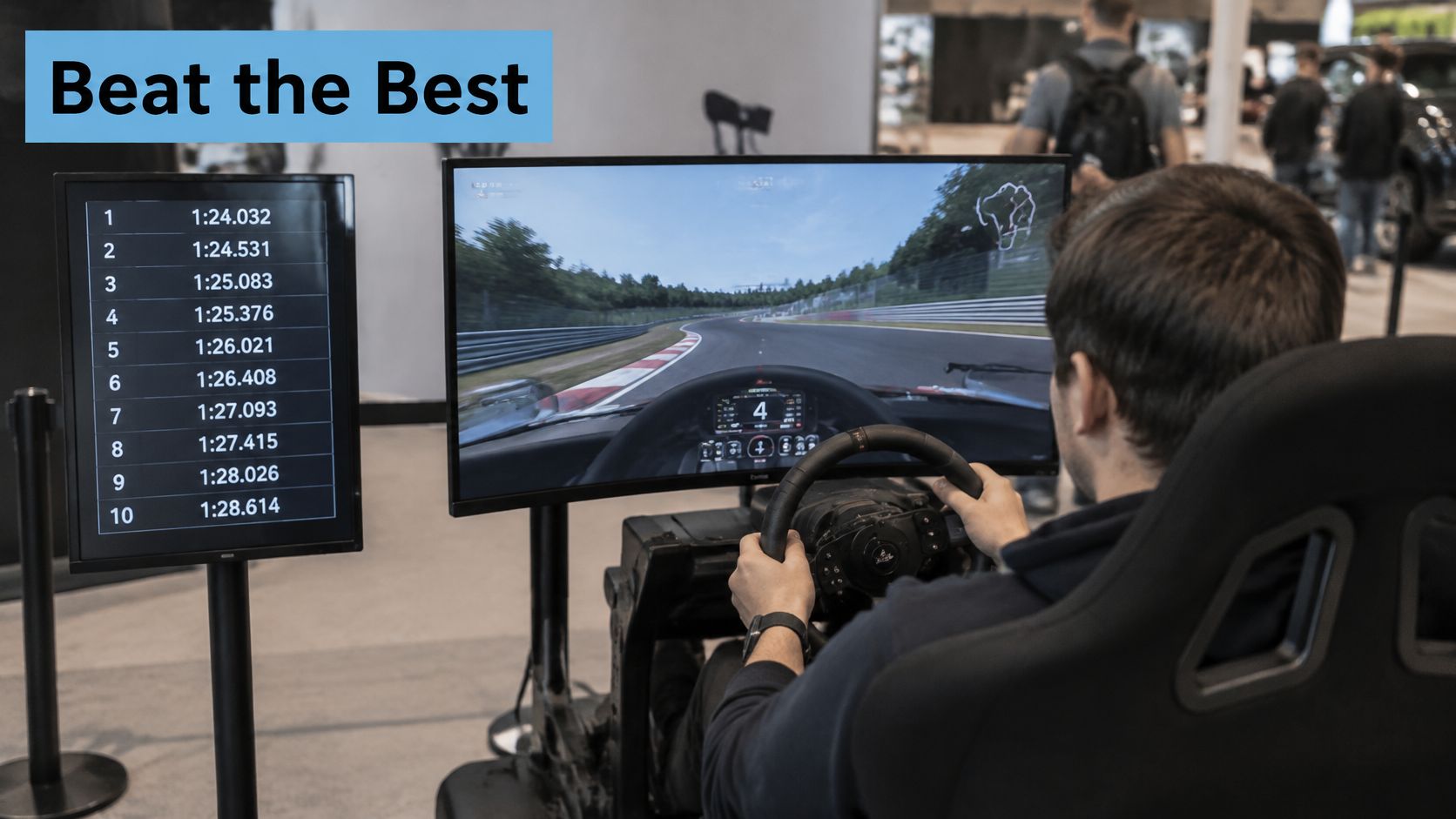
Treat a hired electronic leaderboard as the stand's scoreboard and the day's running record. Publish both raw times and a simple rank so a short session and a long session stay comparable.
- One operator, one screen: They start the clock, confirm the opt-in and wipe a bad run. A second person earns their place only once the queue passes about eight.
- Offline scoring: Venue Wi-Fi drops. A local board that exports a CSV at close of play beats a cloud board that freezes at 11:00.
- Consent at the score, not at the door: People agree when they can see what they are joining. A form three metres away gets ignored.
A realistic first target creates the second attempt. An impossible target creates a shrug.
Space is kinder than a knockout. One cockpit, a 2 m safety gap and the screen. The trade-off is theatre. A solo lap does not hold twenty onlookers unless the driver's face is on the screen. If your goal is a watching crowd, pick the bracket. If your goal is measurable repeats and a follow-up list, pick the board.
3. Accuracy Kick or Throw Challenge
Some visitors will not sit in a rig. They will kick or throw, because the objective is obvious from ten metres away. A set number of shots at an American football, rugby or football target, with points for accuracy and distance, is a mini-game. It sits beside a larger attraction or carries a small stand on its own.
It also matches what visitors say they value. In a 2025 UK exhibition-industry write-up, 64% of surveyed respondents said immersive experiences significantly enhance attendee satisfaction, and 44% said advanced event technology positively influences them, as reported by The London Display. Treat those figures as perception, not a conversion rate. The useful reading is simple. A clear physical challenge beats a passive panel for satisfaction, and you still have to measure whether it produced a lead.
Brand the target, then cap the attempts
Print sponsor marks in the high-score zones. A ball hitting a logo is a photo people take. Cap the session at three or five attempts. Unlimited throws feel generous and destroy the queue by lunchtime. A perfect score wins a small prize and becomes the sentence people repeat at the bar.
American football simulators pull sports fans and corporate teams who already argue about throwing. Rugby kicking challenges belong at sporting venues and fan zones, where the skill is recognised. On a mixed consumer show, a football accuracy board is easier to explain to children and to people in smart shoes.
Say a bank has a 4 m side wall at a regional business show. The target faces the aisle, the kicker stands on a marked mat, and a host holds the next ball. Three kicks, score on a tablet, opt-in if they want the leaderboard photo emailed. The conversation starts with the score, not with a leaflet.
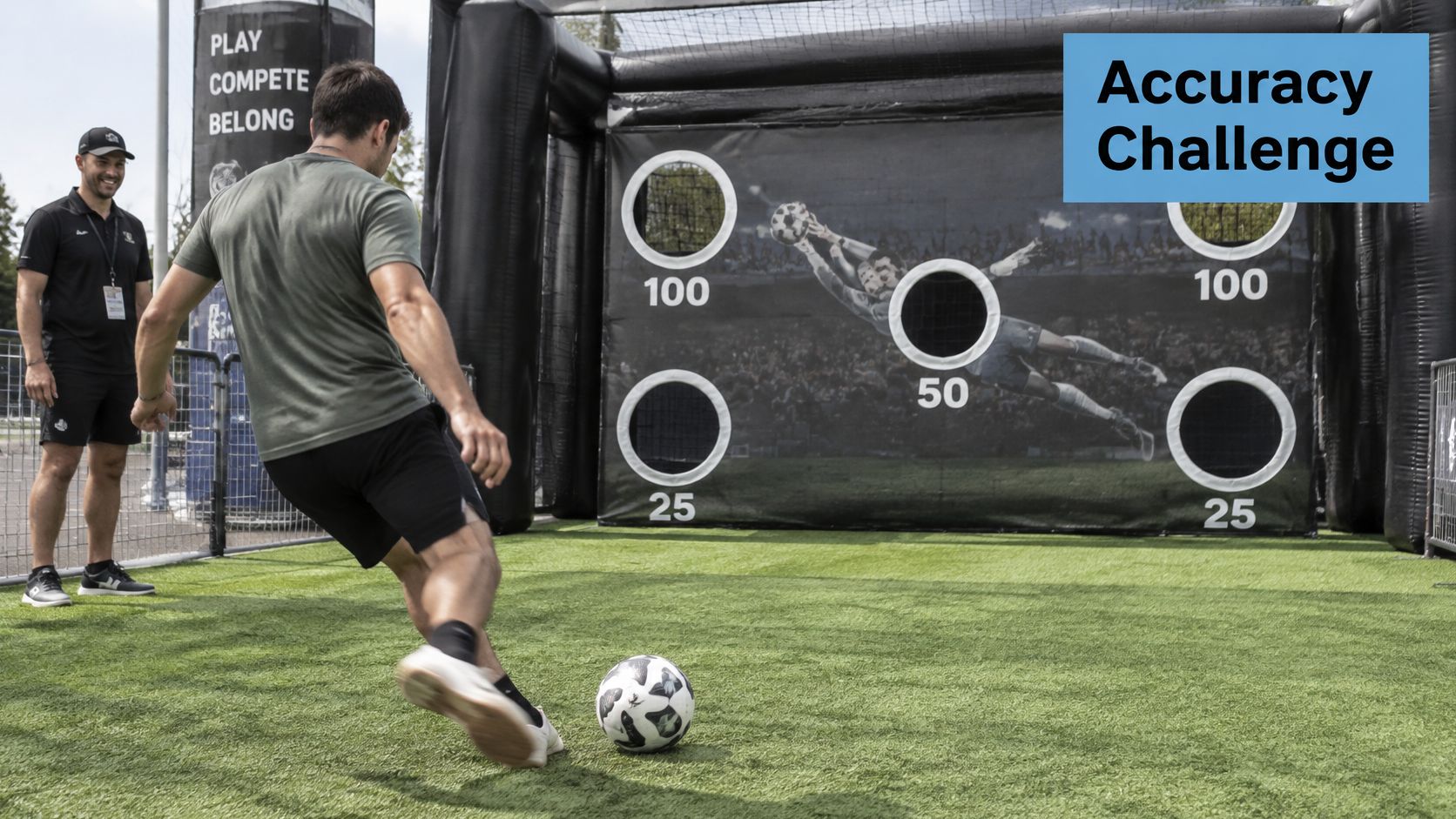
Fix the mat: Tape the standing spot. People creep forward, scores inflate and someone in the queue complains.
Brief before the first kick: One sentence on where to stand, what not to do, and that staff retrieve the ball. Do not discover your health and safety line at the show.
Keep a spare ball: A single ball in the crowd ends the game.
Staff the landing zone: An inflatable target still needs a person stopping spectators walking behind it.
This format fails when the lane crosses a fire exit or when heels and a slick floor meet a full-blooded kick. Use a non-slip mat, a low-power ball if the ceiling is tight, and refuse play in open-toed shoes if the sensor is a hard target. One host can run it. Two are better when the prize desk is separate from the lane. I would not put this on a carpeted stand without checking the venue's floor rules first.
4. Closest-to-the-Pin Golf Challenge
Golf is the B2B format that lets people talk while they play. A set number of shots on a simulator, closest to a pin or a target distance, and a prize for the best of the day. The scoring idea is already in people's heads. You are not teaching a video game. You are giving two clients something to do with their hands while a conversation continues.
That only works if more than the confident players will step up. UK research on interactive museum and gallery experiences found that 47% of UK respondents viewed interactive digital experiences positively, yet 21% had never engaged with interactive or immersive technology, and unclear AR or VR instructions were a major obstacle for about half of UK users, in the Cambridge University Press audience study. A golf sim with a headset and a cryptic menu will lose the half who stall on instructions. A screen, a printed target and a practice swing will not.
Set the room up for talk, not just for swings
Place the bay so spectators stand to the side, not in the backswing. A 4 m depth is a fair planning figure once you include the player, the sensor and a small watching group. Hang the rules at eye height. Offer one practice shot before scoring starts. First-time nerves are what make senior guests refuse, and those are often the guests you wanted.
Closest-to-the-pin formats earn their keep at client days and trade shows where the audience already plays, or at least knows the language. Pair the bay with a drinks ledge a few steps away. People finish, stay for the next player and the dwell time belongs to your hosts, not to the simulator.
A professional-services firm entertaining twelve clients might book 20-minute pairs, show the day's closest shots on a small board, and let the host introduce the next pair. Nobody is trapped in a demo. The game is the reason they are still in the room.
Hire a golf simulator when you want that hospitality pace rather than a noisy knockout. Keep a left-hand club option and a seated explanation card for guests who will not stand for long. Participation breadth per square metre beats a flashier headset that half the room will not wear.
If the instructions need a technician, you have already lost the guest who only came for a drink and a chat.
One experienced host can run a bay if groups are pre-booked. Walk-up traffic needs a second person on the list, or the player waits while you hunt a glove. Do not run prize alcohol if the venue's licence does not cover it. A sleeve of balls or a lesson voucher is cleaner.
5. Power Punch Strength Challenge
A punch score climbing on a big screen is instant theatre. Visitors hit a boxing simulator or punch sensor, the number flashes, and the people behind them react before they have decided to queue. That reaction is the footfall. The leaderboard, or a simple prize threshold, is the reason they give you a name.
You can make that moment measurable without turning the stand into an IT project. The Events Industry Alliance's 2025 UK events report treats AI matchmaking, chatbots, data analytics and XR as live themes, and notes analytics being used for personalisation, success measurement and showing ROI, in the UK Events Report update. For a punch game, the useful slice is a short consented journey. Name, score, prize redeemed, follow-up segment. Skip the chatbot. Keep the export.
Keep the hit safe and the clip consented
Boxing simulators belong at sports activations and festivals. Punch challenges belong in fan zones where people already expect noise. On a corporate stand, set a modest prize line, such as a score that wins a small gift, so the queue includes people who are not trying to break the machine.
Brief every attempt. Feet position, which hand, stop if anything hurts. A funny clip is not worth a sore wrist. If you film, ask before the punch and show where the clip will go. A nod while someone is mid-swing is not consent.
Say a sportswear pop-up runs the sensor facing the aisle, screen above head height, three punches maximum. The host calls the score, offers the prize card and the opt-in in the same breath. Nearby teams film their own colleagues. You get the crowd without hiring a camera crew.
A boxing simulator game is the right hire when you want that visual spike and you have a host who will stop unsafe play. One operator can run it. The space is modest, but the exclusion zone in front of the bag is not optional. People step in to cheer and get clipped.
Large numbers, short sessions: The screen does the marketing. Three punches, then the next person, or the spectacle becomes a private contest.
Normalise the rank: If some guests get a warm-up and others do not, publish a fair ranking, not only the raw peak.
Have a non-striking job: A guest who cannot or will not punch can run the button or read the scores. Exclusion is a lead you will not get.
This format goes wrong when the sensor faces a narrow gangway or when staff treat it as a strength contest for the loudest guest. Cap the session, keep the copy light and move on. Intensity sells the queue. Fairness keeps the brand out of trouble.
6. Team Relay Challenge
A relay is for groups who arrived together and would otherwise split up after two minutes. Teams of three to five rotate through a sequence, such as a short climb, a racing lap and a sports-simulator station. You add the times. The fastest team wins. Collaboration is the point, and so is the extra quarter-hour they spend inside your footprint.
Use this when the audience is a company, a department or a family group, not a stream of solo buyers. Corporate away days and staff rewards suit a fixed route. Festivals and family fun days suit the same idea with softer stations and shorter legs. A relay on a tight trade-show booth usually fails. You need a route, not a single mat.
Draw the route before you book the kit
Sketch the path on the floor plan. Stations in a loop, not a line that crosses itself. Mark where teams wait so they are not blocking the climb. A central board with team names and combined times keeps the groups that have finished from leaving. Without that board, team one disappears to the catering and team three has nobody to beat.
Limit each station to the same number of players. If one team sends two people up the wall and another sends five, the argument lasts longer than the game. A finish photo, taken by your host and sent with consent, gives the organiser something to post on Monday. That photo is often the asset the client remembers.
Say an employer brings 40 staff to a reward afternoon. Eight teams of five, three stations, four minutes per station, a marshal at each point and one person on the master clock. You are staffing four, minimum. Cut a station before you cut a marshal. An unstaffed climb is not a saving.
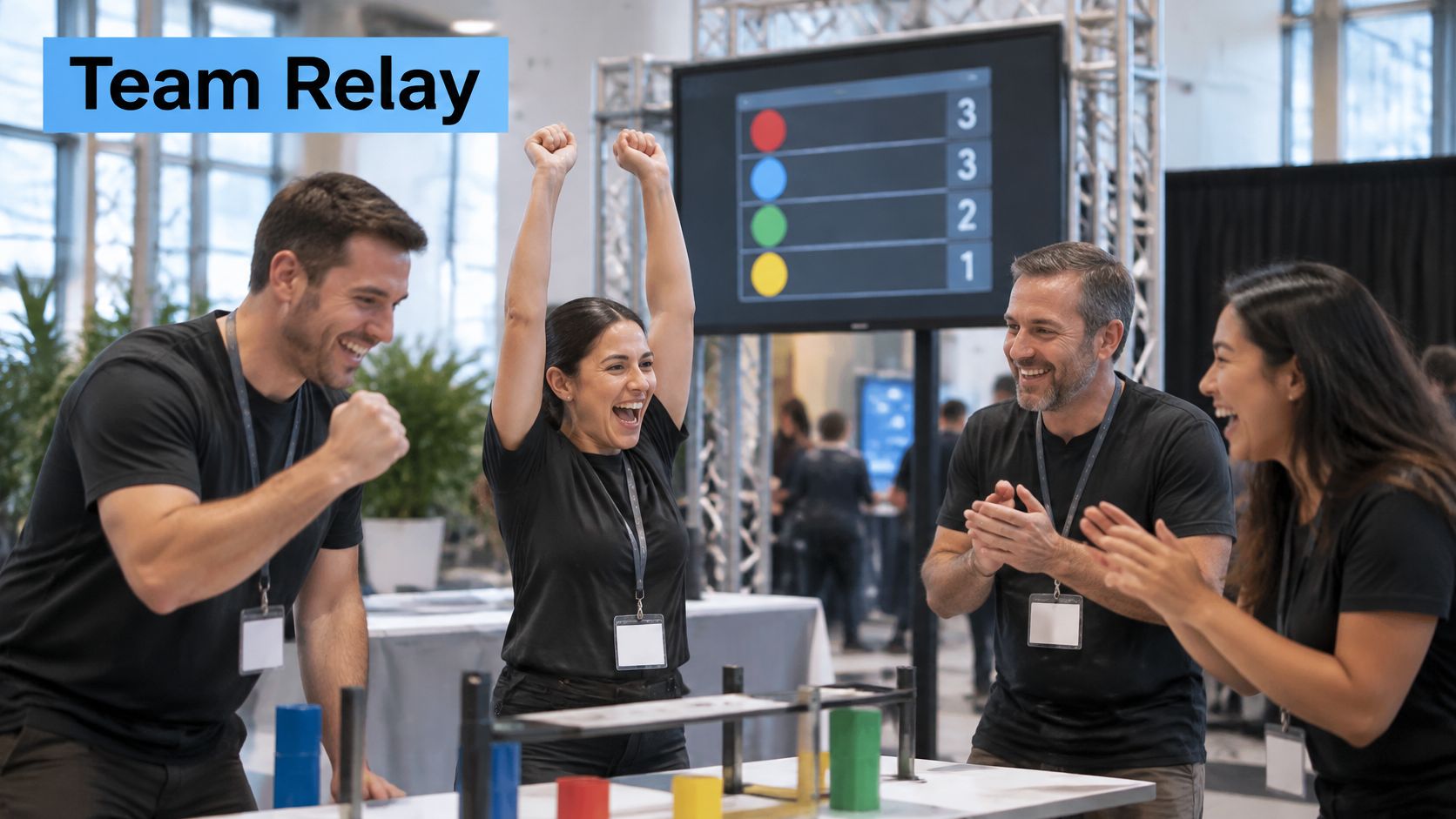
Same rules at every station: Write them on a card the marshal can read aloud. Improvised handicaps feel unfair by team three.
A waiting box: Tape a square. Teams that spill into the aisle get moved by venue security, not by you.
One clock: Phones disagree. The central board is the only time that counts.
Weather cover if any leg is outside: A shower canopy beats cancelling the climb at 14:00. Move what you can indoors if the site allows.
Lead capture sits at registration, not at the wall. Collect the team name and one organiser email before the start. Chasing five people at the finish, while they want the photo, produces bad data. The trade-off against a solo time trial is space and payroll. The gain is a group that stays, talks and associates your brand with their own colleagues, which a banner never does.
7. Mission-Based Flight Simulator Challenge
A flight sim without a task is a queue of people waiting for a go. A flight sim with a three-minute mission is a slot people remember. Timed landing, a short search route or a precision hover in a motion or helicopter simulator gives the ride a purpose. That purpose is what makes it feel like the highlight of a launch rather than a fairground extra.
Use it when the guest list is smaller and the brand story needs a bespoke frame. Aviation partners, product launches and private client evenings suit booked slots. A packed consumer aisle usually does not, because a motion platform turns slowly and the safety briefing is not optional.
Write the mission on one card
One side of a card, four lines. What the guest is doing, what “good” looks like, how long they have, what happens at the end. Tie one line to the product. A precision hover that “holds the new route steady” is enough. A paragraph of brand copy while they are strapping in is too much.
Allow a practice run for first-timers, even if it is thirty seconds. Confidence is the difference between a guest who grins at the debrief screen and a guest who climbs out embarrassed. The debrief is your content. Altitude trace, time on target, a still they can share. Ask before you post it.
For high-value guests, schedule the slots. A motion platform with a walk-up queue creates a crowd you cannot serve and a VIP who will not wait behind eight people. Ten booked sessions in a day, with a host and a trained operator, beats thirty rushed ones. The operator watches the platform. The host watches the guest and the follow-up.
A helicopter challenge at a motorsport hospitality unit might run “land inside the window” in under two minutes, then a debrief at a side table where the sales lead is already sitting. The game ends. The meeting does not feel like it has started from cold.
Seated play is an advantage here. Guests who will not sprint or punch will take a cockpit. Keep a non-motion option in the brief if anyone is unsure about the platform, and stop the session if someone feels unwell. That is a staffing judgement, not a software setting. I would not promise a custom mission skin unless the files are tested on the actual machine the week before. A beautiful brief on a default desert map looks unfinished.
The trade-off is throughput. You will not process a hall. You will give twenty people a story. For footfall, this is the wrong tool. For a private highlight and a debrief that sales can sit in on, it is the right one.
8. Casino-Style Mini Tournament
Chips on a table change the sound of a room. Blackjack, roulette or a simple card game, played with tournament chips that have no cash value, points across a set hour, prizes for the top few and a smaller gift for most of the rest. People stand behind friends, comment on the next card and stay. That social energy suits private parties, corporate evenings and brand events. It is a poor fit for a loud exhibition aisle at 10:30, where nobody wants to sit still.
Be plain about the money. Chips are points. Say so on the table card and again when you seat people. Check promotional rules and any licensing the venue expects before you print a single invite. “It is only a bit of fun” is not a compliance position.
Run it like a timetable, not a drop-in
Open with a five-minute rules brief. Update a screen every fifteen minutes with the top scores so people at the bar walk back. Mix the prizes. A winner-takes-all table creates three delighted guests and seventeen who feel they lost the evening. A top prize plus table gifts keeps the mood.
Casino tournament nights belong at corporate evenings and private parties. A single mini table can sit inside a brand launch as one station among others, with a croupier who can also explain the product between hands. Do not leave the table unhosted. An empty shoe and a pile of chips is an invitation for someone to invent the rules.
Say a 40-person client dinner has one blackjack table and one roulette wheel from 19:30 to 21:30. Two dealers, one floor manager, chips counted in and counted out. Names go on a card at the seat. You are not collecting data mid-hand. The organiser gets the list at the break.
No cash, in writing: On the chip, on the card, in the host's first sentence. If a guest asks what the chip is worth, the answer is nothing.
A finish time: Open-ended tables drift. A last hand at a stated time creates a climax and lets catering reset the room.
Accessible seating: One chair removed from the corner lets a wheelchair sit at the table. Do not make that an afterthought when the guest is already there.
A non-player role: Dealing a practice hand or reading the leaderboard keeps someone in the group who does not want to gamble, even with fake chips.
This format fails when it looks like real-money play, when the dealer cannot explain the scoring, or when the prize is so large that the tone turns sharp. Keep the stakes social. The job is atmosphere and a shared hour, not a spectacle for the aisle. If you need people to stop from ten metres away, go back to the bracket or the punch screen.
How the eight exhibition game formats compare
Each format does a different job on the stand. Players at a time sets your throughput per hour, and the capture column shows where the consent ask sits in play. Heavier staffing buys smoother flow on the busier formats.
| Item | Best For | Players at a Time | Typical Session | Lead Capture Fit |
|---|---|---|---|---|
| Head-to-Head Knockout Bracket | Spectator-friendly competition | 2 | Three-minute races; heats through the day and a timed final | Good with QR pre-registration |
| Timed Time-Trial Leaderboard | Repeat play and measurable engagement | 1 | One lap or a 30-second challenge | Strong; opt-in name and email at entry |
| Accuracy Kick or Throw Challenge | Quick, accessible sports play | 1 | Three kicks or throws per turn | Opt-in when the score posts; leaderboard photo emailed |
| Closest-to-the-Pin Golf Challenge | Corporate hospitality and networking | 1, or teams | 3–5 shots per round | Moderate; leaderboard and prizes support engagement |
| Power Punch Strength Challenge | High-energy, spectator-friendly activations | 1 | A few punches; short attempts | Consented name and score at registration |
| Team Relay Challenge | Team building and group engagement | Teams of 3–5 | One leg per team member; a few minutes per team | Team-level organiser email at registration |
| Mission-Based Flight Simulator Challenge | Branded launches and premium events | 1 | Around 2–3 minutes | Moderate; results and debrief support follow-up |
| Casino-Style Mini Tournament | Corporate evenings and private parties | Several per table | Fixed event period, such as 1–2 hours | Moderate; leaderboard and prizes support engagement |
Matching the Right Game to Your Stand Goals
Start with the job, not the catalogue. If you need people to stop in the aisle, a knockout bracket or a power punch gives onlookers a finish they can see. If you need them to come back, a timed leaderboard or a short mission gives them a score to beat. If you need names, collect the opt-in at entry or at the moment the score appears. A clipboard after they have left the mat is where good games produce empty spreadsheets.
Space, power, staff and safety decide whether the idea survives the first hour. A relay with three stations and one marshal is a queue with a logo on it. A motion flight sim on a shared 13-amp lead is a dead slot by mid-morning. Check height, floor load and weather before you commit, and assume venue Wi-Fi will disappoint. We arrive with enough time to set up so the equipment is ready and tested at least half an hour before the start, and for a large fun day we stay in contact earlier, including site visits and plans. If part of the day is outdoors, we move what we can indoors, and some pieces can sit under shower canopies if rain arrives. You still need the room or marquee to be big enough in footprint, height and weather protection, and you arrange access in and out.
Brief every host, not only the operator. They should know the attempt cap, the prize rule, the consent line and when to stop play. That briefing is what keeps a busy stand fair. Guests forgive a short queue. They do not forgive a rule that changes because a senior person asked.
Exhibitions and trade shows contributed £10.9 billion to the UK business-events economy in 2024, according to VisitBritain's 2025 business-events research citing the UKEVENTS Report 2024, as presented in the VisitBritain business events research. The money in the sector is real. The stand that wins a share of it is the one that turns a passing glance into a timed, staffed, consented interaction. A banner cannot do that job. A game can, if you pick the job first.
If the stand itself still needs building, sort the shell before the game. Custom exhibition stands only work when the attraction has power, a clear aisle sightline and room for the queue you hope to create. PSW Events, based in Cambridge, plans, brands, delivers and staffs these formats across UK halls, and we can run the operation so your team stays with the guests. With over 50 years of combined experience in corporate events, shows and exhibitions, we treat the game as a measured part of the stand, not a sideshow parked in the corner.
PSW Events hires and runs the exhibition games in this guide, from racing and sports simulators to flight sims, leaderboards, climbing walls and casino tables, with planning, installation and on-site staff included. If you are matching a format to a UK hall, a launch or a private event, we will help you choose the one that fits the space and the audience. Visit PSW Events to talk through the stand, the staffing and the date.