
It's a Friday afternoon in a busy office. An email lands at 11am announcing a thank-you event, nobody knows what it involves, half the team can't leave the phones, and the cake is gone by ten past two. The people who most needed the gesture are the ones who missed it.
Staff spot generic recognition instantly. They also remember the days that were planned around them, down to the timing of a slot and the name on a leaderboard. The difference is rarely budget. It's whether the format fits the team in front of you.
This guide sets out nine employee appreciation day ideas for UK teams, from sim racing tournaments and VR challenge hours to full festival fan zones. Each one comes with the detail you need before you book anything: the team type it suits, the group size it handles, the space and power it needs, how to schedule it around shifts and customer cover, and where it tends to go wrong.
If you're still working out how the day sits inside a wider reward strategy, the LeaveWizard staff rewards guide is a useful starting point for the recognition side of that conversation.
1. Office Sim Racing Grand Prix
The most competitive format on this list, and the one that pulls in people who never speak to each other in the lift. Run it on F1 and multi-racing rigs as a structured league across a half or full day: short heats to qualify, knockout finals to finish, and a leaderboard on a screen in the break area.
A friendly grid of colleagues taking turns on a racing rig.
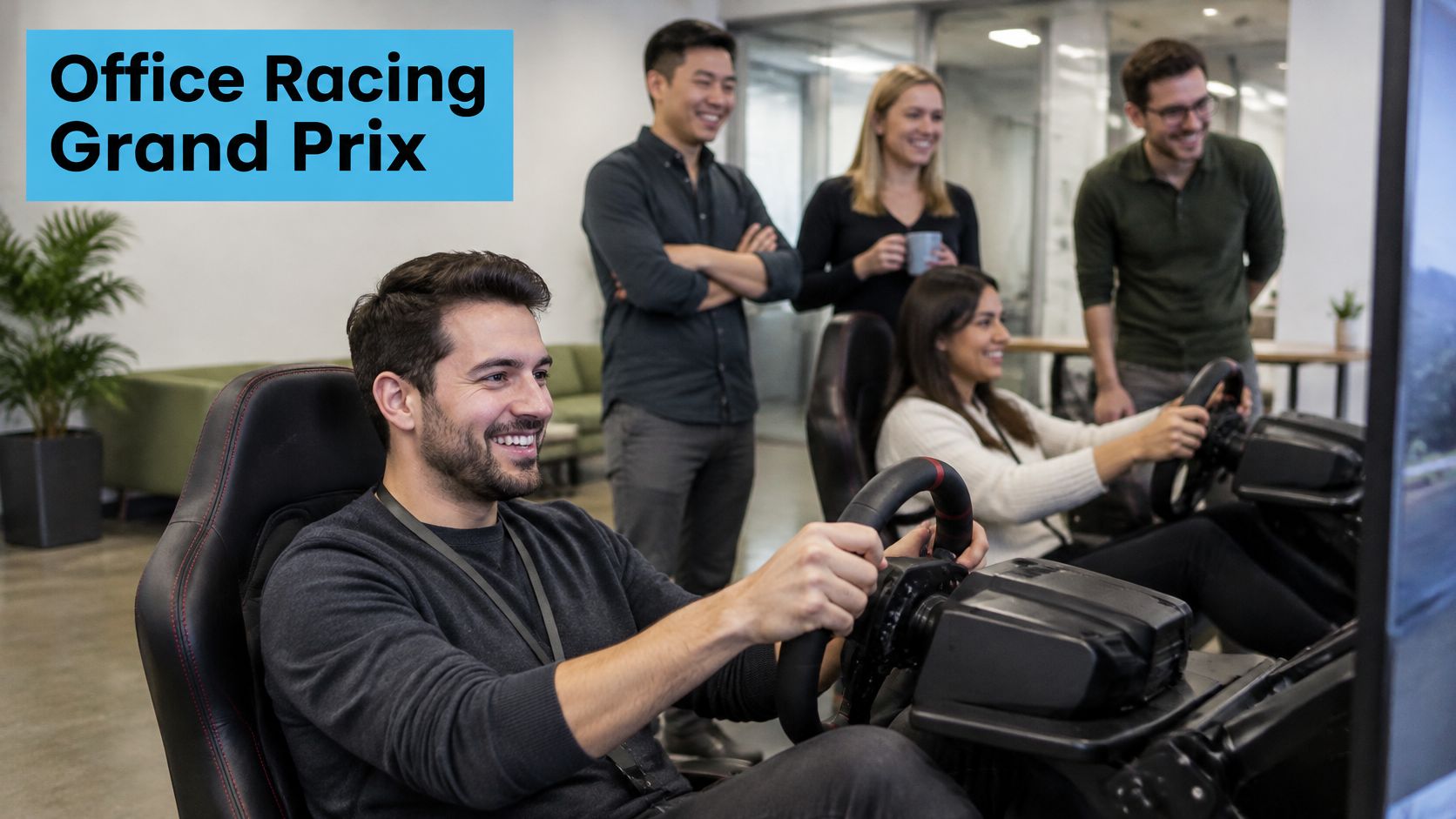
It suits sales floors, operations teams and mixed departments of 12 to 60 people. Above 40, add a second rig rather than lengthening the queue. A six-minute heat gives you roughly eight to ten drivers an hour per rig, so a 30-person tournament fits into an afternoon with room for a final.
The format answers a specific problem. The 2023 OC Tanner Global Culture report, which surveyed 4,653 UK employees, leaders, HR practitioners and executives, found that 47% described workplace praise as meaningless or an empty gesture, and 31% said recognition was delivered in a way that felt uncomfortable (People Management). A published heat sheet with names, times and a stated reason for each entry is the opposite of that.
Practical rule: publish the draw 48 hours ahead so line managers can protect the time, and open with a non-competitive practice lap for anyone who has never held a wheel.
- Cap the heat length: a hard stop keeps the schedule honest and stops one rival's grudge match eating the afternoon.
- Put live results outside the racing zone: screens in the break area give non-players a reason to stay involved.
- Book slots, don't queue: a booking board or shared sheet beats a scrum beside the rigs every time.
- Name the contribution: print one line on each driver's entry explaining what they were recognised for.
A regional sales team can run this as the afternoon half of a quarterly awards day: heats after lunch, final before the awards, winner announced on the same stage. We supply the rigs, installation, branding and on-site crew so your organiser stays with the people rather than the cables.
2. Golf and Rugby Simulator Team Challenge
Teams win this one on aggregate, not on one star player. Participants rotate around golf and rugby simulators collecting scores for accuracy, distance or tries, and every result feeds a team total. A beginner who lands one straight drive still moves the department's number, so nobody can hide and nobody can carry.
It suits departments with existing sporting rivalry and mixed-ability groups where a weaker player would otherwise opt out. Two to four stations, teams of four to eight, rotating on a 10 to 12 minute timer. Set handicaps before the first swing so one strong player can't drag a team to first place, and print the handicap rule on the draw sheet so nobody disputes it at the final rotation.
How the team scoring works
- Individual points convert to team points: three, two or one point per station, so a weak station doesn't sink a team.
- Every participant takes one shot: no spectators in the scoring, no passenger contributions.
- Most improved is a scored category: it changes behaviour, because people start coaching each other between rotations.
- One leaderboard reveal at the close: a single moment beats drip-fed updates.
That coaching effect is why the format earns its place beyond one afternoon. The 2025 Global Culture Report, covering 4,896 UK respondents, found that regular, meaningful recognition was associated with employees being eight times more likely to report a strong sense of belonging (Employee Benefits). A rolling table, run quarterly with the same teams and published results, gives that recognition somewhere to live. For the thinking behind rotation formats and scoring design, this team building guide for HR managers is a useful read before you book.
A corporate hospitality day played straight works well here: golf and rugby stations side by side, teams rotating on a whistle, scores collated while people eat. Close with a small prize for the winning team and a bigger one for most improved. We supply the simulators, installation and on-site crew, so your organiser stays with the guests rather than the equipment.
3. Flight Simulator Experience Afternoon
Some appreciation is meant to feel like a milestone rather than a lunch. A motion or helicopter flight simulator, with an instructor beside each person, gives staff fifteen minutes of something they're unlikely to do twice: a take-off, a set flight path, or a landing challenge scored on the day.
It suits milestone celebrations, long-service awards, top-performer recognition and small groups of 8 to 24. Sessions run one at a time, so book appointments in advance and hand each person a printed slot. Anyone who prefers to stay on the ground can take the observer seat or watch the replay on the debrief screen.
An experience reward is not a universal reward, and pretending otherwise is where this idea goes wrong. In a survey of 2,000 UK employees, the most preferred forms of recognition were financial rewards at 71%, promotions at 66% and private thanks from a manager at 65%, while 19% said they had seen colleagues praised when their own contributions were ignored (People Management). Use the simulator as the visible highlight for a named group on a published list of reasons, and keep private messages and smaller rewards running for everyone who wasn't in that group.
Hand each participant a printed certificate with their flight time, the route they flew and the person who nominated them. It costs almost nothing and it outlasts the day.
Book a flight simulator experience as a block and build the schedule backwards from the longest session. A company can reward top performers with a flight sim session inside a wider company day, or keep it small and private for a single team's milestone. Either way, plan a group photo at the end so the moment is shared with colleagues who weren't in the room.
4. Virtual Reality Challenge Hour
VR earns its place here because it takes two minutes to learn and doesn't demand a competitive personality. Set up two or three headsets in a meeting room or a corner of the office, rotate people through short experiences, and post scores on a leaderboard everyone can see.
It works for open-plan offices, conference break zones and staff parties of 20 to 200, at roughly 15 to 20 people an hour per station. Each station needs about three metres square of clear floor, a power point, and a seat for anyone who'd rather not stand.
A cheerful participant testing a headset in a shared space.
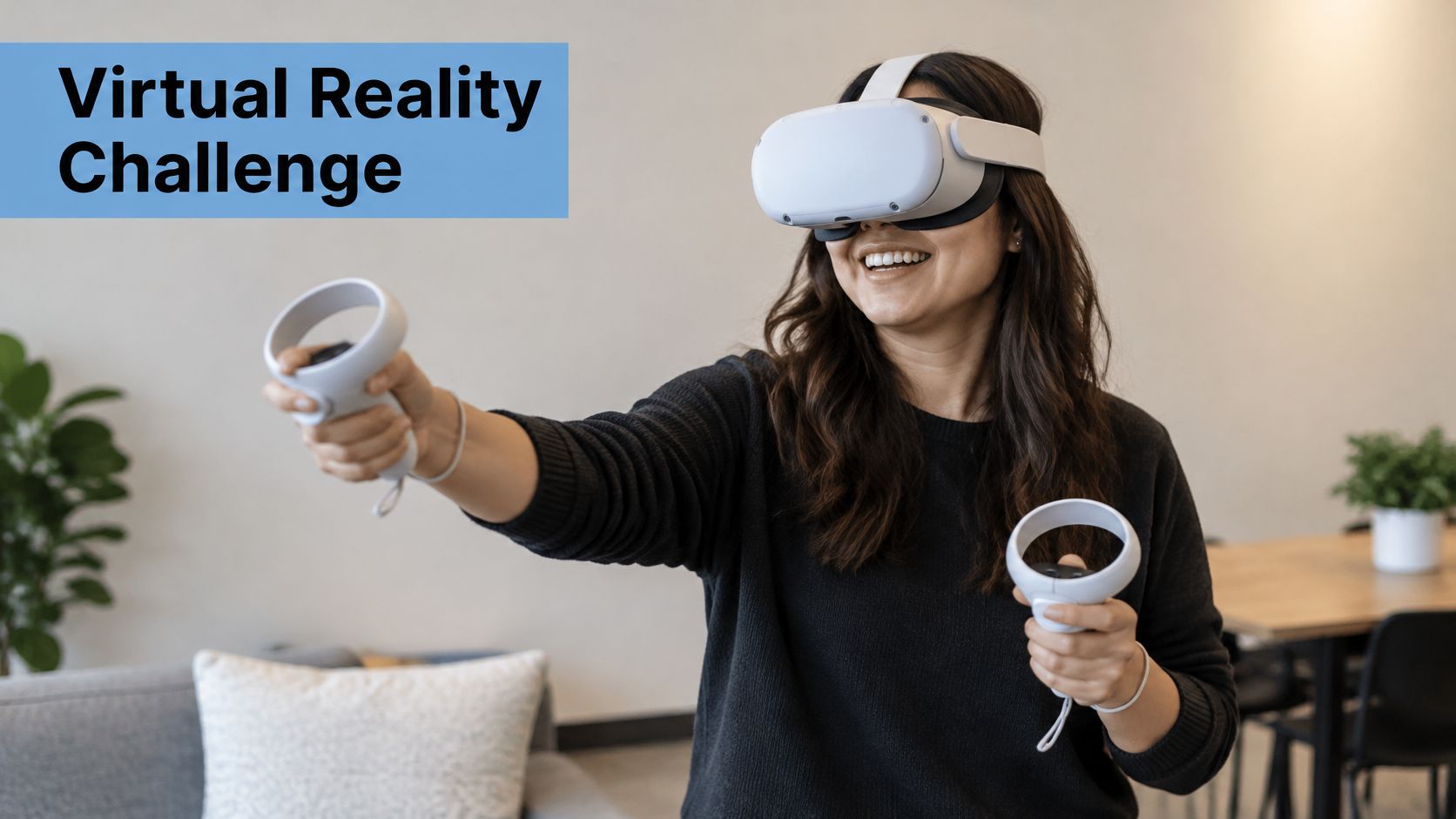
Keep sessions to two or three minutes. Long demos cause more discomfort than delight, and the queue behind the headset is the real cost of a slow turn.
Be clear-eyed about what a break can and can't do. A 2025 survey of more than 3,600 UK professionals found that 36% named lack of recognition and appreciation as a work-related cause of negative wellbeing, behind high workload at 46% and inadequate compensation or benefits at 39% (Hays). A headset hour doesn't fix that on its own. It works as a visible thank-you when a manager has already named what each person did, and it fails when it's the only thing standing in for that.
- Wipe down between users: wipeable covers and sanitiser at the station, every turn, visibly.
- Station a host: someone who explains the controls and keeps the queue moving solves most problems in the first ten minutes.
- Offer the seated version: plenty of people will play if they don't have to stand in a busy room.
- Reset the leaderboard hourly: it gives latecomers a fresh chance to top something.
A conference break zone is the natural fit: exhibitors and visitors take a quick turn between sessions, and the organiser gets a steady, self-managing crowd pull.
5. Giant Scalextric Race Day
Slot cars are the great leveller. A giant Scalextric track takes real visual space, races in heats, and produces a final that a whole office will stand and watch. That spectator value is what makes it work as appreciation: the people who aren't racing are still part of the room.
Plan heats in blocks so every participant races at least twice, and put a marshal on track resets so one dead car doesn't stall the schedule. Teams of two to four with 16 to 40 people per session is the practical ceiling. Beyond that, run two sessions or split by floor, because the queue is what people remember when the racing isn't moving.
A pair of colleagues mid-race on a slot car circuit.

Put the rules on the same sheet
Fairness is where most recognition stalls, and a race day is no different. Perkbox research on the science of reward found that 23% believed workplace rewards were influenced by favouritism and only 39% understood how reward decisions were made (Perkbox). Apply that to a race: publish the format, the points and the prize in one place, and say out loud who chose the winners and how.
- Set a clear spectator area: it protects the track and makes the racing watchable from a distance.
- Use team colours or branded decals: it takes ten minutes and transforms the photos.
- Give the marshal a name badge: the person resetting the track is a contributor worth thanking publicly.
- Run a family bracket: a corporate family day with a race for staff and another for children doubles the turnout.
Book a giant Scalextric hire setup with the branding pre-printed, and put the bracket on a wall where people can read it. A festival fan zone can run the same format alongside other attractions, swapping the corporate bracket for an open queue.
6. Casino Table Night
This is an evening format, not a lunchtime one. Blackjack, roulette and poker tables with play chips, a prize table at the end, and a dress code that gives people a reason to dress up. It suits awards dinners, long-service evenings and company anniversaries of 60 to 300 guests.
Say clearly, on the invitation, on the table cards and again in the closing speech, that the chips have no cash value. Anyone who doesn't want to play needs a real alternative in the same room, not a corridor: a photo booth, a seating area by the bar, a live music corner.
The prize table is where choice matters most. Workhuman's 2024 Human Workplace Index, which surveyed 1,000 full-time UK employees, found that 61% felt a formal recognition programme would make expressing gratitude feel more natural, and nearly 80% would use points from a recognition programme to buy gifts (Workhuman). Build a tiered table with something at each level, and let winners pick rather than handing out thirty identical bottles.
Where the evening goes wrong
- Awards after the casino: run the presentation first, then open the tables, or half the room is distracted during the thank-yous.
- No briefing for croupiers: give them the company context so they can chat, not just deal.
- One price point for prizes: a wide range suits mixed budgets and mixed tastes.
- A dress code with no warning: three weeks' notice, and a stated alternative for anyone who'd rather not.
A company awards dinner works well with a casino floor after the main presentation. A private party can use the same setup for a milestone anniversary, with the prize table swapped for small mementoes.
7. Climbing Wall Team Challenge
A portable climbing wall stops people in their tracks, and it works as appreciation because it hands someone a visible, personal win in front of colleagues who cheer them on. Teams score points for speed, height or completion, and route difficulty is set so beginners can score too.
Book ten-minute climbing slots per person and publish them. A wall serving 20 to 50 people on a fixed challenge moves slowly without a timetable, and slow queues read as poor planning. Keep two easy routes open at all times, offer a cheer squad role for anyone who'd rather not climb, and close with a short finish celebration rather than letting people drift away.
Time is often the honest currency when an activity can't reach everyone. Government analysis of flexible working notes that it can help employees balance professional and personal lives and can increase staff motivation and retention, while the legal right is to request an arrangement rather than to receive every one (GOV.UK). If your wall runs across a shift handover, give the late crew a slot inside their hours or the equivalent time back. That is where the inclusion argument is won or lost.
What breaks it: a single hard route and a stopwatch. Set three grades of climb and score completion as heavily as speed.
Brief every climber on safety and check harness fit before each attempt, not once at the start. A mobile rock climbing wall with an on-site crew handles the safety briefing and the queue, which frees your organiser to take photos and thank people by name.
8. Boxing and Sports Simulator Fun Day
Boxing simulators and multi-sport rigs give an afternoon a scoreboard and a bit of theatre. They only land as appreciation when the day has two layers: a shared, visible experience and an individual, specific thank-you. Build both before you book the equipment.
The gap to design around is a perception gap. A 2026 survey of 4,000 UK employees and 1,000 HR leaders found that 78% of employees felt more motivated when recognition was paired with financial rewards, while 75% of HR leaders believed employees felt valued by their recognition programmes compared with only 53% of employees (HR Review). A fun day can widen that gap: the room has a good time, and people still go home without hearing why their work mattered.
Running the rounds
- Brief before every round: a clear safety zone, a stated time limit and a marshal who enforces both.
- Offer a speed round: thirty seconds suits anyone who wants a turn without the audience.
- Pair simulators with food: a drinks and catering area keeps people in the zone instead of drifting back to desks.
- Add non-athletic categories: best teammate and best celebration are scored categories too.
Pair each heat with a manager saying one specific thing about the person before they step up. That single change separates this from a sports day with a leaderboard.
A staff sports day works with boxing and other simulators in one zone, and a brand activation can use the same boxing challenge to draw a crowd at an exhibition. Keep the queue visible, keep the rounds short, and keep the naming of contributions louder than the scoreboard.
9. Interactive Sports and Festival Fan Zone Appreciation Day
For a site-wide event, no single attraction covers it. A fan zone strings together simulators, giant games, VR, food stalls and a stage, and lets staff move between them as guests rather than attendees at a compulsory assembly. It's the format that scales furthest, and the one that needs the most planning.
Colleagues taking a casual turn at a garden game in a bright workspace.

It suits sites of 100 to 1,000+ spread across buildings, shifts or regions, plus family fun days where children join. Budget the quiet zone as seriously as the headline attraction. A seated games area with food and shade is where the people who don't want a crowd will spend the hour, and they'll notice whether it exists.
Fitting the day to the workforce is the hard part. The 2024 to 2025 government survey of employees and self-employed workers found that 79% of employees had access to flexible working, including 40% with hybrid working and 39% with part-time arrangements (GOV.UK). A fan zone that runs 10am to 2pm on a Tuesday has designed a large part of that group out. Run two windows, one daytime and one evening, or take it to two sites.
Zoning and throughput
- Map queue routes first: draw the site plan before you choose attractions, and keep the food away from the busiest entrance.
- Publish a short programme: what's on, where and when, printed and pinned up in break areas.
- Staff the quiet zone: someone hosting a low-key activity makes it a legitimate choice rather than a hiding place.
- Shoot photos and video: internal comms after the event extend the goodwill to the shifts who couldn't attend.
How the 9 employee appreciation day ideas compare at a glance
| Item | Best for | Format | Key requirement |
|---|---|---|---|
| Office Sim Racing Grand Prix | Shared, competitive team appreciation | Bracketed heats and knockout finals | Space, power, safety briefing, and scheduled heats |
| Golf and Rugby Simulator Team Challenge | Team bonding across mixed-skill groups | Rotating simulator stations with combined team scores | Clear floor plan, equipment, and balanced scoring |
| Flight Simulator Experience Afternoon | Senior recognition or milestone celebrations | Short, instructor-guided simulator sessions | Advance time slots and trained supervision |
| Virtual Reality Challenge Hour | Quick, engaging breaks for large groups | Rotating VR games with a leaderboard | Headset cleaning, short sessions, and an opt-out |
| Giant Scalextric Race Day | Sociable events with active spectators | Slot-car heats followed by a final | Level floor space and track supervision |
| Casino Table Night | Formal dinners and celebratory social events | Hosted casino-style games using play chips | Clear play-chip rules, hosts, and alternative activities |
| Climbing Wall Team Challenge | Active team building and personal achievement | Timed or height-based team challenges | Secure space, trained staff, and safety procedures |
| Boxing and Sports Simulator Fun Day | High-energy, friendly competition | Round-based or timed simulator challenges | Safe movement space and clear player rules |
| Interactive Sports and Festival Fan Zone Appreciation Day | Large teams with varied interests | Full-day event with multiple attractions and entertainment | Suitable venue, capacity planning, space, and power |
Choosing the Right Appreciation Day for Your Team
Start with the team, not the attraction. A sales floor of 30 people with a competitive streak suits a racing bracket and a published final. A mixed-age site event with shift workers and parents on the school run works better as a fan zone with quieter areas, food and two time windows. The best format is the one your people can reach.
Settle the date, budget and space before you compare suppliers. Then check what each format needs on site: power, floor area, access for a van, headroom, and the number of staff required to run it. These details drive cost and timetable far more than the attraction itself.
- Date: avoid month-end, stocktake and school holidays unless you're inviting families.
- Space: walking routes, queue space and a break area, not just the footprint of the equipment.
- Power: ask what each item draws and whether the venue supplies it or you hire a generator.
- Staffing: who briefs participants, who runs the queue, who takes the photos.
Book early for popular dates, especially March and the run-up to year end. Brief staff clearly on how to take part, in writing, with times and locations, and give managers a two-line script so they can name what each person contributed.
Plan one way to share the day afterwards. Photos in the internal newsletter, a short thank-you message from a director, or the leaderboard pinned up in the canteen all extend a single afternoon into a week of goodwill. If you're linking the day to a wider wellbeing programme, providers such as Telomyx health and performance testing cover the longer-term measurement side of that work.
PSW Events, a Cambridge-based one-stop event management and corporate entertainment company, can run the setup, delivery and on-site staffing so your organisers focus on the people rather than the logistics, and short-notice enquiries can often still be accommodated.
If you're planning an appreciation day and want the format settled before you commit budget, PSW Events supplies and runs interactive attractions across the UK, from F1 and multi-racing rigs to flight sims, climbing walls, casino tables and full fan zone setups, with installation, branding and on-site crew included. We'll talk through your team size, venue and date, then build a schedule that fits the people who have to attend. Visit PSW Events to see the full range and start a conversation about your date.