
You've found an electronic arcade basketball machine that fits the campaign, the artwork deadline is approaching, and the venue wants your final stand plan. Then the practical questions arrive: where will players queue, who clears a stuck ball, and can everyone reach the controls?
The cabinet is only part of the booking. For exhibitions and corporate events, you're specifying a small operational attraction, with power, staffing, accessibility and reporting requirements. Get those decisions right before signing, and the game becomes easier to run and easier to justify in the client report.
Booking Checklist Before You Confirm a Machine
Electronic arcade basketball can be a skill-with-prize attraction: UK Government guidance lists basketball games in this category and distinguishes skill-with-prize machines from gaming machines. Confirm the actual scoring and reward arrangement, rather than assuming every cabinet and promotion has the same classification.
Pre-booking checklist by requirement
| Requirement | What to check | Why it matters |
|---|---|---|
| Floor and approach | Clear space for the cabinet, player queue and wheelchair turning space | A stand plan that works on paper can block exits on the day |
| Power | Mains supply, lead length and whether the unit runs without a generator | Generator noise and fuel cost change the layout and budget |
| Certification | Current PAT evidence and applicable inflatable or electrical certificates | Venues may request these at site induction |
| Ball and hoop | Ball weight, ball-return path and hoop height | Affects accessibility, injury risk and queue speed |
| Staffing | Who resets the machine, clears balls and handles faults | Unattended faults interrupt participation and create queues |
| Waste and batteries | Who takes WEEE and batteries away after the event | Relevant workplace separation and producer-responsibility duties need an owner |
| Classification | Confirm the skill-with-prize basis and any ticket or prize rules | Helps establish the applicable amusement-machine framework |
Test the layout against the event
Say you're working with a 3 metre stand in a busy exhibition hall. The cabinet fits, but the player stands outside its footprint and spectators gather behind them. If the queue reaches an exit route, the booking doesn't fit operationally, even though the equipment dimensions fit geometrically.
Draw the player position, attendant station and queue on the plan. Keep the route to neighbouring stands and emergency exits clear, and agree where the attendant stops accepting players when the allocated space fills.
A marquee presents a different problem. If there's no mains socket near the proposed position, don't assume an extension lead solves it. Establish the machine's electrical demand, the available supply, cable routing and protection with the venue's electrical contractor before considering a generator.
Booking rule: Approve the operating footprint, not just the cabinet footprint.
When comparing arcade game rental options, work from the exact model rather than a representative photograph. Send the supplier your site plan, available power specification and the venue's certificate requirements; obtain the machine's power requirement and certificate copies before confirming.
Making Play Accessible to Every Visitor
Run an access audit before choosing the cabinet. The UK exhibition eGuide calls for accessibility to be considered when designing stands with exhibits and interactive features.
- Can a seated player reach everything? Check the start button, control panel and ball-return area without requiring someone to lean across a barrier.
- Can visitors approach and turn? Measure the usable approach and wheelchair turning space with the branding surround and queue barriers installed.
- What physical effort does play require? Test ball weight, grip, reach and whether someone can participate using one arm.
- Can players follow the game? Check display readability from different heights, contrast under venue lighting and adjustable audio volume.
- What happens when shooting isn't suitable? Prepare an alternative scoring format and the same opportunity to participate in the activation.
The photograph illustrates seated participation, but your booking decision needs a test of the actual equipment.
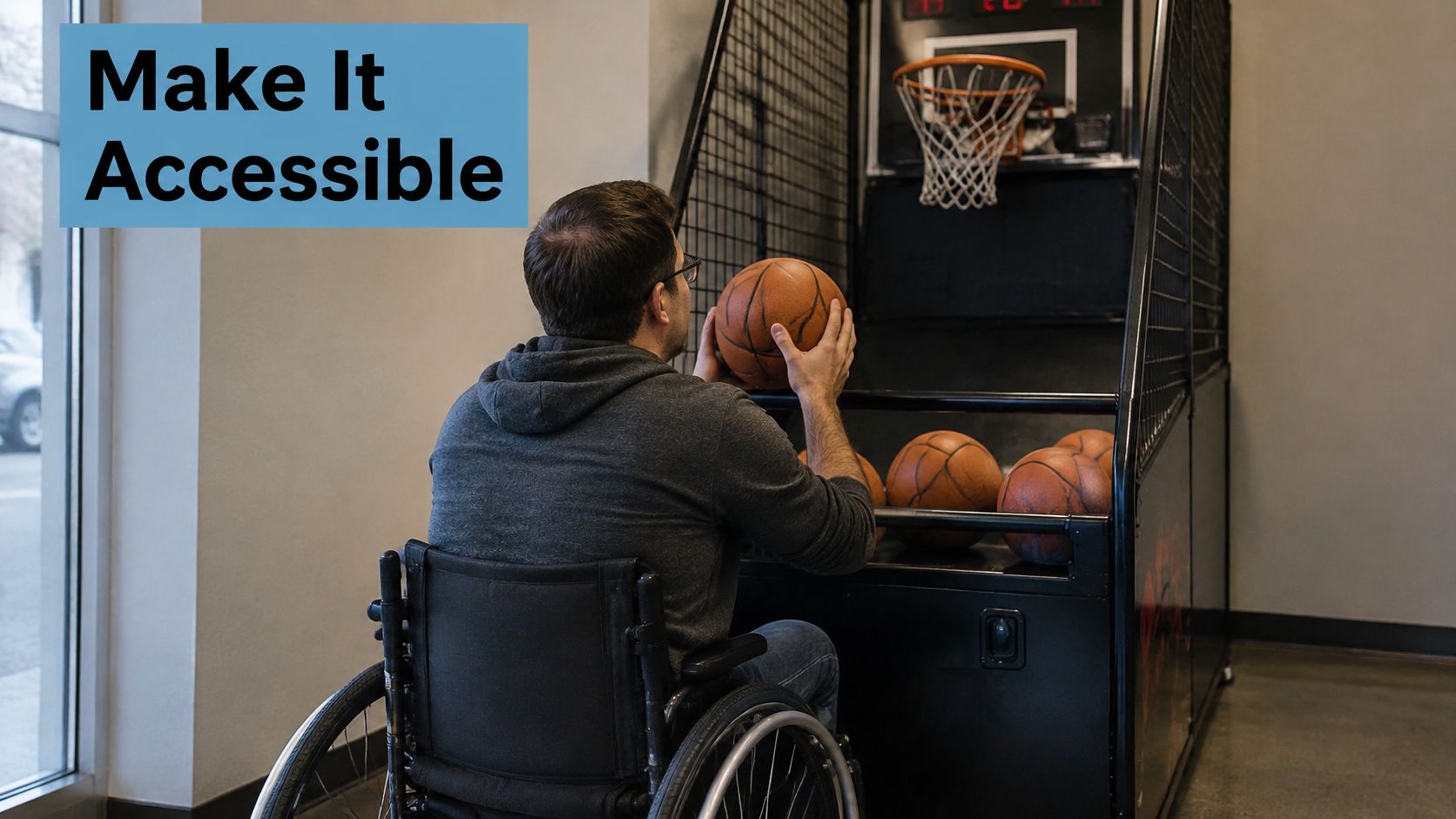
Test independence, not just available space
A wider stand doesn't make a high fixed hoop accessible. Nor does it solve a heavy ball, an unreachable return tray or a countdown that gives someone insufficient time to collect and release a shot.
Test the exact model at the venue, with its proposed graphics and furniture. Ask whether players can use it independently and what assistance they would prefer, rather than assuming assistance is welcome. Keep any transfer space clear, but don't make transferring out of a wheelchair a condition of participation.
At an employee event, a wheelchair user might reach the start button but not the ball return. A seated-height ball station can address collection where the shooting position is otherwise suitable; if shooting remains unsuitable, offer an accessible points-only activity without a timed shooting requirement. Route both options to the same participation and lead-capture process, without asking the visitor to explain their disability.
Safety, Waste and Documentation Duties
Inspection covers the whole attraction, not just the illuminated scoreboard. The Health and Safety Executive's amusement-equipment guidance sets out the principle of safety so far as reasonably practicable and regular inspection by a competent person to identify deterioration, damage and wear.
Turn that into a recorded pre-use check of the frame, hoop, net, ball return, guards, cables, electrical connections and stability. Check after installation, when the machine is in its final position, rather than relying solely on a warehouse inspection.
Under the General Product Safety Regulations 2005 guidance, consumer products in Great Britain must be safe in normal or reasonably foreseeable use; Northern Ireland moved to EU Regulation 2023/988 from 13 December 2024. For basketball equipment, assess repeated shooting, contact with the cabinet, ball handling and participation by children or inexperienced players.
Keep an event-ready document pack
- Equipment records: Hold inspection and maintenance information, applicable test certificates and the operating instructions.
- Installation assessment: Record stability, cable protection, surrounding clearance and restrictions on use.
- Operating responsibilities: Name the person authorised to isolate the machine and the route for reporting defects.
- Waste records: Keep applicable waste-transfer documentation and evidence supporting the agreed take-back, repair or reuse route.
Every inflatable and electrical piece of PSW Events equipment has an RPII or PIPA test certificate and a PAT test certificate. Request the copies relevant to the booked equipment, rather than treating an inflatable certificate as a universal requirement for a rigid cabinet. Include these in the wider event health and safety arrangements.
Settle disposal responsibility in writing
Since 31 March 2025, workplaces in England with 10 or more full-time-equivalent employees must separate dry recyclables, food waste and residual waste; workplace recycling guidance excludes electrical items and batteries from ordinary recycling collections.
A returned hire cabinet isn't automatically waste. Nevertheless, agree who handles failed electrical parts, spent batteries and packaging, and how any actual WEEE enters an appropriate collection route.
Ask who removes batteries, where they go, and what documentation will be available. A durable machine with a credible repair and reuse process can be a better procurement choice than replacing equipment for appearance alone.
Branding and Lead Capture That Pay Back
Start with the branding surround, not a logo file pasted onto the cabinet photograph. Specify the header panel, side graphics and any usable scoring-display branding so visitors can identify the sponsor from the aisle.
As an artwork rule, place the main logo around head height on the cabinet and repeat it on the queue barrier. Check sightlines with people standing in front of the machine. Keep graphics clear of the scoring sensor, ventilation, ball-return path and control panel.
Build capture into the handover
After each completed round, the attendant can offer a short form or badge scan while the next player approaches. Keep participation and marketing permission distinct, and don't turn the game into a compulsory sales interview.
Visitors using an accessible points-only format should reach the same capture point. Give the attendant a short, consistent explanation of what happens after someone submits their details.
If a printed takeaway supports the conversation, The Print Warehouse Ltd's design tips for printed leaflets are a useful reference when briefing the artwork. Match the leaflet's message to the activation, with a clear next action rather than a crowded product catalogue.
Measure the commercial handover, not just how many people watched the game.
For a hypothetical campaign, a £2,400 hire and staffing bill, 240 completed rounds and 160 scanned badges produce a £15 cost per captured lead. Those are planning assumptions, not a hire quotation or an expected result.
Keep completed rounds, captured leads and cost per lead separate in the report. Then record how many captured leads become meetings within a week: a low acquisition cost is less useful if nobody follows up promptly or the contacts aren't relevant to the sales team.
What Hire Costs and What Drives It
A SEGA Sonic Sports Basketball Redemption Machine was listed by Liberty Games at £7,995 excluding VAT in 2025, with England and Wales delivery and installation listed as free. That's a purchase listing, not an event hire rate.
At the other end, PriceSpy UK listed an Electronic Arcade Basketball Neon Series product at £39.99 in 2025. A consumer product listing isn't a like-for-like alternative to an installed, supported corporate-event attraction.
Listed prices for arcade basketball
| Item | Listed price (2025) | What it covers |
|---|---|---|
| SEGA Sonic Sports Basketball Redemption Machine | £7,995 excluding VAT | Machine listing; England and Wales delivery and installation listed as free |
| Electronic Arcade Basketball Neon Series | £39.99 | Consumer listing; not comparable with event-grade hire |
| Full event hire with staffing and insurance | Obtain an itemised event quotation | Ask for delivery, staffing, certificates and waste removal to be explicitly included |
Compare the delivered service
The useful comparison is total event cost, not the lowest headline machine price. Hire duration, machine quantity, staffing hours, insurance arrangements, power provision, branding and waste handling all belong in the commercial discussion.
Delivery access matters too. Tell the supplier about loading slots, lifts, stairs, restricted vehicle access and collection deadlines before accepting the quotation. Otherwise, you're comparing an accurately scoped proposal with an incomplete one.
Separate included services from optional additions. Check whether staffing covers opening hours only or also the briefing and test run, and whether collection includes removing the supplier's packaging.
Ownership may suit repeated use, but it also leaves you responsible for storage, transport, repairs and competent operation. Hire transfers only the responsibilities included in the agreement; it doesn't remove the organiser's need to coordinate the venue.
A cheap unit that needs a generator, two attendants in a hypothetical setup, and separate battery disposal can cost more overall than a dearer machine powered by the venue and collected under an agreed service. Compare the practical arrangements before negotiating the cabinet rate.
How to Run the Activation Step by Step
This routine suits a stand or floor activation running for a day or more, where the same team resets the machine many times. Brief everyone against the same operating sheet so a change of attendant doesn't change the rules.
The visual provides a quick staff briefing aid.
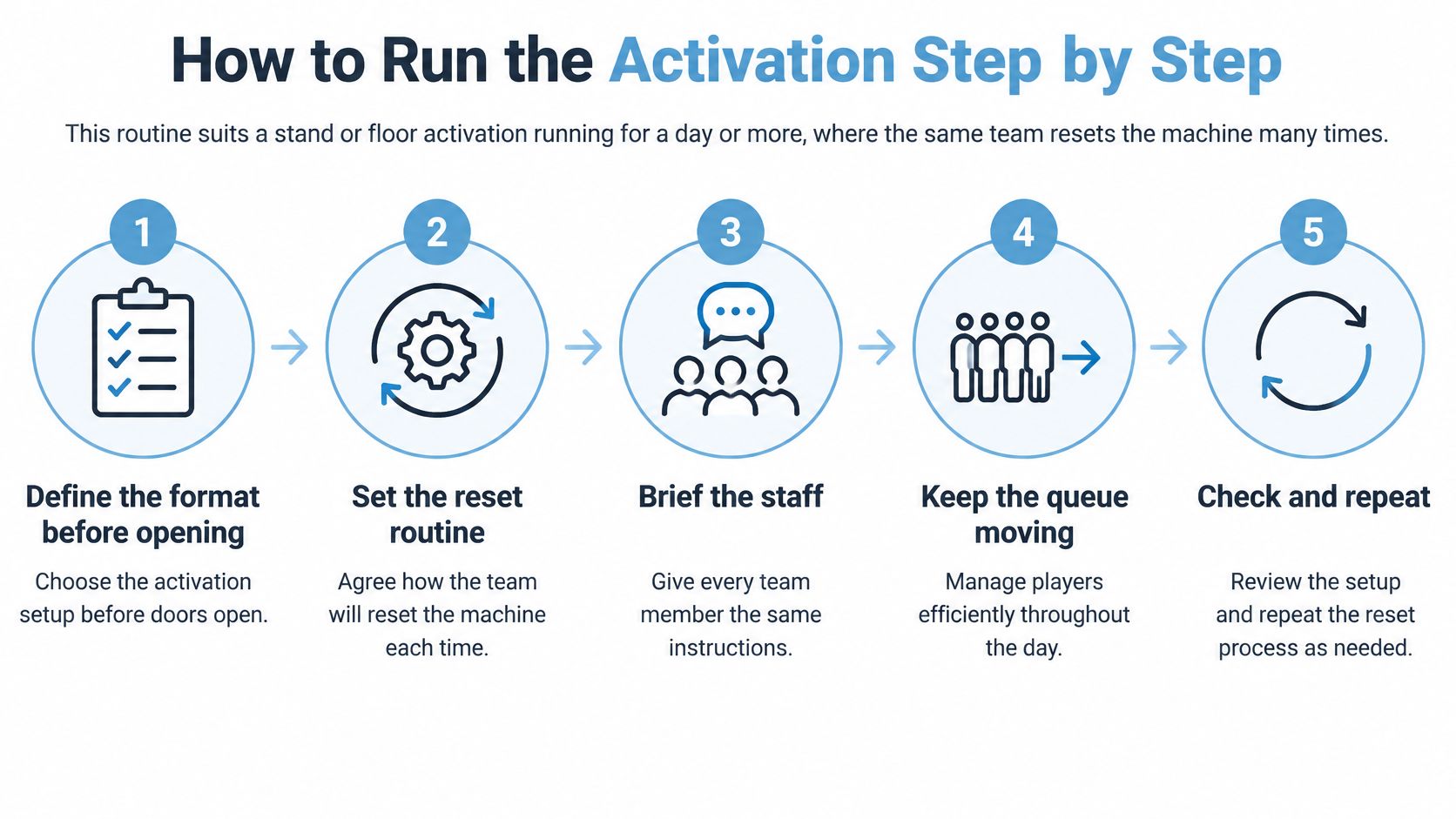
Use a repeatable operating routine
- Define the format before opening. Choose fixed-time rounds, for example a hypothetical 30-second round, or first-to-target scoring, and publish the rules on a sign. The common slip is allowing informal retries that lengthen the queue and make results inconsistent.
- Inspect and log the installation. Check the cabinet, hoop sensor, ball-return path, power leads, floor stability and surrounding clearance before admitting players. Don't assume the delivery crew's handover replaces the operator's check of the finished stand.
- Record the running conditions. Log participant flow, round duration, scores, faults and queue length every hour as an operating routine. Recording only the highest scores hides slow handovers, abandoned queues and repeated interruptions.
- Investigate abnormal results. Stop play after an unregistered shot, a stuck ball or an unexplained score, then reset according to the manufacturer's procedure and verify the sensor before restarting. Never reach into an energised mechanism or let an untrained attendant improvise a repair.
- Review when conditions change. Reassess after incidents, layout changes or equipment swaps, and brief the incoming team on the revised controls. The common failure is moving a barrier or cabinet without checking what that does to the player area and escape route.
Buckinghamshire Council's event risk-assessment guidance calls for attractions and equipment to be assessed separately, with hazards, affected groups, controls and findings recorded and reviewed when risks change. Keep inspection and maintenance records available, and remove defective equipment from use until repaired.
Respond to the cause of the queue
Say a hypothetical three-day exhibition develops a 40-minute queue before the afternoon peak. Watch the handover before changing the round length: if the delay comes from collecting and feeding balls, adding a second ball attendant may help; if the playing area itself is saturated, another attendant won't create space.
Give the floor lead authority to pause admissions and explain the delay. Don't keep accepting players just because the queue looks impressive in photographs.
A healthy operating day has steady round lengths, consistent throughput and no unlogged faults. Staff should know both how to restart normal play and when they must stop.
Metrics That Make Results Comparable
Operating measures for arcade basketball
| Metric | Formula | What it tells you |
|---|---|---|
| Throughput | Completed rounds divided by operating hours | How many player-rounds the attraction handles per hour |
| Scoring reliability | Correctly registered shots divided by observed shots | Whether the sensor needs a reset or a check |
| Availability | (Scheduled minutes minus fault and reset minutes) divided by scheduled minutes | How much booked time was available for play |
| Attempts and round length | Recorded per round and per session | Makes results comparable across venues and formats |
Top scores tell a client little about operational performance. A skilled player can post an impressive result while the attraction spends much of the session unavailable.
For throughput, distinguish player-rounds from unique visitors. Repeat players increase completed rounds without necessarily expanding audience reach. If unique participation matters, record it separately through an appropriate registration method.
Apply consistent definitions
Consider a hypothetical 6-hour stand with 180 completed rounds and 25 minutes of resets, with no other downtime. Throughput is 30 rounds per hour, and availability is about 93 per cent, calculated from 335 available minutes divided by 360 scheduled minutes.
For a separate illustrative sensor check, 98 correctly registered shots from 100 observed shots give 98 per cent scoring reliability. Record how you observed those shots; a brief check during quiet play isn't evidence that every round performed identically.
For attempts and duration, record each round's attempted shots, successful shots, actual playing time and interruption reason. Include an age band or height category only where appropriate and necessary for the comparison, without collecting unnecessary personal information.
An electronic leaderboard presentation can make competition easier to follow, but the public display and the operational log serve different purposes. Keep a separate record of downtime and checks rather than expecting the visible score list to explain the event.
Reporting caution: An unstandardised win rate isn't a reliable measure of attraction performance.
Player height, shooting distance, ball condition, fatigue, round length and difficulty settings all affect outcomes. Agree what constitutes a completed round, a valid shot and a fault before opening, then use those definitions throughout the report.
Confirm the Site Survey Before You Sign
A supplier's product photograph can't confirm whether your event layout works. The final approval should relate to the exact stand, hall or marquee, including the delivery route and the positions of neighbouring activity.
Treat the booking as a production sign-off, not just an equipment reservation. Resolve the remaining decisions in this order.
Turn the plan into an agreed installation
First, request a site survey or an accurately scaled layout. Send the pre-booking checklist with your request, plus the venue's access information and the location of available power. Include the branding surround and furniture in the drawing so nobody approves an empty-space version of the stand.
Next, obtain a short written operational confirmation:
- Game format: The scoring rules, round limits and treatment of interrupted attempts.
- Accessible participation: The exact-model test and agreed alternative activity.
- Live support: The person responsible for resets and fault clearance during opening hours.
Keep that confirmation separate from the safety and waste document pack so the floor team can find the operating decisions quickly. Check that the named contact will be reachable during your event, rather than only during office hours.
Approve power, people and rehearsal together
Finally, agree the power arrangement and staffing plan against the finished layout. Book the test run at least a day before opening as a planning recommendation, allowing time to correct a blocked return path, poor display sightline or unsuitable cable route.
We offer simulator hire for American Football, Baseball, Basketball, Boxing, Cricket, Cycling, Football, Golf, Ice Hockey, Rowing, Rugby and Shooting. That gives planners comparing sports activities a defined starting point, but the exact attraction still needs approval against the venue and audience.
During the rehearsal, have the attendant run a complete player handover, not just switch the cabinet on. Test the normal round, the accessible option and the response to an interrupted game.
A confirmed booking ends with a signed site plan, a written scoring format and a named person on call during the event. If any of those is missing, there's still an operational decision to make before doors open.
PSW Events provides interactive attractions for exhibitions and corporate events, with planning, branding, logistics, installation, on-site staffing and health and safety support. Visit PSW Events with your venue plan, audience requirements and event dates to discuss an electronic arcade basketball activation built around your available space and operating needs.