
You've got the venue hold, the client wants two racing simulators and a VR zone on a stand that looked spacious on the floorplan, and the venue has just asked for your risk assessment, method statement, insurance, and crowd plan by Friday. That's the point where most organisers discover event health and safety isn't a folder you submit. It's a set of decisions about queues, power, staffing, and escape routes that have to work when the doors open and everyone's moving at once.
Done well, it doesn't slow delivery down. It stops you rebuilding a queue barrier at 8 a.m. because it blocks a fire exit, or discovering your operator can't explain the emergency stop procedure to the venue safety officer.
What Event Health and Safety Actually Covers in the UK
Generic workplace safety covers your crew building a set, loading kit, and working around cables. Event health and safety adds the public to that picture, plus temporary structures, hired attractions, stewards, medical cover, and people who don't know the venue and won't read your signage carefully if they're excited, lost, or rushed.
That distinction matters because equipment can function correctly and still create risk. A simulator with a long queue across a circulation route, a climbing wall beside a busy entrance, or a fan zone game that empties participants into oncoming foot traffic are all safety problems, not just operational annoyances.
Where the perimeter sits
The Health and Safety Executive identifies crowd surging, swaying, crushing against fixed structures, falls, and trampling as principal hazards at crowded events in HSE guidance on assessing crowd safety risks. The same guidance expects you to assess foreseeable crowd dynamics, coordinate with relevant parties, and plan for incidents and emergencies. Routine operational safety doesn't normally ask you to do that.
Use this test for each element of your event:
- Routine workplace safety: Build, breakdown, loading, manual handling, electrical work, and staff welfare away from the public.
- Event-specific safety: Anything where visitors interact, queue, circulate, evacuate, or depend on stewards, operators, or medical staff.
- Overlap: Temporary structures, powered attractions, and escape routes, where a build decision becomes a public risk on show day.
If an item sits in the overlap, it needs someone named, a control you can point to on the floorplan, and a check before opening. Paperwork alone won't satisfy a venue or regulator. They're looking for foresight, which means you thought about what the crowd would do, not what you hoped they'd do.
Legal Duties, Duty Holders and Who Is Responsible
At a busy activation, the first question after an incident is who had authority to stop it. If the simulator kept cycling while a queue compressed the exit lane, “the supplier runs the kit” is not an answer a venue or inspector will accept.
The event organiser remains the duty holder for public safety. A contract can hand tasks to a venue, attraction supplier, or stewarding company, but it cannot hand over the duty to check those tasks are competent, coordinated, and current on the day. Under UK guidance, the organiser retains overall responsibility for public safety even when stewarding is assigned to contractors, and must define who is responsible for each safety duty in normal operations and emergencies.
I map duties as authorities: who can pause, close, stop, refuse, and evacuate.
| Duty holder | Authority on the floor | Evidence I ask for |
|---|---|---|
| Organiser | Pause entry, approve reopening, own the risk assessment | Named lead, briefing record, escalation route |
| Venue | Control capacity, doors, house systems, evacuation call where agreed | Capacity limits, opening checks, alarm procedure |
| Attraction supplier | Stop the ride or simulator instantly, refuse participants | Operator competence, inspection status, method statement, screening rules |
| Stewarding lead | Close a queue, redirect flow, hold a pinch point | Deployment plan, radio channel, incident log |
Shared delivery works when each authority has a named person before doors. Put those names, trigger points, and handovers on one page at event control. Re-brief when the layout, arrival rate, or staffing changes.
Competence matters more than org charts. Ask who is on site, what training they have, and who can act without calling a manager. Your risk assessment should carry the organiser's name because accountability stays there even when specialist work is contracted out.
Writing a Risk Assessment That Survives Scrutiny
A credible assessment follows five steps and stays specific to your layout, audience, and kit. Generic wording copied from a previous event fails quickly because venues compare it against the floorplan in front of them.
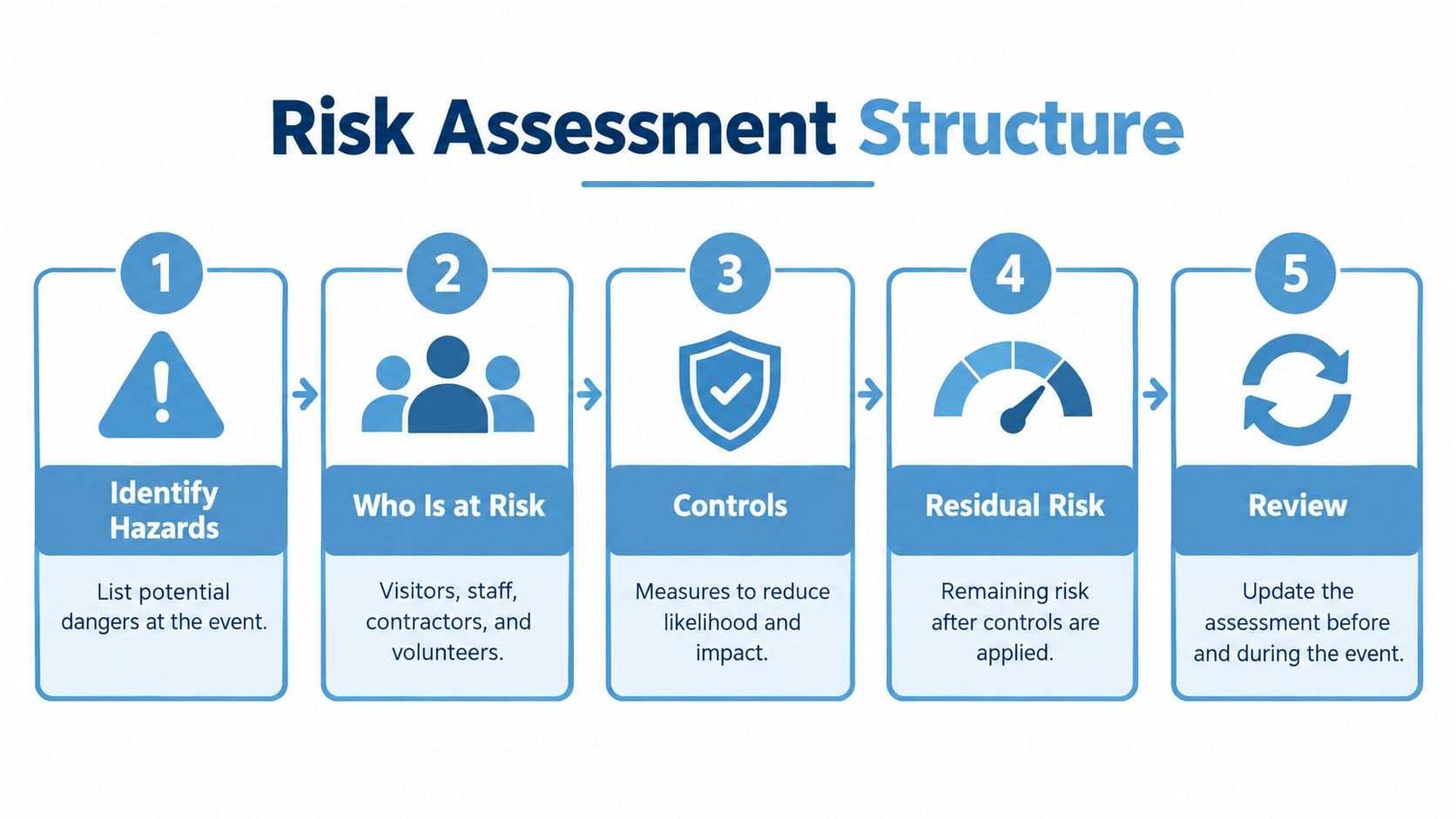
Start with hazards, identify who is at risk, set controls, record residual risk, then review before and during the event. For structure, a practical event risk assessment template helps, provided you replace every generic line with site-specific detail.
Three worked examples
- Simulator installation: Electrical supply, trailing leads, participant restraint, and sudden motion. Controls include PAT tested equipment, protected cable routes, restraint checks, operator screening for relevant medical exclusions, and a tested emergency stop.
- Climbing wall: Fall from height is the obvious hazard, but anchoring, matting, harness fitting, and bystanders entering the fall zone matter just as much. Controls include anchor inspection, competent fitting, and a segregated landing area.
- VR zone: Participants can't see cables, furniture, or other guests. Controls include overhead or managed cabling, a cleared play area, a spotter, session limits, and a clear response if someone feels unwell.
The wider context is sobering. HSE data recorded 126 workers killed in work-related accidents in 2025/26, with falls from height at approximately 28% of worker fatal injuries, averaging about 37 deaths per year. Those are all-sector figures, but they explain why build and breakdown controls belong in the same document as live-show risks.
Review the assessment whenever the floorplan, weather, supplier, or audience changes. A signed version that no longer matches the room is weaker than an updated draft the team has briefed.
Crowd Capacity, Flow and the Three Phases of Crowd Movement
A racing simulator with a forty-minute queue doesn't care that the hall is licensed for twice the headcount currently inside it. Density is local, and capacity failures are almost always local too. One hot attraction, one pinch point, or one badly placed registration desk can overload a corner while the rest of the floor stands half empty.
So treat capacity as the number of people who can arrive, circulate, participate, and leave safely under your layout, your audience, and your staffing. Change the layout and the safe number changes with it.
UK guidance requires organisers to assess crowd safety across arrival and entry, movement within the venue, and departure and dispersal, and to provide a way to leave a queue without moving against the crowd or into vehicle traffic. Each phase fails differently, so assess each on its own terms.
| Phase | Where it fails | What fixes it |
|---|---|---|
| Arrival | Doors, registration, and security checks where demand arrives in pulses | Timed entry, enough lanes, queue space that doesn't spill onto traffic routes |
| Circulation | Crossflows where a queue, an attraction exit, and foot traffic collide | One-way routing at peaks, queues on dead space rather than stairs or escape paths |
| Departure | Everyone leaving after a keynote, final race, or prize draw at once | Staggered finishes, secondary exits opened, staff holding egress routes clear |
Two things sit underneath all three phases. First, named staff watching density and behaviour, with a defined escalation route to the event controller or safety officer rather than a vague instruction to "keep an eye on it". Second, honesty about throughput. If an attraction processes people slowly, the queue grows, and quoting a maximum capacity figure won't fix the crowd building in front of it.
Security Layouts and Accessibility Working Together
Three days before doors, the security contractor drops a ring of vehicle barriers across the forecourt. The pedestrian plan was signed off weeks earlier. Nobody walks it again. On opening morning the queue for the one remaining gap backs onto the road, and the step-free route now detours through a screening lane.
That sequence is common enough that the Sports Grounds Safety Authority warns that badly positioned vehicle barriers can create bottlenecks, increase crowd density and obstruct accessibility. The HSE lists the same hazards behind it: congestion, crossflows, inadequate entrances and exits, vehicles sharing pedestrian space. Security and access get designed by different people, at different times, against different risks, and the site inherits the conflicts.
So run the audit as a joint walk-through on a timeline. A fortnight out, overlay vehicle routes, delivery access, pedestrian flow and emergency access on one plan and catch the clashes on paper. At build, push a wheelchair through the finished layout: barrier gaps, screening lanes, queue rails, temporary ramps, tested as built rather than as drawn. On the morning, watch where the arrival surge pools and whether that crowd sits on an egress route or the accessible entrance. Before doors, agree who can reposition a barrier mid-event and who approves it. A layout that cannot flex under pressure is its own hazard.
Every security measure trades against movement. More barriers strengthen hostile vehicle mitigation and slow evacuation. Wider lanes speed up flow and dilute screening control. The workable answer is a tested compromise, documented and briefed to both teams.
More physical security is not automatically safer. If it narrows movement or delays evacuation, it can introduce the crowd risk it was meant to prevent.
Equipment Safety for Simulators, Rides and Interactive Kit
Interactive kit combines power, movement, software, and an unpredictable participant. Your controls therefore need three layers working together, inspected equipment, a safe installation, and an operator who can intervene early.
For suppliers, PSW Events is one UK option that provides planning, installation, staffing, and health and safety documentation for simulator and interactive attraction hire. Whoever you use, ask for the same evidence and check it matches the exact unit arriving on site.
Inspection touchpoints
| Equipment Layer | Key Check | Typical Evidence |
|---|---|---|
| Electrical | PAT testing, earthing, residual-current protection, protected cable routes | Test labels, certificates, installation sign-off |
| Mechanical | Anchoring, moving parts, restraints, emergency stop function | Inspection records, pre-opening test log |
| Participant interface | Screening, seating, harness or restraint fitting, supervision | Operator briefing record, operating procedure |
| Surrounding zone | Segregation of participants, queue, and bystanders | Floorplan, barrier check, method statement |
Review the venue's power, access, floor loading, and positioning constraints against the supplier's installation requirements for interactive attractions before build day. Most equipment problems I see are interface problems, a rig that fits the stand but leaves no safe operator position, or a cable route that crosses the queue because the nearest socket was in the wrong place.
Documentation should travel with the kit, inspection records, method statement, insurance, and operating instructions. Then test on site anyway. Run the emergency stop, check restraints under supervision, confirm anchors, and walk the bystander boundary. If the operator can't demonstrate a control, treat it as absent until proven otherwise.
Staff Training, Stewarding and Competence Evidence
Mid-afternoon on a busy Saturday, the simulator queue folds back across the main aisle and the nearest steward is being asked three things at once: how long the wait is, whether a child meets the height rule, and why the lane has stopped moving. If they have to radio for permission to pause the line, the control already failed.
UK guidance leaves room for judgement. The Purple Guide stresses that stewards should be suitably trained, with numbers depending on audience profile and venue logistics, while the organiser still answers for employees, volunteers, spectators and visitors. For interactive attractions, that judgement is tighter: the person on the queue is managing crowd behaviour, participant screening and a moving pinch point at the same time.
Build competence around the pinch points
Write role cards for the posts that exist: operator, queue controller, front-of-house greeter, event control, named safety officer. Each card needs authority, limits and escalation in plain language: who can stop a session, who can close a lane, which exclusions are enforceable, what is said over the radio, and when spectators are cleared. Keep the signed induction, briefing time and refresher date where the duty holder can produce them without digging through a van.
Short drills beat certificates. Before doors, run the awkward cases: an overloaded queue, a distressed participant, a lost child, a refusal at the restraint, a steward challenged for enforcing a rule. Role-specific refreshers stick better than an annual lecture, and crafting safety training videos that work can help turn procedures into briefings staff remember under noise.
Then assess behaviour on shift. The evidence folder matters less if nobody challenges an unsafe participant or escalates early; competence shows when someone spots drift and acts within their authority.
Emergency Planning, Medical Cover and Heat Contingencies
A medical plan built only around staff first aid doesn't fit a public event. Visitors faint in queues, children get separated, participants feel unwell after motion or exertion, and an evacuation has to work for people who can't use stairs quickly.
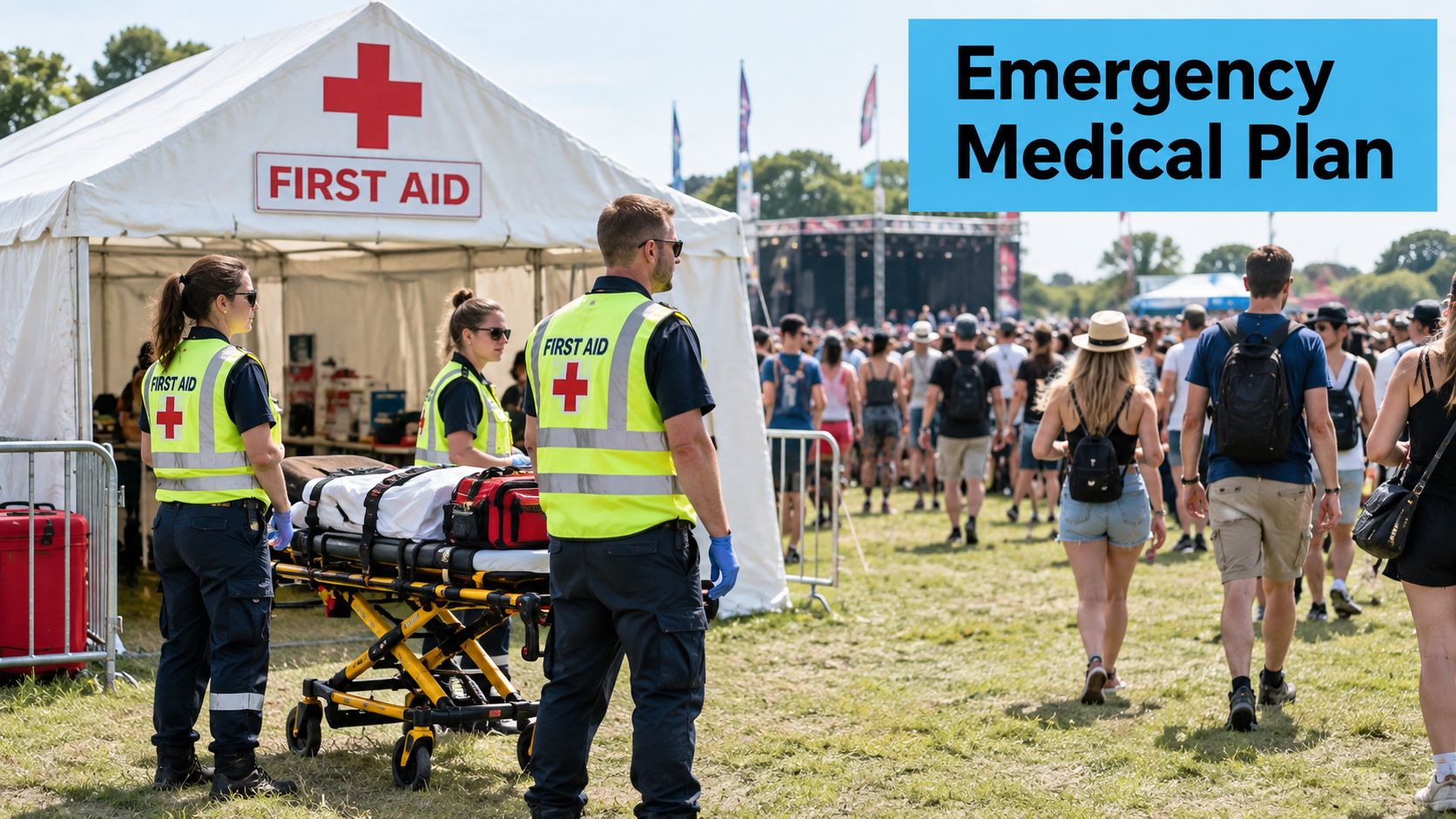
Assess first aid, medical, and ambulance needs against your audience profile, activities, and site access, then liaise with local services so your provision respects wider capacity. Use event first aid requirements as a planning prompt, but confirm numbers and access routes with your venue and medical provider. For team readiness, ERT training for medical professionals is a useful reference point for how structured emergency response roles are prepared.
Your plan should connect four things on one page, who responds, how they're contacted, where ambulances and responders gain access, and how evacuation and crowd communication work, including arrangements for disabled guests.
Heat is an operational risk, not a comfort note
England recorded an estimated 1,504 heat-associated deaths during five heat episodes in summer 2025, and HSE guidance expects organisers to plan for sudden bad weather, provide medical assistance, and give additional help to people with disabilities, limited mobility, learning difficulties, and children.
Make heat controls activity-specific rather than waiting for one temperature threshold:
- Shade and surface choice: Keep queues and high-exertion attractions away from heat-trapping surfaces where you can, and shade waiting areas.
- Hydration and rest: Visible drinking water, staff rotation away from powered kit, and welfare checks for vulnerable guests.
- Stop-work authority: A named person who can pause high-exertion activity, shorten sessions, or close a queue without a committee decision.
Fire Safety as an Overlapping Assessment
Fire safety shares information with your main risk assessment, but it isn't a subsection you can tick off inside it. In Great Britain, employers, building owners, or occupiers hosting events are required to carry out and maintain a fire-safety risk assessment, with findings leading to measures that minimise the risk of injury or loss of life in a fire.
Temporary attractions change the fire picture a venue assessed when the room was empty. Branded structures, stalls, powered kit, packaging, and queue barriers can add combustible material, ignition sources, and obstructions in one build.
Items interactive operators commonly miss
- Escape signage obscured by hired structures, branding, or simulator housing after installation.
- Extinguisher access blocked by flight cases, cable ramps, or queue rails near powered equipment.
- Storage creep under stands or behind set, where packaging and spare kit accumulate during the show.
- Changed layouts after a test day, where kit moves but nobody updates escape routes or the assessment.
For a structured cross-check against UK duties, the Wisenet Security Ltd compliance guide is a handy reference alongside your venue's own fire strategy.
Walk escape routes after build, not before it, and again after any move or addition. Fire controls must follow the assessed risks of the actual layout. If the room changes, the assessment must be maintained to match it, not filed as history.
Cross-References by Event Type
Different events fail in predictable places. Use your event type to decide which controls deserve the most scrutiny first, then work through the rest.
Where to look first
- Corporate conferences with hired attractions: Duty holders and equipment safety. Gaps usually sit between organiser, venue, and supplier, especially over who owns the queue and who can stop the kit.
- Exhibition stands with simulators: Crowd flow and fire safety. Small footprints, slow throughput, and branding that obscures signage create problems quickly in busy aisles.
- Brand activations in fan zones: Security layouts, capacity, and heat. Outdoor queues, temporary barriers, peak surges around fixtures, and accessible routes need joint testing.
- Private celebrations: Stewarding and competence. Smaller events often skip named crowd control, lost child procedures, and operator briefings because the guest list feels familiar.
- Large-scale festivals: Emergency planning and medical cover. Scale, weather, dispersal, and local service capacity dominate, with attractions adding localised density on top.
Fast-build setups deserve extra suspicion across every type. Electrical isolation, anchor checks, and escape route walks are the tasks most likely to be skipped when the schedule tightens, and they're cheap to do before doors and expensive to retrofit after.
Quick Reference Checklist
Print this for the safety officer and work it as evidence, not intention. Each line should end with an artefact someone can produce if the venue, client, or regulator asks.
Pre-opening evidence check
- Duties: Named organiser, safety officer, attraction operators, stewards, and escalation contacts on one briefed page.
- Risk assessment: Site-specific, signed, reviewed after layout or weather changes, with residual risks recorded.
- Crowd plan: Arrival, circulation, and dispersal assessed, queues tested, exits open and clear, density monitoring assigned.
- Equipment: Inspection records, PAT evidence, method statements, insurance, emergency stop and restraint tests logged.
- Staffing: Induction records, role cards, pre-shift briefing completed, stop-work authority confirmed.
- Emergency and medical: Provider confirmed, access routes clear, evacuation support for disabled guests briefed, heat controls in place.
- Fire: Assessment maintained for the as-built layout, escape routes walked, signage visible, extinguishers accessible.
Keep the checklist live during the show. Log incidents, near misses, queue closures, and equipment pauses as they happen, because reconstructing them afterwards helps nobody.
Event health and safety is judged by what was reasonably foreseeable, not by what was theoretically possible to prevent. Show that you foresaw it, controlled it, and checked it.
If you're planning an exhibition, conference, fan zone, or brand activation and want interactive attractions delivered with risk assessments, method statements, competent operators, and crowd-aware installation built in, talk to PSW Events about your floorplan and audience before you lock the layout. Bring us the venue constraints early and we'll help you build an attraction plan that works on paper and on show day.