
You've planned the floor plan, booked an impressive attraction and approved the artwork. Then the event opens. Attendees drift past the stand, glance at their phones, join a queue that blocks the aisle, and leave without speaking to anyone. The equipment works, but the experience doesn't.
That outcome rarely means the audience lacks interest. More often, the operation has made participation awkward. Customer experience enhancement at live events starts with staffing, flow and friction reduction, not with adding another screen or louder piece of branding. When people can understand what to do, move comfortably and get help quickly, engagement becomes far easier to create and measure.
Why Most Corporate Events Fail at Customer Experience
A corporate activation can fail in full view of a busy exhibition hall. At ExCeL London or Manchester Central, attendees may pass dozens of stands in a single day. If the attraction has no visible entry point, the queue spills into the main walkway or the host opens with a sales pitch, people keep moving.
The familiar response is to blame attention spans or audience quality. That's usually the wrong diagnosis. Visitors are making a rational decision based on the effort required, the time available and whether the reward is clear. A simulator with an unclear process creates hesitation. A physical challenge with one operator creates a queue. A generic prize-led game attracts a quick attempt but gives the brand little meaningful conversation.
UK audiences also bring strong expectations of competent service. The Institute of Customer Service UKCSI benchmark has been published twice a year since 2008. Its July 2026 score was 78.3 out of 100, up 1.0 point year on year and only 0.1 points above January 2026, using a consistent methodology covering 277 organisations and organisation types across 13 sectors. For event teams, that long-running baseline matters because it reflects expectations shaped by digital service, complaint handling and the quality of human interaction.
Practical rule: Treat every activation as a service operation with entertainment attached, not as equipment placed inside a branded space.
The wider UK picture reinforces the point. Ipsos and Engage Business Media reported that 47% of UK consumers had experienced indifferent or forgettable experiences in the previous year (UK CX Report). That doesn't mean an event needs constant novelty. It needs a clear invitation, a sensible journey and staff who can turn an attempt into a human interaction.
Start by auditing the activation from the attendee's position. Can someone see how to take part from the aisle? Is the first instruction understandable without an explanation? Does the experience work for someone arriving alone? Are there enough operators to manage the attraction and speak to participants? A practical guide to Manchester corporate events can help with broader planning context, but the same operational test applies at any venue. Use a written participation plan, such as this approach to encouraging event participation, before selecting the visual spectacle.
Choosing Interactive Attractions That Actually Engage
Choose the attraction by job to be done, not by novelty. A trade show stand may need a fast interaction that creates a reason to stop. A product launch may need a more controlled experience that supports a story. A team-building day may prioritise repeated participation, visible competition and shared conversation.
Use four filters before you confirm the hire.
Match the attraction to the audience
An F1 racing rig gives a motorsport audience an immediate hook, while a flight simulator may suit an aviation, travel or engineering context. A Batak Pro reaction wall is easier to understand at a glance and can work well when the objective is quick participation. VR can create immersion, but it also introduces practical considerations around cleaning, supervision, sightlines and the number of people who can take part at once.
The attraction should fit the audience's confidence and physical ability. Don't assume that every visitor wants a high-intensity challenge. Offer a simple entry route, explain the time commitment and make it easy to watch before committing.
Test throughput before you admire the kit
Ask how many people can participate in parallel, how long a typical attempt lasts and how quickly staff can reset the experience. A high-throughput attraction can pull people through a busy stand, while a slower simulator may create deeper engagement but needs more space and queue discipline.
Electronic leaderboards add a useful layer because they make participation visible. They can display individual or team scores and update throughout an event, giving people a reason to return or encourage colleagues. The board should support the experience, though, not become an excuse for a queue that nobody understands.
Check the physical footprint
Measure the operating area, not only the equipment dimensions. You'll need space for approach, waiting, spectators, staff movement, cable management and safe transitions. A compact attraction can still create a bottleneck if the queue forms directly across an aisle.
For hospitality-led events, the same thinking applies to supporting features. A mobile hot chocolate stand setup guide is useful when planning a warm drink station, because service space, replenishment and guest movement must work together rather than compete for the same footprint.
Make the brand connection part of play
Brand integration works best when it changes the experience itself. Use a custom livery on an F1 rig, a themed Batak Pro challenge or a leaderboard carrying the event identity. Avoid covering every surface with logos while leaving the activity generic.
Before booking, score each option against these questions:
- Participation: Can attendees understand the action without a long briefing?
- Capacity: Can the attraction serve the expected flow without creating an uncomfortable wait?
- Conversation: Does the activity give staff a natural reason to speak with participants?
- Relevance: Does it reinforce the brand, product or event purpose?
- Resilience: Can trained operators reset it quickly if something goes wrong?
A good attraction earns attention in seconds, but it earns business value through the quality of the interaction around it. Choose the mechanism that your team can operate confidently, your audience can access comfortably and your floor plan can absorb.
Designing Event Flow to Eliminate Bottlenecks
A strong attraction can damage customer experience if it sits in the wrong place. I've seen queues form beside emergency routes, spectators block the approach to a stand and staff lose sight of people waiting to participate. The fix isn't always more floor space. It's often a better sequence.
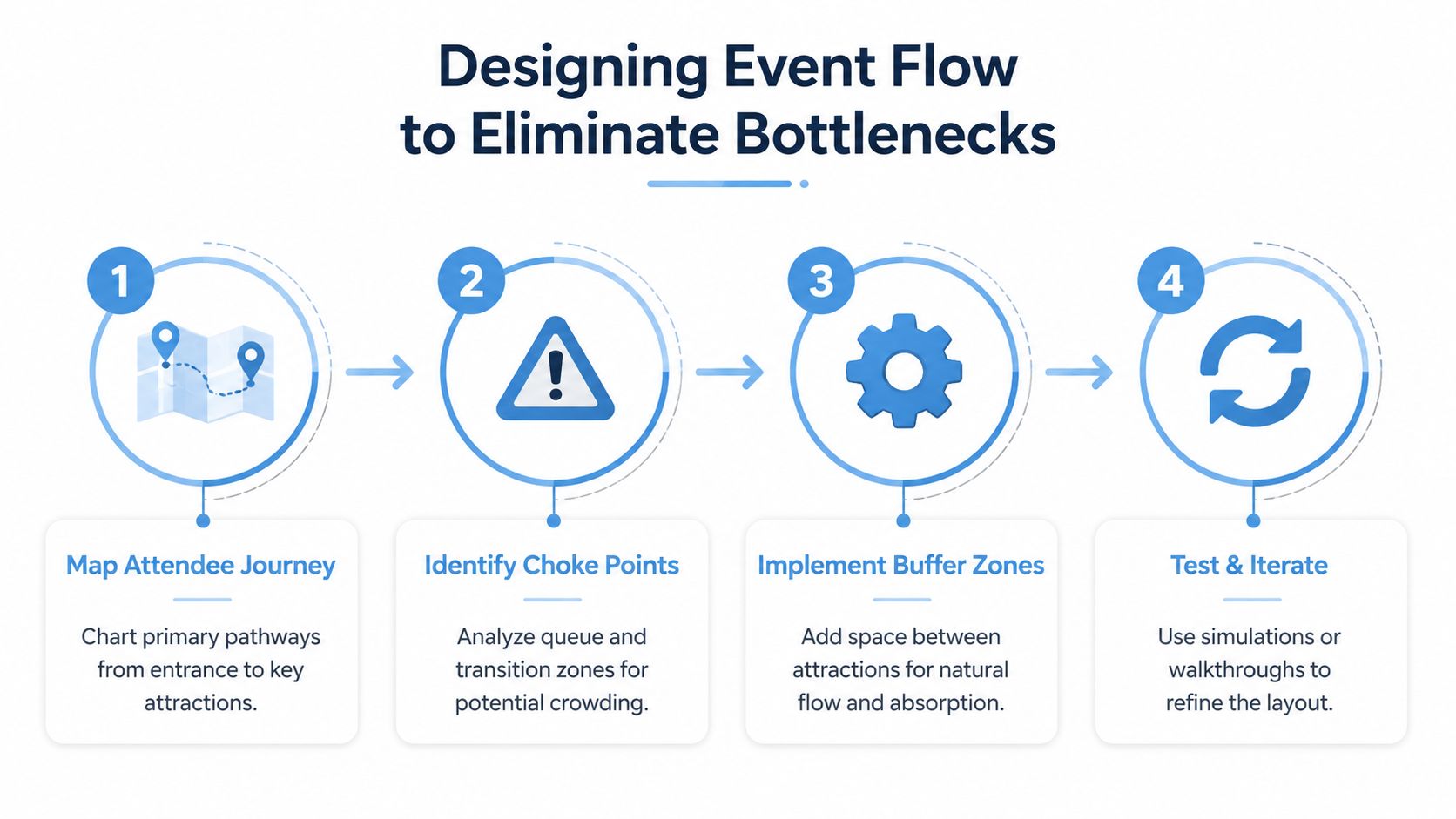
Begin with the full attendee journey, from entrance to exit. Mark the obvious destinations, including registration, catering, stage areas, toilets and high-interest exhibitors. Then add your activation and identify where people will pause, watch, queue and leave. Draw the route as if you're carrying a drink, looking at a phone or moving with a colleague. That exposes awkward turns that a clean floor plan hides.
Build for absorption
Place fast, simple activities near the outer edge of the activation. They create an accessible entry point and help staff invite passers-by without pulling a queue into the aisle. Put slower, deeper experiences further inside, where participants can move after the first interaction.
Buffer zones matter. Leave enough room between an attraction and its leaderboard, sampling point or conversation area so one group can finish while another starts. Use visible signs to separate watching, waiting and playing. If those groups occupy the same space, the activation feels busy even when participation is modest.
At venues such as ExCeL London and Manchester Central, digital displays and electronic leaderboards can act as flow magnets. Position them where they're visible from a natural approach route, then place the actual participation point far enough inside the footprint to encourage movement rather than a static crowd at the boundary.
Manage waiting as part of the experience
People tolerate a wait more easily when they can see progress and understand what happens next. Give the queue a clear start and finish. Let visitors watch a live attempt where possible, but don't make them stand close enough to interrupt the operator.
Use staff to keep the line informed. A simple explanation of the format, approximate wait and scoring method reduces uncertainty. If the queue becomes too long, offer an alternative interaction, collect details for a later slot or redirect visitors to a nearby activity. Never let the team continue inviting people into a queue they can't responsibly serve.
Walk the route with the actual equipment, furniture and branding in place. Simulations are useful, but a physical walkthrough reveals sightline problems, noisy overlaps and awkward staff access that a diagram won't show.
The operational test is straightforward: can a new visitor identify where to go, understand the commitment and complete the activity without blocking someone else? If not, change the layout before changing the attraction.
Staffing and Brand Integration Tactics
Staff make or break an activation. Equipment can attract attention, but people decide whether the interaction feels welcoming, confusing or overtly commercial. An operator who only presses buttons misses the moment when a participant needs encouragement, a rule explained or a result connected to the brand.
Train staff on three layers. First, they need technical competence: startup, reset, safety checks and the response to common faults. Second, they need facilitation skills: greeting without blocking, explaining the activity in plain English and adapting instructions for different participants. Third, they need brand context, so they can answer the obvious follow-up question without turning the experience into a scripted pitch.
Give every shift a clear operating rhythm
Build a rota that protects the experience during breaks, peaks and handovers. One person may welcome and qualify visitors, another may operate the attraction and a third may manage the queue or leaderboard. On smaller stands, define which task takes priority when the space fills.
Brief staff with useful prompts rather than rigid speeches:
- Open naturally: “Would you like to see how your colleague gets on?”
- Explain the commitment: “It's a quick attempt, then your score goes on the board.”
- Connect the result: “That was a strong reaction time. The challenge reflects the responsiveness this product is designed to support.”
- Close appropriately: Offer the next step only when the participant has finished and is receptive.
Branding should sit inside the mechanics. A custom simulator livery, a company-themed challenge or a leaderboard named for the event feels more integrated than a logo placed beside an unrelated game. Keep instructions legible and prioritise safety notices over decorative graphics.
Protect consistency and compliance
Check staff presentation, access requirements, equipment positioning and venue rules before doors open. High-profile venues expect organised delivery, and H&S compliance must cover cables, barriers, moving parts, participant briefings and emergency access. If the event requires DBS-checked personnel, confirm that requirement during planning, not during load-in.
A supplier offering event staffing solutions can support the delivery model, but the client team still needs to define the desired conversation and escalation route. For branded giveaways, consider the operational question as well as the item itself. This guide to measuring ROI on event merchandise is useful when deciding whether a giveaway supports a measurable interaction or adds volume to the stand.
Measuring Impact Beyond Vanity Metrics
Footfall is useful context, but it doesn't tell you whether the activation worked. A busy stand may contain spectators who never participate, repeat visitors who don't fit the target audience or people attracted only by a prize. Social mentions can indicate visibility, but they rarely explain whether staff created a useful conversation.
Set measurement rules before the event. Decide what a meaningful interaction looks like, how staff will record it and which data the team can collect without slowing the experience. Electronic leaderboards can capture participation and scores as part of the fun. Lead forms can capture intent, but only if the exchange is clear and proportionate.
The UK market is heavily Google-led, with Google accounting for 91.56% of UK search engine market share in July 2026, compared with Bing at 5.87%, according to StatCounter's UK search engine market data. That matters when you evaluate post-event search activity or plan content around the activation. UK visibility should prioritise Google, while still recognising that attendees may discover and discuss the event through other channels.
Match the measure to the objective
| Event Objective | Primary Metric | Data Source | Actionable Insight |
|---|---|---|---|
| Brand awareness | Qualified interactions and recall | Staff tally plus post-event survey | Shows whether visibility became a memorable encounter |
| Product education | Completed demonstrations and questions asked | Operator log and lead form | Identifies which messages generated genuine interest |
| Lead generation | Consent-based, relevant leads | Digital form or badge scan | Reveals whether the experience attracted the intended audience |
| Participation | Completed attempts and repeat participation | Attraction system or leaderboard | Shows whether the mechanic encouraged involvement |
| Experience quality | Ease of participation and resolution of issues | Short survey plus incident log | Highlights friction in instructions, queues or staffing |
| Commercial follow-up | Accepted next steps and sales-qualified conversations | CRM handover | Connects event activity to the team's follow-up process |
A useful framework for experiential marketing ROI should distinguish between exposure, engagement and outcome. Don't force every event to produce an immediate sale. A brand-awareness activation may succeed by creating strong recall and appropriate conversations, while a trade show stand may need a tighter lead definition.
Track friction, not just success
Record abandoned attempts, queue complaints, equipment faults, unclear instructions and moments when staff had to intervene. These observations often explain performance better than a headline participation number. If participants repeatedly ask the same question, rewrite the sign or briefing. If people leave before completing the activity, investigate waiting, complexity or staff availability.
Measure customer experience enhancement through the effort required to participate and the quality of the resulting interaction. The strongest dashboard shows not only how many people arrived, but how easily they moved from curiosity to action.
Optimising for Future Activations
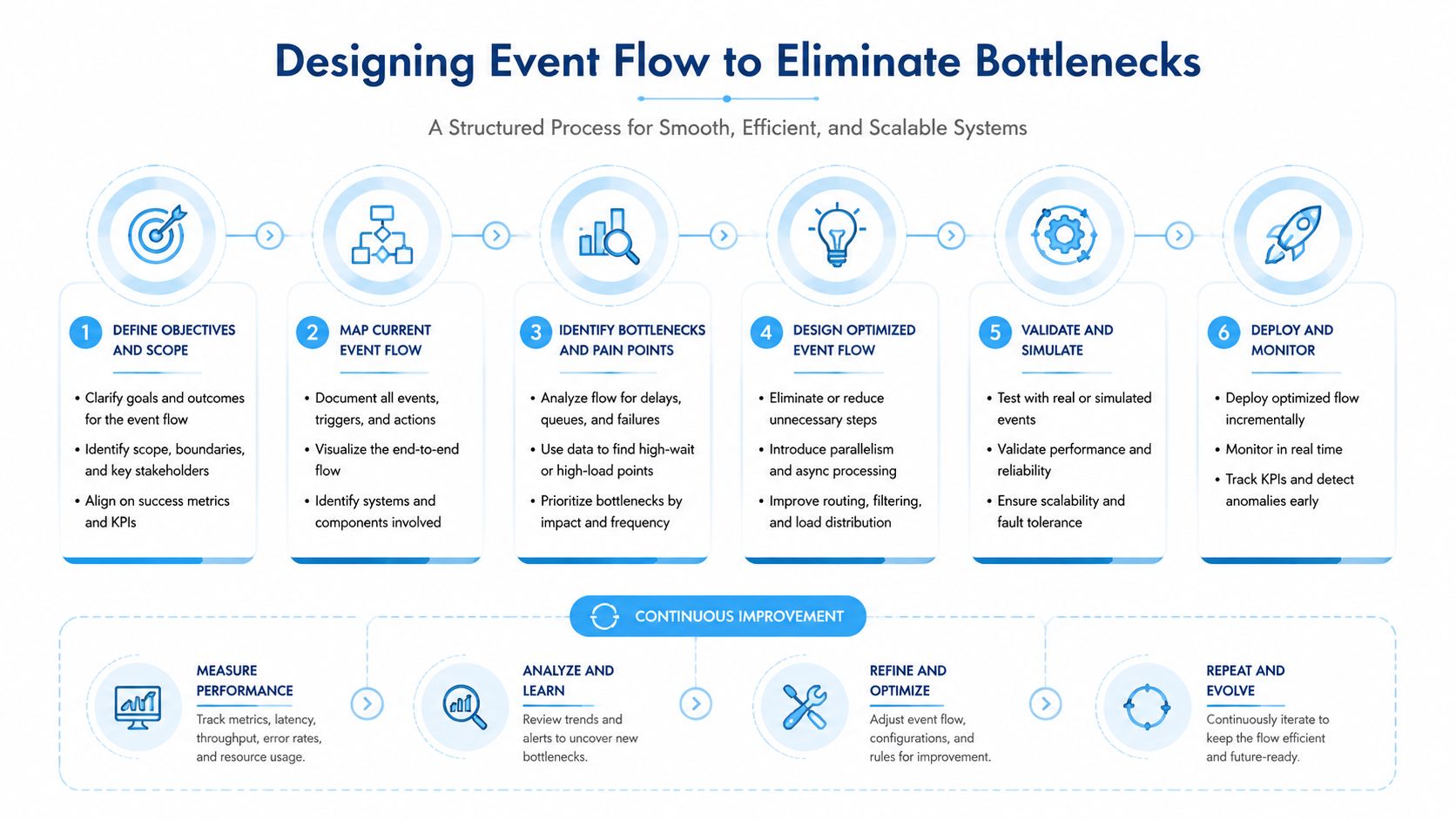
The best post-event debrief happens while the details are still fresh. Don't ask only whether the client was happy. Ask where people hesitated, when the queue became uncomfortable, which briefing worked, which staff position created gaps and what happened when the equipment needed attention.
Separate inherent friction from avoidable friction. Some waiting may be unavoidable with a single-seat simulator. Confusing signage, poor queue placement and a missing operator aren't. This distinction stops teams from chasing impossible perfection while still addressing problems they can control.
Use a disciplined debrief
Bring the producer, venue contact, client, staffing lead and attraction operator into the same conversation. Compare their observations rather than collecting isolated opinions. A useful debrief records:
- What happened: Capture the sequence of events, including peak periods, faults and queue changes.
- Why it happened: Identify whether the cause was layout, capacity, instructions, staffing or audience fit.
- What changes next time: Assign an owner and define the practical adjustment.
- What must stay: Protect the mechanics that created easy participation or strong conversation.
- What needs testing: Trial uncertain changes before committing to a larger or more complex setup.
Store the findings in a reusable activation record. Include floor plans, attraction specifications, operating notes, staffing ratios, briefing language, H&S observations and measurement results. Over time, this becomes more valuable than a collection of photographs because it helps planners make informed decisions under pressure.
Improve one constraint at a time
Don't respond to a crowded stand by adding more attractions automatically. More equipment can increase noise, split staff attention and create competing queues. Start with the largest constraint, then test the smallest operational change that could relieve it. That might mean moving the leaderboard, adding a host at the entrance, shortening the briefing or changing the order of activities.
Search visibility also belongs in the learning loop. The UK search engine industry was estimated at £5.7 billion in 2026, with 1,474 businesses and Alphabet Inc. holding the largest share, according to IBISWorld's UK search engines industry profile. For UK-focused event marketing, review which event pages, attraction descriptions and post-event assets performed in Google search, then refine future content around the language your audience uses.

A repeatable cycle looks like this: observe the journey, identify the avoidable friction, change one operational variable, measure the result and document the learning. That approach keeps innovation grounded. It also gives the next event team a practical starting point instead of another vague instruction to “make it more engaging”.
PSW Events provides interactive simulators, racing and sports attractions, VR, Batak Pro, electronic leaderboards, staffing, branding, installation and on-site event delivery across the UK and worldwide. Visit PSW Events to discuss an activation designed around smoother flow, confident facilitation and measurable attendee engagement.