
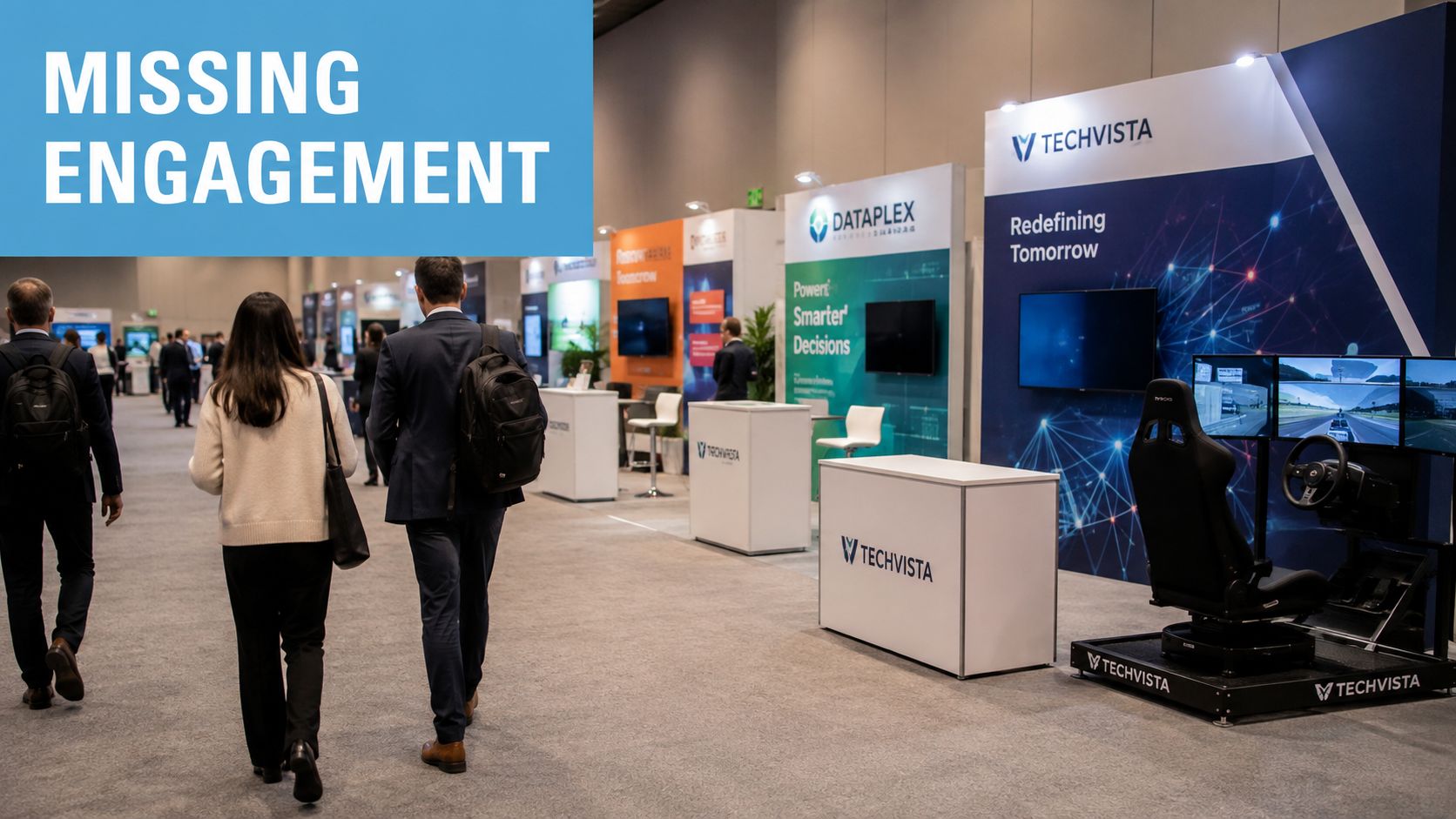
You've got the stand, the simulator, the branded back wall, and a decent crowd moving through the hall. People slow down, glance at the screen, then drift off because nobody has given them a clear reason to stop, speak, or play. That's the problem with how to encourage participation at corporate events, it's rarely about the attraction itself, it's about the friction around it.
Why Most Event Activations Fail to Engage
A quiet stand doesn't usually fail because the kit is weak. It fails because the experience feels ambiguous, high effort, or socially awkward before anyone has even started. In UK public involvement guidance, the baseline is simple, publish what you're doing, explain the purpose clearly, invite feedback, and close the loop with a visible “you said, we did” response. That same logic applies on a show floor, people engage when they can see why they're there, what they're supposed to do, and how their input changes something they can notice later. The Office for National Statistics also stresses that engagement works best when participation is purposeful rather than tokenistic, and when organisations build time and support into normal operations instead of treating involvement as an afterthought. See the UK public involvement toolkit from the Office for National Statistics guidance on public involvement and engagement in official statistics.
The hidden cost of silence
Silence costs more than most planners realise. If staff wait too long, attendees assume the stand isn't for them, or they feel like they'd be interrupting. That's why the best activations don't depend on a brave passer-by, they reduce the social risk of being first.
The German statistical research on participation drivers groups the problem into three parts, increasing the perceived benefit, reducing the cost of taking part, and building trust. That fits event reality neatly. If the ask is vague, the benefits feel distant, or the activation looks tokenistic, people keep walking. If the purpose is plain, the task is quick, and the outcome feels credible, participation rises because the experience is easy, credible, and visibly consequential.
Practical rule: if someone can't understand the point of the activity in a few seconds, the stand design is doing too much talking and not enough inviting.
The fix is not louder branding. It's a tighter entry point, a clearer next step, and a visible feedback loop that tells people their action mattered. In event terms, that means removing the awkward pause, making the ask concrete, and showing what happens after someone joins in.
Pre-Event Promotion That Builds Anticipation
Participation starts before doors open. If your audience only discovers the activation on-site, you're asking them to switch from passive browsing to active involvement without any warm-up, and that's a hard jump in a busy venue. The UK search environment matters here too, because Ofcom's 2024 Online Nation report shows search engines are one of the highest-reach online activities in the UK, with Google Search dominant and search used by the vast majority of internet users. That makes search-led content useful for event planners who are already looking for activation ideas, simulator hire, and exhibition games before they book a supplier.
A good pre-event campaign does three things. First, it shows the experience in motion, not as a static hire item. Second, it removes uncertainty by explaining what people will do on the day. Third, it gives a reason to act now, whether that's a leaderboard challenge, an early booking benefit, or a limited-time contest.
The strongest preview content is usually simple. Short clips of an F1 racing simulator, a Batak Pro reaction wall, or a golf challenge work because they show energy, competition, and immediate payoff. If you're building a sequence, start with teaser footage four weeks out, send agenda highlights three weeks out, push practical details and registration reminders two weeks out, then use polls or contests a week before the event. Three days out, the message should be purely logistical, venue map, arrival instructions, and FAQs.
Useful test: if the email or landing page doesn't make the experience feel tangible, it won't lower the friction of showing up.
For UK event search visibility, write the copy the way real buyers search, for example, interactive event attractions, exhibition games hire, or simulator-based team building. That keeps the content discoverable without sounding stuffed with keywords. It also helps the right audience self-select, which matters more than raw clicks.

Designing On-Site Activations That Pull People In
The best stands rarely look complicated from a distance. They look busy, clear, and slightly contagious. One person is already taking part, two others are watching, and a third is asking when they can have a go. That sequence matters, because watching leads to joining when the attraction is legible and the queue feels manageable.
Simulator-based attractions are strong here because they create instant theatre. A racing rig, flight sim, golf simulator, or Batak Pro wall gives passers-by something to evaluate in seconds, while leaderboards add a visible reason to linger. At venues like Silverstone, ExCeL London, and SEC Glasgow, the practical difference is usually not the machine itself, it's where the machine sits, how the crowd can see it, and whether staff turn curiosity into action before interest evaporates. PSW Events' experiential marketing activations are a useful example of how the setup, branding, and staffing need to work as one system.
Layout beats novelty
Place the highest-energy attraction where it can be seen from the aisle, not tucked into a corner. Give the audience a clear line of sight to the action, a clean queue path, and enough breathing space for spectators to watch without feeling blocked. If the activation looks crowded but organised, it usually feels more desirable, not less.
Leaderboards help because they create a second layer of participation. People who don't want to jump straight in can still compare scores, ask questions, and come back later. An electronic leaderboard also turns a one-off try into a repeat visit, which is one of the easiest ways to extend dwell time without pushing harder.
The trade-off with flashy kit is simple. A big simulator can attract attention, but if the surrounding flow is clumsy, you've built a spectacle, not a participation engine. The stand has to make the first move easy, and the next move obvious.
Make the environment feel inhabited
Branded environments work best when they feel lived in rather than sealed off. Use visible scoring, short reset times, and staff positioning that shows the attraction is active right now. People are far more likely to join something that already looks socially accepted by the room.
For clients who want a broader mix of experiences, PSW Events also supplies football, rugby, boxing, motion and helicopter flight sims, giant Scalextric, VR, climbing walls, casino tables, and more. The point isn't to stack every item on one stand. The point is to choose the attraction that best matches the audience, the venue, and the kind of participation you want, then design the sightlines so it doesn't die in the corner.
Facilitation Mechanics That Drive Real Engagement
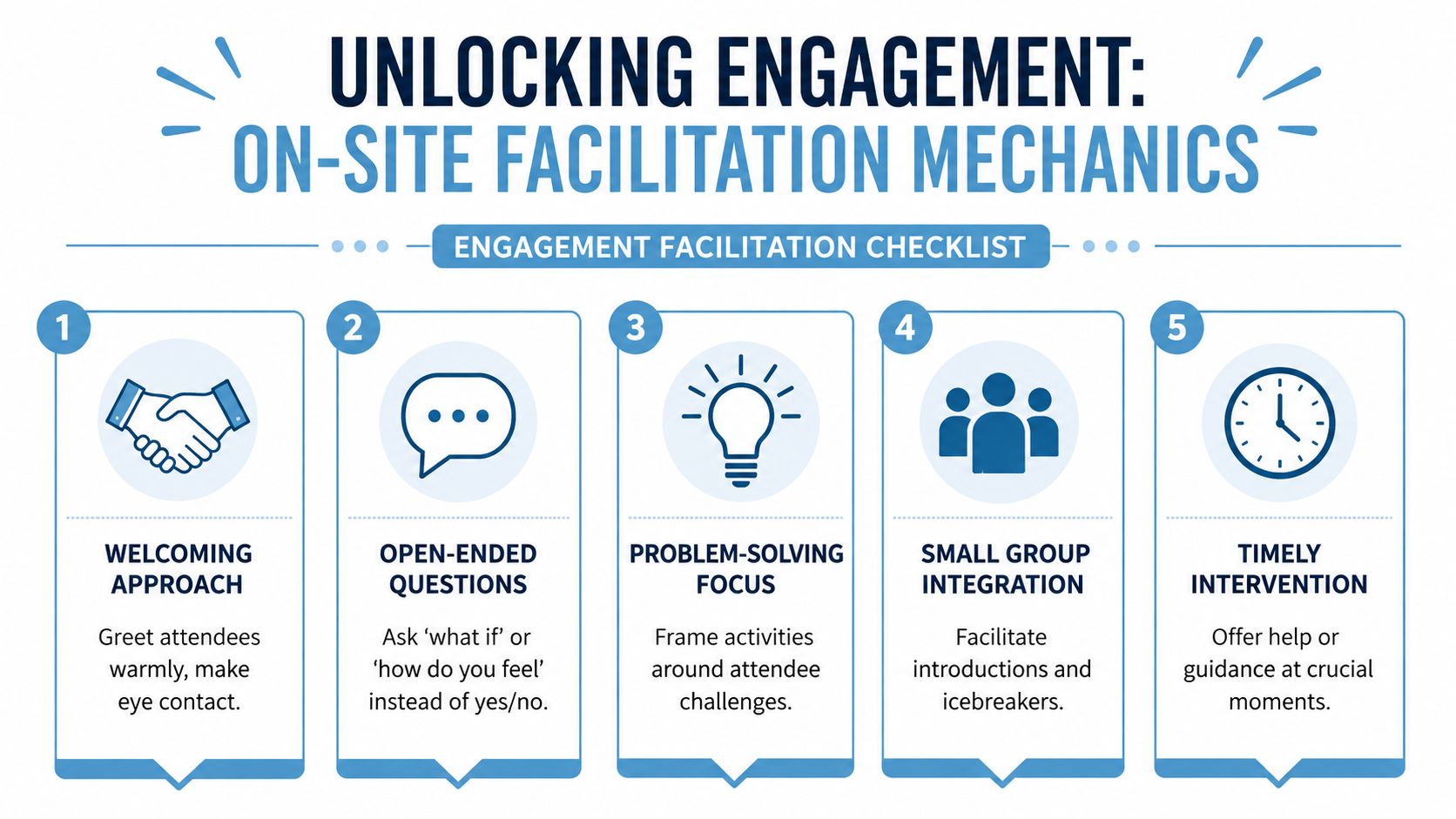
A strong attraction still falls flat if the staff freeze when people hover nearby. The usual mistake is talking too much at the wrong moment, which turns the first step into an interview instead of an invitation. Good facilitation lowers the social cost of entry and gives different personality types a way in.
The University of California, Berkeley's GSI Teaching & Resource Center recommends asking broad “how” and “why” questions because they prompt people to think through a process, evaluate information, and form opinions. Washington University in St. Louis advises giving people 5 to 10 seconds to think before moving on, and rephrasing the question if 10 to 15 seconds pass without an answer. That small pause matters on a stand. It gives the attendee time to process, and it signals that silence is allowed.
What staff should do differently
Train teams to use short prompts, then wait. If someone is hesitant, offer a non-verbal route in, such as a quick poll, a one-minute paper, or a reaction test. Shared tasks also work well, especially for team-building activations where small groups need a clear turn-taking structure instead of open-ended chat.
A useful briefing for stand staff is:
- Open with a warm welcome: make eye contact, smile, and avoid launching into a pitch.
- Ask one open question: use “how” or “why” rather than a yes or no prompt.
- Pause properly: don't fill every silence.
- Offer choices: let people take part verbally, visually, or through a quick interaction.
- Close cleanly: explain what happens next so the participant doesn't feel stranded.
A calm pause often works better than a louder invitation. People need space to choose, not pressure to perform.
The patient engagement playbook reinforces the same principle, participation improves when the environment is clear, supportive, and easy to enter.
The H&S side matters too. High-traffic venues need obvious queue boundaries, cable management, and staff who know when to step back from the equipment. Engagement drops fast if people sense the area is chaotic or unsafe, especially around fast-moving attractions.
A visible leaderboard gives hesitant visitors another route in. The electronic leaderboard can turn a one-off try into a repeat visit, because people come back to check whether they have been overtaken, or whether a teammate can beat the current score. That matters on busy stands where the strongest hook is often social proof, not a hard sell.
Building Trust and Inclusivity Into Every Touchpoint
Participation falls away when people don't see themselves in the room, or when the activation feels built for somebody else. That's especially true in corporate events, where sceptical attendees often scan for whether the experience is welcoming, credible, and worth the time cost. Trust-building is not a soft add-on, it's a multiplier.
A 2024 NIHR review of under-served groups identified five recurring engagement needs, changing methods, organisational support, using technology, enhancing trust, and improving reporting or publication. Another 2024 synthesis of clinical-trial participation among underserved communities grouped effective strategies into awareness-sharing, community-centred approaches, value assignment, and better representation of both participants and investigators. Those findings translate directly to events. If you want people to join in, they need to see visible representation, feel the format is accessible, and believe the feedback won't disappear into a void. See the NIHR review on engagement needs for under-served groups.
What trust looks like on the floor
Accessibility starts with the basics, clear space around simulator entries, seats for those who need them, readable instructions, and staff who can explain the activity without jargon. Representation matters too. If the marketing imagery, host team, and on-site facilitators all look identical, some attendees will assume the activation wasn't designed with them in mind.
Local intermediaries help because people trust familiar voices more than generic invitations. That can mean working with internal employee networks, venue teams, regional partners, or sector-specific communities who can validate the experience before the event opens. The strongest feedback loops are also visible, a simple board showing what people said, what changed, and what the team will do next.
For a practical comparison from a different field, the lessons in resilience from sports piece is useful because it shows how participation rises when people feel supported, recognised, and not judged for starting slowly.
Practical rule: if the activation can't explain itself to a cautious newcomer in plain language, it's not inclusive enough yet.
The aim is not to remove all friction. The aim is to make the first step feel safe, legible, and worth taking. Once that happens, participation starts to look less like a conversion problem and more like a trust problem solved in real time.
Gamification and Measurement for Continuous Improvement
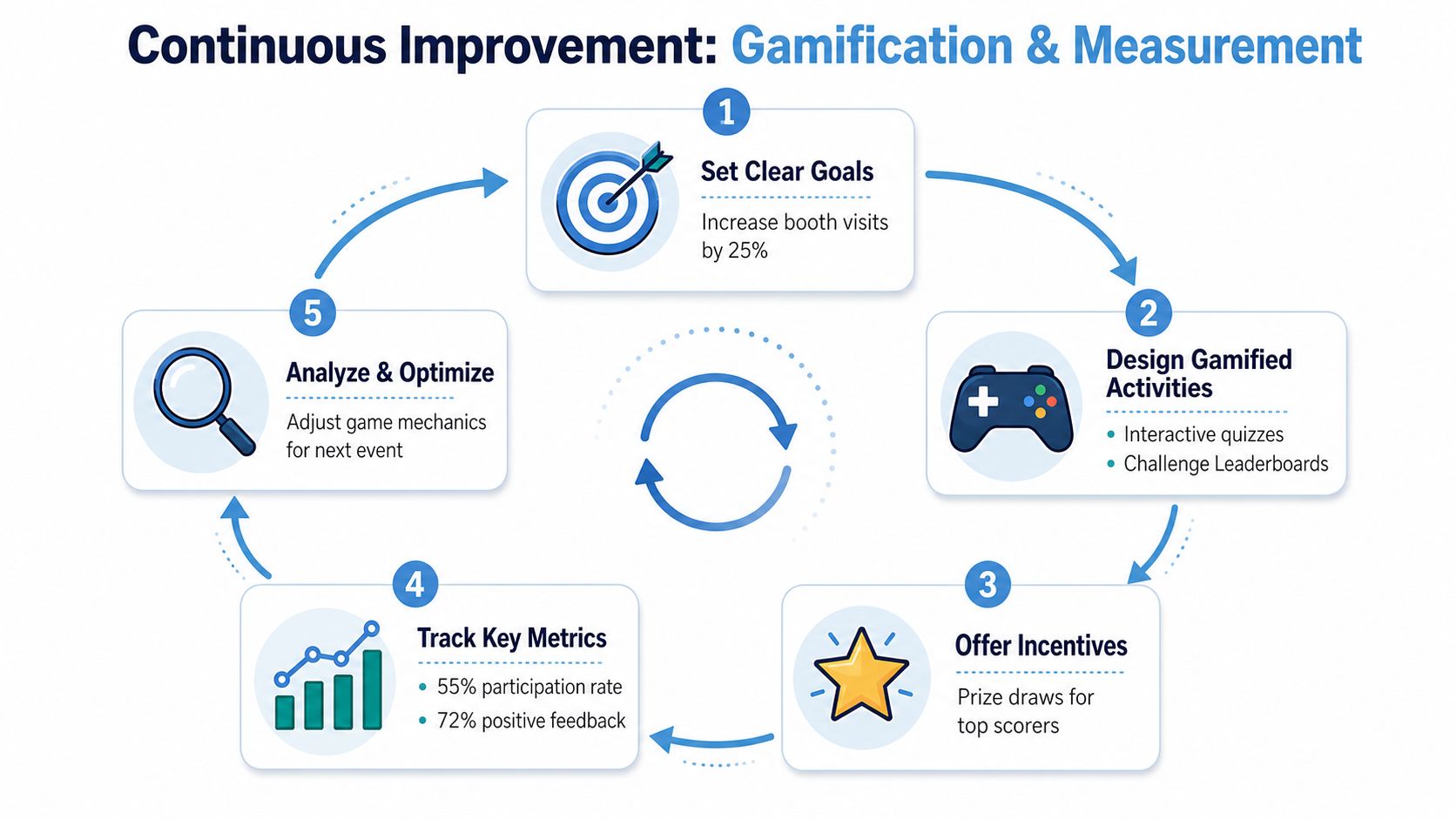
Gamification only works when it's tied to a feedback loop. If the leaderboard, prize draw, or challenge score doesn't tell you anything useful, it's just theatre. The point is to create a repeatable system where competition drives action, data shows what happened, and the next event gets sharper because of it.
A points-based structure is especially useful for multi-day exhibitions, because it gives people a reason to return. If you're thinking about the mechanics of that structure, running a points program is a useful reference point for how scorekeeping, reward progression, and repeat engagement can work together without feeling forced. The same logic applies on a stand, clear rules, visible progress, and a reward that feels earned rather than gimmicky.
What to measure and why it matters
Track the things that reflect real participation, not just footfall. Dwell time shows whether people stayed long enough to engage. Lead capture shows whether the activation created a follow-up opportunity. Repeat engagement shows whether the experience was strong enough to bring people back.
A simple optimisation loop helps here:
- Set the goal for the stand or activation.
- Design the challenge around one clear behaviour.
- Add a visible incentive that fits the audience.
- Measure what happened during the event.
- Adjust the setup before the next activation.
That framework keeps the conversation grounded. It stops teams from celebrating a busy-looking stand that didn't produce meaningful interaction.
If you want a broader implementation example, PSW Events' gamification in events work sits in the same space as simulator-based activation, where the challenge, the audience flow, and the scoring all need to work together. The best blue-chip activations I've seen don't rely on one big moment. They build a simple loop where people watch, join, compare, and return.
The smartest next step is to choose one event, one attraction, and one improvement to test. Tighten the first question, improve the queue flow, or make the scoreboard easier to read. Then keep the parts that move people.
If you're planning a conference, exhibition, or brand activation and want participation to feel natural rather than forced, PSW Events can help design the attraction, the facilitation, and the on-site delivery around that goal. Visit PSW Events to see how simulator hire, leaderboard mechanics, and full event support can turn passive footfall into real engagement.