
The most popular advice about virtual reality in events is also the least reliable: add headsets and the audience will engage. That assumption ignores realities of UK event production. A headset can create a memorable, highly focused interaction, but it can also slow a stand to a crawl, isolate spectators, complicate access, and consume more staff time than a faster physical attraction.
The right question isn't whether VR looks cutting-edge. It's whether the experience supports the event objective, audience flow, venue conditions and measurement plan. UK planners have decades of experience to draw on, from specialist VR conferences to cultural pilots that introduced first-time users to narrative VR. The practical lesson is straightforward: choose immersion when immersion solves a specific problem, not because the technology is available.
When Virtual Reality Is the Wrong Choice for Your Event
A headset isn't automatically a high-performing engagement tool. At a busy exhibition, one attendee occupies the experience while everyone else waits, watches or walks away. If the content needs careful fitting, instructions and a reset between users, the queue becomes part of the brand experience, whether you planned it that way or not.
VR is particularly risky when the stand needs rapid interactions and broad visibility. A headset blocks the user's view and makes the experience difficult for passers-by to understand. Spectators may see a person moving in a virtual world, but they won't necessarily understand the product message without a large external screen, presenter or clear call to action.
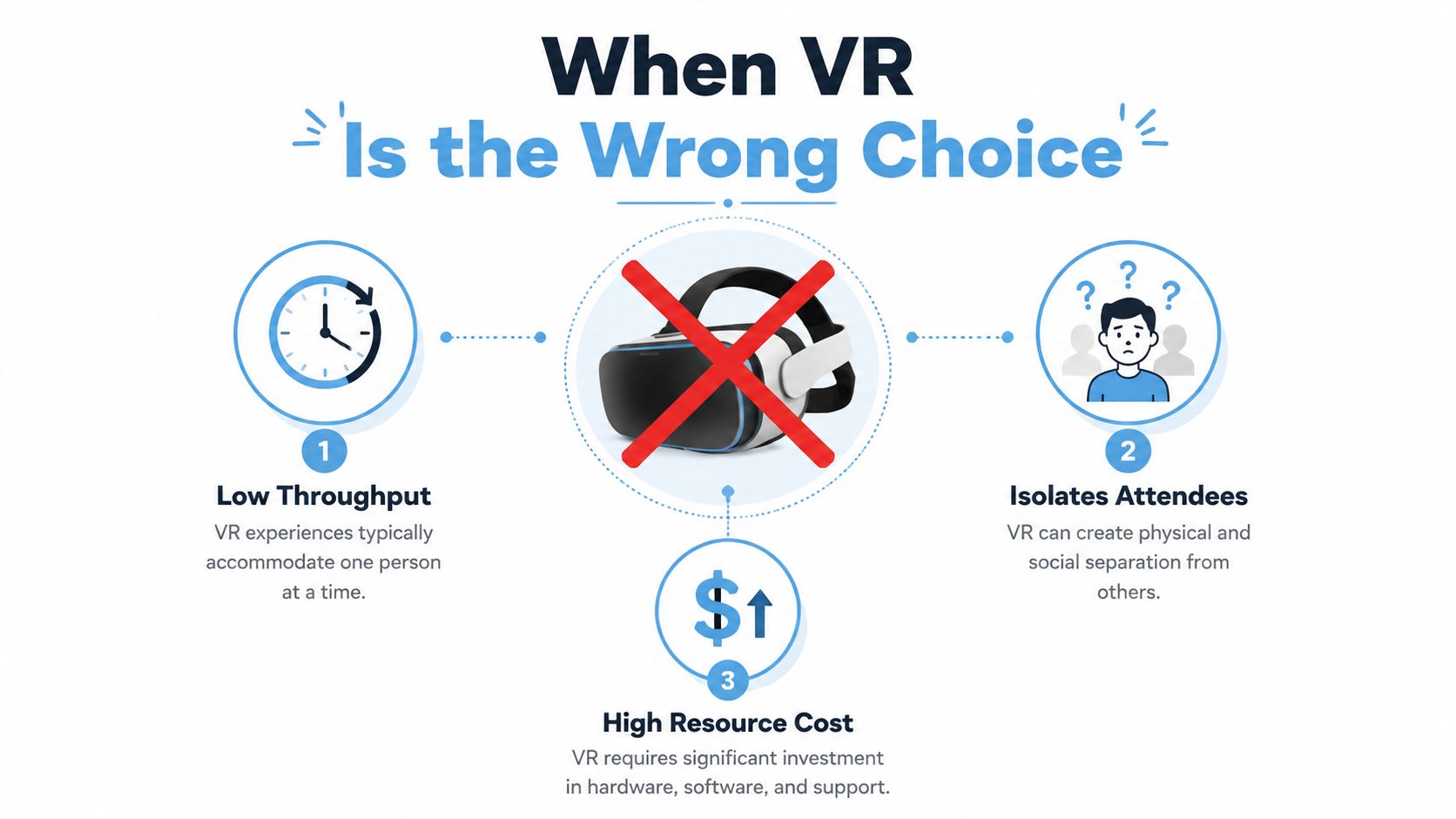
Use a decision filter before booking
Ask these questions before committing floor space and production budget:
- Is speed the priority? If the stand needs constant movement, a racing rig, Batak Pro installation or other hands-on attraction may create more conversations than a single-user headset.
- Does the venue support the technology? Outdoor activations, bright spaces and restricted areas can create tracking, power, data and weather-management problems.
- Can the audience participate comfortably? Some people won't want to wear shared equipment, stand for a session or use content that creates visual or vestibular discomfort.
- Does the content have a job? Product configuration, simulated training, remote environments and controlled demonstrations give VR a clear purpose. A generic game may generate attention without generating useful engagement.
VR earns its place more easily in a VIP hospitality suite, a controlled product reveal or a training environment where the simulated situation directly reflects the learning objective. Scheduled attendance also helps. The University of Exeter's immersive VR workshop used a free, day-long format with registration required, held on 8 September 2025 from 9:30 to 16:30 at the XFI Henderson Lecture Theatre, demonstrating how advance booking and timed participation can make a VR event more manageable through its published workshop details.
Practical rule: If the audience needs to understand the experience in seconds and participate without assistance, start by testing a non-headset format.
The strongest activation may combine a small VR zone with a visible, social attraction. That approach gives the campaign a deeper immersive layer without forcing every visitor through a headset-based journey.
The UK Virtual Events Market and Why It Matters Now
VR's presence at UK events stretches back to the early 1990s, well before the current commercial wave. The first annual UK conference and exhibition focused on VR, VR'91 Impacts and Applications, took place in June 1991. The historical record also notes a UK home-grown VR newsletter in February 1992, Europe's first open VR event in Brussels in January 1993, and the first UK VR-SIG Conference at Nottingham University on 14 March 1994 in this history of VR in the UK.
For planners, that history puts today's activations in context. Immersive event work grew through academic gatherings, specialist communities, cultural programming, training applications and commercial experiences. The current market brings those established event disciplines together with newer headsets, real-time content and higher audience expectations.
UK virtual events generated USD 5,662.4 million in revenue in 2024 and are projected to reach USD 18,031.0 million by 2030, with a projected 21.3% CAGR from 2025 to 2030, according to the UK virtual events market outlook. The same source identifies external events as the largest revenue-generating event type in 2024, with a 39.15% revenue share, while extended events are projected to be the fastest-growing segment during the forecast period.
These figures cover the broad virtual events market. They do not show that a headset activation will produce a return. They do explain why procurement teams increasingly ask for a clear business case, particularly when VR competes with faster, more visible attractions. The UK government has described around 1,000 immersive-specialist companies generating £660 million in sales, alongside £18 million in government and industry funding for next-generation immersive experiences within its UK immersive technology context. The industrial base is substantial, but planners still need to match the format to the audience, venue and intended outcome.
Adoption maturity differs by event type
| Event Segment | VR Adoption Stage | YoY Growth | Typical Deployment Scale |
|---|---|---|---|
| Enterprise conferences | Developing | Not consistently reported in the verified UK data | Scheduled demonstration, breakout or training zone |
| Trade exhibitions | Selective | Not consistently reported in the verified UK data | Branded stand activation or product demonstration |
| Brand activations | Selective to established | Not consistently reported in the verified UK data | Managed public experience with staffed stations |
| Private corporate events | Developing | Not consistently reported in the verified UK data | Entertainment feature or hosted competition |
Venue constraints still determine what can run reliably. Power provision, network arrangements, floor plan, loading access, fire controls and permitted installation methods all affect the brief. UK procurement teams also compare headset experiences with physical attractions that visitors can understand quickly and share with colleagues.
The ecosystem extends beyond entertainment venues. BhamXR, based in the UK, connects immersive technology activity and collaboration across universities, showing that VR event work also includes academic and industry-facing gatherings through the University of Birmingham's BhamXR resource.
Comparing VR Headsets Against Interactive Simulators and Attractions
A headset-based experience and an interactive simulator solve different operational problems. VR prioritises single-user immersion. A racing simulator, motion platform, AR mirror or physical game can expose the activity to a wider audience and let several people understand the proposition at once.
That difference affects more than entertainment value. It changes queue behaviour, staffing, accessibility, lead capture and the amount of usable floor space. A VR experience may deliver a concentrated brand story, while a physical attraction may create more visible social energy and faster handovers.
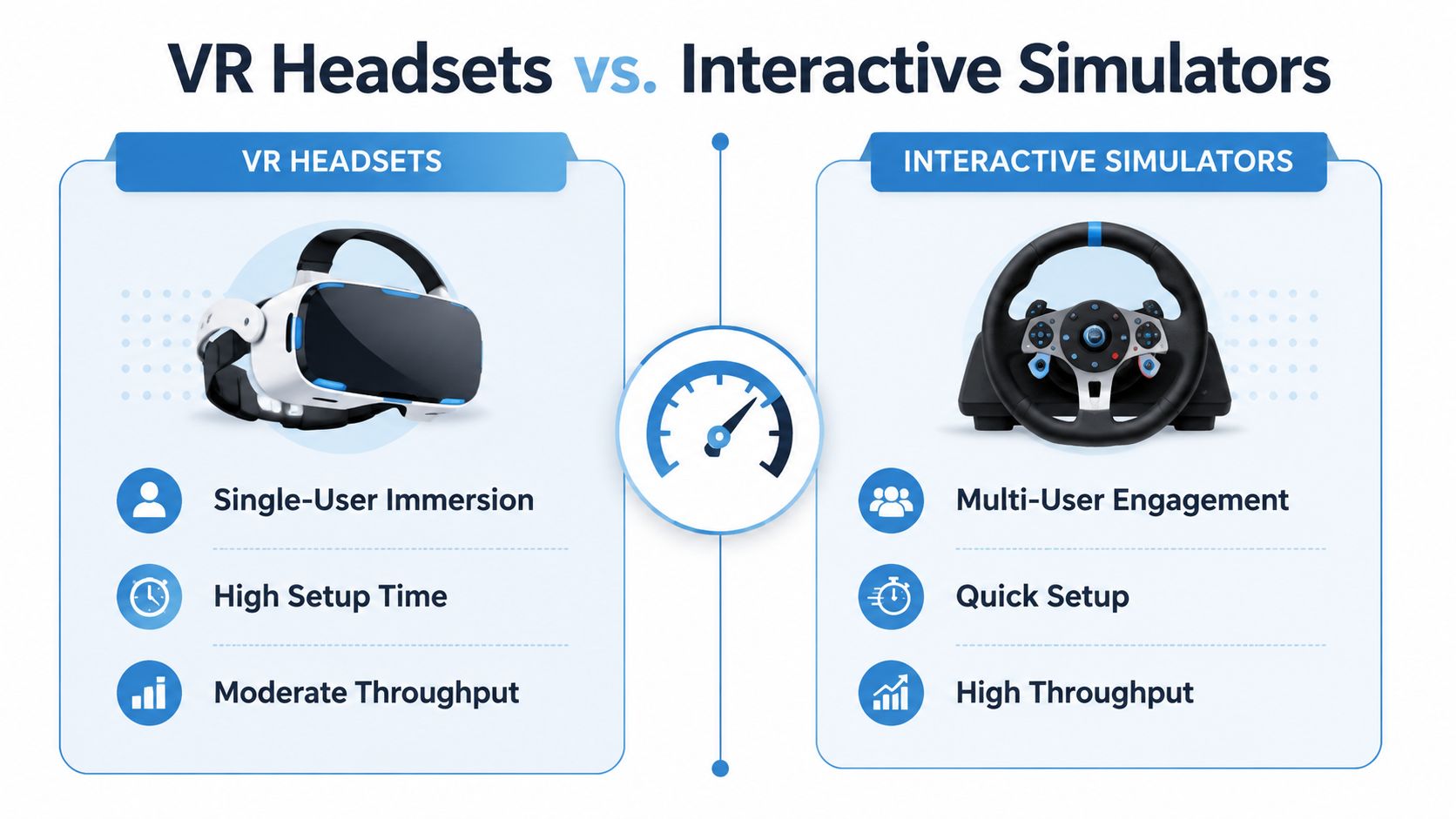
The operational comparison
| Consideration | VR headsets | Interactive simulators and attractions |
|---|---|---|
| Audience relationship | Focused, usually individual participation | More visible and often social |
| Queue management | Requires careful briefing, fitting, hygiene and reset | Usually easier to understand from the queue |
| Staffing | Attendant-led operation is normally important | Staff support remains necessary, but the interaction can be more self-explanatory |
| Content | Strong for simulated environments and controlled narratives | Strong for competition, physical interaction and spectator appeal |
| Accessibility | Requires alternative routes for people who can't or won't use a headset | Can often be adapted through seated, standing or assisted play |
| Brand visibility | Needs screens, mirroring or presenters to explain what the user sees | The action is usually visible without additional explanation |
The hidden cost of VR isn't limited to equipment hire. You need a trained operator to fit the headset, explain controls, monitor the participant, manage hygiene and restart the application. If a controller loses connection or the software fails to launch, the queue doesn't pause politely. It grows while staff troubleshoot.
A simulator can still create bottlenecks, particularly if the experience is complex or physically demanding. The difference is that the audience can usually see the competition, understand the scoring and join the conversation without wearing equipment. That makes formats such as F1 rigs, giant Scalextric and sports simulators useful when the marketing team values footfall, social participation and lead conversations as much as immersion.
A technically impressive experience that only one person can understand at a time may be less effective than a simpler attraction that makes the whole stand feel active.
Use immersive experience design to connect the technology choice to the audience journey, rather than treating the headset as the experience by itself.
The decision should also account for physical and sensory access. Provide an alternative interaction for people with visual impairments, mobility restrictions, hearing needs, vestibular sensitivities or a preference not to wear a headset. An inclusive event doesn't make the alternative feel like a consolation prize. It gives the visitor an equally clear way to engage with the product or message.
This video offers a visual reference for the difference between a headset-led experience and an interactive driving format:
For high-footfall events, faster-moving attractions often win because they support conversation before, during and after participation. VR wins when the content itself needs the attendee to leave the physical surroundings behind.
Logistics and Compliance for VR Deployments at UK Venues
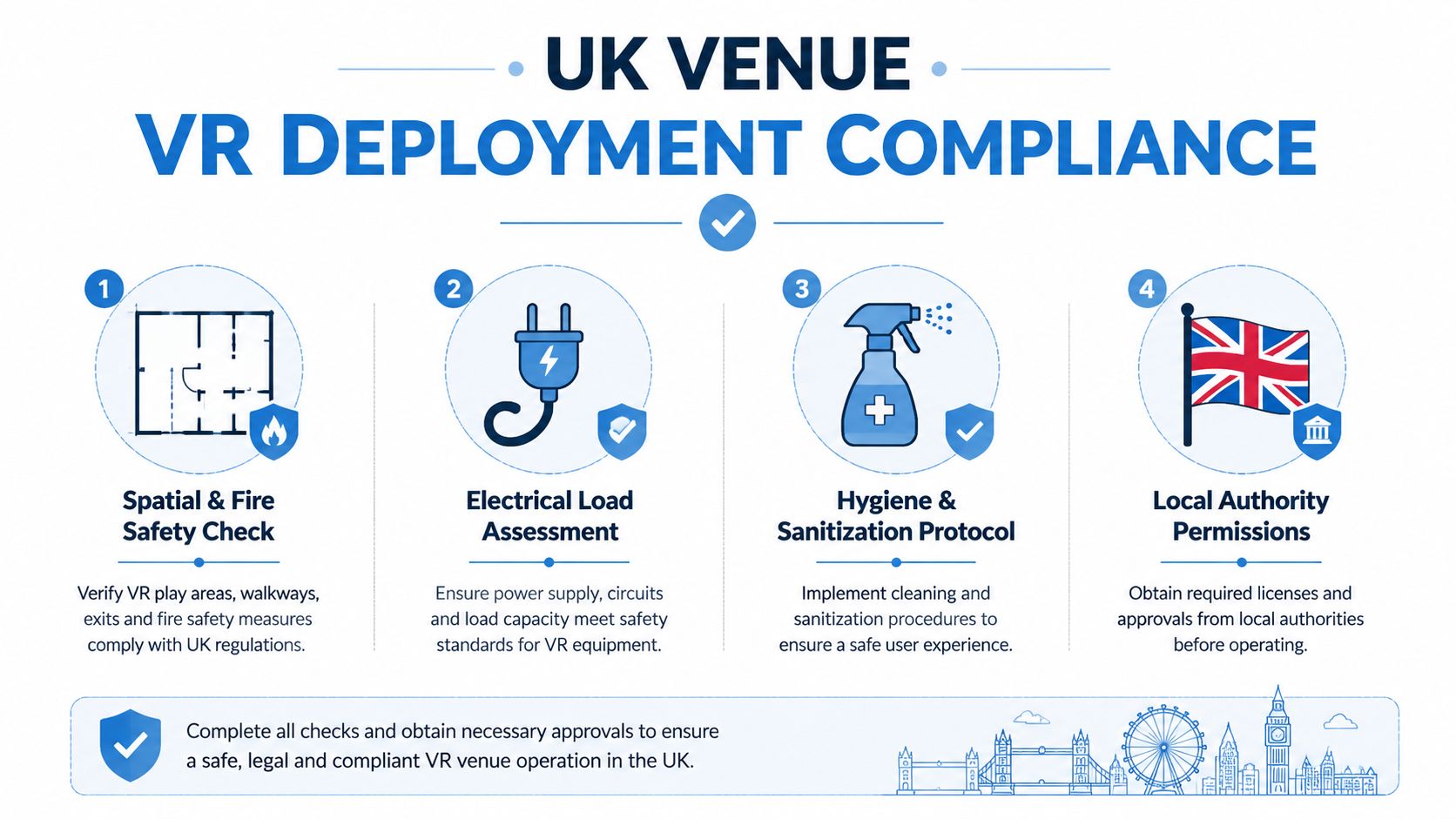
The most expensive VR problem often appears during load-in, not during the creative presentation. A venue may approve the concept in principle while imposing restrictions on floor loading, cable routes, electrical distribution, fire exits, rigging, noise or public access. Put the technical survey into the production schedule before the equipment arrives.
Start with the floor plan. Allocate enough room for the station, the participant, the operator, the queue and safe circulation. Don't position a standing user beside an aisle, fire exit or low-level obstruction. Seated configurations can reduce movement risk and may make the experience more accessible, but they still need clear transfer and circulation arrangements.
Build a venue-ready technical plan
Confirm the footprint and sightlines. Mark the station, queue, operator position and any external display on the venue plan. Show how visitors enter and leave without crossing cables or blocking escape routes.
Audit power and data. Ask the venue for its electrical distribution plan and confirm what equipment the supplier will bring. Don't assume event Wi-Fi is suitable for every application. If the experience needs a network connection, test the route, access permissions and fallback behaviour before show open.
Control cable hazards. Use approved floor covers, overhead routes or protected stand structures where appropriate. Tape alone isn't a complete risk assessment. The method must suit the venue surface, pedestrian traffic and fire requirements.
Write the hygiene procedure. Clean the headset contact points between users, provide disposable face protection where appropriate, and document the process. UV-C equipment may form part of a supplier's kit, but it shouldn't replace a clear wipe-down and inspection routine.
Manage comfort and access deliberately
Motion discomfort can undermine an otherwise polished activation. Select content with stable movement, avoid unnecessary acceleration and give the operator permission to stop a session immediately. Short, controlled sessions are easier to manage than a long experience that leaves a participant uncomfortable and delays the next booking.
Accessibility needs to be part of the design conversation under the Equality Act 2010, not a note added after the kit is booked. Ask the supplier how wheelchair users can participate, how someone with limited vision can access the brand message, and what happens when a visitor can't wear a headset. Offer a non-VR version with comparable information, attention and staff support.
Compliance check: Ask the venue and supplier to review the risk assessment together. The venue knows its building constraints, while the supplier understands the equipment's operating requirements.
Confirm insurance documentation, public liability terms, equipment responsibilities and incident procedures. Venue-specific rules can affect whether a supplier may install independently, use certain power arrangements or operate in public circulation areas. Keep the approved method statement, risk assessment, electrical paperwork and cleaning procedure accessible to the event manager.
A well-run deployment feels simple to the visitor because the complexity has been handled in advance. That preparation protects the audience, the venue and the campaign budget.
Real Audience Results from UK VR Event Pilots
The clearest UK evidence comes from cultural venue pilots, where organisers tested whether people unfamiliar with narrative VR would attend, enjoy and repeat the experience. StoryFutures Xperience delivered nearly 300 VR events across UK cinemas and arts centres and attracted more than 5,000 participants. Seventy per cent were first-time narrative VR users, while 87% said they were likely or very likely to attend a similar VR event again in the Royal Holloway report on the programme.
That result challenges the idea that VR only appeals to existing enthusiasts. A familiar venue, scheduled access and a supported introduction can lower the barrier to participation. The setting did part of the operational work, because visitors understood how to arrive, wait and enter a programmed experience.
A separate StoryFutures report covering a UK pilot across eight venues found that 83% of attendees were likely to attend a similar VR event again, while 87% said they enjoyed the experience “very much” or “quite a lot”. Forty-five per cent were visiting the venue for the first time, and 87% attended with friends or family in the Film Hub Midlands report.
What the pilots do and don't prove
| Event Type | Location | Throughput/Hour | Avg Dwell Time | Completion Rate | Lead Quality Score |
|---|---|---|---|---|---|
| Cultural VR programme | UK cinemas and arts centres | Not reported in the verified data | Not reported | Not reported | Not reported |
| StoryFutures venue pilot | Eight UK venues | Not reported in the verified data | Not reported | Not reported | Not reported |
| Academic immersive workshop | Exeter | Scheduled sessions, hourly throughput not reported | Day-long event format, session duration not reported | Not reported | Not reported |
The available UK evidence supports audience interest, first-time adoption and repeat intent. It doesn't provide verified figures for trade-show throughput, dwell time, completion rate or lead quality in the Birmingham, London and Manchester examples described in some event marketing discussions. Those figures shouldn't be presented as established case-study results without a source that publishes them.
That limitation matters. A cultural pilot measures enjoyment and willingness to return. A trade show needs to measure qualified conversations, data capture and commercial follow-up. The same headset setup may perform well in one context and poorly in another because the audience, queue and objective differ.
For corporate planners, the useful takeaway is not that VR guarantees repeat attendance. It's that low-friction access and thoughtful hosting can convert first-time users into positive participants. The commercial question still requires a separate measurement plan.
Measuring ROI and Dwell Time Beyond the Novelty Factor
Headset usage is an activity measure, not a return-on-investment measure. A visitor can complete an experience without understanding the product, sharing contact details or speaking to the sales team. Counting users alone hides the difference between busy equipment and useful engagement.
Start with the event objective. A product launch may prioritise message comprehension and meeting requests. A trade exhibition may prioritise qualified leads. A conference may use VR to make a complex process easier to understand. Each objective needs a different success definition.
Build a measurement chain
Track the journey from exposure to commercial action:
- Exposure: How many visitors could see the activation, including people who watched rather than participated?
- Participation: How many visitors entered the experience, and how many needed assistance?
- Depth: Which scenes, product features or interactions did participants complete?
- Data capture: Did the registration process record consent and useful segmentation?
- Follow-up: Did participants book meetings, request information or enter a qualified sales process?
- Recall: Can attendees describe the message after the event, rather than only remembering the headset?
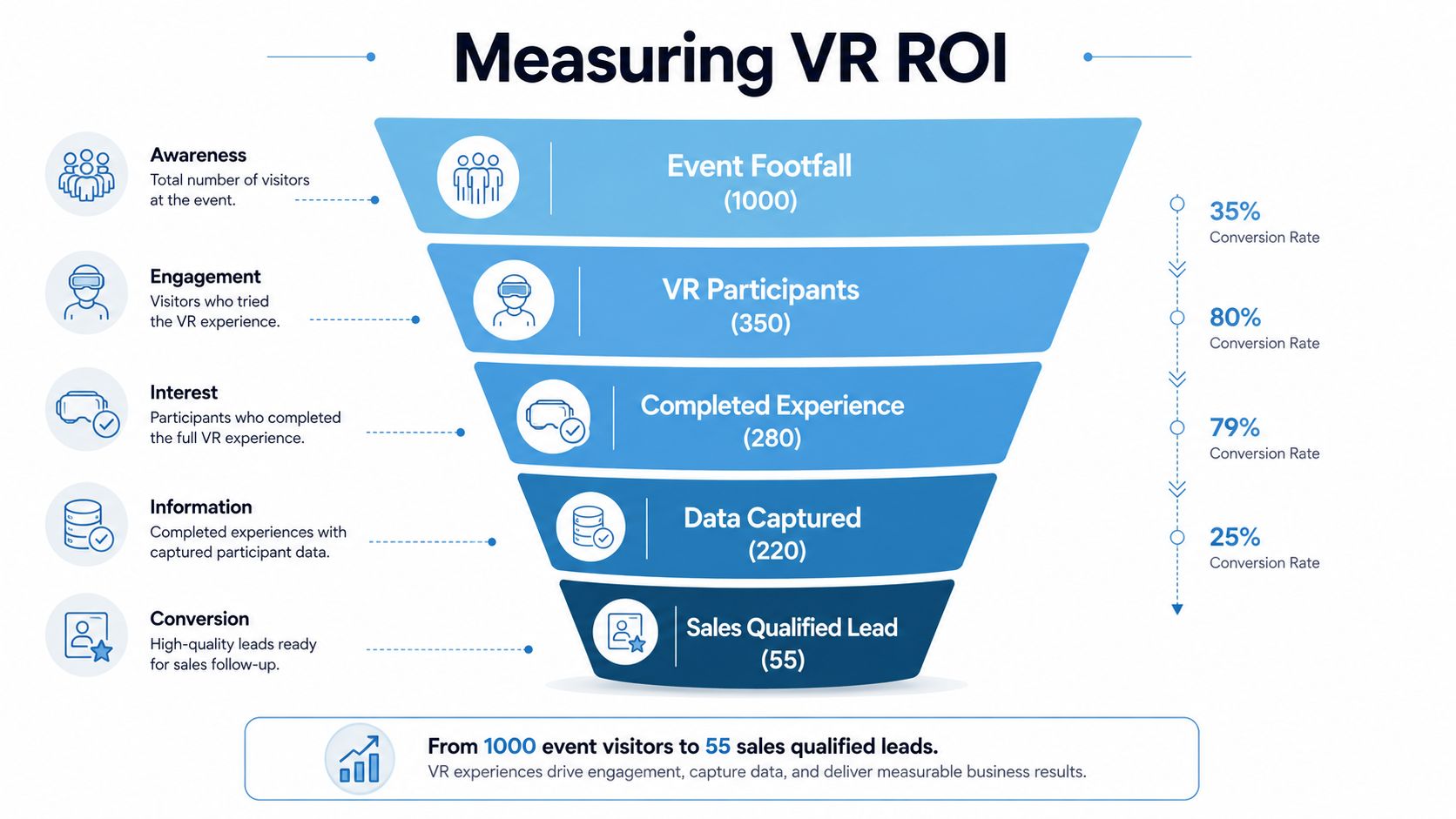
Use a consistent definition for dwell time. Record the time in the headset, but also record briefing time, product discussion, queue abandonment and the length of any follow-up conversation. A longer session isn't automatically better if the user spends the time navigating a confusing interface.
Cost-per-engagement should include the whole activation. Add equipment, content licensing, transport, crew, venue requirements, cleaning, contingency, data reporting and the floor-space opportunity cost. Then compare the result with a simulator, physical installation or facilitated demonstration that could occupy the same area.
Experiential marketing ROI becomes easier to defend when the measurement plan is agreed before the creative is approved. Set a baseline for the chosen alternative where possible, and use the same lead definitions across both formats. That won't eliminate attribution challenges, but it will stop the post-event report from relying on photographs and headset counts.
Measurement principle: A memorable interaction earns its budget when the event team can connect it to a defined audience action.
Repeat intent can be useful, particularly for public or cultural programming, and the StoryFutures results show why it deserves attention. In a B2B setting, pair it with message recall, consented data capture and sales outcomes. Novelty attracts the first participant. Relevance determines whether the activation contributes to the event.
Budgeting and Choosing a VR Vendor for Corporate Events
A reliable VR budget starts with a complete delivery model, not a headset hire line. Ask for separate costs for hardware, content, licensing, transport, installation, technicians, insurance, cleaning, backup equipment, data reporting and dismantling. If the proposal only describes the equipment, it isn't yet a production budget.
Turnkey packages can reduce coordination, while modular builds may give the brand more control over content and presentation. Neither is automatically cheaper. Venue power, network access, stand construction and late changes can create costs outside the supplier's headline price.
Check the supplier before checking the creative
| Evaluation Criteria | Minimum Standard / Red Flag Threshold |
|---|---|
| Insurance | Current public liability and relevant employer or product cover, with limits accepted by the venue |
| Electrical safety | Evidence of suitable testing and a clear power plan |
| Staffing | Named, trained operators with responsibilities defined |
| Backup provision | Spare headsets, controllers or a documented swap plan |
| Throughput | Assumptions explained, including briefing, fitting, reset and cleaning time |
| Content rights | Written confirmation of usage, licensing and post-event permissions |
| Data protection | Clear GDPR process for registration, lead capture and any feedback data |
| Service response | Agreed response time for equipment or software failure |
| Cancellation | Terms that address venue changes, force majeure and technology failure |
Ask the supplier to demonstrate the complete user journey, not just the application. Watch how long fitting takes, how the attendant resets the system and what the visitor sees while waiting. Vague throughput promises are a red flag, as are proposals with no backup equipment or a dependence on consumer-grade devices without a strong event support plan.
For a broader procurement perspective, planners can also review guidance on how to choose platform vendors wisely, particularly when the technology affects access, reliability and the visitor journey.
Content ownership deserves a written answer. Establish who owns the commissioned assets, whether the supplier can reuse footage or interaction data, and how long the licence lasts. If the experience captures personal information or biometric feedback, confirm the lawful basis, consent language, retention process and deletion route before the event.
For teams comparing delivery models, VR experience hire can sit alongside simulator and physical attraction options in the same early-stage brief. PSW Events provides VR headset experiences and a wider range of interactive attractions, including racing and sports simulators, with planning, installation, staffing and event safety support available as part of delivery.
Negotiate cancellation and substitution terms while the brief is still flexible. The contract should explain what happens if the venue changes its restrictions, the content fails acceptance testing or a critical device becomes unavailable. A credible supplier won't treat those questions as awkward. They'll already have a practical answer.
PSW Events can help corporate planners compare VR with faster-moving simulators and interactive attractions, then manage branding, logistics, on-site staffing and event safety across UK venues. Visit PSW Events to discuss an activation built around your audience flow, accessibility needs and measurable event objectives.