
You've found a venue that looks promising, but the sports hall is busy, the exhibition floor is tight, and a full court would consume more space than the activation can justify. That's a common planning problem. The best indoor basketball game for a corporate event isn't automatically a regulation match: a compact format can give more people a turn, produce clear scores and fit a space that wouldn't work as a court.
Pick a Format Your Space and Audience Can Support
Choose the format before you book the venue. It determines the floor area, how many people can play at once and how many staff you'll need. The UK gap between basketball's popularity and access to suitable indoor facilities makes this choice practical, not just creative: basketball is played weekly by approximately 1.55 million people across the UK, while London research found 48.3% of respondents rated existing facilities as poor or very poor. The same report describes indoor access as limited and often prohibitively expensive. The London Assembly's analysis of basketball facilities supports a straightforward conclusion for organisers: a full court isn't necessarily the best event experience.
Compare the options before committing. The figures below are planning assumptions for the compact formats, not universal facility standards. Confirm the footprint and staffing with your venue or supplier rather than treating an estimate as a specification.
Indoor basketball formats compared for event planning
| Format | Floor space needed | Participants at once | Spectator view | Staff per station |
|---|---|---|---|---|
| Full regulation court | 28 m × 15 m plus 2 m run-off on each side | 10 on court plus substitutes | Good from sides and back | Referee, table official, clock operator |
| Half-court 3×3 | 15 m × 11 m | 4 on court plus queue | Good from one side | One official and one scorer |
| Shooting challenge bay | Allow a dedicated bay and a clear queue area; confirm footprint with supplier | 1–2 at a time | Excellent from queue | One host |
| Simulator or electronic-scoring station | Check hire specification; allow operating and spectator space | 1–2 at a time | Good on live leaderboard | One operator |
| Tournament stations | Several small bays, size per station confirmed on site | Many, in rotation | Mixed, set by layout | One per station |
Narrow the choice with three questions. Who's playing: children, adults or a mixed group? How long does each person need to feel they've had a proper go? Is the crowd there to play or to watch? If people are passing through an exhibition, a short shooting challenge may suit better than a match that needs teams to stay together. If spectators need a reason to gather, visible scoring and a leaderboard can add interest without requiring full-court play.
Decision rule: Pick one primary format and one fallback. Identify what will fail first at peak times, usually throughput, then plan the queue and rotation around it.
If the venue also provides public or guest Wi-Fi, clarify how access is managed before the event. A specialist guide to content filtering for gym networks can help venue teams think through appropriate network controls. Keep any unknown footprint or staff figure marked for confirmation; guessing turns a flexible concept into a venue-day problem.
Compare Hire Options and Total Cost
There are four practical routes to an indoor basketball game, and the cheapest-looking quote isn't always the lowest-cost option once delivery, staffing and setup are included.
A specialist supplier package can combine the shooting bay or simulator with staff, scoring and insurance. It reduces the number of separate arrangements, but check exactly what the package includes. Individual equipment hire lets you hire a hoop, timed-shot bay or electronic leaderboard separately and run it with your own team. That can work well if you already have suitable staff and an agreed operating plan.
Using the venue's sports hall or fixed hoops avoids transporting some equipment, but it doesn't remove the need to measure the usable court and safety space. Buying equipment for repeat use can suit an organisation running the activity several times a year. For a one-off event, purchase and storage may be harder to justify than hire.
Compare every route on the same basis. Ask for delivery, set-up, collection, staffing, test certificates and insurance to be itemised, then divide the total by the number of participants you expect across the event day. That gives a fairer comparison between a shooting bay serving one or two players at a time and a half-court game with four players on court.
Request the supplier's expected throughput per hour and the staffing assumed at each station. If either figure is unconfirmed, record it as an open question instead of building the budget around an assumption. Choose the lowest cost per participant among the options that pass the format, venue and staffing checks, and keep a second quote on file in case your preferred supplier can't deliver on the date.
Measure the Space Against Court and Safety Benchmarks
Check the venue against Basketball England's facility benchmarks before signing. Write each measurement on an audit sheet and keep it as the record used to approve the setup. A small discrepancy can change what fits safely, so measure the usable playing area rather than relying on a floor plan or a venue's description of the hall.
Venue benchmarks for an indoor basketball game
| Requirement | Senior competition benchmark | Compact event setup | Check on site |
|---|---|---|---|
| Court size | 28 m × 15 m | Set the playable footprint to the chosen format | Measure boundaries, not walls |
| Safety run-off | Minimum 2 m to walls, benches and tables | Minimum 2 m; 1 m only for junior play | Keep branding and queues outside the run-off |
| Clear height | At least 7 m | Confirm the lowest ceiling obstruction | Check hanging branding and lights |
| Lighting | Uniform, at least 500 lux | 500 lux measured on the playing area | Take readings in several spots |
| Temperature | 16–19°C | 16–19°C where the hall allows | Log at start and mid-session |
| Playing surface | BS EN 14904:2005, at least 90% ball rebound, friction 80–110 | Same standard where the floor is portable | Ask for test records |
| Line markings | 50 mm contrasting lines | 50 mm contrasting markings where lines are needed | Check width and contrast |
Basketball England's NBL facility benchmarks set out these requirements for senior Division 1–2 play and provide a useful reference for an event audit. Treat the run-off as part of the court footprint: keep at least 2 m between the court boundary and walls, benches, tables or other obstructions. The 1 m allowance applies only to junior competition, not as a general workaround for a crowded event layout.
That's why a 26 m × 14 m court can't be assumed acceptable. Its dimensions don't meet the cited senior benchmark, and any reduction in playing area must be considered alongside the format and clear space around it. Temporary equipment can reduce that space further: spectators at the line, cables, queue barriers, sponsor structures and hanging branding all need to be accounted for. For practical help organising a broader event safety review, see health and safety support from Opus Safety.
Don't judge lighting by eye. Record measured lux readings across the playing area and check uniformity, since an apparently bright hall can still have poorly lit patches. Confirm the lowest ceiling obstruction above the activity, including lights and suspended branding. For equipment installation, put the agreed installation requirements alongside the venue audit so the supplier and site team are working from the same constraints.
If the run-off doesn't fit, reduce the court footprint or move the queue and spectators. Don't accept an obstructed safety zone as the price of squeezing in another branded element.
Logistics, Power and Weather Backup Plans
Use this pre-event checklist to catch the problems that can delay a build or force changes on the day.
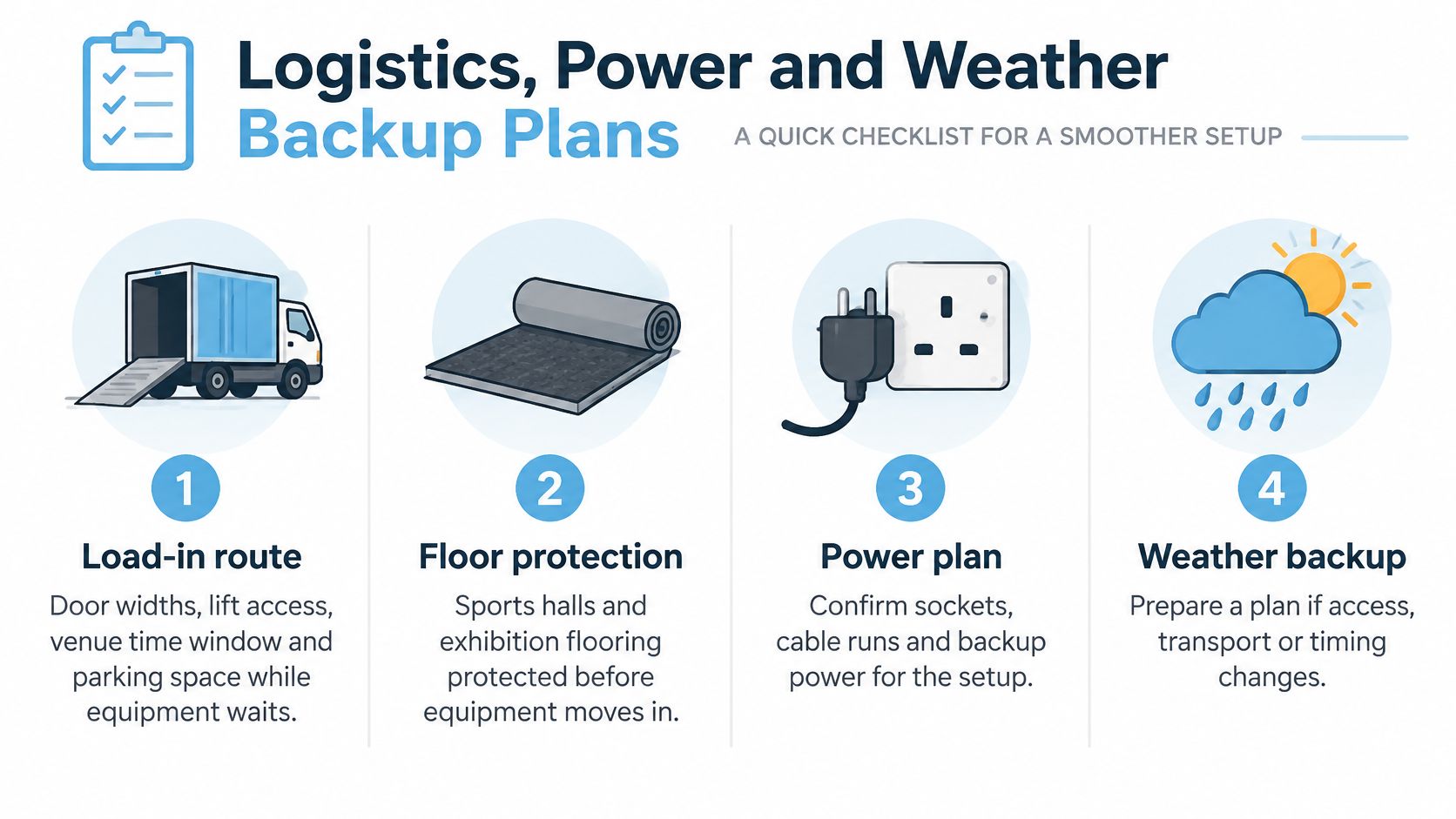
Load-in route. Confirm door widths, lift access, the venue's delivery window and where equipment can wait if the crew arrives before the space is ready. A route that works for guests may not fit the equipment or allow a safe turn into the hall.
Floor protection. Agree how sports-hall or exhibition flooring will be protected before equipment moves in. Protect the floor under heavy items and keep cables taped down and outside the run-off, where they won't become a trip hazard or interrupt play.
Power plan. List each circuit the game will use, check that it's separate from lighting and catering supplies, and keep suitable spare extension leads on site. Test the setup using the planned connections rather than assuming that a nearby socket will be adequate.
Certificates. Ask for copies before delivery. Every inflatable and electrical piece of PSW Events equipment has an RPII or PIPA test certificate and a PAT test certificate; confirm that the relevant documents are available for the equipment being supplied.
Weather backup. If the programme includes outdoor activity, decide when you'll move equipment under cover if conditions change. Where possible, PSW Events may move equipment to an indoor area if part of the event is outdoors, and some pieces of equipment can be covered with shower canopies if rain arrives. Agree the trigger in advance, including who makes the call and where the equipment goes.
The day before the event, sign off the route, power, certificates, floor protection, weather trigger and a named venue contact. A written check gives the team one clear version of the plan to follow.
Staffing Roles and Headcount per Court
Staffing a court is a throughput decision before it is a rules decision. A shooting bay can run with one trained host and a queue marshal. A timed game with scores that count needs a table team, and one casual attendant cannot referee, manage the clock, record scores and control the queue at the same time.
Basketball England's academy regulations require licensed referees, table officials and statisticians for academy games. EABL and WEABL games require visible clocks and a shot clock. Those competition rules are not automatically the rules for an event activation. Set the format and clock rules first, then staff to match.
Staffing roles per indoor basketball court
| Role | Per court | Core duties | Needed for |
|---|---|---|---|
| Referee | 1 | Rules, fouls and decisions on play | Competitive games |
| Table official and scorer | 1 | Live scoring, possession and foul logs | Competitive games and stats |
| Timekeeper or shot-clock operator | 1 | Game clock and shot clock where required | Competitive games |
| Floor host and queue marshal | 1–2 | Briefing, rotation and keeping run-off clear | All formats |
| First aider | Venue or insurer | Injury response and route to first aid | All formats |
| Statistician or video operator | 1 | Recording and rebuilding statistics from video | Stats-led events |
For a structured game, make the clock visible from the spectator area as well as the playing area. Assign scoring duties before doors open and run a trial possession so the table team can practise the actual sequence. If live statistics are not completed, academy regulations require them to be reconstructed from video by the end of game day.
Common failures are avoidable: shot-clock rules nobody has explained, scorers who have not practised, no video backup and final scores with no record of play. Track possessions, field-goal attempts, turnovers, rebounds, time per participant and conversion rate. A clear event-team structure assigns ownership of those tasks to named people.
Match the staffing plan to the chosen format. A public fan zone usually needs the second floor host more than a second referee, because queue control and rotation decide how many guests play. Reduce headcount only where the rules and the work allow it, and confirm first-aid cover with the venue or insurer rather than guessing.
How to Build, Test and Open the Game
Treat the build as a run-of-show. Each check should use the venue audit and logistics decisions, so the crew isn't trying to solve layout, access and safety questions while guests are waiting.
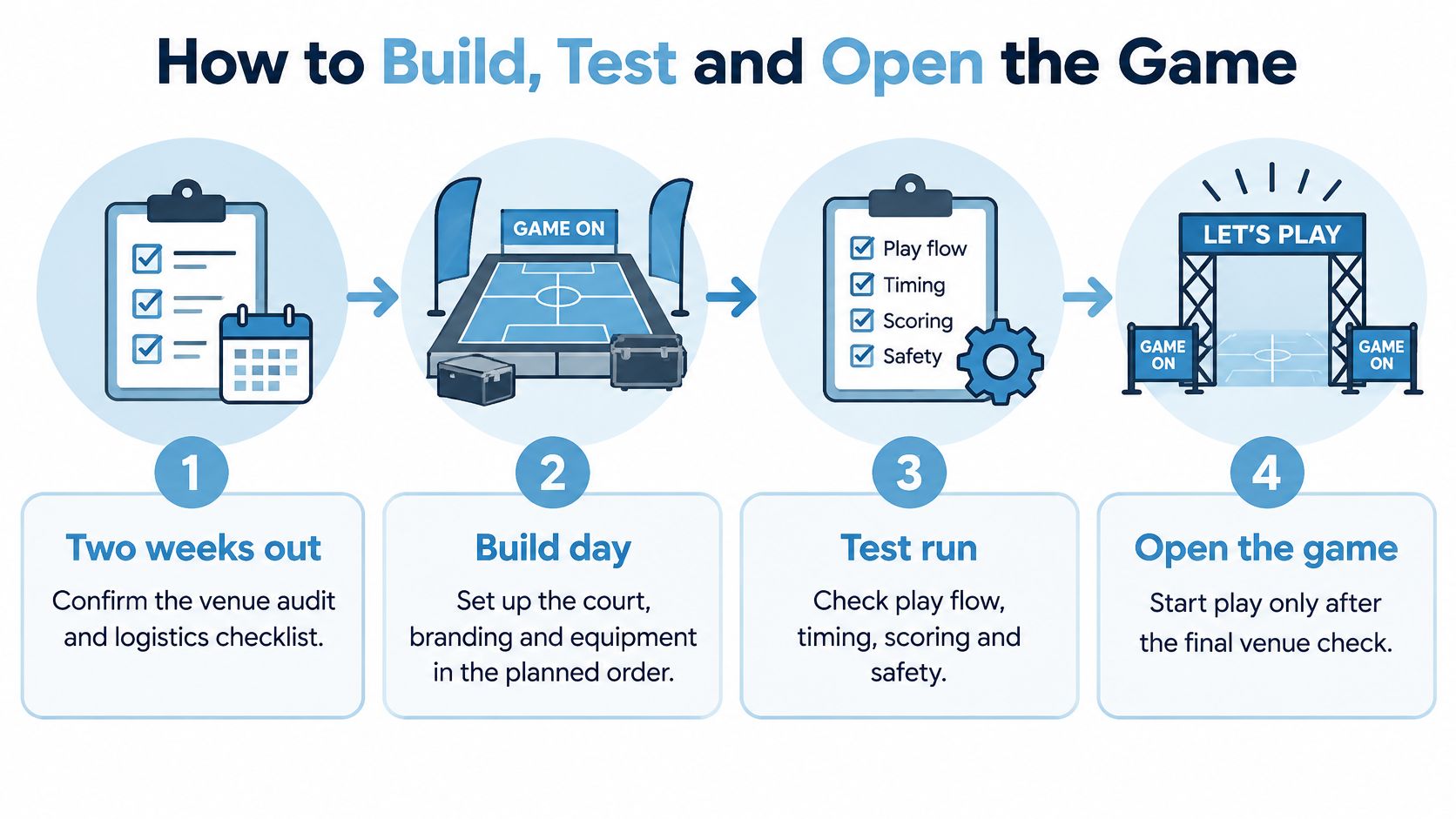
Two weeks out, confirm the audit and access. Check the venue audit sheet, delivery window and named venue contact. This gives the supplier and site team time to resolve any mismatch between the planned footprint and the available space.
On the day before the event, load in and protect the floor. Lay the agreed protection and mark the court lines with contrasting 50 mm markings where needed. Getting these tasks done before equipment is positioned makes the layout easier to inspect and adjust.
Install scoring equipment and inspect sightlines. Test the scoreboard or leaderboard from the playing area and the spectator queue, not only from the operator's position. A score display that guests can't see weakens the experience and makes it harder to follow a competition.
Take readings and record them. Measure lighting and temperature, then enter the results on the sign-off sheet. A written record gives the event lead a clear basis for opening approval.
Energise each circuit and verify documents. Connect the equipment to its planned supply and confirm the relevant test certificates are on file. This catches power or paperwork problems before play begins.
Brief the operating team. Explain the rules, who gives the stop signal and how to reach first aid. Staff need to know what to do when play pauses, not just how to keep it moving.
Run a trial possession and timed shooting round. Have staff play through the actual scoring and reset process, then correct any snag before guests arrive. For an electronic display, confirm what the audience will see on the basketball electronic scoreboard.
Open with a buffer and recheck the layout. Leave a fifteen-minute buffer before the first guest, then check the run-off and queue again at each change of hour. Close with a teardown order, identify which equipment should return under cover first and name the person who signs off the cleared site.
Branding and Measuring Engagement Without Blocking Play
Plan branding for a crowd that may include young people, adults and competitive players. Basketball England's participation figures underline that range: Sport England data reported approximately 306,400 adults aged 16 and over playing basketball at least twice per month, while one in four teenagers had played at least once a month during the preceding year. The grassroots basketball report describes participation across casual and organised settings, a useful reminder to make an event challenge legible to newcomers as well as regular players.
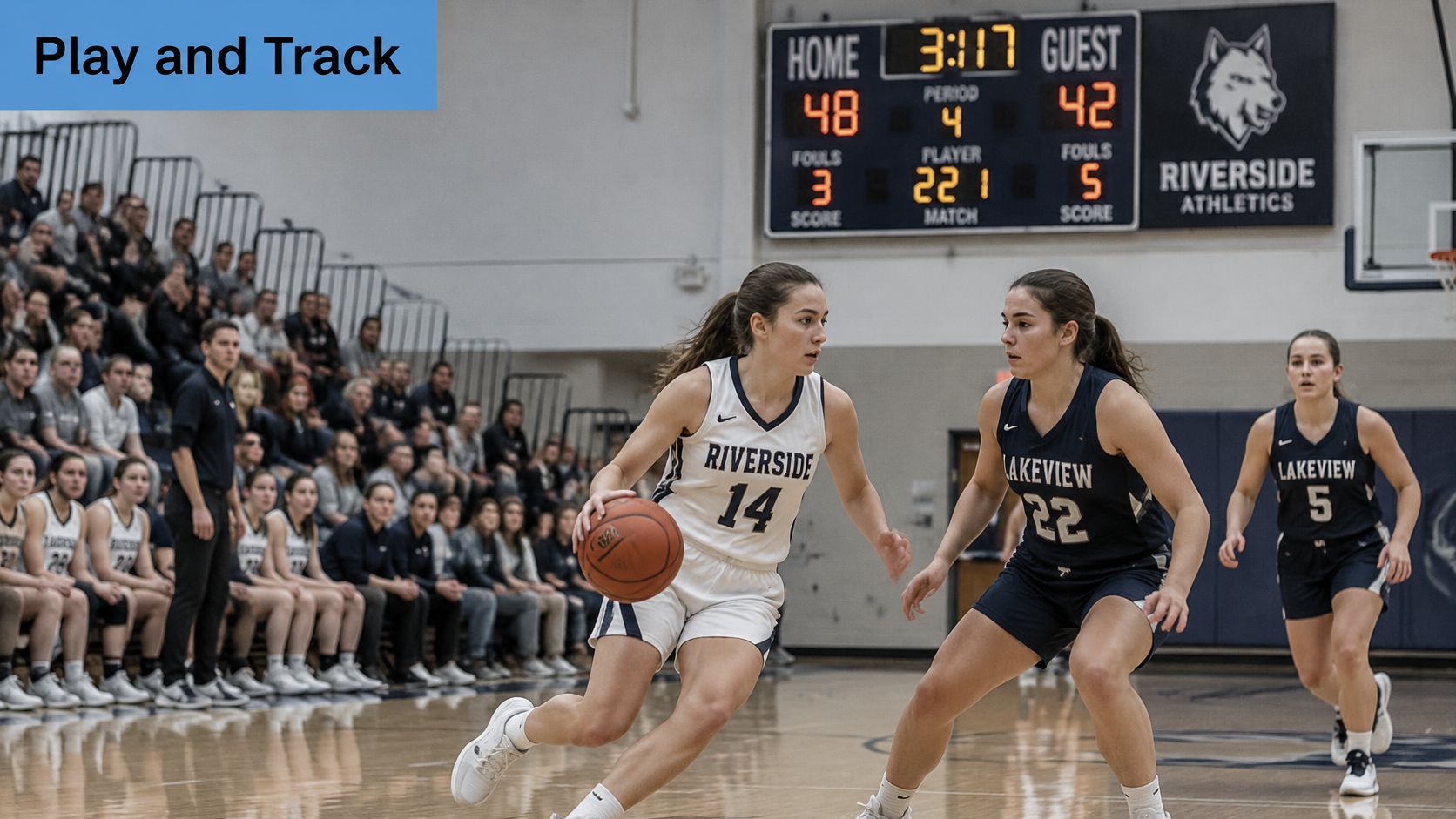
Put sponsor branding on the scoreboard or leaderboard, the back of the spectator rail and the frame of the shooting bay. Keep it off the floor inside the run-off. A visible logo is useful; a logo on a surface where players need safe, unobstructed movement isn't.
Decide what success means before the first session. Log attempts or possessions, conversion rate, time per participant, repeat players and dwell time. For example, a scorer can record each attempt on a tablet while a short video clip backs up the final tally. Set a target for each measure on the audit sign-off sheet so the results can be compared with a clear intention, not just remembered impressions.
Include a seated shooting option, adjustable challenge distances and a non-competitive way to take part. These choices let people try the activity at a level that feels comfortable and help the activation serve more than one ability or experience level. After the event, compare the results with the recorded targets and decide whether the format deserves another run.
Brief Your Provider Before You Confirm the Booking
By the time you ask for a final quote, you should have chosen a format, measured the space and set the staffing plan. Send the provider the selected setup, floor space and ceiling height from the audit sheet, headcount per station, load-in window and weather trigger.
Ask for written confirmation of the remaining unknowns: the space required for a shooting bay or simulator, its power draw and first-aid cover. PSW Events offers basketball simulator hire, a compact option for mixed-audience spaces, and lists Electronic Leaderboard hire for live scores that spectators and sponsors can follow.
Keep the booking sequence simple:
- Send the brief and venue audit sheet.
- Return unknown values to the venue and supplier for confirmation.
- Agree the sign-off record and certificate copies.
- Pay the deposit only after those details are confirmed.
Book the format that passes the venue and staffing checks, then keep the fallback ready for weather or late changes to the space. That gives you a practical alternative without asking the supplier or venue team to invent a new layout under pressure.
PSW Events offers basketball simulator hire and electronic leaderboards for indoor activations, exhibitions and fan zones. Share your event format and venue constraints with PSW Events to discuss a setup that fits the space and gives guests a clear way to play and score.