
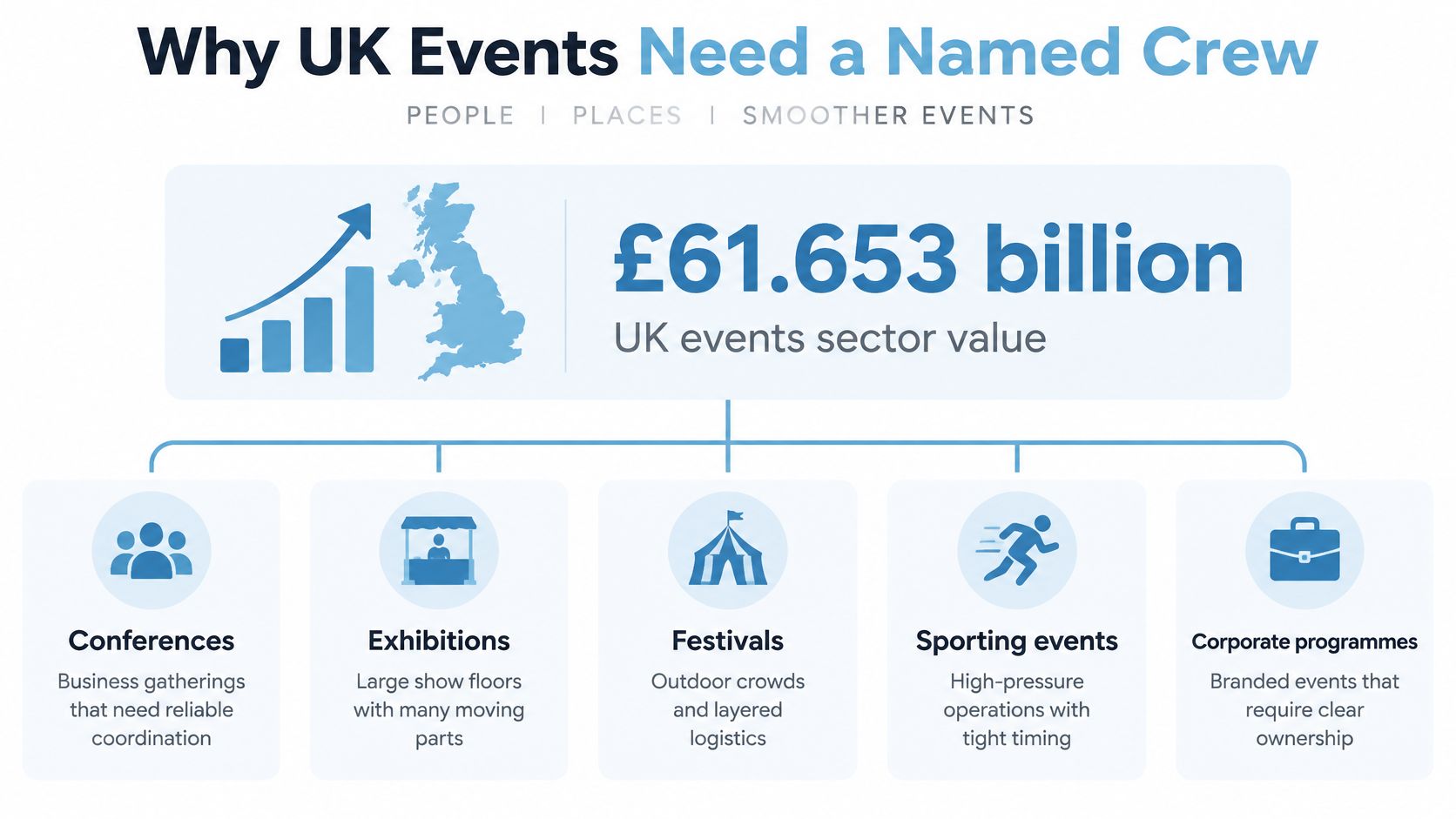
UK venues hosted an estimated 95.4 million delegates in 2024, while the sector's total value was estimated at £61.653 billion by the UK Events Report. Building an event team means organising the people who carry that operational load, not just finding willing helpers.
A lean permanent core can be safer than extra headcount, provided someone owns each decision, accessibility has a named lead, and specialist suppliers are appointed before show day. Without those conditions, a larger crew can leave you with more people waiting for the same unanswered instruction.
Why UK Events Need a Named Crew
A corporate activation, exhibition stand or family fun day sits within a supply chain spanning conferences, exhibitions, festivals, cultural events, sporting events and corporate programmes. Your attraction might occupy a modest footprint, but its delivery still touches venue access, electrical provision, production schedules, visitor movement and emergency arrangements.
The predictable failure isn't a shortage of enthusiasm. It's a crew of general helpers trying to manage a queue, receive a delivery and restart an attraction while nobody knows who can suspend participation.
Build around decisions rather than job titles
Start with the decisions that could affect safety or delivery, then assign people who have the competence and availability to make them. A senior title doesn't help if its holder is hosting clients away from the radio.
Your working documents should provide:
- A named role chart: Each operational responsibility has an owner, deputy and reporting route.
- A staffing rule: Permanent staff retain decision-making responsibility while contractors supply defined capacity or specialist competence.
- A recruitment and training sequence: People are selected against actual duties, then briefed on the site and equipment.
- A show-day operating brief: Queue triggers, accessibility arrangements, communications and emergency actions are usable on the floor.
Practical rule: A person can hold several roles only when those duties won't demand their attention simultaneously.
That's the difference between a lean team and an understaffed event. Combining planning responsibilities can work; expecting an attraction operator to supervise a remote entrance during live operation cannot.
Use the role chart below as the starting point for the call sheet, replacing role names with actual people before you confirm the crew.
Event Team Roles and When to Add Them
UK event team roles and staffing triggers
| Role | Owns | Add when | Seat |
|---|---|---|---|
| Event lead | Brief, budget calls, run of show | Every event | In-house |
| Safety lead | Risk assessment, stop-work, authority liaison | Any public or crowded event | In-house or named contractor |
| Operations and logistics | Site plan, load-in, power, vehicle routes | Multi-zone or equipment events | In-house coordinator |
| Zone supervisor | One defined area and its stewards | More than one simultaneous activity | Core plus extras |
| Stewards | Queues, circulation, exits | Forecast attendance or queue trigger points | Mix of staff and trained casuals |
| Communications and incident | Control point, radios, public information | Any event with an emergency plan | Named lead |
| Accessibility lead | Briefing, routes, sensory and participation options | Interactive kit, noise or complex layouts | Named owner, not a shared task |
| First aid lead | Casualties, disabled evacuation support | Risk assessment requires medical cover | Contractor or trained staff |
| Attraction operators | Exclusion zones, throughput, resets | Each hired or owned activity | Specialist crew |
Put authority beside the name
The event lead owns the client brief, budget decisions and final run of show. Give that person a clear boundary: they may change the programme, but they can't override a safety stop merely because guests are waiting.
The safety lead coordinates the risk assessment, exercises agreed stop-work authority and manages external liaison. The Health and Safety Executive's guidance on working with others calls for clear crowd-safety responsibilities and liaison with the local authority, police and emergency services, including proposals to a local Safety Advisory Group where appropriate.
A SAG provides advice; it doesn't become your operational management team. Agree emergency responsibilities with the relevant services in advance, rather than assuming an arriving responder will immediately take over every task.
Operations turns the programme into a workable site: delivery slots, loading access, power distribution, vehicle movements and installation order. Zone supervisors then take responsibility for defined patches, with boundaries marked on the site plan.
Make the chart usable on a radio
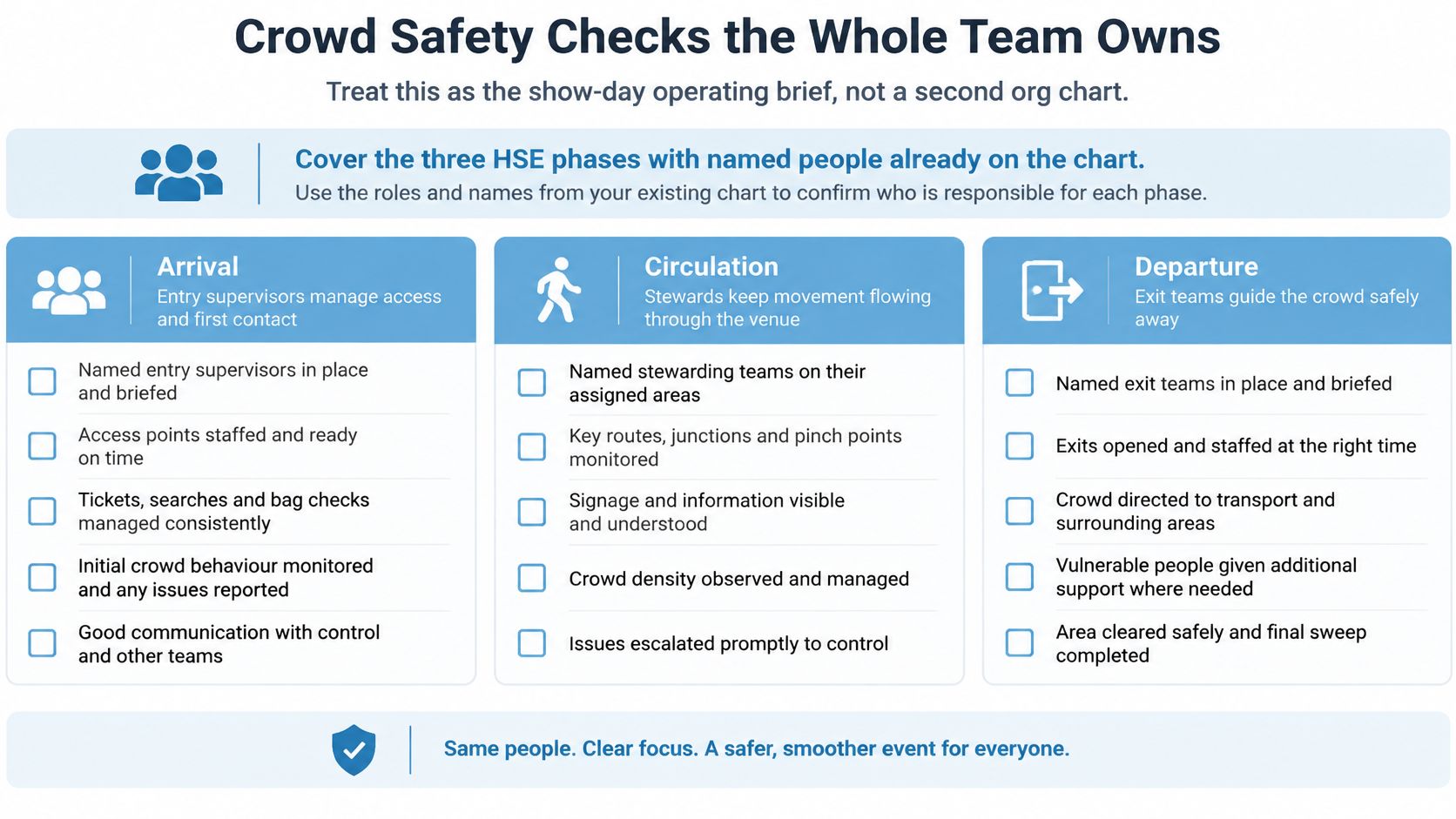
Stewards need assigned positions and relief arrangements, not an instruction to keep an eye on things. Cover entry queues, internal circulation and departure, with a supervisor able to redeploy people without abandoning another critical post.
The communications coordinator needs access to crowd information, queue reports and incident messages. Give the control point a clear location and prevent routine supplier queries from drowning out urgent calls.
For document structure, HR Management 365's resource on how to build audit-ready organisational charts can help turn reporting lines into a legible record. Adapt the chart for live delivery by adding radio call signs, deputies and decision permissions.
Accessibility and first aid need distinct ownership even where the same organisation supplies both. The first-aid lead coordinates casualty care and agreed evacuation support; that doesn't make them solely responsible for every disabled attendee's evacuation arrangements.
Attractions require competent operators with written exclusion zones, participant limits, reset procedures and isolation instructions. Don't count an operator as spare stewarding capacity while their equipment is live.
Copy the chart into the duty list and share it with venue staff, suppliers and volunteers before doors. Each person should be able to identify their supervisor without searching an email thread.
In-House Core or Specialist Contractors
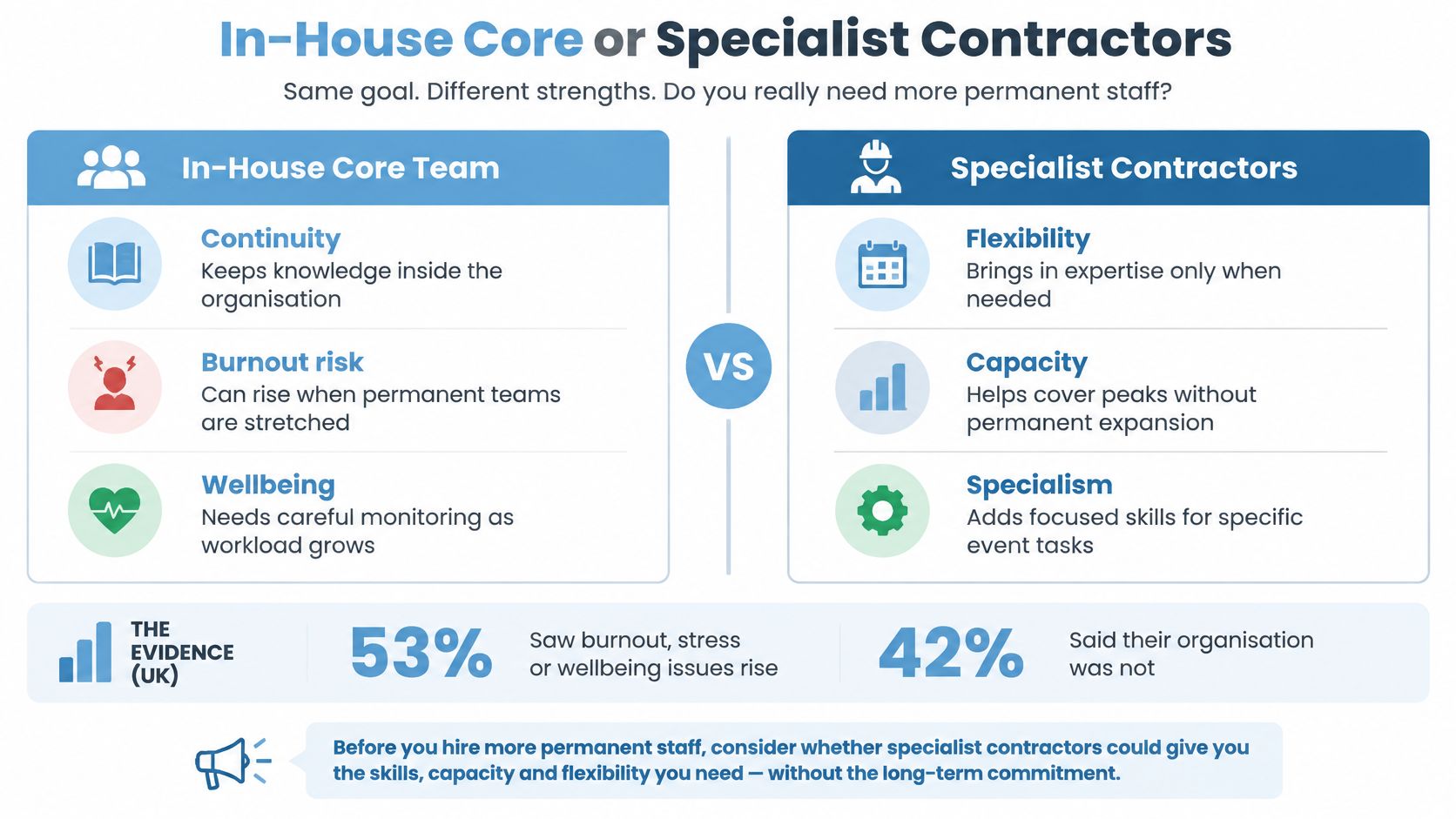
The Meetings Industry Association reported that 53% of respondents had seen burnout, stress or wellbeing issues increase during the previous year, while 42% said their organisation wasn't investing in upskilling or reskilling, as recorded in this published discussion of event-workforce resilience. Hiring more permanent staff won't resolve unclear decisions, missing competence or schedules that rely on people remaining constantly available.
Use the budget to buy the capability you lack. Keep continuity inside the organisation, and contract clearly defined delivery tasks where demand peaks or specialist skills are needed.
What to keep in-house and what to contract
| Function | Keep in-house | Contract | Staffing trigger |
|---|---|---|---|
| Client liaison and run of show | Event lead | Rare cover only | Every event |
| Risk assessment and stop-work | Safety lead | Deputy if absent | Public or crowded events |
| Site plans and supplier calls | Logistics coordinator | Install crew | Multi-zone, marquees or heavy kit |
| Queue and exit stewarding | Zone supervisors | Extra stewards | Queue reaches a set point or flows conflict |
| Medical and casualty care | Named first-aid owner | Medical contractor | Risk assessment requires it |
| Attraction operation | Brief and exclusion rules | Trained operators | Each simulator, ride or interactive |
| Accessibility checks | Named lead | Specialist adviser if needed | Sensory, mobility or layout risk |
Retain ownership without doing every task
Keep client liaison, the event lead and the accountable safety owner in-house wherever practicable. You can appoint a competent external safety specialist, but an internal owner must still understand the advice and control the organiser's response.
Contracting works when the supplier receives an outcome, operating boundary and escalation route. It works poorly when a purchase order says staffing and everyone assumes somebody else will specify duties.
Say a popular simulator draws a queue across an adjacent stand's entrance. The venue may remain below its overall capacity, yet that local route is becoming unsafe. Budget stewarding against the queue's available space and escape route, not just the registration total.
Bring in technical crews when installation, electrical isolation or participant throughput requires specialist competence. Medical cover should follow the assessed risks and response arrangements, rather than being added as an optional finishing touch.
Pay for resilience, not habitual overtime
Permanent recruitment makes sense when the same capability is repeatedly needed and there's enough ongoing work to develop it properly. Contractors make sense for concentrated installation periods, specialist equipment and additional live coverage.
Neither approach removes the need for breaks, relief and succession cover. Name deputies for the event lead and safety lead, give them access to current documents, and rehearse how they assume control.
Extra headcount isn't resilience if every consequential decision still waits for the same exhausted person.
Before approving another role, write down what its holder may decide without permission. If you can't identify that authority or a concrete task load, clarify the organisation before increasing it.
Use a blunt stress test: if a last-minute layout change would overload the same small group handling everything else, the resulting technical or logistics work should already have a named supplier.
How to Recruit Brief and Train the Crew
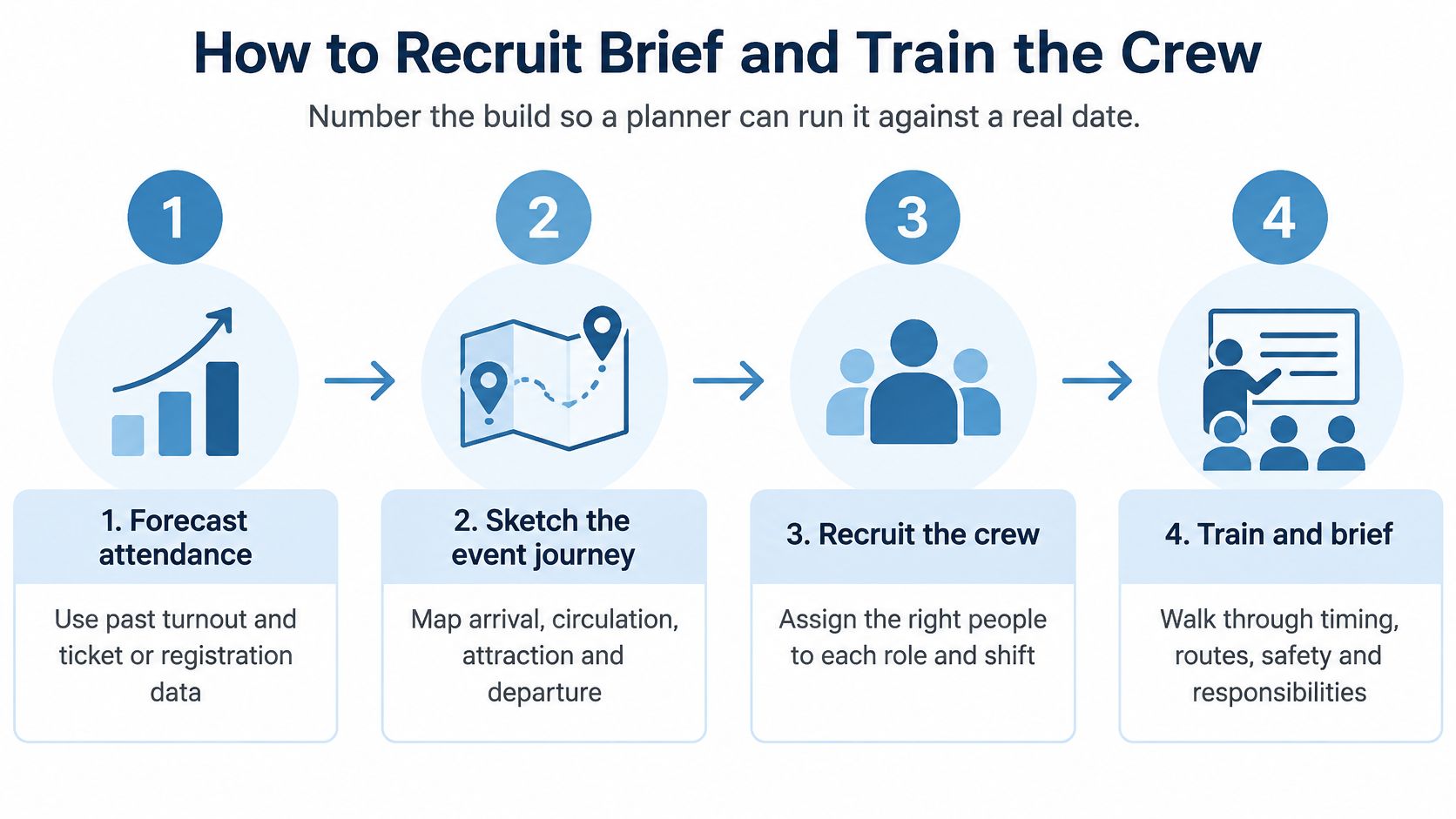
Recruit against the site and operating plan, not a generic request for event staff. The HSE's guidance on managing crowds inside an event says everyone involved, including volunteers, needs suitable information, instruction and training, supported by competent supervision and effective communications.
Recruit to the operating plan
Forecast attendance and draw the journey. Use past turnout and ticket or registration information, then sketch arrival, circulation, attraction queues and departure. Mark likely pinch points before writing job adverts; otherwise you'll recruit for the programme while missing the work around it.
Create a duty card for every role. Include location, shift, supervisor, radio call sign, permitted decisions and the action to take when something becomes unsafe. Write the escalation instruction in plain language, so a temporary steward doesn't have to interpret an organisational diagram under pressure.
Recruit the core before filling delivery shifts. Appoint the event lead, safety lead and logistics coordinator, then recruit supervisors, stewards and operators against the operating triggers. Prefer relevant venue-type experience, but test judgement too: ask candidates how they'd handle a blocked exit or conflicting radio instructions.
Walk the site for large or outdoor shows. Confirm delivery access, floor surfaces, equipment footprint, height clearance, weatherproofing and power arrangements. With our deliveries, the client must arrange any help needed to access or leave the venue, and rooms or marquees must accommodate the equipment's footprint, clearance and weatherproofing requirements.
Train for the actual job
Train everyone on their assigned duties. Volunteers need a proper induction, and operators need equipment-specific training rather than a generic safety presentation. Each member of our staff receives full training from PSW Events management on every piece of equipment the company houses; use our event staffing guidance when defining the operational cover your brief needs.
Establish control and test backup communications. Provide charged radios, spare batteries, mobile contact details and a loudhailer if the public-address system fails. Practise a short incident message containing location, hazard and assistance required, then check that someone acknowledges it.
Lock logistics before arrival. In most cases, our Logistics team contacts the customer the week before the event for a final run-through and changes check, and confirms required arrival times. We arrive with enough setup time for equipment to be ready and tested at least half an hour before the event starts; schedule other contractors so their work doesn't invalidate those tests.
Meet the whole crew on site and rehearse the triggers. Point out the marked queue location that prompts another service point, the route that must remain clear and who authorises reopening after a stop. Review controls during operation, then assign the incident coordinator to collect records and the event lead to update the playbook after hand-back.
Keep informal crew connection separate from competence assessment. If you're organising an optional shared drinks break, The Matcha Bike's invitation to join The Matcha Bike community is a social resource, not evidence that somebody is qualified to supervise an attraction.
Finish the briefing with questions about actions, not a general request for questions. Ask a steward to identify their relief contact and an operator to explain their stop procedure; gaps become visible before guests arrive.
Crowd Safety Checks the Whole Team Owns
Plan the visitor journey through arrival, circulation and departure. The HSE's crowd-management controls guidance sets out these phases and explains that queues need a safe way out without forcing people against the line or into vehicle routes.
Entry supervisors manage admission, circulation stewards protect movement through the venue, and the exit lead manages dispersal. Before admitting visitors, confirm that exits are open, routes are clear and emergency arrangements are ready.
Rehearse the emergency handover
An emergency plan must do more than summon an ambulance. The HSE's incidents and emergencies guidance covers moving people from danger, assisting emergency services, handling casualties, supporting displaced but uninjured people, liaising with authorities, protecting property and handing over control when necessary.
Translate those duties into staff actions: who raises the alarm, speaks to the public, clears emergency-vehicle access, coordinates evacuation and provides first aid. Include disabled people's evacuation arrangements and identify who remains at incident control while others respond.
Before doors: Test whether the nominated deputy can find the emergency plan, contact the relevant lead and explain the handover without help from the event producer.
Give accessibility a live owner
Among disabled delegates surveyed, 93% reported barriers, including overstimulating environments, untrained staff, inaccessible layouts and missing information, according to Brighter's wellbeing-in-events account. A compliant venue doesn't remove the need to manage your temporary layout, attraction controls and frontline responses.
The accessibility lead should approve published access information and walk the installed layout, not merely the drawing. Brief staff on sensory, mobility and communication needs, quieter participation and alternative formats, without promising that every attraction can accommodate every requirement.
For outdoor equipment, our on-site staff decide whether working conditions are safe using forecasts covering the event dates. Where possible, we may move equipment indoors, but the alternative space must still be suitable for operation.
Sign off the installed event
Use our health and safety compliance guidance alongside the venue's arrangements. Treat the timings below as working deadlines for your crew plan, not universal statutory thresholds.
Pre-doors safety and accessibility checklist
| Check | Owner | Timing | Evidence |
|---|---|---|---|
| Exits unlocked and routes clear | Safety lead | Before doors | Signed checklist |
| Queue exit route free of vehicle paths | Exit lead | Before doors | Site walk record |
| Emergency arrangements agreed with authorities | Safety lead | Before doors | Written handover |
| Radios, spare batteries and loudhailer tested | Communications coordinator | 30 minutes before doors | Test log |
| Accessibility information published | Accessibility lead | Two weeks before | Published page |
| Frontline staff briefed on sensory, mobility and communication needs | Accessibility lead | Before doors | Briefing sign-off |
| Weather check for outdoor kit | Safety lead | Morning of event | Go or move-indoors decision |
| Queue trigger points restated | Event lead | Before doors | Briefing note |
The safety lead signs the consolidated record, but each owner supplies evidence from their area. A signature isn't permission to ignore a later change: moved barriers, deteriorating weather or a new queue require another check.
Confirm the Crew Plan Before You Book
Match the service level to the team you can provide. Dry hire suits equipment that requires no operator; attractions needing active operation, exclusion zones and resets need staffed delivery.
For a lean client team, our service levels run from dry hire to full event management. The latter includes online planning meetings, site visits to help create site plans, power and utility requirements, staffing and management on the day, allowing your team to focus on potential clients and guests.
Lock the booking documents
Don't confirm crew against an incomplete plan. Check these items are written down:
- Named role chart: Every seat has a person and a workable cover arrangement.
- Employment split: In-house and contractor responsibilities are explicit.
- Logistics call: The final run-through is scheduled and someone records changes.
- Pre-doors checks: Safety and accessibility owners know what evidence they must supply.
- Emergency handover: Responsibilities are agreed with the relevant authorities and services.
An empty seat isn't a reason to add casual helpers without a defined duty. Recruit the required competence or reduce the activity.
Send a single supplier brief
For programme-heavy conferences, organisers can manage conference programs with Planion from Planstone while maintaining a separate operational crew plan. Programme administration doesn't replace the call sheet or the authority to stop an unsafe activity.
Use the event logistics checklist to assemble the supplier brief: location, load-in and show times, site contact, footprint, power needs and stop-work authority. PSW Events is one option for corporate events, exhibitions and fun days; whichever supplier you select should receive the same clear information.
Fill the role chart for your next event and send it with the site plan before confirming any crew. That gives suppliers something concrete to resource, rather than a promise that everyone will help out.
PSW Events provides equipment delivery, installation, trained on-site staffing and event management for corporate events, exhibitions and fun days. Visit PSW Events with your role chart and site plan to discuss the delivery support your crew needs, so your client-facing team can concentrate on guests.