If a packed stand counted as a working activation, why do so many UK exhibition teams leave with a crowd and an empty pipeline?
Brand activation is a planned, participatory experience that makes a brand tangible and asks for a measurable response. It is the response layer of brand building. The poster, ad or social post earns attention. The activation converts that attention into an action you can count: a demo booked, a sample trialled, a sign-up completed, a purchase made.
A planner searching for brand activation meaning wants a label they can defend in a briefing, not another phrase for "we had a fun stand". A stunt can fill a space and still leave no trace in the pipeline. An activation starts with the response it needs and designs the experience backwards from there.
At UK corporate events and exhibitions, the mistake is easy to make because attendance is visible and response is not. The test is simple: name the action first. If the activity cannot name it, the budget is buying decoration.
What Brand Activation Means in Plain English
Say a soft drinks brand sets up a sampling table at a London station. A host in a black apron offers a cold cup, asks one question, and invites the person to scan a code for a multipack offer. The poster on the wall is awareness. The cup in the hand is the activation.
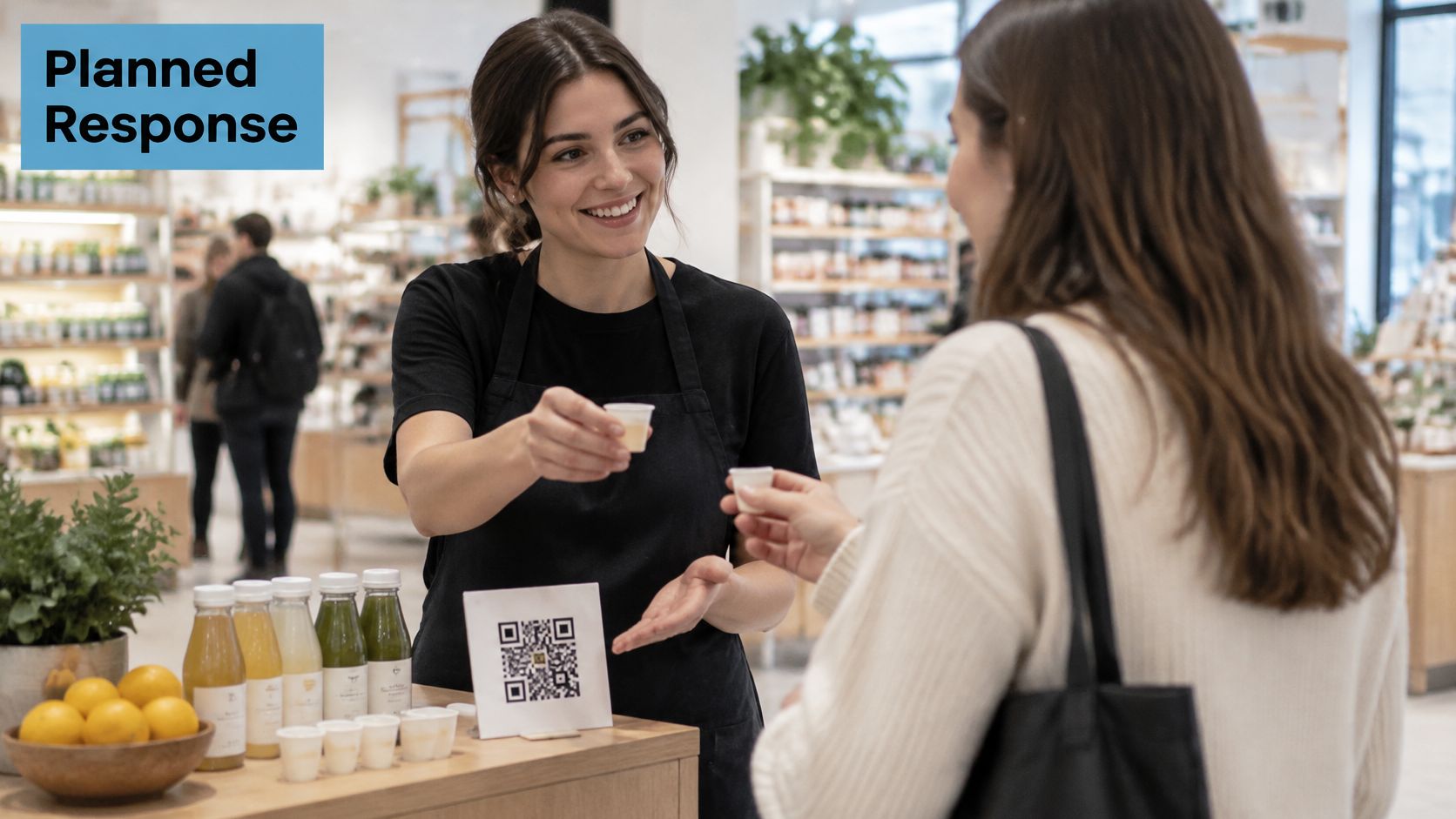
Awareness is the brand seen on a poster. Activation is the moment someone picks the product up and tries it. The poster can be beautiful and still produce nothing you can count. The sample has a job: trial, a purchase, a share, or a higher chance the person considers the brand next time.
Three words trip people up.
- Brand: the identity people already associate with a company, not the logo on a backdrop.
- Activation: the trigger that turns attention into a specific action.
- Measurable: a result you can count, such as a sign-up, a booked demo, or a shared post.
Teams use the phrase loosely. Any launch party, any inflatable, any DJ set gets the label. Use a simple test. If the activity cannot name the response it is designed to produce, it is decoration rather than activation.
LBB Online, reporting a nationally representative survey of 2,000 UK consumers, found that among people who remembered a live brand experience, 20% bought a product or service afterwards, 18% tried one, and 24% discussed it in person or by phone. The same piece recorded that 73% found the experience more memorable than other brands' advertising, and 81% said it made them more likely to consider the brand later. Those are responses, not headcounts.
If you cannot name the response, you have booked decoration.
Repeat this in the planning meeting. An activation earns its name only when participation is designed to produce a response you can count.
Brand Activation Compared With Advertising and Experiential Marketing
Planners mix three labels that sit next to each other and do different jobs.
| Dimension | Brand activation | Brand advertising | Experiential marketing |
|---|---|---|---|
| Main aim | Trigger an immediate or near-term response | Build memory and preference over time | Create a memorable live experience |
| Audience role | Participant who acts | Viewer who receives a message | Visitor who takes part on site |
| Typical timescale | Weeks to months, including follow-up | Months to years | One event or a short run |
| Usual measures | Leads, trials, sales and data captured | Awareness, consideration and brand tracking | Dwell time, sign-ups and social shares |
| Typical examples | Sampling, challenges and launch activations | TV, outdoor and digital display | Festivals, pop-ups and exhibition attractions |
Where the labels overlap
The table draws clean lines. Live work doesn't. Experiential marketing is often the vehicle for an activation, not a rival to it. A timed tournament on an exhibition stand can be both. It is experiential because people take part on site. It is an activation only if someone designed a response, such as a consented demo request, rather than a queue for its own sake.
Advertising sits further away. A viewer receives a message and may do nothing that day. That isn't a failure of the ad. It is a different job.
The budget split that gives the word its meaning
The Institute of Practitioners in Advertising analysed its effectiveness awards dataset and concluded that the optimum budget allocation across contexts was slightly more than 60% for brand building and slightly less than 40% for activation. Activation is the near-term response layer. Advertising is the long-term memory layer. Neither replaces the other.
The same IPA reporting treats events as a serious place to deliver that response. Its Q1 2024 Bellwether described events as the fastest-growing budget category in the survey's history, and its 2024/25 outlook recorded a net balance of +18.7% of respondents expecting event spending to rise against the previous financial year. Spending more on events doesn't, by itself, create an activation. The spend still needs a trackable action: a registration, a qualified conversation, a demonstration, a trial, a share, or a sale. Attendance alone doesn't qualify.
A TV campaign can build recognition across a season. A timed challenge on an ExCeL stand can produce a set of qualified leads in one day, then a follow-up sequence over the next month. Fix the objective first. Choose the format second.
What a Brand Activation Should Achieve
Judge the work in three windows, not one headline number.
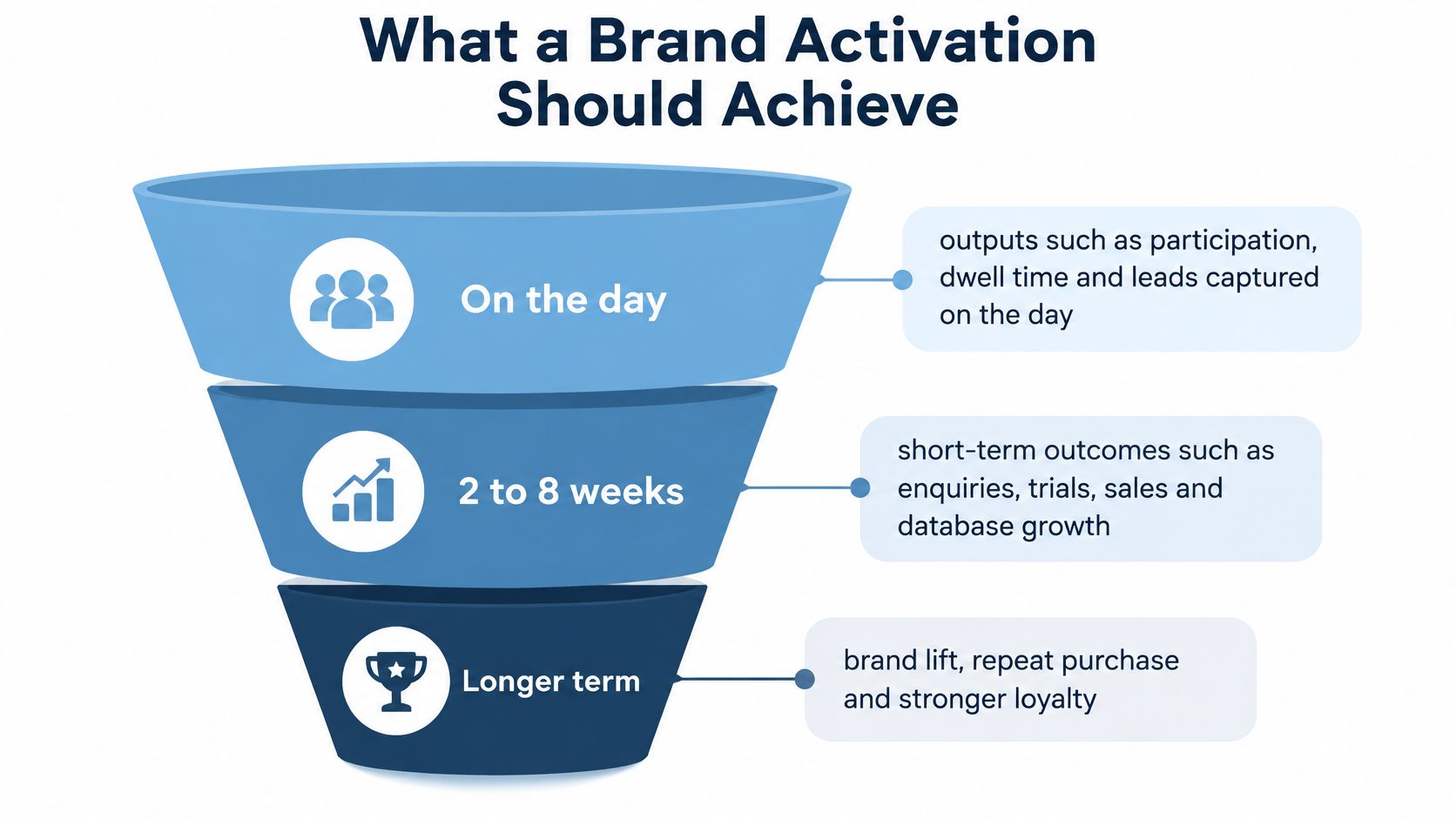
| Outcome tier | Examples | Typical window | Example metric |
|---|---|---|---|
| Outputs | Participation, dwell time, content created | On the day | Completed interactions per hour |
| Short-term outcomes | Enquiries, trials, sales, database growth | Two to eight weeks | Qualified leads and conversion rate |
| Long-term effects | Awareness, consideration, preference, customer value | Six months or more | Brand tracking and repeat purchase rate |
Why a busy stand can still fail
An event can look successful on footfall and dwell time while sales and pipeline stay flat. Outputs tell you the mechanic worked as entertainment. Short-term outcomes tell you the commercial path worked. Long-term effects tell you the brand moved in memory, preference, or repeat value. Mixing those tiers is how teams congratulate themselves for the wrong result.
Say a B2B software brand runs interactive challenges on a busy stand. Footfall is strong all afternoon. Eight weeks later, qualified conversations are thin and the pipeline figure hasn't moved. The footfall number didn't lie. It answered a question nobody should have treated as the objective. Experiential marketing ROI only becomes readable once each objective has a tier and a metric attached before the doors open.
Name the tier and the metric before the event, not in the wash-up.
On the day, count completed interactions. Within two to eight weeks, count qualified leads and the conversion rate. Over six months or more, look at brand tracking and repeat purchase. If you skip a window, you will either kill a slow brand effect too early or defend a stunt that never produced a response.
How a Brand Activation Works, Step by Step
A live moment earns attention. Continuity decides whether that attention becomes intent you can use. SAP's UK consumer research found that 82% of consumers are discouraged by disorganised brand interactions that make them repeat information or move between teams, while only 56% said their favourite brand delivers connected experiences. Design the journey as one path.
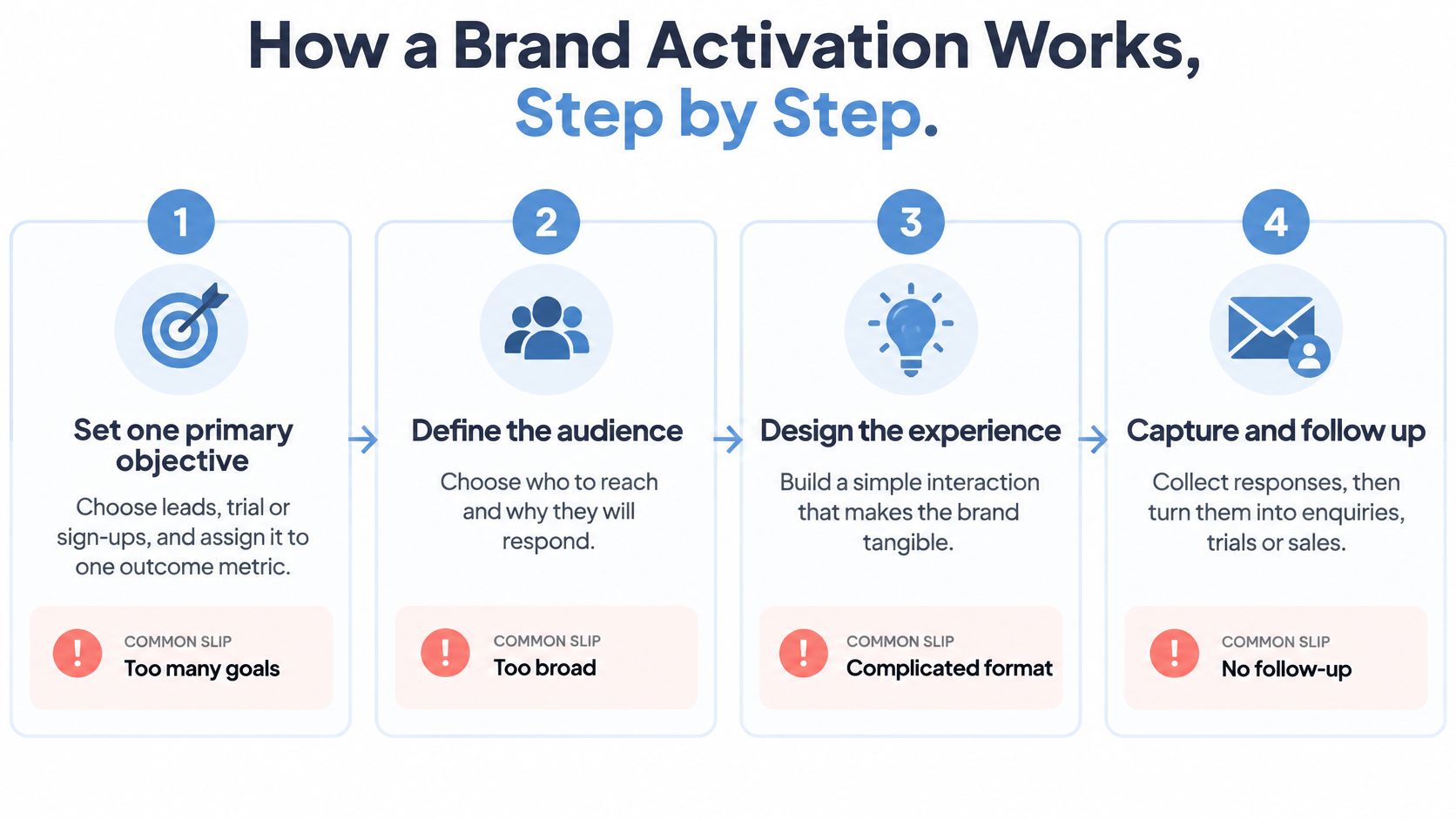
- Set one primary objective. Pick leads, trial, or sign-ups, plus one secondary metric, and assign both to an outcome tier. Too many goals means the host script, the form, and the follow-up all pull in different directions.
- Define the audience. Name them tightly, such as trade visitors at a named stand or existing customers at a launch. "Anyone walking past" produces a queue you can't follow up.
- Design a short mechanic. Keep participation under three minutes and make the brand visible, for example a timed challenge with a branded leaderboard. A complicated format burns the queue and hides the product.
- Connect every touchpoint. Registration, on-site handover, consent screen, CRM capture, and the follow-up message should feel like one journey, with the same branding on signage, host scripts, and post-event content. Capture only the fields the objective needs.
- Set the response path. Decide who receives each lead and how fast, for example within 24 hours, under a written service-level agreement. A lead that sits in a shared inbox until Monday is a dropped response.
- Amplify before and after the day. Invitations and appointment-setting fill the right slots. Post-event content gives people who didn't attend a second chance to respond.
- Measure drop-off. Check each stage, from invite to completed interaction to consent to sales contact. Report the experience numbers and the downstream outcomes together.
Run the full journey as a dry run before launch. A host, a consent screen, and a test lead sent to the right person will show the break before a real visitor hits it.
Brand Activation Examples at Corporate Events and Exhibitions
The mechanic changes with the room. The rule doesn't. Each row below names a response and the measure that proves it.
| Event | Activation mechanic | Primary objective | Measure to track |
|---|---|---|---|
| Trade show stand | Timed simulator challenge with a leaderboard | Lead capture | Qualified leads and consent rate |
| Product launch | Branded racing rig with a trial prize | Trial and demo bookings | Demos booked and trials completed |
| Staff reward day | Team competition on an electronic leaderboard | Internal engagement | Participation rate and pulse survey score |
| Festival fan zone | Virtual challenge with a social share prompt | Advocacy | Shares, sign-ups and dwell time |
| Conference networking | Hosted tournament with meeting booking | Pipeline | Meetings set and pipeline created |
One stand, followed through
A B2B software brand takes a stand at a UK exhibition and runs a timed simulator challenge on a branded leaderboard. Visitors who reach a set score are offered a follow-up demo, and the consent screen records a yes or a no. Sales receives the qualified leads within 24 hours. The content team posts leaderboard highlights the next morning for people who missed the slot.
That counts as activation because three things exist together: a defined response, a consented data path, and a follow-up with an owner. A busy simulator with none of those is a game.
The day is one piece of a wider system. Analysis of 569 campaigns in the IPA Effectiveness Databank, reported by Bauer Media, found that campaigns combining audio, outdoor, and publishing produced 33% more brand effects and 8% more business effects than comparison campaigns. Large or very large activation effects showed up in 45% of campaigns using all three channels, against 15% using none of them. Those channels aren't a compulsory kit for every stand. They do show that "the activity on the day" is a weak definition. Pre-event targeting, a shareable mechanic, and post-event outreach turn the same simulator into a campaign asset. More brand activation examples follow that pattern across launches, fan zones, and conferences.
If the challenge needs a sign-up over the venue network, plan deploying guest Wi-Fi for events so the consent screen doesn't fail when the hall network drops. The same mechanic can serve a fan zone, a product launch, or a staff reward day. The objective you wrote first decides which column you report.
Common Misconceptions About Brand Activation
Four habits keep showing up in briefs, and each one spends the budget on the wrong proof.
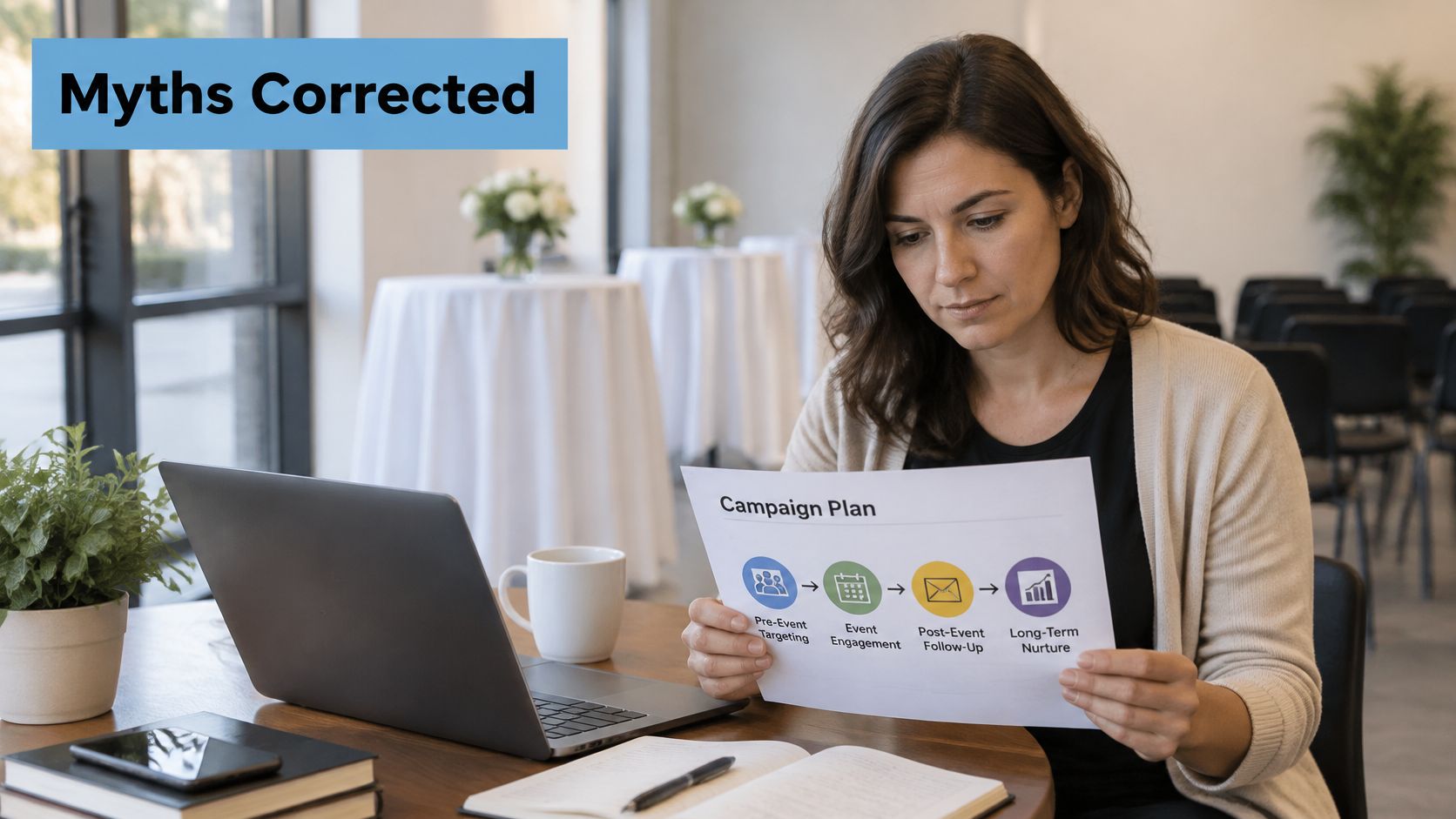
"It's a one-day stunt." The day is the trigger. Value depends on who you invited beforehand and who you contact afterwards. Strip those out and you have hired a spectacle.
"High footfall proves it worked." Footfall without a qualified action is an output. It belongs in the on-the-day tier. It doesn't stand in for enquiries, trials, or pipeline.
"Activation replaces advertising." The two work together. Activation supplies the near-term response. Advertising builds the memory that makes that response more likely when someone meets the brand in person.
"Any interactive game is an activation." Without a defined response and a data path, it is entertainment. Guests can have a great time and the business can still have nothing to act on.
Where activation is a poor fit
Activations work best when the objective and the audience are already clear. They're weaker for products with long purchase cycles where no near-term action is realistic, because you've nothing honest to measure in the weeks after the event. They also cost more per head than mass channels, so they're a poor way to buy raw reach.
A launch with 2,000 visitors and no follow-up can deliver less than a smaller event with a tested handover. Keep the look consistent while you do that work. A shared set of consistent logos, colours and campaign templates stops the leaderboard, the consent screen, and the follow-up email from looking like three different brands.
Confirm Your Objective Before You Book an Activation
Answer three questions before you request a quote.
- Which single response do we want? One primary action, such as a qualified lead, a trial, or a sign-up.
- Which tier does that response belong to? Output on the day, short-term outcome within weeks, or long-term effect over months.
- Who receives the lead or the data, and how fast? Name the person and the deadline, not "the sales team".
If those answers are clear, write the objective as one sentence, name the tier, and send that sentence with the event date and the audience when you ask for a quote.
PSW Events is one option for that brief. We supply interactive attractions, including simulator and racing rigs, for exhibitions, product launches, fan zones, and team events, for both B2B and B2C audiences. Delivery covers planning, branding, logistics, installation, on-site staffing, and health and safety compliance.
PSW Events builds participatory brand activations around simulators, racing rigs, and competitive challenges, with the planning, branding, and on-site staffing that turn a stand into a measurable response. If you are briefing an exhibition, launch, or fan zone and you already know the action you want, visit PSW Events and send the objective, the audience, and the date with your enquiry.