
You've paid for the stand space, approved the graphics and booked a digital activation that looked impressive in the proposal. Then the exhibition opens, and visitors gather around a simple metal loop, cheering every time someone touches the wire. That scene is familiar to many UK event teams. A wire buzzer game can attract attention because the challenge is immediate, visible and easy to understand, even in a crowded hall.
Used properly, it's more than a nostalgic fairground prop. It can create a conversation point for brand ambassadors, a controlled queue for lead capture and a repeatable competition that gives visitors a reason to stay. The commercial value depends on the details, though, particularly positioning, accessibility, operating rules and the way your team records engagement.
Understanding the Wire Buzzer Game Mechanics
At a trade show, the attraction often works before the presenter says a word. A visitor sees a colleague holding a metal loop over a winding wire, hears the buzzer sound and moves closer to find out what went wrong. The game has a clear objective, move the loop along the entire wire without touching it. According to BBC Bitesize's explanation of the game, touching the wire allows electricity to flow to the buzzer, producing the alarm.
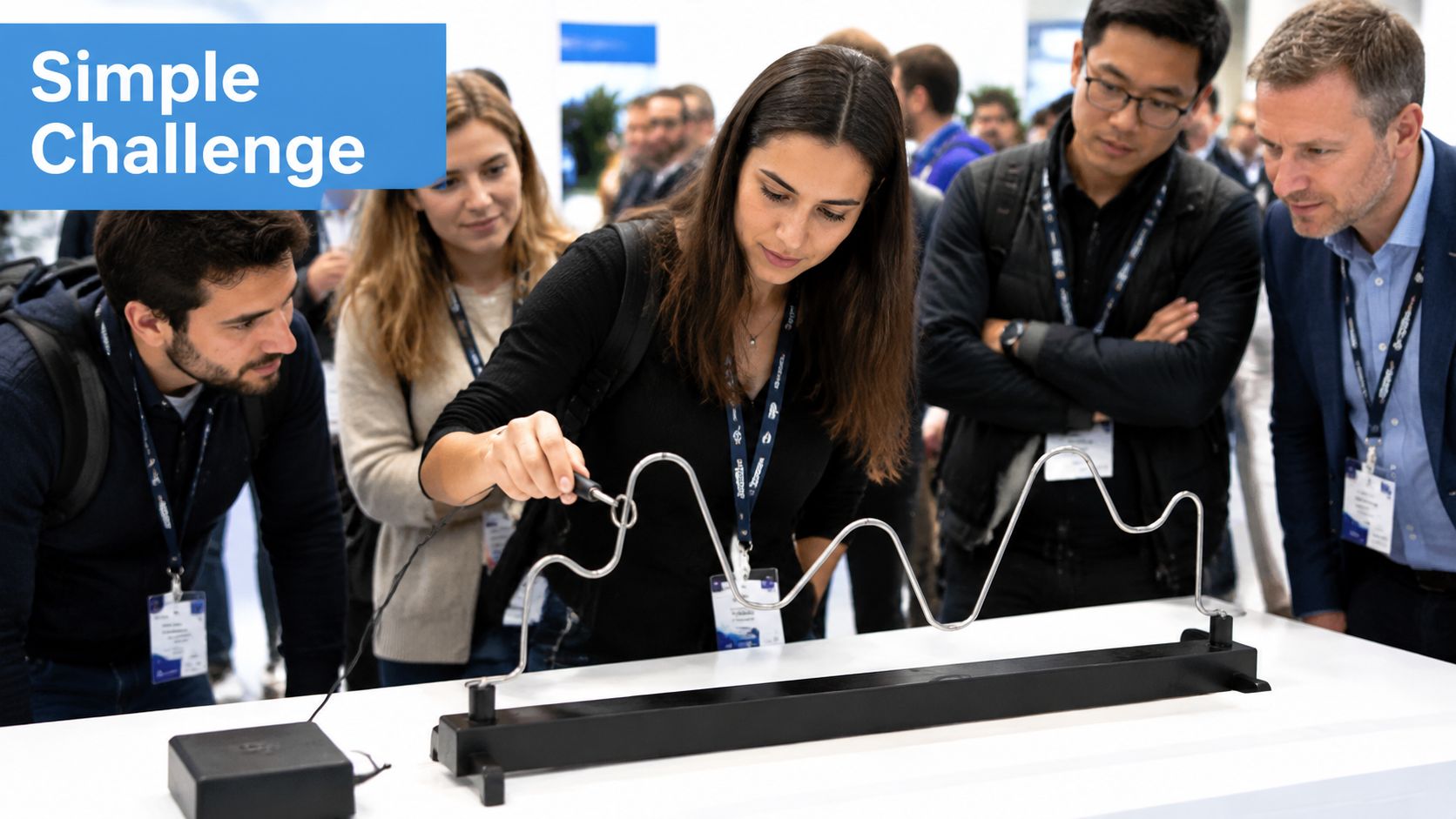
The mechanism is deliberately simple. The metal loop and shaped wire form part of an electrical circuit. When they make contact, the circuit closes and activates the buzzer, or on some units, a light and audible indicator. That direct cause and effect gives players instant feedback without a screen, controller or lengthy explanation.
Why the format has lasted
The modern commercial format has a specifically documented UK origin. Robert “Bob” Scrimshaw invented it in Yorkshire in 1953, after John Waddington asked him to create a game for a garden party, as recorded in the history of the wire loop game. Waddington later patented the design and sold early versions through Waddingtons Game Co. in the mid-1950s.
That history matters to corporate planners because the attraction isn't an imported novelty that depends on a short-lived trend. It grew from a British invention into a format used in fairgrounds, theme parks, science fairs and educational settings. UK coverage also connects the game with the post-1950s growth of home and amusement versions, while STEM project materials use its low-voltage circuit to demonstrate conductivity, control and hand-eye coordination, as described by Adventure Coast Southport.
From toy to activation
The same simplicity that makes the game accessible to a passing visitor gives an event team control. You can explain the rules quickly, observe the result publicly and invite a natural follow-up conversation. A branded steady hands attraction, such as the PSW Events steady hands game, can therefore sit at the front of a stand while staff use the attempt as an opening for qualification.
The game itself doesn't generate return on investment. Your operating design does. Decide what happens before the player starts, what information the host collects afterwards and how the score or time connects to the brand message.
Technical Specifications and Venue Footprint
Floor planning starts before the hire is confirmed. Request the unit's overall dimensions, player clearance, cable route, table requirements and power arrangement, then place each item on the stand or venue plan. The objective is clear sightlines without obstructing fire routes, accessible circulation or neighbouring exhibitors.
Low-voltage, battery-powered designs can simplify indoor installation by reducing dependence on trailing mains cables. One UK product specification lists 12V DC power, a sealed rechargeable 2.3Ah battery, insulated start and stop controls, a piezo siren and LED indicator, as detailed in this UK buzz wire product specification. The immediate sound and light response also helps hosts confirm the result without a separate scoring system.
Compare the formats before booking
| Format | Dimensions (Approx) | Power Source | Ideal Event Type |
|---|---|---|---|
| Tabletop unit | About 0.85m x 0.3m x 0.75m | 12V DC, rechargeable battery | Exhibition stands, foyers and indoor activations |
| Larger tabletop-style version | Roughly 4ft x 1ft | Battery or supplier-specified supply | Corporate parties and compact competition areas |
| Full-size installation | About 1.21m x 0.31m x 1.52m operating space | One 13A power socket may be specified | Corporate days, larger exhibitions and branded competition zones |
These figures are planning benchmarks based on UK event-hire product guidance, not a replacement for the supplier's final technical drawing. Confirm the exact footprint, power specification and access route with the hire company. A compact unit may fit on a stand table, while the player still needs room to stand, reach, turn and leave without crossing the queue.
Build the site plan around behaviour
Mark three areas on the plan:
- Playing position: Keep the unit stable and place it where the player can reach the wire without twisting.
- Queue line: Position waiting visitors so the line does not spill into a neighbouring stand or block a corridor.
- Conversation point: Leave the brand ambassador enough space to speak with the player after the attempt and record the agreed engagement outcome.
Battery operation removes one cable issue, not every setup task. Confirm charging arrangements, spare batteries where relevant, isolation controls and the location of the emergency stop or reset before doors open. Full-size builds may need a socket and a larger operating area, so venue approval should cover the attraction, its access route and the space required for safe player movement. This planning also gives the team a realistic basis for estimating throughput and staffing before the activation begins.
Maximising Engagement Across Event Formats
A wire buzzer game creates attention, but the event format determines whether that attention becomes useful engagement. A visitor who plays once and walks away gives you a moment. A visitor who enters a branded challenge, shares a result, speaks with an ambassador and agrees to a follow-up gives the activation a measurable commercial path.
Start with the audience and the desired behaviour. Trade shows need quick explanations and orderly throughput. Corporate away days can support more theatre, team rivalry and repeat attempts. Pop-ups need a visually obvious challenge that can start and finish without a long briefing.

Choose the mode to match the queue
A UK giant buzz wire listing describes several operating variations. A Time Trial uses a 45-second limit, while an Ultimate Steady Hand mode has no time limit. Another no-time-limit format gives players three lives, with the game ending on the fourth alarm trigger, according to RM Leisure's game listing.
Each mode changes the psychology of the queue:
- Timed challenge: Creates urgency and makes results easy to compare. It suits a stand where the host wants a concise interaction and a visible leaderboard.
- No time limit: Encourages concentration and can produce a longer, quieter attempt. It works better for team-building or a lower-volume setting.
- Limited lives: Gives nervous players a second chance while retaining a clear end point. It also creates useful opportunities for the host to explain the product between attempts.
Don't promise a throughput figure unless the supplier has tested that specific unit with your staffing model. One UK supplier advertises capacity of up to 80 users per hour, but that figure isn't evidence of exhibition lead generation or conversion performance. Use it as a supplier claim to test against your own queue, briefing and data-capture process, not as a guaranteed outcome.
Turn play into a planned interaction
For a trade show, place the challenge at the front edge of the stand and make the entry condition simple. A host can ask one qualifying question before play, then collect consent and contact details after the attempt. The prize or leaderboard should support the conversation, not replace it.
For a corporate day, divide participants into teams and use the result as one station within a wider activity circuit. The game offers a short, tactile contrast to facilitated discussion, but it shouldn't carry the whole team-building programme.
For a pop-up, focus on visibility and fast reset. Use a host who can invite passers-by, explain the rule in one sentence and direct spectators away from the playing line. Measure entries, completed attempts, recorded scores and qualified conversations separately. Those are different actions, and combining them into one “engagement” figure hides where the format performs well or falls short.
Health and Safety and Inclusive Design
A simple rule does not make a wire buzzer game accessible. Standard full-size frames can require players to reach across a tall structure, excluding wheelchair users, shorter guests and some mixed-age audiences. Sudden alarms may also create discomfort for neurodiverse visitors or anyone sensitive to sharp sounds. Treat access and sensory comfort as booking requirements, not last-minute adjustments.
UK hire guidance should cover supervision, pre-use inspection, PAT-tested electrical equipment and a sturdy waist-height support surface. Review the supplier's risk information and PSW Events' health and safety compliance information when preparing the event plan. Waist-height placement gives players a stable position. A low or unstable game encourages leaning and overreaching, which can increase the risk of a tip-over or trip.
Treat participation as a design question
Ask who can use the attraction before confirming the booking. Product information may assume that players can reach a 4ft frame, with adult supervision advised and some operators describing the format as suited to people over 10. Those assumptions may not fit a corporate audience containing staff, clients, families and visitors with different physical or sensory needs.
Practical adjustments include:
- Adjustable playing height: Choose a tabletop or custom support that permits seated and standing participation.
- Alternative loop options: Request handles or loops with different reach characteristics, subject to the supplier's safety approval.
- Visual feedback: Ask whether the audible alarm can be muted or paired with an LED indicator. Celeste Mechanical Music describes a design powered by 4x AA batteries with a toggle switch that can silence the sound.
- Quiet participation: Explain the alarm before each attempt and offer a lower-sensory version where the equipment allows it.
- Clear observation space: Keep sightlines open so spectators can watch without crowding the player.
These choices also affect engagement data. If some visitors cannot comfortably reach the wire or tolerate the alarm, participation rates will reflect the setup rather than genuine interest in the brand.
Make supervision active
The operator should check the base, wire, loop, controls and power before opening, then repeat those checks after heavy use or relocation. The risk assessment should address the venue surface, table stability, queue movement, cable management, supervision, emergency isolation and agreed accessibility arrangements.
Confirm the briefing, adjustment options and stop procedure with the event team before guests arrive. Inclusive design works best when agreed during procurement, while the supplier can still provide suitable equipment and staffing.
Custom Branding and Measuring Activation ROI
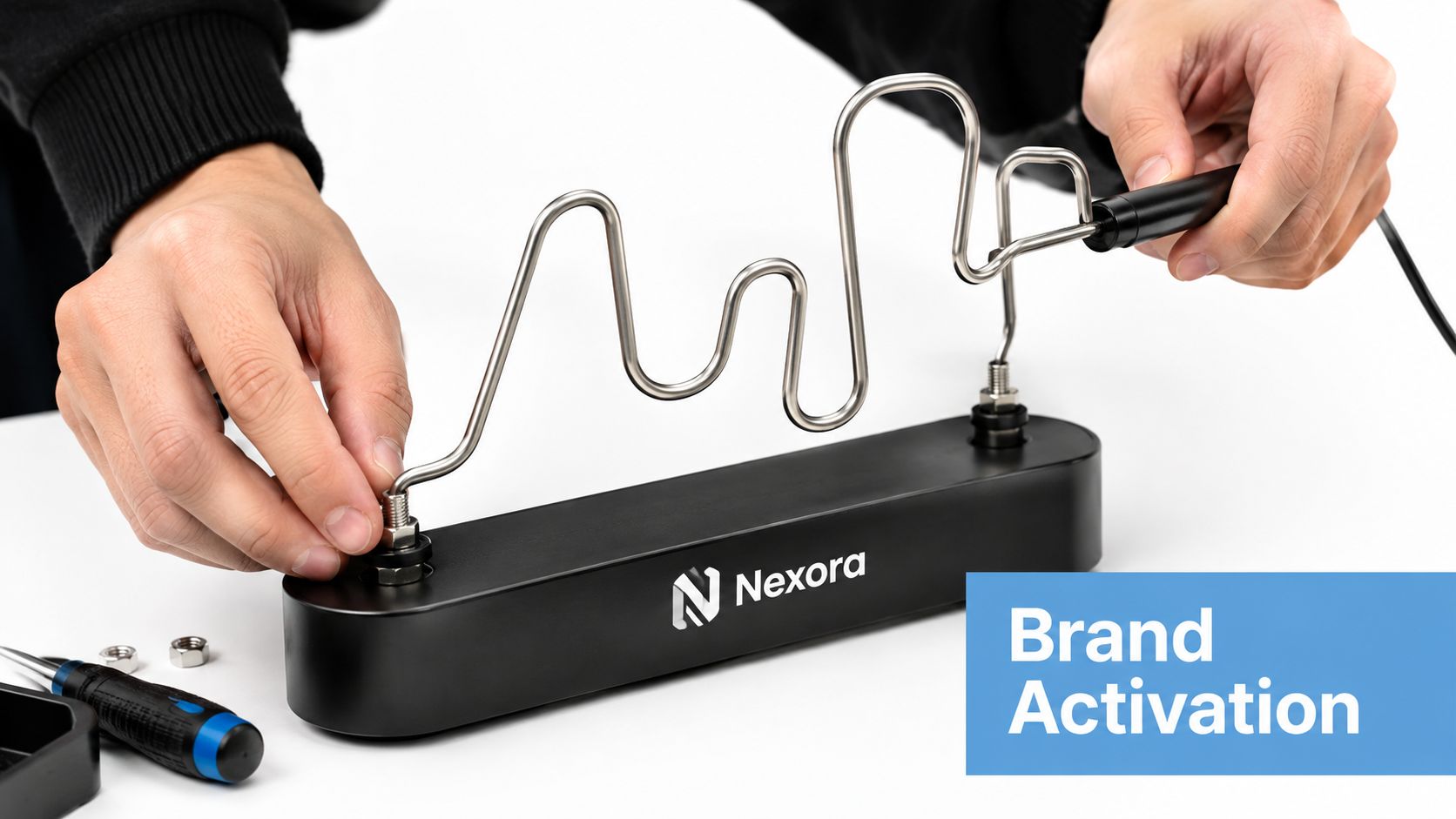
An unbranded wire buzzer game can attract a crowd, but it may not explain why that crowd should remember your company. Physical customisation gives the attraction a role in the campaign. The wire can potentially follow a company logo, product outline or recognisable silhouette, provided the supplier confirms that the shape remains playable and safe.
Brand the physical experience
Branding can sit on the base, start and finish points, player handle, score display and surrounding sign. A product-shaped route can reinforce a launch message, but a complicated wire may frustrate players and slow the queue. The best design trade-off is recognisable branding with a path that remains readable at a glance.
Digital additions can make the result more useful. A screen or iPad form can record the player's name, company, consent, result and follow-up status. Keep the data exchange proportionate to the prize and conversation. A visitor shouldn't have to complete a long form before a simple game, particularly in a busy exhibition environment.
The attraction should qualify prospects rather than collect untargeted names. For example, an ambassador might ask which business challenge brought the visitor to the exhibition, then use the game as a relaxed transition into a relevant product conversation. The score is supporting context. It isn't a substitute for a properly defined lead.
Measure the commercial path
Agree the measurement plan before the first visitor plays. Track the funnel as separate actions:
- Opportunity to play: Count people who stop or enter the queue.
- Completed attempts: Record starts, finishes and abandoned plays.
- Data capture: Separate consented records from casual participants.
- Qualified leads: Apply the same qualification definition used by the sales team.
- Follow-up outcome: Match records to meetings, proposals or other agreed commercial actions.
Calculate cost per lead by dividing the total activation cost by the number of qualified leads, not by the number of people who touched the loop. Average dwell time can be measured by sampling entry and exit times, while queue conversion compares people who join with people who complete an attempt. These measures show whether the attraction draws attention, holds attention or produces useful sales conversations.
Use a consistent naming convention for the activity in your CRM and campaign reporting. The PSW Events approach to experiential marketing ROI is relevant to this wider discipline because a physical game creates value through the interaction around it, not just through equipment hire.
Hire Pricing and the Corporate Booking Checklist
UK pricing varies according to format, staffing, transport, branding and event duration. Published examples include a tabletop version from £55+VAT and a two-day hire starting at £350+VAT at a Midlands exhibition venue, as noted in the UK exhibition attraction listings. These figures are examples, not a universal rate card, so compare what each supplier includes before treating the headline price as comparable.
A dry-hire tabletop unit may suit a private room with an existing supervisor and a straightforward setup. A giant branded installation can justify a larger budget when it needs delivery coordination, installation, an operator, competition management, data capture and a stronger visual presence. The cheaper option isn't automatically better value if your team has to solve every operational issue on the day.
Ask these questions before signing
- What arrives in the package? Confirm the game, base, loop, batteries or charger, controls, instructions and any spare components.
- Who delivers and installs it? Establish arrival time, collection window, assembly responsibility and whether out-of-hours access creates an extra charge.
- What does the venue require? Check loading bay rules, lift dimensions, access times, floor protection, fire routes and socket availability.
- Who supervises play? Clarify whether a trained operator is included and what happens during breaks or busy periods.
- What insurance is supplied? Request current public liability documentation and any venue-specific certificates.
- What branding is possible? Confirm artwork deadlines, proofing, fabrication charges, removal and whether custom wire shaping affects the playing experience.
- How is performance recorded? Ask whether scores, attempts, queue counts or digital leads can be exported in a usable format.
Procurement rule: Compare the complete operating cost, not the hire price alone.
Build a written schedule around delivery, testing, opening, breaks, pack-down and collection. Require the supplier to document the agreed dimensions and power plan, then share that information with the venue and production manager. A clear scope prevents small assumptions from becoming day-one costs.
Frequently Asked Questions for Event Planners
Can a wire buzzer game operate outdoors?
It can be considered for an outdoor event, but standard indoor equipment shouldn't be placed outside without supplier approval. Moisture, condensation, wind, unstable ground and uncontrolled power distribution can affect both the electrical components and the player's footing.
Use a covered, level area with a stable base and protect the unit from rain and spray. Confirm whether the supplier provides weather protection, outdoor-rated power equipment, battery operation and an isolation procedure. Keep any socket, distribution board or cable connection away from wet areas, and include weather changes in the risk assessment. If the forecast becomes unsuitable, the organiser needs a clear decision point and an alternative indoor location.
Can two players compete head to head?
Yes, but only if the supplier provides compatible units or a purpose-built multi-player system. Don't assume that two individual games can be electrically linked or that their scores will synchronise safely.
For a corporate tournament, define the competition format first. You might run parallel attempts, record each result centrally and progress players through a host-controlled bracket. The operator needs to manage resets, explain tie-break rules and prevent spectators from crossing the playing area. Head-to-head play works because the audience can compare visible outcomes, but the equipment and scoring process must be designed for that use.
How should the game sit inside a wider experiential zone?
Place it where passers-by can see the action without forcing the queue through another activity. Keep the buzzer away from quiet consultation areas, presentation microphones and audio-sensitive installations, or use a silent visual feedback setting where the equipment allows it.
Create a clear flow from invitation, to play, to prize or score, to brand conversation and exit. Give the host a defined handover point for lead capture, then move completed players away from the playing position so the next person can start promptly. Sightlines matter as much as floor space. If visitors can't see the loop, the reaction and the score, the attraction loses much of its spectator value.
PSW Events can supply and manage steady hands attractions for exhibitions, conferences, brand activations and team-building events, with planning, branding, logistics, installation, staffing and health and safety support. Visit PSW Events to discuss a wire buzzer game format that fits your venue, audience and lead-capture objectives.