
An HR lead has 200 staff, two hours, a budget and a room with one door. The activity may look simple on the agenda, but the room can bottleneck at check-in, queues can swallow the session, and a single host can't keep every team involved. Large-group team building fails when organisers treat a crowd like one small team. The right format depends on how many people can participate at once, where it can run, and who's responsible for the logistics on the day.
The strongest team building ideas for large groups split people into smaller teams while giving everyone a shared objective. That could mean parallel rooms, a simulator league with a live leaderboard, or an outdoor challenge with a workable indoor alternative when British weather changes the plan. UK workforce findings also point to the value of activities that build shared objectives, mutual support and time for teams to review how they worked together, not just compete. The Department for Work and Pensions' 2019 Civil Service People Survey found that 87% of respondents agreed their team worked well together to achieve shared objectives, while 74% said their team regularly reviewed its performance.
Choose an activity that fits the people and the venue, then build the running order around how it behaves at scale. These ten options range from indoor puzzles and quizzes to city hunts, volunteering and water-based challenges. If you're also considering bringing agile practices to large groups, use the event to practise shared decisions and short feedback loops, not just to fill an afternoon.
1. Multi-Room Escape Challenge
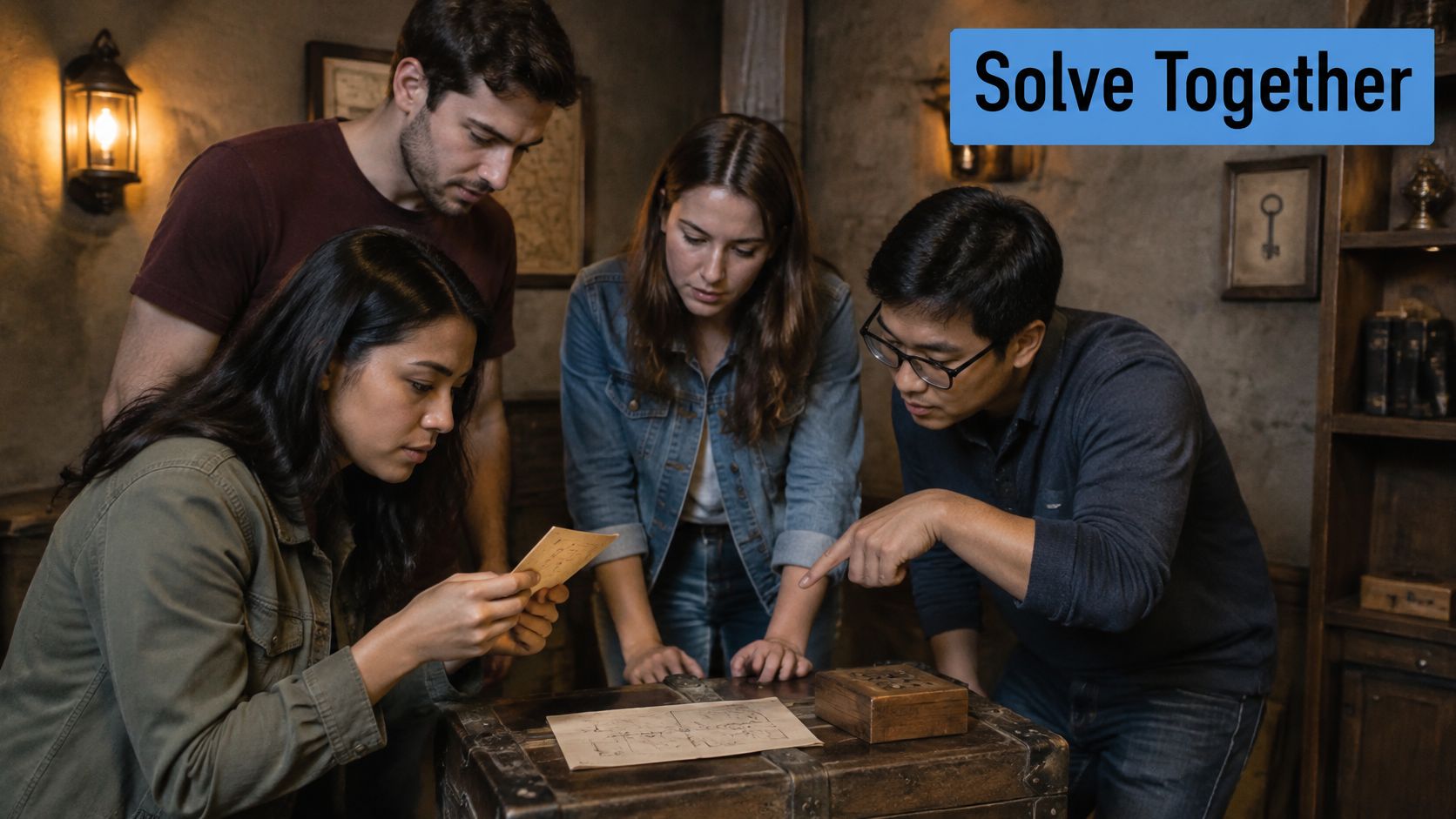
Escape challenges work best when participants can get their hands on the clues, not when a large audience watches a few confident colleagues solve everything. Split the workforce across identical or parallel rooms, then bring the results together on a shared scoreboard or a final cross-team puzzle. Commercial escape rooms in London and other UK cities can suit away days and client entertainment; mobile escape-room sets can bring the format into a conference venue.
Keep each team small enough that everyone has a useful role. Teams of four to six are a practical fit: assign a searcher, a codebreaker and a note-keeper, then let people swap roles as the puzzle develops. Explain the hint system before the timer starts, including how teams request help and whether hints affect their score.
Keep the whole group moving
For a 200-person staff afternoon, use staggered sessions or multiple sets so people aren't left waiting outside a room. Give each room a named facilitator and put a clear start and finish time on the schedule. If the venue has a single entrance, plan the rotation so one group can exit before the next arrives.
The activity can reveal how teams share information under pressure, but only if you make room for a short debrief. Ask each team what helped them combine clues, which roles went quiet, and how they decided when to request a hint. A puzzle is entertainment; that reflection is what helps connect the experience to workplace behaviour.
2. Sports Simulator League Tournament
A simulator league gives a large group a competitive focus without requiring everyone to be a confident athlete. Golf, rugby, American football and boxing simulators can run in heats, with a live leaderboard giving spectators something to follow while other teams take their turn. Racing rigs also suit exhibition floors and fan zones, where a short round can attract participants between other activities.
Build a schedule around the number of stations, not just the headcount. If teams arrive faster than the simulators can process them, queues become the event. Use fixed round times, a visible call-up system and a non-competitive practice area for people who want to try the controls before their scored attempt.
Scale test: The leaderboard keeps spectators engaged, but it doesn't replace a queue plan or a named operator at each station.
Mix colleagues from different departments so the tournament creates introductions beyond familiar teams. For a conference or staff event with limited floor space, map the footprint, power access, spectator area and queue route before booking equipment. A provider should manage installation and on-site staffing; PSW Events' UK sports simulator hire includes simulator options that can be built into corporate events and exhibitions.
3. City-Wide Treasure Hunt
A treasure hunt turns a town centre, park or campus into the playing field. Teams follow clues, complete local tasks and collect points or a final code. It suits an away day in a historic city such as Bath, York or Edinburgh, but the same structure can work on a company campus when travel between locations would eat into the session.
For a large group, assign different starting points and divide the route into zones. Otherwise, teams bunch around the first clue or crowd a narrow street while trying to decode it. Set clear boundaries, use staffed check-in points, and give every team a route map, organiser contact and emergency instructions. Check whether the chosen locations need permission or coordination with local authorities.

Design for mixed attendance and conditions
A hunt can be lively outdoors, but don't make participation depend on a long walk or rapid movement. Include clue-solving and observation tasks alongside navigation, and give teams a way to ask for help without having to return to the start. One task should require the whole team to contribute, so the fastest person can't complete the route alone.
Hybrid participation needs more than streaming a few clues to remote colleagues. The Office for National Statistics reported that 28% of working adults in Great Britain worked in a hybrid pattern between January and March 2025 in its hybrid working analysis. For a distributed company, pair local teams with remote participants who can solve digital clues, choose route decisions or submit answers through a live host. That makes remote colleagues part of the game rather than an audience.
4. Corporate Olympics
Corporate Olympics suit groups that want movement, colour and friendly rivalry. Run relays, sack races, tug of war or simple obstacle challenges at a park or sports ground, with departments mixed into teams and points awarded across several stations. Parallel events let more people take part than a single, central race.
The first logistics problem is usually not the games. It's the weather, ground conditions, changing space and the time needed to rotate teams. Book an indoor backup or agree a clear rain plan before the event, then make sure the schedule accounts for warm-up, instructions, transitions and breaks. A group can move quickly between stations only if the routes are obvious and each station has its own lead.

Not everyone wants to run or pull a rope. Build in roles such as scorer, referee, timekeeper and commentator, and give those roles real influence on the event. Use a shared scoring board or printed scorecards with the same rules for every team, so an unclear penalty doesn't sour the final result.
Rain-plan rule: If the indoor alternative can't support the same activity, decide in advance which events will change and how teams will still earn points.
A sports day can support a charity or fundraising element, but keep the purpose and scoring easy to understand. For help shaping the format and activities, see PSW Events' corporate sports day service.
5. Team Bake-Off Challenge
A bake-off gives teams a shared task with a visible result, and the Great British Bake Off format is familiar to UK audiences. Set up one station per team, give everyone the same brief and ingredients, and let teams plan, make and present a themed bake or dish. A conference venue with suitable catering facilities can work, as can an office kitchen if the number of stations and equipment fits the space.
Before the event, collect dietary requirements and allergen information. Mark ingredients clearly, separate utensils where needed and tell participants exactly what equipment they can use. Appoint judges and publish the criteria, such as taste, presentation and teamwork, before anyone starts decorating.

Allow for the work around the baking
The format scales in parallel, but every station needs a clear brief, enough work surface and a way to manage clean-up. If ovens are shared, teams will spend more time waiting than baking. Choose recipes that fit the available equipment, or make the challenge about decorating and assembly rather than cooking from scratch.
Say a company has several departments meeting for an afternoon. Each team could create a themed tray using pre-prepared bases and a shared selection of decorations, then present its choices to the judges. That keeps the activity creative without requiring a full commercial kitchen. Leave time for tasting and clearing the venue, and offer a non-food role such as photographer or presentation lead for people who'd rather not handle ingredients.
6. Immersive Murder Mystery Experience
A murder mystery gives a large dinner or evening event a storyline that brings people into conversation. Participants interview characters, exchange clues and decide which evidence matters. For a company-wide group, run several casts or parallel scenes, then bring everyone together for a final reveal hosted by a facilitator.
The biggest risk is overcomplicating the plot. If participants have to remember too many names, clues and side stories, the confident performers take over and everyone else loses the thread. Keep the premise simple, provide a written character brief, and give each table or team a facilitator who can answer questions and keep the pace.
Offer optional roles for people who don't want to perform. A participant can analyse evidence, take notes or help their team prepare its conclusion without acting in character. That choice helps make the activity welcoming for different communication styles, rather than rewarding only the loudest people in the room.
For example, a client dinner can use a short mystery between courses, with each table assigned a set of evidence and a chance to submit a theory before the reveal. At a staff event, finish with a brief discussion about how teams shared information and dealt with conflicting accounts. Keep the reflection light and practical; the mystery should feel like an evening activity, not a disguised performance review.
7. Dragon Boat Racing
Dragon boat racing puts coordination ahead of individual speed. A team paddles in rhythm with a drummer or steerer, and organisers can run heats and a final so several crews take part during the day. It suits companies looking for an outdoor challenge with a strong shared objective, provided the workforce is comfortable with a water-based activity.
Book a qualified instructor to lead the first practice and explain technique before racing begins. Confirm the venue's water-safety arrangements, provide the required life jackets and make sure participants know how to follow instructions on the water. Build in a warm-up and stretching session, and schedule enough time to get crews in and out of boats without turning the dock into a queue.
The weather can change the experience quickly, so agree a cancellation or alternative plan with the venue. Don't make winning the only measure of success. Score crews for synchronisation or teamwork as well as race results, and let people choose a land-based support role if they can't or don't want to paddle.
This format works well for a company away day near a lake or reservoir, where teams can practise together, race, then regroup for food and a short debrief. It isn't the easiest option for a tight urban conference schedule. Travel, changing facilities, water access and safety supervision all need to fit the day.
8. Team Hackathon
A hackathon turns a business problem into a structured group challenge. Cross-functional teams get a shared brief, develop a concept or prototype, and present it to a judging panel. It can work indoors in a conference room when the weather is poor, as long as each team has a table, supplies, power access and space to discuss ideas without competing with the presentation area.
Start with a problem statement that people can understand and influence. A brief such as “improve the handover between teams” is more useful than an open-ended request to innovate. Assign a mentor to each team, set simple judging criteria for feasibility, impact and presentation, and give participants a clear timeline for check-ins and the final pitch.
Make the follow-through part of the event
A hackathon can produce polished presentations without producing anything the business acts on. Name a sponsor who can respond to proposals, record the strongest ideas, and agree what happens after the judging. Otherwise, participants may leave with the impression that the work was a one-off contest.
For a practical example, a business could ask teams from operations, customer service and marketing to redesign one recurring customer handover. Each group maps the current steps, proposes a change and presents a simple test the company could run. The format builds communication across departments, but it needs a facilitator who can keep the scope realistic and stop teams from spending the session debating a problem they can't solve.
9. Community Volunteer Build Day
A volunteer day can leave a visible result for a local community as well as give colleagues a shared task. Teams might build planters, prepare food for a charity, decorate a school or help restore a park. Divide the work into defined jobs, with a named coordinator for each team and a clear list of tools and materials.
Partner with an established local charity, school or council, and agree the task before the event. Check insurance and health-and-safety requirements with the host, make sure equipment suits the work, and give each team a short briefing on the site and the finished outcome. Large groups need enough meaningful jobs: if several people are left watching a small crew complete the task, the event stops feeling participatory.
Participation test: Every team should have a useful task, a named person to ask for help and a clear view of what its work contributes.
A company might split volunteers between painting, assembling raised beds and preparing a shared outdoor area. The host should confirm which jobs are suitable for different abilities, and organisers should provide alternatives for colleagues who can't do manual work. Close the day by sharing the outcome with participants and thanking the community partner. That follow-up helps connect the work to its purpose without making the charity project feel like a marketing prop.
10. Live Corporate Quiz League
A quiz is one of the easiest formats to move indoors when the weather turns, and it can hold a large audience in a ballroom or conference room. Put participants at mixed-department tables, use a live host and display scores on a leaderboard. Rounds can cover general knowledge, music, film, company history or a themed subject linked to the event.
Design questions so no single table has an automatic advantage. Mix specialist topics with accessible rounds, and let teams submit answers through a scoring app or printed sheets. A live host keeps the pace, but someone else should handle scoring and resolve disputed answers. If the host has to do both, pauses between rounds can drag.
For a company with remote employees, use a hybrid version with a remote host feed, shared answer submission and teams allocated across offices. A league that runs over several sessions can keep people involved beyond one event, but make each session work on its own so a missed round doesn't exclude a participant.
Use a company quiz to encourage conversation across departments, not to test who remembers internal jargon. If you need inspiration for formats, browse group quiz ideas from Million Whys. For hosted show-style entertainment, PSW Events' quiz game is another option. Keep prizes modest and rules visible, so the competition stays friendly.
How Each Large-Group Activity Scales
Team size is only part of the capacity check. At 100-plus guests, the first constraints are usually how many people can take part at once, how quickly teams rotate and whether the venue works indoors if weather changes.
| Item | Team Size | Setting | Format |
|---|---|---|---|
| Multi-Room Escape Challenge | 4–6 per team | Escape rooms or pop-up venues | Timed puzzle challenge |
| Sports Simulator League Tournament | Multiple teams of 4–6 | Indoor simulator venue | Knockout or league tournament |
| City-Wide Treasure Hunt | Multiple teams of 4–6 | Town centre, park, or campus | Location-based clue hunt |
| Corporate Olympics | Mixed-ability teams of 6–10 | Outdoor field or indoor backup venue | Multi-event sports day |
| Team Bake-Off Challenge | Multiple teams of 4–6 | Kitchen or catering venue | Timed team baking competition |
| Immersive Murder Mystery Experience | Tables of 6–8 per cast or scene | Dinner venue or private event space | Roleplay mystery with a final reveal |
| Dragon Boat Racing | Around 20 paddlers per boat, plus crew | Lake, reservoir, or river | Timed heats and finals |
| Team Hackathon | 4–6 per team | In-person or hybrid workspace | Time-boxed innovation challenge |
| Community Volunteer Build Day | Task-based teams of 6–10 | Community project site | Hands-on volunteer day |
| Live Corporate Quiz League | 4–8 per team | Venue, virtual, or hybrid | Multi-round quiz league |
Use these team sizes as a starting point, then match them to the available stations, rooms or work areas. Simulator leagues need timed heats and enough staffing to keep participants moving. Hunts spread teams across a route, so clue timing and clear boundaries matter more than a shared indoor room. Bake-offs need sufficient workstations and equipment; extra teams can otherwise spend more time waiting than baking.
For indoor UK venues, escape challenges, murder mysteries, hackathons and quizzes can run without relying on the weather. Outdoor formats need an indoor alternative or a clear decision about what happens if conditions change. Corporate Olympics also needs activities that suit mixed abilities, while a volunteer build day should divide work into tasks that can be completed safely by each team. Team numbers alone do not guarantee capacity. Check the space and rotation plan before confirming attendance.
Matching the Activity to Your Group, Venue and Budget
Choose by logistics first, then by theme. Before you book, answer three questions: How many people can take part at once? Is the space indoors, outdoors or weather-proof? Who will run the logistics on the day? Those answers usually narrow the list faster than asking which activity sounds most exciting.
For groups above 100, start with a format that runs in parallel. Escape rooms can use multiple rooms or portable sets; simulator leagues can move participants through timed heats; quiz tables can all play at once. Each format still has a different pinch point. Escape rooms need enough simultaneous capacity and controlled rotations, simulators need queue management and station staff, and quizzes need reliable sound, scoring and a host who can hold the room.
Plan for inclusion as well as attendance. The UK Civil Service People Survey from 2017 found that 88% of respondents agreed that people in their team could be relied upon to help when work became difficult, while 84% agreed their team worked together to find ways to improve the service it provided. For event design, that points to two useful behaviours to support: teams helping one another under pressure and reflecting on how to improve. Mix departments, rotate roles and give people more than one way to contribute. Don't judge success only by who wins or how loud the room gets.
A hybrid workforce needs a deliberate participation plan. The CIPD's flexible and hybrid working report reports that 74% of UK organisations had hybrid working in place in 2025, and identifies difficulties with manager effectiveness, connection to organisational purpose and organisational culture among the negative impacts employers reported. If remote colleagues can't join in the same way, add a live facilitator, digital scoring, remote decision rounds or an asynchronous component. A central room isn't automatically an inclusive event.
Give the activity a clear finish. The Department for Work and Pensions' 2019 survey found an 13-percentage-point gap between respondents who agreed their team worked well together to achieve shared objectives and those who said their team regularly reviewed its performance. A short debrief, feedback round or cross-team learning session can help make the event more than a fun afternoon. For evaluation, track participation, waiting, repeat play, team connections and feedback, then compare those measures with the purpose of the event.
Safety and flow belong in the plan from the start. The Health and Safety Executive's event-planning guidance says organisers should assess the event's scale, type, audience, location and duration, then match planning detail to the risks. Its event management guidance also emphasises clear responsibilities, competent staff and coordination through build-up and breakdown. For a large group, name activity leads, brief them on hazards and escalation, map routes between stations, and keep queues away from entrances and emergency access. The HSE's crowd-flow assessment guidance treats arrival, movement, exit and dispersal as separate stages to plan.
For simulator tournaments, sports simulator hire or a full event-management partner can take equipment delivery, installation, staffing and health-and-safety coordination off the internal team's plate. PSW Events is based in Cambridge and provides event planning, site visits, installation and on-site staffing, so organisers can focus on the people in the room. For outdoor formats, plan outdoor team events with PADL with a clear site and weather plan before committing to the activity. If you want to turn the shortlist into a workable running order, start by mapping headcount, venue layout and the team responsible for delivery.
PSW Events provides sports simulators and interactive entertainment for corporate team building, conferences and exhibitions, with planning, installation and on-site staffing. Tell the team your group size, venue and event objective, then visit PSW Events to discuss a format that can work at scale.