
You've got a date pencilled in, HR wants something inclusive, marketing wants photos that look like people enjoyed themselves, and finance wants a plan that won't unravel the moment the weather turns. That's the starting point for a corporate sports day in the UK. It isn't a sack-race nostalgia piece. It's a structured engagement event that has to work for mixed abilities, tight diaries, venue constraints, and duty-of-care scrutiny.
The version that works in 2026 looks different from the old field-only model. Outdoor competition still has a place, especially in the popular summer window noted by Newwave Events, but the stronger format for most UK teams is a hybrid one. Keep the social energy and team-versus-team momentum of a sports day, then build in a simulator-led indoor option that survives rain, space limits, and varied confidence levels.
That matters because demand is there. A UK employee survey of 2,315 employees found office sports teams scored 88.59 out of 100 as an office perk, while 33% said a company hobby or sport-related perk would make them happier at work, 31% said it would make them feel more rewarded, and 27% said it would help team bonding. Yet only 5% of British employers were offering office sports teams in that research, which leaves a clear gap between what staff want and what employers provide in practice, according to Perkbox's UK workplace perk research.
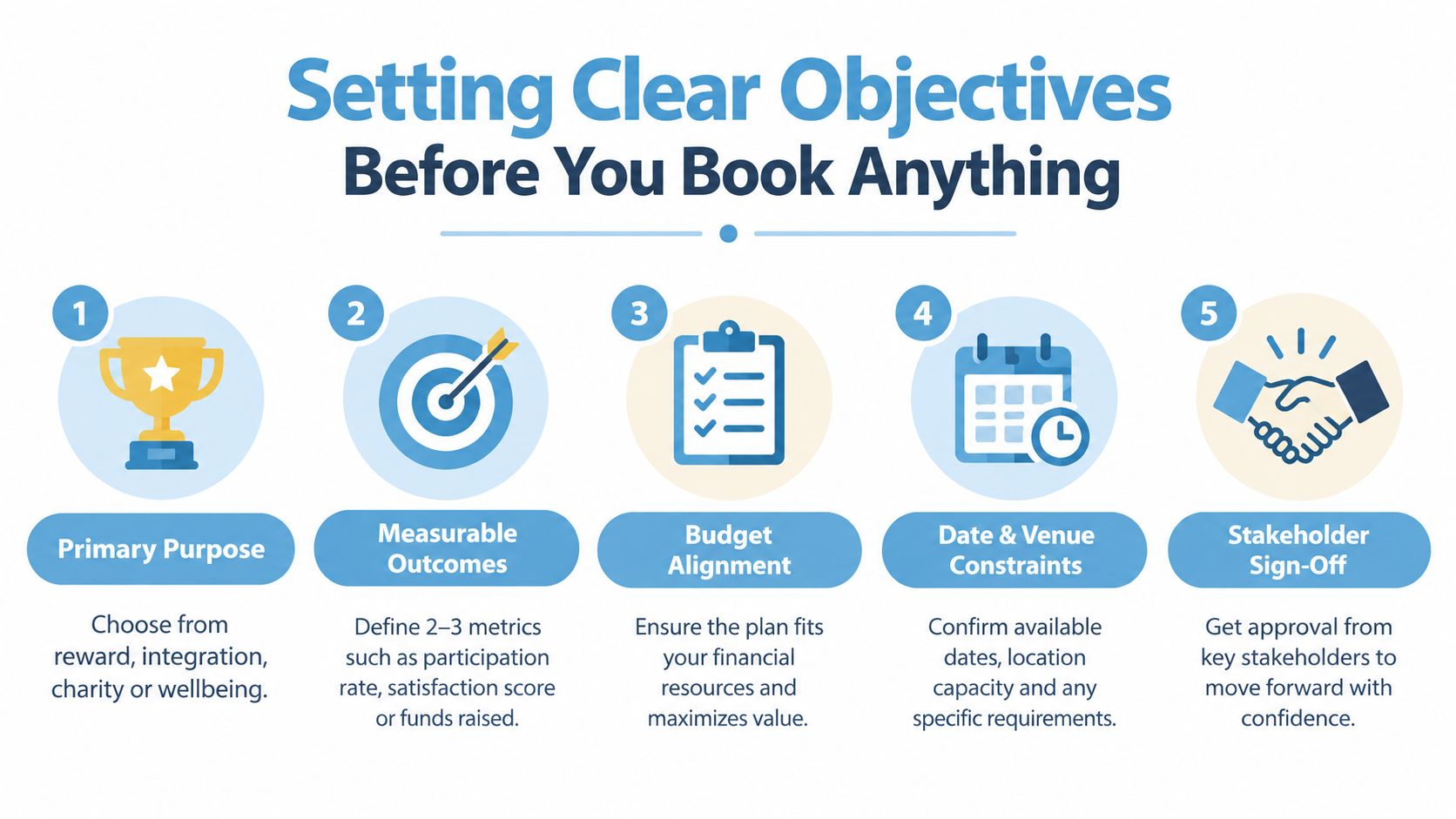
Setting Clear Objectives Before You Book Anything
A common failure point shows up in week one. HR wants something inclusive, sales wants energy, leadership wants visible engagement, and procurement is already asking for venue options before anyone has agreed what the day is meant to do. That is how a corporate sports day turns into an expensive mix of nice ideas that do not fit together.
Set the brief before you speak to venues or suppliers. For a UK flagship engagement event, that means deciding whether you are building around outdoor competition, a simulator-led indoor programme, or a hybrid format that can absorb weather risk and hybrid attendance without rewriting the event a week out. If you need help turning that into a usable document, a structured event planning and execution process cuts out a lot of late-stage rework.
Start with one job for the event
Pick the primary purpose and write it in a sentence. Reward and recognition. Post-merger integration. Charity fundraising. Wellbeing activation. Internal brand moment. Any of those can support a strong sports day, but only one should drive the format.
This matters in practice. A reward-led day can justify stronger catering, better hosting, and higher production value. An integration brief usually needs mixed-team formats, shared scoring, and lower barriers to entry. A wellbeing brief often works better with shorter activity blocks, indoor simulator rotations, and less emphasis on outright athletic performance.
Trying to serve all of them usually produces a weak middle ground.
Define success in a way you can actually measure
Use two or three outcomes, not a page of vague aims. Good measures are specific enough to influence design decisions before booking starts.
Examples that work:
- Participation rate across attendees, not just keen competitors
- Cross-team mixing if departments rarely spend time together
- Manager and staff feedback on whether the format felt inclusive
- Take-up of follow-on wellbeing or social activity after the event
- Attendance across hybrid groups, where some staff join on site and others join for a parallel digital element
If you will not track it on the day or in the week after, leave it out.
Build for the real audience, not the ideal one
A UK corporate sports day is rarely one crowd. It usually includes confident participants, quieter staff who prefer low-pressure activity, spectators, senior stakeholders, people with accessibility requirements, and hybrid colleagues who may only join for part of the programme.
That mix changes the brief immediately.
A field-only plan can work well for a fit, summer-heavy sales team. It is a poor fit for a mixed office population if the only route to taking part is sprinting across wet grass. In those cases, simulator-led indoor stations earn their place because they widen participation, reduce weather dependency, and give people a credible way to join in without the social friction that comes with traditional sports fixtures.
Keep accessibility and welfare requirements separate from the general RSVP list. They need active planning, not a note buried in a spreadsheet.
Set the operating window before procurement starts
Format length shapes everything. AVVA Experience notes that the active core of a corporate sports day often runs for 90 to 120 minutes, with shorter 60 or 75 minute versions used where diaries are tight, in its UK sports day planning guidance. That is a useful benchmark because it forces hard choices early.
A tight 90-minute core usually suits conference add-ons, leadership away days, and hybrid programmes where attention drops if the competitive element drags. A longer window gives you more social time and more stations, but it also increases staffing, welfare cover, and drop-off risk. I have seen plenty of teams ask for a full afternoon, then discover that the strongest part of the event was the first two hours.
Keep the energy high and the brief disciplined.
Get sign-off on the operating rules
Before anyone requests quotes, confirm these points with the people who will approve or challenge the event:
- Primary purpose. What the day is there to achieve.
- Required event shape. Outdoor, indoor simulator-led, or hybrid.
- Required fallback position. What happens if weather, travel disruption, or attendance changes.
- Decision-makers. HR, internal comms, procurement, venue, and health and safety.
- Audience profile. Active, social, spectator, remote, and accessibility needs.
- Duty-of-care limits. Any activity, schedule, or venue feature that would create avoidable HSE concerns.
That last point matters more after 2025, not less. Hybrid programming, flexible attendance, and stronger scrutiny around inclusion mean objective-setting is now part of duty-of-care, not just event strategy. If the brief is clear, the rest of the planning gets faster. If it is vague, every later decision gets harder and more expensive.
Building a Realistic Budget and Headcount Plan
At 10am, the brief says 180 people. By contract stage, that often means 110 active participants, 40 people dipping in between meetings, 20 guests watching from the sidelines, and a late request for indoor cover if the forecast turns. If the budget was built on “180 doing everything”, the numbers are already wrong.
Start with event shape and likely behaviour, then price from there. A UK corporate sports day can be a low-infrastructure outdoor programme, a flagship indoor simulator build, or a hybrid format that lets office-based and remote teams join in without stretching duty-of-care beyond what the venue and staffing model can support. Those are different commercial models, and finance will spot the gap quickly if the estimate pretends otherwise.
Cost the event the way procurement will read it
One total line is useless in a budget review. Break the spend into the parts that can move independently: venue hire, activity kit, simulator rental, AV and scoring, staffing, first aid and welfare, catering, branding, transport, and contingency.
A practical 2025 planning model often looks like this:
| UK corporate sports day budget bands (2025) | Per-head cost | Typical inclusions |
|---|---|---|
| Venue-led outdoor programme | £65 to £110 | Field hire, basic games equipment, event staff, simple branding, light refreshments |
| Simulator-led and full-production format | £120 to £180 | Indoor or mixed venue, sports simulators, AV, leaderboards, branded assets, technical crew |
| Premium or branded major-venue day | £200+ | Major venue infrastructure, custom branding, expanded catering, enhanced staffing, premium entertainment build |
These bands are planning ranges, not supplier promises. Value is that they force an honest conversation early. If the brief needs weather resilience, accessible participation, live scoring, and a hybrid element for regional teams, the event is no longer a basic field hire with cones and bibs.
Indoor simulator-led formats often look dearer on day rate and cheaper on risk. You pay more for tech and crew, but you usually lose fewer hours to weather, reduce ground-repair exposure, and make participation easier for mixed-ability groups. That trade-off matters in the UK, particularly for post-2025 programmes where attendance patterns are less predictable and employers are under more pressure to show sensible HSE planning.
Build headcount around usage, not invitations
The cleanest budgets split the audience into operational groups:
- Active participants. Rotating through scored stations or team challenges.
- Light-touch participants. Joining selected activities, social areas, and catering, but not every rotation.
- Spectators and guests. Present for atmosphere, networking, and brand experience rather than competition.
That split changes more than catering numbers. It affects simulator throughput, staffing ratios, seating, registration flow, prize quantities, welfare cover, and what capacity you should guarantee with suppliers.
For simulator-led builds, throughput is the first number I test. A golf, racing, or football simulator can create a strong focal point indoors, but only if the queue works. If 120 people all need a meaningful turn inside 90 minutes, one unit will not do the job. If only 35 to 50 people are expected to use it while others rotate through parallel content, the same unit may be enough. That is the difference between a feature and a bottleneck.
Base supplier minimums on realistic participation, not total employee count.
Protect the budget from late-stage drift
Three areas usually push the final number up. Weather cover. Catering upgrades. Last-minute changes to headcount.
Set a contingency before quotes go for approval. Then agree the trigger points. For example, what happens if attendance drops by 20 people, or rises by 30, or the client wants to convert an outdoor afternoon into an indoor simulator-led format in the final week. Without those rules, small additions stack up and the event changes category.
Also settle the finance treatment early with HR and procurement. Corporate sports days can sit differently depending on whether the day is framed as employee engagement, hospitality, reward, or a mixed internal and guest-facing event. That decision affects approvals and paperwork, and it is much easier to sort before contracts are signed than after.
Choosing a Venue That Works in Any Season
At 7am, the rain starts, the grass car park softens, and half the brief suddenly depends on whether the venue can absorb 150 people indoors without crushing the schedule. That is why venue choice for a corporate sports day is an operating decision first and a style decision second.
In the UK, the strongest sites are the ones that can run in two modes. Outdoor if conditions hold. Indoor or split-format if they do not. That matters even more after 2025, because plenty of programmes now mix in-person team activity with branded content capture, short conference segments, simulators, and guest attendance patterns that are less predictable than they were a few years ago.
Compare venue types by fallback strength, not brochure appeal
| UK corporate sports day venue decision matrix | Capacity fit | Weather resilience | On-site facilities | Brand impact | Indicative cost | Best for |
|---|---|---|---|---|---|---|
| Local authority playing fields | Flexible for broad groups | Low unless paired with indoor fallback | Usually basic | Low to moderate | Lower | Grassroots employee days and tight budgets |
| Hotel and country club grounds | Good for contained corporate groups | Moderate | Stronger welfare and catering | Moderate | Mid-range | Combined meeting and social formats |
| Major venues such as Silverstone or ExCeL | Strong for larger branded events | Moderate to strong depending on package | Built-in infrastructure | High | Higher | Sponsor-facing and high-visibility days |
| Indoor experiential venues and event halls | Strong when planned around stations | High | Controlled environment | Moderate to high | Mid to higher | Winter events, mixed ability groups, simulator-led builds |
The trade-off is usually clear. Pure field venues cost less, but they ask more of the weather and more of your audience. If the group includes mixed confidence levels, hybrid attendance patterns, or a meaningful indoor content plan, the cheaper field can become the more expensive decision once wet-weather cover, extra flooring, transport changes, and compressed timings are added.
Indoor halls and experiential spaces solve a different problem. They give you control. For simulator-led formats, that control matters because ceiling height, power distribution, loading access, acoustic bleed, and queue space all affect whether the room feels premium or cramped.
Check the risks the sales tour will not show you
A venue can look perfect for 45 minutes and still fail under live event conditions. I look for four failure points first. Shared public access, poor contractor access, weak welfare provision, and no credible wet-weather migration plan.
The Health and Safety Executive's guidance on event safety puts the emphasis where it belongs: site condition, crowd movement, traffic routes, fire precautions, emergency procedures, and the suitability of temporary equipment all need to be assessed for the actual event setup, not the venue's marketing version of it, as outlined in the HSE guidance for the events industry.
That shared-use point catches clients out regularly. A public park may have dog walkers cutting across play zones. A country house may host a wedding load-in on the same afternoon. An exhibition hall may be available, but only through a loading door that turns a simulator install into a four-hour problem.
Indoor fallback should be designed, not improvised
A proper all-season venue has an indoor plan that still feels intentional. It does not become a holding pen with coffee and a PA system.
For a flagship corporate sports day, the best indoor fallback usually works as a station-based programme with one or two anchor simulators, short competitive rotations, a social scoring area, and enough side activity to keep queues under control. In practice, that means checking the room can take safe cable runs, spectator zones, and technical support positions without blocking fire exits or food service routes.
A useful rule is simple. If the outdoor version fails at 9pm the night before, can the venue still deliver a day that feels like the event people were promised? If the answer is no, keep looking.
Walk the site like a producer
Before contract signature, inspect the venue in person and confirm the details that affect operation on the day:
- Ground and surface condition. Drainage, slip risk, gradients, and transitions between indoor and outdoor zones.
- Power in the right places. Not just total supply, but usable sockets, phase, distance to event positions, and whether cable covers will create pedestrian pinch points.
- Ceiling height and rigging limits. Particularly for golf, football, and racing simulator installs, branded headers, and lighting.
- People flow. Registration, bag drop, spectator hold areas, catering queues, and whether team movement crosses vehicle routes.
- Welfare space. Toilets, shade or shelter, drinking water, seating, quiet room access, and a place for first aid to operate privately.
- Noise control. Can simultaneous activity, announcements, and simulator audio run without turning the room into echo and confusion?
A venue that only works in dry weather with perfect attendance is not an all-season venue.
Confirm noise restrictions, reinstatement rules, security requirements, insurance responsibilities, and exclusive-use terms in writing. If the fallback hall, overflow room, or covered terrace is "usually available", treat that as unavailable until it appears in the contract.
Selecting Activities and Sports Simulators
The activity mix determines whether people describe the day as inclusive or awkward. One badly chosen anchor activity can skew the whole atmosphere. If everything depends on athletic confidence, a big slice of the room checks out before the first whistle.
The format that usually performs best is a mixed station rotation. Give teams enough variety to compete, enough social space to reset, and enough indoor resilience to carry on when a field plan becomes fragile.
Put the activity buckets side by side
| Activity Buckets Compared for a Corporate Sports Day | Setup Time | Footprint (m²) | Throughput/Hour | Ability Range | Weather Risk |
|---|---|---|---|---|---|
| Traditional field sports | Moderate to longer | Larger | Moderate | Narrower to mixed, depending on format | Higher |
| Low-impact inclusive games | Short to moderate | Small to medium | High | Broad | Moderate |
| Simulator-led indoor attractions | Moderate with technical setup | Small to medium per station | Moderate to high | Broad | Low |
Traditional field sports still have value. Rounders, touch rugby, and cricket nets create familiar team rivalry and good spectator energy. The issue is dependency. If your event hangs on one field sport, you expose the whole day to weather, confidence gaps, and queue imbalance.
Low-impact stations solve a different problem. Giant Jenga, inflatable darts, beanbag toss, and reaction challenges keep less competitive guests involved. They also absorb overflow while larger-format activities reset.
Simulator-led indoor attractions give you control. Golf, racing, football, and scenario-based games work especially well for mixed groups because they create competition without requiring everyone to sprint, tackle, or already know the rules. For teams thinking more broadly about wellbeing measurement around the event, something like VO2 max fitness testing in Manchester can also sit alongside a sports-day programme where a client wants a more data-led health angle.
Build the rotation around movement, not novelty
A good sports day doesn't need dozens of activities. It needs the right six to ten. Rotate mixed-ability teams every 15 to 20 minutes and keep the scoring visible.
That structure fixes three common failures:
- Bottlenecks. One glamorous station with a queue while everything else sits half-used.
- Drop-off. Overlong game formats that lose social attendees.
- Weather exposure. Too much of the scoring tied to outdoor play.
For an indoor or hybrid build, interactive sports simulators are one practical option when you need compact footprints, leaderboard integration, and activities that can work inside exhibition halls, conference centres, or major venues.
The best station plans let the quiet analyst beat the keen five-a-side captain somewhere during the day.
What to check before hiring simulators
Procurement for simulator-led programming should cover technical detail, not just game title. Ask about screen size, ambient light tolerance, power draw, cable management, staffing, lead times for setup, and how the scoring exports to a leaderboard.
Also check whether the supplier can adapt the game mode to an event crowd. A consumer-style simulator setup isn't automatically an event-ready one. The station has to reset quickly, coach first-time users fast, and survive repeated throughput without becoming the hold-up on the floor.
Running Day-Of Logistics With Confidence
The event never feels smooth by accident. It feels smooth because somebody built a run-sheet that accounts for loading, registration, power-up, briefing, rotation timing, catering windows, prize moments, and breakdown. Sports day logistics are a timing exercise with people, not just kit.
A practical schedule starts long before the first guest arrives.

Build the run-sheet from load-in to debrief
The backbone day usually follows this pattern:
- 06:00 load-in. Vehicles, unloading, power checks, signage placement, and contractor briefing.
- 07:30 registration opens. Wristbands or QR code check-in by cohort.
- 08:00 welcome briefing. Safety notes, scoring method, team identification, and movement rules.
- 09:00 activities begin. Rotations, leaderboard updates, roaming support.
- 12:30 lunch or social break. Short enough to keep momentum.
- 14:00 finals or feature rounds. Higher-energy competitive segment.
- 16:00 awards. Fast, visible, and photo-ready.
- 17:00 breakdown. Controlled strike and asset check.
- 18:00 debrief. Incident review, supplier sign-off, and next actions.
Registration is where many days wobble early. Pre-issued wristbands or QR codes keep cohorts moving and reduce the need for a registration desk to solve avoidable admin problems while the queue grows.
Staff the floor with clear role ownership
Six on-site roles do most of the heavy lifting:
| Role | What they own |
|---|---|
| Event manager | Overall schedule, escalation, client liaison |
| Station marshal | Briefing, scoring, queue control at each activity |
| Registration lead | Arrival flow, team packs, attendee issues |
| First aider | Welfare response, incident record, escalation |
| AV lead | Sound, screens, power continuity, announcements |
| Simulator technician | Calibration, reset, game flow, fault handling |
If one person is trying to cover two of those jobs, expect delays. The most fragile combination is AV and registration. Both need attention at the same time.
Keep the event legible for guests
People enjoy sports days more when they can instantly understand where to go and what's happening. That means visible branding and visible information. Feather flags, step-and-repeat boards, score screens, and team-colour assets do more than decorate. They cut questions and create momentum.
Refresh leaderboard screens regularly so teams feel the competition is live. Keep comms simple too. Use a shared radio channel for core crew, set a lost-and-found point, and provide a quiet welfare space for neurodivergent guests or anyone who needs a break from the noise.
A lot of day-of stress disappears when attendees don't have to guess what happens next.
Meeting UK Safety and Compliance Duties
Safety planning isn't an appendix for a corporate sports day. It's the operating system. If the event includes active games, temporary infrastructure, power, contractors, or public-facing circulation, then safety decisions shape the format from the beginning.
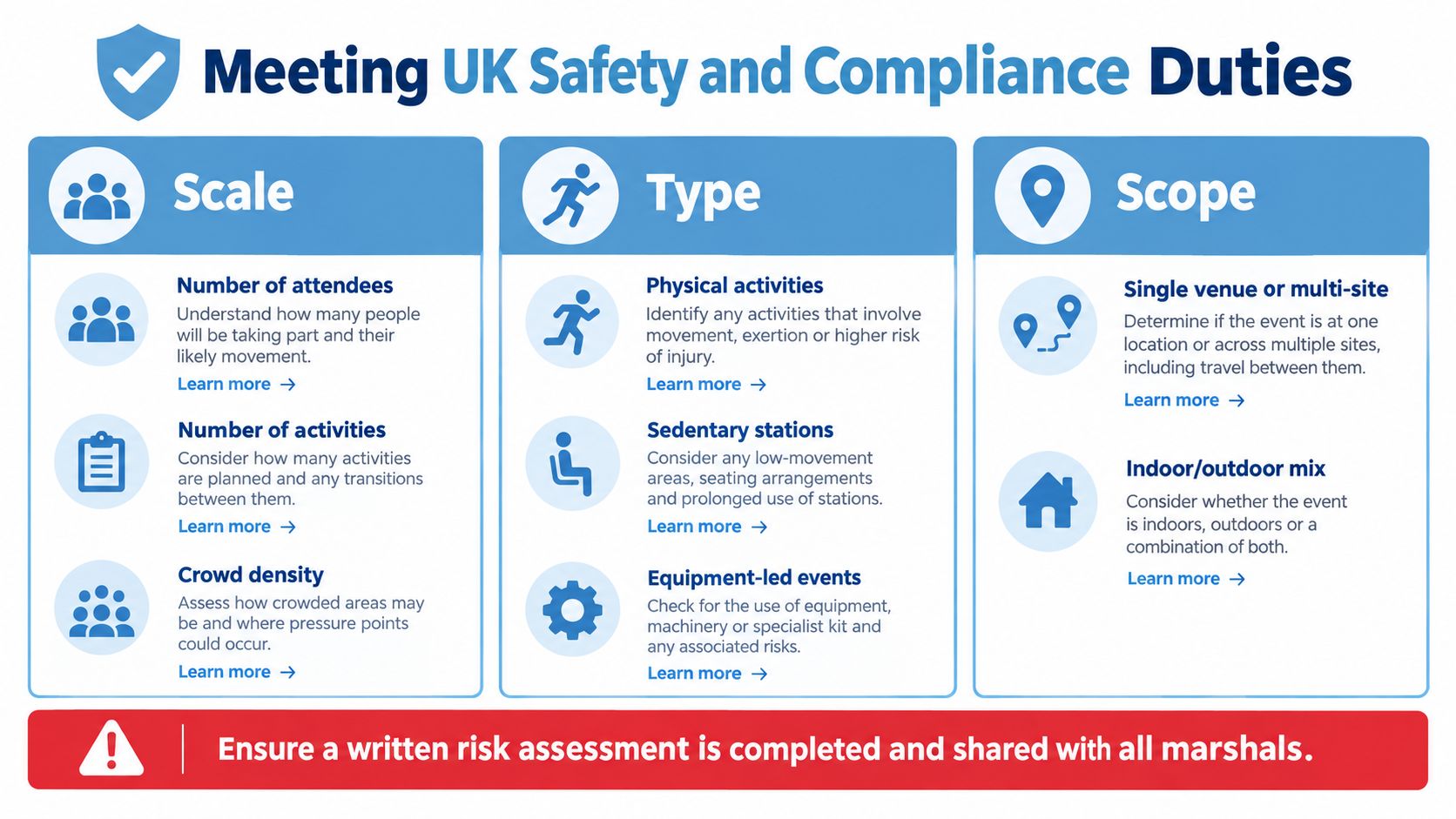
The UK framework is straightforward if you apply it early and properly. The Health and Safety Executive says organisers should identify the scale, type, scope, location, duration, and timing of the event, then turn that into an appropriate safety plan, while involving workers in planning and liaising with venue management and relevant authorities where needed, as set out in HSE's getting started guidance for event safety.
Apply the HSE framework to the event design
Scale means the number of attendees, density around headline activities, and how many moving parts you're asking crew to supervise at once. Type means whether the event is physically demanding, sedentary, equipment-led, or mixed. Scope means whether it's contained at one venue or spread across multiple zones or sites.
Those decisions affect everything from queue barriers to first-aid positioning. They also influence whether an indoor simulator hall is the safer answer than a weather-exposed field layout.
HSE's event management guidance is also clear that organisers are responsible for overall safety, need arrangements to control risks, coordinate activities, provide risk information to employees and contractors, ensure staff competence, monitor compliance, and review arrangements after the event or a significant incident, as stated in HSE's managing an event guidance.
Vet contractors and welfare arrangements properly
Use a documented competence check for every supplier. Ask for RAMS, insurance evidence, operator qualifications where relevant, and a clear statement of who controls what risk on site. The Security Industry Authority's event-safety material says organisers should ensure enough competent staff are in place and use a watchlist for staff management, while HSE also stresses selecting suitable and competent contractors and ensuring welfare and first-aid facilities are in place before work starts, according to the government event security guidance hosted by the SIA.
If your event includes outdoor exposure, heat, or long periods on open ground, practical public-facing advice can help shape your attendee comms too. A concise guide to staying safe outdoors is useful context when building pre-event reminders around hydration, sun protection, and basic self-care.
For organiser-side delivery, a structured health, safety and compliance approach matters most when your programme combines activity zones, electrical equipment, and multiple contractors.
Safety paperwork is only useful if marshals, technicians, and venue staff can act on it in real time.
Treat the debrief as part of compliance
The event isn't finished when the prizes are handed out. Review near misses, contractor performance, signage failures, registration congestion, and any welfare issues while the day is still fresh. If a control measure only existed on paper and not in practice, note it and fix it before the next event.
That's where sports days improve year on year. Not through bigger games, but through tighter control.
Measuring Impact and Following Up After the Event
At 9:15 the next morning, the photos are already in Slack, but that is not the result. The result is whether the client can show who took part, which format drew in the quieter teams, whether the indoor simulator zone outperformed the outdoor track, and what should change before the next date goes in the diary.
For a UK corporate sports day, I measure impact against the brief set before booking. If the event was meant to pull hybrid staff back on site, the first question is attendance against invite list. If the goal was cross-team mixing, check whether people stayed inside their own department or moved between activities. If duty-of-care shaped the format, include practical points such as queue lengths, welfare requests, accessibility issues, and whether the indoor fallback carried the day when weather, travel, or confidence levels affected turnout.
Start collecting usable evidence on the day
The cleanest post-event report starts with disciplined capture during the programme. Use one sheet per zone, or one shared form if the event is smaller, and log four things only: participation count, average dwell time, repeat plays, and any operational issue that affected access or flow. That is enough to compare a five-a-side pitch with a batting cage, or an outdoor relay with a simulator-led indoor station, without drowning the client in numbers.
Photos help internal comms. They do not replace evidence.
I also recommend a Day 1 pulse survey with no more than five questions. If it takes longer than 60 seconds, response rates fall off sharply in office teams. A practical version looks like this:
- Did you take part in at least one activity?
- Which zone did you spend the most time in?
- Did the format feel inclusive for your fitness level or confidence level?
- Would you attend again if this ran as an indoor, outdoor, or hybrid event?
- What is one thing we should change next time?
That final question usually gives the best material. It is where you find out that the golf simulator kept attracting senior staff who would never join a track race, or that remote-first employees would attend if the social side started later and the competitive side finished tighter.
Turn the debrief into a one-page client report
A long deck rarely gets read. A one-page report usually does.
Keep it to five blocks: event objective, attendance, activity split, operational notes, and recommendation. Under recommendation, separate what to repeat from what to change. For example: "Repeat simulator-led indoor zone because it had the highest dwell time and lowest drop-off. Reduce outdoor rotation from six heats to four because queues built after lunch. Keep mixed-team scoring because it improved cross-department participation."
That format works well for post-2025 hybrid programming because it gives HR, operations, and comms different answers from the same page. HR gets participation and inclusion. Operations gets flow and contractor notes. Comms gets the headline and imagery. Finance gets a clearer case for whether the spend should stay with a traditional field format or shift toward an indoor-heavy model that carries less weather risk.
Use the first 30 days properly
The event has a short shelf life unless the follow-up is planned. Send the thank-you and pulse survey within 24 hours, while people still remember which activity they joined and why they skipped others. Hold the debrief inside two weeks, while the producer, venue, and client team can still identify what happened without guesswork.
Use this sequence:
- Day 0. Finalise attendance, zone counts, and incident notes.
- Day 1. Send thank-you message, photo selection, and pulse survey.
- Week 1. Review participation by activity type, including indoor versus outdoor usage.
- Within 14 days. Run a debrief with HR, comms, operations, and the event producer.
- By Day 21. Issue the one-page report with clear recommendations.
- By Day 30. Confirm whether the next event stays outdoor, moves indoors, or runs as a hybrid model.
The follow-up decides whether the sports day becomes an annual flagship engagement event or a one-off spend that looked good in pictures and solved very little.
PSW Events supplies corporate sports day entertainment across the UK, including sports simulators, branded score-led activity builds, on-site staffing, logistics support, and health and safety coordination for indoor, outdoor, and hybrid formats. If you're weighing up a traditional field day against a weather-proof simulator-led option, visit PSW Events to see the kinds of attractions and delivery support that can make the programme work in real venues, not just on paper.