
You're probably staring at an event brief that asks for three things at once. It needs to pull people in, keep them engaged long enough for a real conversation, and leave them remembering your brand after the stand has been packed away.
That's where simulator hire earns its place.
Used badly, a simulator is just an expensive novelty in the corner. Used properly, it becomes a working part of the event plan. It gives your team a reason to stop passers-by, a format for structured competition, and a clean way to connect entertainment with lead capture, brand messaging, and dwell time. For exhibitions, conferences, hospitality spaces and internal events, that difference matters.
The strongest briefs usually aren't asking for “something fun”. They're asking for a tool that helps hit commercial goals without making the event feel transactional. Racing, flight, golf and VR experiences can all do that, but only if the choice, setup and staffing match the audience and the objective.
Beyond the Booth The Power of Interactive Entertainment
A lot of exhibition stands still rely on the same formula. A screen on the wall, a printed backdrop, a counter with brochures, and a team waiting for someone to start the conversation. The problem isn't effort. The problem is that passive spaces rarely interrupt busy attendee behaviour.
A simulator changes the dynamic because people understand it instantly. They can see someone competing, they can hear the reaction around it, and they know there's a reason to stop. That matters when your stand is competing with dozens of others for attention in the same aisle.
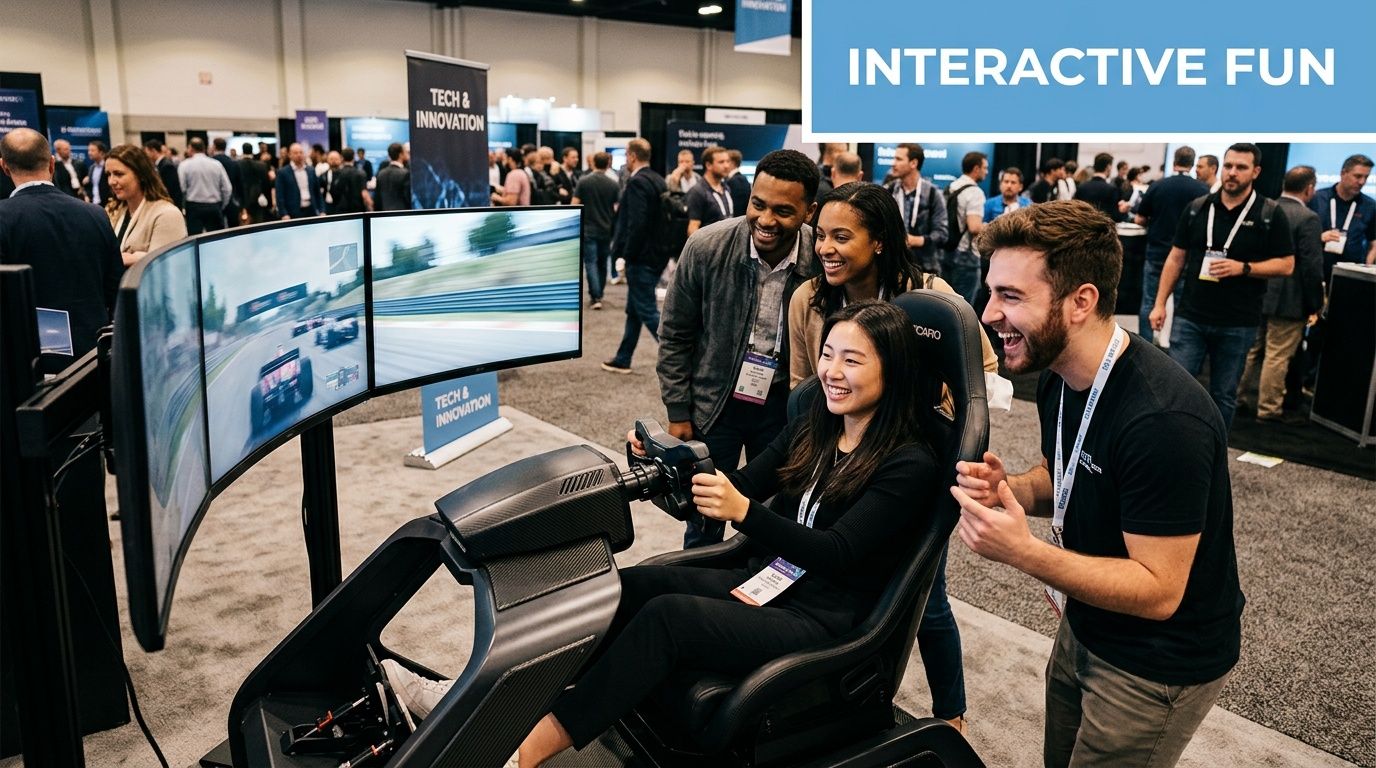
A well-run racing simulator on a stand does more than entertain. It creates a queue, which creates visibility. It gives your team an easy opener. It gives guests a reason to stay longer. And if you add branded screens, a leaderboard, or a prize mechanic, it gives the interaction a structure that supports marketing goals rather than distracting from them.
Why interactive kit outperforms passive displays
The hire model has become more important because event teams want impact without the cost and complexity of owning specialist equipment. The UK accounts for about 18% of the European simulators market, and the global market is projected to reach US$ 34.4 Bn by 2033, with the services category, including hire, forecast to grow fastest, according to Persistence Market Research's simulators market outlook.
That trend makes sense on the ground. Most brands don't need permanent simulator hardware. They need a reliable experience delivered for a specific campaign, venue, roadshow, or launch window.
Practical rule: If the activation has to earn floor attention quickly, interactive participation usually beats passive messaging.
Brands using experiential marketing activations already know this. People remember what they did more vividly than what they glanced at. A lap time challenge, a nearest-the-pin contest, or a flight task gives guests a role in the experience. That role is what turns footfall into engagement.
What works and what doesn't
What works is a simulator tied to a clear event purpose. A motorsport brand can run timed laps. A technology company can frame the experience around innovation and reaction speed. A hospitality event can use a simulator to break the ice between guests who don't know each other.
What doesn't work is dropping a rig into the stand with no staffing plan, no queue management, and no follow-up action. If nobody captures names, explains the challenge, or connects the experience back to the brand, you'll get noise without value.
What a Full Service Simulator Hire Includes
Clients often ask for simulator hire as if they're booking a single item. In practice, the equipment is only one part of the job. The difference between a smooth activation and a stressful one usually comes down to what sits around the rig.
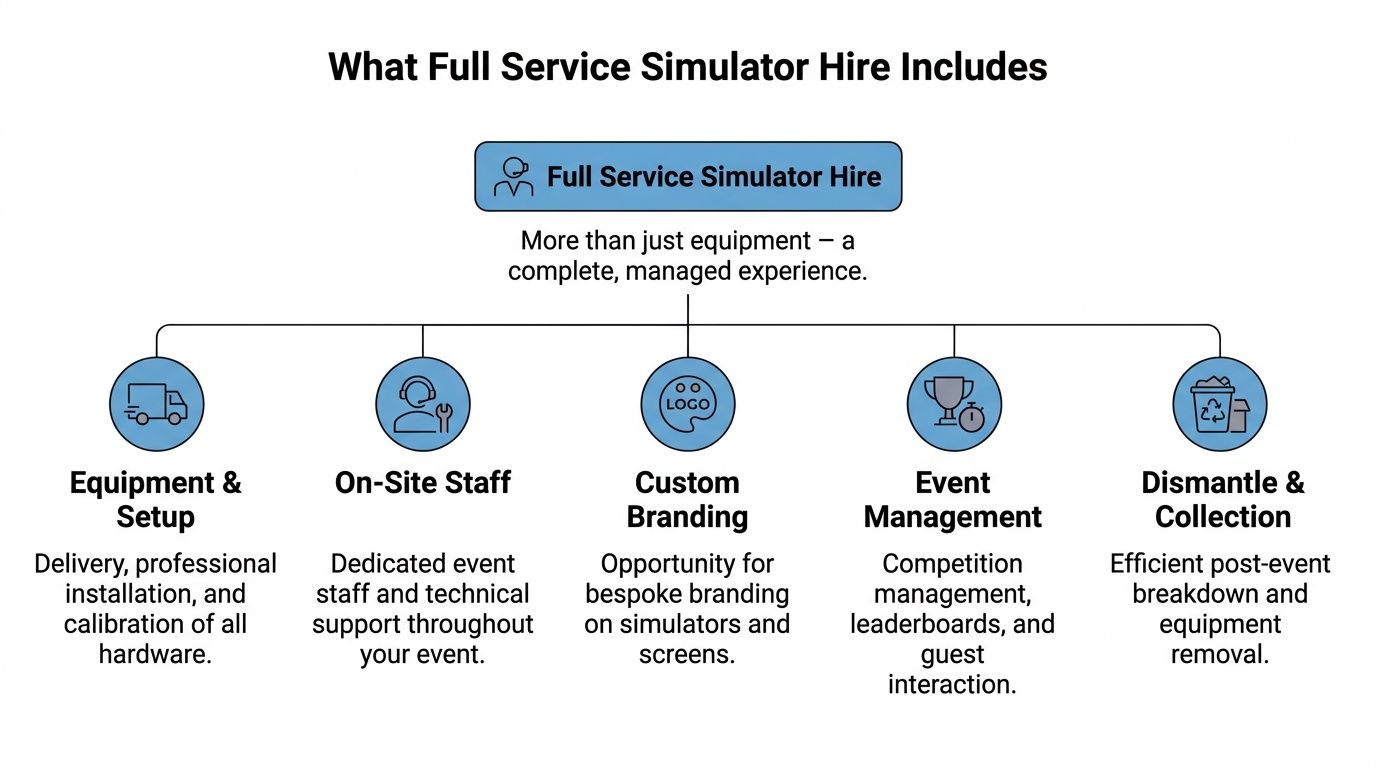
A proper full-service booking should cover the operational pieces that planners don't want to chase separately. That includes pre-event planning, transport, setup, testing, live operation, breakdown and collection. It should also cover the less visible details such as branding assets, safety paperwork and contingency planning.
The core parts of the package
A professional hire normally includes:
- Pre-event consultation: Clarifying audience, venue restrictions, event schedule, staffing levels and what success should look like.
- Delivery and installation: Bringing the simulator to site, moving it into position, assembling the hardware and calibrating it for live use.
- On-site staffing: Having trained crew there to brief guests, manage turns, troubleshoot issues and keep the experience moving.
- Brand integration: Applying logos, branded screens, custom challenge naming or event-specific visuals where the format allows.
- Live management: Running competitions, resetting sessions, updating leaderboards and maintaining guest flow.
- Breakdown and collection: Removing equipment efficiently once the event closes, without burdening the venue team.
That's the baseline. Better providers also think about how the simulator fits the venue traffic pattern, not just whether it technically fits the floorplan.
The extras that clients often overlook
The hidden work sits in the details. For exhibitions, you may need a fast turnover between guests so the queue stays healthy without becoming frustrating. For internal events, you may need a less competitive setup so beginners aren't put off. For branded campaigns, software visuals and screen messaging often matter just as much as the hardware.
Health and safety is another common blind spot. The provider should supply risk assessments, manage cable routing, confirm equipment safety checks and provide trained operators who can supervise use responsibly. Insurance matters too. PSW Events supplies simulator experiences with £10 million products, employee, and public liability insurance, alongside planning, logistics, installation and staffing as part of its service model.
The easiest way to spot a weak quote is this: it lists the rig, but says little about who's running it, how it's branded, or what happens if something changes on site.
What a client should ask before signing off
A quick checklist helps cut through vague proposals:
| Question | Why it matters |
|---|---|
| Who is operating the simulator on the day? | Equipment without event staff slows down fast. |
| What branding is included? | Base branding and bespoke overlays are often treated differently. |
| What's needed from the venue? | Access, power, timing and floor surface all affect setup. |
| What paperwork is supplied? | You may need RAMS, insurance documents and electrical compliance details. |
| How is guest data handled, if captured? | A leaderboard or registration mechanic needs clear ownership and process. |
The more complete the answer, the more likely the day will run cleanly.
Choosing Your Simulator From F1 Cars to Golf Swings
The right simulator isn't the one that sounds most exciting on paper. It's the one that suits the audience, the venue, and the pace of the event. A brilliant exhibition tool can be the wrong choice for a VIP drinks reception. A technically impressive setup can underperform if it takes too long to brief each guest.
That's why selection starts with behaviour. Are people walking past quickly? Are they staying for hospitality? Are they competitive? Are they complete beginners?
Racing simulators
Racing simulators are the safest choice when you want broad appeal. Guests don't need specialist knowledge to understand the objective. Sit down, drive a lap, try to beat the time. That simplicity is why they work so well at exhibitions, conferences, product launches and sponsor activations.
The category is also backed by strong market demand. The UK driving simulator market generated USD 127.9 million in 2024 and is projected to reach USD 159.7 million by 2030, according to Grand View Research's UK driving simulator outlook.
Best fit:
- Exhibitions and trade shows: Strong visual draw and easy queue mechanic.
- Brand activations: Ideal for timed challenges and branded leaderboards.
- Hospitality events: Good for informal competition between guests.
Watch-outs:
- Noise and energy level: Great for busy spaces, less suitable for quiet networking zones.
- Turn length: Too long and the queue stalls. Too short and the experience feels throwaway.
Flight simulators
Flight simulators attract a different kind of guest. They feel more technical, more premium, and often more conversational. They suit audiences that enjoy realism, problem-solving or aspirational experiences.
A flight simulator can work well in executive hospitality, STEM-themed events, recruitment campaigns and controlled indoor spaces where the audience will spend longer with the experience. They're less about quick-fire throughput and more about depth.
Typical strengths:
- Higher perceived exclusivity
- Good talking point for technical brands
- Memorable one-to-one guided experience
The trade-off is pacing. Flight experiences often need more explanation, so they're not always the best option when you need rapid guest turnover.
Sports simulators
Golf is one of the most flexible formats because it can be competitive without being intimidating. Guests can step in wearing normal event attire, take a swing, and understand the result immediately. It also works well across hospitality, staff events and exhibition stands where you want something social rather than frantic.
If you're planning around golf, it's useful to look at the modern club growth model because it reflects a wider shift toward accessible, experience-led participation rather than formal membership behaviour. That same mindset is why golf simulator hire options for events have become such a practical fit for corporate audiences.
Other sports formats, such as boxing or football-style challenges, can be excellent in fan zones and family days. They're usually stronger for energy and spectacle than for nuanced lead capture conversations.
A second look at simulator formats in action helps here:
VR simulators
VR is the most adaptable category. It can be themed around speed, adventure, sport or pure novelty, and it works when you want to transport guests into a branded world rather than replicate a real one.
It's useful for:
- Creative launches
- Youth-focused events
- Pop-up experiential spaces
But VR needs careful management. Headsets can slow throughput, hygiene handling needs thought, and some venues or audiences prefer experiences that are easier to watch from the outside. If spectators can't see what's happening, you lose part of the crowd effect.
Choose the simulator your audience will join fastest, not the one your internal team finds most impressive.
Top Use Cases for Simulator Hire
The best use cases are the ones where the simulator solves a planning problem. Sometimes that problem is low stand engagement. Sometimes it's a hospitality brief that needs structure. Sometimes it's an internal event where the organiser needs people to relax, mingle and take part without awkward forcing.
Exhibitions and trade shows
At exhibitions, a simulator acts as a people magnet when the stand needs visible activity. A racing challenge or golf contest creates a reason to stop that doesn't rely on hard selling. Once someone joins the queue or watches a colleague take part, your team gets an opening that feels natural.
What makes it commercially useful is the flow around it. The simulator creates the attention, but the supporting format creates the value. That might be a branded leaderboard, a prize draw tied to registration, or a short conversation during the guest handover between turns.
A simple stand routine often works best:
- Attract: Use the visible simulator and current score display to pull attention from the aisle.
- Engage: Give the guest a clear, low-friction challenge.
- Capture: Collect details as part of entry or prize eligibility.
- Follow up: Hand the lead to sales or marketing with context about the interaction.
Brand activations and product launches
For activations, the simulator becomes a physical expression of the campaign. A car brand can align naturally with speed and competition. A technology business can link the experience to precision, reaction, innovation or performance. A sports sponsor can place the brand inside an activity that already carries energy.
Branded visuals are important. If the game mechanic, screens and surrounding environment all support the same message, the activation feels designed rather than rented.
A simulator should never feel bolted on. If the branding and guest journey are disconnected, people enjoy it but forget who delivered it.
Team building and internal events
Internal events are different. The brief is usually less about lead generation and more about participation. A simulator works well because it removes the pressure of formal networking. People gather around a challenge, encourage each other, and start talking without needing a facilitator to force the interaction.
Golf is particularly strong here. The UK golf simulator market was valued at USD 157.58 million in 2024 and is forecast to reach USD 323.06 million by 2032, according to Credence Research's UK golf simulator market report. That growth reflects exactly why it works at hospitality days, team socials and mixed-experience corporate events. It's approachable, recognisable and easy to adapt for competitive or casual play.
Private celebrations and hospitality spaces
For private parties, weddings and premium hospitality, the aim is usually atmosphere. Guests need something that adds movement and conversation without making the event feel like an arcade. In these settings, the simulator has to suit the tone of the room.
That usually means:
- Cleaner visual presentation
- Shorter, guided turns
- A format that works for spectators as well as players
A simulator in a hospitality suite can also help bridge guest groups. Clients, prospects and colleagues often talk more easily when there's a shared challenge on screen than when they're standing around a high table making small talk.
Planning Logistics and Safety Requirements
Most simulator hire issues are predictable. They happen when space, access, timing or venue rules are checked too late. The simplest way to avoid problems is to treat the simulator like production equipment, not like a standard prop.
Space and access
Start with the route into the room, not just the footprint once installed. A simulator may fit perfectly on the floorplan but still become difficult if the venue has tight doorways, awkward corridors, low ceilings or lift restrictions.
Use this checklist early:
- Access route: Confirm loading bay access, door widths, lift size and any stairs.
- Venue timings: Check when the crew can load in, test and clear the space.
- Operating area: Leave enough room for the player, the operator and the audience around the experience.
- Spectator flow: Make sure queues don't block aisles, fire exits or neighbouring stands.
For flight-specific setups, practical planning questions around footprint, power and positioning are covered well in this guide to flight simulator requirements for events.
Power, staffing and live operation
Power is usually straightforward when checked in advance and stressful when assumed. Confirm what supply is available, where the sockets are, and whether cables will need matting or route protection. On an exhibition floor, also ask whether the organiser has any restrictions on where equipment can be positioned relative to service points.
Operationally, ask who is managing guest flow. A simulator without an active operator can become slow very quickly. People need a brief, a defined turn, and a clear handover to the next participant.
Safety and compliance
Safety should sit in the background when it's done properly. Guests shouldn't be thinking about it, but the organiser absolutely should.
A provider should be ready to supply and manage:
| Item | Why it matters |
|---|---|
| Risk assessment and method details | Venues and organisers often require them before approval. |
| Electrical compliance documentation | Confirms the kit is suitable for event use. |
| Insurance documents | Protects the organiser and venue if they need evidence of cover. |
| Trained event staff | Reduces misuse, delays and unsafe participant behaviour. |
The provider also needs the confidence to adapt on site. If the stand layout changes, if the venue restricts access, or if crowd flow becomes heavier than expected, the operation should be adjusted without compromising safety or guest experience.
Budgeting for Simulator Hire and Measuring ROI
The wrong budgeting conversation starts with one question. “What's your day rate?” That's understandable, but it rarely tells you what the event will cost or what the booking will deliver.
The better question is, “What's included, what isn't, and how will we judge whether this was worth doing?”
Why clear pricing matters
Pricing confusion is still one of the biggest friction points in this category. According to a UK Event Management Survey, 62% of corporate planners cite “unclear pricing” as their top friction point when booking simulators, and 71% of B2B clients prefer all-inclusive quotes, as noted in this overview of racing simulator hire considerations.
That lines up with what clients often encounter in the market. A basic quote may mention the simulator itself, but leave branding, staffing, transport, venue-specific setup or on-site management to be clarified later. By the time those are added, the comparison between suppliers becomes muddy.
Understanding Your Simulator Hire Quote
| Service Component | Included in All-Inclusive Hire | Potential Extra Cost on Basic Hire |
|---|---|---|
| Simulator hardware | Yes | Usually included |
| Delivery and collection | Yes | May be added later |
| Installation and breakdown | Yes | May be separate |
| On-site operator | Yes | Sometimes extra |
| Branding and screen customisation | Sometimes included, clearly defined | Often treated as an add-on |
| Competition management and leaderboard | Often included if discussed upfront | Frequently additional |
| Safety paperwork and insurance evidence | Yes, where professionally managed | May not be clearly stated |
If a quote looks cheap, check what work has quietly been moved outside the number.
Measure value, not just spend
ROI depends on the event goal. For a trade show, the simulator may justify itself by helping the stand team start more relevant conversations. For an internal event, value may come from participation and atmosphere. For a product launch, the focus may be branded engagement and social content.
Useful metrics include:
- Lead capture quality: Did the simulator create better conversations or just more casual traffic?
- Dwell time: Did people stay long enough for the team to qualify interest?
- Brand interaction: Were guests engaging with branded screens, scoreboards or challenge mechanics?
- Footfall pattern: Did activity around the simulator create a visible draw at key times?
- Team efficiency: Did the attraction help staff approach visitors more naturally?
The most reliable way to improve ROI is to design the mechanic around the objective. If you need leads, connect participation to registration. If you need brand recall, make the challenge and visuals unmistakably tied to the campaign. If you need hospitality value, keep the pace social and accessible.
Cost matters. But in simulator hire, weak planning wastes more budget than premium hardware ever does.
Frequently Asked Questions About Simulator Hire
How much space do I need?
It depends on the simulator type and whether you want spectator room around it. Always plan for operating space, queue space and safe access, not just the rig footprint.
Can the simulator be branded?
Usually yes. Branding can include external panels, surrounding graphics, screen visuals or leaderboards. Ask exactly what format is included so there's no confusion later.
Do guests need experience to take part?
No. The strongest event formats are beginner-friendly. The operator should be able to brief first-time users quickly and adapt difficulty if needed.
Is simulator hire suitable for short event windows?
Yes, if the format is chosen properly. Fast-turn experiences like racing or simple sports challenges tend to work better when throughput matters.
Who handles setup and safety paperwork?
A professional provider should handle delivery, setup, operation, breakdown and the relevant supporting documents for venue approval.
Can simulator hire support lead generation?
Yes, when the experience is built around a clear registration or competition mechanic. Without that structure, it's entertainment first and marketing second.
If you're planning simulator hire for an exhibition, conference, launch or hospitality event, start with the commercial outcome you need. The right simulator is the one that helps your team create that result in a way guests actually want to join.