
You're probably planning a stand, conference zone, team event, or branded activation where the brief sounds simple, but the situation is often complex. You need people to stop, take part, stay long enough for a meaningful conversation, and leave remembering your brand instead of the dozen stands around you.
That's exactly where an American Football Simulator earns its place.
Used badly, it's just a novelty. Used properly, it becomes a working part of your event strategy. It gives attendees a reason to approach, gives your team a reason to start a conversation, and gives you a practical way to turn passive traffic into trackable engagement. In the UK market, that matters even more because American football still carries novelty, but interest is growing faster than hands-on familiarity. That gap is useful if you know how to design around it.
Beyond the Booth How to Win Attendee Attention
Most exhibition stands fail for one reason. They ask too much too soon.
A cold attendee walking past your stand doesn't want a sales pitch. They want a reason to pause. If you give them something active, competitive, and easy to understand, you remove the friction. An American football simulator does that far better than a static display or a bowl of giveaways.
The smart approach is to treat the simulator as your engagement engine, not your entertainment line item. It pulls people in because the action is visible from the aisle. Someone sees a throw, a target, a score, and a crowd reaction. They understand the challenge instantly. That matters in busy halls where you have seconds to win attention.
What makes it work on a stand
Three things.
- It creates visible action: Motion attracts attention faster than graphics panels or looping video.
- It lowers the barrier to entry: Attendees don't need prior experience to have a go.
- It gives staff a natural opener: “Fancy a throw?” works better than “Can I tell you about our services?”
Practical rule: If the attraction doesn't help your team start conversations, qualify visitors, or collect data, it's taking up expensive floor space.
This is why interactive sport works so well in exhibition environments. It creates a reason for people to stop without forcing them into a hard sell. Then your team can guide the interaction towards a business outcome, whether that's lead capture, product education, or brand recall.
How to use it strategically
Don't place the simulator at the back of the stand. Put it where passing traffic can see the participation. Keep the challenge simple. Make the first attempt quick. Then use the queue, score display, or leaderboard as the transition into conversation.
For planners building a more interactive stand concept, these interactive exhibition stand ideas are a useful reference point.
If your current stand plan relies on brochures, screens, and hope, change it. Attention has to be earned. An American football simulator gives you a direct way to earn it.
Understanding the American Football Simulator Experience
Your stand team has done the hard part. People have stopped. Now you need an experience that turns a glance into participation and participation into a trackable commercial moment.
An American football simulator does that by giving attendees a simple, physical challenge with an immediate result. They pick up a real ball, throw at a digital target, and get live feedback on accuracy, score, or speed. The format suits UK audiences particularly well because interest in the NFL has grown faster than direct hands-on familiarity. People recognise the sport, but many have never thrown an American football in their lives. That gap works in your favour.

What attendees are actually buying into
They are not just having a throw. They are testing themselves in public, comparing scores with colleagues, and getting a quick introduction to a sport they know from broadcasts, highlights, and major league branding.
That matters.
A standard console setup keeps the action on a screen. A simulator puts the action in the event space, where the throw, the result, and the reactions all become part of the attraction. For a corporate planner, that makes it far more useful than passive entertainment because the experience creates natural pause points for staff to qualify visitors, ask a follow-up question, or capture details after the attempt.
It also sits in a different category from a standard UK football simulator. A football simulator usually relies on instant familiarity. An American football simulator adds novelty without becoming confusing, which is exactly why it performs well at exhibitions, team events, and branded activations.
Why this format works so well in the UK
The strongest activations meet attendees halfway. American football does that. The audience already has enough context to want a go, but not so much experience that the challenge feels closed off to beginners.
That changes the participant dynamic in useful ways:
- At exhibitions, first-time players are happy to try a quick throw because the task is obvious
- At team building events, seniority matters less because very few people arrive with a genuine skill advantage
- At brand activations, the sport brings energy, competition, and a strong visual identity that brands can use well
For planners, the recommendation is simple. Use the simulator as a bridge between awareness and action. It helps attendees move from “I've seen this on TV” to “I've done this myself,” and that shift makes the brand interaction more memorable.
What a good user experience looks like
Keep it short. Keep it clear. Keep it competitive.
Give each participant a defined objective, such as hitting targets in a set time or beating the previous score. Brief them in one sentence. Then let them throw. Long explanations slow the queue and drain the energy from the activation.
The best setups also make the outcome visible. Scores, hit zones, timers, and leaderboard mechanics give spectators a reason to watch and players a reason to stay engaged for another attempt. That is where the simulator starts delivering more than amusement. It gives you repeat plays, better dwell time, stronger audience involvement, and a cleaner route into lead capture or branded follow-up.
If you want the hire to produce measurable results, treat the simulator as a participation tool with a business job to do. Fun gets people in. The structure around the game determines whether the activation performs.
Technical Specifications and Game Modes
A simulator that looks great in the pitch deck can still fail on site.
The problem is usually basic. It needs more clearance than the stand plan allowed, the power drop is in the wrong place, or the game format is too slow for the crowd that attends. If you want the activation to perform, sort the operational details before you approve branding, staffing, or supporting graphics.
The physical setup
For venue planning, start with the unit specification. A typical 2-player American football simulator uses a footprint of 2.4m (W) × 1.2m (D) × 2.2m (H), runs from a standard 13A (230V) socket, and is specified for continuous 8-hour exhibition use, according to Interactive Fun's I-Wall American football simulator specification.
Use that as your minimum planning baseline, not your total space allowance.
| Planning point | What to confirm |
|---|---|
| Space | Leave room for the unit, throwing position, queue line, and a small spectator pocket |
| Height | Check ceiling clearance under rigging, shell scheme fascias, and temporary signage |
| Power | Confirm a standard socket at the exact stand location, not just somewhere on the hall plan |
| Surface | Confirm the simulator can operate safely on your event flooring type |
| Access | Check loading doors, lifts, corridors, and build windows before sign-off |
Good planners also ask one more question early. Where will the queue sit when the stand gets busy? If you do not assign that space on the floorplan, the crowd will assign it for you, usually across your meeting area.
Why these details matter
This is not a large-format attraction, but it still needs disciplined positioning.
Put it too close to the aisle and you create spill-out that blocks approach routes. Push it too far back and the live action loses its pull. The strongest layout gives players enough room to throw comfortably, gives onlookers a clear view of the score screen, and protects a separate space for staff conversations and lead capture.
That is the difference between hiring a novelty and building an activation that works.
The software side of the experience
Game software decides whether the simulator feels sharp or forgettable. Fast response matters. Clear scoring matters. Repeatable challenge formats matter most.
Some systems offer a wider range of stadium environments, structured challenges, and realistic ball-flight behaviour, as noted earlier from supplier specifications. For a corporate event, the practical question is simpler. Does the game react instantly, does the scoring make sense in seconds, and can a first-time player complete a round without a long explanation?
If the answer is no, skip it.
UK audiences often recognise the NFL brand and match-day imagery before they understand routes, downs, or tactical play. Your simulator should close that experience gap, not expose it. Choose software built around intuitive target-based play rather than rule-heavy simulation. That gets more people involved and gives your brand team more usable interactions per hour.
Game mode choices that work best at events
Pick the mode to match the commercial objective.
- Quick accuracy challenges suit high-footfall exhibitions where speed and turnover matter
- Head-to-head play works well for hospitality, social events, and internal competitions
- Leaderboard formats increase repeat attempts and give spectators a reason to stay nearby
- Branded challenge rounds fit campaigns where the game needs to support a product message or data capture mechanic
Make one decision early. Are you optimising for throughput, dwell time, or conversation quality? That choice should shape round length, scoring format, and staffing.
For most exhibition stands, short rounds win. They keep the line moving, lower the drop-off rate, and give your team more chances to qualify visitors. Longer modes are better reserved for guest hospitality or evening events where the brief is relationship-building rather than volume.
Driving Engagement at Exhibitions and Activations
At 11:15 on a busy exhibition morning, your stand has ten seconds to stop the right person walking past. A well-run American football simulator gives you that stop. It creates visible activity, draws a crowd, and gives your team a natural reason to start a business conversation.
That matters because passive stand design rarely holds attention for long. Active participation does.

Why it fits the UK market now
UK planners have a useful opportunity. Interest in the NFL has grown, but many attendees still have little or no hands-on experience of the sport. That gap works in your favour if you handle it properly.
As highlighted in Flutter's article on American football's popularity with UK punters, the sport now has broad recognition among UK audiences. For corporate events, that gives you something better than a novelty game. You get a familiar visual hook with a low barrier to entry, which helps attendees take part quickly and gives your brand team more chances to capture interest, explain the campaign, and qualify visitors.
This is the strategic value. The simulator helps brands tap into rising local NFL interest without assuming prior knowledge. It turns recognition into participation.
What strong activations do differently
The simulator should never sit on the stand as a self-contained attraction. It needs a clear job.
Use it to support one measurable objective:
- increase qualified footfall
- collect opted-in leads
- create longer dwell time for product conversations
- support a branded competition or product launch
- give hospitality guests a shared activity with a scoring mechanic
If you try to do all five at once, you weaken the activation. Pick the priority first, then build the experience around it.
For exhibition environments, PSW Events would usually advise planners to keep the journey tight. Invite the attendee in with a short challenge, capture a name or scan when the timing feels natural, display the result clearly, and move the participant to the next action while the energy is still high.
How to turn throws into conversations
Good event staff make the simulator pay for its floor space. Poor staffing turns it into background entertainment.
Brief your team to do three things well. First, frame the challenge in one sentence. Second, react to the score and keep the moment lively. Third, move straight into a relevant follow-up question.
That question should connect to your event objective, not to the sport itself. Ask about current suppliers, project timing, product interest, team size, or whether they want a demo. The throw is the opener. The commercial conversation is the point.
A visible leaderboard also helps. It gives spectators a reason to stay nearby, encourages repeat attempts, and gives your staff a simple line to bring people in. If you want stronger reporting after the event, pair the game with a scoring screen and a registration step designed around your wider experiential marketing ROI strategy.
Where activations lose value
Planners usually go wrong in the operational detail. The game may be strong, but the stand flow is weak. Queues block the frontage. Nobody explains what to do. Scores are not captured. Sales staff wait until the attendee walks off before trying to engage.
Fix those points before show day.
Set queue space. Decide who hosts the game and who qualifies the lead. Make sure branding is visible from distance. Confirm what happens after each round, especially if the participant hits a high score, joins a prize draw, or asks for more information.
Handled properly, an American football simulator does more than entertain. It gives UK event planners a practical way to bridge the audience experience gap, turn rising NFL interest into confident participation, and produce business outcomes the client can report with confidence.
How to Measure Your Event ROI
Your finance lead asks a fair question after the show. What did the simulator produce?
If your answer is limited to footfall and a few photos, you have a weak case for using the activation again. A better answer ties the experience to pipeline, audience quality, and brand response. That matters even more with an American football simulator in the UK. The format attracts people who are curious about the NFL but may not know the sport well, which gives your team a practical way to start conversations, capture data, and move attendees into a clear next step.
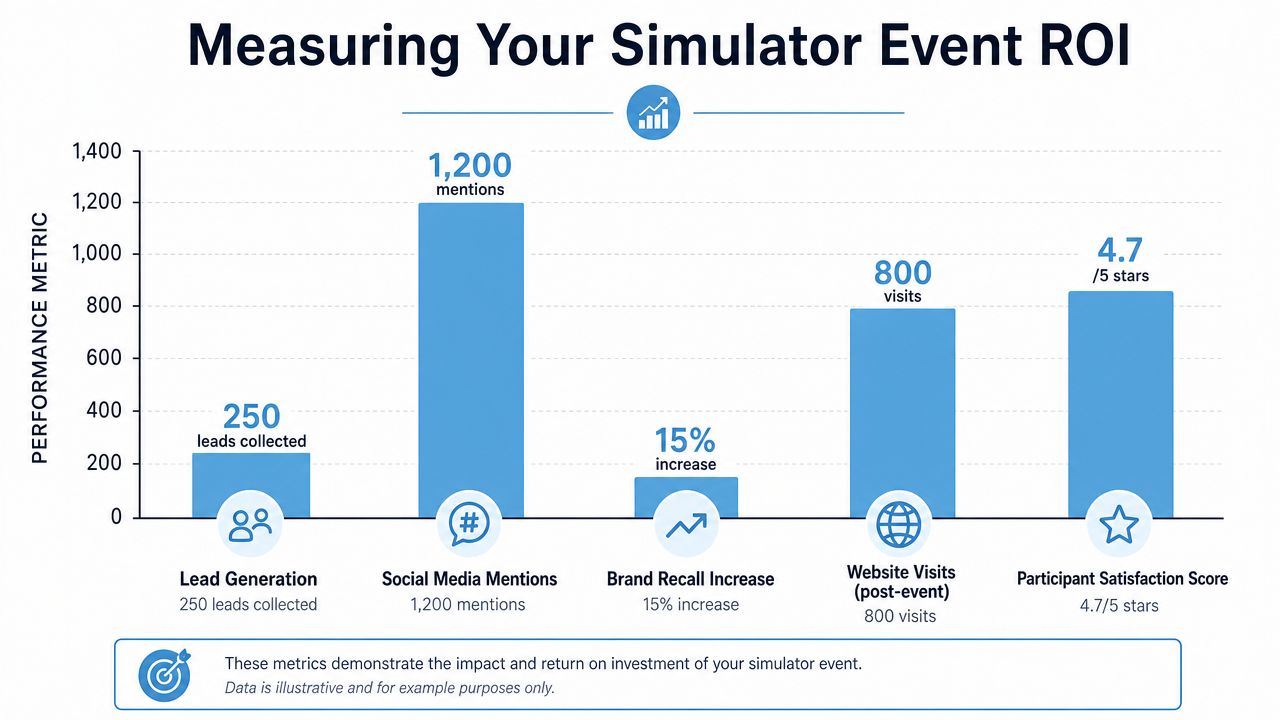
Start with metrics your stakeholders will use
Report a short list. Make every number answer a business question.
- Qualified leads: how many participants matched your target audience and agreed to follow-up
- Conversion actions: demo requests, booked meetings, brochure requests, or campaign sign-ups linked to the activation
- Cost per qualified interaction: event spend divided by meaningful sales conversations, not total plays
- Average dwell time: whether the simulator kept prospects on the stand long enough for your team to engage properly
- Brand recall: whether attendees remembered the brand, message, or product after taking part
Those measures show whether the simulator did its job. Senior stakeholders want to know if it pulled the right people in and gave the stand team a better chance to sell.
Set the reporting framework before build day
ROI is decided before the first attendee throws a pass. If you have not defined what counts as a lead, who records it, and how follow-up is tracked, your post-event report will be guesswork.
Use a simple framework your stand staff can maintain:
| KPI area | What to record | Why it matters |
|---|---|---|
| Traffic quality | Participant job role, company type, buying relevance | Separates casual play from commercial value |
| Engagement depth | Time on stand, repeat attempts, staff interactions | Shows whether interest lasted long enough to matter |
| Lead capture | Badge scans, form completions, consent status | Gives sales a usable list instead of loose notes |
| Sales progression | Meetings booked, demo requests, post-event replies | Connects the game to pipeline movement |
| Brand response | Recall, comments, social sharing, team feedback | Shows whether the activation made the brand more memorable |
Be strict here. If a metric will not influence your next event decision, do not track it.
Judge performance in context
A simulator at an exhibition stand should not be measured the same way as one at a staff party or client hospitality event. The target changes. So does the reporting.
At a trade show, the benchmark is lead quality and sales follow-up. At an internal event, focus on participation, satisfaction, and team involvement. At a public brand activation, look harder at dwell time, social content, opt-ins, and message recall.
Often, planners miss the bigger opportunity. Rising NFL interest gives you a strong theme, but novelty alone is not the return. The return comes from using a familiar but still accessible sport to reduce hesitation, invite participation from first-timers, and create a branded interaction people remember.
Present the result in commercial language
Write the final report for the person controlling next year's budget.
State how many people played, how many matched the target audience, how many sales conversations followed, and what happened after the event. If the simulator increased stand time but lead quality stayed weak, your capture process needs work. If qualified meetings increased, keep the format in your event mix and improve the follow-up. For a practical planning model, use this experiential marketing ROI framework to structure the numbers before the event starts.
Good reporting is blunt. It shows what the activation produced, where value was lost, and what you will change next time.
Your Event Planning and Booking Checklist
You are three weeks from a major exhibition. The simulator arrives, but the access route is too tight, the power drop is on the wrong side of the stand, and nobody agreed who is collecting leads. The attraction still runs. The activation underperforms.
That is avoidable.

Treat the booking like an event asset with a commercial job to do. In the UK, that usually means using growing NFL interest to draw people in, then turning a simple, low-barrier experience into a branded conversation your team can track.
Confirm the operating basics first
Planners often spend too long discussing graphics and too little time checking whether the simulator will work properly in the space. Start with the operational points that affect build, play, and throughput on the day.
- Venue fit: Confirm footprint, ceiling height, safe throwing clearance, and the route from loading bay to event space.
- Power position: Ask where the power source sits, not just whether the venue has one.
- Audience profile: A B2B exhibition crowd needs quick turns and immediate staff follow-up. A hospitality event can support longer play and more commentary.
- Event objective: Decide what the simulator must do. Stop traffic, support a campaign theme, start sales conversations, or reward guests.
- Operator support: Confirm who handles delivery, setup, live hosting, troubleshooting, and derig.
Get those answers before you approve the booking. That is what separates a useful activation from an expensive distraction.
Build the experience around your event goal
An American football simulator works best when the format matches the audience's confidence level. That matters in the UK, where NFL interest is growing but many guests still need a quick introduction before they take part.
Set the experience up so first-time players can join without feeling lost. Use short instructions, one clear challenge, visible scoring, and staff who can keep the queue moving. If the event has a stronger commercial focus, add a reason to stay engaged after the first throw, such as a leaderboard, a branded challenge round, or a simple follow-up mechanic tied to a meeting or prize draw.
Ask sharper branding and lead-capture questions
A logo on a screen is weak branding. If the simulator is part of a campaign, the creative should feel built into the activity.
Ask about:
- In-game branding: score screens, challenge names, team colours, and campaign visuals
- Set branding: backdrops, side panels, floor vinyl, or a branded surround
- Leaderboard design: useful for repeat attempts and visible competition
- Registration method: QR sign-up, badge scan, tablet entry, or staff capture
- Prize structure: only if it supports lead quality and does not slow the queue
PSW Events supplies simulator hire alongside branding, logistics, installation, on-site staffing, and health and safety compliance. That helps if you want one supplier managing the operational detail instead of splitting responsibility across multiple contractors.
Price the job properly
American football simulator hire sits in the premium interactive category. Budget for the full activation, not just the equipment.
Supplier pricing varies by format, staffing, branding, travel, and event duration. Do not rely on a headline day rate. A useful budget check is to ask for a line-by-line breakdown before you sign.
| Budget item | Confirm before booking |
|---|---|
| Hire fee | Duration, daily rate, and staffed operating hours |
| Delivery | Travel coverage, parking, access restrictions, and waiting time |
| Branding | Included artwork, custom production, and approval deadlines |
| Setup | Build time, derig time, and venue access window |
| Support | On-site host, technical cover, and fault response process |
If a quote looks cheap, inspect what has been left out.
Check safety paperwork before approval
Public interaction needs proper planning. Ask for risk assessments, insurance details, operating procedures, and any method statements required by the venue. Use this guide to a risk assessment for football activities to check whether the supplier is covering the right ground.
If a supplier cannot clearly explain safe operating space, staffing responsibility, or insurance cover, reject the booking.
Make the final decision with a simple test
Book the simulator if it fits the audience, supports the campaign objective, and gives your team a practical way to capture value from every session.
Do not book it because it looks fun in a sales deck.
Frequently Asked Questions
How much branding can you actually apply?
Usually more than planners expect. The basic level is logo placement on the game interface or surrounding set. The better approach is branded score screens, challenge naming, and a clear visual tie-in to the campaign theme. If the activation matters commercially, ask for branding that feels integrated rather than pasted on.
Is it safe for public events?
Yes, if the hire is managed properly. You should expect a professional event supplier to provide risk documentation, clear operating procedures, and public-facing supervision. At PSW Events, that includes £10 million products, employee, and public liability insurance, plus the operational planning that goes with live event delivery. The number matters less than the standard behind it. You want a supplier that treats safety as part of production, not an afterthought.
Can it be used outdoors?
It can, but not exposed to the weather. Electronics, screens, and sensor-based systems need protection. If the simulator is going outside, use a marquee or another fully covered structure, and confirm floor conditions, power routing, and wind exposure before the booking is finalised.
Is it better for exhibitions or team building?
It can work for both, but the format should change. Exhibitions need short cycles, strong hosting, and quick lead capture. Team building can lean harder into competition, head-to-head play, and leaderboards. The mistake is running the same game flow in both settings.
Will attendees understand it if they don't know American football?
Yes, if the challenge is framed properly. Keep the instruction short, make the objective visual, and let staff guide first-time players. In the UK, that accessibility is part of the appeal. People don't need to know the sport in depth to enjoy the challenge.
What should you ask a supplier before booking?
Ask about footprint, power, staffing, branding, insurance, setup times, and what happens if the venue access is awkward. Then ask one final question. “How will this help us capture leads or start conversations?” If the answer is weak, the activation probably will be too.
If you want the simulator to do more than entertain, build the surrounding experience with the same care as the stand itself. That's where the return comes from.