
You’re probably looking at a familiar brief.
The stand needs to pull people in. Sales wants better conversations. Brand wants something more memorable than a standard prize wheel. Operations wants an attraction that won’t create venue headaches. Finance wants a sensible case for the spend.
That’s where a rowing simulator fits, if you treat it as a marketing asset rather than a piece of fitness kit.
Used well, it gives you competition, spectacle, data capture, and a reason for people to stop. Used badly, it becomes a novelty machine that draws a short queue and gives you very little back. The difference usually comes down to format, staffing, branding, and whether you’ve defined what success looks like before the first guest sits down.
Why Your Next Event Needs a Rowing Simulator
Most event attractions fail for one of two reasons. They’re either too passive to stop footfall, or too complicated to get broad participation. A rowing simulator sits in the useful middle. It looks competitive from a distance, it’s easy to understand in seconds, and it gives people a clear reason to engage.
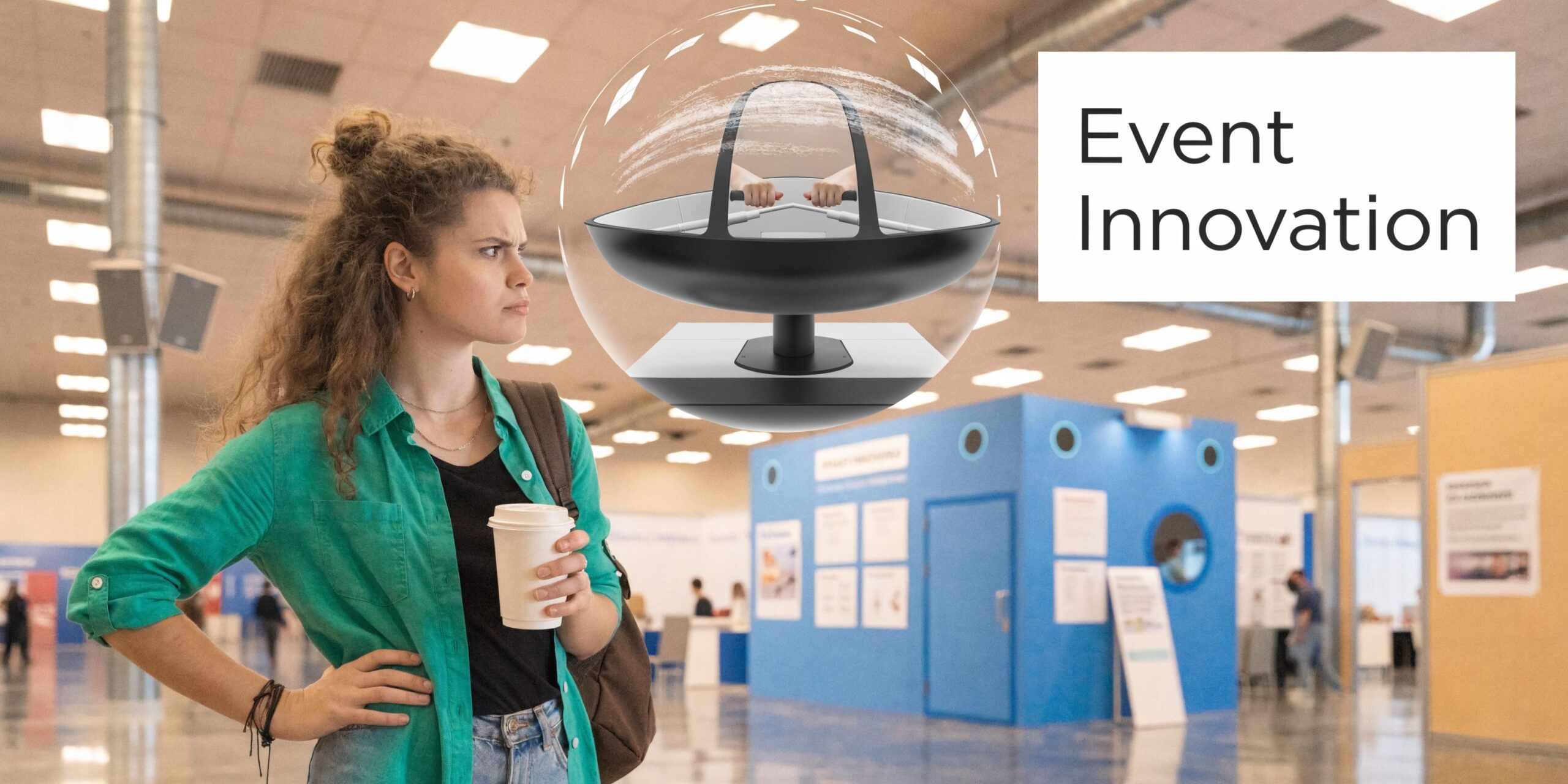
It carries cultural weight in the UK
A lot of interactive kit can be fun without meaning much. Rowing is different in the UK because it already has strong cultural recognition. The Oxford-Cambridge Boat Race was first held on June 10, 1829, and the Henley Royal Regatta began in 1839, which helped establish a national connection to the sport for UK audiences (rowing history reference).
That matters for marketers. You’re not asking attendees to learn an obscure game. You’re tapping into a sport people already associate with rivalry, discipline, teamwork, and prestige.
It works as theatre, not just participation
A rowing simulator creates a visible moment. The pulling action is physical enough to attract attention, but simple enough that people watching immediately understand the challenge. That’s useful on a busy exhibition floor where every attraction is competing for a glance.
A strong setup usually includes:
- A clear challenge format: fastest sprint, head-to-head race, or team relay.
- A visible score display: people stay longer when they can see standings update.
- A staff-led invitation: someone needs to convert watchers into participants.
- A branded backdrop: otherwise the activity gets remembered, but not the brand behind it.
For brands planning broader experiential marketing activations, that mix is especially effective because it combines movement, competition, and easy storytelling.
A good attraction doesn’t just entertain. It gives your team a reason to start better conversations.
It suits several event objectives at once
That’s the primary appeal. One rowing simulator can support different outcomes depending on how you frame it.
If your objective is footfall, use open challenge play with a leaderboard. If it’s lead generation, gate entry through a quick data capture flow. If it’s team-building, shift from individual times to crew scoring. If it’s brand positioning, style the activation around endurance, precision, or collaboration.
What doesn’t work is hiring the machine and hoping the engagement takes care of itself. The simulator is the mechanism. The event result comes from the format wrapped around it.
Understanding the Technology Behind Rowing Simulators
Not every rowing simulator delivers the same event experience. That’s the first thing to get right.
Some machines are designed for simple, durable throughput. Others aim for more realism. Some are ideal for head-to-head competition on a stand. Others are better for coached sessions, premium hospitality, or team-building workshops where the story matters as much as the score.
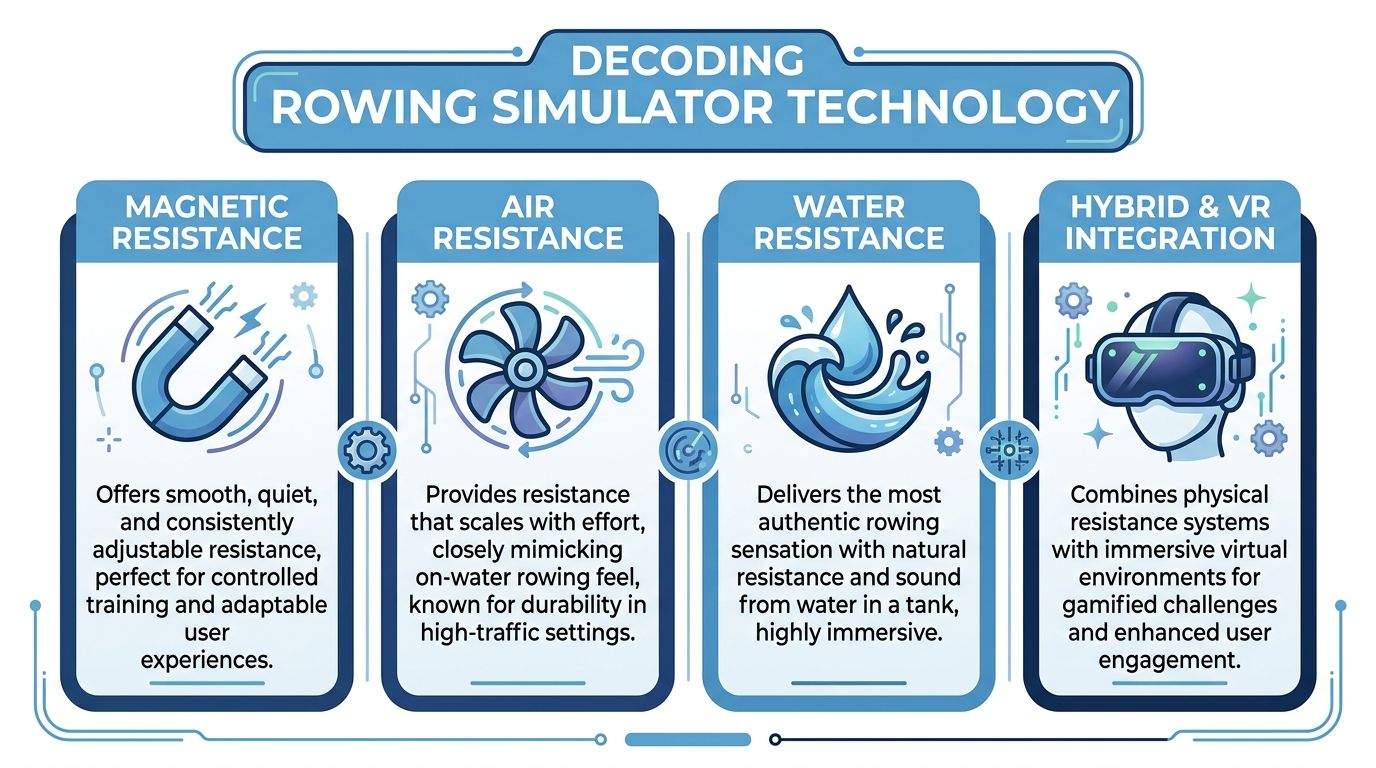
Start with the resistance system
The resistance system shapes how the machine feels, sounds, and performs under event conditions.
Magnetic resistance
Magnetic systems are smooth and relatively quiet. They’re useful where you want controlled resistance and a polished environment, such as conference breakout spaces or executive hospitality.
The trade-off is feel. They can be less dramatic from a spectator’s point of view, and they don’t always create the same sense of effort that helps build a crowd.
Air resistance
Air resistance is the familiar workhorse for many event activations. The harder the participant pulls, the more resistance they create. That makes the challenge intuitive. It also gives the machine a visible and audible sense of effort, which helps on a live stand.
This is usually the safest choice for busy public events because it balances realism, durability, and fast user turnover.
Water resistance
Water systems deliver a more immersive sensation and natural rowing sound. They can look premium and feel more experiential, especially in brand environments where atmosphere matters.
The trade-off is practicality. They’re not always the first pick for high-throughput exhibitions where easy transport, quick reset, and simple servicing matter more than ambience.
Static versus dynamic matters more than most buyers realise
A static ergometer stays fixed in place. It’s straightforward, dependable, and often the easiest to deploy. For exhibitions, roadshows, and branded competitions, that simplicity is a major advantage.
A dynamic rowing simulator adds movement that better reflects on-water mechanics. British athletes’ indoor records reflect how central simulators have become to serious rowing preparation, including Constantine Louloudis’ 5,000m dynamic record of 14:51.0 in 2015, Tom George’s static record of 14:53.9 in 2022, and James Cracknell’s 15:09.9 in 2002 (indoor rowing and records reference).
For marketers, the practical difference is this:
- Static machines: easier setup, easier throughput, easier briefing.
- Dynamic machines: more realism, stronger premium feel, better for coached or technique-led experiences.
Immersive and haptic systems
At the specialist end, some simulators use real-time haptic feedback to recreate oar-water interaction. Research on advanced scull simulator systems found that this type of feedback can enhance motor learning by 15-20%, which makes the experience more intuitive for novices as well as more technically meaningful (PLOS ONE scull simulator study).
That doesn’t mean every corporate event needs a high-end haptic setup. Most don’t. But it does show why some premium rowing simulator experiences feel far more convincing than a standard gym rower with a screen attached.
Practical rule: buy realism only if realism serves the event objective. If the goal is rapid participation and lead capture, simplicity usually wins.
Choose the format that matches the event
Here’s a useful buying view.
| Simulator Type | Typical Footprint | Power Needs | Best Use Case | Engagement Level |
|---|---|---|---|---|
| Static ergometer | Compact to moderate | Often simple venue power or low technical demand | Exhibitions, conferences, fast individual challenges | High when paired with leaderboards |
| Dynamic simulator | Moderate | More considered technical setup | Premium activations, coached demos, team-building | High with stronger realism |
| Crew or linked simulator | Larger | Depends on display and control system | Team events, relays, internal engagement | Very high for groups |
| VR or immersive rowing simulator | Moderate to larger | Display and headset integration increase setup needs | Brand experiences, hospitality, gamified activations | High for novelty and immersion |
The wrong technology choice is usually obvious in use
A few common mismatches come up repeatedly:
- Too advanced for the audience: if guests need too much instruction, queue conversion drops.
- Too basic for the brief: if the brand wants premium immersion, a bare machine can feel undercooked.
- Too fragile for the environment: public exhibitions need hardware that copes with repeated use.
- Too space-hungry for the venue: dynamic and immersive systems need careful planning around access and audience flow.
A rowing simulator works best when the experience feels deliberate. The machine should support the event concept, not define by default.
Planning Your Rowing Simulator Activation Logistics
A rowing simulator activation often looks simple from the aisle. Behind the scenes, it needs proper event planning.
That’s usually good news for a marketing manager. The practical issues are predictable. The poor outcomes tend to come from assumptions made too early, especially around space, access, staffing, and health and safety paperwork.

Space planning starts with user movement
The footprint of the machine is only part of the equation. You also need room for the participant to get on and off safely, room for staff to brief them, and room for spectators to watch without blocking the stand.
In practice, the operating area matters more than the unit dimensions. A rowing action has a long seated stroke, so the setup needs clear front and rear space, side clearance, and safe cable routing if screens or timing systems are involved.
I’d also look at what the attraction is doing to the stand layout. If the simulator faces the aisle, it can become a stopper. If it’s tucked inside a cramped shell scheme, it often loses impact.
Venue access causes more delays than the machine itself
The machine may fit on the stand plan but still be awkward to deliver if the route includes service corridors, loading bays, lifts, or tight turns.
Good delivery depends on the same kind of complex logistics management you see across live events generally. The gear has to arrive in sequence, unload cleanly, move through the venue safely, and install without disrupting other contractors.
Check these early:
- Door widths and lift sizes: especially at city venues and older buildings.
- Loading slot restrictions: some exhibition centres are strict on access windows.
- Build and breakdown timing: a simulator install is quick when the path is clear.
- Flooring and surface protection: particularly if branding, truss, or screens are added.
Power is rarely difficult, but it should never be guessed
Some rowing simulator setups have light technical demands. Others involve larger displays, branded interfaces, timing systems, or AV integration. That changes the power conversation.
The smart approach is to specify the full activation, not just the machine. If you’re adding screens, uplighters, tablets for lead capture, or a live leaderboard, those elements should be costed and planned together.
For teams running launches tied to wider event build-outs, it helps to consider the simulator inside the full product launch event planning schedule rather than as a last-minute add-on.
If a supplier asks only about the machine and not about screens, branding, traffic flow, and staffing, they’re planning equipment hire, not an activation.
Staffing changes the result
A rowing simulator can be technically supervised by one person. That doesn’t mean one person should do everything.
There are usually two distinct roles:
Technical supervisor
This person handles setup checks, resets, safe operation, and any troubleshooting. They keep the experience running.
Brand-facing host
This person invites people in, explains the challenge, keeps energy up, and hands participants into the sales or marketing conversation. Without this role, many stands end up with people watching but not committing.
A common mistake is assuming booth staff can absorb that second job. They often can’t, especially when they’re already balancing prospect meetings.
Health and safety has to be visible, not implied
Health and safety must be visible, not implied. Experienced suppliers often save clients considerable stress in this regard. Public-facing simulators need proper risk assessment, operating procedures, and insurance cover that matches the venue’s expectations.
The event team should be ready to discuss:
- Participant suitability: who can use it, and who shouldn’t.
- Safe mounting and dismounting: especially in crowded environments.
- Queue control: so spectators don’t create pinch points.
- Cleaning and reset procedure: important for repeated public use.
- Incident response: clear ownership if someone feels unwell or stops mid-session.
What doesn’t work is treating the simulator like generic furniture. It’s an active attraction, so venues and organisers expect a more considered standard.
Maximising Engagement with Creative Branding Tactics
A rowing simulator attracts attention on its own. That’s not enough.
If people remember the race but forget the brand, you’ve funded entertainment rather than marketing. The activation has to make the brand inseparable from the experience.

Brand the machine and the moment
The obvious layer is physical branding. Wrap panels, branded side boards, floor vinyls, backdrops, and screen surrounds all help the attraction read as part of your campaign rather than borrowed equipment.
The stronger layer is motion and interface design. Animated countdowns, custom race screens, branded result screens, and dynamic name entry give the whole interaction a campaign feel. If your team is shaping those visual assets, this overview of graphic design animation is a useful reference point because motion cues often do more for perceived production value than static graphics alone.
Design the challenge for your audience, not for rowers
Most event guests aren’t trained rowers. Long-distance formats often lose them. Short, high-energy formats usually perform better in live environments.
Three competition formats tend to work well:
- Fast sprint challenge: quick to explain, quick to complete, easy to replay.
- Head-to-head race: strong crowd appeal because the winner is obvious.
- Team relay: ideal for internal events where department rivalry matters.
The key is friction. If the challenge takes too long to understand, you’ll lose spontaneous participation. If it’s too physically punishing, people will watch rather than join.
Use data on screen, but keep it readable
Real-time metrics make the rowing simulator feel more advanced and more competitive. Research into ergometer performance shows leg power contributes around 45% of total drive-phase output, and using real-time biofeedback such as stroke rate and peak force on a leaderboard can increase engagement and dwell time by over 25% at trade shows (ergometer performance analysis).
That doesn’t mean you should throw every metric on screen. In public event settings, clarity beats completeness.
Use a simple display hierarchy:
- Primary score: race result, time, or distance.
- Secondary competitive stat: stroke rate or peak force.
- Brand element: logo, campaign line, or prize mechanic.
- Call to action: scan, sign up, speak to the team.
The best leaderboard isn’t the one with the most data. It’s the one that turns a result into a conversation.
Match branding to commercial intent
Different brand goals need different activation styles.
For lead generation
Gate the challenge with a light registration touchpoint. Keep it fast. Ask only for the information the team will use.
For product marketing
Tie the race mechanic to a message. If the campaign is about performance, precision, endurance, teamwork, or efficiency, frame the challenge around that idea and script the host to connect the dots.
For social amplification
Create a visible winner moment. A branded result screen, photo position, or short celebratory clip gives people something worth sharing.
For internal engagement
Shift the emphasis from individual glory to team totals, departmental rankings, or timed relay rounds. People who’d skip a fitness challenge often join when the format feels collective rather than personal.
A useful reference point for inspiration is this gallery of brand activation examples. The principle is the same across all of them. The activity should express the campaign rather than sit beside it.
What usually underperforms
A few choices repeatedly weaken otherwise good rowing simulator activations:
- Generic branding: a logo dropped onto a machine won’t carry the story.
- No crowd screen: if only the participant can see results, spectators drift away.
- Overlong sessions: queues build, throughput falls, and hosts lose momentum.
- No handoff to sales: engagement ends when the race ends.
- Prize mechanics with no relevance: giveaways can drive traffic, but they need to support the message, not replace it.
The strongest activations treat every stroke as part of a wider branded sequence. Invite, compete, display, capture, follow up.
How to Measure Rowing Simulator ROI for Your Event
Many interactive activations are judged too loosely.
A packed stand can feel successful and still underperform commercially. A rowing simulator earns its place when you measure what happened before, during, and after participation.
Start with the right success definition
Don’t begin with “we want engagement”. That’s too vague to guide setup decisions.
A better approach is to assign the activation one primary objective and two supporting ones. For example:
| Objective type | Good KPI focus | What to avoid |
|---|---|---|
| Lead generation | Qualified contacts captured during or after participation | Counting raw entries with no follow-up value |
| Brand awareness | Dwell time, recall, and social sharing | Assuming a crowd equals memorability |
| Sales conversation support | Meetings started, demos booked, conversations extended | Treating participation as the endpoint |
| Team engagement | Participation spread across groups, repeat attempts, internal interaction | Measuring only fastest scores |
Track the journey, not just the race
The useful data points usually sit around the activity rather than inside it.
Look at:
- Attraction rate: how many people stop and show interest.
- Participation conversion: how many watchers become participants.
- Lead capture quality: whether contacts match your target audience.
- Conversation depth: whether sales teams got time with the right people.
- Post-event follow-up response: whether those contacts progressed.
Interactive experience data matters here. UK event industry reports indicate that interactive experiences boost dwell time by 35% and lead capture by 28%, while there’s still an underserved need for rowing-specific ROI benchmarks, which means suppliers should help clients build their own event-by-event evidence base (interactive experience ROI gap reference).
Build your own benchmark over time
That gap in rowing-specific public benchmarks is useful. It gives you a chance to create internal performance standards that matter to your business.
A simple framework works well:
Before the event
Define the commercial target. That could be qualified leads, booked meetings, content capture, or brand recall.
During the event
Record participation numbers, queue volume, lead source, and staff observations. Note the periods when traffic was strongest and what changed it.
After the event
Review pipeline outcomes, not just stand activity. Which leads came through the rowing simulator route? Which converted into next-step meetings? Which messages did participants remember?
Measurement rule: if you can’t connect the attraction to a business objective, you’re only measuring popularity.
Budget decisions should follow the KPI
A rowing simulator package can be structured in different ways depending on what you need around it. The machine alone is rarely the whole story.
Your cost model should account for:
- Hire duration: one day, multi-day, or touring use.
- Branding scope: simple application or full custom environment.
- Display requirements: standalone monitor or integrated AV.
- Staffing model: technical supervision only, or hosted engagement.
- Data capture workflow: on-device, tablet-based, or integrated with your event process.
The right spend depends on what outcome you’re buying. If the simulator is there to anchor a serious lead generation campaign, a fuller branded setup usually makes sense. If it’s supporting an internal social or hospitality experience, you may prioritise ease and atmosphere instead.
Ask better supplier questions
A serious supplier should be able to help you plan the measurement model, not deliver only the equipment.
Ask:
- How do you structure throughput for a busy exhibition?
- What information can be displayed live?
- How do you support branded lead capture?
- What staffing mix works for our audience?
- How should we measure success for this specific event?
Those questions move the conversation away from “what does it cost?” and toward “what is it for?”. This clarifies ROI.
Partner with PSW Events for Your Next Activation
If you want a rowing simulator to do more than entertain, the delivery model matters as much as the hardware.
One option in the UK market is PSW Events, which supplies rowing simulator hire for exhibitions, conferences, team-building events, brand activations, and private functions, alongside planning, installation, staffing, branding support, and health and safety documentation. The company also works at venues such as Silverstone, Wembley, ExCeL London, Manchester Central and SEC Glasgow, with £10 million products, employee, and public liability insurance cover described in its company information.
The practical advantage of a turnkey approach is simple. The stand team isn’t left coordinating separate suppliers for the machine, graphics, transport, setup, operation, and compliance.
That reduces risk in the areas that usually cause problems:
- Mismatch between branding and hardware
- Late logistics decisions
- Understaffed operation on the day
- Weak data capture flow
- Missing venue documentation
If your brief is commercial rather than recreational, build the activation around the outcome you need. A rowing simulator can generate attention, dwell time, and valuable interactions, but only when the format, logistics, and branding have been thought through properly.
Frequently Asked Questions About Rowing Simulator Hire
Can a rowing simulator be made accessible for disabled guests
Yes, but accessibility should be designed into the activation from the start rather than treated as a last-minute adjustment.
That matters even more now because adaptive sim enquiries in the UK reportedly surged by 22% post-Paralympics, and suppliers can provide options such as adjustable seating and simplified controls to support compliance with the Equality Act 2010 and create a better experience for more attendees (accessibility reference).
In practical terms, that can include:
- Seat height adjustments: to make transfer easier for some users.
- Simplified briefing: shorter instructions and clearer visual cues.
- Alternative participation formats: timed pulls, assisted starts, or team scoring.
- Supportive layout: enough space around the machine for access and assistance.
The right answer depends on the venue, the audience, and the type of simulator being used. What doesn’t work is assuming one standard setup will suit everyone.
How far in advance should I book
Earlier is always better if you need custom branding, venue approvals, or a larger build around the machine.
A straightforward hire with standard presentation can often be planned more quickly than a heavily branded activation with screens, data capture, and custom scenic elements. The biggest pressure points are usually artwork sign-off, logistics scheduling, and venue paperwork rather than the simulator itself.
For major exhibitions and launches, I’d secure the attraction as soon as the stand concept is approved. That gives enough room for sensible design decisions instead of rushed compromises.
What information should I give a supplier before asking for a quote
The more context you provide, the more useful the proposal will be.
At minimum, include:
- Event type and audience
- Venue and access details
- Dates and build times
- Stand size or room layout
- Primary objective
- Branding requirements
- Whether you need staffing
- Whether leads need to be captured
If you only ask for a machine price, you’ll usually get an equipment answer rather than an activation answer.
What’s the best format for an exhibition stand
For most trade shows, short-format competition works best.
A sprint challenge, fast head-to-head race, or rolling leaderboard tends to keep throughput high while still creating enough theatre to attract a crowd. Long sessions usually hurt performance because they slow queues and reduce the number of qualified interactions your team can have.
The right format is the one your host can explain in one sentence.
Keep the mechanic simple enough that a passer-by understands it before they stop walking.
Can the simulator be fully branded
Yes. The level of branding depends on budget, lead time, and the finish you want.
Common options include machine graphics, floor vinyls, branded screens, leaderboards, scenic backdrops, and custom result flows. The best branding isn’t always the most extensive. It’s the branding that helps participants understand who’s behind the experience and what message they should take away.
A useful process is to start with three layers:
- Core identity: logo, colours, campaign line.
- Interactive layer: score screen, entry flow, result screen.
- Environmental layer: backdrop, floor, surrounding signage.
That keeps the design coherent instead of adding visuals in fragments.
Do I need a staff member to run it all day
For a public-facing activation, yes, that’s usually the sensible route.
Even if the rowing simulator itself is simple, somebody needs to handle briefing, participant flow, resets, and basic supervision. If the event objective includes lead generation or product messaging, you’ll usually want a second person focused on audience engagement rather than technical operation.
Unstaffed setups often underperform because the machine sits waiting for confident participants instead of being actively used to start conversations.
Is a rowing simulator only suitable for sports-themed events
Not at all. It works well anywhere the brand wants to express effort, precision, teamwork, endurance, momentum, or competition.
That includes finance, tech, automotive, education, recruitment, health, internal communications, and hospitality. The activity is broad enough to fit many sectors. The framing is what makes it relevant.
For one brand, the rowing simulator might be about performance under pressure. For another, it’s about collaboration. For another, it’s a high-visibility way to create dwell time on a crowded stand.
What should happen after someone finishes their race
What should happen after someone finishes their race. Many activations lose value at this stage.
The finish line should trigger the next action immediately. That might be a leaderboard update, a photo moment, a prize check, a product demo invitation, or a quick sales introduction.
A clean post-race flow often looks like this:
- Result appears on screen
- Host reacts and reinforces the brand message
- Participant is offered the next interaction
- Lead details are confirmed if relevant
- Sales or marketing team takes over where appropriate
If the experience ends with “thanks, next person”, the attraction has done only half the job.