
The most popular product launch event advice is to make the experience bigger, louder and more immersive. That's the wrong starting point. A smaller room of relevant buyers, with a working demonstration and a clear sales handover, can be more useful than a crowded attraction that produces photographs but no buying conversations.
Start with the decision you want guests to make. Then choose the venue, simulator, staffing and follow-up process that make that decision easier.
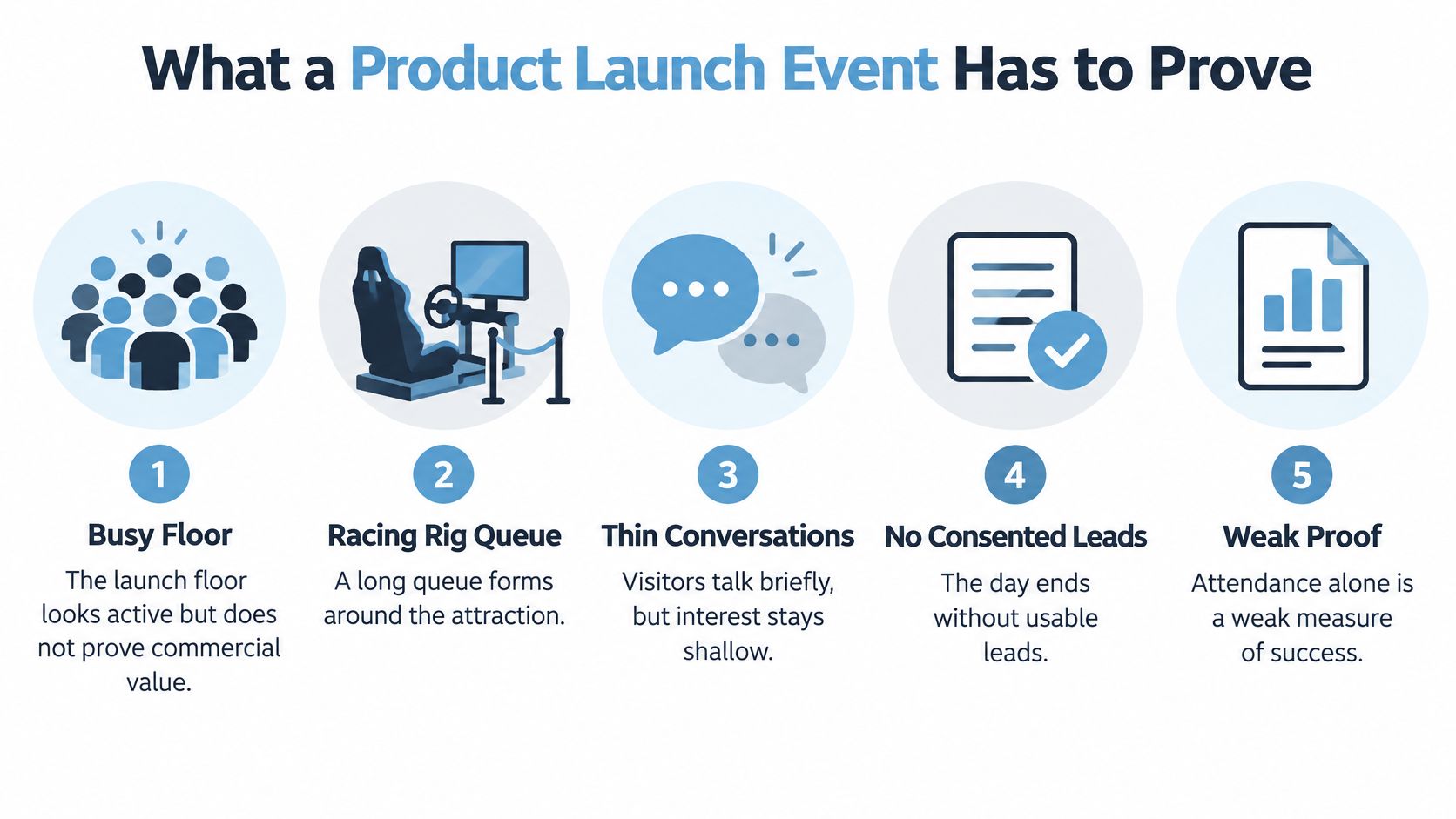
What a Product Launch Event Has to Prove
A racing rig has a queue across the stand. Guests cheer at the leaderboard, the photographer has plenty to shoot, and the marketing team reports strong attendance. At closing time, nobody can identify which participants need the product, who agreed to follow-up or which salesperson owns the next conversation.
A busy floor isn't proof of commercial value. You can fill a room with people who enjoy the entertainment but have no relevant buying role, problem or purchase horizon.
The September 2025 UK venue-performance update shared by Peter Heath reported sales rising 3.8% year on year while event numbers fell 8.5%, average delegation size increased 27% and revenue per delegate rose 5.1%. Those are venue-trading measures, not proof that smaller launches always win. They do challenge the assumption that more events or more spectacle automatically means better commercial performance.
Give every invitation a buying job
A sales-linked launch invites guests for a named reason: evaluate a new capability, compare an existing process or understand an implementation decision. Registration should establish relevance before arrival, rather than leave hosts to discover it beside a noisy attraction.
Agree what counts as a qualified conversation. A useful rule records the guest's role, relevant problem, fit with the product and agreed next action. A badge scan alone doesn't satisfy it.
If an experience can't connect a named person, a qualification rule and a meeting opportunity, treat it as entertainment rather than evidence of launch success.
Put the operating decisions in the same brief: timeline, budget allocation, audience journey, supplier responsibilities, accessible participation and commercial ownership. The attraction earns its place when it helps people understand the product and gives the sales team a relevant reason to continue the conversation.
Product Launch Event Timeline and Budget Shares
Launch timeline and budget shares
The following is a hypothetical planning model, not an industry benchmark. Use its timings and allocation ranges to draft a brief, then replace them with your actual deadlines and quotations.
| Phase | When | Lock before moving on | Budget share |
|---|---|---|---|
| Objectives and measures | 16 to 12 weeks out | Named outcomes and guest cap | 5–8% of planning time, little cash |
| Audience and invites | 12 to 8 weeks out | Who is qualified to attend | 8–12% guest acquisition |
| Venue, power and suppliers | 12 to 8 weeks out | Site, load-in and attraction footprint | 35–45% venue and technical production |
| Creative and activations | 8 to 4 weeks out | Trial format and branding that keeps exits clear | 15–25% product trial; 8–12% creative and content |
| Risk, staff and rehearsal | 4 to 1 weeks out | Controls, ratios and a passed pre-open test | 10–15% staffing and hospitality |
| Live event | Event week | Stop-work rules and on-site owners | Contingency 8–10% if needed |
| Follow-up | Day 1 to day 90 | Attribution window and CRM owners | Remaining staff time, not a new build |
Lock dependencies before approving artwork
The guest cap comes before the attraction footprint. Otherwise, you can approve an impressive installation that leaves insufficient room for its queue, accessible viewing and sales conversations.
Consent wording comes before badge and registration design. Product readiness comes before the demonstration script. Supplier drawings come before final floor-plan approval, not during installation.
Use the event planning timeline to turn these dependencies into named tasks. Give each approval an accountable owner and record what must change if it slips. A late product build might require a guided demonstration instead of unsupervised trial; it shouldn't automatically trigger rushed production work.
For UK search acquisition, build a useful launch landing page for Google and Bing before promotion begins. State the product, intended audience, location, access arrangements and registration action in searchable text. Don't hide essential information inside an invitation image or make visitors download a brochure just to understand whether they should attend.
Make the allocation add up
The ranges aren't independent allowances to maximise. Select a combination that fits the total budget, and check that technical production and activation quotations don't both include the same screens, operators or transport.
For a hypothetical balanced allocation, you could use 35% venue and technical production, 20% product trial, 15% staffing and hospitality, 10% creative, 10% acquisition and 10% contingency. That's a working example, not a recommended split for every launch.
A London exhibition centre and a regional hotel won't spend those categories the same way. A hotel might include furniture but constrain loading access; an exhibition hall may require separate power, connectivity and handling orders. Compare the delivered cost, not the room-hire headline.
Budget discipline: Hold contingency outside the creative wish list. Release it against an approved change, such as additional power, overtime or weather protection.
Circle the phase you're already late on. Reduce complexity there before compressing rehearsal, safety checks or follow-up preparation.
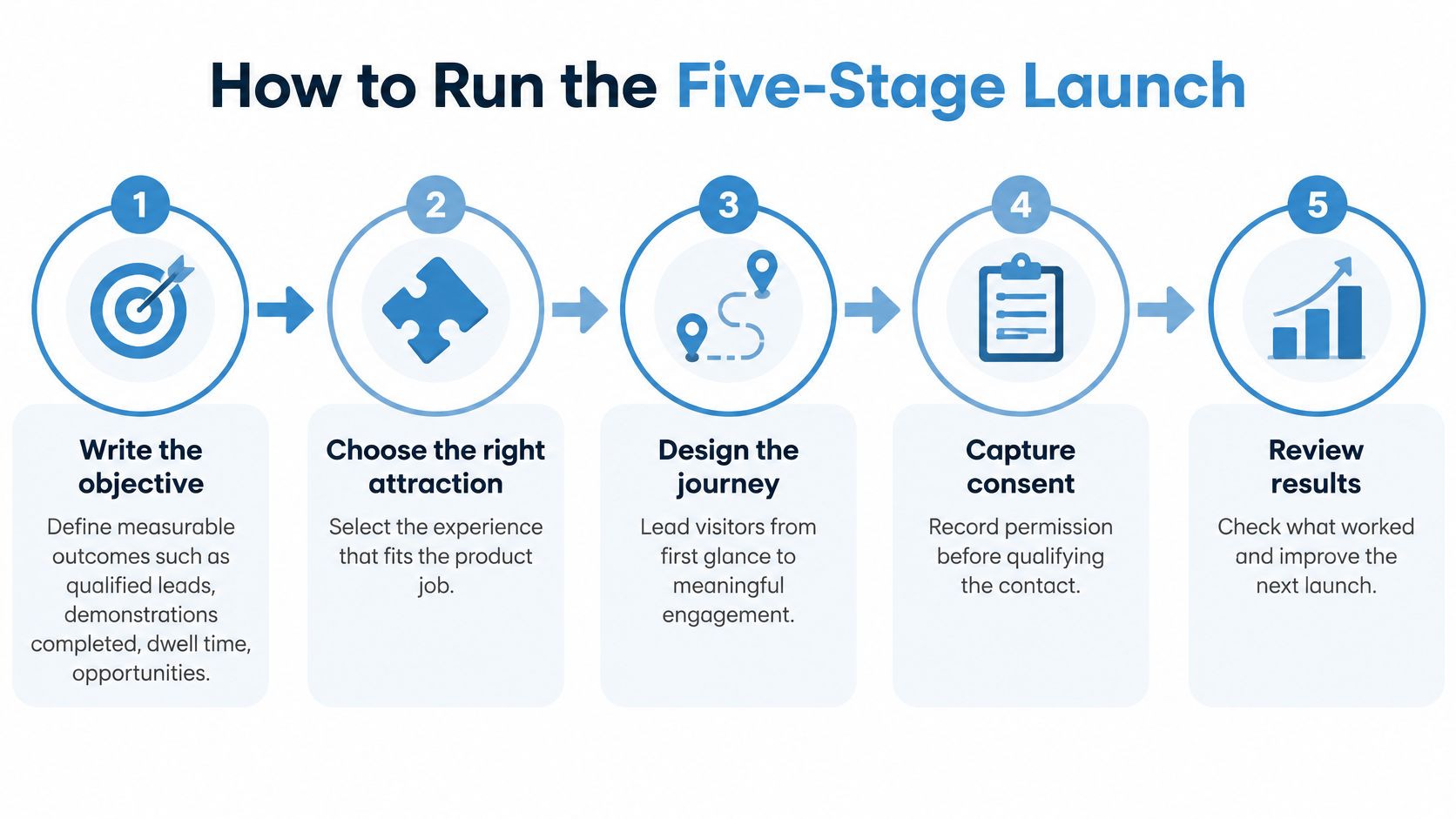
How to Run the Five-Stage Launch
Use a single operating method with clear handovers. Marketing owns the commercial purpose, production owns delivery coordination, and each live task needs someone authorised to act.
Set the journey and its controls
Write the objective as an outcome.
The marketing lead should specify the required qualified leads, completed demonstrations, useful dwell time, sales meetings and opportunities. Give sales responsibility for agreeing the qualification rule before invitations go out. The usual miss is approving an attendance target without deciding what anyone should learn or do.Map the complete audience flow.
The producer should walk the route from arrival to registration, product interaction, consent capture and departure. Include a direct route for guests who won't use the simulator, plus somewhere to hold a conversation without interrupting loading. Test exceptions: an unregistered buyer, a guest needing assistance, a failed scanner and a participant who wants to leave midway.Complete a competent-person risk assessment.
Name the hazards, affected groups, controls, responsible owners and review points. Cover the build and breakdown crews as well as guests and operators. The HSE guidance on managing an event makes organisers responsible for managing risks and monitoring controls throughout delivery, rather than treating the assessment as finished paperwork.
For temporary launches, check that the venue supports safe assembly, movement, evacuation and emergency access. If the activity isn't covered by the existing premises arrangements, ask the venue and local licensing authority whether a Temporary Event Notice is appropriate. Don't assume a hotel booking or exhibition contract settles every licensing question.
Test the floor and reconcile the outcome
Test controls during setup and live operation.
The floor manager should witness the pre-opening test and brief operators on escalation. Assign someone to monitor queue time, throughput, equipment downtime and incidents while the attraction runs. A drawing can show a clear exit while the actual queue, bags and spectators obstruct it, so inspect the occupied floor.Reconcile the event against the agreed outcomes.
The CRM owner should join attendance, interaction records, qualification notes and subsequent sales activity. Separate influence, where attendance formed part of an existing relationship, from attribution, where the agreed evidence supports assigning an opportunity to the launch. Neither a scan nor a consent box proves that the event created a sale.
The common operational failure is a full room with no defined purpose for collecting details and no consistent qualification rule. Staff improvise, records become incomparable, and sales receives a list rather than a set of actionable conversations.
A run of show needs decision owners, not just presentation times. Someone must be able to pause an attraction, redirect a queue and resolve a registration exception.
Use the commercial dashboard to report these decisions consistently. Don't invent fresh success measures after doors close because the original ones look disappointing.
Venue and Simulator Supplier Checks
Treat the venue and attraction supplier as separate contracts that must agree on the same floor. A supplier's standard drawing doesn't confirm that this hall has suitable loading, power, access or escape routes.
What to confirm before you book
| Check | Venue owns | Supplier owns | Fail sign |
|---|---|---|---|
| Floor and structure | Load, fixings, fire routes | Weight, guarding, exclusion zone | Unchecked supplier drawing |
| Power and cables | Supply, location, isolation | Equipment load and routing | Trailing leads across exits |
| People | Evacuation and stewarding brief | Supervision ratio and emergency stop | No named owner on the floor |
| Timing | Get-in and curfew | Deliver, test, ready 30 minutes prior | First power-up after doors open |
| Insurance and partners | Venue licence and house rules | Liability cover and named subcontractors | Event quietly handed to a third party |
Reconcile the drawings with the contract
Ask the venue to confirm floor loading, power capacity, isolation points, cable routes, step-free access and permitted branding fixings. The supplier must provide equipment operating limits, guarding, exclusion zones, supervision arrangements and the operator who remains responsible onsite.
Use the installation requirements to prepare the venue conversation. Check lighting with both participation and photography in mind. Jimmy Clemmons Photographer's advice to check lighting before your shoot is useful when assessing daylight changes, awkward backgrounds and whether the product will photograph clearly without compromising the operating area.
Keep installation and live-operation risks separate. The HSE report on temporary demountable structures records 115 reported injury accidents, including 56 while structures were in use. A safe build doesn't remove the need for supervision, inspections and emergency arrangements once guests arrive.
Make stopping an explicit responsibility
Write the stop-work rule into the operator brief. Pause the experience if a queue compromises an escape route, guarding moves, equipment behaves outside specification, a participant reports injury or distress, or staffing drops below the assessed supervision ratio.
Confirm liability limits and subcontracting arrangements in writing. We hold £10 million Products, Employee and Public liability insurance. We'll never offer a customer's event to a third party, and we'll tell the customer if someone is joining us to work alongside our team.
Our equipment is ready and tested at least half an hour before the event starts. In most cases, our Logistics team contacts the customer the week before the event to reconfirm details and check for changes.
Reject a quote that leaves responsibilities unnamed, paperwork nobody has checked against the hall, or a rig whose queue has no exit plan.
Activation Ideas That Show Buying Intent
A performance launch with a meaningful debrief
Say an engineering brand launches a control system. A single-seater racing simulator can support its story if the experience demonstrates a relevant principle, such as feedback, response or consistency, and the host can explain that relationship accurately.
The lap isn't the product demonstration unless the guest encounters the product or a faithful representation of it. If the simulator is only an attraction, keep that distinction clear and move participants into a separate, genuine product trial.
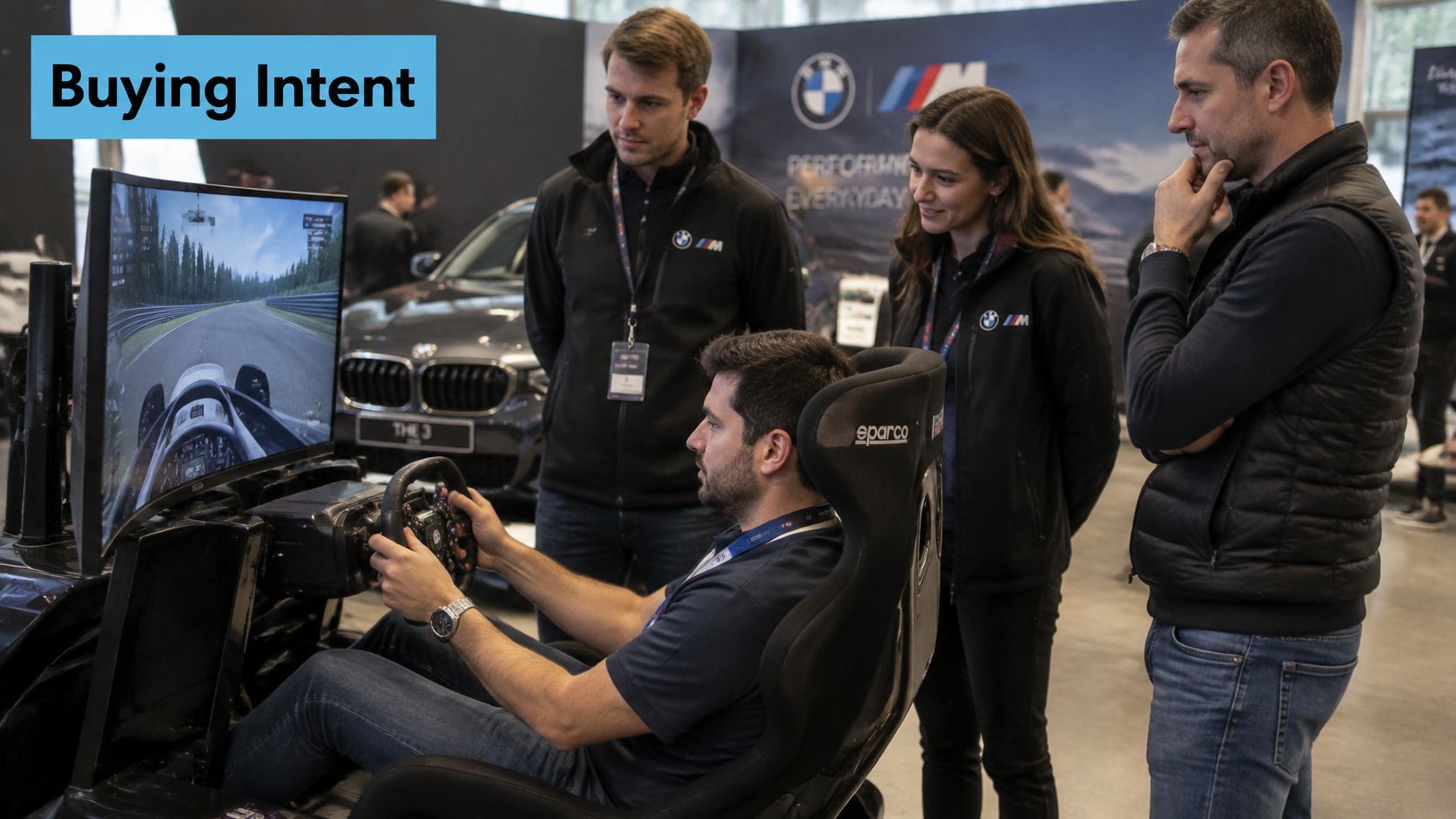
At the exit, the host asks which operating problem the guest is trying to solve. A relevant answer leads to a product specialist; an irrelevant answer ends politely without forcing a sales pitch. Keep the seller away from the loading point so the next participant can enter safely.
Publish the session format and stopping point before people join. An open-ended high-score challenge encourages repeat play, which can displace the buyers you invited to evaluate the launch.
A service launch that uses competition carefully
For a software or service launch, a coached session on a sports simulator, flight simulator or reaction wall can create a useful opening conversation. The host can ask about the guest's current process during the reset, then guide them to a live software demonstration that addresses the answer.
A giant slot-car track or shared leaderboard suits group participation, but the competitive format needs boundaries. Cap repeat attempts, explain when the session ends and position the follow-up host at the exit rather than letting a seller block the entrance.
Score the engagement against an explicit rule:
- Product trial completed. The guest used the product or a faithful demonstration, not merely the entertainment.
- Permission recorded. The contact understood the stated follow-up purpose and the relevant permission was captured.
- Disposition logged. A next step was booked, or the host recorded why the guest wasn't a fit.
A disqualified participant is a completed assessment, not a qualified sales lead. Keep those totals separate.
Offer a seated, low-noise product table or captioned film in the same zone, with the same qualification questions. Keep branding away from escape routes and sound low enough for the adjacent conversation.
Entertainment is the route. The conversation at the end of the session is the launch.
Measure the Launch and Track Commercial Impact
Launch measures and what they prove
For this proposed reporting model, use a 90-day commercial review window. It's an agreed operating choice, not a promise that every B2B sale will close within it.
| Measure | When | Proves | Weak on its own |
|---|---|---|---|
| Invitation-to-attendance rate | At doors opening and reconciled afterwards | List quality | A packed room of the wrong buyers |
| Dwell time | On site | Interest | Lingering without a conversation |
| Demonstrations completed | On site | Product trial | Unguided button pressing |
| Consented leads | On site | Recorded permission for the stated follow-up | Names with no purpose stated |
| Qualified conversations | On site | Fit against the brief | Badge scans |
| Meetings booked | On site or within days | Sales access | Vanity calendar holds |
| Opportunities within 90 days | After | Pipeline | Revenue claimed with no CRM link |
| Cost per qualified engagement | After | Efficiency | Cost per head in the door |
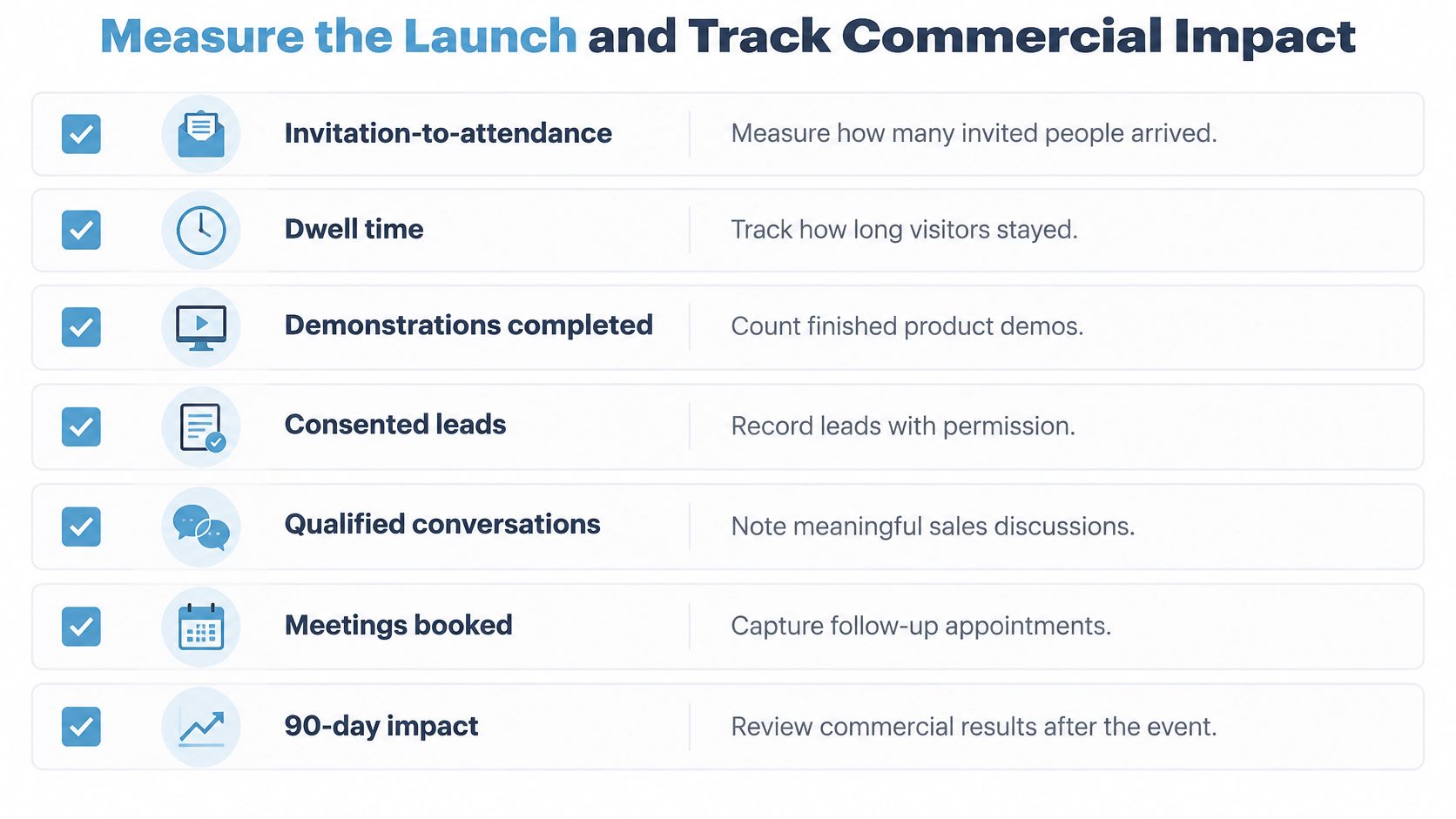
Read the relationships between measures
A high permission-capture rate with few meetings should trigger a hosting and offer review. Check whether staff explained a useful next step, whether the invite list matched the product and whether meetings were available while interest was fresh.
Add queue time, throughput, downtime and incident records beside the commercial measures. Calculate cost per qualified engagement using the full agreed event cost and a deduplicated count of engagements that satisfy the qualification rule. The experiential marketing ROI guide provides a useful basis for structuring that review.
For a hypothetical follow-up schedule, assign a CRM owner to send agreed materials within two working days, with reviews on day 1, day 30 and day 90. Log existing opportunities separately from newly attributed ones, and don't relabel all influenced pipeline as event-generated revenue.
Keep the sample trustworthy
The Association of Event Organisers' 2025 exhibition report records 1,154 exhibitions and conferences with exhibition elements at major UK venues, attracting an estimated 6.8 million visits. At that scale, participation design matters to the quality of event reporting as well as guest experience.
Record which participation format each guest used. Otherwise, your results may describe only people comfortable using the main attraction. Include materials, transport, power and waste records in the close-out, and log near misses alongside injuries so the next floor plan reflects actual operation.
Accessibility, Sustainability and Compliance Checks
Plan equivalent participation before signing off artwork. A message saying assistance is available doesn't replace a route that guests can use or an alternative that explains the same product benefit.
Publish an accessibility route map showing step-free entry, viewing positions, alternative demonstrations and a clear way out of the activity area. Describe the experience, including movement, flashing effects, sound and any equipment-specific restrictions.
Make the alternative commercially equivalent
Guests who can't use a simulator shouldn't receive a lesser sales experience. Provide a guided product table, captioned demonstration or low-stimulation presentation nearby, with access to the same specialist and next-step options.
- Registration choice. Offer an assisted or accessible form instead of making a touchscreen or personal phone compulsory.
- Queue management. Set a physical queue boundary and provide a way to return without standing throughout the wait.
- Sensory conditions. Agree lighting and noise controls in the risk assessment, then check them with the attraction running.
- Safeguarding. Define supervision, photography permissions and escalation arrangements for children and vulnerable guests.
Don't improvise transfers into equipment. Check the operating limits and agreed assistance arrangements before promising that a guest can participate.
Match environmental claims to delivery records
Confirm the waste-separation requirements applicable to the event's location, venue and waste contractor. Simpler Recycling is not a single blanket rule for every UK venue, so don't copy an England-focused checklist into a launch elsewhere without checking its applicability.
Specify material streams, bin positions, collection responsibilities and contamination checks in the production plan. Include backstage packaging and installation waste, not just the bins guests see beside catering.
Prefer reusable branding where it still communicates the launch accurately. Ask the production team to record what was transported, what power was used and where materials went after breakdown. Avoid calling an activation sustainable merely because a scenic element can theoretically be recycled.
A waste plan that exists only as a verbal promise is unfinished. The person signing off the press release should have delivery records behind any environmental claim.
Decide Who Runs the Launch Floor
Choose a turnkey operator when your team can't host, qualify and supervise safely at the same time. Bare equipment hire is only useful when you already have competent operators, clear supervision arrangements and someone available to manage faults without abandoning guests.
Before the supplier meeting, answer these questions:
- People. Can your staff maintain the assessed supervision ratio while holding useful buyer conversations?
- Purpose. Is the attraction connected to product trial and a defined follow-up, or is it only a crowd puller?
- Delivery. Do you need a crew to handle installation, branding, operation and breakdown while marketing concentrates on guests?
If you're running the floor internally, document the named operator, escalation contact and breakdown responsibilities before signing the brief. If you're outsourcing, give the operator the same commercial and access requirements you would give your own team.
We operate sports simulators ranging from football to motor sports and flight simulators, suitable for conferences, exhibitions, brand awareness, party entertainment, sports fan zones and public events. We can run the show so your team can focus on potential clients and guests.
Our team is based in Cambridge, and customers can meet us at our offices or arrange an onsite visit. Call 01638 601720 or email sales@pswevents.co.uk with your venue, event timings and operating questions.
Book only when the current timeline phase, stop-work authority and commercial follow-up owner are named in the same brief.
PSW Events offers interactive attractions with planning, branding, logistics, installation and onsite staffing for your product launch event. Visit PSW Events with your proposed venue, guest profile and product-trial objective so the team can help shape an activation that supports useful conversations rather than just a queue.