
You’re probably in one of two positions right now. You need an activation that pulls people in on a busy exhibition floor, or you’re planning a team event and don’t want another polite-but-forgettable activity that people endure rather than remember.
That’s where a pit stop challenge earns its place. It has noise, pace, visible teamwork, and instant competition. What's more, when it’s designed properly, it gives you something many interactive attractions never do: a clean path from excitement to measurable business value.
The mistake planners make is treating it like a prop. A race car nose, a few tyres, a stopwatch, and a prize. That setup can work, but it rarely delivers budget sign-off on its own. What gets stakeholder approval is a pit stop challenge built around outcomes, run with proper safety discipline, and structured to capture either team performance or commercial data.
At venues such as Silverstone, ExCeL London, Wembley, Manchester Central, and SEC Glasgow, the difference between a crowd-pleaser and a professionally useful activation usually comes down to planning choices made long before the first team steps onto the mat. Crew size. Queue design. host briefing. tool control. leaderboard logic. sponsor visibility. registration flow. Those details decide whether the challenge feels sharp or chaotic.
From Kick-Off to Finish Line Defining Your Event Objectives
A pit stop challenge works best when the business objective is decided before the kit list. If you start with the hardware, you’ll end up with a fun feature. If you start with the result you need, you’ll build an activation that earns its footprint.
Match the challenge to the reason for running it
Most briefs fall into three categories.
- Team building: You want colleagues to communicate under pressure, divide roles quickly, and improve after each attempt.
- Lead generation: You need visitors to stop, register, compete, and give your sales team a reason to follow up.
- Brand engagement: You want your stand or launch event to feel active, photogenic, and memorable.
Those are very different jobs. The challenge format should change accordingly. A team-building session needs debrief time, role rotation, and visible learning. A trade show version needs faster throughput, clear rules, and a registration process that doesn’t create friction. A launch event needs branded visuals, commentary, and enough theatre to attract a crowd from the aisle.
Set KPIs that fit the format
For internal events, I’d usually track behavioural outcomes rather than just fastest times. Did teams improve between round one and round two? Did they reorganise themselves? Did one person dominate, or did the group become more coordinated? Those observations matter because they tell you whether the challenge created insight or just noise.
For public-facing events, practical KPIs are usually better:
- Qualified registrations
- Leaderboard entries
- Repeat attempts
- Dwell time
- Post-event follow-up opportunities
Practical rule: If the only success measure is “people seemed to enjoy it”, the activation hasn’t been planned tightly enough.
There’s a useful performance lens for corporate settings in the Pitstop to Perform™ framework. It reports 7-25% measurable gains in team output and says its Results-Based Learning cycles can accelerate learning by over 50% in UK corporate use, which is why the model translates well into structured team events rather than one-off entertainment alone (Pitstop to Perform™ sample overview).
Build the objective into the event design
The strongest pit stop challenges have a sentence behind them. Something simple, specific, and useful:
- Improve collaboration under time pressure
- Increase stand traffic quality
- Create a reason for prospects to stop and stay
- Reward staff with a competitive shared experience
- Turn passive spectators into active participants
That sentence guides everything. It affects crew size, scoring, how long each heat lasts, whether you include a facilitator-led debrief, and how you brief the host.
If your event needs broader interactive support around the pit stop element, it helps to think in terms of the full corporate entertainment event mix rather than one isolated attraction. The pit challenge may be the headline act, but it often performs better when it sits inside a wider flow of networking, hospitality, or branded competition.
Avoid the common objective mistake
The biggest planning error is trying to make one challenge do everything at once. Team building, lead capture, viral content, hospitality entertainment, and technical education all sound attractive, but they pull the format in different directions.
A better approach is to choose a primary goal and a secondary benefit. For example:
| Event type | Primary goal | Secondary benefit |
|---|---|---|
| Sales exhibition | Lead capture | Social content |
| Internal conference | Team learning | Entertainment |
| Product launch | Brand buzz | Guest participation |
That’s the point where the pit stop challenge stops being “something fun for the stand” and becomes a tool with a clear job.
Designing Your Pit Stop Challenge Blueprint
The blueprint stage decides whether your event runs cleanly or spends the day fighting preventable issues. Good pit stop challenge design is part floorplan, part theatre, part queue management.
Start with footprint and flow
At ExCeL or Manchester Central, the challenge needs enough room for four things to happen without colliding: briefing, live attempt, spectator viewing, and exit. If any one of those overlaps badly, the area feels congested and the excitement turns into delay.
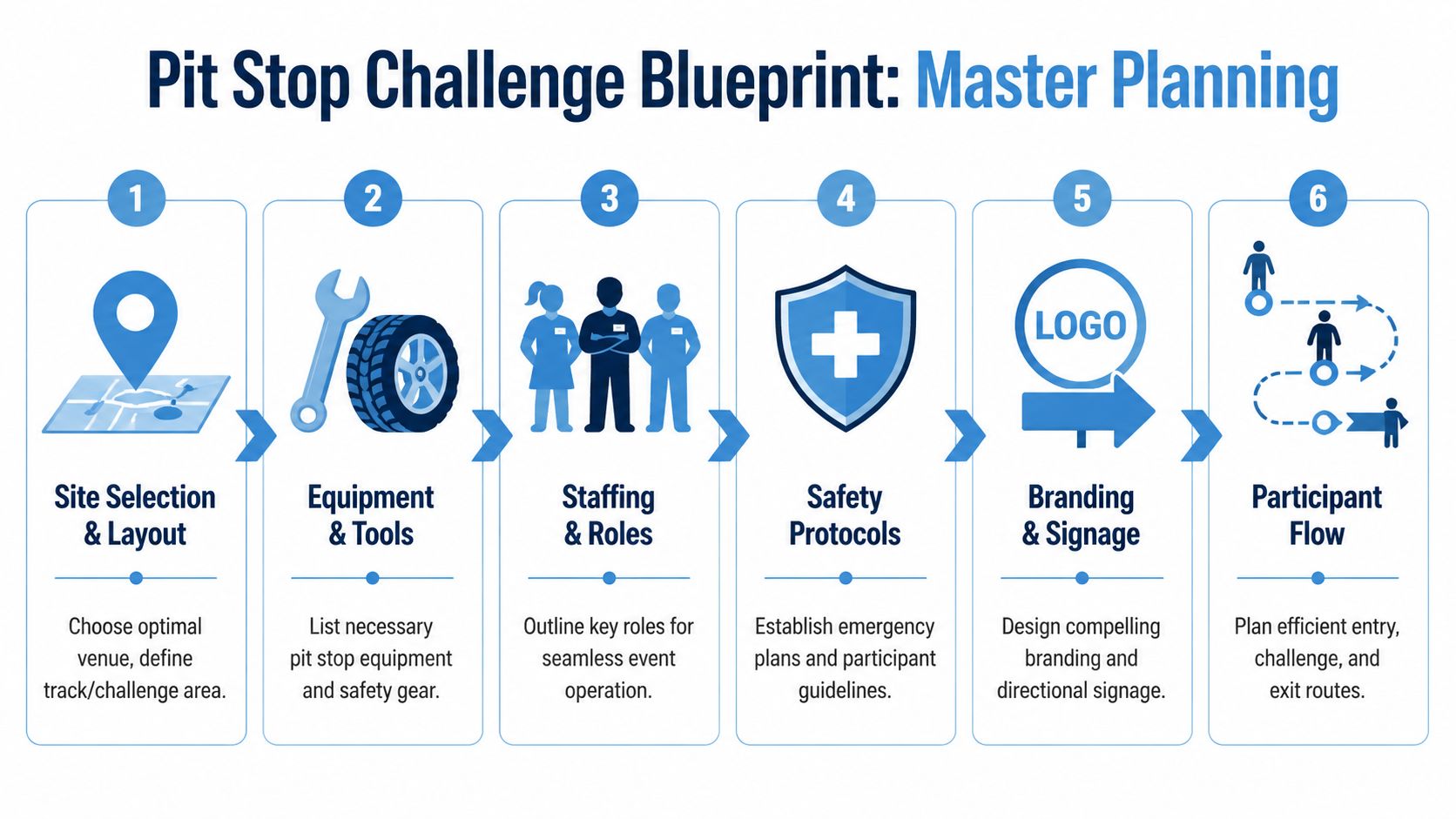
For most corporate formats, I’d plan the layout around these zones:
- Arrival point: Registration or check-in, waiver if needed, quick explanation
- Briefing lane: Participants hear the rules and are assigned roles
- Challenge bay: The active pit stop area with timer, tools, tyres, and staff control
- Viewing edge: A clear spectator line so crowds can watch without blocking access
- Results zone: Leaderboard, photo moment, data capture, and prize information
A lot of planners focus on the challenge bay and forget the edges. The edges are where queues form, brand impressions happen, and sales conversations begin.
Choose equipment that fits the audience
A professional-looking pit stop setup usually includes a car nose or wheel station, replica tyres, wheel guns or safe challenge tools, timing system, barriers, flooring, and display screens. What matters is that the equipment matches the venue and audience.
At a conference, neat presentation and controlled noise matter more. At an outdoor fan zone, visual impact and durability become the priority. For family audiences, the challenge may need simplified mechanics. For corporate team sessions, the setup should let people fail, learn, and retry without making the process feel fiddly.
A quick checklist helps during procurement:
- Core challenge kit: Car nose or wheel mount, tyres, fastening tools, timer
- Set dressing: Pit wall graphics, branded flooring, cones or barriers, uniforms or bibs
- Tech layer: Screens, leaderboard software, PA, tablets for sign-in
- Operational support: Spare consumables, cable management, tool checks, cleaning kit
- Safety layer: Briefing signage, staff comms, controlled tool access, first aid plan
If catering or hospitality sits nearby, think about adjacent trader operations too. The same practical thinking you’d use when reviewing mobile coffee business tips applies here: power access, service flow, spill risk, queuing pressure, and clear customer movement all affect the attraction around them.
Brand every visible surface that earns attention
A pit stop challenge has more branding real estate than many planners realise. The obvious items are the car, overalls, and leaderboard. The less obvious ones often work harder: queue barriers, timing screens, briefing boards, holding graphics, trophy area, and the backdrop behind participant photos.
The best branded activations don’t interrupt the game. They sit inside it.
Think in layers:
- Hero branding on the main visual focal point, usually the car nose or challenge station.
- Functional branding on the timer, rules board, and leaderboard.
- Shareable branding where guests naturally take photos after a run.
- Sponsor presence integrated into uniforms, pit lane barriers, and winner moments.
For planners who want a ready-built motorsport format rather than sourcing separate components, racing simulator hire is one route to evaluate alongside physical pit equipment. The right choice depends on floor space, staffing level, and whether your event needs tactile teamwork or a more compact racing-themed footprint.
Build for reset speed, not just show value
A challenge can look spectacular and still underperform if reset takes too long. Every extra adjustment between teams reduces throughput and drains momentum from the crowd.
That’s why I prefer formats that let staff reset quickly, explain rules in under a minute, and move one team out while the next is being briefed. Clean transitions make the event feel premium. Slow resets make even expensive kit look under-rehearsed.
Mastering Event Day Execution and Safety
Event day is where the activation either proves its value or exposes every shortcut taken in planning. A pit stop challenge is physical, competitive, and highly visible. That combination rewards discipline.
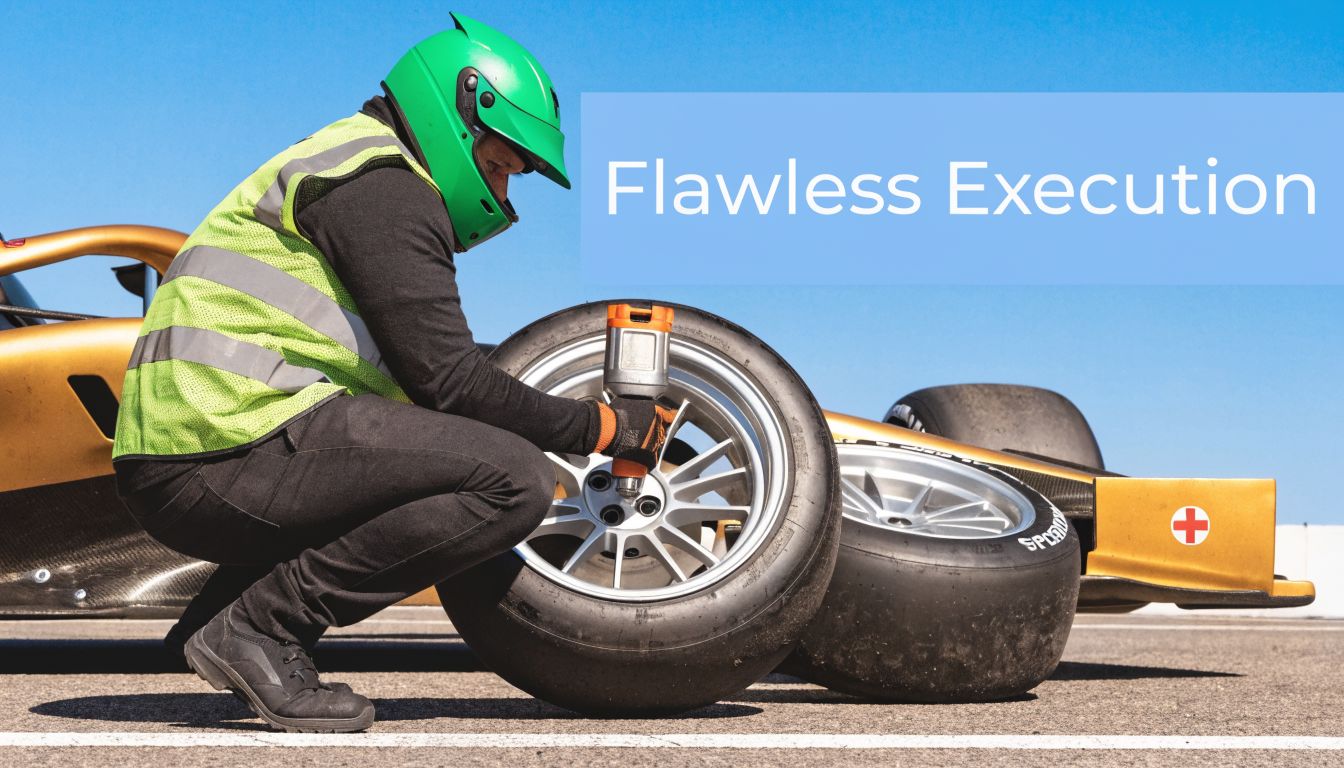
At the 2014 British Grand Prix at Silverstone, Williams completed a stop for Felipe Massa in 2.02 seconds, and 7 of that season’s top 10 fastest stops came from the same team, which tells you what matters most in this format: repetition, role clarity, and process control (Statathlon’s pit stop strategy analysis). Corporate events aren’t trying to recreate Formula 1 exactly, but they should copy the same discipline.
Staff roles decide the standard on the floor
A strong pit stop challenge doesn’t run on charisma alone. It runs on defined roles.
- Host or MC: Keeps the energy up, explains the rules clearly, and gives spectators a reason to care about each run.
- Adjudicator or timekeeper: Applies the scoring fairly and records results consistently.
- Technical operator: Resets equipment, checks functionality, and fixes small issues before they become delays.
- Safety lead: Monitors participant behaviour, controls tool handling, and stops the activity if anything becomes unsafe.
- Registration support: Manages entry flow and makes sure data capture is complete.
Trying to merge too many of these duties into one person is where standards slip. The host misses a safety breach while talking. The technician becomes the queue manager. The adjudicator starts answering guest questions and timing becomes inconsistent.
For events where you need those functions covered professionally, dedicated event staffing solutions are often easier to manage than borrowing venue staff who don’t know the format.
Health and safety is part of the guest experience
Poorly handled H&S doesn’t just create risk. It makes the event feel amateur. Good H&S, by contrast, gives guests confidence and keeps the challenge moving.
My event-day checklist usually includes:
- Pre-open inspection: Check all tools, tyres, fixings, flooring, barriers, cables, and screens before the first briefing.
- Controlled briefing: Every participant hears the same rules, role allocation, and stop signals.
- Tool discipline: No one handles equipment until instructed. Tools return to a defined position after each run.
- Staff spacing: Team members know exactly where to stand during active attempts and resets.
- Emergency plan: First aid route, incident escalation, and who pauses the activity if needed.
On busy stands, calm control looks more professional than hype.
Wheel guns and fast-paced tasks can create a false sense that speed is the point. Safety comes first. The quickest way to kill the atmosphere is to let the challenge become messy, unclear, or physically awkward for guests.
A useful reference point for briefing style and pace is seeing how visual demonstrations help participants understand role sequencing before they step in.
Run the day on a proper schedule
The smoothest pit stop challenge has a rhythm. Brief. Attempt. Record. Reset. Rotate. Repeat.
That sounds simple, but the run sheet needs to cover practical realities:
| Moment | What staff need to control |
|---|---|
| Venue open | Equipment test, signage position, registration check |
| First wave | Participant briefing and queue discipline |
| Peak period | Throughput, crowd line, scoreboard updates |
| Midday reset | Tool check, mat clean, role rotation if needed |
| Final hour | Prize focus, last entries, winner verification |
If something slips, fix the process before adding more volume. On these activations, people and process matter more than adding extra props.
Driving Engagement and Capturing Leads
The attraction gets attention. The format determines whether that attention turns into useful data.
A pit stop challenge is naturally strong at stopping foot traffic because people understand it immediately. They see tyres, timing, pressure, and competition. They don’t need a long explanation. That’s why it works so well on exhibition floors where you’ve only got a few seconds to pull someone out of the aisle.
Why the format holds people longer
Interactive attractions perform when they answer three questions quickly: what is it, can I do it, and will anyone care about my score. The pit stop challenge answers all three in seconds.
UK event data shows simulator-style attractions can increase visitor dwell time by up to 25% when they’re executed well, which matters because longer dwell usually gives your team more time to qualify visitors and open conversations (UK engagement reference)).
The practical drivers of engagement are straightforward:
- Visible competition: People want to beat a posted time.
- Public recognition: Leaderboards turn a private activity into a social one.
- Short learning curve: Most guests can understand the objective immediately.
- Repeatability: Teams often want a second attempt once they see where they lost time.

Build the lead capture into the game, not after it
The worst lead-capture method is asking for details after the fun is over. That’s when people drift away. The better method is to make registration part of entry and to keep it friction-light.
I prefer one of these models:
- Pre-run registration on a tablet with clear opt-in wording.
- Team entry format where one captain submits details for the group.
- Prize qualification linked to a complete entry rather than just participation.
Electronic leaderboards help because they give participants a reason to provide accurate details. People care more when they know their name, team name, or company name will appear correctly on screen.
If the leaderboard is exciting but the registration feels bureaucratic, people will watch and walk.
Merchandise can help too, especially if it makes teams look like part of the show. Bright crew identifiers, caps, and themed accessories improve photos and help spectators identify competitors. If you want ideas for highly visible event wear, Dirt Cheap Headwear's neon trucker hats are a useful reference point for bold colour-led branding that reads well across a crowded space.
What actually improves conversion quality
Not every lead generated at a pit stop challenge is worth the same follow-up effort. You improve quality when the host or stand team uses the challenge as an opening, not the whole interaction.
A few methods work consistently:
- Score-triggered follow-up: Fastest teams earn a deeper conversation, demo, or hospitality invitation.
- Segmented registration fields: Keep forms short, but collect one or two fields that matter to qualification.
- Structured prize messaging: Tie prizes to business relevance where possible, rather than generic giveaways.
- Post-run conversation points: Ask what helped or slowed the team. It opens a natural dialogue.
The challenge creates permission for engagement. Your team still has to do something with it.
Adapting the Challenge for Any Event or Budget
A pit stop challenge isn’t one format. It’s a family of formats. The right version depends on venue rules, audience type, available space, and how much operational support you can realistically put behind it.
Indoor and outdoor setups behave differently
Indoor conference and exhibition versions need cleaner presentation, tighter acoustic control, and compact footprints. You’re usually balancing the challenge against neighbouring stands, catering, and scheduled content. That pushes you towards simpler queue lines, fast resets, and a controlled host style.
Outdoor versions have more physical freedom, but they introduce weather, uneven surfaces, power planning, and longer sightlines. That means the set dressing must read from further away, and the challenge area needs stronger edge control so spectators don’t drift into operational space.
Physical versus virtual is a real planning choice
Some planners assume a physical wheel-change setup is always the stronger option. It isn’t. Physical formats are excellent for tactile teamwork and visual authenticity, but they need more room and more active control. Virtual and simulator-led versions can fit tighter footprints and often integrate more neatly with conferences, product showcases, and venue restrictions.
Verified UK trend data notes 18% growth in simulator hire and a move towards VR-enhanced pits, which is why more organisers now treat virtual formats as a practical event tool rather than a compromise (motorsport event trend reference). The same data also points to smaller, more efficient crews being 12% faster on average, which is useful for corporate planners because it supports a format that’s easier to stage than larger US-style crew models.
Smaller crews usually work better for corporate audiences
This is one of the clearest trade-offs in the format. Bigger teams look dramatic, but they can create confusion when participants aren’t trained. Smaller crews usually learn the sequence faster, make fewer handover mistakes, and are easier to brief.
That has knock-on benefits:
- Less waiting for role assignment
- Easier adjudication
- Better use of compact indoor footprints
- More consistent guest experience across repeated heats
Sample Pit Stop Challenge Budget Tiers
| Component | Bronze (Basic Hire) | Silver (Branded Activation) | Gold (Full Service Production) |
|---|---|---|---|
| Challenge setup | Compact physical or simulator-led format | Branded challenge station with enhanced visuals | Fully produced branded environment with multiple touchpoints |
| Staffing | Essential operator coverage | Host plus operational support | Full crew including host, adjudication, technical, registration |
| Branding | Basic event identity | Custom graphics, screen branding, team naming | Deep brand integration across set, uniforms, screens, prize moments |
| Lead capture | Manual or simple tablet sign-in | Integrated registration and leaderboard display | Full registration flow with reporting and managed follow-up support |
| Best fit | Smaller meetings, internal socials, limited floor space | Trade shows, conferences, sponsor activations | Major launches, large exhibitions, premium hospitality events |
The right budget choice isn’t always the biggest one. It’s the version that your team can operate well, your venue can support, and your audience will use.
Frequently Asked Questions About Pit Stop Challenges
How many people should be in each team?
For most corporate events, smaller crews are easier to brief and manage. They also keep the challenge moving and reduce confusion on the floor.
Is a pit stop challenge suitable for exhibitions as well as team-building days?
Yes, but the format should change. Exhibitions need quicker throughput and integrated registration. Team-building events need more debrief, role rotation, and learning focus.
Do we need specialist staff on site?
Usually, yes. You need someone to host, someone to control scoring, and someone to manage equipment and safety. Combining those jobs often creates delays or inconsistency.
What’s the biggest mistake planners make?
They focus on the car and forget the process. Queue design, briefing quality, reset speed, and data capture decide whether the attraction performs.
Can the challenge work in smaller venues?
Yes. Compact physical builds and simulator-led versions are often the better fit when floor space is limited.
How do you make budget approval easier?
Tie the challenge to one primary business outcome. If the event is about leads, show how registration, leaderboard use, and post-run conversations support that. If it’s about team performance, show how the format creates visible collaboration under pressure.
If you’re planning a pit stop challenge for a conference, exhibition, hospitality event, or team day, the strongest results come from treating it as an operational experience rather than a novelty. That means clear objectives, clean design, disciplined staffing, and a lead-capture plan that feels natural to the guest. That’s the difference between a crowded attraction and a useful one.